Group Members
 Umar Jamil
Faiz Majeed
International Islamic University Islamabad
Pakistan
The Concept of a Field
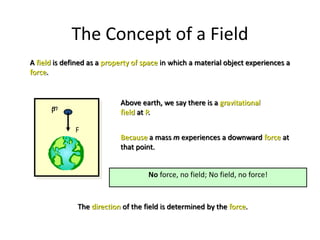
A field is defined as a property of space in which a material object experiences a
force.
.P
Above earth, we say there is a gravitational
field at P.
Because a mass m experiences a downward force at
that point.
No force, no field; No field, no force!
m
F
The direction of the field is determined by the force.
Field is Property of Space
E
Electric Field
+
+
+
+
+
+
+
+
Q
.
r
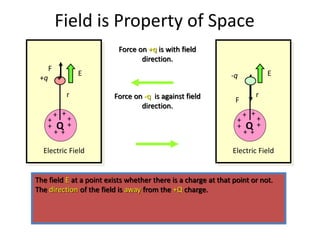
The field E at a point exists whether there is a charge at that point or not.
The direction of the field is away from the +Q charge.
E
Electric Field
+
+
+
+
+
+
+
+
Q
.
r
++q --q
F
F
Force on +q is with field
direction.
Force on -q is against field
direction.
Electric Field
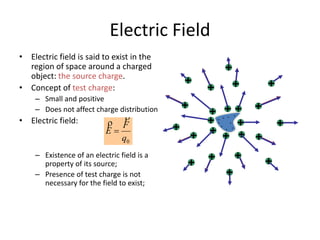
• Electric field is said to exist in the
region of space around a charged
object: the source charge.
• Concept of test charge:
– Small and positive
– Does not affect charge distribution
• Electric field:
– Existence of an electric field is a
property of its source;
– Presence of test charge is not
necessary for the field to exist;
0q
F
E



+ + +
+
+
+ +
+
+
September 18, 2007
Electric Field
0q
F
E



 Magnitude: E=F/q0
 Direction: is that of the force that acts on the
positive test charge
 SI unit: N/C
Situation Value
Inside a copper wire of household circuits 10-2 N/C
Near a charged comb 103 N/C
Inside a TV picture tube 105 N/C
Near the charged drum of a photocopier 105 N/C
Electric breakdown across an air gap 3×10⁶ N/C
At the electron’s orbit in a hydrogen atom 5×10¹¹ N/C
On the suface of a Uranium nucleus 3×10²¹ N/C
 A Point Charge in an Electric Field
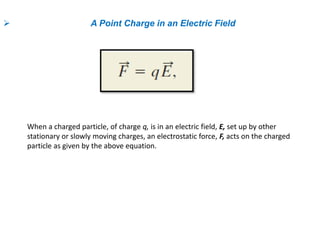
When a charged particle, of charge q, is in an electric field, E, set up by other
stationary or slowly moving charges, an electrostatic force, F, acts on the charged
particle as given by the above equation.
The Electric Field
Due to a Point Charge
Coulomb's law says
... which tells us the electric field due to a point charge q is
1 2
2
12
q q
F =k ,
12 r
This is your third starting equation.
q 2
q
E =k , away from +
r
r
…or just… 2
q
E=k
r
The equation for the electric field of a point charge then
becomes:
2
q
ˆE=k r
r
r
We define as a unit vector from the source point to the field
point:
ˆr
+
source point
field point
ˆr
You may start with either
equation for the electric field
(this one or the one on the
previous slide).
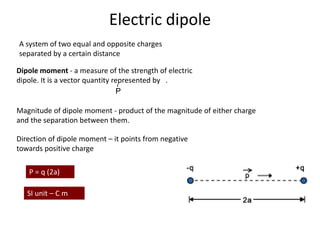
A system of two equal and opposite charges
separated by a certain distance
Dipole moment - a measure of the strength of electric
dipole. It is a vector quantity represented by .
P
r
Magnitude of dipole moment - product of the magnitude of either charge
and the separation between them.
P = q (2a)
SI unit – C m
Direction of dipole moment – it points from negative
towards positive charge
Electric dipole
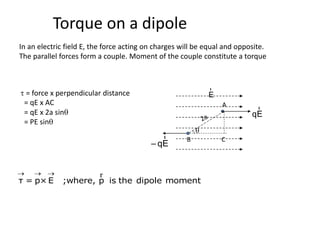
Torque on a dipole
In an electric field E, the force acting on charges will be equal and opposite.
The parallel forces form a couple. Moment of the couple constitute a torque
τ = p×E ;where, p is the dipole moment
   r
E
r
qE
r
– qE
r
q
B C
A
t = force x perpendicular distance
= qE x AC
= qE x 2a sinq
= PE sinq
Electric Field
Electric Field

Electric Field

  • 1.
    Group Members  UmarJamil Faiz Majeed International Islamic University Islamabad Pakistan
  • 2.
    The Concept ofa Field A field is defined as a property of space in which a material object experiences a force. .P Above earth, we say there is a gravitational field at P. Because a mass m experiences a downward force at that point. No force, no field; No field, no force! m F The direction of the field is determined by the force.
  • 3.
    Field is Propertyof Space E Electric Field + + + + + + + + Q . r The field E at a point exists whether there is a charge at that point or not. The direction of the field is away from the +Q charge. E Electric Field + + + + + + + + Q . r ++q --q F F Force on +q is with field direction. Force on -q is against field direction.
  • 4.
    Electric Field • Electricfield is said to exist in the region of space around a charged object: the source charge. • Concept of test charge: – Small and positive – Does not affect charge distribution • Electric field: – Existence of an electric field is a property of its source; – Presence of test charge is not necessary for the field to exist; 0q F E    + + + + + + + + +
  • 5.
    September 18, 2007 ElectricField 0q F E     Magnitude: E=F/q0  Direction: is that of the force that acts on the positive test charge  SI unit: N/C Situation Value Inside a copper wire of household circuits 10-2 N/C Near a charged comb 103 N/C Inside a TV picture tube 105 N/C Near the charged drum of a photocopier 105 N/C Electric breakdown across an air gap 3×10⁶ N/C At the electron’s orbit in a hydrogen atom 5×10¹¹ N/C On the suface of a Uranium nucleus 3×10²¹ N/C
  • 6.
     A PointCharge in an Electric Field When a charged particle, of charge q, is in an electric field, E, set up by other stationary or slowly moving charges, an electrostatic force, F, acts on the charged particle as given by the above equation.
  • 7.
    The Electric Field Dueto a Point Charge Coulomb's law says ... which tells us the electric field due to a point charge q is 1 2 2 12 q q F =k , 12 r This is your third starting equation. q 2 q E =k , away from + r r …or just… 2 q E=k r
  • 8.
    The equation forthe electric field of a point charge then becomes: 2 q ˆE=k r r r We define as a unit vector from the source point to the field point: ˆr + source point field point ˆr You may start with either equation for the electric field (this one or the one on the previous slide).
  • 9.
    A system oftwo equal and opposite charges separated by a certain distance Dipole moment - a measure of the strength of electric dipole. It is a vector quantity represented by . P r Magnitude of dipole moment - product of the magnitude of either charge and the separation between them. P = q (2a) SI unit – C m Direction of dipole moment – it points from negative towards positive charge Electric dipole
  • 10.
    Torque on adipole In an electric field E, the force acting on charges will be equal and opposite. The parallel forces form a couple. Moment of the couple constitute a torque τ = p×E ;where, p is the dipole moment    r E r qE r – qE r q B C A t = force x perpendicular distance = qE x AC = qE x 2a sinq = PE sinq