- Nuclear fission involves splitting large nuclei like uranium, releasing energy. Fusion joins light nuclei like hydrogen, also releasing energy.
- Fission is used in nuclear power plants and bombs. Fusion powers stars and could be an energy source on Earth if containment and high temperature issues are solved.
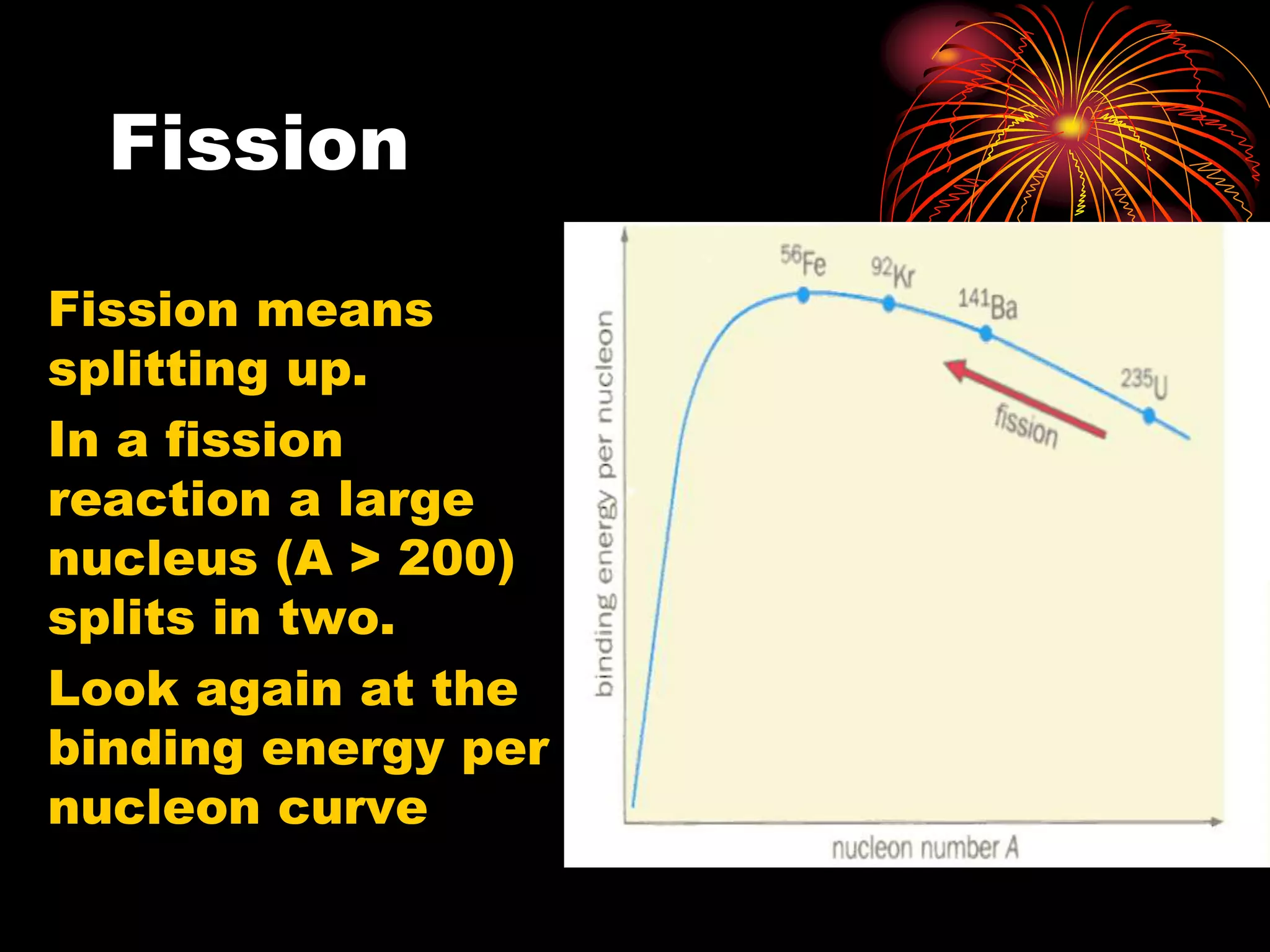
- The binding energy curve shows that mid-sized nuclei are most stable, and that fission and fusion involving less stable nuclei release energy.
Einstein’s Mass-Energy
Equivalence
Relationship
In 1905,while developing his
special theory of relativity,
Einstein made the startling
suggestion that energy and mass
are equivalent.
He predicted that if the energy of
a body changes by an amount E,
its mass changes by an amount m
given by the equation
E = mc2
TOK
3.
E = mc2
wherec is the speed of light.
Everyday examples of energy gain are
much too small to produce detectable
changes of mass.
The changes of mass accompanying
energy changes in chemical reactions
are not much greater and cannot be
used to prove Einstein's equation.
4.
However, radioactive decay,which is
a spontaneous nuclear reaction, is
more helpful.
Thus for a radium atom, the combined
mass of the alpha particle it emits and
the radon atom to which it decays is,
by atomic standards, appreciably less
than the mass of the original radium
atom.
Atomic masses can now be measured
to a very high degree of accuracy by
mass spectrographs.
5.
Mass appears asenergy and the
two can be regarded as
equivalent.
In nuclear physics mass is
measured in unified atomic mass
units (u),
1 u being one twelfth of the mass
of the carbon-12 atom and equals
1.66 x 10⁻²⁷ kg.
It can readily be shown using E = mc2
that 931 MeV has mass 1 u
6.
A unit ofenergy may therefore be
considered to be a unit of mass,
and in tables of physical
constants the masses of various
atomic particles are often given
in MeV as well as in kg and u.
For example, the electron has a
rest mass of about 0.5 MeV
7.
If the principleof conservation of
energy is to hold for nuclear reactions
it is clear that mass and energy must
be regarded as equivalent.
The implication of E = mc2 is that any
reaction producing an appreciable
mass decrease is a possible source of
energy.
Shortly we will consider two types of
nuclear reaction in this category.
8.
Mass Defect andBinding
Energy
The mass of a nucleus is found to be
less than the sum of the masses of the
constituent protons and neutrons.
This is explained as being due to the
binding of the nucleons together into a
nucleus and the mass defect
represents the energy which would be
released in forming the nucleus from
its component particles.
9.
The energy equivalentis called
the binding energy of the nucleus;
it would also be the energy
needed to split the nucleus into
its individual nucleons if this
were possible.
10.
The binding energy,derived in a
similar manner for other nuclides, is
found to increase as the mass
(nucleon) number increases.
For neon, 20
10Ne, it is 160 MeV
If the binding energy of a nucleus is
divided by its mass number, the
binding energy per nucleon is
obtained.
The next graph shows how this
quantity varies with mass number; in
most cases it is about 8 MeV
12.
Nuclides in themiddle of the graph
have the highest binding energy per
nucleon and are thus the most stable
since they need most energy to
disintegrate.
The smaller values for higher and lower
mass numbers imply that potential
sources of nuclear energy are reactions
involving the disintegration of a heavy
nucleus or the fusing of particles to
form a nucleus of high nucleon number.
In both cases nuclei are produced
having a greater binding energy per
nucleon and there is consequently a
mass transfer during their formation.
If a nucleuswith A > 200 splits in
half, the two fragments have a
higher binding energy per nucleon
than the parent.
This means that the fragments
are more stable than the parent.
The excess energy is released by
the reaction.
17.
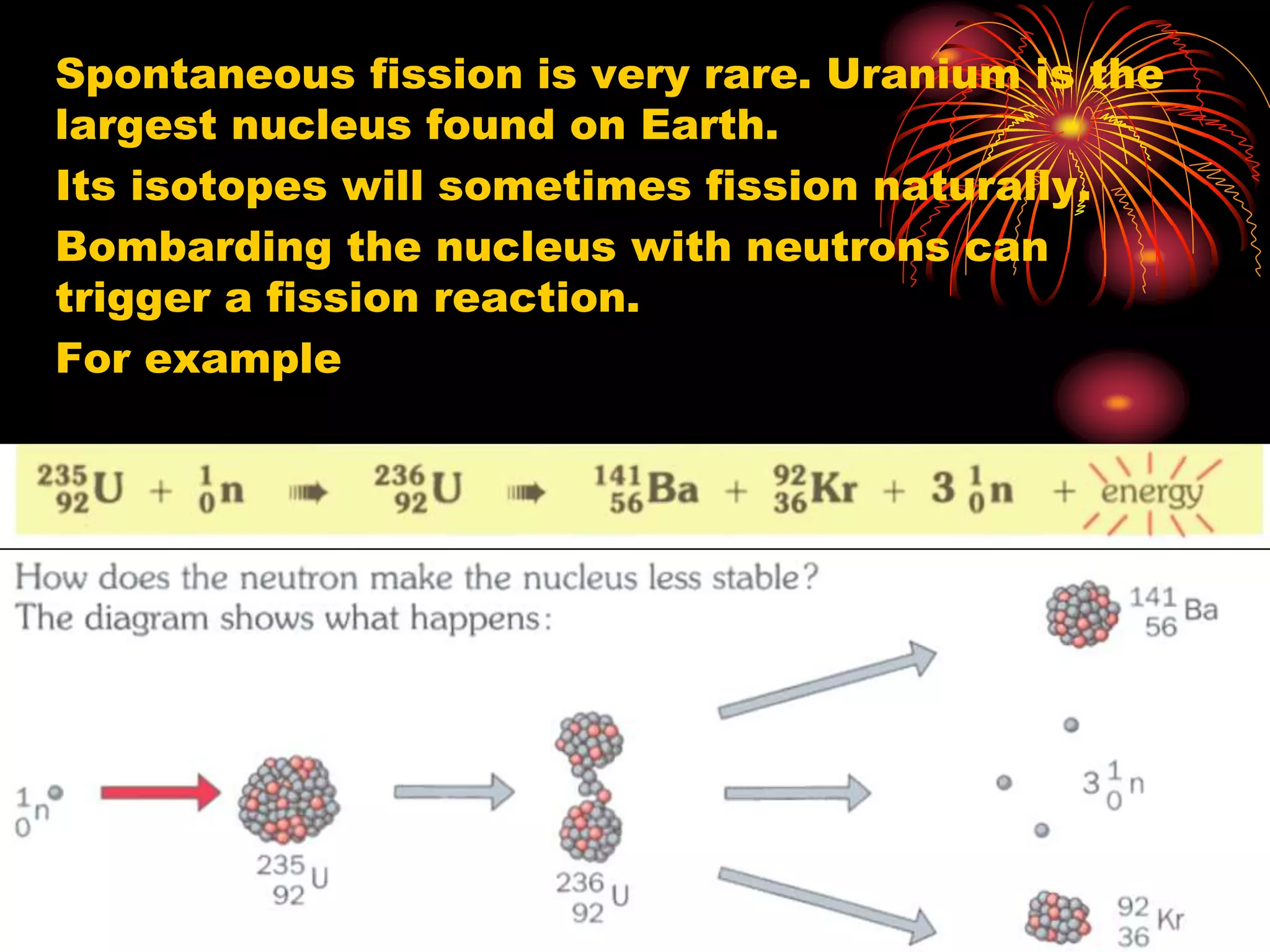
Spontaneous fission isvery rare. Uranium is the
largest nucleus found on Earth.
Its isotopes will sometimes fission naturally.
Bombarding the nucleus with neutrons can
trigger a fission reaction.
For example
18.
The strong forcesthat hold the
nucleus together only act over a
very short distance.
When a uranium nucleus absorbs
a neutron it knocks the nucleus
out of shape.
If the nucleus deforms enough,
the electrostatic repulsion
between the protons in each half
becomes greater than the strong
force.
It then splits in two.
19.
The nucleus splitsrandomly.
In the diagram, the fission
fragments are shown as isotopes
of barium and krypton.
This is just one of the many
possible combinations.
Fission of a uranium nucleus
gives out about 200 MeV of
energy.
20.
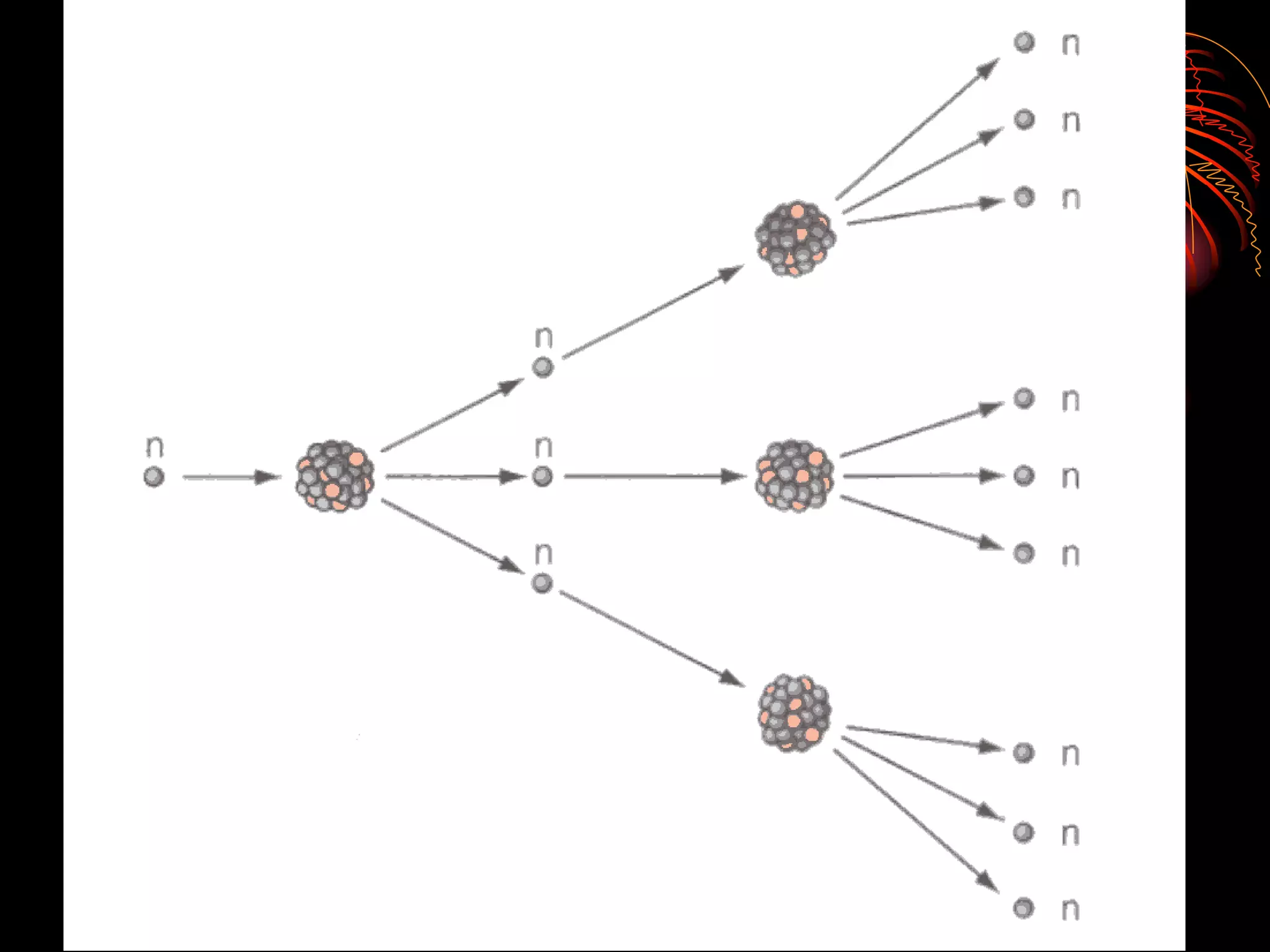
Chain Reactions
When theuranium nucleus splits,
a number of neutrons are also
ejected.
If each ejected neutron causes
another uranium nucleus to
undergo fission, we get a chain
reaction
The number of fissions increases
rapidly and a huge amount of
energy is released.
21.
Uncontrolled chain reactionsare used
in nuclear bombs
The energy they unleash is
devastating.
Nuclear power stations use the heat
released in carefully controlled fission
reactions to generate electricity.
They use control rods to absorb some
of the neutrons.
TOK
23.
Fusion
Fusion means joining
together.
Ina fusion reaction
two light nuclei join
together to make a
heavier nucleus.
Fusion gives out
more energy per
kilogram of fuel than
fission.
Can you see why
from the graph?
24.
The increases inbinding energy
per nucleon are much larger for
fusion than for fission reactions,
because the graph increases
more steeply for light nuclei.
So fusion gives out more energy
per nucleon involved in the
reaction than fission.
25.
The stars arepowered by fusion
reactions.
Each second, in our Sun, more than
560 million tonnes of hydrogen fuse
together to make helium.
One series of reactions for this is
shown here:
26.
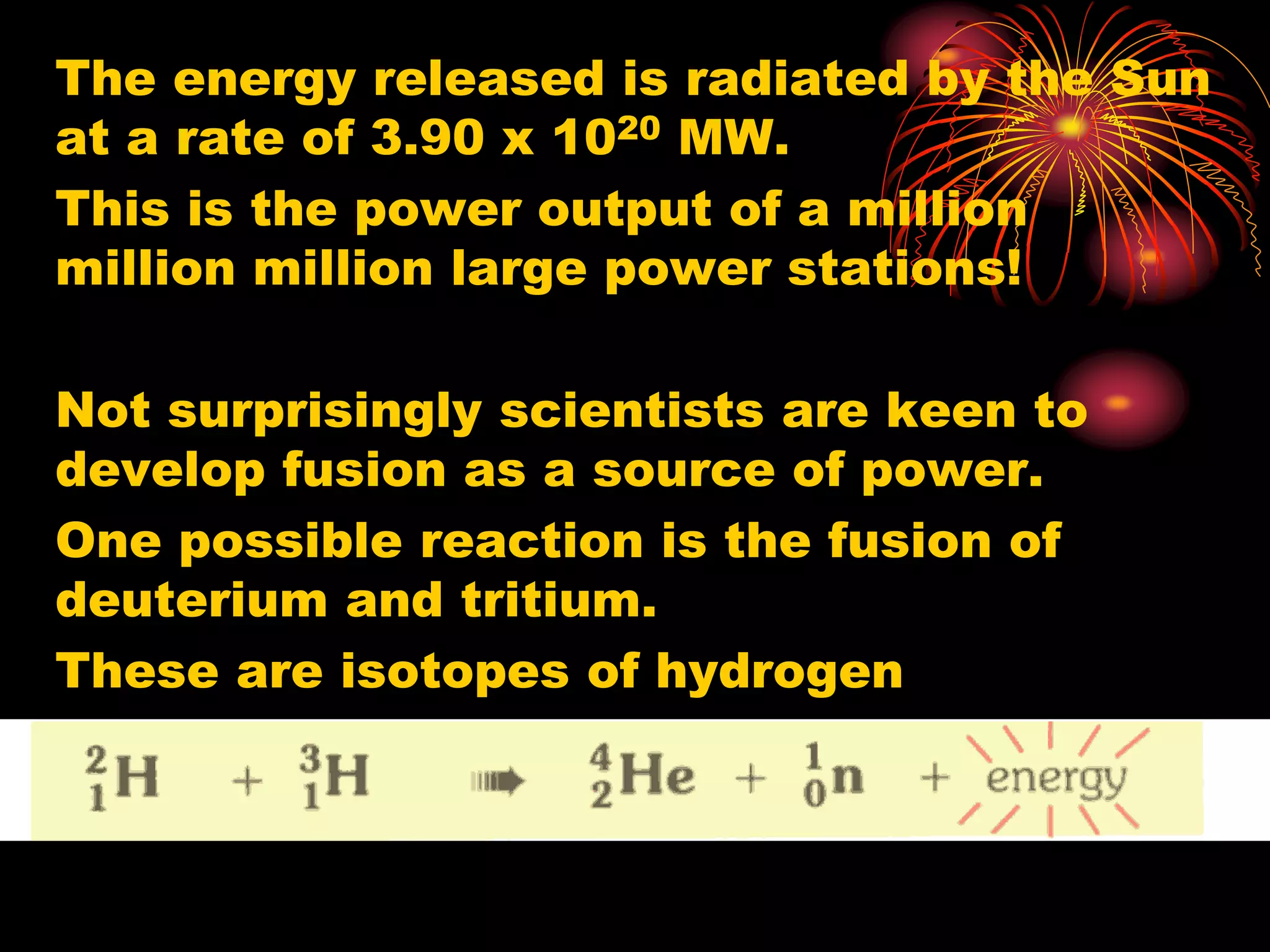
The energy releasedis radiated by the Sun
at a rate of 3.90 x 10²⁰ MW.
This is the power output of a million
million million large power stations!
Not surprisingly scientists are keen to
develop fusion as a source of power.
One possible reaction is the fusion of
deuterium and tritium.
These are isotopes of hydrogen
27.
Fusion has anumber of advantages
over fission:
greater power output per kilogram,
the raw materials are cheap and
readily available,
no radioactive elements are produced
directly,
irradiation by the neutrons leads to
radioactivity in the reactor materials
but these have relatively short half
lives and only need to be stored safely
for a short time.
28.
So why don'twe use fusion in nuclear
power stations?
The JET (Joint European Torus)
project was set up to carry out
research into fusion power.
It has yet to generate a self-sustaining
fusion reaction.
The main problem is getting two
nuclei close enough for long enough
for them to fuse.
TOK
29.
The enormous temperaturesand
pressures in the Sun's core
provide the right conditions.
On Earth temperatures of over
100 million kelvin are needed.
At this temperature all matter
exists as an ionised gas or
plasma.
30.
Another problem iscontainment.
What can you use to hold something
this hot?
JET uses magnetic fields in a
doughnutshaped chamber called a
torus to keep the plasma away from
the container walls.
Unfortunately generating high
temperatures and strong magnetic
fields uses up more energy than the
fusion reaction produces!
We are still some years off a fusion
power station.