Electric Fields
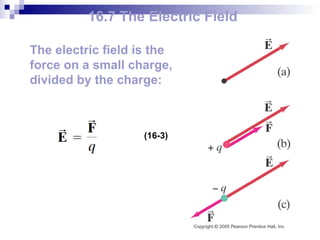
16.7 The Electric Field The electric field is the force on a small charge, divided by the charge: (16-3)
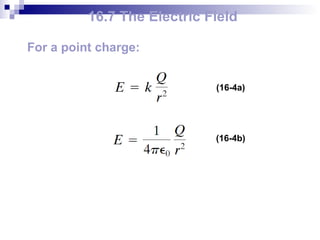
16.7 The Electric Field For a point charge: (16-4a) (16-4b)
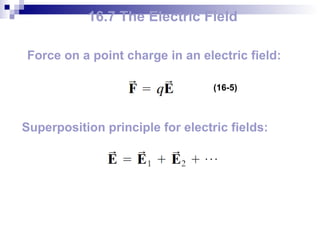
16.7 The Electric Field Force on a point charge in an electric field: (16-5) Superposition principle for electric fields:
16.7 The Electric Field Problem solving in electrostatics: electric forces and electric fields Draw a diagram; show all charges, with signs, and electric fields and forces with directions Calculate forces using Coulomb’s law Add forces vectorially to get result
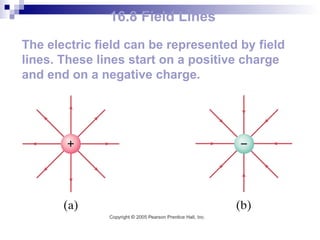
16.8 Field Lines The electric field can be represented by field lines. These lines start on a positive charge and end on a negative charge.
16.8 Field Lines The number of field lines starting (ending) on a positive (negative) charge is proportional to the magnitude of the charge. The electric field is stronger where the field lines are closer together.
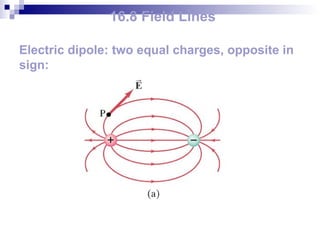
16.8 Field Lines Electric dipole: two equal charges, opposite in sign:
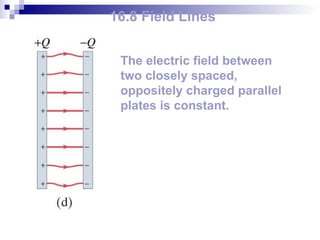
16.8 Field Lines The electric field between two closely spaced, oppositely charged parallel plates is constant.
16.8 Field Lines Summary of field lines: Field lines indicate the direction of the field; the field is tangent to the line. The magnitude of the field is proportional to the density of the lines. Field lines start on positive charges and end on negative charges; the number is proportional to the magnitude of the charge.
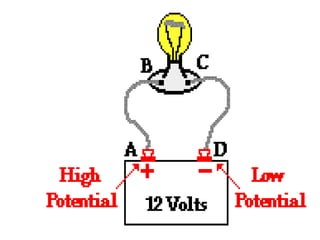
Electric Potential Electric Potential and Gravitational Potential have several similarities Mass/Charge Height/Distance Electric Potential is given as the amount of work that can be done to move the charge Unit of electric potential is Volts (V)
 
 
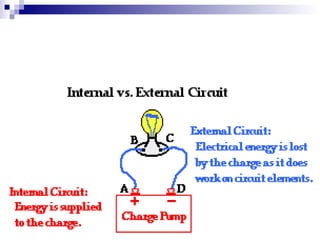
If the electrical circuit in your Ipod were analogous to a water circuit at a water park, then the battery would be comparable to _____. a. the people which slide from the elevated positions to the ground b. the obstacles which stand in the path of the moving water c. the pump which moves water from the ground to the elevated positions d. the pipes through which water flows e. the distance which water flows through the circuit
If a battery provides a high voltage, it can ____. a. do a lot of work over the course of its lifetime  b. do a lot of work on each charge it encounters c. push a lot of charge through a circuit d. last a long time
Electric Circuit  Requires Closed path The path can only be created by conductors Energy Source
Electric Current Current – the rate at which charge passes a point in a circuit  I = Q/t Unit is Coulomb per second  Ampere (A) or amps Current requires a closed path. Positive to negative
http://www.youtube.com/watch?v=W1UbXriii_Y
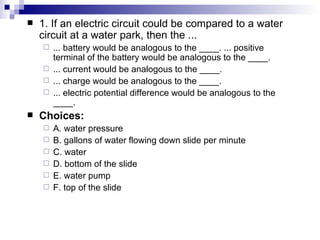
1. If an electric circuit could be compared to a water circuit at a water park, then the ... ... battery would be analogous to the ____. ... positive terminal of the battery would be analogous to the ____. ... current would be analogous to the ____. ... charge would be analogous to the ____. ... electric potential difference would be analogous to the ____. Choices: A. water pressure B. gallons of water flowing down slide per minute C. water D. bottom of the slide E. water pump F. top of the slide
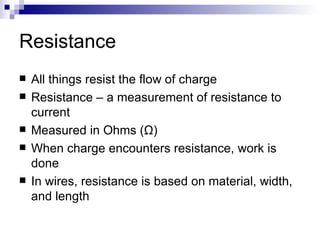
Resistance All things resist the flow of charge Resistance – a measurement of resistance to current Measured in Ohms ( Ω ) When charge encounters resistance, work is done In wires, resistance is based on material, width, and length
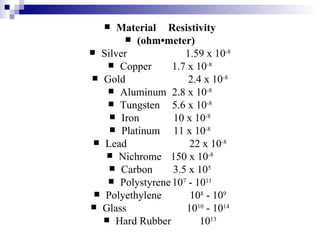
Material Resistivity (ohm•meter) Silver 1.59 x 10 -8 Copper 1.7 x 10 -8 Gold 2.4 x 10 -8 Aluminum 2.8 x 10 -8 Tungsten 5.6 x 10 -8 Iron 10 x 10 -8 Platinum 11 x 10 -8 Lead 22 x 10 -8 Nichrome 150 x 10 -8 Carbon 3.5 x 10 5 Polystyrene 10 7  - 10 11 Polyethylene 10 8  - 10 9 Glass 10 10  - 10 14 Hard Rubber 10 13
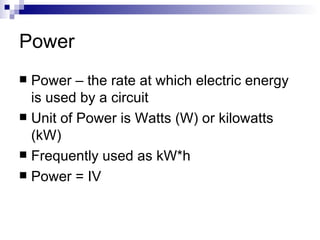
Power Power – the rate at which electric energy is used by a circuit Unit of Power is Watts (W) or kilowatts (kW) Frequently used as kW*h Power = IV
Ohms law There exists a relationship between Current, resistance, and voltage V=IR This equation is often rearranged as  I=V/R
http://www.physicsclassroom.com/Class/circuits/u9l3c.cfm
Two wires - A and B - with circular cross-sections have identical lengths and are made of the same material. Yet, wire A has four times the resistance of wire B. How many times greater is the diameter of wire B than wire A?
Which of the following will cause the current through an electrical circuit to decrease? Choose all that apply. a. decrease the voltage  b. decrease the resistance c. increase the voltage d. increase the resistance
You have likely been warned to avoid contact with electrical appliances or even electrical outlets when your hands are wet. Such contact is more dangerous when your hands are wet (vs. dry) because wet hands cause ____. a. the voltage of the circuit to be higher  b. the voltage of the circuit to be lower c. your resistance to be higher d. your resistance to be lower e. the current through you to be lower  
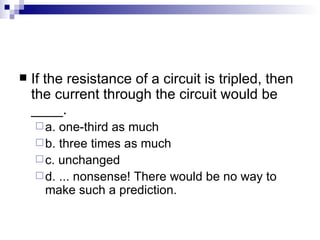
If the resistance of a circuit is tripled, then the current through the circuit would be ____. a. one-third as much  b. three times as much c. unchanged d. ... nonsense! There would be no way to make such a prediction.
http://www.hamradio.co.in/circuit/emergency-light.gif

Electric Fields

  • 1.
  • 2.
    16.7 The ElectricField The electric field is the force on a small charge, divided by the charge: (16-3)
  • 3.
    16.7 The ElectricField For a point charge: (16-4a) (16-4b)
  • 4.
    16.7 The ElectricField Force on a point charge in an electric field: (16-5) Superposition principle for electric fields:
  • 5.
    16.7 The ElectricField Problem solving in electrostatics: electric forces and electric fields Draw a diagram; show all charges, with signs, and electric fields and forces with directions Calculate forces using Coulomb’s law Add forces vectorially to get result
  • 6.
    16.8 Field LinesThe electric field can be represented by field lines. These lines start on a positive charge and end on a negative charge.
  • 7.
    16.8 Field LinesThe number of field lines starting (ending) on a positive (negative) charge is proportional to the magnitude of the charge. The electric field is stronger where the field lines are closer together.
  • 8.
    16.8 Field LinesElectric dipole: two equal charges, opposite in sign:
  • 9.
    16.8 Field LinesThe electric field between two closely spaced, oppositely charged parallel plates is constant.
  • 10.
    16.8 Field LinesSummary of field lines: Field lines indicate the direction of the field; the field is tangent to the line. The magnitude of the field is proportional to the density of the lines. Field lines start on positive charges and end on negative charges; the number is proportional to the magnitude of the charge.
  • 11.
    Electric Potential ElectricPotential and Gravitational Potential have several similarities Mass/Charge Height/Distance Electric Potential is given as the amount of work that can be done to move the charge Unit of electric potential is Volts (V)
  • 12.
  • 13.
  • 14.
    If the electricalcircuit in your Ipod were analogous to a water circuit at a water park, then the battery would be comparable to _____. a. the people which slide from the elevated positions to the ground b. the obstacles which stand in the path of the moving water c. the pump which moves water from the ground to the elevated positions d. the pipes through which water flows e. the distance which water flows through the circuit
  • 15.
    If a batteryprovides a high voltage, it can ____. a. do a lot of work over the course of its lifetime b. do a lot of work on each charge it encounters c. push a lot of charge through a circuit d. last a long time
  • 16.
    Electric Circuit Requires Closed path The path can only be created by conductors Energy Source
  • 17.
    Electric Current Current– the rate at which charge passes a point in a circuit I = Q/t Unit is Coulomb per second Ampere (A) or amps Current requires a closed path. Positive to negative
  • 18.
  • 19.
    1. If anelectric circuit could be compared to a water circuit at a water park, then the ... ... battery would be analogous to the ____. ... positive terminal of the battery would be analogous to the ____. ... current would be analogous to the ____. ... charge would be analogous to the ____. ... electric potential difference would be analogous to the ____. Choices: A. water pressure B. gallons of water flowing down slide per minute C. water D. bottom of the slide E. water pump F. top of the slide
  • 20.
    Resistance All thingsresist the flow of charge Resistance – a measurement of resistance to current Measured in Ohms ( Ω ) When charge encounters resistance, work is done In wires, resistance is based on material, width, and length
  • 21.
    Material Resistivity (ohm•meter)Silver 1.59 x 10 -8 Copper 1.7 x 10 -8 Gold 2.4 x 10 -8 Aluminum 2.8 x 10 -8 Tungsten 5.6 x 10 -8 Iron 10 x 10 -8 Platinum 11 x 10 -8 Lead 22 x 10 -8 Nichrome 150 x 10 -8 Carbon 3.5 x 10 5 Polystyrene 10 7 - 10 11 Polyethylene 10 8 - 10 9 Glass 10 10 - 10 14 Hard Rubber 10 13
  • 22.
    Power Power –the rate at which electric energy is used by a circuit Unit of Power is Watts (W) or kilowatts (kW) Frequently used as kW*h Power = IV
  • 23.
    Ohms law Thereexists a relationship between Current, resistance, and voltage V=IR This equation is often rearranged as I=V/R
  • 24.
  • 25.
    Two wires -A and B - with circular cross-sections have identical lengths and are made of the same material. Yet, wire A has four times the resistance of wire B. How many times greater is the diameter of wire B than wire A?
  • 26.
    Which of thefollowing will cause the current through an electrical circuit to decrease? Choose all that apply. a. decrease the voltage b. decrease the resistance c. increase the voltage d. increase the resistance
  • 27.
    You have likelybeen warned to avoid contact with electrical appliances or even electrical outlets when your hands are wet. Such contact is more dangerous when your hands are wet (vs. dry) because wet hands cause ____. a. the voltage of the circuit to be higher b. the voltage of the circuit to be lower c. your resistance to be higher d. your resistance to be lower e. the current through you to be lower  
  • 28.
    If the resistanceof a circuit is tripled, then the current through the circuit would be ____. a. one-third as much b. three times as much c. unchanged d. ... nonsense! There would be no way to make such a prediction.
  • 29.