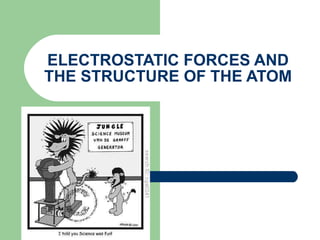
ELECTROSTATIC FORCES AND THE STRUCTURE OF THE ATOM
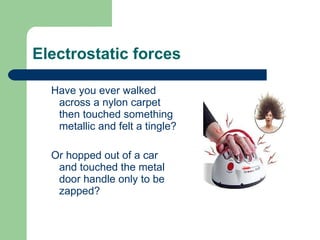
Electrostatic forces Have you ever walked across a nylon carpet then touched something metallic and felt a tingle?  Or hopped out of a car and touched the metal door handle only to be zapped?
These things happen because of electric charges.  When objects are rubbed together, the friction between them can cause the build-up of electric charge. Electric Charges
Early History Around 600 BC Greeks found by rubbing a hard fossilized resin   Amber against a fur cloth, it would attract particles of straw. This strange effect remained a mystery for over 2000 years.
Two Thousand Years Later Around 1600, William Gilbert, a physician  Studied magnetic phenomena and, demonstrated that the Earth itself, was a huge magnet, by means of his "terrella" experiment. He also studied the attraction produced when materials were rubbed, and named it the "electric" attraction. From that came the word "electricity".
This build-up of charge is called  static electricity  because the charge remains stationary. These are  non-contact  forces and can affect objects from a distance. Static Electricity
Static Electricity Two objects may become oppositely charged when surface electrons are transferred from one to another by rubbing
Static Electricity Take a comb or plastic pen and rub it on almost any piece of fabric, it will acquire a small electric charge If placed near small pieces of paper, they will be attracted .
(B) after combing. Arbitrary numbers of protons (+) and electrons (-) on a comb and in hair (A) before combing
Combing transfers electrons from the hair to the comb by friction, resulting in a negative charge on the comb and a positive charge on the hair
Practical Charging a plastic rod Near running water Pieces of paper Like rods Unlike rods Charging a balloon
If charge is transferred from or to an atom it is now called an  ion . An object becomes electrostatically charged by Friction  ,which transfers electrons between two objects in contact Contact  with a charged body which results in the transfer of electrons Induction  which produces a charge redistribution of electrons in a material Static Electricity
Charging by induction. The comb has become charged by friction, acquiring an excess of electrons.
The paper (A) normally has a random distribution of (+) and (-) charges.
(B) When the charged comb is held close to the paper, there is a reorientation of charges because of the repulsion of the charges.
This leaves a net positive charge on the side close to the comb, and since unlike charges attract, the paper is attracted to the comb
Identify which objects are charged _ _ _ _ _ _ _ _ _ _ _ _ _ _ _ _ _ _ _ _ _ _ _ + + + + + + + + + + + + + + + + + + + +
Which objects would be attracted to each other _ _ _ _ _ _ _ _ _ _ _ _ _ _ _ _ _ _ _ _ _ + + + + + + + + + + + + + + + + + + +
Questions Why does your hair stand on end when you place your hands on a van der graaf? What happens if you rub a balloon on your jumper? How can a balloon stick to a wall? Why does water bend towards a charged comb?
A neutral atom has no net charge because the numbers of electrons and protons are equal.   In the Atom
Removing an electron produces a net positive charge; the charged atom is called a positive ion.   The addition of an electron produces a net negative charge and a negative ion.
Charging by Friction
There is an invisible area around charged objects called a field. Anything entering this field is affected. Charged objects behave in certain ways when they are brought together. Fields
Electric Fields Around a charge is an electric field Fields are easier to see for magnetism Remember the iron filling experiment from y8
Electric and Magnetic Fields
When a pith ball is rubbed, it attracts small bits of paper, or another pith ball The first pith ball was charged and the second uncharged. Therefore, charged objects can attract uncharged objects
If two balloons are both rubbed with the same cloth or charged in the same way and brought together, they don’t attract each other. Instead, they push one another away.  So objects that have the same charge repel each other .
 
Questions What is charging by induction? What is an electroscope? How do atoms become negatively ions? What causes lightning? Can you name benefits of charging objects?
Is charge a good thing? Advantages of charge Photocopiers Spray painting Cleaning chimneys Identifying atoms
PHOTOCOPIERS Photocopiers rely on negative and positive charges to produce an image. The paper is positively charged and the toner is negatively charged The toner is therefore attracted to the positive paper, forming an image.
Spray painting Video clip Spray painting works by making the metallic body oppositely charged to the paint (the paint is charged as it is passed through the fine nozzle)
Spectroscopy The identity of atoms can be determined by flame tests If we put atoms in a large electric field (like an electric arc) or feed a flame, we can cause rearrangements of the electrons in the atoms As the atoms return to their resting states they emit light
Is charge a bad thing? Disadvantages of charge Lightning Sparks In operating theatres and at petrol pumps, electrostatic sparks can ignite the gases in the air
Lightning Positive and negative charges can build up in thunderclouds.  If these charges become large enough electrons can suddenly move from one part of the cloud to another, or to the ground, causing a spark that heats the air and causes lightning.
Earthing Earthing is the discharging of an object This is done by giving the static electricity a path to the ground, so that it leaks away and does not build up and cause problems. In operating theatres, doctors and nurses wear
Charges All matter is made up of atoms and molecules contain charged particles, the proton and electron. The charges on each are equal but opposite in sign.
The Role of the Electrostatic Force The electrostatic force of attraction between the negatively charged electrons and the positively charged nucleus, keeps the electrons in orbit. Just like gravity keeps the Earth in orbit around the Sun
The Atom and charge The atom consists of  a positively charged nucleus The nucleus is made up of protons and neutrons Electrons orbit the nucleus If the atom was 10 metres in diameter, the nucleus would be 1 mm wide.
Structure of the atom nucleus proton neutron electrons
 
Electrons   have a negative electrical charge Protons   have a positive electrical charge These charges interact to create an electrical force. Like charges produce repulsive forces. Unlike charges produce attractive forces. Electric Charge and Electrical Forces
Size of nucleus vs. electron cloud If an atom was the size of a sports stadium, the nucleus would be the size of a marble! Subatomic Particles : Protons : + charge, relative mass = 1.007 atomic mass units (amu); round to 1 Neutrons: = charge, relative mass = 1.009 atomic mass units (amu); round to 1 Electrons: - charge, relative mass = 0.0005 atomic mass units (amu); round to 0 (not factored in when figuring total mass of an atom)
How big is the nucleus If the atom was the size of the MCG, the nucleus would be the size of a pea in the middle of the oval and electrons would move over the entire field
Charges The quantity of charge is measured in coulombs (C). 1C = charge carried by 6.25 x 10 18  electrons The charge on one electron = -1.6 x 10 -19  C The charge on one proton = +1.6 x 10 -19 C
How many electrons? If an electron has a charge of -1.6 x10 -19 C In a coulomb In a sodium ion In a thousand coulombs In 25 coulombs
Coulomb’s Law (not assessed) Charles Augustin de Coulomb   in 1785 , I nvestigated the force acting   between any two charged objects. He discovered that there was a relationship between force ( F ) , two charges on the objects  q 1 and  q 2 .
Coulomb’s Law This is similar to Newton’s law of universal gravitation:
What is the force when? Two electrons are placed 3m apart A proton and an electron are placed 2mm apart An electron is orbiting a calcium nucleus at a distance of 3 x 10  -11  m An electron is the outer shell of hydrogen atom (radius is 5 x 10 -9 m) 10 μ C charge is placed 5cm from a -2  μ C charge

Electric Forces

  • 1.
    ELECTROSTATIC FORCES ANDTHE STRUCTURE OF THE ATOM
  • 2.
    Electrostatic forces Haveyou ever walked across a nylon carpet then touched something metallic and felt a tingle? Or hopped out of a car and touched the metal door handle only to be zapped?
  • 3.
    These things happenbecause of electric charges. When objects are rubbed together, the friction between them can cause the build-up of electric charge. Electric Charges
  • 4.
    Early History Around600 BC Greeks found by rubbing a hard fossilized resin Amber against a fur cloth, it would attract particles of straw. This strange effect remained a mystery for over 2000 years.
  • 5.
    Two Thousand YearsLater Around 1600, William Gilbert, a physician Studied magnetic phenomena and, demonstrated that the Earth itself, was a huge magnet, by means of his "terrella" experiment. He also studied the attraction produced when materials were rubbed, and named it the "electric" attraction. From that came the word "electricity".
  • 6.
    This build-up ofcharge is called static electricity because the charge remains stationary. These are non-contact forces and can affect objects from a distance. Static Electricity
  • 7.
    Static Electricity Twoobjects may become oppositely charged when surface electrons are transferred from one to another by rubbing
  • 8.
    Static Electricity Takea comb or plastic pen and rub it on almost any piece of fabric, it will acquire a small electric charge If placed near small pieces of paper, they will be attracted .
  • 9.
    (B) after combing.Arbitrary numbers of protons (+) and electrons (-) on a comb and in hair (A) before combing
  • 10.
    Combing transfers electronsfrom the hair to the comb by friction, resulting in a negative charge on the comb and a positive charge on the hair
  • 11.
    Practical Charging aplastic rod Near running water Pieces of paper Like rods Unlike rods Charging a balloon
  • 12.
    If charge istransferred from or to an atom it is now called an ion . An object becomes electrostatically charged by Friction ,which transfers electrons between two objects in contact Contact with a charged body which results in the transfer of electrons Induction which produces a charge redistribution of electrons in a material Static Electricity
  • 13.
    Charging by induction.The comb has become charged by friction, acquiring an excess of electrons.
  • 14.
    The paper (A)normally has a random distribution of (+) and (-) charges.
  • 15.
    (B) When thecharged comb is held close to the paper, there is a reorientation of charges because of the repulsion of the charges.
  • 16.
    This leaves anet positive charge on the side close to the comb, and since unlike charges attract, the paper is attracted to the comb
  • 17.
    Identify which objectsare charged _ _ _ _ _ _ _ _ _ _ _ _ _ _ _ _ _ _ _ _ _ _ _ + + + + + + + + + + + + + + + + + + + +
  • 18.
    Which objects wouldbe attracted to each other _ _ _ _ _ _ _ _ _ _ _ _ _ _ _ _ _ _ _ _ _ + + + + + + + + + + + + + + + + + + +
  • 19.
    Questions Why doesyour hair stand on end when you place your hands on a van der graaf? What happens if you rub a balloon on your jumper? How can a balloon stick to a wall? Why does water bend towards a charged comb?
  • 20.
    A neutral atomhas no net charge because the numbers of electrons and protons are equal. In the Atom
  • 21.
    Removing an electronproduces a net positive charge; the charged atom is called a positive ion. The addition of an electron produces a net negative charge and a negative ion.
  • 22.
  • 23.
    There is aninvisible area around charged objects called a field. Anything entering this field is affected. Charged objects behave in certain ways when they are brought together. Fields
  • 24.
    Electric Fields Arounda charge is an electric field Fields are easier to see for magnetism Remember the iron filling experiment from y8
  • 25.
  • 26.
    When a pithball is rubbed, it attracts small bits of paper, or another pith ball The first pith ball was charged and the second uncharged. Therefore, charged objects can attract uncharged objects
  • 27.
    If two balloonsare both rubbed with the same cloth or charged in the same way and brought together, they don’t attract each other. Instead, they push one another away. So objects that have the same charge repel each other .
  • 28.
  • 29.
    Questions What ischarging by induction? What is an electroscope? How do atoms become negatively ions? What causes lightning? Can you name benefits of charging objects?
  • 30.
    Is charge agood thing? Advantages of charge Photocopiers Spray painting Cleaning chimneys Identifying atoms
  • 31.
    PHOTOCOPIERS Photocopiers relyon negative and positive charges to produce an image. The paper is positively charged and the toner is negatively charged The toner is therefore attracted to the positive paper, forming an image.
  • 32.
    Spray painting Videoclip Spray painting works by making the metallic body oppositely charged to the paint (the paint is charged as it is passed through the fine nozzle)
  • 33.
    Spectroscopy The identityof atoms can be determined by flame tests If we put atoms in a large electric field (like an electric arc) or feed a flame, we can cause rearrangements of the electrons in the atoms As the atoms return to their resting states they emit light
  • 34.
    Is charge abad thing? Disadvantages of charge Lightning Sparks In operating theatres and at petrol pumps, electrostatic sparks can ignite the gases in the air
  • 35.
    Lightning Positive andnegative charges can build up in thunderclouds. If these charges become large enough electrons can suddenly move from one part of the cloud to another, or to the ground, causing a spark that heats the air and causes lightning.
  • 36.
    Earthing Earthing isthe discharging of an object This is done by giving the static electricity a path to the ground, so that it leaks away and does not build up and cause problems. In operating theatres, doctors and nurses wear
  • 37.
    Charges All matteris made up of atoms and molecules contain charged particles, the proton and electron. The charges on each are equal but opposite in sign.
  • 38.
    The Role ofthe Electrostatic Force The electrostatic force of attraction between the negatively charged electrons and the positively charged nucleus, keeps the electrons in orbit. Just like gravity keeps the Earth in orbit around the Sun
  • 39.
    The Atom andcharge The atom consists of a positively charged nucleus The nucleus is made up of protons and neutrons Electrons orbit the nucleus If the atom was 10 metres in diameter, the nucleus would be 1 mm wide.
  • 40.
    Structure of theatom nucleus proton neutron electrons
  • 41.
  • 42.
    Electrons have a negative electrical charge Protons have a positive electrical charge These charges interact to create an electrical force. Like charges produce repulsive forces. Unlike charges produce attractive forces. Electric Charge and Electrical Forces
  • 43.
    Size of nucleusvs. electron cloud If an atom was the size of a sports stadium, the nucleus would be the size of a marble! Subatomic Particles : Protons : + charge, relative mass = 1.007 atomic mass units (amu); round to 1 Neutrons: = charge, relative mass = 1.009 atomic mass units (amu); round to 1 Electrons: - charge, relative mass = 0.0005 atomic mass units (amu); round to 0 (not factored in when figuring total mass of an atom)
  • 44.
    How big isthe nucleus If the atom was the size of the MCG, the nucleus would be the size of a pea in the middle of the oval and electrons would move over the entire field
  • 45.
    Charges The quantityof charge is measured in coulombs (C). 1C = charge carried by 6.25 x 10 18 electrons The charge on one electron = -1.6 x 10 -19 C The charge on one proton = +1.6 x 10 -19 C
  • 46.
    How many electrons?If an electron has a charge of -1.6 x10 -19 C In a coulomb In a sodium ion In a thousand coulombs In 25 coulombs
  • 47.
    Coulomb’s Law (notassessed) Charles Augustin de Coulomb in 1785 , I nvestigated the force acting between any two charged objects. He discovered that there was a relationship between force ( F ) , two charges on the objects q 1 and q 2 .
  • 48.
    Coulomb’s Law Thisis similar to Newton’s law of universal gravitation:
  • 49.
    What is theforce when? Two electrons are placed 3m apart A proton and an electron are placed 2mm apart An electron is orbiting a calcium nucleus at a distance of 3 x 10 -11 m An electron is the outer shell of hydrogen atom (radius is 5 x 10 -9 m) 10 μ C charge is placed 5cm from a -2 μ C charge