Electric Fields and Forces


    AP Physics B
Electric Charge
“Charge” is a property of subatomic particles.
Facts about charge:
 There are 2 types basically, positive (protons)

  and negative (electrons)
 LIKE charges REPEL and OPPOSITE

  charges ATTRACT
 Charges are symbolic of fluids in that they

  can be in 2 states, STATIC or DYNAMIC.
Electric Charge – The specifics
                                •The symbol for CHARGE is “q”
                                •The unit is the COULOMB(C),
 Some important                 named after Charles Coulomb
                                •If we are talking about a SINGLE
   constants:                   charged particle such as 1 electron
                                or 1 proton we are referring to an
                                ELEMENTARY charge and often
                                use, e , to symbolize this.

Particle          Charge                   Mass
Proton            1.6x10⁻¹⁹ C              1.67 x10⁻²⁷ kg
Electron          1.6x10⁻¹⁹ C              9.11 x10⁻³¹ kg
Neutron           0                        1.67 x10⁻²⁷ kg
Charge is “CONSERVED”

             Charge cannot be
              created or destroyed
              only transferred from
              one object to another.
              Even though these 2
              charges attract initially,
              they repel after
              touching. Notice the
              NET charge stays the
              same.
Conductors and Insulators
The movement of charge is limited by the substance
  the charge is trying to pass through. There are
  generally 2 types of substances.
Conductors: Allow charge to move readily though it.
Insulators: Restrict the movement of the charge

                       Conductor = Copper Wire
                       Insulator = Plastic sheath
Charging and Discharging

There are basically 2 ways
   you can charge
   something.          “BIONIC is the first-ever ionic formula
                       mascara. The primary ingredient in
1. Charge by friction BIONIC is a chain molecule with a
                       positive charge. The friction caused by
2. Induction           sweeping the mascara brush across
                               lashes causes a negative charge. Since
                               opposites attract, the positively charged
                               formula adheres to the negatively
                               charged lashes for a dramatic effect that
                               lasts all day.”
Induction and Grounding
The second way to charge something is via
  INDUCTION, which requires NO PHYSICAL
  CONTACT.


We bring a negatively charged rod near a neutral sphere. The protons in the sphere
localize near the rod, while the electrons are repelled to the other side of the sphere. A
wire can then be brought in contact with the negative side and allowed to touch the
GROUND. The electrons will always move towards a more massive objects to increase
separation from other electrons, leaving a NET positive sphere behind.
Electric Force
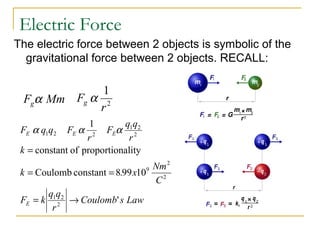
The electric force between 2 objects is symbolic of the
  gravitational force between 2 objects. RECALL:

             1
 Fgα Mm Fg α 2
            r
                   1       qq
 FE α q1q2   FE α      FEα 1 2 2
                  r2        r
 k = constant of proportionality
                                 Nm 2
 k = Coulomb constant = 8.99 x10⁹ 2
                                 C
       q1q2
 FE = k 2 → Coulomb' s Law
        r
Electric Forces and Newton’s Laws
Electric Forces and Fields obey Newton’s Laws.
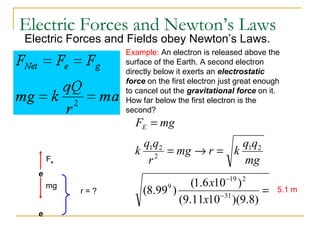
                  Example: An electron is released above the
                  surface of the Earth. A second electron
                  directly below it exerts an electrostatic
                  force on the first electron just great enough
                  to cancel out the gravitational force on it.
                  How far below the first electron is the
                  second?
                    FE = mg
                     q1q2            q1q2
                    k 2 = mg → r = k
      Fe              r              mg
  e
      mg                           (1.6 x10 −19 ) 2
           r=?         (8.999 )           −31
                                                    =         5.1 m
                                (9.11x10 )(9.8)
  e
Electric Forces and Vectors
Electric Fields and Forces are ALL vectors,
  thus all rules applying to vectors must be
  followed.
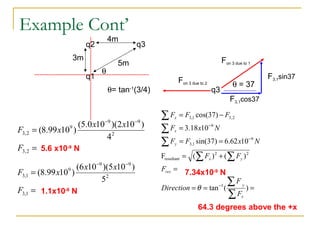
Consider three point charges, q1 = 6.00 x10⁻⁹ C (located at the origin),q3 =
5.00x10⁻⁹ C, and q2 = -2.00x10⁻⁹ C, located at the corners of a RIGHT triangle. q2
is located at y= 3 m while q3 is located 4m to the right of q2. Find the resultant
force on q3.
                                                      Which way does q2 push q3?
                               4m
                        q2              q3            Which way does q1 push q3?
                   3m                                                   Fon 3 due to 1
                                    5m
                             θ
                        q1                        Fon 3 due to 2
                                                                             θ = 37
                                                                   q3

                                 θ= tan-1(3/4)
Example Cont’
                                      4m
                             q2               q3
                        3m                                                           Fon 3 due to 1
                                         5m
                                  θ
                             q1                                Fon 3 due to 2                           F3,1sin37
                                                                                          θ = 37
                                      θ= tan-1(3/4)                             q3
                                                                                         F3,1cos37

                                                      ∑F   x   = F3,1 cos(37) − F3, 2
                      (5.0 x10 −9 )(2 x10 −9 )
F3, 2   = (8.99 x10 )
                    9
                                                      ∑F   x   = 3.18 x10 −9 N
                                42
F3, 2   = 5.6 x10⁻⁹ N
                                                      ∑F   y   = F3,1 sin(37) = 6.62 x10 −9 N
                                                      Fresultant = (∑ Fx ) 2 + (∑ Fy ) 2
                   (6 x10 −9 )(5 x10 −9 )             Fres =
F3,1 = (8.99 x10 )  9
                                                                  7.34x10⁻⁹ N
                            52                                                         ∑F
                                                      Direction = θ = tan −1 (
                                                                                               y
F3,1 = 1.1x10⁻⁸ N                                                                                  )=
                                                                                       ∑F     x

                                                                        64.3 degrees above the +x
Electric Fields

By definition, these are
  “LINES OF FORCE”

Some important facts:
 An electric field is a
  vector                       If you placed a 2nd positive charge
 Always is in the direction   (test charge), near the positive
                               charge shown above, it would
  that a POSITIVE “test”       move AWAY.
  charge would move
 The amount of force          If you placed that same charge
                               near the negative charge shown
  PER “test” charge            above it would move TOWARDS.
Electric Fields and Newton’s Laws
                                          Once again, the equation for
                                            ELECTRIC FIELD is
                                            symbolic of the equation for
                                            WEIGHT just like coulomb’s
                                            law is symbolic of Newton’s
                                            Law of Gravitation.

 The symbol for Electric Field is, “E”. And since it is defined as a force per
 unit charge he unit is Newtons per Coulomb, N/C.

 NOTE: the equations above will ONLY help you determine the MAGNITUDE
 of the field or force. Conceptual understanding will help you determine the
 direction.

 The “q” in the equation is that of a “test charge”.
Example
An electron and proton are each placed at rest in an external
  field of 520 N/C. Calculate the speed of each particle after
  48 ns                                   
                       FE                FE
                      E=       520 =
 What do we know          q           1.6 x10 −19
                      FE = 8.32 x10⁻¹⁹ N
 me=9.11 x 10 kg
            -31


 mp= 1.67 x10⁻²⁷ kg     FNet = ma FE = FNet
 qboth=1.6 x10⁻¹⁹
                    C
                        FE = me a → (9.11x10 −31 )a =              9.13x10¹³ m/s/s


 vo = 0 m/s             FE = m p a → (1.67 x10 − 27 )a =           4.98 x10¹⁰ m/s/s


 E = 520 N/C            v = vo + at
                        ve = ae (48 x10 −9 ) =     4.38 x10⁶ m/s
 t = 48 x 10-9 s
                        v p = a p (48 x10 −9 ) =   2.39 x10³ m/s
An Electric Point Charge
As we have discussed, all charges exert forces on other charges
  due to a field around them. Suppose we want to know how
  strong the field is at a specific point in space near this charge
  then we calculate the effects this charge will have on other
  charges, should they be placed at that point.

                                      Qq            FE
                                FE = k 2         E=    → FE = Eq
                                      r             q
                                      Qq
                                Eq = k 2
                                       r
                                                 kQ
                                Epoint charge   = 2
                                                 r

                             TEST CHARGE
     POINT CHARGE
Example
A -4x10-12C charge Q is placed at the origin. What is the
   magnitude and direction of the electric field produced
   by Q if a test charge were placed at x = -0.2 m ?

                                                   −12
      kQ           9 ( 4 x10                             )
  E = 2 = 8.99 x10           2
       r                  .2                                 0.2 m        E


  Emag = 0.899 N/C                                   E
                                                                     -Q
                                                                              E


  Edir =        Towards Q to the right                                E

  Remember, our equations will only give us MAGNITUDE. And the electric
  field LEAVES POSITIVE and ENTERS NEGATIVE.
Electric Field of a Conductor
A few more things about electric fields, suppose you bring a conductor
   NEAR a charged object. The side closest to which ever charge will be
   INDUCED the opposite charge. However, the charge will ONLY exist
   on the surface. There will never be an electric field inside a conductor.
   Insulators, however, can store the charge inside.


                                                         There must be a
  There must be a
                                                         negative charge on
  positive charge on
                                                         this side OR this
  this side
                                                         side was induced
                                                         positive due to the
                                                         other side being
                                                         negative.

Ap physics b_-_electric_fields_and_forces

  • 1.
    Electric Fields andForces AP Physics B
  • 2.
    Electric Charge “Charge” isa property of subatomic particles. Facts about charge:  There are 2 types basically, positive (protons) and negative (electrons)  LIKE charges REPEL and OPPOSITE charges ATTRACT  Charges are symbolic of fluids in that they can be in 2 states, STATIC or DYNAMIC.
  • 3.
    Electric Charge –The specifics •The symbol for CHARGE is “q” •The unit is the COULOMB(C), Some important named after Charles Coulomb •If we are talking about a SINGLE constants: charged particle such as 1 electron or 1 proton we are referring to an ELEMENTARY charge and often use, e , to symbolize this. Particle Charge Mass Proton 1.6x10⁻¹⁹ C 1.67 x10⁻²⁷ kg Electron 1.6x10⁻¹⁹ C 9.11 x10⁻³¹ kg Neutron 0 1.67 x10⁻²⁷ kg
  • 4.
    Charge is “CONSERVED” Charge cannot be created or destroyed only transferred from one object to another. Even though these 2 charges attract initially, they repel after touching. Notice the NET charge stays the same.
  • 5.
    Conductors and Insulators Themovement of charge is limited by the substance the charge is trying to pass through. There are generally 2 types of substances. Conductors: Allow charge to move readily though it. Insulators: Restrict the movement of the charge Conductor = Copper Wire Insulator = Plastic sheath
  • 6.
    Charging and Discharging Thereare basically 2 ways you can charge something. “BIONIC is the first-ever ionic formula mascara. The primary ingredient in 1. Charge by friction BIONIC is a chain molecule with a positive charge. The friction caused by 2. Induction sweeping the mascara brush across lashes causes a negative charge. Since opposites attract, the positively charged formula adheres to the negatively charged lashes for a dramatic effect that lasts all day.”
  • 7.
    Induction and Grounding Thesecond way to charge something is via INDUCTION, which requires NO PHYSICAL CONTACT. We bring a negatively charged rod near a neutral sphere. The protons in the sphere localize near the rod, while the electrons are repelled to the other side of the sphere. A wire can then be brought in contact with the negative side and allowed to touch the GROUND. The electrons will always move towards a more massive objects to increase separation from other electrons, leaving a NET positive sphere behind.
  • 8.
    Electric Force The electricforce between 2 objects is symbolic of the gravitational force between 2 objects. RECALL: 1 Fgα Mm Fg α 2 r 1 qq FE α q1q2 FE α FEα 1 2 2 r2 r k = constant of proportionality Nm 2 k = Coulomb constant = 8.99 x10⁹ 2 C q1q2 FE = k 2 → Coulomb' s Law r
  • 9.
    Electric Forces andNewton’s Laws Electric Forces and Fields obey Newton’s Laws. Example: An electron is released above the surface of the Earth. A second electron directly below it exerts an electrostatic force on the first electron just great enough to cancel out the gravitational force on it. How far below the first electron is the second? FE = mg q1q2 q1q2 k 2 = mg → r = k Fe r mg e mg (1.6 x10 −19 ) 2 r=? (8.999 ) −31 = 5.1 m (9.11x10 )(9.8) e
  • 10.
    Electric Forces andVectors Electric Fields and Forces are ALL vectors, thus all rules applying to vectors must be followed. Consider three point charges, q1 = 6.00 x10⁻⁹ C (located at the origin),q3 = 5.00x10⁻⁹ C, and q2 = -2.00x10⁻⁹ C, located at the corners of a RIGHT triangle. q2 is located at y= 3 m while q3 is located 4m to the right of q2. Find the resultant force on q3. Which way does q2 push q3? 4m q2 q3 Which way does q1 push q3? 3m Fon 3 due to 1 5m θ q1 Fon 3 due to 2 θ = 37 q3 θ= tan-1(3/4)
  • 11.
    Example Cont’ 4m q2 q3 3m Fon 3 due to 1 5m θ q1 Fon 3 due to 2 F3,1sin37 θ = 37 θ= tan-1(3/4) q3 F3,1cos37 ∑F x = F3,1 cos(37) − F3, 2 (5.0 x10 −9 )(2 x10 −9 ) F3, 2 = (8.99 x10 ) 9 ∑F x = 3.18 x10 −9 N 42 F3, 2 = 5.6 x10⁻⁹ N ∑F y = F3,1 sin(37) = 6.62 x10 −9 N Fresultant = (∑ Fx ) 2 + (∑ Fy ) 2 (6 x10 −9 )(5 x10 −9 ) Fres = F3,1 = (8.99 x10 ) 9 7.34x10⁻⁹ N 52 ∑F Direction = θ = tan −1 ( y F3,1 = 1.1x10⁻⁸ N )= ∑F x 64.3 degrees above the +x
  • 12.
    Electric Fields By definition,these are “LINES OF FORCE” Some important facts:  An electric field is a vector If you placed a 2nd positive charge  Always is in the direction (test charge), near the positive charge shown above, it would that a POSITIVE “test” move AWAY. charge would move  The amount of force If you placed that same charge near the negative charge shown PER “test” charge above it would move TOWARDS.
  • 13.
    Electric Fields andNewton’s Laws Once again, the equation for ELECTRIC FIELD is symbolic of the equation for WEIGHT just like coulomb’s law is symbolic of Newton’s Law of Gravitation. The symbol for Electric Field is, “E”. And since it is defined as a force per unit charge he unit is Newtons per Coulomb, N/C. NOTE: the equations above will ONLY help you determine the MAGNITUDE of the field or force. Conceptual understanding will help you determine the direction. The “q” in the equation is that of a “test charge”.
  • 14.
    Example An electron andproton are each placed at rest in an external field of 520 N/C. Calculate the speed of each particle after 48 ns    FE FE E= 520 = What do we know q 1.6 x10 −19 FE = 8.32 x10⁻¹⁹ N me=9.11 x 10 kg -31 mp= 1.67 x10⁻²⁷ kg FNet = ma FE = FNet qboth=1.6 x10⁻¹⁹ C FE = me a → (9.11x10 −31 )a = 9.13x10¹³ m/s/s vo = 0 m/s FE = m p a → (1.67 x10 − 27 )a = 4.98 x10¹⁰ m/s/s E = 520 N/C v = vo + at ve = ae (48 x10 −9 ) = 4.38 x10⁶ m/s t = 48 x 10-9 s v p = a p (48 x10 −9 ) = 2.39 x10³ m/s
  • 15.
    An Electric PointCharge As we have discussed, all charges exert forces on other charges due to a field around them. Suppose we want to know how strong the field is at a specific point in space near this charge then we calculate the effects this charge will have on other charges, should they be placed at that point. Qq FE FE = k 2 E= → FE = Eq r q Qq Eq = k 2 r kQ Epoint charge = 2 r TEST CHARGE POINT CHARGE
  • 16.
    Example A -4x10-12C chargeQ is placed at the origin. What is the magnitude and direction of the electric field produced by Q if a test charge were placed at x = -0.2 m ? −12 kQ 9 ( 4 x10 ) E = 2 = 8.99 x10 2 r .2 0.2 m E Emag = 0.899 N/C E -Q E Edir = Towards Q to the right E Remember, our equations will only give us MAGNITUDE. And the electric field LEAVES POSITIVE and ENTERS NEGATIVE.
  • 17.
    Electric Field ofa Conductor A few more things about electric fields, suppose you bring a conductor NEAR a charged object. The side closest to which ever charge will be INDUCED the opposite charge. However, the charge will ONLY exist on the surface. There will never be an electric field inside a conductor. Insulators, however, can store the charge inside. There must be a There must be a negative charge on positive charge on this side OR this this side side was induced positive due to the other side being negative.