Electrostatics
Topic covered - Property of charges , Electrostatic Force and
Electric Field
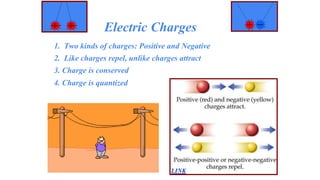
Electric Charges
1. Two kinds of charges: Positive and Negative
2. Like charges repel, unlike charges attract
3. Charge is conserved
4. Charge is quantized
LINK
The total charge in a closed system remains constant.
Charges are transferred.
The total charge in a closed system remains constant.
⮚ Neutral objects have equal amounts of positive and negative charge.
⮚ Only electrons are transferred in solids.
⮚ Single charges may not be created nor destroyed.
⮚ Pairs of opposite charges may be created or destroyed.
Examples: Charge separation by friction
Chemical equations
Beta Decay
Pair production / pair annihilation
Law of Conservation of Charge
SI Unit for Charge
● Coulomb [C] is the SI unit for charge.
● Coulomb is a derived unit based on the fundamental unit for
current, Ampere.
● Coulomb is a humongous amount of charge.
Natural unit for charge
On the atomic level, the unit of charge is the
elementary charge, e.
● +e is the charge of a proton
● -e is the charge of an electron
● +2e is the charge of an alpha particle
Natural unit for charge
On the sub-atomic level, fractional charges
exist.
Quarks have + (1/3) e
or + (2/3) e
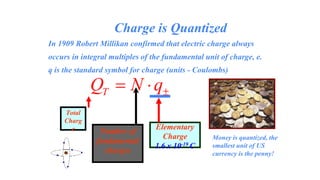
Charge is Quantized
In 1909 Robert Millikan confirmed that electric charge always
occurs in integral multiples of the fundamental unit of charge, e.
q is the standard symbol for charge (units - Coulombs)
Money is quantized, the
smallest unit of US
currency is the penny!
Total
Charg
e Number of
fundamental
charges
Elementary
Charge
1.6 x 10⁻¹⁹ C
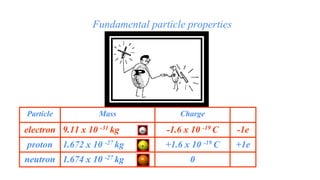
Particle Mass Charge
electron 9.11 x 10 -31 kg -1.6 x 10 -19 C -1e
proton 1.672 x 10 -27 kg +1.6 x 10 -19 C +1e
neutron 1.674 x 10 -27 kg 0
Fundamental particle properties
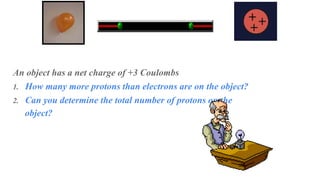
An object has a net charge of +3 Coulombs
1. How many more protons than electrons are on the object?
2. Can you determine the total number of protons on the
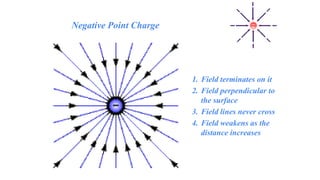
object?
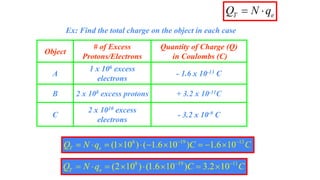
Object
# of Excess
Protons/Electrons
Quantity of Charge (Q)
in Coulombs (C)
A
1 x 10⁶ excess
electrons
- 1.6 x 10⁻¹³ C
B 2 x 10⁸ excess protons + 3.2 x 10⁻¹¹C
C
2 x 10¹⁰ excess
electrons
- 3.2 x 10⁻⁹ C
Ex: Find the total charge on the object in each case
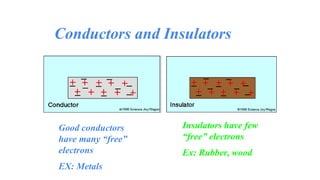
Conductors and Insulators
Good conductors
have many “free”
electrons
EX: Metals
Insulators have few
“free” electrons
Ex: Rubber, wood
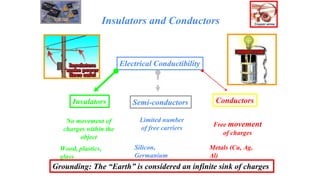
Insulators and Conductors
Electrical Conductibility
Insulators Conductors
No movement of
charges within the
object
Free movement
of charges
Semi-conductors
Limited number
of free carriers
Wood, plastics,
glass
Silicon,
Germanium
Metals (Cu, Ag,
Al)
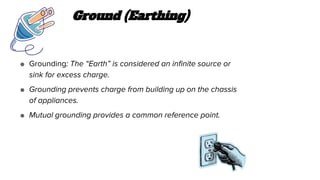
Grounding: The “Earth” is considered an infinite sink of charges
Ground (Earthing)
● Grounding: The “Earth” is considered an infinite source or
sink for excess charge.
● Grounding prevents charge from building up on the chassis
of appliances.
● Mutual grounding provides a common reference point.
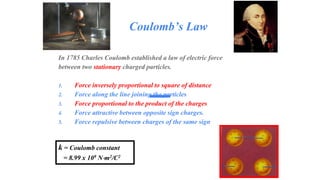
Coulomb’s Law
In 1785 Charles Coulomb established a law of electric force
between two stationary charged particles.
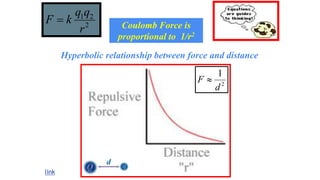
1. Force inversely proportional to square of distance
2. Force along the line joining the particles
3. Force proportional to the product of the charges
4. Force attractive between opposite sign charges.
5. Force repulsive between charges of the same sign
k = Coulomb constant
= 8.99 x 10⁹ N⋅m2/C2
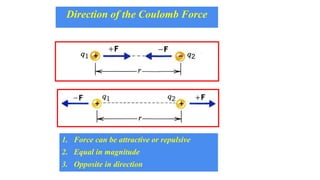
Direction of the Coulomb Force
1. Force can be attractive or repulsive
2. Equal in magnitude
3. Opposite in direction
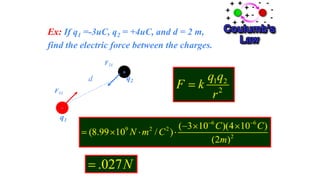
Ex: If q1 =-3uC, q2 = +4uC, and d = 2 m,
find the electric force between the charges.
+
-
q1
q2d
F12
F21
Coulomb Force is
proportional to 1/r2
Hyperbolic relationship between force and distance
link
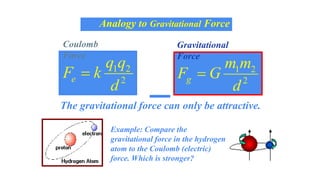
Analogy to Gravitational Force
Coulomb
Force
Gravitational
Force
The gravitational force can only be attractive.
Example: Compare the
gravitational force in the hydrogen
atom to the Coulomb (electric)
force. Which is stronger?
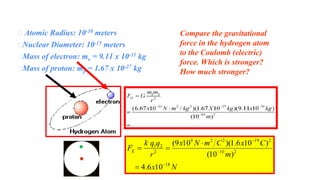
⮚ Atomic Radius: 10-10 meters
⮚Nuclear Diameter: 10-15 meters
⮚Mass of electron: me = 9.11 x 10⁻³¹ kg
⮚Mass of proton: mp = 1.67 x 10⁻²⁷ kg
Compare the gravitational
force in the hydrogen atom
to the Coulomb (electric)
force. Which is stronger?
How much stronger?
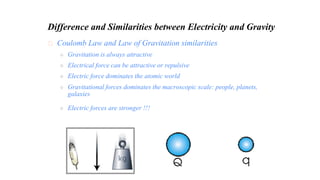
Difference and Similarities between Electricity and Gravity
⮚ Coulomb Law and Law of Gravitation similarities
○ Gravitation is always attractive
○ Electrical force can be attractive or repulsive
○ Electric force dominates the atomic world
○ Gravitational forces dominates the macroscopic scale: people, planets,
galaxies
○ Electric forces are stronger !!!
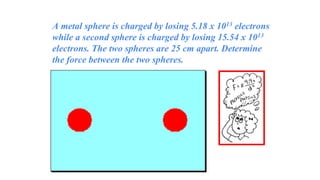
A metal sphere is charged by losing 5.18 x 10¹³ electrons
while a second sphere is charged by losing 15.54 x 10¹³
electrons. The two spheres are 25 cm apart. Determine
the force between the two spheres.
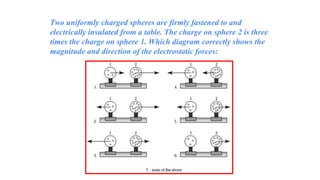
Two uniformly charged spheres are firmly fastened to and
electrically insulated from a table. The charge on sphere 2 is three
times the charge on sphere 1. Which diagram correctly shows the
magnitude and direction of the electrostatic forces:
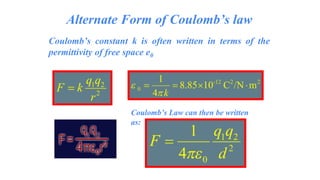
Alternate Form of Coulomb’s law
Coulomb’s constant k is often written in terms of the
permittivity of free space e0
Coulomb’s Law can then be written
as:
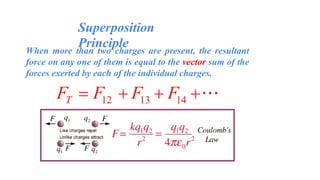
Superposition
PrincipleWhen more than two charges are present, the resultant
force on any one of them is equal to the vector sum of the
forces exerted by each of the individual charges.
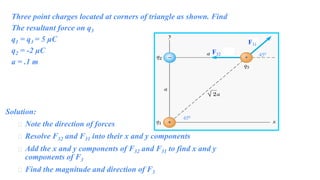
Solution:
⮚ Note the direction of forces
⮚ Resolve F32 and F31 into their x and y components
⮚ Add the x and y components of F32 and F31 to find x and y
components of F3
⮚ Find the magnitude and direction of F3
450F32
F31
450
Three point charges located at corners of triangle as shown. Find
The resultant force on q3
q1 = q3 = 5 μC
q2 = -2 μC
a = .1 m
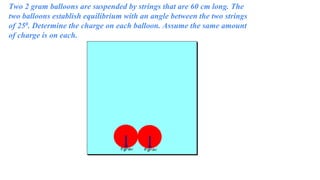
Two 2 gram balloons are suspended by strings that are 60 cm long. The
two balloons establish equilibrium with an angle between the two strings
of 250. Determine the charge on each balloon. Assume the same amount
of charge is on each.
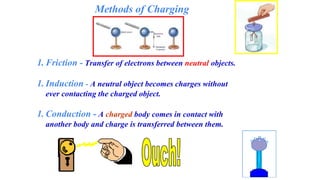
Methods of Charging
1. Friction - Transfer of electrons between neutral objects.
1. Induction - A neutral object becomes charges without
ever contacting the charged object.
1. Conduction - A charged body comes in contact with
another body and charge is transferred between them.
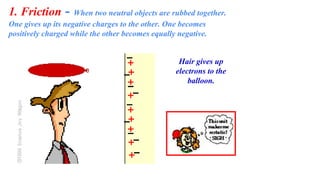
1. Friction - When two neutral objects are rubbed together.
One gives up its negative charges to the other. One becomes
positively charged while the other becomes equally negative.
Hair gives up
electrons to the
balloon.
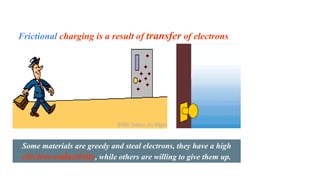
Frictional charging is a result of transfer of electrons
Some materials are greedy and steal electrons, they have a high
electroconductivity, while others are willing to give them up.
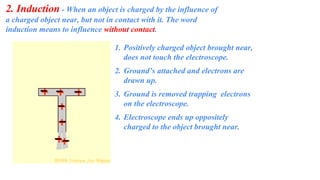
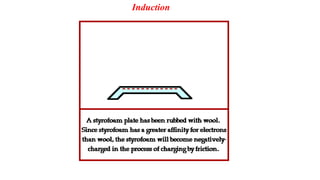
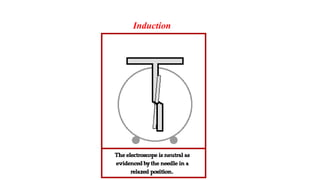
2. Induction - When an object is charged by the influence of
a charged object near, but not in contact with it. The word
induction means to influence without contact.
1. Positively charged object brought near,
does not touch the electroscope.
2. Ground’s attached and electrons are
drawn up.
3. Ground is removed trapping electrons
on the electroscope.
4. Electroscope ends up oppositely
charged to the object brought near.
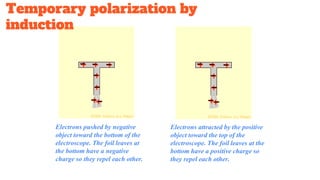
Electrons attracted by the positive
object toward the top of the
electroscope. The foil leaves at the
bottom have a positive charge so
they repel each other.
Electrons pushed by negative
object toward the bottom of the
electroscope. The foil leaves at
the bottom have a negative
charge so they repel each other.
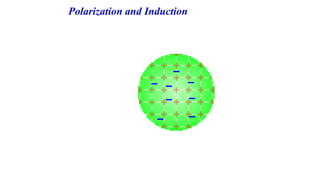
Temporary polarization by
induction
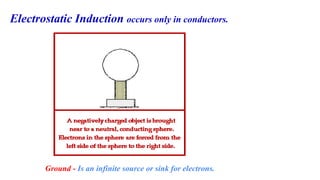
Electrostatic Induction occurs only in conductors.
Ground - Is an infinite source or sink for electrons.
Induction
Induction
Polarization and Induction
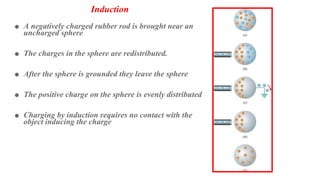
● A negatively charged rubber rod is brought near an
uncharged sphere
● The charges in the sphere are redistributed.
● After the sphere is grounded they leave the sphere
● The positive charge on the sphere is evenly distributed
● Charging by induction requires no contact with the
object inducing the charge
Induction
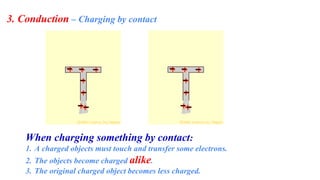
3. Conduction – Charging by contact
When charging something by contact:
1. A charged objects must touch and transfer some electrons.
2. The objects become charged alike.
3. The original charged object becomes less charged.
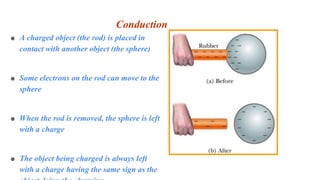
Conduction
● A charged object (the rod) is placed in
contact with another object (the sphere)
● Some electrons on the rod can move to the
sphere
● When the rod is removed, the sphere is left
with a charge
● The object being charged is always left
with a charge having the same sign as the
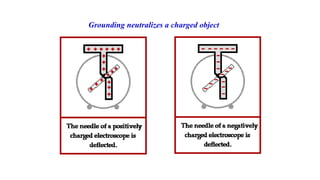
Grounding neutralizes a charged object
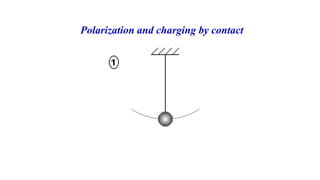
Polarization and charging by contact
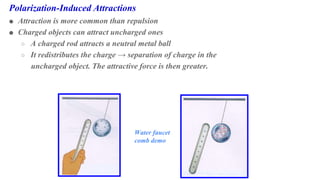
Polarization-Induced Attractions
● Attraction is more common than repulsion
● Charged objects can attract uncharged ones
○ A charged rod attracts a neutral metal ball
○ It redistributes the charge → separation of charge in the
uncharged object. The attractive force is then greater.
Water faucet
comb demo
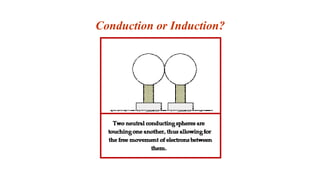
Conduction or Induction?
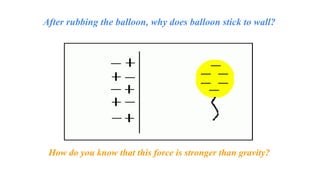
After rubbing the balloon, why does balloon stick to wall?
How do you know that this force is stronger than gravity?
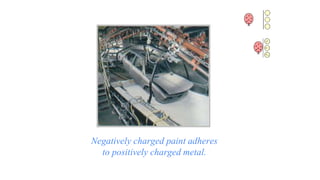
Negatively charged paint adheres
to positively charged metal.
Charge Distributions
● The excess charge on a conductor resides on the
outer surface concentrating on rough edges and
corners.
● Automobiles are a safe haven from lightening.
● Lightening rods and point discharge
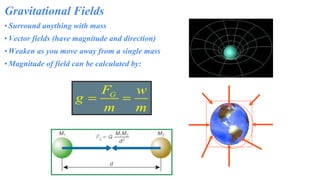
Gravitational Fields
•Surround anything with mass
•Vector fields (have magnitude and direction)
•Weaken as you move away from a single mass
•Magnitude of field can be calculated by:
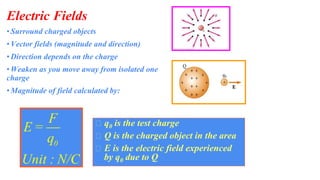
⮚ q0 is the test charge
⮚ Q is the charged object in the area
⮚ E is the electric field experienced
by q0 due to Q
Electric Fields
•Surround charged objects
•Vector fields (magnitude and direction)
•Direction depends on the charge
•Weaken as you move away from isolated one
charge
•Magnitude of field calculated by:
Electric Field Strength
The Electric Field Strength at a point in an
Electric Field is the Force per unit positive
test charge exerted on a charge at that
point.
E = F/q
*Vector Quantity
*[N/C]
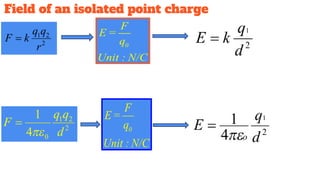
Field of an isolated point charge
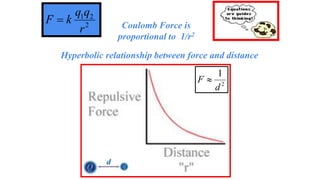
Coulomb Force is
proportional to 1/r2
Hyperbolic relationship between force and distance
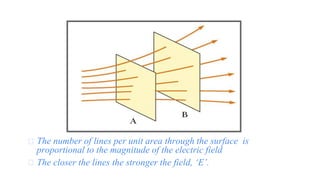
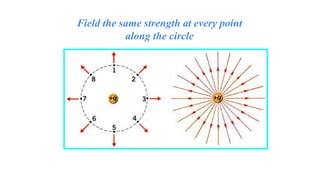
⮚ The number of lines per unit area through the surface is
proportional to the magnitude of the electric field
⮚ The closer the lines the stronger the field, ‘E’.
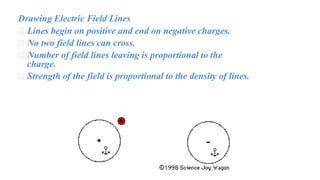
Drawing Electric Field Lines
⮚ Lines begin on positive and end on negative charges.
⮚ No two field lines can cross.
⮚ Number of field lines leaving is proportional to the
charge.
⮚ Strength of the field is proportional to the density of lines.
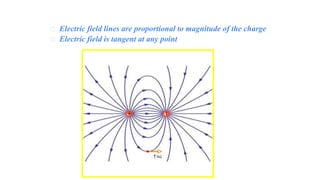
⮚ Electric field lines are proportional to magnitude of the charge
⮚ Electric field is tangent at any point
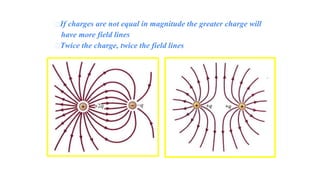
⮚If charges are not equal in magnitude the greater charge will
have more field lines
⮚Twice the charge, twice the field lines
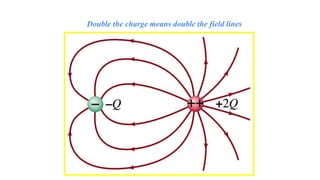
Double the charge means double the field lines
Field the same strength at every point
along the circle
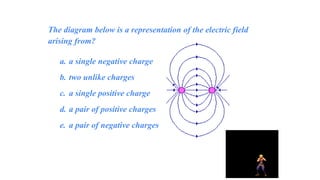
The diagram below is a representation of the electric field
arising from?
a. a single negative charge
b. two unlike charges
c. a single positive charge
d. a pair of positive charges
e. a pair of negative charges
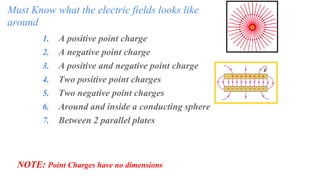
Must Know what the electric fields looks like
around
1. A positive point charge
2. A negative point charge
3. A positive and negative point charge
4. Two positive point charges
5. Two negative point charges
6. Around and inside a conducting sphere
7. Between 2 parallel plates
NOTE: Point Charges have no dimensions
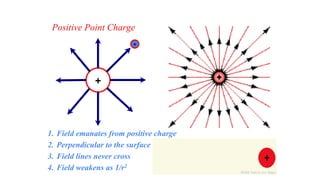
Positive Point Charge
+
+
1. Field emanates from positive charge
2. Perpendicular to the surface
3. Field lines never cross
4. Field weakens as 1/r2
1. Field terminates on it
2. Field perpendicular to
the surface
3. Field lines never cross
4. Field weakens as the
distance increases
Negative Point Charge
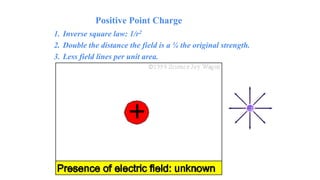
1. Inverse square law: 1/r2
2. Double the distance the field is a ¼ the original strength.
3. Less field lines per unit area.
Positive Point Charge
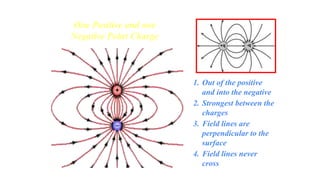
1. Out of the positive
and into the negative
2. Strongest between the
charges
3. Field lines are
perpendicular to the
surface
4. Field lines never
cross
One Positive and one
Negative Point Charge
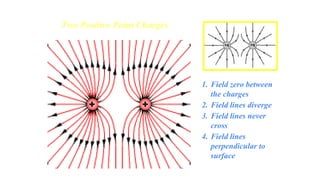
1. Field zero between
the charges
2. Field lines diverge
3. Field lines never
cross
4. Field lines
perpendicular to
surface
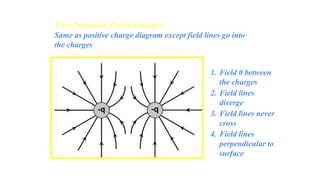
Two Positive Point Charges
1. Field 0 between
the charges
2. Field lines
diverge
3. Field lines never
cross
4. Field lines
perpendicular to
surface
Two Negative Point Charges
Same as positive charge diagram except field lines go into
the charges
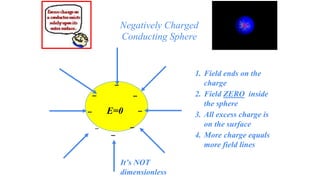
Negatively Charged
Conducting Sphere
E=0
_
_ _
__
__
_
1. Field ends on the
charge
2. Field ZERO inside
the sphere
3. All excess charge is
on the surface
4. More charge equals
more field lines
It’s NOT
dimensionless
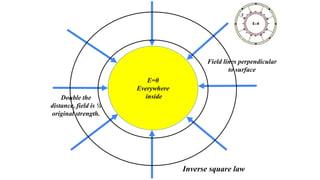
E=0
Everywhere
inside
Field lines perpendicular
to surface
Double the
distance, field is ¼
original strength.
Inverse square law
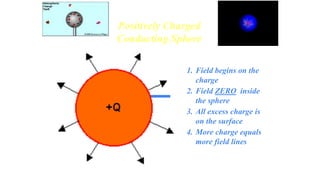
1. Field begins on the
charge
2. Field ZERO inside
the sphere
3. All excess charge is
on the surface
4. More charge equals
more field lines
Positively Charged
Conducting Sphere
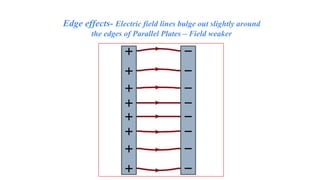
Edge effects- Electric field lines bulge out slightly around
the edges of Parallel Plates – Field weaker
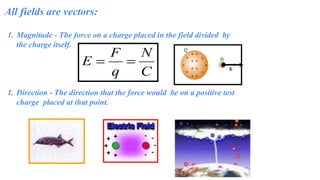
1. Magnitude - The force on a charge placed in the field divided by
the charge itself.
1. Direction - The direction that the force would be on a positive test
charge placed at that point.
All fields are vectors:
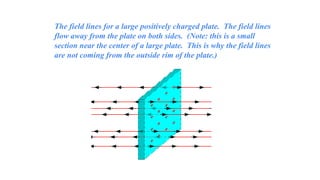
The field lines for a large positively charged plate. The field lines
flow away from the plate on both sides. (Note: this is a small
section near the center of a large plate. This is why the field lines
are not coming from the outside rim of the plate.)
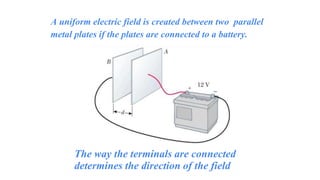
A uniform electric field is created between two parallel
metal plates if the plates are connected to a battery.
The way the terminals are connected
determines the direction of the field
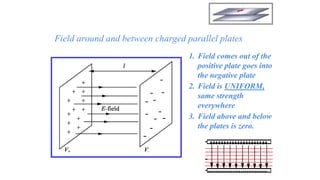
Field around and between charged parallel plates
1. Field comes out of the
positive plate goes into
the negative plate
2. Field is UNIFORM,
same strength
everywhere
3. Field above and below
the plates is zero.
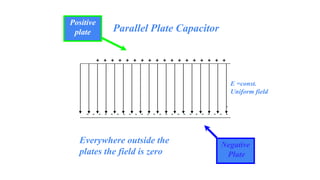
++++++++++++++++++
------------------------
-
Positive
plate
Negative
Plate
E =const.
Uniform field
Parallel Plate Capacitor
Everywhere outside the
plates the field is zero
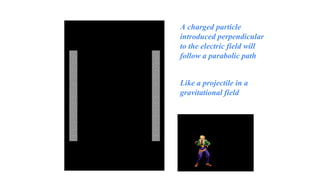
A charged particle
introduced perpendicular
to the electric field will
follow a parabolic path
Like a projectile in a
gravitational field

Electrostatics

  • 1.
    Electrostatics Topic covered -Property of charges , Electrostatic Force and Electric Field
  • 2.
    Electric Charges 1. Twokinds of charges: Positive and Negative 2. Like charges repel, unlike charges attract 3. Charge is conserved 4. Charge is quantized LINK
  • 3.
    The total chargein a closed system remains constant. Charges are transferred. The total charge in a closed system remains constant. ⮚ Neutral objects have equal amounts of positive and negative charge. ⮚ Only electrons are transferred in solids. ⮚ Single charges may not be created nor destroyed. ⮚ Pairs of opposite charges may be created or destroyed. Examples: Charge separation by friction Chemical equations Beta Decay Pair production / pair annihilation Law of Conservation of Charge
  • 4.
    SI Unit forCharge ● Coulomb [C] is the SI unit for charge. ● Coulomb is a derived unit based on the fundamental unit for current, Ampere. ● Coulomb is a humongous amount of charge.
  • 5.
    Natural unit forcharge On the atomic level, the unit of charge is the elementary charge, e. ● +e is the charge of a proton ● -e is the charge of an electron ● +2e is the charge of an alpha particle
  • 6.
    Natural unit forcharge On the sub-atomic level, fractional charges exist. Quarks have + (1/3) e or + (2/3) e
  • 7.
    Charge is Quantized In1909 Robert Millikan confirmed that electric charge always occurs in integral multiples of the fundamental unit of charge, e. q is the standard symbol for charge (units - Coulombs) Money is quantized, the smallest unit of US currency is the penny! Total Charg e Number of fundamental charges Elementary Charge 1.6 x 10⁻¹⁹ C
  • 8.
    Particle Mass Charge electron9.11 x 10 -31 kg -1.6 x 10 -19 C -1e proton 1.672 x 10 -27 kg +1.6 x 10 -19 C +1e neutron 1.674 x 10 -27 kg 0 Fundamental particle properties
  • 9.
    An object hasa net charge of +3 Coulombs 1. How many more protons than electrons are on the object? 2. Can you determine the total number of protons on the object?
  • 10.
    Object # of Excess Protons/Electrons Quantityof Charge (Q) in Coulombs (C) A 1 x 10⁶ excess electrons - 1.6 x 10⁻¹³ C B 2 x 10⁸ excess protons + 3.2 x 10⁻¹¹C C 2 x 10¹⁰ excess electrons - 3.2 x 10⁻⁹ C Ex: Find the total charge on the object in each case
  • 11.
    Conductors and Insulators Goodconductors have many “free” electrons EX: Metals Insulators have few “free” electrons Ex: Rubber, wood
  • 12.
    Insulators and Conductors ElectricalConductibility Insulators Conductors No movement of charges within the object Free movement of charges Semi-conductors Limited number of free carriers Wood, plastics, glass Silicon, Germanium Metals (Cu, Ag, Al) Grounding: The “Earth” is considered an infinite sink of charges
  • 13.
    Ground (Earthing) ● Grounding:The “Earth” is considered an infinite source or sink for excess charge. ● Grounding prevents charge from building up on the chassis of appliances. ● Mutual grounding provides a common reference point.
  • 14.
    Coulomb’s Law In 1785Charles Coulomb established a law of electric force between two stationary charged particles. 1. Force inversely proportional to square of distance 2. Force along the line joining the particles 3. Force proportional to the product of the charges 4. Force attractive between opposite sign charges. 5. Force repulsive between charges of the same sign k = Coulomb constant = 8.99 x 10⁹ N⋅m2/C2
  • 15.
    Direction of theCoulomb Force 1. Force can be attractive or repulsive 2. Equal in magnitude 3. Opposite in direction
  • 16.
    Ex: If q1=-3uC, q2 = +4uC, and d = 2 m, find the electric force between the charges. + - q1 q2d F12 F21
  • 17.
    Coulomb Force is proportionalto 1/r2 Hyperbolic relationship between force and distance link
  • 18.
    Analogy to GravitationalForce Coulomb Force Gravitational Force The gravitational force can only be attractive. Example: Compare the gravitational force in the hydrogen atom to the Coulomb (electric) force. Which is stronger?
  • 19.
    ⮚ Atomic Radius:10-10 meters ⮚Nuclear Diameter: 10-15 meters ⮚Mass of electron: me = 9.11 x 10⁻³¹ kg ⮚Mass of proton: mp = 1.67 x 10⁻²⁷ kg Compare the gravitational force in the hydrogen atom to the Coulomb (electric) force. Which is stronger? How much stronger?
  • 20.
    Difference and Similaritiesbetween Electricity and Gravity ⮚ Coulomb Law and Law of Gravitation similarities ○ Gravitation is always attractive ○ Electrical force can be attractive or repulsive ○ Electric force dominates the atomic world ○ Gravitational forces dominates the macroscopic scale: people, planets, galaxies ○ Electric forces are stronger !!!
  • 21.
    A metal sphereis charged by losing 5.18 x 10¹³ electrons while a second sphere is charged by losing 15.54 x 10¹³ electrons. The two spheres are 25 cm apart. Determine the force between the two spheres.
  • 22.
    Two uniformly chargedspheres are firmly fastened to and electrically insulated from a table. The charge on sphere 2 is three times the charge on sphere 1. Which diagram correctly shows the magnitude and direction of the electrostatic forces:
  • 23.
    Alternate Form ofCoulomb’s law Coulomb’s constant k is often written in terms of the permittivity of free space e0 Coulomb’s Law can then be written as:
  • 24.
    Superposition PrincipleWhen more thantwo charges are present, the resultant force on any one of them is equal to the vector sum of the forces exerted by each of the individual charges.
  • 25.
    Solution: ⮚ Note thedirection of forces ⮚ Resolve F32 and F31 into their x and y components ⮚ Add the x and y components of F32 and F31 to find x and y components of F3 ⮚ Find the magnitude and direction of F3 450F32 F31 450 Three point charges located at corners of triangle as shown. Find The resultant force on q3 q1 = q3 = 5 μC q2 = -2 μC a = .1 m
  • 26.
    Two 2 gramballoons are suspended by strings that are 60 cm long. The two balloons establish equilibrium with an angle between the two strings of 250. Determine the charge on each balloon. Assume the same amount of charge is on each.
  • 27.
    Methods of Charging 1.Friction - Transfer of electrons between neutral objects. 1. Induction - A neutral object becomes charges without ever contacting the charged object. 1. Conduction - A charged body comes in contact with another body and charge is transferred between them.
  • 28.
    1. Friction -When two neutral objects are rubbed together. One gives up its negative charges to the other. One becomes positively charged while the other becomes equally negative. Hair gives up electrons to the balloon.
  • 29.
    Frictional charging isa result of transfer of electrons Some materials are greedy and steal electrons, they have a high electroconductivity, while others are willing to give them up.
  • 30.
    2. Induction -When an object is charged by the influence of a charged object near, but not in contact with it. The word induction means to influence without contact. 1. Positively charged object brought near, does not touch the electroscope. 2. Ground’s attached and electrons are drawn up. 3. Ground is removed trapping electrons on the electroscope. 4. Electroscope ends up oppositely charged to the object brought near.
  • 31.
    Electrons attracted bythe positive object toward the top of the electroscope. The foil leaves at the bottom have a positive charge so they repel each other. Electrons pushed by negative object toward the bottom of the electroscope. The foil leaves at the bottom have a negative charge so they repel each other. Temporary polarization by induction
  • 32.
    Electrostatic Induction occursonly in conductors. Ground - Is an infinite source or sink for electrons.
  • 33.
  • 34.
  • 35.
  • 36.
    ● A negativelycharged rubber rod is brought near an uncharged sphere ● The charges in the sphere are redistributed. ● After the sphere is grounded they leave the sphere ● The positive charge on the sphere is evenly distributed ● Charging by induction requires no contact with the object inducing the charge Induction
  • 37.
    3. Conduction –Charging by contact When charging something by contact: 1. A charged objects must touch and transfer some electrons. 2. The objects become charged alike. 3. The original charged object becomes less charged.
  • 38.
    Conduction ● A chargedobject (the rod) is placed in contact with another object (the sphere) ● Some electrons on the rod can move to the sphere ● When the rod is removed, the sphere is left with a charge ● The object being charged is always left with a charge having the same sign as the
  • 39.
  • 40.
  • 41.
    Polarization-Induced Attractions ● Attractionis more common than repulsion ● Charged objects can attract uncharged ones ○ A charged rod attracts a neutral metal ball ○ It redistributes the charge → separation of charge in the uncharged object. The attractive force is then greater. Water faucet comb demo
  • 42.
  • 43.
    After rubbing theballoon, why does balloon stick to wall? How do you know that this force is stronger than gravity?
  • 44.
    Negatively charged paintadheres to positively charged metal.
  • 45.
    Charge Distributions ● Theexcess charge on a conductor resides on the outer surface concentrating on rough edges and corners. ● Automobiles are a safe haven from lightening. ● Lightening rods and point discharge
  • 46.
    Gravitational Fields •Surround anythingwith mass •Vector fields (have magnitude and direction) •Weaken as you move away from a single mass •Magnitude of field can be calculated by:
  • 47.
    ⮚ q0 isthe test charge ⮚ Q is the charged object in the area ⮚ E is the electric field experienced by q0 due to Q Electric Fields •Surround charged objects •Vector fields (magnitude and direction) •Direction depends on the charge •Weaken as you move away from isolated one charge •Magnitude of field calculated by:
  • 48.
    Electric Field Strength TheElectric Field Strength at a point in an Electric Field is the Force per unit positive test charge exerted on a charge at that point. E = F/q *Vector Quantity *[N/C]
  • 49.
    Field of anisolated point charge
  • 50.
    Coulomb Force is proportionalto 1/r2 Hyperbolic relationship between force and distance
  • 51.
    ⮚ The numberof lines per unit area through the surface is proportional to the magnitude of the electric field ⮚ The closer the lines the stronger the field, ‘E’.
  • 52.
    Drawing Electric FieldLines ⮚ Lines begin on positive and end on negative charges. ⮚ No two field lines can cross. ⮚ Number of field lines leaving is proportional to the charge. ⮚ Strength of the field is proportional to the density of lines.
  • 53.
    ⮚ Electric fieldlines are proportional to magnitude of the charge ⮚ Electric field is tangent at any point
  • 54.
    ⮚If charges arenot equal in magnitude the greater charge will have more field lines ⮚Twice the charge, twice the field lines
  • 55.
    Double the chargemeans double the field lines
  • 56.
    Field the samestrength at every point along the circle
  • 57.
    The diagram belowis a representation of the electric field arising from? a. a single negative charge b. two unlike charges c. a single positive charge d. a pair of positive charges e. a pair of negative charges
  • 58.
    Must Know whatthe electric fields looks like around 1. A positive point charge 2. A negative point charge 3. A positive and negative point charge 4. Two positive point charges 5. Two negative point charges 6. Around and inside a conducting sphere 7. Between 2 parallel plates NOTE: Point Charges have no dimensions
  • 59.
    Positive Point Charge + + 1.Field emanates from positive charge 2. Perpendicular to the surface 3. Field lines never cross 4. Field weakens as 1/r2
  • 60.
    1. Field terminateson it 2. Field perpendicular to the surface 3. Field lines never cross 4. Field weakens as the distance increases Negative Point Charge
  • 61.
    1. Inverse squarelaw: 1/r2 2. Double the distance the field is a ¼ the original strength. 3. Less field lines per unit area. Positive Point Charge
  • 62.
    1. Out ofthe positive and into the negative 2. Strongest between the charges 3. Field lines are perpendicular to the surface 4. Field lines never cross One Positive and one Negative Point Charge
  • 63.
    1. Field zerobetween the charges 2. Field lines diverge 3. Field lines never cross 4. Field lines perpendicular to surface Two Positive Point Charges
  • 64.
    1. Field 0between the charges 2. Field lines diverge 3. Field lines never cross 4. Field lines perpendicular to surface Two Negative Point Charges Same as positive charge diagram except field lines go into the charges
  • 65.
    Negatively Charged Conducting Sphere E=0 _ __ __ __ _ 1. Field ends on the charge 2. Field ZERO inside the sphere 3. All excess charge is on the surface 4. More charge equals more field lines It’s NOT dimensionless
  • 66.
    E=0 Everywhere inside Field lines perpendicular tosurface Double the distance, field is ¼ original strength. Inverse square law
  • 67.
    1. Field beginson the charge 2. Field ZERO inside the sphere 3. All excess charge is on the surface 4. More charge equals more field lines Positively Charged Conducting Sphere
  • 68.
    Edge effects- Electricfield lines bulge out slightly around the edges of Parallel Plates – Field weaker
  • 69.
    1. Magnitude -The force on a charge placed in the field divided by the charge itself. 1. Direction - The direction that the force would be on a positive test charge placed at that point. All fields are vectors:
  • 70.
    The field linesfor a large positively charged plate. The field lines flow away from the plate on both sides. (Note: this is a small section near the center of a large plate. This is why the field lines are not coming from the outside rim of the plate.)
  • 71.
    A uniform electricfield is created between two parallel metal plates if the plates are connected to a battery. The way the terminals are connected determines the direction of the field
  • 72.
    Field around andbetween charged parallel plates 1. Field comes out of the positive plate goes into the negative plate 2. Field is UNIFORM, same strength everywhere 3. Field above and below the plates is zero.
  • 73.
  • 74.
    A charged particle introducedperpendicular to the electric field will follow a parabolic path Like a projectile in a gravitational field