ELECTROMAGNETISM
Topic 11.1 Electromagnetic Induction
INDUCED ELECTROMOTIVE
FORCE (E.M.F.)
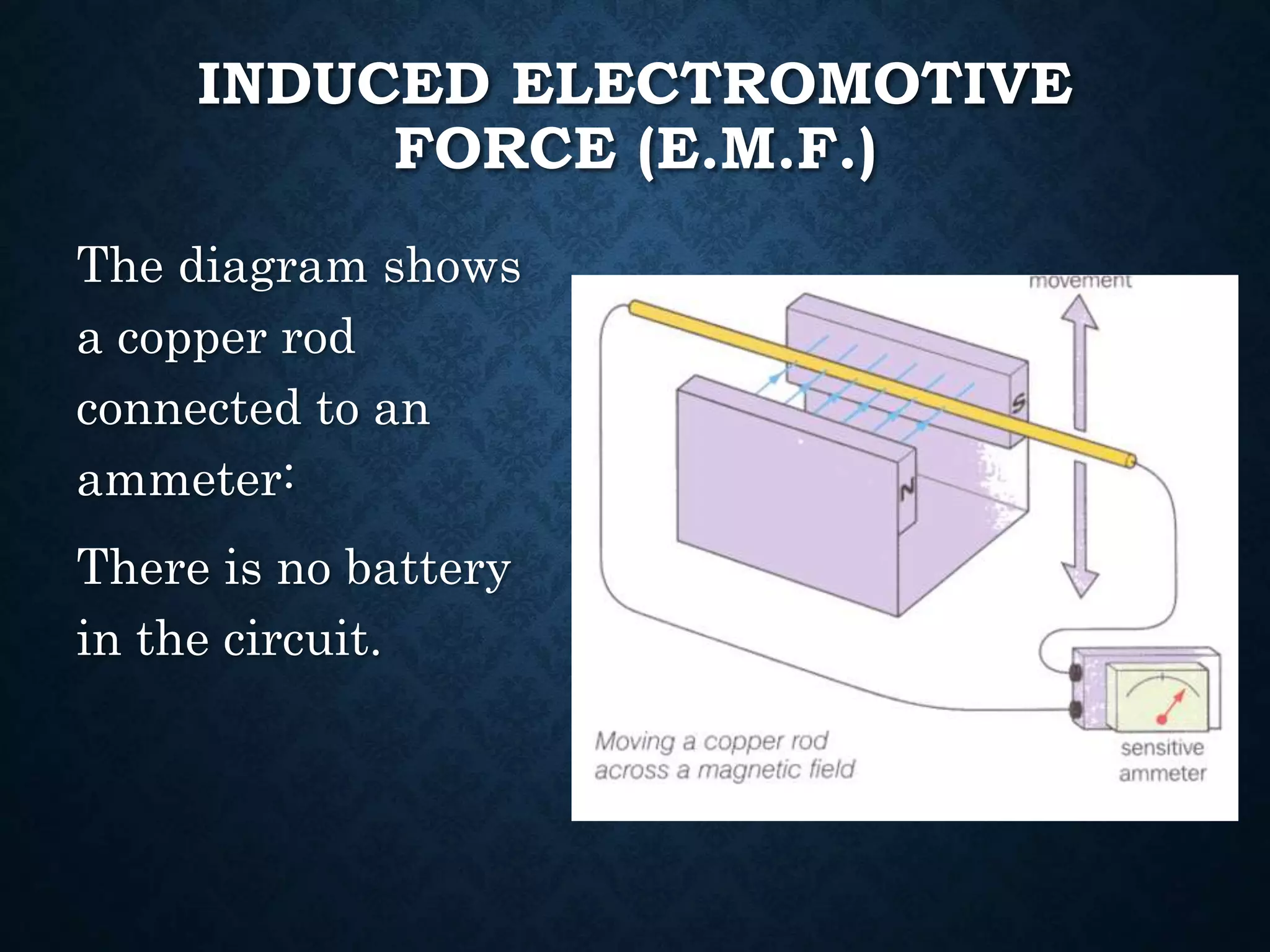
The diagram shows
a copper rod
connected to an
ammeter:
There is no battery
in the circuit.
What happens when you move the
copper rod downwards, to cut across the
horizontal magnetic field?
The pointer on the meter makes a brief
`flick' to the right, showing that an
electric current has been induced.
What happens when you move the rod
upwards?
The meter again gives a `flick', but this
time to the left.
You have now induced a current in the
opposite direction.
If you hold the rod stationary, or if you
move the rod along the field lines, there
is no induced current.
WHY DOES ELECTROMAGNETIC
INDUCTION OCCUR?
When you move the copper rod, its free electrons
move with it.
But when a charge moves in a magnetic field it
experiences a force on it
(the B Q v force).
You can use Flemings Left hand Rule to show
that the force on each electron is to the left as
shown in the diagram
(Remember that an electron moving down has to
be treated like a positive charge moving up.
So electrons accumulate at one end of
the rod, making it negative.
This leaves the other end short of
electrons and therefore positive.
There is now a voltage (potential
difference) across the ends of the
moving rod.
If the ends of the moving rod are joined
to form a complete circuit, the induced
voltage causes a current to flow round
the circuit as shown by the flick of the
ammeter.
The induced voltage is a source of electrical
energy - an e.m.f
When a conductor is moving in a magnetic
field like this, an e.m.f is induced, even if
there isn't a complete circuit for a current to
flow.
FORMULA FOR A STRAIGHT
CONDUCTOR
Consider a conductor
of length l that moves
with velocity v
perpendicular to a
magnetic flux density
or induction B as
shown in the figure.
When the wire conductor moves in the
magnetic field, the free electrons
experience a force because they are
caused to move with velocity v as the
conductor moves in the field.
F = e v B
This force causes the electrons to drift from
one end of the conductor to the other, and one
end builds-up an excess of electrons and the
other a deficiency of electrons.
This means that there is a potential
difference or emf between the ends.
Eventually, the emf becomes large enough to
balance the magnetic force and thus stop
electrons from moving.
evB = eE ( from F = evB and F = eE)
Therefore E = Bv
If the potential difference (emf) between the
ends of the conductor is ε then
ε = E L (from E = V/d)
By substitution we have
ε = B v L
MAGNETIC FLUX
The magnetic flux (Φ) through a region is a
measure of the number of lines of magnetic
force passing through that region.
Φ = AB cos θ
where A is the area of the region and θ is the
angle of movement between the magnetic
field and a line drawn perpendicular to the
area swept out.
The unit of magnetic flux is the weber Wb.
For a single conductor in the magnetic flux
density, it can be seen that
ε = - ΔΦ/ Δt (the rate of change of flux density)
For N number of conductors as in the case for a
solenoid, the term flux-linkage is used.
Then
ε = - N Δ (Φ/ Δt)
This is Faraday’s Law
The minus sign shows us that the emf is always
produced so as to oppose the change in flux.
TIME-CHANGING MAGNETIC
FLUX
Therefore the production of an emf is
produced by a time changing magnetic flux.
This could be due to the wire or coil moving
through a magnetic field
Or by an increasing or decreasing magnetic
field of an electromagnet next to a wire or
coil.
FARADAY’S LAW
We know that an e.m.f. is induced when there
is a change in the flux linking a conductor.
Faraday's law makes the connection between
the size of the induced e.m.f. and the rate at
which the flux is changing.
It states that:
the magnitude of the induced e.m.f is directly
proportinonal to the rate of change of
magnetic flux or flux linkage.
LINKING
For a single conductor in the magnetic flux
density, it can be seen that
ε = - ΔΦ/ Δt (the rate of change of flux
density)
And ε = B v l
Therefore - ΔΦ/ Δt = B v l
LENZ’S LAW
Faraday's law tells us the size of the induced
e.m.f., but we can find its direction using
Lenz's law
The direction of the induced e.m.f is such that
it will try to oppose the change in flux that is
producing it.
Lenz's law is illustrated in the diagrams: As
you move the N-pole into the coil, an e.m.f. is
induced which drives a current round the
circuit as shown.
Now use the right-hand grip rule
Can you see that the current produces a
magnetic field with a N-pole at the end of the
coil nearest to the magnet?
So the coil repels the incoming magnet, and
in this way the induced current opposes the
change in flux.
Why is the current reversed as you move the
N-pole out?
By Lenz's law, the coil needs to attract the
receding N-pole
Lenz's law is a result of the conservation of
energy. If you move the magnet into the coil,
you feel the repulsive force.
You have to do work to move the magnet
against this force.
And so energy is transferred from you (or the
system that is moving the magnet) to the
electrical energy of the current.
Interactive Faraday
Emf
Faraday

11.1

  • 1.
  • 2.
    INDUCED ELECTROMOTIVE FORCE (E.M.F.) Thediagram shows a copper rod connected to an ammeter: There is no battery in the circuit.
  • 3.
    What happens whenyou move the copper rod downwards, to cut across the horizontal magnetic field? The pointer on the meter makes a brief `flick' to the right, showing that an electric current has been induced.
  • 4.
    What happens whenyou move the rod upwards? The meter again gives a `flick', but this time to the left. You have now induced a current in the opposite direction.
  • 5.
    If you holdthe rod stationary, or if you move the rod along the field lines, there is no induced current.
  • 6.
    WHY DOES ELECTROMAGNETIC INDUCTIONOCCUR? When you move the copper rod, its free electrons move with it. But when a charge moves in a magnetic field it experiences a force on it (the B Q v force). You can use Flemings Left hand Rule to show that the force on each electron is to the left as shown in the diagram (Remember that an electron moving down has to be treated like a positive charge moving up.
  • 8.
    So electrons accumulateat one end of the rod, making it negative. This leaves the other end short of electrons and therefore positive. There is now a voltage (potential difference) across the ends of the moving rod. If the ends of the moving rod are joined to form a complete circuit, the induced voltage causes a current to flow round the circuit as shown by the flick of the ammeter.
  • 9.
    The induced voltageis a source of electrical energy - an e.m.f When a conductor is moving in a magnetic field like this, an e.m.f is induced, even if there isn't a complete circuit for a current to flow.
  • 10.
    FORMULA FOR ASTRAIGHT CONDUCTOR Consider a conductor of length l that moves with velocity v perpendicular to a magnetic flux density or induction B as shown in the figure.
  • 11.
    When the wireconductor moves in the magnetic field, the free electrons experience a force because they are caused to move with velocity v as the conductor moves in the field. F = e v B
  • 12.
    This force causesthe electrons to drift from one end of the conductor to the other, and one end builds-up an excess of electrons and the other a deficiency of electrons. This means that there is a potential difference or emf between the ends. Eventually, the emf becomes large enough to balance the magnetic force and thus stop electrons from moving.
  • 13.
    evB = eE( from F = evB and F = eE) Therefore E = Bv If the potential difference (emf) between the ends of the conductor is ε then ε = E L (from E = V/d) By substitution we have ε = B v L
  • 14.
    MAGNETIC FLUX The magneticflux (Φ) through a region is a measure of the number of lines of magnetic force passing through that region. Φ = AB cos θ where A is the area of the region and θ is the angle of movement between the magnetic field and a line drawn perpendicular to the area swept out. The unit of magnetic flux is the weber Wb.
  • 15.
    For a singleconductor in the magnetic flux density, it can be seen that ε = - ΔΦ/ Δt (the rate of change of flux density) For N number of conductors as in the case for a solenoid, the term flux-linkage is used. Then ε = - N Δ (Φ/ Δt) This is Faraday’s Law The minus sign shows us that the emf is always produced so as to oppose the change in flux.
  • 16.
    TIME-CHANGING MAGNETIC FLUX Therefore theproduction of an emf is produced by a time changing magnetic flux. This could be due to the wire or coil moving through a magnetic field Or by an increasing or decreasing magnetic field of an electromagnet next to a wire or coil.
  • 17.
    FARADAY’S LAW We knowthat an e.m.f. is induced when there is a change in the flux linking a conductor. Faraday's law makes the connection between the size of the induced e.m.f. and the rate at which the flux is changing. It states that: the magnitude of the induced e.m.f is directly proportinonal to the rate of change of magnetic flux or flux linkage.
  • 18.
    LINKING For a singleconductor in the magnetic flux density, it can be seen that ε = - ΔΦ/ Δt (the rate of change of flux density) And ε = B v l Therefore - ΔΦ/ Δt = B v l
  • 19.
    LENZ’S LAW Faraday's lawtells us the size of the induced e.m.f., but we can find its direction using Lenz's law The direction of the induced e.m.f is such that it will try to oppose the change in flux that is producing it.
  • 21.
    Lenz's law isillustrated in the diagrams: As you move the N-pole into the coil, an e.m.f. is induced which drives a current round the circuit as shown. Now use the right-hand grip rule Can you see that the current produces a magnetic field with a N-pole at the end of the coil nearest to the magnet? So the coil repels the incoming magnet, and in this way the induced current opposes the change in flux.
  • 22.
    Why is thecurrent reversed as you move the N-pole out? By Lenz's law, the coil needs to attract the receding N-pole
  • 23.
    Lenz's law isa result of the conservation of energy. If you move the magnet into the coil, you feel the repulsive force. You have to do work to move the magnet against this force. And so energy is transferred from you (or the system that is moving the magnet) to the electrical energy of the current.
  • 27.