6.2 – Electric Force and Field
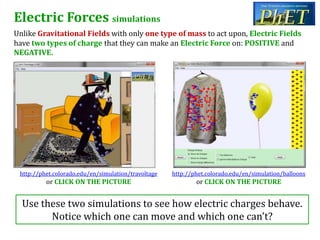
Electric Forces simulations
Unlike Gravitational Fields with only one type of mass to act upon, Electric Fields
have two types of charge that they can make an Electric Force on: POSITIVE and
NEGATIVE.


 http://phet.colorado.edu/en/simulation/travoltage   http://phet.colorado.edu/en/simulation/balloons
          or CLICK ON THE PICTURE                            or CLICK ON THE PICTURE


  Use these two simulations to see how electric charges behave.
        Notice which one can move and which one can’t?
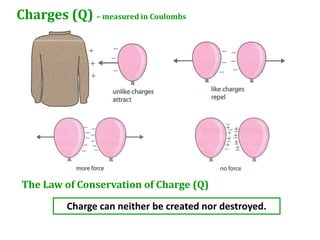
Charges (Q) – measured in Coulombs


 The Law of Conservation of Charge (Q)

          Charge can neither be created nor destroyed.
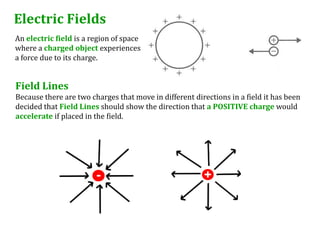
Electric Fields
An electric field is a region of space
where a charged object experiences
a force due to its charge.


Field Lines
Because there are two charges that move in different directions in a field it has been
decided that Field Lines should show the direction that a POSITIVE charge would
accelerate if placed in the field.
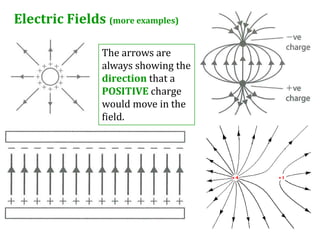
Electric Fields (more examples)

                The arrows are
                always showing the
                direction that a
                POSITIVE charge
                would move in the
                field.
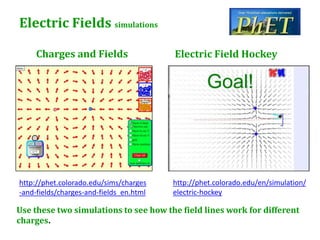
Electric Fields simulations

     Charges and Fields                  Electric Field Hockey


http://phet.colorado.edu/sims/charges    http://phet.colorado.edu/en/simulation/
-and-fields/charges-and-fields_en.html   electric-hockey

Use these two simulations to see how the field lines work for different
charges.
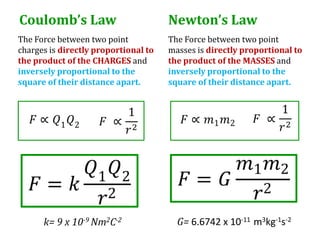
Coulomb’s Law                         Newton’s Law
The Force between two point           The Force between two point
charges is directly proportional to   masses is directly proportional to
the product of the CHARGES and        the product of the MASSES and
inversely proportional to the         inversely proportional to the
square of their distance apart.       square of their distance apart.


      k= 9 x 10⁻⁹ Nm2C-2                G= 6.6742 x 10⁻¹¹ m3kg-1s-2
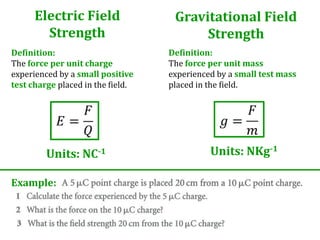
Electric Field                Gravitational Field
        Strength                         Strength
Definition:                        Definition:
The force per unit charge          The force per unit mass
experienced by a small positive    experienced by a small test mass
test charge placed in the field.   placed in the field.


         Units: NC-1                         Units: NKg-1

Example:
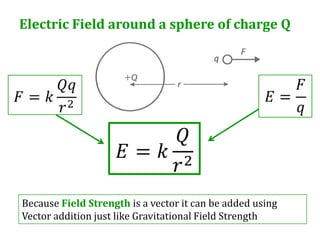
Electric Field around a sphere of charge Q


Because Field Strength is a vector it can be added using
Vector addition just like Gravitational Field Strength

6.2 - Electric Force and field

  • 1.
    6.2 – ElectricForce and Field
  • 2.
    Electric Forces simulations UnlikeGravitational Fields with only one type of mass to act upon, Electric Fields have two types of charge that they can make an Electric Force on: POSITIVE and NEGATIVE. http://phet.colorado.edu/en/simulation/travoltage http://phet.colorado.edu/en/simulation/balloons or CLICK ON THE PICTURE or CLICK ON THE PICTURE Use these two simulations to see how electric charges behave. Notice which one can move and which one can’t?
  • 3.
    Charges (Q) –measured in Coulombs The Law of Conservation of Charge (Q) Charge can neither be created nor destroyed.
  • 4.
    Electric Fields An electricfield is a region of space where a charged object experiences a force due to its charge. Field Lines Because there are two charges that move in different directions in a field it has been decided that Field Lines should show the direction that a POSITIVE charge would accelerate if placed in the field.
  • 5.
    Electric Fields (moreexamples) The arrows are always showing the direction that a POSITIVE charge would move in the field.
  • 6.
    Electric Fields simulations Charges and Fields Electric Field Hockey http://phet.colorado.edu/sims/charges http://phet.colorado.edu/en/simulation/ -and-fields/charges-and-fields_en.html electric-hockey Use these two simulations to see how the field lines work for different charges.
  • 7.
    Coulomb’s Law Newton’s Law The Force between two point The Force between two point charges is directly proportional to masses is directly proportional to the product of the CHARGES and the product of the MASSES and inversely proportional to the inversely proportional to the square of their distance apart. square of their distance apart. k= 9 x 10⁻⁹ Nm2C-2 G= 6.6742 x 10⁻¹¹ m3kg-1s-2
  • 8.
    Electric Field Gravitational Field Strength Strength Definition: Definition: The force per unit charge The force per unit mass experienced by a small positive experienced by a small test mass test charge placed in the field. placed in the field. Units: NC-1 Units: NKg-1 Example:
  • 9.
    Electric Field arounda sphere of charge Q Because Field Strength is a vector it can be added using Vector addition just like Gravitational Field Strength