





ENGG2013 Unit 17
Diagonalization
Eigenvector and eigenvalue
Mar, 2011.
EXAMPLE 1
kshum ENGG2013 2
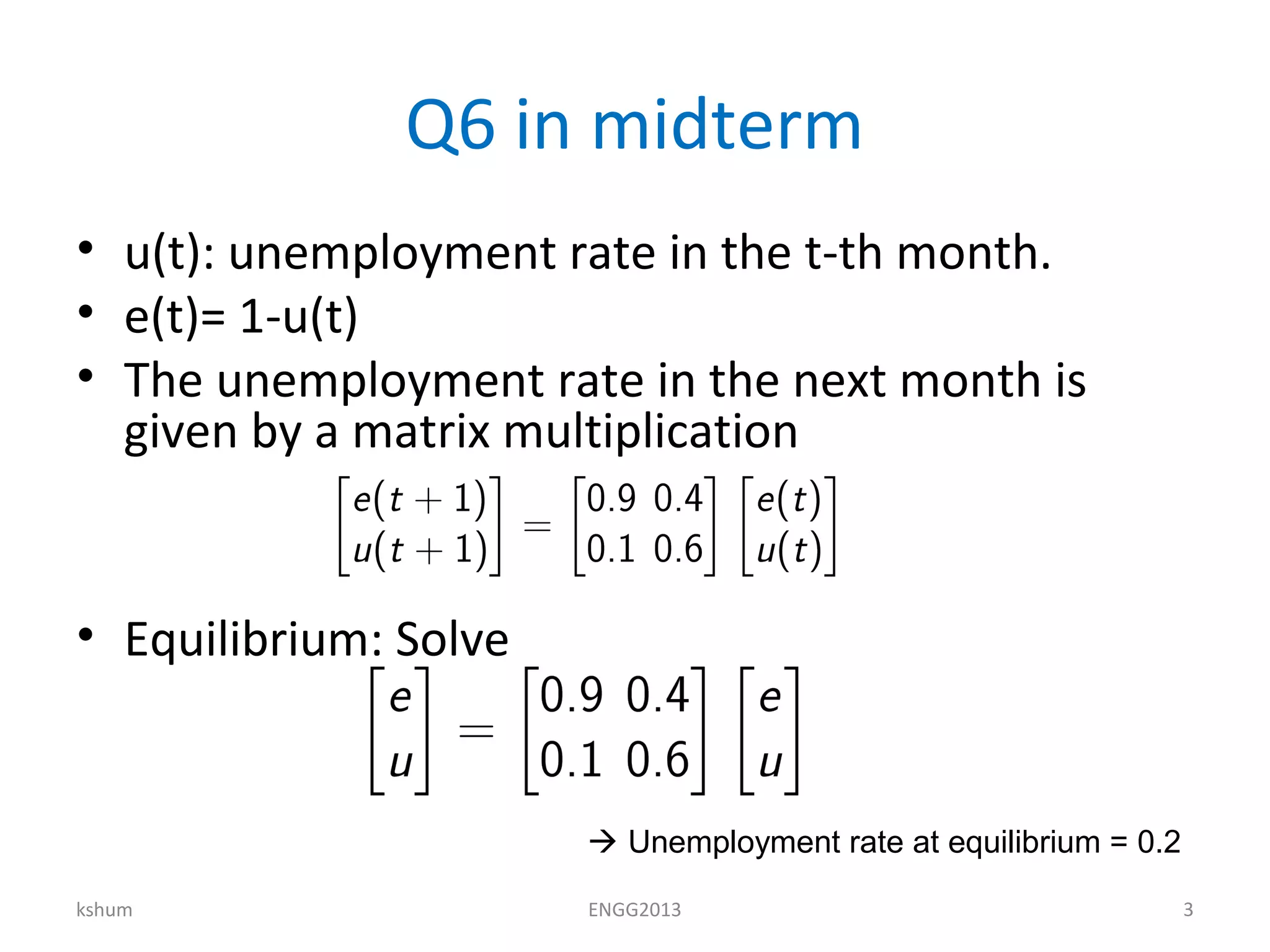
Q6 in midterm
• u(t): unemployment rate in the t-th month.
• e(t)= 1-u(t)
• The unemployment rate in the next month is
given by a matrix multiplication
• Equilibrium: Solve
kshum ENGG2013 3
 Unemployment rate at equilibrium = 0.2
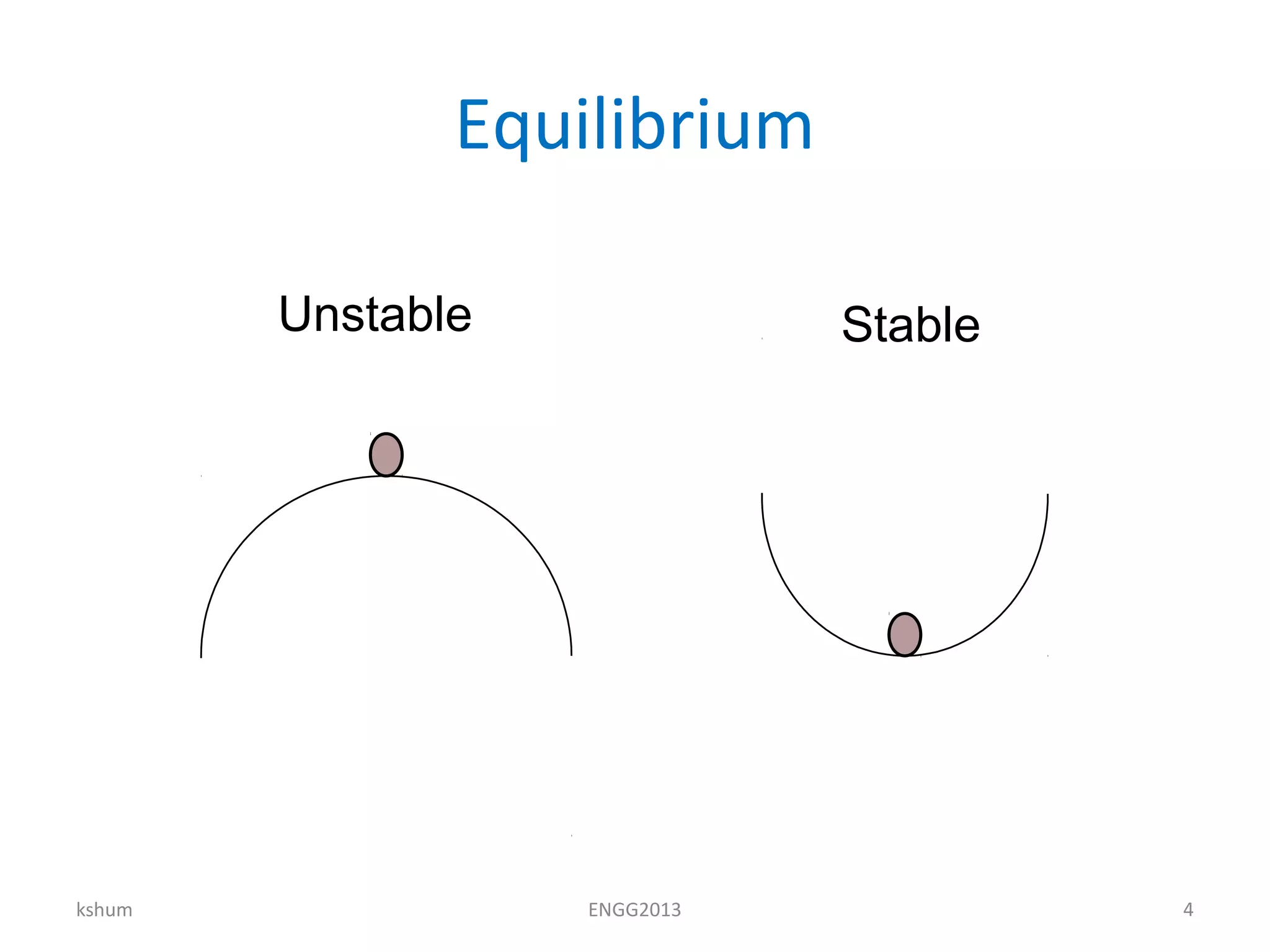
Equilibrium
kshum ENGG2013 4
Unstable Stable
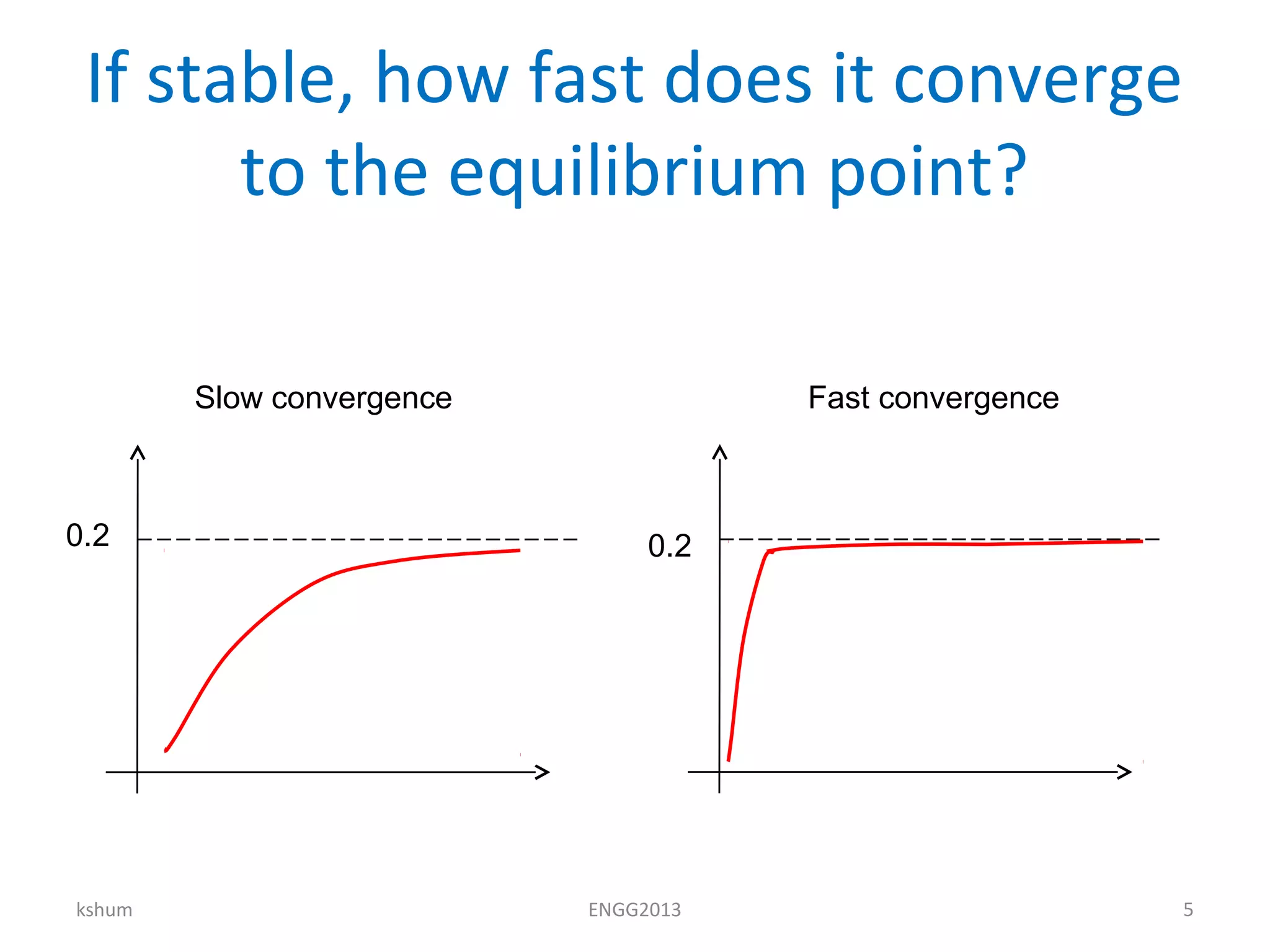
If stable, how fast does it converge
to the equilibrium point?
kshum ENGG2013 5
0.2 0.2
Fast convergenceSlow convergence
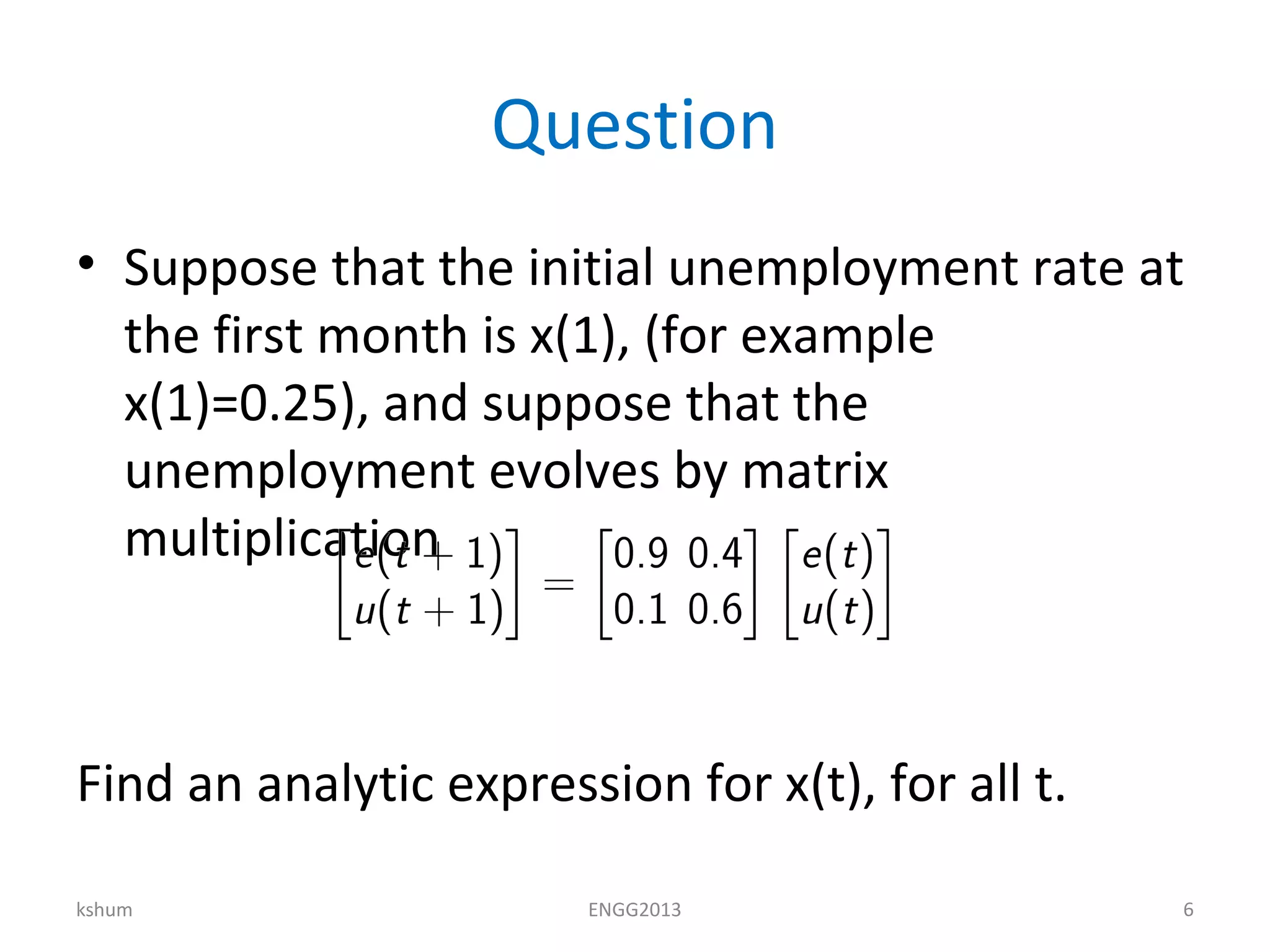
Question
• Suppose that the initial unemployment rate at
the first month is x(1), (for example
x(1)=0.25), and suppose that the
unemployment evolves by matrix
multiplication
Find an analytic expression for x(t), for all t.
kshum ENGG2013 6
EXAMPLE 2
kshum ENGG2013 7
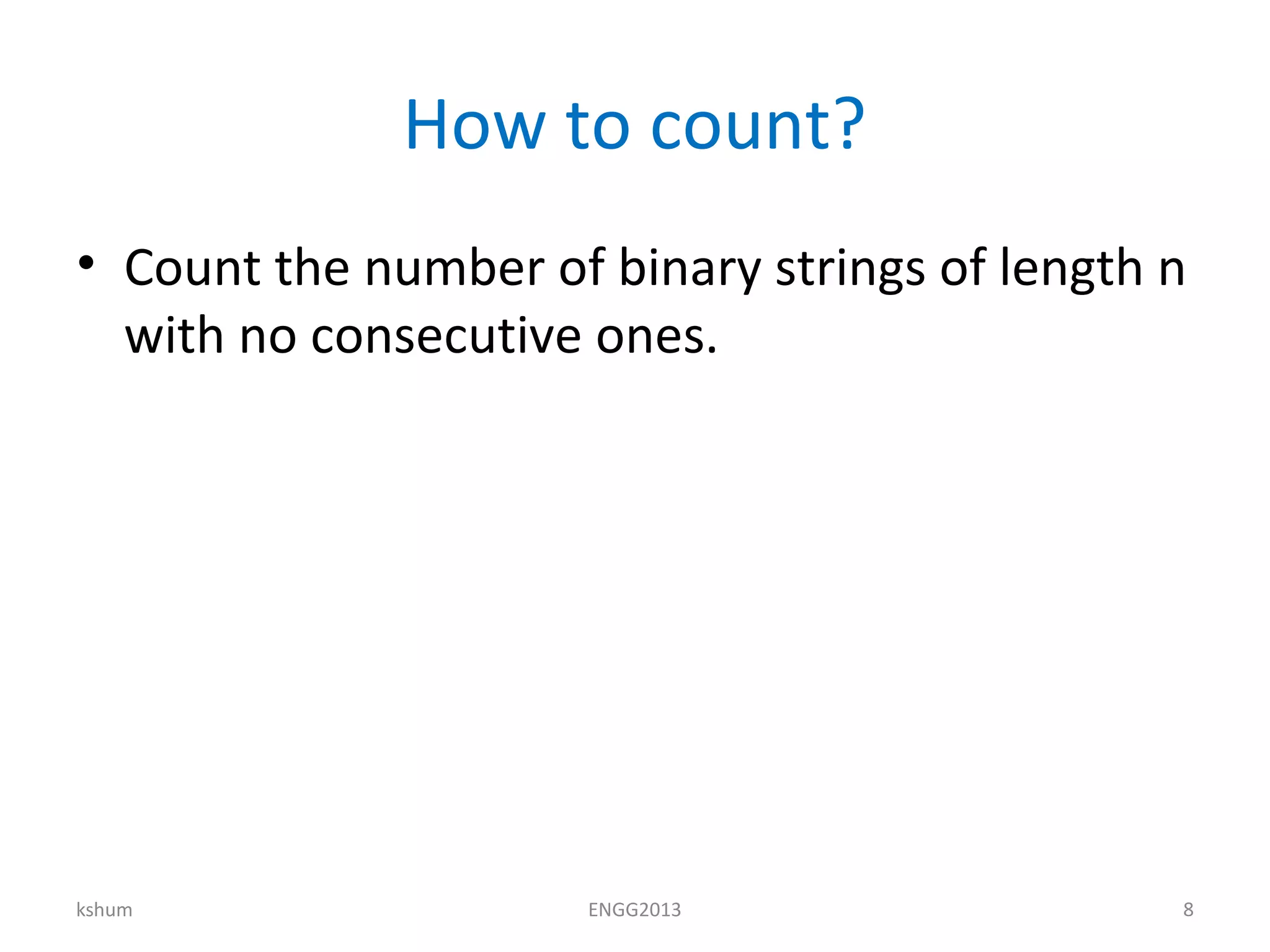
How to count?
• Count the number of binary strings of length n
with no consecutive ones.
kshum ENGG2013 8
SOLVING RECURRENCE RELATION
kshum ENGG2013 9
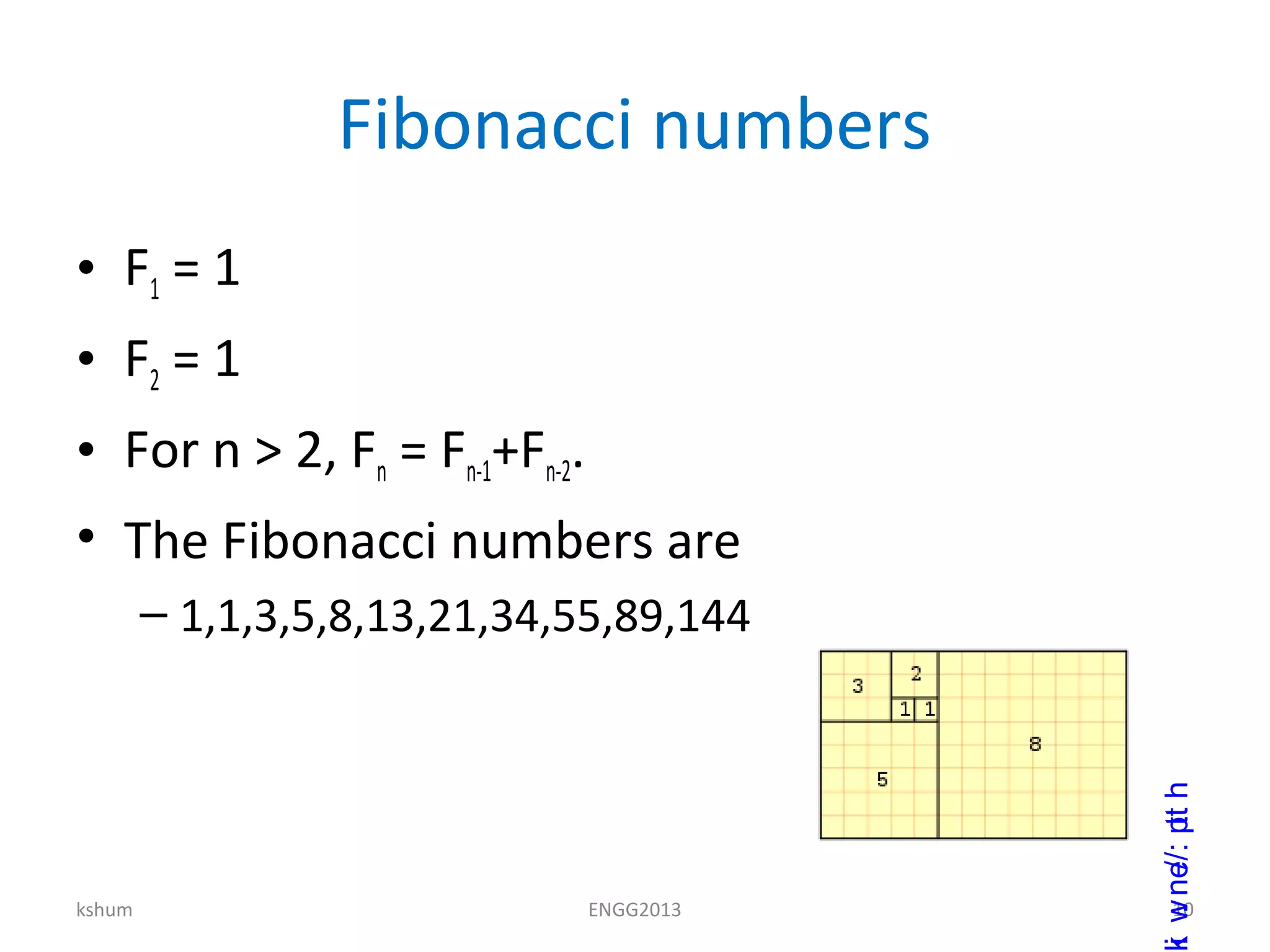
Fibonacci numbers
• F1 = 1
• F2 = 1
• For n > 2, Fn = Fn-1+Fn-2.
• The Fibonacci numbers are
– 1,1,3,5,8,13,21,34,55,89,144
kshum ENGG2013 10
http://en.wik
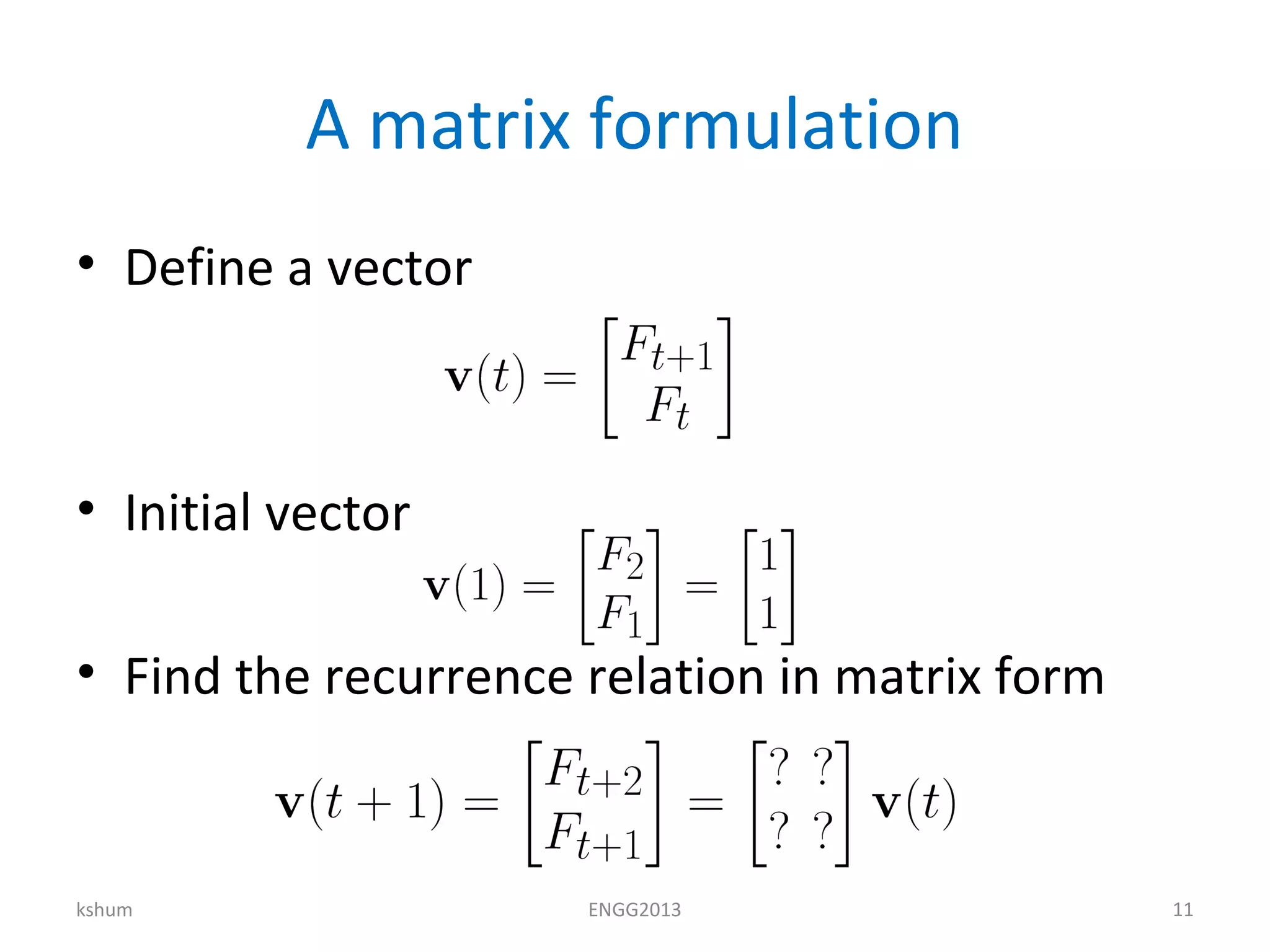
A matrix formulation
• Define a vector
• Initial vector
• Find the recurrence relation in matrix form
kshum ENGG2013 11
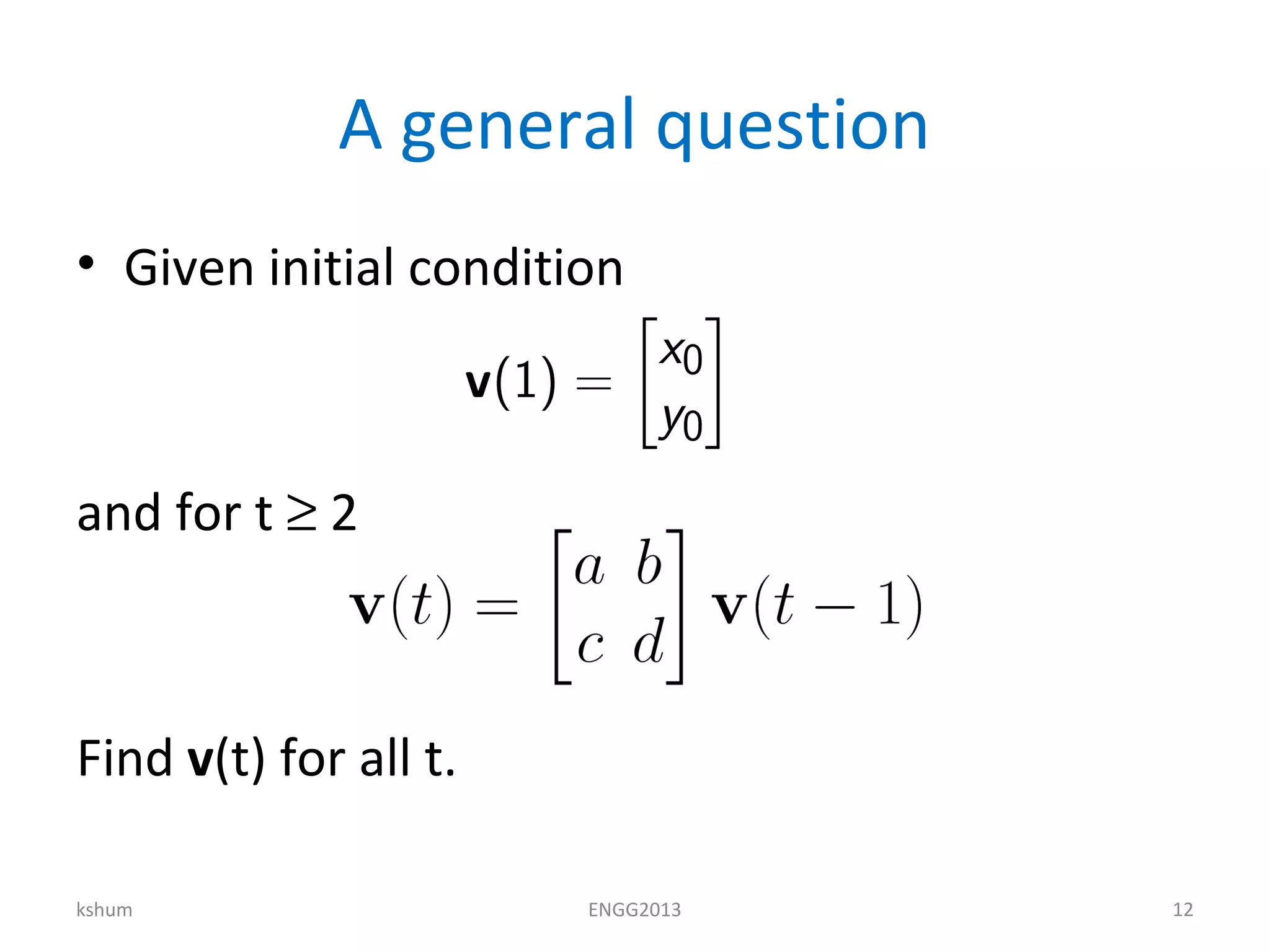
A general question
• Given initial condition
and for t ≥ 2
Find v(t) for all t.
kshum ENGG2013 12
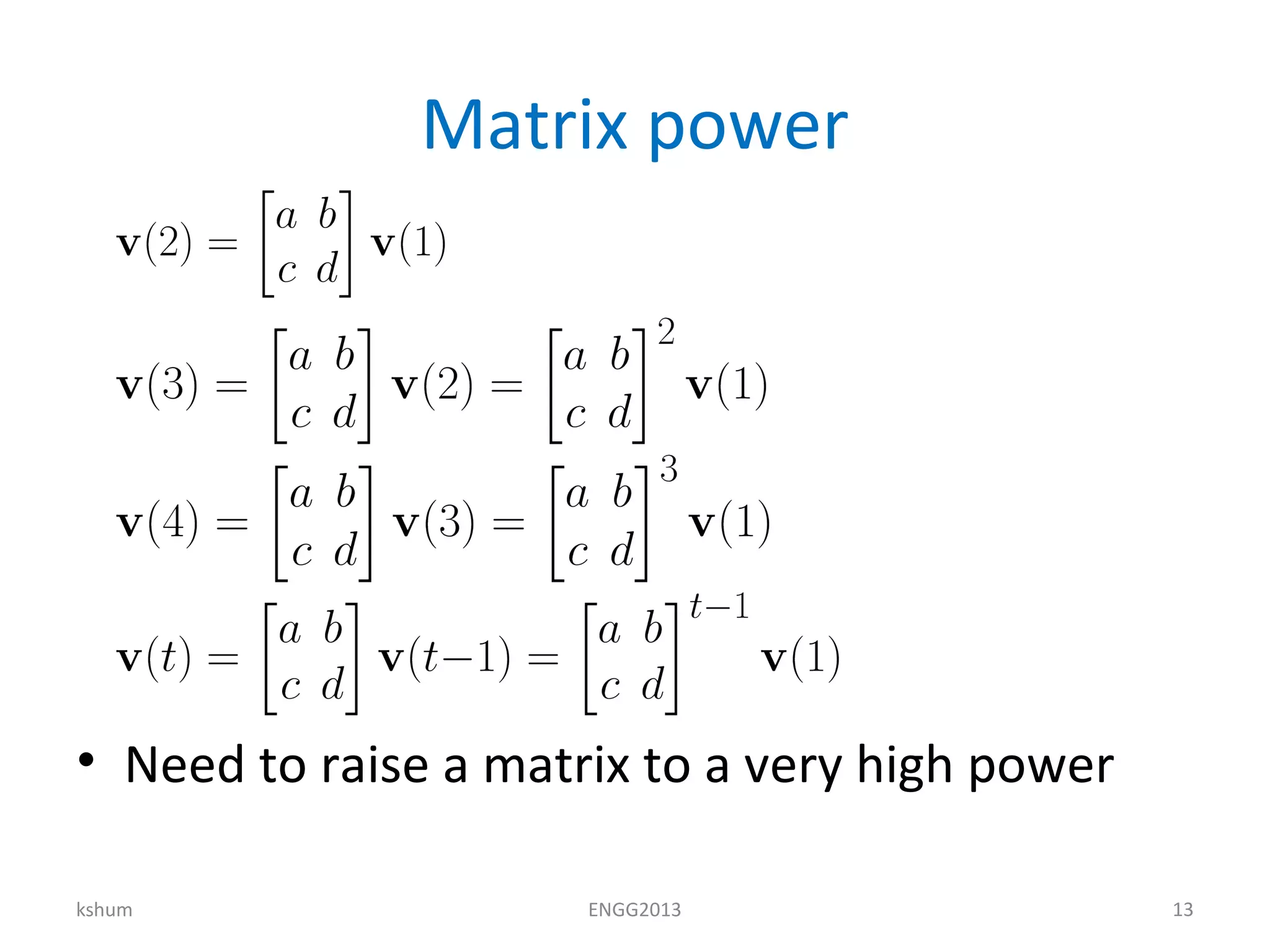
Matrix power
• Need to raise a matrix to a very high power
kshum ENGG2013 13
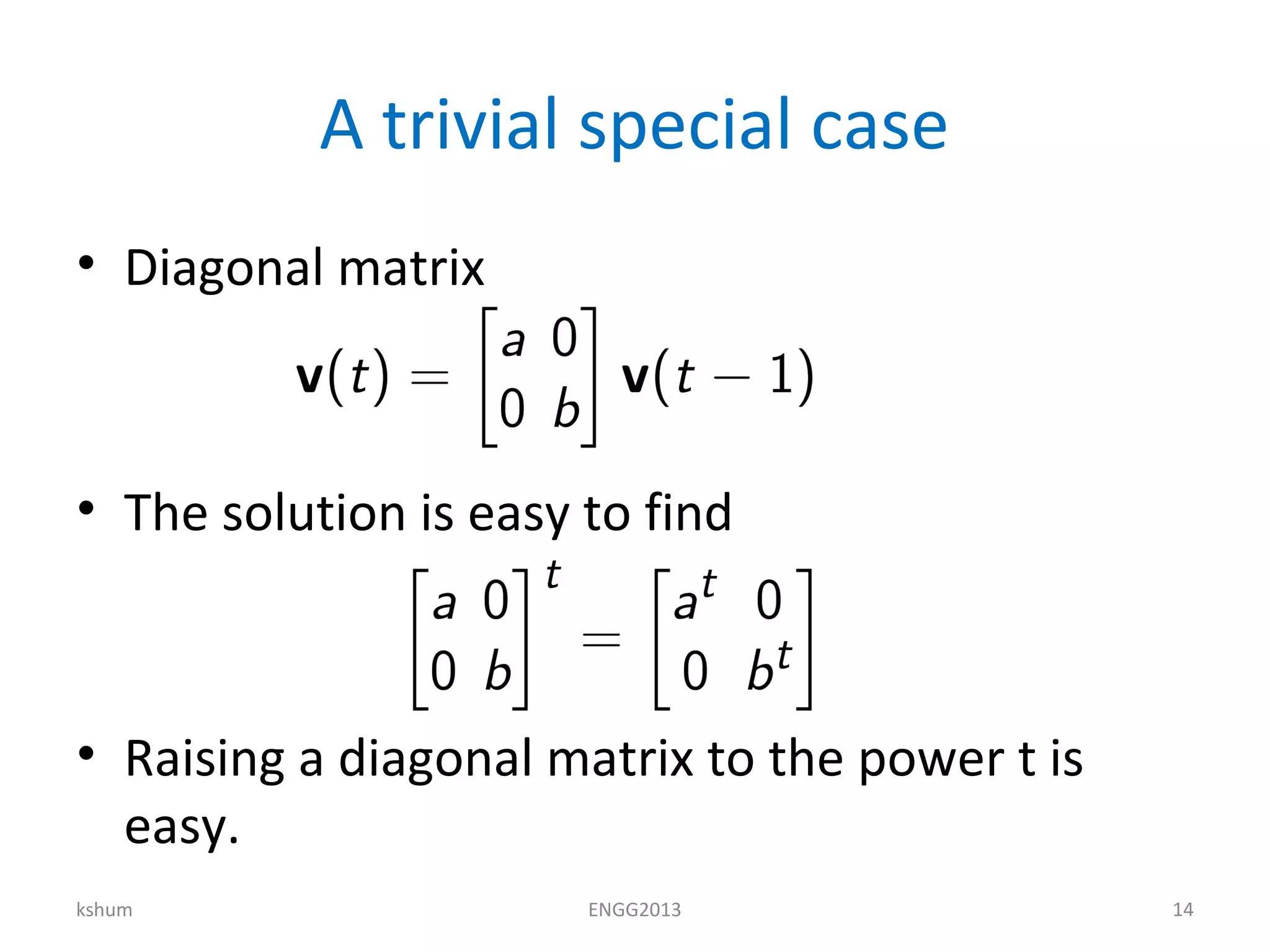
A trivial special case
• Diagonal matrix
• The solution is easy to find
• Raising a diagonal matrix to the power t is
easy.
kshum ENGG2013 14
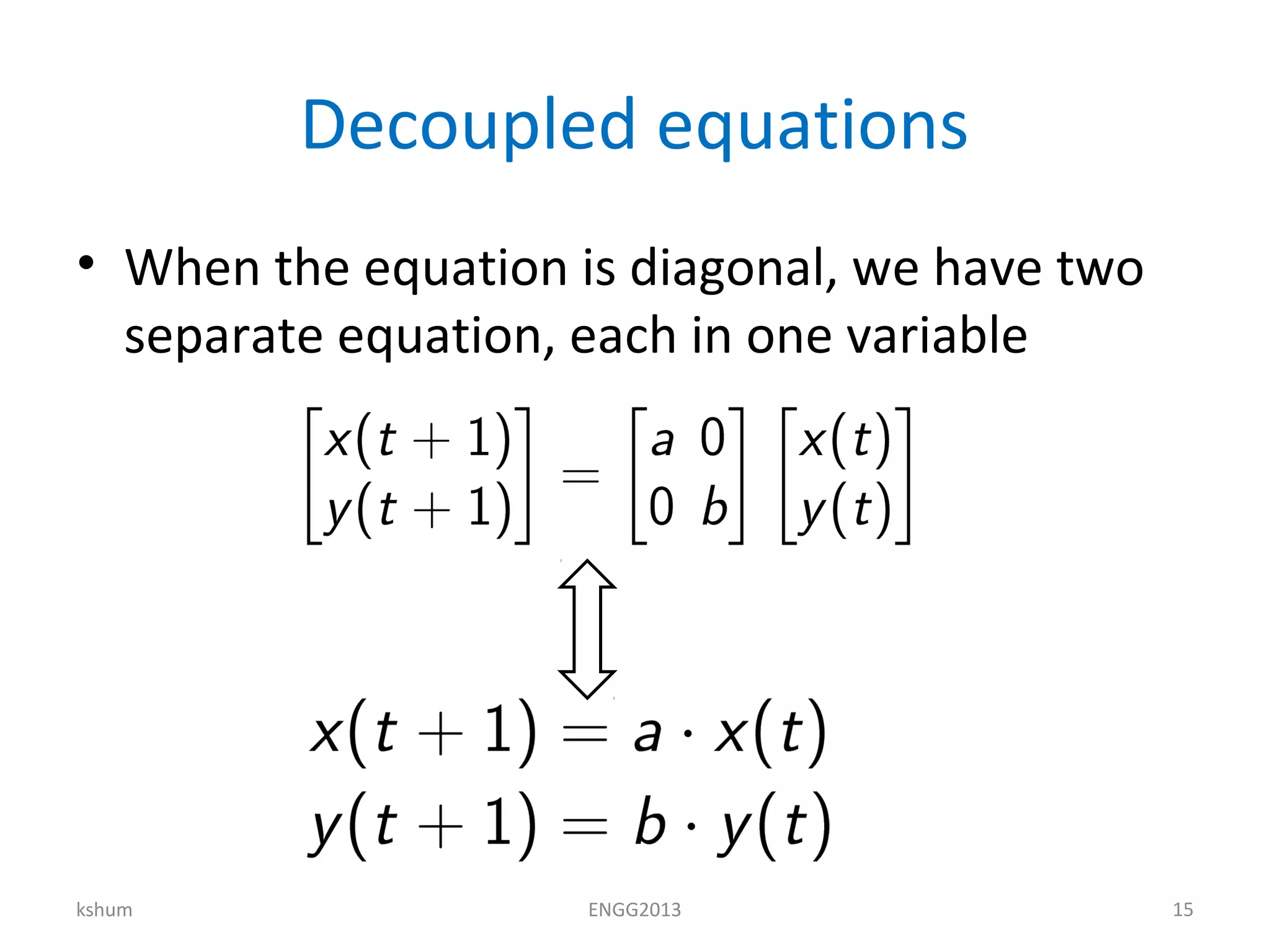
Decoupled equations
• When the equation is diagonal, we have two
separate equation, each in one variable
kshum ENGG2013 15
DIAGONALIZATION
kshum ENGG2013 16
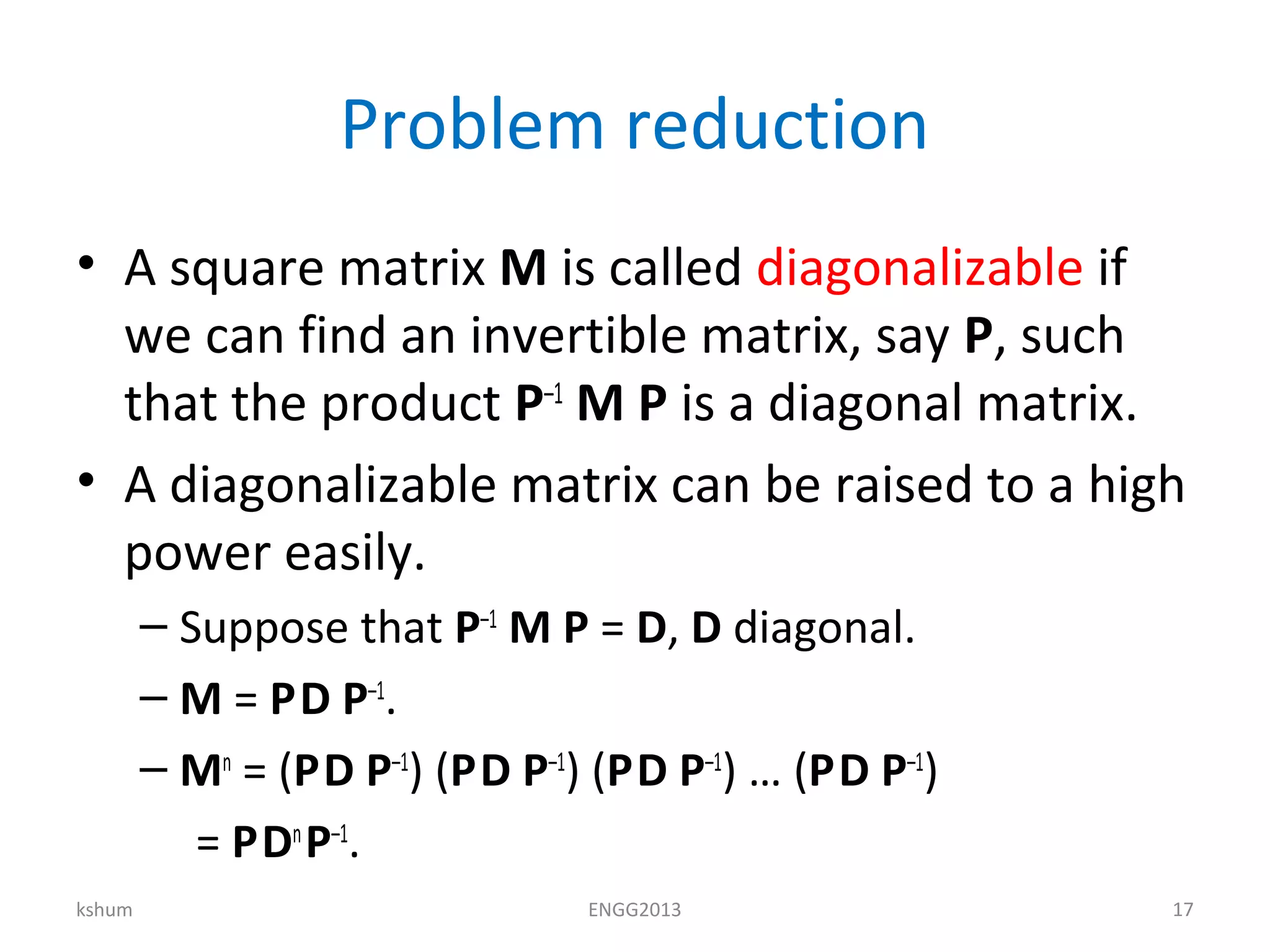
Problem reduction
• A square matrix M is called diagonalizable if
we can find an invertible matrix, say P, such
that the product P–1
M P is a diagonal matrix.
• A diagonalizable matrix can be raised to a high
power easily.
– Suppose that P–1
M P = D, D diagonal.
– M = PD P–1
.
– Mn
= (PD P–1
) (PD P–1
) (PD P–1
) … (PD P–1
)
= PDn
P–1
.
kshum ENGG2013 17
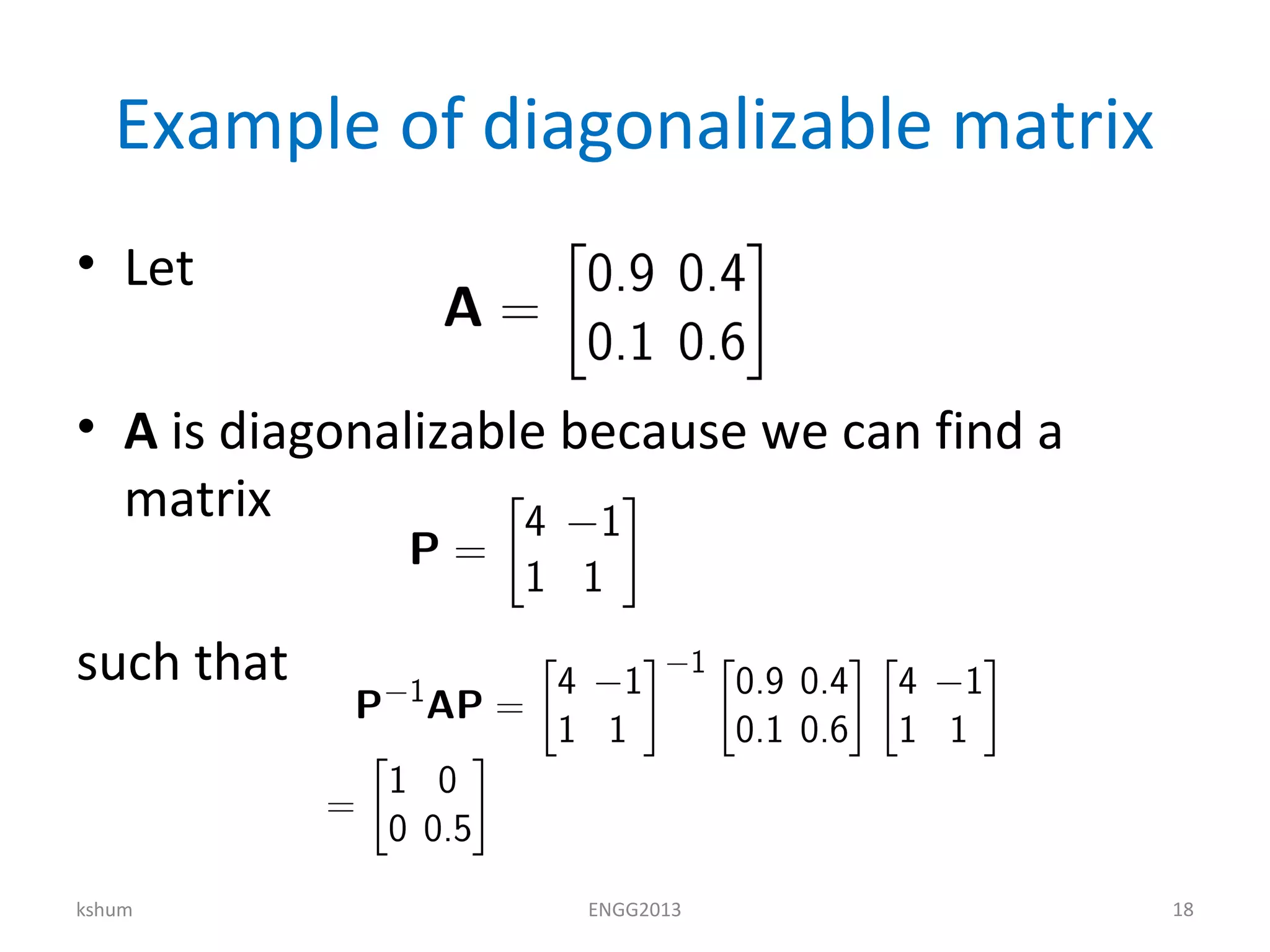
Example of diagonalizable matrix
• Let
• A is diagonalizable because we can find a
matrix
such that
kshum ENGG2013 18
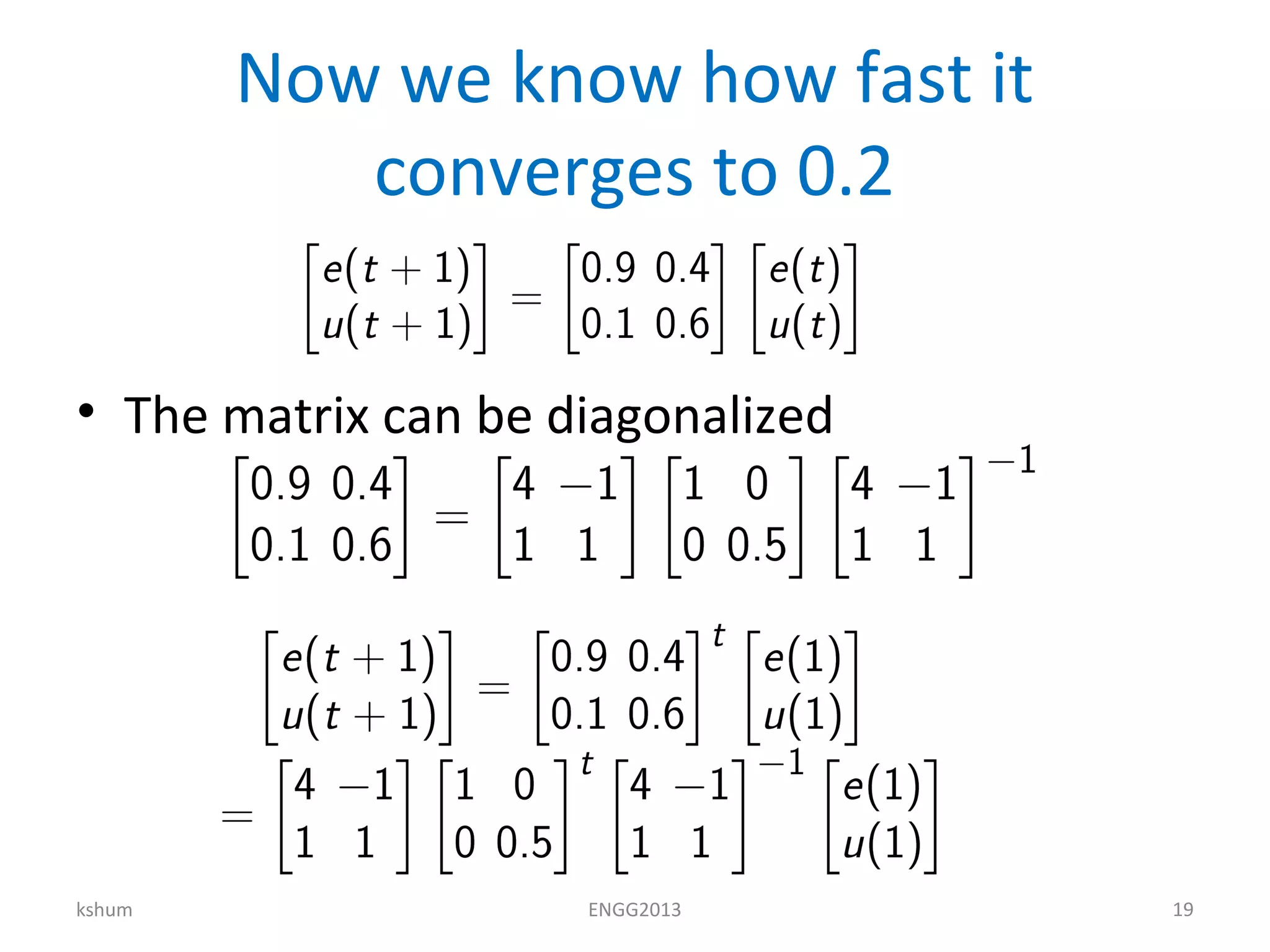
Now we know how fast it
converges to 0.2
• The matrix can be diagonalized
kshum ENGG2013 19
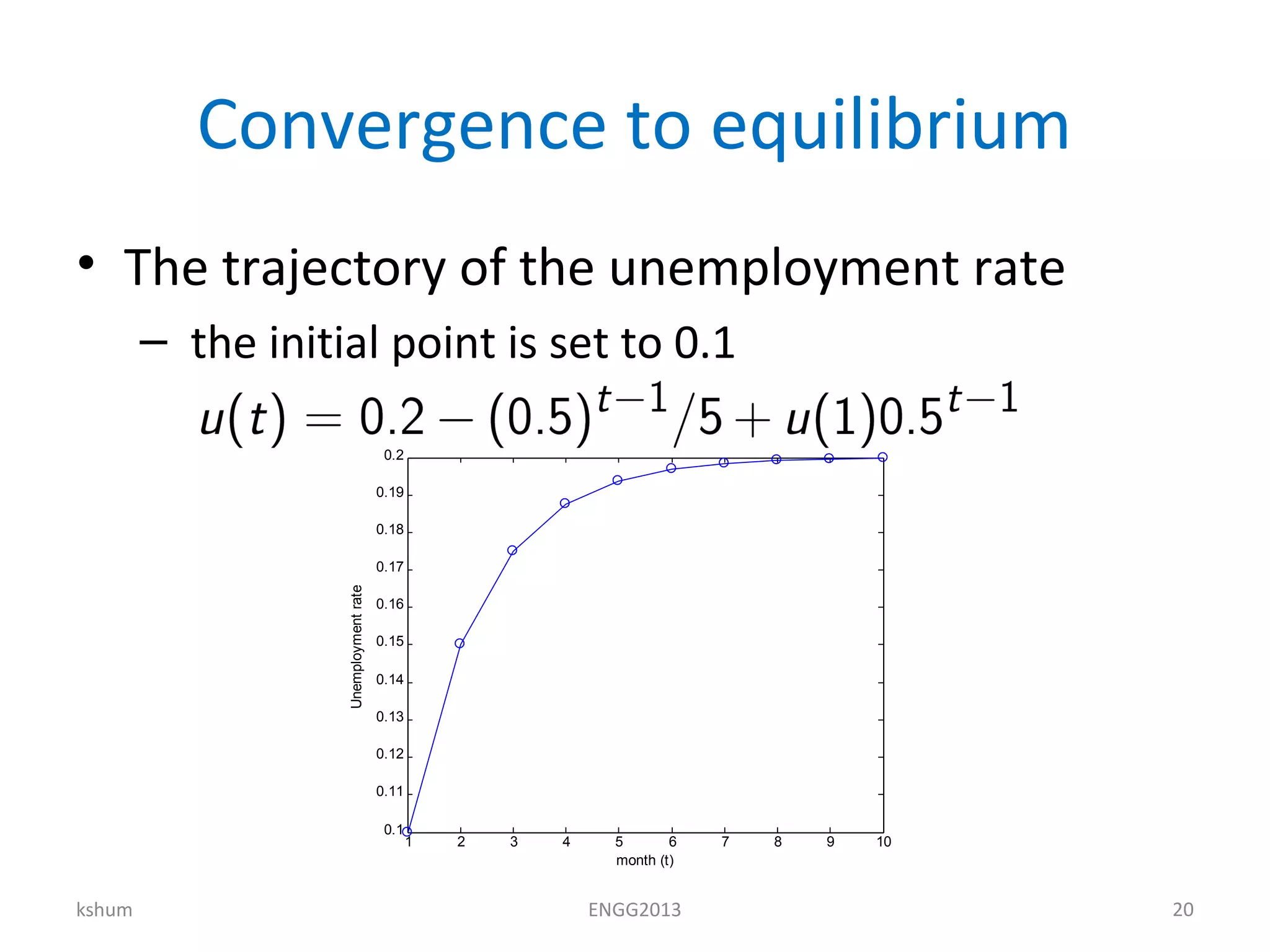
Convergence to equilibrium
• The trajectory of the unemployment rate
– the initial point is set to 0.1
kshum ENGG2013 20
1 2 3 4 5 6 7 8 9 10
0.1
0.11
0.12
0.13
0.14
0.15
0.16
0.17
0.18
0.19
0.2
month (t)
Unemploymentrate
EIGENVECTOR AND EIGENVALUE
kshum ENGG2013 21
How to diagonalize?
• How to determine whether a matrix M is
diagonalizable?
• How to find a matrix P which diagonalizes a
matrix M?
kshum ENGG2013 22
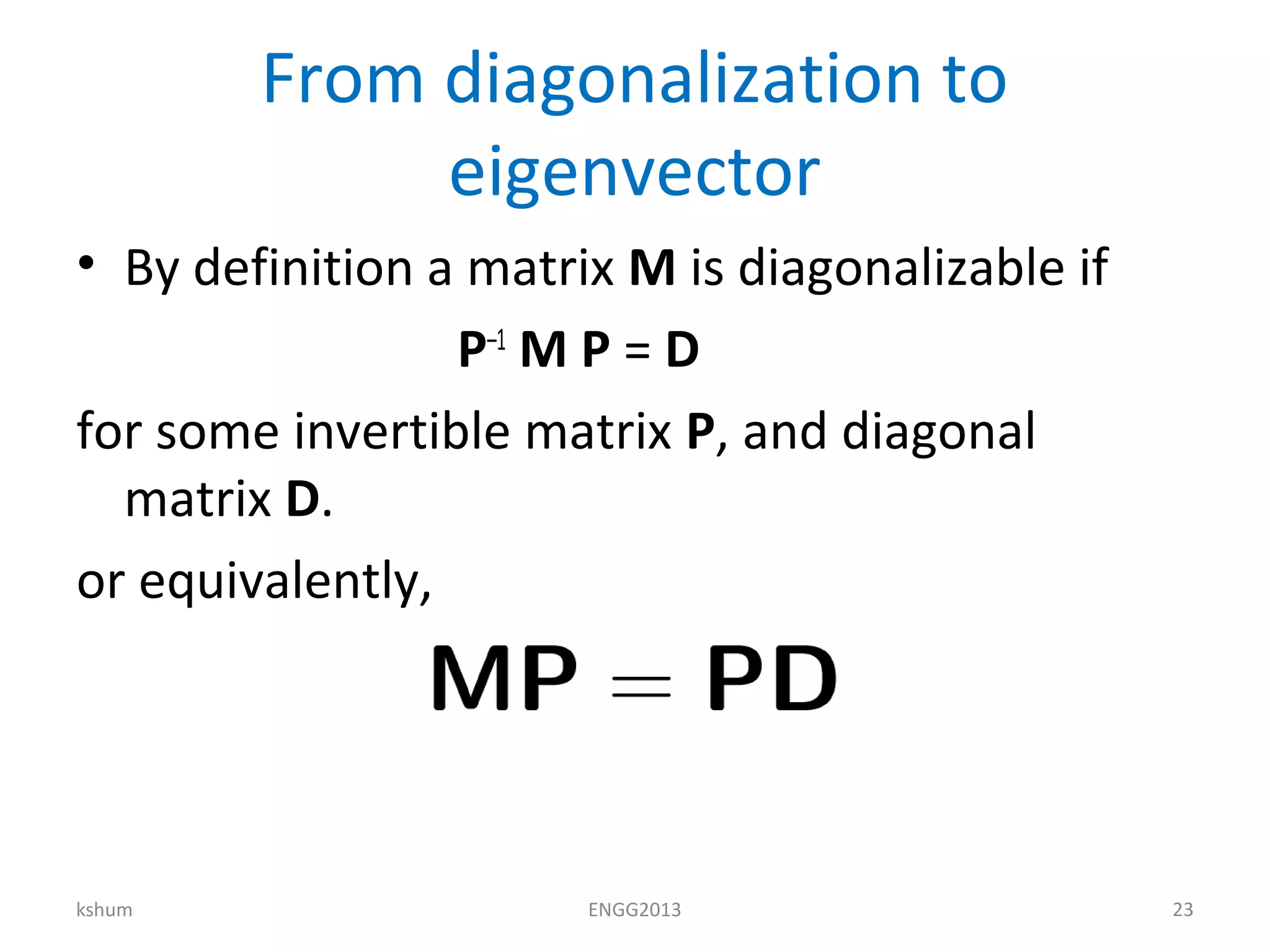
From diagonalization to
eigenvector
• By definition a matrix M is diagonalizable if
P–1
M P = D
for some invertible matrix P, and diagonal
matrix D.
or equivalently,
kshum ENGG2013 23
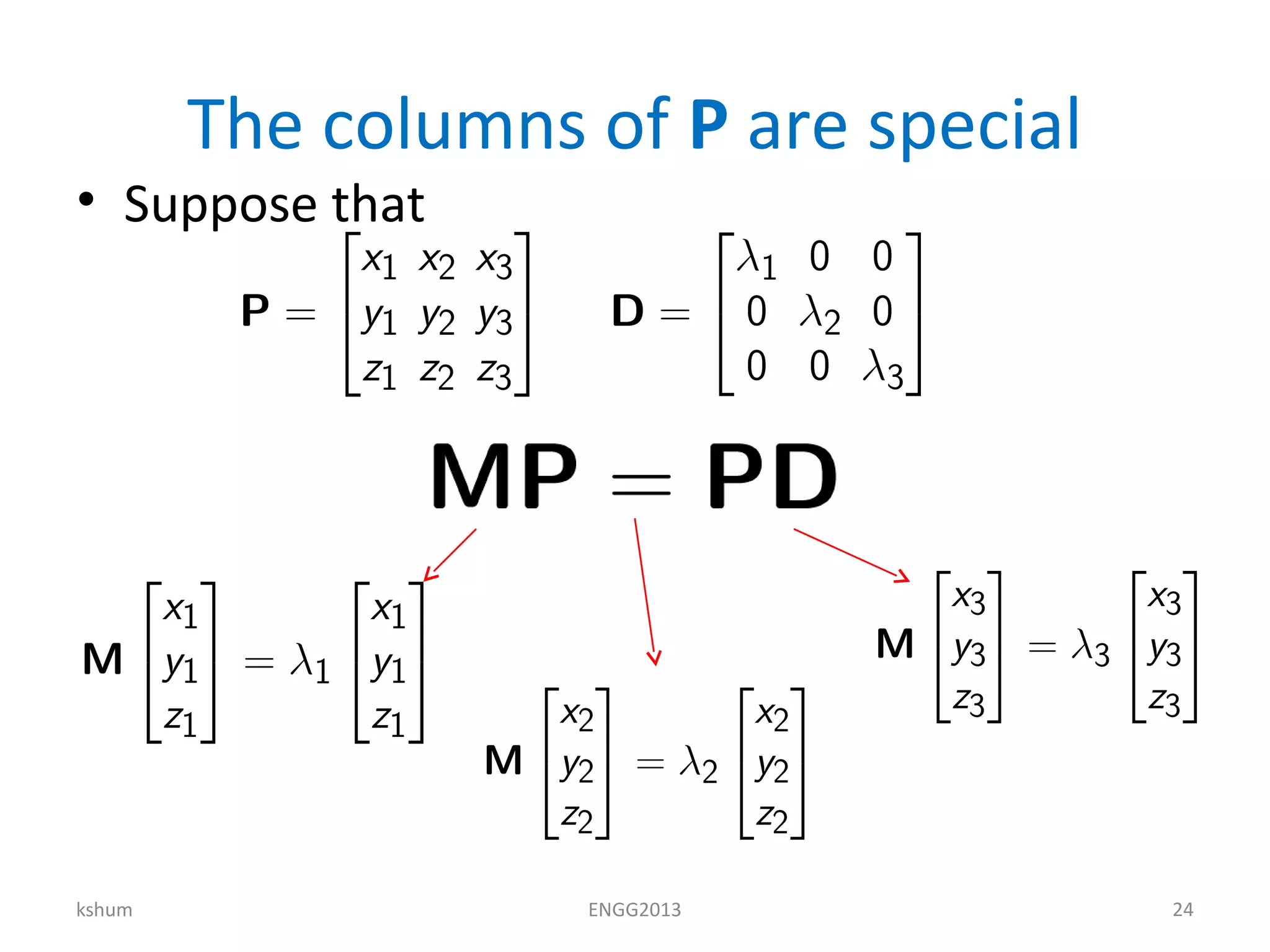
The columns of P are special
• Suppose that
kshum ENGG2013 24
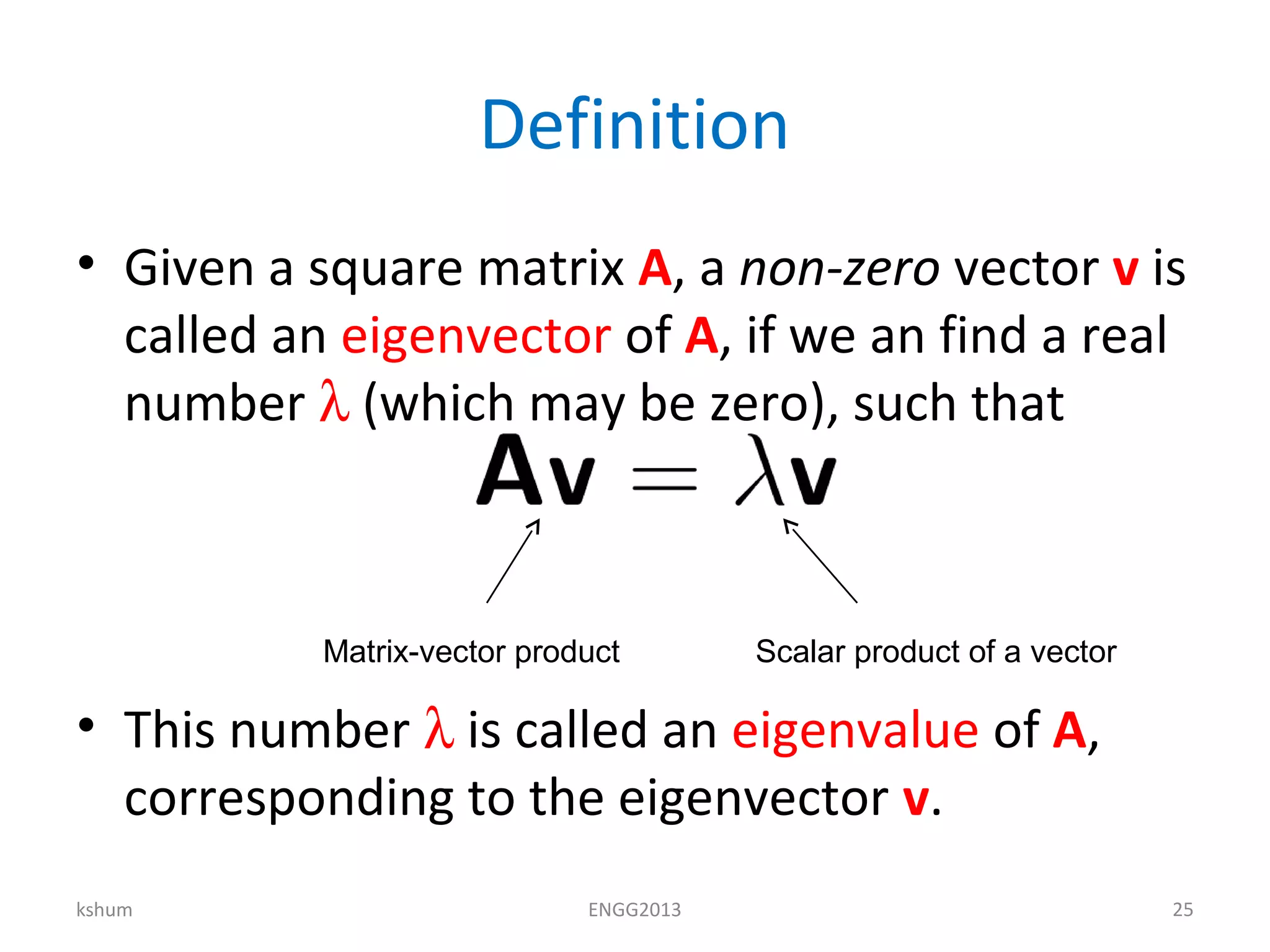
Definition
• Given a square matrix A, a non-zero vector v is
called an eigenvector of A, if we an find a real
number λ (which may be zero), such that
• This number λ is called an eigenvalue of A,
corresponding to the eigenvector v.
kshum ENGG2013 25
Matrix-vector product Scalar product of a vector
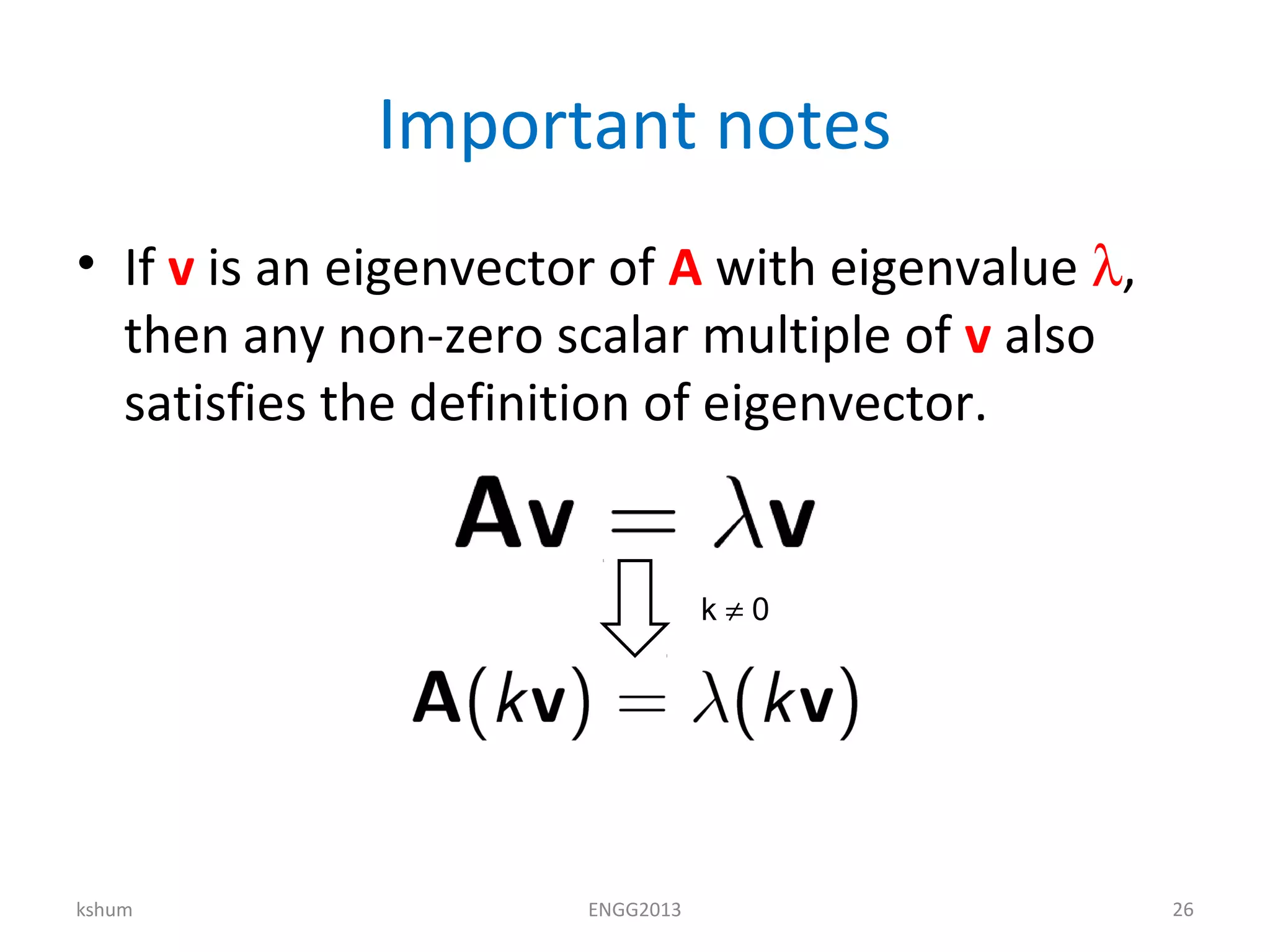
Important notes
• If v is an eigenvector of A with eigenvalue λ,
then any non-zero scalar multiple of v also
satisfies the definition of eigenvector.
kshum ENGG2013 26
k ≠ 0
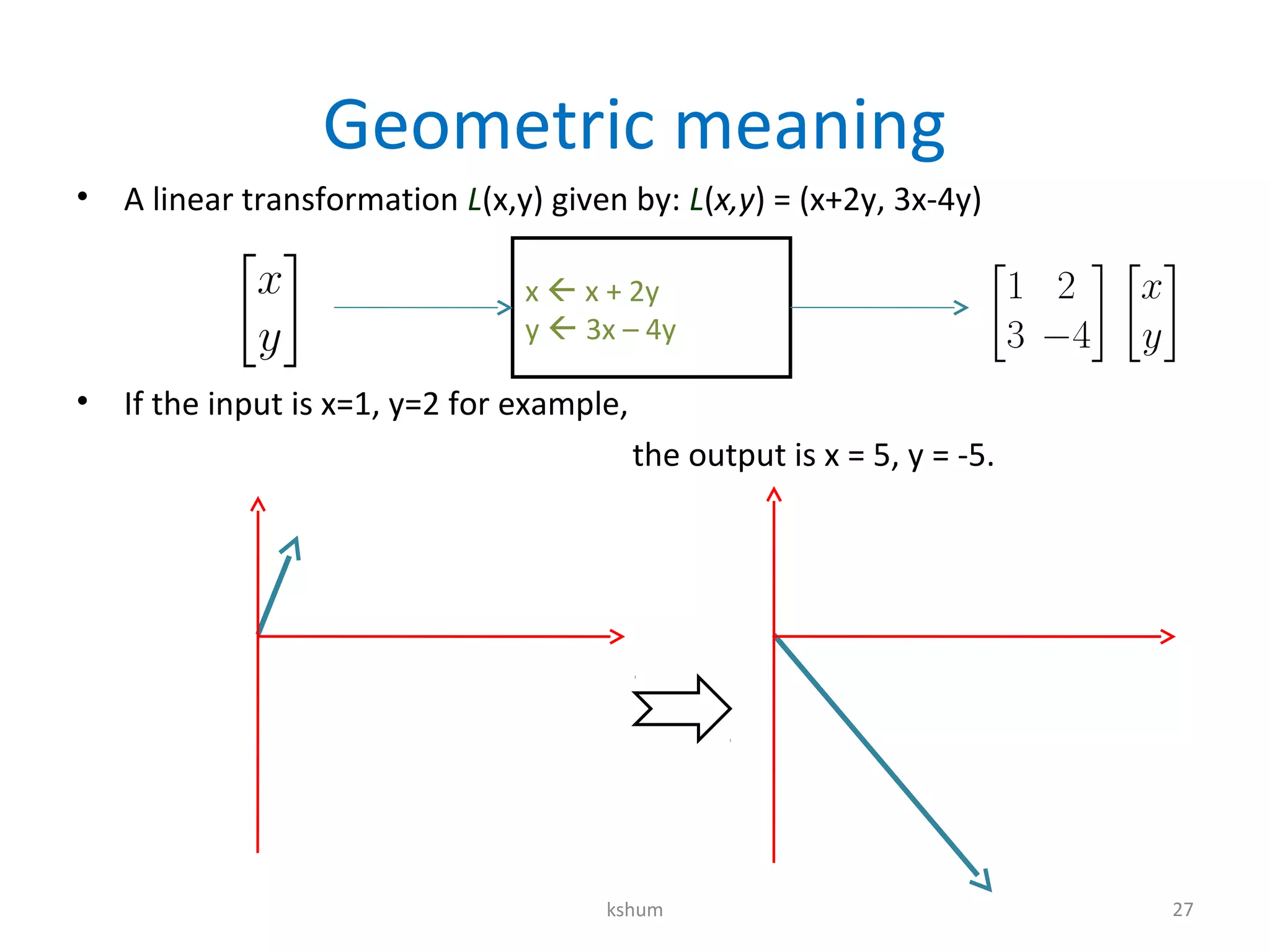
Geometric meaning
• A linear transformation L(x,y) given by: L(x,y) = (x+2y, 3x-4y)
• If the input is x=1, y=2 for example,
the output is x = 5, y = -5.
kshum 27
x  x + 2y
y  3x – 4y
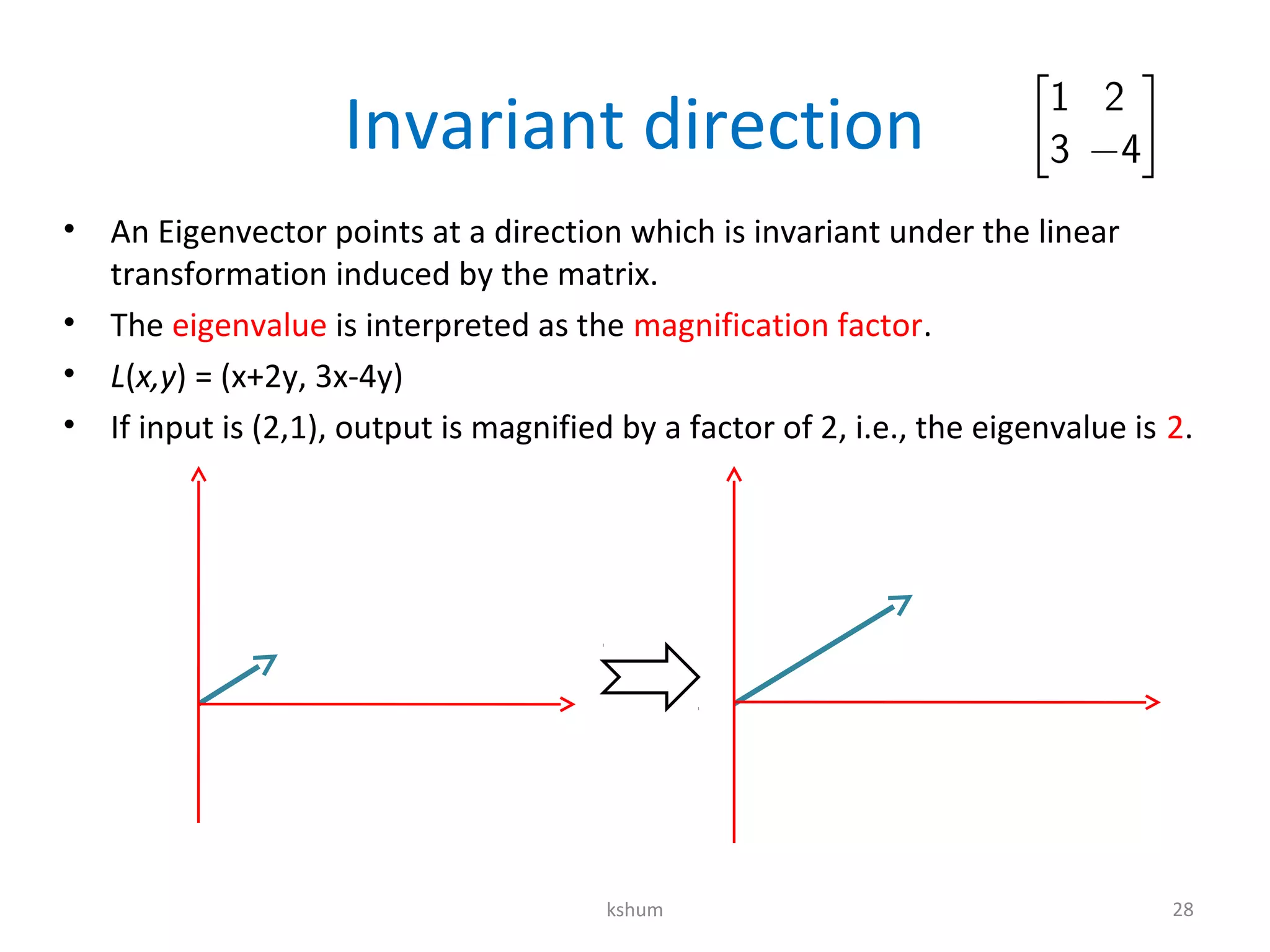
Invariant direction
• An Eigenvector points at a direction which is invariant under the linear
transformation induced by the matrix.
• The eigenvalue is interpreted as the magnification factor.
• L(x,y) = (x+2y, 3x-4y)
• If input is (2,1), output is magnified by a factor of 2, i.e., the eigenvalue is 2.
kshum 28
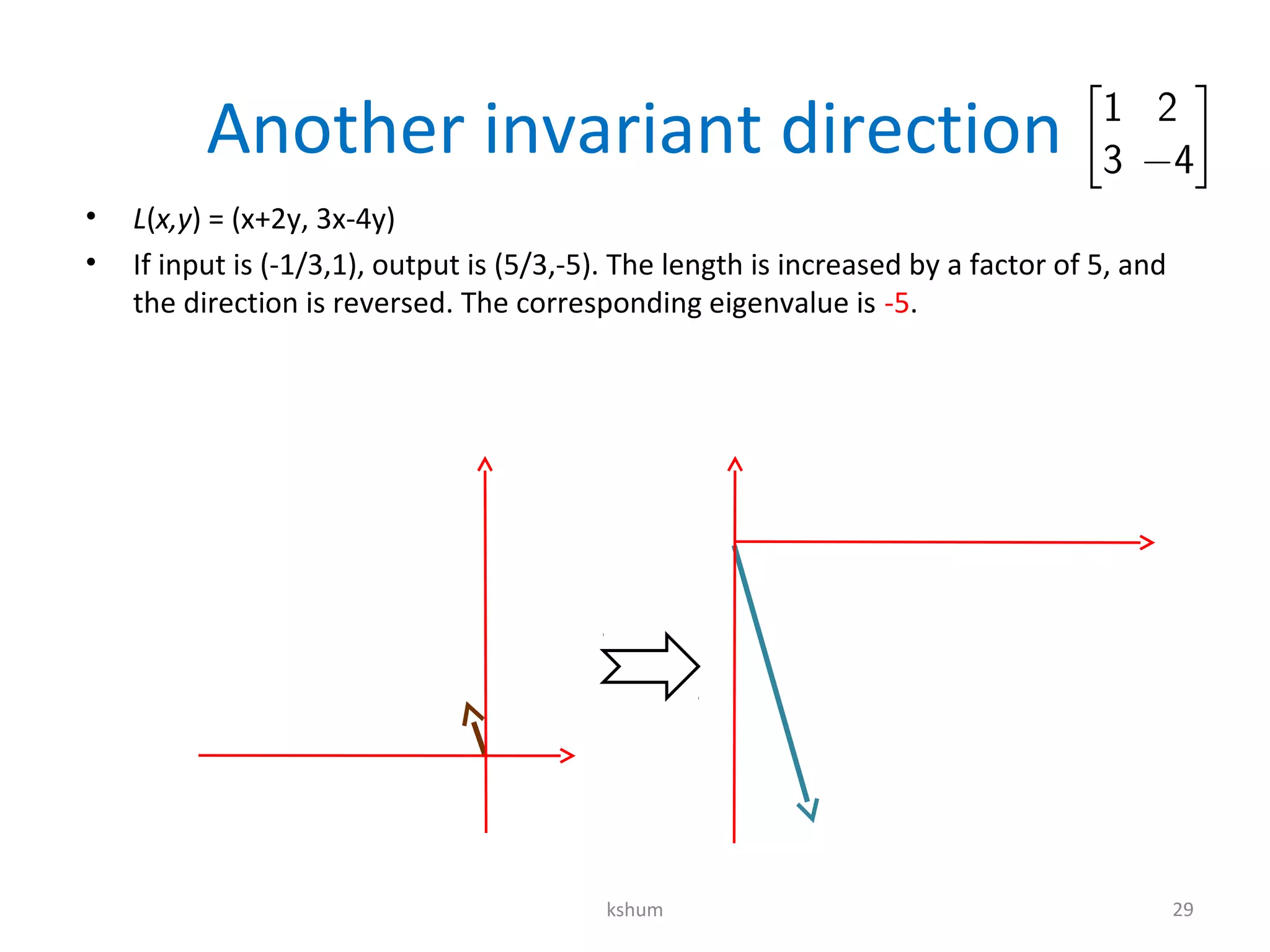
Another invariant direction
• L(x,y) = (x+2y, 3x-4y)
• If input is (-1/3,1), output is (5/3,-5). The length is increased by a factor of 5, and
the direction is reversed. The corresponding eigenvalue is -5.
kshum 29
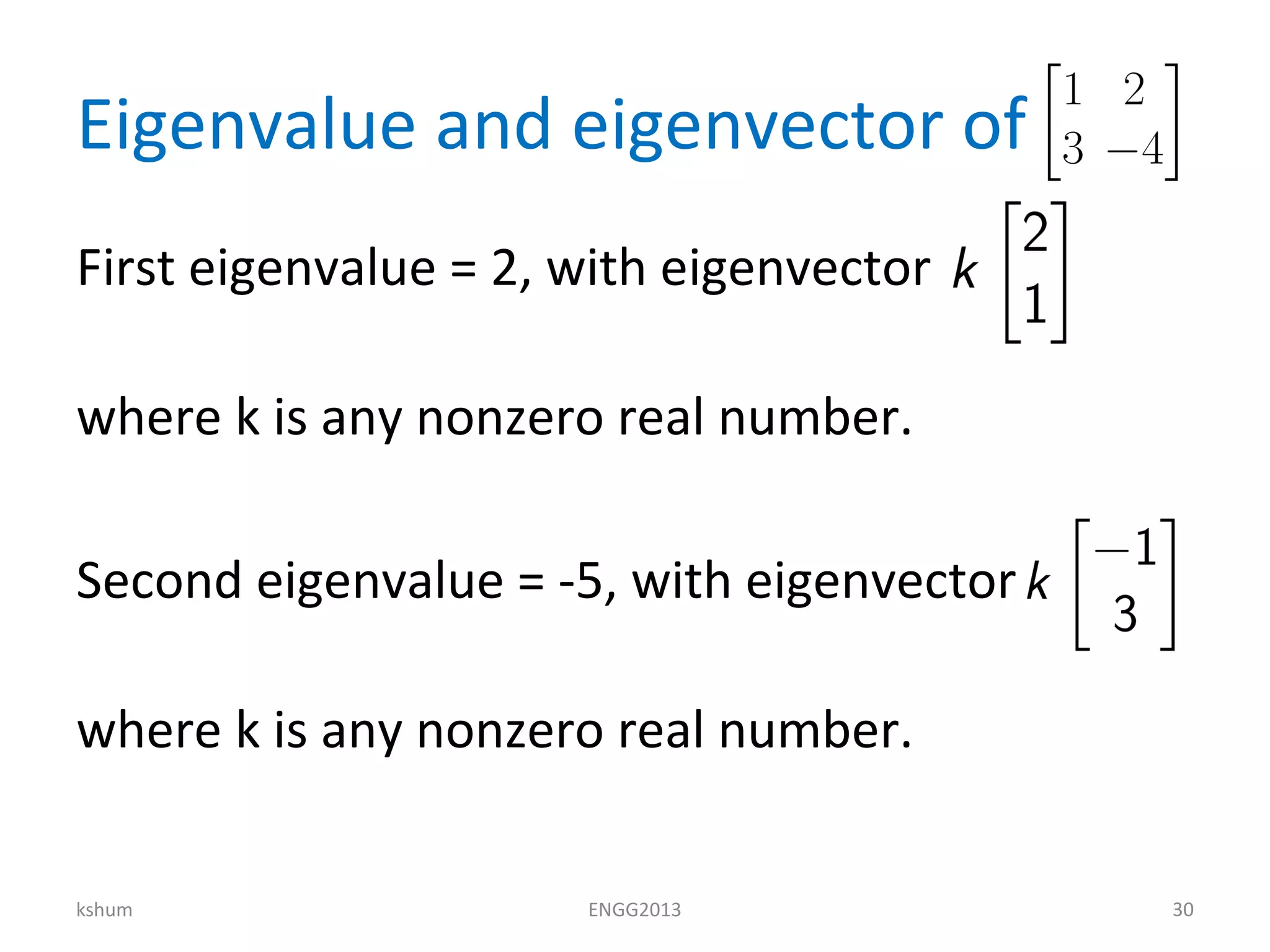
Eigenvalue and eigenvector of
First eigenvalue = 2, with eigenvector
where k is any nonzero real number.
Second eigenvalue = -5, with eigenvector
where k is any nonzero real number.
kshum ENGG2013 30
Summary
• Motivation: want to solve recurrence
relations.
• Formulation using matrix multiplication
• Need to raise a matrix to an arbitrary power
• Raising a matrix to some power can be easily
done if the matrix is diagonalizable.
• Diagonalization can be done by eigenvalue
and eigenvector.
kshum ENGG2013 31

Eighan values and diagonalization

  • 1.
  • 2.
  • 3.
    Q6 in midterm •u(t): unemployment rate in the t-th month. • e(t)= 1-u(t) • The unemployment rate in the next month is given by a matrix multiplication • Equilibrium: Solve kshum ENGG2013 3  Unemployment rate at equilibrium = 0.2
  • 4.
  • 5.
    If stable, howfast does it converge to the equilibrium point? kshum ENGG2013 5 0.2 0.2 Fast convergenceSlow convergence
  • 6.
    Question • Suppose thatthe initial unemployment rate at the first month is x(1), (for example x(1)=0.25), and suppose that the unemployment evolves by matrix multiplication Find an analytic expression for x(t), for all t. kshum ENGG2013 6
  • 7.
  • 8.
    How to count? •Count the number of binary strings of length n with no consecutive ones. kshum ENGG2013 8
  • 9.
  • 10.
    Fibonacci numbers • F1= 1 • F2 = 1 • For n > 2, Fn = Fn-1+Fn-2. • The Fibonacci numbers are – 1,1,3,5,8,13,21,34,55,89,144 kshum ENGG2013 10 http://en.wik
  • 11.
    A matrix formulation •Define a vector • Initial vector • Find the recurrence relation in matrix form kshum ENGG2013 11
  • 12.
    A general question •Given initial condition and for t ≥ 2 Find v(t) for all t. kshum ENGG2013 12
  • 13.
    Matrix power • Needto raise a matrix to a very high power kshum ENGG2013 13
  • 14.
    A trivial specialcase • Diagonal matrix • The solution is easy to find • Raising a diagonal matrix to the power t is easy. kshum ENGG2013 14
  • 15.
    Decoupled equations • Whenthe equation is diagonal, we have two separate equation, each in one variable kshum ENGG2013 15
  • 16.
  • 17.
    Problem reduction • Asquare matrix M is called diagonalizable if we can find an invertible matrix, say P, such that the product P–1 M P is a diagonal matrix. • A diagonalizable matrix can be raised to a high power easily. – Suppose that P–1 M P = D, D diagonal. – M = PD P–1 . – Mn = (PD P–1 ) (PD P–1 ) (PD P–1 ) … (PD P–1 ) = PDn P–1 . kshum ENGG2013 17
  • 18.
    Example of diagonalizablematrix • Let • A is diagonalizable because we can find a matrix such that kshum ENGG2013 18
  • 19.
    Now we knowhow fast it converges to 0.2 • The matrix can be diagonalized kshum ENGG2013 19
  • 20.
    Convergence to equilibrium •The trajectory of the unemployment rate – the initial point is set to 0.1 kshum ENGG2013 20 1 2 3 4 5 6 7 8 9 10 0.1 0.11 0.12 0.13 0.14 0.15 0.16 0.17 0.18 0.19 0.2 month (t) Unemploymentrate
  • 21.
  • 22.
    How to diagonalize? •How to determine whether a matrix M is diagonalizable? • How to find a matrix P which diagonalizes a matrix M? kshum ENGG2013 22
  • 23.
    From diagonalization to eigenvector •By definition a matrix M is diagonalizable if P–1 M P = D for some invertible matrix P, and diagonal matrix D. or equivalently, kshum ENGG2013 23
  • 24.
    The columns ofP are special • Suppose that kshum ENGG2013 24
  • 25.
    Definition • Given asquare matrix A, a non-zero vector v is called an eigenvector of A, if we an find a real number λ (which may be zero), such that • This number λ is called an eigenvalue of A, corresponding to the eigenvector v. kshum ENGG2013 25 Matrix-vector product Scalar product of a vector
  • 26.
    Important notes • Ifv is an eigenvector of A with eigenvalue λ, then any non-zero scalar multiple of v also satisfies the definition of eigenvector. kshum ENGG2013 26 k ≠ 0
  • 27.
    Geometric meaning • Alinear transformation L(x,y) given by: L(x,y) = (x+2y, 3x-4y) • If the input is x=1, y=2 for example, the output is x = 5, y = -5. kshum 27 x  x + 2y y  3x – 4y
  • 28.
    Invariant direction • AnEigenvector points at a direction which is invariant under the linear transformation induced by the matrix. • The eigenvalue is interpreted as the magnification factor. • L(x,y) = (x+2y, 3x-4y) • If input is (2,1), output is magnified by a factor of 2, i.e., the eigenvalue is 2. kshum 28
  • 29.
    Another invariant direction •L(x,y) = (x+2y, 3x-4y) • If input is (-1/3,1), output is (5/3,-5). The length is increased by a factor of 5, and the direction is reversed. The corresponding eigenvalue is -5. kshum 29
  • 30.
    Eigenvalue and eigenvectorof First eigenvalue = 2, with eigenvector where k is any nonzero real number. Second eigenvalue = -5, with eigenvector where k is any nonzero real number. kshum ENGG2013 30
  • 31.
    Summary • Motivation: wantto solve recurrence relations. • Formulation using matrix multiplication • Need to raise a matrix to an arbitrary power • Raising a matrix to some power can be easily done if the matrix is diagonalizable. • Diagonalization can be done by eigenvalue and eigenvector. kshum ENGG2013 31

Editor's Notes

  • #16 \begin{bmatrix} x(t+1)\\ y(t+1) \end{bmatrix}=\begin{bmatrix} a & 0\\ 0& b \end{bmatrix}\begin{bmatrix} x(t)\\ y(t) \end{bmatrix}
  • #19 \mathbf{A} = \begin{bmatrix} 0.9 & 0.4\\ 0.1 & 0.6 \end{bmatrix}
  • #20 \begin{bmatrix} x(t+1)\\ y(t+1) \end{bmatrix} =\begin{bmatrix} 0.9 & 0.4\\ 0.1 & 0.6 \end{bmatrix}^t\begin{bmatrix} x(1)\\ y(1) \end{bmatrix}\\ = \begin{bmatrix} 4 &-1 \\ 1 &1 \end{bmatrix} \begin{bmatrix} 1 & 0\\ 0 & 0.5 \end{bmatrix}^t \begin{bmatrix} 4 &-1 \\ 1 &1 \end{bmatrix}^{-1}\begin{bmatrix} x(1)\\ y(1) \end{bmatrix}
  • #21 u(t)=0.2 - (0.5)^{t-1}/5 + u(1) 0.5^{t-1}
  • #25 \mathbf{P}=\begin{bmatrix} x_1 & x_2 & x_3\\ y_1 & y_2 & y_3\\ z_1 & z_2 & z_3 \end{bmatrix}