EIGENVALUES AND
EIGENVECTORS
MATH 15 - Linear Algebra
Department of Mathematics
At the end of this lesson, the students are
expected to :
•Define eigenvalues and eigenvectors
•Prove properties of eigenvalues and eigenvectors
•Determine the eigenvalues and associated eigenvectors
•Determine if a given matrix is diagonalizable
•Identify properties of a diagonalizable matrix
OBJECTIVES
DEFINITION:
The prefix eigen- is adopted from the German word
“eigen” for “innate”, “own”.
The eigenvectors are sometimes also called proper
vectors, or characteristic vectors.
Similarly, the eigenvalues are also known as proper
values, or characteristic values.
EIGENVALUE
DEFINITION:
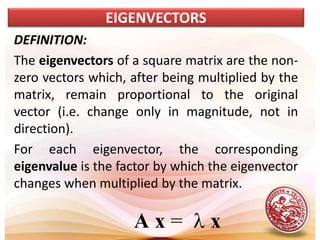
The eigenvectors of a square matrix are the non-
zero vectors which, after being multiplied by the
matrix, remain proportional to the original
vector (i.e. change only in magnitude, not in
direction).
For each eigenvector, the corresponding
eigenvalue is the factor by which the eigenvector
changes when multiplied by the matrix.
EIGENVECTORS
A x = l x
DEFINITION:
Simple eigenvalues are eigenvalues of A that has
multiplicity of 1,
If the eigenvalue appears as a root more than
once (k>1), then it is an eigenvalue with
multiplicity k.
EIGENVALUES
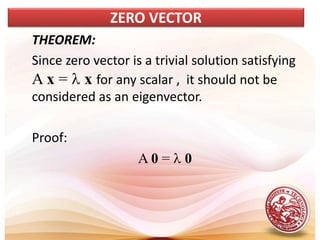
THEOREM:
Since zero vector is a trivial solution satisfying
A x = l x for any scalar , it should not be
considered as an eigenvector.
Proof:
A 0 = l 0
ZERO VECTOR
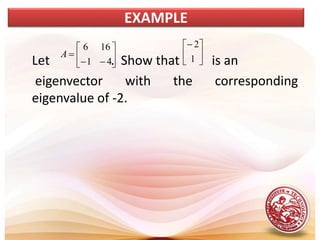
Let . Show that is an
eigenvector with the corresponding
eigenvalue of -2.
EXAMPLE









4
1
16
6
A 





1
2
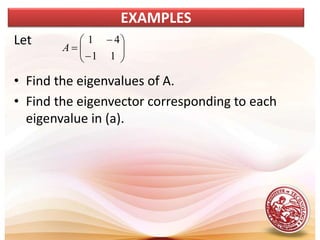
Let
• Find the eigenvalues of A.
• Find the eigenvector corresponding to each
eigenvalue in (a).
EXAMPLES











1
1
4
1
A
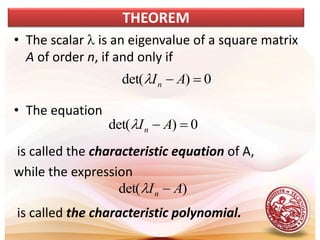
• The scalar l is an eigenvalue of a square matrix
A of order n, if and only if
• The equation
is called the characteristic equation of A,
while the expression
is called the characteristic polynomial.
THEOREM
0
)
det( 
 A
In
l
0
)
det( 
 A
In
l
)
det( A
In 
l
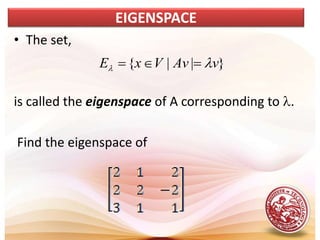
• The set,
is called the eigenspace of A corresponding to l.
Find the eigenspace of
EIGENSPACE
}
|
|
{ v
Av
V
x
E l
l 


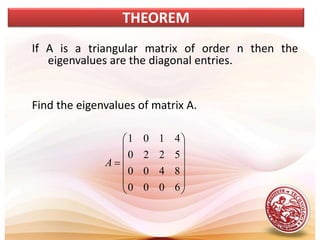
If A is a triangular matrix of order n then the
eigenvalues are the diagonal entries.
Find the eigenvalues of matrix A.
THEOREM















6
0
0
0
8
4
0
0
5
2
2
0
4
1
0
1
A
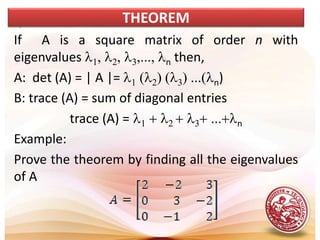
If A is a square matrix of order n with
eigenvalues l1, l2, l3,..., ln then,
A: det (A) = | A |= l1 (l2) (l3) ...(ln)
B: trace (A) = sum of diagonal entries
trace (A) = l1 + l2 + l3+ ...+ln
Example:
Prove the theorem by finding all the eigenvalues
of A
THEOREM
.
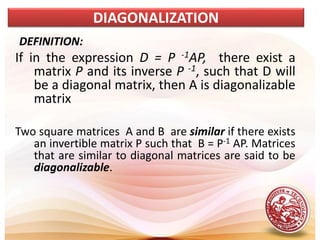
DEFINITION:
If in the expression D = P -1AP, there exist a
matrix P and its inverse P -1, such that D will
be a diagonal matrix, then A is diagonalizable
matrix
Two square matrices A and B are similar if there exists
an invertible matrix P such that B = P-1 AP. Matrices
that are similar to diagonal matrices are said to be
diagonalizable.
DIAGONALIZATION
DEFINITION:
If in the expression D = P -1AP, there exist a
matrix P and its inverse P -1, such that D will
be a diagonal matrix, then A is diagonalizable
matrix
Two square matrices A and B are similar if there exists
an invertible matrix P such that B = P-1 AP. Matrices
that are similar to diagonal matrices are said to be
diagonalizable.
DIAGONALIZATION
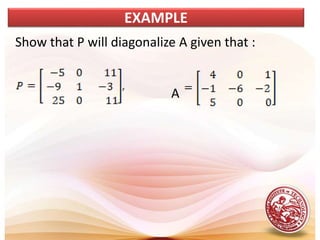
Show that P will diagonalize A given that :
A
EXAMPLE
DEFINITION:
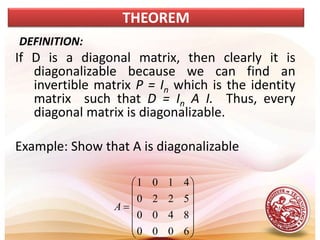
If D is a diagonal matrix, then clearly it is
diagonalizable because we can find an
invertible matrix P = In which is the identity
matrix such that D = In A I. Thus, every
diagonal matrix is diagonalizable.
Example: Show that A is diagonalizable
THEOREM















6
0
0
0
8
4
0
0
5
2
2
0
4
1
0
1
A
DEFINITION:
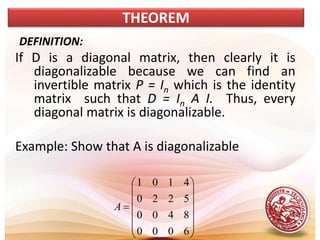
If D is a diagonal matrix, then clearly it is
diagonalizable because we can find an
invertible matrix P = In which is the identity
matrix such that D = In A I. Thus, every
diagonal matrix is diagonalizable.
Example: Show that A is diagonalizable
THEOREM















6
0
0
0
8
4
0
0
5
2
2
0
4
1
0
1
A
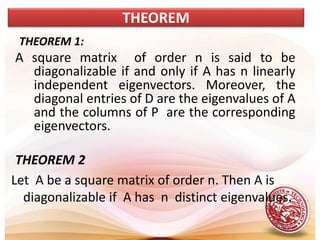
THEOREM 1:
A square matrix of order n is said to be
diagonalizable if and only if A has n linearly
independent eigenvectors. Moreover, the
diagonal entries of D are the eigenvalues of A
and the columns of P are the corresponding
eigenvectors.
THEOREM 2
Let A be a square matrix of order n. Then A is
diagonalizable if A has n distinct eigenvalues.
THEOREM
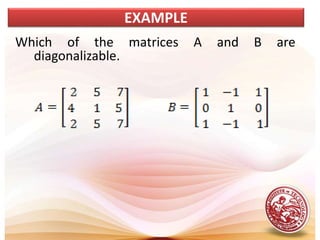
Which of the matrices A and B are
diagonalizable.
EXAMPLE
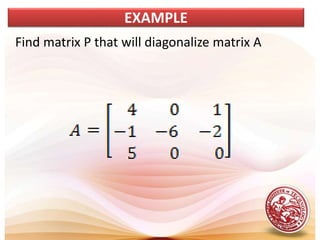
Find matrix P that will diagonalize matrix A
EXAMPLE
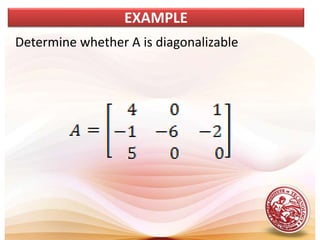
Determine whether A is diagonalizable
EXAMPLE
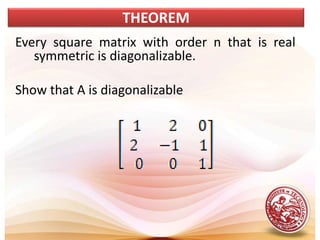
Every square matrix with order n that is real
symmetric is diagonalizable.
Show that A is diagonalizable
THEOREM
TEXTBOOKS
Elementary Linear Algebra, Bernard Kolman and David
R. Hill, 7th ed., 2003
WEBSITES:
http://en.wikipedia.org/wiki/Eigenvalue,_eigenvector_a
nd_eigenspace
SUGGESTED READINGS

MATHEMATICS Lecture lesson helpful 12.pptx

  • 1.
    EIGENVALUES AND EIGENVECTORS MATH 15- Linear Algebra Department of Mathematics
  • 2.
    At the endof this lesson, the students are expected to : •Define eigenvalues and eigenvectors •Prove properties of eigenvalues and eigenvectors •Determine the eigenvalues and associated eigenvectors •Determine if a given matrix is diagonalizable •Identify properties of a diagonalizable matrix OBJECTIVES
  • 3.
    DEFINITION: The prefix eigen-is adopted from the German word “eigen” for “innate”, “own”. The eigenvectors are sometimes also called proper vectors, or characteristic vectors. Similarly, the eigenvalues are also known as proper values, or characteristic values. EIGENVALUE
  • 4.
    DEFINITION: The eigenvectors ofa square matrix are the non- zero vectors which, after being multiplied by the matrix, remain proportional to the original vector (i.e. change only in magnitude, not in direction). For each eigenvector, the corresponding eigenvalue is the factor by which the eigenvector changes when multiplied by the matrix. EIGENVECTORS A x = l x
  • 5.
    DEFINITION: Simple eigenvalues areeigenvalues of A that has multiplicity of 1, If the eigenvalue appears as a root more than once (k>1), then it is an eigenvalue with multiplicity k. EIGENVALUES
  • 6.
    THEOREM: Since zero vectoris a trivial solution satisfying A x = l x for any scalar , it should not be considered as an eigenvector. Proof: A 0 = l 0 ZERO VECTOR
  • 7.
    Let . Showthat is an eigenvector with the corresponding eigenvalue of -2. EXAMPLE          4 1 16 6 A       1 2
  • 8.
    Let • Find theeigenvalues of A. • Find the eigenvector corresponding to each eigenvalue in (a). EXAMPLES            1 1 4 1 A
  • 9.
    • The scalarl is an eigenvalue of a square matrix A of order n, if and only if • The equation is called the characteristic equation of A, while the expression is called the characteristic polynomial. THEOREM 0 ) det(   A In l 0 ) det(   A In l ) det( A In  l
  • 10.
    • The set, iscalled the eigenspace of A corresponding to l. Find the eigenspace of EIGENSPACE } | | { v Av V x E l l   
  • 11.
    If A isa triangular matrix of order n then the eigenvalues are the diagonal entries. Find the eigenvalues of matrix A. THEOREM                6 0 0 0 8 4 0 0 5 2 2 0 4 1 0 1 A
  • 12.
    If A isa square matrix of order n with eigenvalues l1, l2, l3,..., ln then, A: det (A) = | A |= l1 (l2) (l3) ...(ln) B: trace (A) = sum of diagonal entries trace (A) = l1 + l2 + l3+ ...+ln Example: Prove the theorem by finding all the eigenvalues of A THEOREM .
  • 13.
    DEFINITION: If in theexpression D = P -1AP, there exist a matrix P and its inverse P -1, such that D will be a diagonal matrix, then A is diagonalizable matrix Two square matrices A and B are similar if there exists an invertible matrix P such that B = P-1 AP. Matrices that are similar to diagonal matrices are said to be diagonalizable. DIAGONALIZATION
  • 14.
    DEFINITION: If in theexpression D = P -1AP, there exist a matrix P and its inverse P -1, such that D will be a diagonal matrix, then A is diagonalizable matrix Two square matrices A and B are similar if there exists an invertible matrix P such that B = P-1 AP. Matrices that are similar to diagonal matrices are said to be diagonalizable. DIAGONALIZATION
  • 15.
    Show that Pwill diagonalize A given that : A EXAMPLE
  • 16.
    DEFINITION: If D isa diagonal matrix, then clearly it is diagonalizable because we can find an invertible matrix P = In which is the identity matrix such that D = In A I. Thus, every diagonal matrix is diagonalizable. Example: Show that A is diagonalizable THEOREM                6 0 0 0 8 4 0 0 5 2 2 0 4 1 0 1 A
  • 17.
    DEFINITION: If D isa diagonal matrix, then clearly it is diagonalizable because we can find an invertible matrix P = In which is the identity matrix such that D = In A I. Thus, every diagonal matrix is diagonalizable. Example: Show that A is diagonalizable THEOREM                6 0 0 0 8 4 0 0 5 2 2 0 4 1 0 1 A
  • 18.
    THEOREM 1: A squarematrix of order n is said to be diagonalizable if and only if A has n linearly independent eigenvectors. Moreover, the diagonal entries of D are the eigenvalues of A and the columns of P are the corresponding eigenvectors. THEOREM 2 Let A be a square matrix of order n. Then A is diagonalizable if A has n distinct eigenvalues. THEOREM
  • 19.
    Which of thematrices A and B are diagonalizable. EXAMPLE
  • 20.
    Find matrix Pthat will diagonalize matrix A EXAMPLE
  • 21.
    Determine whether Ais diagonalizable EXAMPLE
  • 22.
    Every square matrixwith order n that is real symmetric is diagonalizable. Show that A is diagonalizable THEOREM
  • 23.
    TEXTBOOKS Elementary Linear Algebra,Bernard Kolman and David R. Hill, 7th ed., 2003 WEBSITES: http://en.wikipedia.org/wiki/Eigenvalue,_eigenvector_a nd_eigenspace SUGGESTED READINGS