The world of Eigenvalues-eigenfunctions

An operator    A   operates on a function and produces a
function.

For every operator, there is a set of functions which
when operated by the operator produces the same
function modified only multiplied by a constant
factor.

Such a function is called the eigenfunction of the
operator, and the constant modifier is called its
corresponding eigenvalue. An eigenvalue is just a
number: Real or complex.

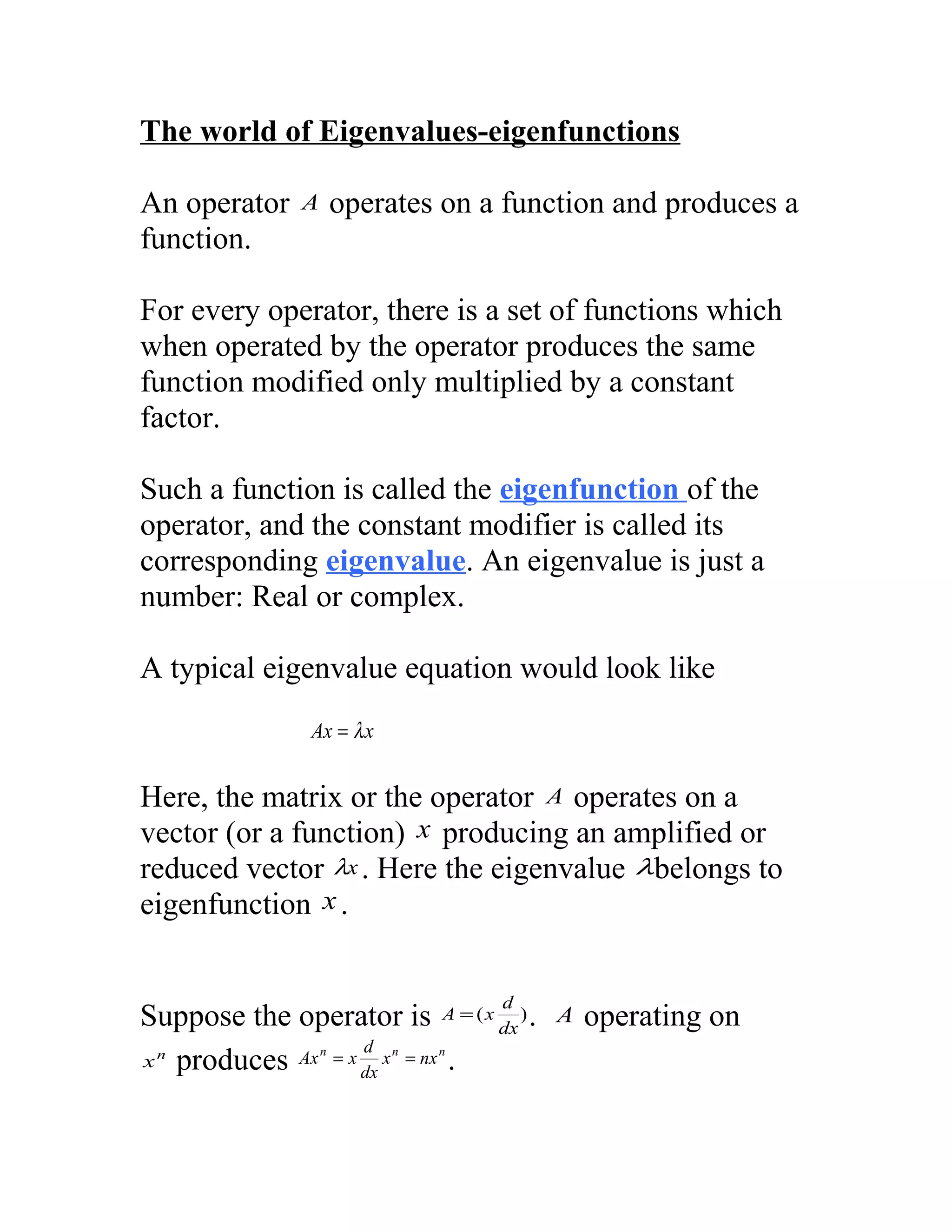
A typical eigenvalue equation would look like
                Ax = λ x


Here, the matrix or the operator A operates on a
vector (or a function) x producing an amplified or
reduced vector λx . Here the eigenvalue λbelongs to
eigenfunction x .


                                  d
Suppose the operator is A = ( x dx ) .   A   operating on
                   d n
x n produces Ax = x x = nx .
               n          n
                   dx
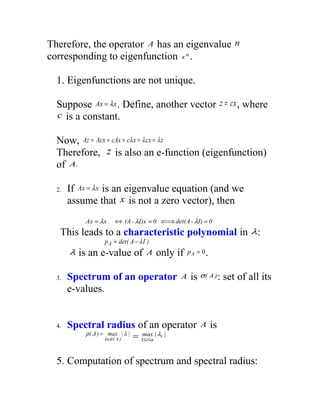
Therefore, the operator A has an eigenvalue n
corresponding to eigenfunction x n .

  1. Eigenfunctions are not unique.

  Suppose Ax = λ x . Define, another vector z = cx , where
  c is a constant.

  Now, Az = Acx = cAx = cλ x = λ cx = λ z
  Therefore, z is also an e-function (eigenfunction)
  of A.

  2.   If Ax = λ x is an eigenvalue equation (and we
       assume that x is not a zero vector), then
            Ax = λx   ⇔ (A - λI)x = 0 ⇐⇒ det(A - λI) = 0
   This leads to a characteristic polynomial in λ:
                  p A = det( A − λ I )
       λ   is an e-value of          A   only if   pA = 0.


  3.   Spectrum of an operator                 A    is σ( A ) : set of all its
       e-values.


  4.   Spectral radius of an operator                  A     is
           ρ ( A ) = max | λ |
                    λ∈σ ( A )  = 1maxn | λi |
                                  ≤i ≤


  5. Computation of spectrum and spectral radius:
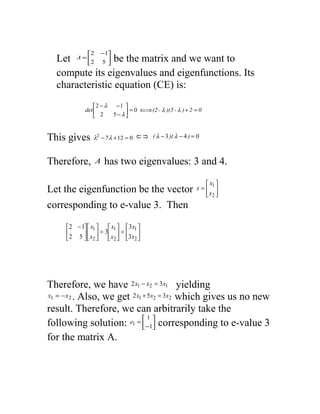
2   −1
  Let A = 2 5  be the matrix and we want to
              
  compute its eigenvalues and eigenfunctions. Its
  characteristic equation (CE) is:
                 2 − λ    −1 
             det                = 0 ⇐⇒ (2 - λ )(5 - λ ) + 2 = 0
                  2      5 − λ
                               


This gives λ2 − 7λ + 12 = 0 ⇐ ⇒            ( λ − 3 )( λ − 4 ) = 0


Therefore,         A   has two eigenvalues: 3 and 4.

                                                                   x 
Let the eigenfunction be the vector                            x =  1
                                                                    x2 
corresponding to e-value 3. Then

      2 − 1  x1   x1   3 x1 
      2 5   x  = 3 x  =  3 x 
            2   2   2 


Therefore, we have 2 x1 − x2 = 3x1 yielding
x1 = − x2 . Also, we get 2 x1 + 5 x2 = 3 x2 which gives us no new

result. Therefore, we can arbitrarily take the
                              1 
following solution: e1 = −1 corresponding to e-value 3
                               
for the matrix A.
Similarly, for e-value of 4, the eigenfunction appears
           1 
to be e2 = − 2 .
            


  6. Faddeev-Leverrier Method to get characteristic
     polynomial.

  Define a sequence of matrices                              P = A, p1 = trace( P )
                                                              1                  1
                            1
  P2 = A[ P − p1I ] , p2 = trace( P2 )
           1
                            2
                            1
  P3 = A[ P2 − p2 I ] , p3 = trace( P3 )
                            3
  …
  …
                                  1
  Pn = A[ Pn −1 − pn −1I ] , p n = trace( Pn )
                                  n
  Then the characteristic polynomial                               P( λ )   is
                  [
  P( λ ) = ( −1 )n λn − p1λn −1 − p2 λn − 2 − ... − pn   ]
                12  6        − 6
                 6 16         2 
  e.g.       A=
                                
                − 6 2
                             16 
                                 


  Define        P = A, p1 = trace( A ) = 12 + 16 + 16 = 44
                 1
  P2 = A( P − p1I ) =
           1


  12  6       − 6− 32      6      −6 
   6 16        2  6       − 28     2 
                                      
  − 6 2
              16  − 6
                             2     − 28
                                         


    − 312     −108     108 
  = −108     − 408     − 60 , p 2 = −564
                            
     108
              − 60     − 408
                             
And one proceeds this way to get          p3 = 1728


  The CA polynomial = ( −1 )3 [λ3 − 44λ2 + 564λ −1728]


  The eigenvalues are next found solving
    [λ3 − 44λ2 + 564λ −1728] = 0

  7. More facts about eigenvalues.

  Assume Ax = λ x . Therefore,      λ   is the eigenvalue of
  A with eigenvector x .


  a. A−1 has the same eigenvector as A and the
  corresponding eigenvalue is λ−1 .

  b. An has the same eigenvector as          A   with the
  eigenvalue λn .

  c. ( A + µI ) has the same eigenvector as      A   with the
  eigenvalue ( λ + µ ) .

  d. If   A   is symmetric, all its eigenvalues are real.

  e. If P is an invertible matrix then       P −1 AP    has the
  same eigenvalues as A .

Proof of e.
Suppose, the eigenfunction of                                                 P −1 AP          is     y     with
eigenvalue k .
Then,
       P − APy = ky
          1
                               ⇐⇒        APy = Pky = kPy

Therefore, Py = x and k must be equal to λ. Therefore
the eigenvalues of A and P −1 AP are identical and the
eigenvector of one is a linear mapping of the other
one.

If the eigenvalues of A , λ1 ,λ2 ,...,λn are all distinct
then there exists a similarity transformation such that
           λ1 0               0      .. 0 
           0 λ                0      .. 0 
                2                          
 −1
P AP = D =  0 0               λ3     .. 0 
            .. ..              ..    .. 0 
                                           
           
           0 0                0      .. λn 
                                            


Let the eigenvectors of A be                                      x ( 1 ) , x ( 2 ) ,..., x ( i ) ,...x ( n )

such that we have Ax( i ) = λi x( i )

Then the matrix P = [ x( 1 ) , x( 2 ) ,..., x( n ) ]
Then AP = [ Ax( 1 ) , Ax( 2 ) ,..., Ax( n ) ]
                     [
                = λ1 x( 1 ) ,λ2 x( 2 ) ,..., λn x( n )     ]
                 [                           ][
              = x ( 1 ) , x ( 2 ) ,..., x ( n ) λ1e( 1 ) ,λ 2 e( 2 ) ,..., λn e( n )   ]
= PD

Therefore,               P −1 AP = D


Also, note the following. If                                   A     is symmetric, then
. So, we can normalize each
( x ( i ) )t x (   j)
                        = 0 , ∀i ≠ j
                                                                     (i )
                            x                               (i)
eigenvector and obtain u = x so that the                             (i )


matrix Q = [u ( 1 ) ,u ( 2 ) ,...,u ( n ) ] would be an orthogonal matrix.
i.e. Q AQ = Dt


Matrix-norm.

Computationally, the                                l 2 -norm               of a matrix is
determined as

            l 2 -norm               of                  [
                                          A =|| A ||2 = ρ( At A )   ]1 / 2
                 1            1    0
e.g.          A = 1           2    1
                                    
                 −1
                              1    2
                                     


                         1         1    −1 1     1       0  3           2   −1
Then               A A = 1
                    t
                                    2    1  1     2       1 =  2         6   4
                                                                              
                         0
                                   1    2 −1
                                                  1       2 −1
                                                                           4   5


The eigenvalues are:
            λ1 = 0, λ2 = 7 + 7 , λ3 = 7 − 7


Therefore,                      A2 =       ρ( At A ) = 7 + 7 ≈ 3.106


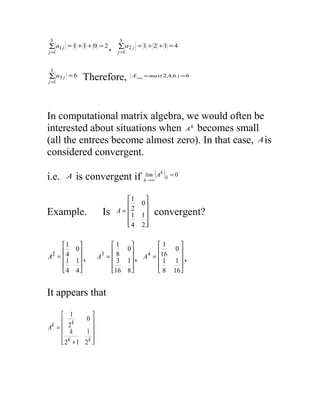
                                                                  A ∞ = max ∑ aij
The l∞norm is defined as                                               1≤i ≤n      j
                      1        1        0 
e.g.               A =1        2        1 
                                          
                      −1
                               1       − 4
                                           
3                           3
∑ a1 j = 1 + 1 + 0 = 2 ,   ∑ a2 j = 1 + 2 + 1 = 4
j =1                       j =1


3
∑ a3 j = 6
j =1
             Therefore,           A ∞ = max( 2 ,4 ,6 ) = 6


In computational matrix algebra, we would often be
interested about situations when A k becomes small
(all the entrees become almost zero). In that case, A is
considered convergent.

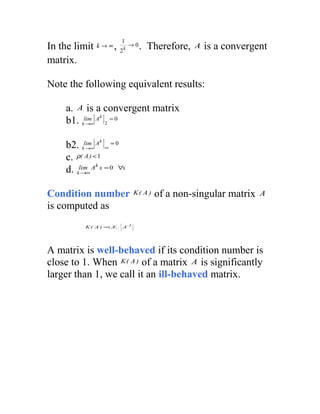
           is convergent if klim∞( A )ij = 0
                                    k
i.e.   A                      →


                               1      
                                     0
Example.              Is   A = 2          convergent?
                                 1    1
                                      
                               4     2

     1                  1           1     
      4 0               8  0        16 0 
A2 =                A3 =         A4 = 
       1 1 ,               3 1 ,        1 1 ,
                                          
      4 4               16 8         8 16 


It appears that

      1         
      2k      0
Ak = 
         k     1
                
      2k + 1 2k 
                
1
In the limit   k → ∞,
                        2k
                             →0   . Therefore,   A   is a convergent
matrix.

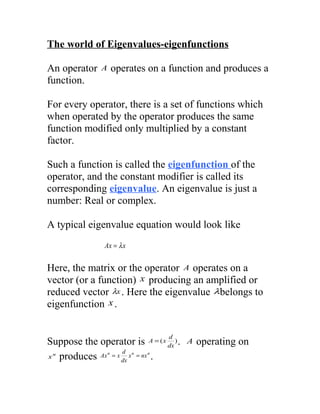
Note the following equivalent results:

    a. A is a convergent matrix
               k
    b1. klim∞ A 2 = 0
          →


               k
    b2. klim∞ A ∞ = 0
           →

    c. ρ( A ) < 1
               k
    d. klim∞ A x = 0 ∀x
         →


Condition number               K( A )   of a non-singular matrix   A
is computed as
          K ( A ) = A . A -1


A matrix is well-behaved if its condition number is
close to 1. When K ( A ) of a matrix A is significantly
larger than 1, we call it an ill-behaved matrix.

Eigenvalues

  • 1.
    The world ofEigenvalues-eigenfunctions An operator A operates on a function and produces a function. For every operator, there is a set of functions which when operated by the operator produces the same function modified only multiplied by a constant factor. Such a function is called the eigenfunction of the operator, and the constant modifier is called its corresponding eigenvalue. An eigenvalue is just a number: Real or complex. A typical eigenvalue equation would look like Ax = λ x Here, the matrix or the operator A operates on a vector (or a function) x producing an amplified or reduced vector λx . Here the eigenvalue λbelongs to eigenfunction x . d Suppose the operator is A = ( x dx ) . A operating on d n x n produces Ax = x x = nx . n n dx
  • 2.
    Therefore, the operatorA has an eigenvalue n corresponding to eigenfunction x n . 1. Eigenfunctions are not unique. Suppose Ax = λ x . Define, another vector z = cx , where c is a constant. Now, Az = Acx = cAx = cλ x = λ cx = λ z Therefore, z is also an e-function (eigenfunction) of A. 2. If Ax = λ x is an eigenvalue equation (and we assume that x is not a zero vector), then Ax = λx ⇔ (A - λI)x = 0 ⇐⇒ det(A - λI) = 0 This leads to a characteristic polynomial in λ: p A = det( A − λ I ) λ is an e-value of A only if pA = 0. 3. Spectrum of an operator A is σ( A ) : set of all its e-values. 4. Spectral radius of an operator A is ρ ( A ) = max | λ | λ∈σ ( A ) = 1maxn | λi | ≤i ≤ 5. Computation of spectrum and spectral radius:
  • 3.
    2 −1 Let A = 2 5  be the matrix and we want to   compute its eigenvalues and eigenfunctions. Its characteristic equation (CE) is: 2 − λ −1  det  = 0 ⇐⇒ (2 - λ )(5 - λ ) + 2 = 0  2 5 − λ  This gives λ2 − 7λ + 12 = 0 ⇐ ⇒ ( λ − 3 )( λ − 4 ) = 0 Therefore, A has two eigenvalues: 3 and 4. x  Let the eigenfunction be the vector x =  1  x2  corresponding to e-value 3. Then  2 − 1  x1   x1   3 x1   2 5   x  = 3 x  =  3 x    2   2   2  Therefore, we have 2 x1 − x2 = 3x1 yielding x1 = − x2 . Also, we get 2 x1 + 5 x2 = 3 x2 which gives us no new result. Therefore, we can arbitrarily take the 1  following solution: e1 = −1 corresponding to e-value 3   for the matrix A.
  • 4.
    Similarly, for e-valueof 4, the eigenfunction appears 1  to be e2 = − 2 .   6. Faddeev-Leverrier Method to get characteristic polynomial. Define a sequence of matrices P = A, p1 = trace( P ) 1 1 1 P2 = A[ P − p1I ] , p2 = trace( P2 ) 1 2 1 P3 = A[ P2 − p2 I ] , p3 = trace( P3 ) 3 … … 1 Pn = A[ Pn −1 − pn −1I ] , p n = trace( Pn ) n Then the characteristic polynomial P( λ ) is [ P( λ ) = ( −1 )n λn − p1λn −1 − p2 λn − 2 − ... − pn ] 12 6 − 6  6 16 2  e.g. A=   − 6 2  16   Define P = A, p1 = trace( A ) = 12 + 16 + 16 = 44 1 P2 = A( P − p1I ) = 1 12 6 − 6− 32 6 −6   6 16 2  6 − 28 2     − 6 2  16  − 6  2 − 28  − 312 −108 108  = −108 − 408 − 60 , p 2 = −564    108  − 60 − 408 
  • 5.
    And one proceedsthis way to get p3 = 1728 The CA polynomial = ( −1 )3 [λ3 − 44λ2 + 564λ −1728] The eigenvalues are next found solving [λ3 − 44λ2 + 564λ −1728] = 0 7. More facts about eigenvalues. Assume Ax = λ x . Therefore, λ is the eigenvalue of A with eigenvector x . a. A−1 has the same eigenvector as A and the corresponding eigenvalue is λ−1 . b. An has the same eigenvector as A with the eigenvalue λn . c. ( A + µI ) has the same eigenvector as A with the eigenvalue ( λ + µ ) . d. If A is symmetric, all its eigenvalues are real. e. If P is an invertible matrix then P −1 AP has the same eigenvalues as A . Proof of e.
  • 6.
    Suppose, the eigenfunctionof P −1 AP is y with eigenvalue k . Then, P − APy = ky 1 ⇐⇒ APy = Pky = kPy Therefore, Py = x and k must be equal to λ. Therefore the eigenvalues of A and P −1 AP are identical and the eigenvector of one is a linear mapping of the other one. If the eigenvalues of A , λ1 ,λ2 ,...,λn are all distinct then there exists a similarity transformation such that λ1 0 0 .. 0  0 λ 0 .. 0   2  −1 P AP = D =  0 0 λ3 .. 0   .. .. .. .. 0     0 0 0 .. λn   Let the eigenvectors of A be x ( 1 ) , x ( 2 ) ,..., x ( i ) ,...x ( n ) such that we have Ax( i ) = λi x( i ) Then the matrix P = [ x( 1 ) , x( 2 ) ,..., x( n ) ] Then AP = [ Ax( 1 ) , Ax( 2 ) ,..., Ax( n ) ] [ = λ1 x( 1 ) ,λ2 x( 2 ) ,..., λn x( n ) ] [ ][ = x ( 1 ) , x ( 2 ) ,..., x ( n ) λ1e( 1 ) ,λ 2 e( 2 ) ,..., λn e( n ) ] = PD Therefore, P −1 AP = D Also, note the following. If A is symmetric, then
  • 7.
    . So, wecan normalize each ( x ( i ) )t x ( j) = 0 , ∀i ≠ j (i ) x (i) eigenvector and obtain u = x so that the (i ) matrix Q = [u ( 1 ) ,u ( 2 ) ,...,u ( n ) ] would be an orthogonal matrix. i.e. Q AQ = Dt Matrix-norm. Computationally, the l 2 -norm of a matrix is determined as l 2 -norm of [ A =|| A ||2 = ρ( At A ) ]1 / 2 1 1 0 e.g. A = 1 2 1   −1  1 2  1 1 −1 1 1 0  3 2 −1 Then A A = 1 t 2 1  1 2 1 =  2 6 4      0  1 2 −1  1 2 −1   4 5 The eigenvalues are: λ1 = 0, λ2 = 7 + 7 , λ3 = 7 − 7 Therefore, A2 = ρ( At A ) = 7 + 7 ≈ 3.106 A ∞ = max ∑ aij The l∞norm is defined as 1≤i ≤n j 1 1 0  e.g. A =1 2 1    −1  1 − 4 
  • 8.
    3 3 ∑ a1 j = 1 + 1 + 0 = 2 , ∑ a2 j = 1 + 2 + 1 = 4 j =1 j =1 3 ∑ a3 j = 6 j =1 Therefore, A ∞ = max( 2 ,4 ,6 ) = 6 In computational matrix algebra, we would often be interested about situations when A k becomes small (all the entrees become almost zero). In that case, A is considered convergent. is convergent if klim∞( A )ij = 0 k i.e. A → 1   0 Example. Is A = 2 convergent? 1 1   4 2 1  1  1   4 0 8 0 16 0  A2 =  A3 =  A4 =  1 1 , 3 1 , 1 1 ,        4 4 16 8   8 16  It appears that  1   2k 0 Ak =  k 1    2k + 1 2k   
  • 9.
    1 In the limit k → ∞, 2k →0 . Therefore, A is a convergent matrix. Note the following equivalent results: a. A is a convergent matrix k b1. klim∞ A 2 = 0 → k b2. klim∞ A ∞ = 0 → c. ρ( A ) < 1 k d. klim∞ A x = 0 ∀x → Condition number K( A ) of a non-singular matrix A is computed as K ( A ) = A . A -1 A matrix is well-behaved if its condition number is close to 1. When K ( A ) of a matrix A is significantly larger than 1, we call it an ill-behaved matrix.