Mathematics
By jitendra thakor
Session
Matrices and Determinants - 2
Session Objectives
 Determinant of a Square Matrix
 Minors and Cofactors
 Properties of Determinants
 Applications of Determinants
Area of a Triangle
Solution of System of Linear Equations (Cramer’s Rule)
 Class Exercise
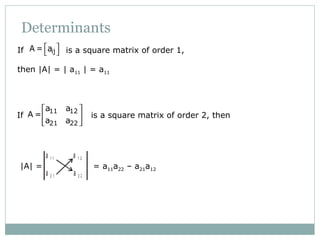
Determinants
If is a square matrix of order 1,
then |A| = | a11 | = a11
ijA = a 
 
If is a square matrix of order 2, then
11 12
21 22
a a
A =
a a
 
 
 
|A| = = a11a22 – a21a12
a a
a a
1 1 1 2
2 1 2 2
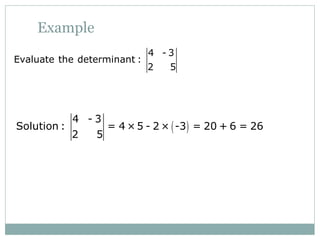
Example
4 - 3
Evaluate the determinant :
2 5
( )
4 - 3
Solution : = 4 ×5 - 2 × -3 = 20 + 6 = 26
2 5
Solution
If A = is a square matrix of order 3, then
11 12 13
21 22 23
31 32 33
a a a
a a a
a a a
 
 
 
  
[Expanding along first row]
11 12 13
22 23 21 23 21 22
21 22 23 11 12 13
32 33 31 33 31 32
31 32 33
a a a
a a a a a a
| A |= a a a = a - a + a
a a a a a a
a a a
( ) ( ) ( )11 22 33 32 23 12 21 33 31 23 13 21 32 31 22= a a a - a a - a a a - a a + a a a - a a
( ) ( )11 22 33 12 31 23 13 21 32 11 23 32 12 21 33 13 31 22a a a a a a a a a a a a a a a a a a= + + − + +
Example
2 3 - 5
Evaluate the determinant : 7 1 - 2
-3 4 1
( )
2 3 - 5
1 - 2 7 - 2 7 1
7 1 - 2 = 2 - 3 + -5
4 1 -3 1 -3 4
-3 4 1
( ) ( ) ( )= 2 1 + 8 - 3 7 - 6 - 5 28 + 3
= 18 - 3 - 155
= -140
[Expanding along first row]
Solution :
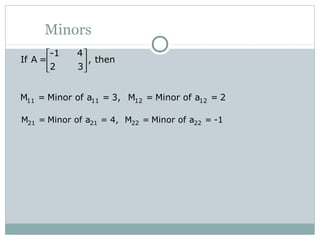
Minors
-1 4
If A = , then
2 3
 
 
 
21 21 22 22M = Minor of a = 4, M = Minor of a = -1
11 11 12 12M = Minor of a = 3, M = Minor of a = 2
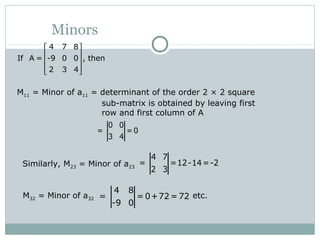
Minors
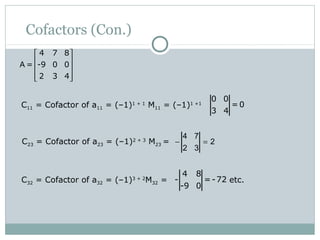
4 7 8
If A = -9 0 0 , then
2 3 4
 
 
 
  
M11 = Minor of a11 = determinant of the order 2 × 2 square
sub-matrix is obtained by leaving first
row and first column of A
0 0
= = 0
3 4
Similarly, M23 = Minor of a23
4 7
= =12-14=-2
2 3
M32 = Minor of a32 etc.
4 8
= = 0+72 =72
-9 0
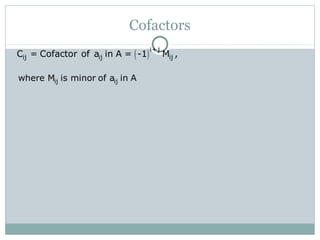
Cofactors
( )i+ j
ij ij ijC = Cofactor of a in A = -1 M ,
ij ijwhere M is minor of a in A
Cofactors (Con.)
C11 = Cofactor of a11 = (–1)1 + 1
M11 = (–1)1 +1
0 0
= 0
3 4
C23 = Cofactor of a23 = (–1)2 + 3
M23 = − =
4 7
2
2 3
C32 = Cofactor of a32 = (–1)3 + 2
M32 = etc.
4 8
- =-72
-9 0
4 7 8
A = -9 0 0
2 3 4
 
 
 
  
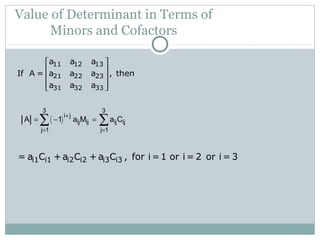
Value of Determinant in Terms of
Minors and Cofactors
11 12 13
21 22 23
31 32 33
a a a
If A = a a a , then
a a a
 
 
 
  
( )
3 3
i j
ij ij ij ij
j 1 j 1
A 1 a M a C
+
= =
= − =∑ ∑
i1 i1 i2 i2 i3 i3= a C +a C + a C , for i =1 or i = 2 or i = 3
Properties of Determinants
1. The value of a determinant remains unchanged, if its
rows and columns are interchanged.
1 1 1 1 2 3
2 2 2 1 2 3
3 3 3 1 2 3
a b c a a a
a b c = b b b
a b c c c c
i e A A=. . '
2. If any two rows (or columns) of a determinant are interchanged,
then the value of the determinant is changed by minus sign.
[ ]
1 1 1 2 2 2
2 2 2 1 1 1 2 1
3 3 3 3 3 3
a b c a b c
a b c = - a b c R R
a b c a b c
Applying ↔
Properties (Con.)
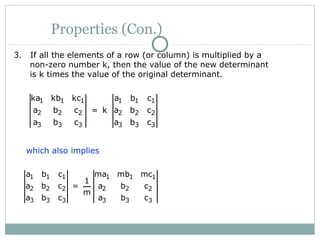
3. If all the elements of a row (or column) is multiplied by a
non-zero number k, then the value of the new determinant
is k times the value of the original determinant.
1 1 1 1 1 1
2 2 2 2 2 2
3 3 3 3 3 3
ka kb kc a b c
a b c = k a b c
a b c a b c
which also implies
1 1 1 1 1 1
2 2 2 2 2 2
3 3 3 3 3 3
a b c ma mb mc
1
a b c = a b c
m
a b c a b c
Properties (Con.)
4. If each element of any row (or column) consists of
two or more terms, then the determinant can be
expressed as the sum of two or more determinants.
1 1 1 1 1 1 1 1
2 2 2 2 2 2 2 2
3 3 3 3 3 3 3 3
a +x b c a b c x b c
a +y b c = a b c + y b c
a +z b c a b c z b c
5. The value of a determinant is unchanged, if any row
(or column) is multiplied by a number and then added
to any other row (or column).
[ ]
1 1 1 1 1 1 1 1
2 2 2 2 2 2 2 2 1 1 2 3
3 3 3 3 3 3 3 3
a b c a +mb - nc b c
a b c = a +mb - nc b c C C + mC -nC
a b c a +mb - nc b c
Applying →
Properties (Con.)
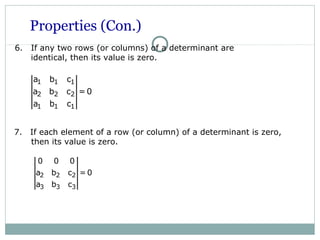
6. If any two rows (or columns) of a determinant are
identical, then its value is zero.
2 2 2
3 3 3
0 0 0
a b c = 0
a b c
7. If each element of a row (or column) of a determinant is zero,
then its value is zero.
1 1 1
2 2 2
1 1 1
a b c
a b c = 0
a b c
Properties (Con.)
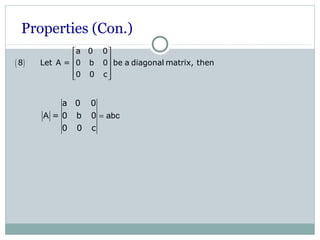
( )
a 0 0
8 Let A = 0 b 0 be a diagonal matrix, then
0 0 c
 
 
 
  
a 0 0
= 0 b 0
0 0 c
A abc=
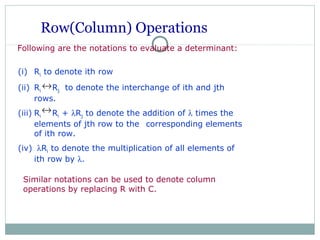
Row(Column) Operations
Following are the notations to evaluate a determinant:
Similar notations can be used to denote column
operations by replacing R with C.
(i) Ri to denote ith row
(ii) Ri Rj to denote the interchange of ith and jth
rows.
(iii) Ri Ri + λRj to denote the addition of λ times the
elements of jth row to the corresponding elements
of ith row.
(iv) λRi to denote the multiplication of all elements of
ith row by λ.
↔
↔
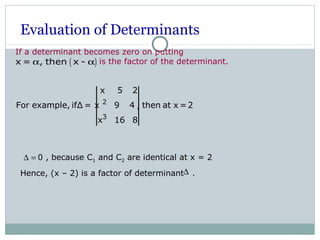
Evaluation of Determinants
If a determinant becomes zero on putting
is the factor of the determinant.( )x = , then x -α α
2
3
x 5 2
For example, ifΔ = x 9 4 , then at x =2
x 16 8
, because C1 and C2 are identical at x = 2
Hence, (x – 2) is a factor of determinant .
∆ = 0
∆
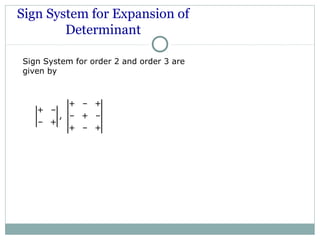
Sign System for Expansion of
Determinant
Sign System for order 2 and order 3 are
given by
+ – +
+ –
, – + –
– +
+ – +
( )
42 1 6 6×7 1 6
i 28 7 4 = 4×7 7 4
14 3 2 2×7 3 2
[ ]1
6 1 6
=7 4 7 4 Taking out 7 common from C
2 3 2
Example-1
6 -3 2
2 -1 2
-10 5 2
42 1 6
28 7 4
14 3 2
Find the value of the following determinants
(i) (ii)
Solution :
1 3= 7 × 0 C and C are identical
= 0
  Q
Example –1 (ii)
6 -3 2
2 -1 2
-10 5 2
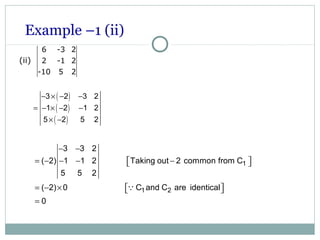
(ii)
( )
( )
( )
− × − −
= − × − −
× −
3 2 3 2
1 2 1 2
5 2 5 2
− −
= − − − −  
= − ×   
=
1
1 2
3 3 2
( 2) 1 1 2 Taking out 2 common from C
5 5 2
( 2) 0 C and C are identical
0
Q
Evaluate the determinant
1 a b+c
1 b c+a
1 c a+b
Solution :
[ ]3 2 3
1 a b+c 1 a a+b+c
1 b c+a = 1 b a+b+c Applying c c +c
1 c a+b 1 c a+b+c
→
( ) ( ) 3
1 a 1
= a+b+c 1 b 1 Taking a+b+c common from C
1 c 1
  
Example - 2
( ) 1 3= a + b + c × 0 C and C are identical
= 0
  Q
2 2 2
a b c
We have a b c
bc ca ab
[ ]2
1 1 2 2 2 3
(a-b) b-c c
= (a-b)(a+b) (b-c)(b+c) c Applying C C -C and C C -C
-c(a-b) -a(b-c) ab
→ →
( ) ( )2
1 2
1 1 c
Taking a-b and b-c common
=(a-b)(b-c) a+b b+c c
from C and C respectively
-c -a ab
 
 
 
Example - 3
bc
2 2 2
a b c
a b c
ca ab
Evaluate the determinant:
Solution:
[ ]2
1 1 2
0 1 c
=(a-b)(b-c) -(c-a) b+c c Applying c c -c
-(c-a) -a ab
→
2
0 1 c
=-(a-b)(b-c)(c-a) 1 b+c c
1 -a ab
[ ]2
2 2 3
0 1 c
= -(a-b)(b-c)(c-a) 0 a+b+c c -ab Applying R R -R
1 -a ab
→
Now expanding along C1 , we get
(a-b) (b-c) (c-a) [- (c2
– ab – ac – bc – c2
)]
= (a-b) (b-c) (c-a) (ab + bc + ac)
Solution Cont.
Without expanding the determinant,
prove that
3
3x+y 2x x
4x+3y 3x 3x =x
5x+6y 4x 6x
3x+y 2x x 3x 2x x y 2x x
L.H.S= 4x+3y 3x 3x = 4x 3x 3x + 3y 3x 3x
5x+6y 4x 6x 5x 4x 6x 6y 4x 6x
3 2
3 2 1 1 2 1
= x 4 3 3 + x y 3 3 3
5 4 6 6 4 6
Example-4
Solution :
[ ]3 2
1 2
3 2 1
= x 4 3 3 +x y×0 C and C are identical in II determinant
5 4 6
Q
Solution Cont.
[ ]3
1 1 2
1 2 1
= x 1 3 3 Applying C C -C
1 4 6
→
[ ]3
2 2 1 3 3 2
1 2 1
= x 0 1 2 ApplyingR R -R and R R -R
0 1 3
→ →
[ ]3
1
3
= x ×(3-2) Expanding along C
=x = R.H.S.
3
3 2 1
=x 4 3 3
5 4 6
Prove that : = 0 , where ω is cube root of unity.
3 5
3 4
5 5
1ω ω
ω 1 ω
ω ω 1
3 5 3 3 2
3 4 3 3
5 5 3 2 3 2
1ω ω 1 ω ω .ω
L.H.S =ω 1 ω = ω 1 ω .ω
ω ω 1 ω .ω ω .ω 1
[ ]
2
3
2 2
1 2
1 1ω
= 1 1ω ω =1
ω ω 1
=0=R.H.S. C and C are identical
  Q
Q
Example -5
Solution :
Example-6
2
x+a b c
a x+b c =x (x+a+b+c)
a b x+C
Prove that :
[ ]1 1 2 3
x+a b c x+a+b+c b c
L.H.S= a x+b c = x+a+b+c x+b c
a b x+C x+a+b+c b x+c
Applying C C +C +C→
Solution :
( )
( ) 1
1 b c
= x+a+b+c 1 x+b c
1 b x+c
Taking x+a+b+c commonfrom C  
Solution cont.
[ ]2 2 1 3 3 1
1 b c
=(x+a+b+c) 0 x 0
0 0 x
Applying R R -R and R R -R→ →
Expanding along C1 , we get
(x + a + b + c) [1(x2
)] = x2
(x + a + b + c)
= R.H.S
[ ]1 1 2 3
2(a+b+c) 2(a+b+c) 2(a+b+c)
= c+a a+b b+c Applying R R +R +R
a+b b+c c+a
→
1 1 1
=2(a+b+c) c+a a+b b+c
a+b b+c c+a
Example -7
Solution :
Using properties of determinants, prove that
2 2 2
b+c c+a a+b
c+a a+b b+c =2(a+b+c)(ab+bc+ca-a -b -c ).
a+b b+c c+a
b+c c+a a+b
L.H.S= c+a a+b b+c
a+b b+c c+a
[ ]1 1 2 2 2 3
0 0 1
=2(a+b+c) (c-b) (a-c) b+c Applying C C -C and C C - C
(a-c) (b-a) c+a
→ →
Now expanding along R1 , we get
2
2(a+b+c) (c-b)(b-a)-(a-c)  
2 2 2
=2(a+b+c) bc -b - ac+ab -(a +c -2ac)  
Solution Cont.
2 2 2
=2(a+b+c) ab+bc+ac-a -b -c
=R.H.S
  
Using properties of determinants prove that
2
x+4 2x 2x
2x x+4 2x =(5x+4)(4-x)
2x 2x x+4
Example - 8
1 2x 2x
=(5x+4)1 x+4 2x
1 2x x+4
Solution :
[ ]1 1 2 3
x+4 2x 2x 5x+4 2x 2x
L.H.S= 2x x+4 2x =5x+4 x+4 2x Applying C C +C +C
2x 2x x+4 5x+4 2x x+4
→
Solution Cont.
[ ]2 2 1 3 3 2
1 2x 2x
=(5x+4) 0 -(x- 4) 0 ApplyingR R -R and R R -R
0 x- 4 -(x- 4)
→ →
Now expanding along C1 , we get
2
(5x+4) 1(x-4) -0  
2
=(5x+4)(4-x)
=R.H.S
Example -9
Using properties of determinants, prove that
x+9 x x
x x+9 x =243 (x+3)
x x x+9
x+9 x x
L.H.S= x x+9 x
x x x+9
[ ]1 1 2 3
3x+9 x x
= 3x+9 x+9 x Applying C C +C +C
3x+9 x x+9
→
Solution :
[ ]1=3(x+3) 81 Expanding along C
=243(x+3)
=R.H.S.
×
1 x x
=(3x+9)1 x+9 x
1 x x+9
Solution Cont.
( ) 2 2 1 3 3 2
1 x x
=3 x+3 0 9 0 Applying R R -R and R R -R
0 -9 9
 → → 
Example -10
Solution :
2 2 2 2 2
2 2 2 2 2
1 1 3
2 2 2 2 2
(b+c) a bc b +c a bc
L.H.S.= (c+a) b ca = c +a b ca Applying C C -2C
(a+b) c ab a +b c ab
 → 
[ ]
2 2 2 2
2 2 2 2
1 1 2
2 2 2 2
a +b +c a bc
a +b +c b ca Applying C C +C
a +b +c c ab
= →
2
2 2 2 2
2
1 a bc
=(a +b +c )1 b ca
1 c ab
2 2
2 2 2 2 2
2 2
(b+c) a bc
(c+a) b ca =(a +b +c )(a-b)(b-c)(c-a)(a+b+c)
(a+b) c ab
Show that
Solution Cont.
[ ]
2
2 2 2
2 2 1 3 3 2
1 a bc
=(a +b +c ) 0 (b-a)(b+a) c(a-b) Applying R R -R and R R -R
0 (c-b)(c+b) a(b-c)
→ →
[ ]2 2 2 2 2
1=(a +b +c )(a-b)(b-c)(-ab-a +bc+c ) Expanding along C
2 2 2
=(a +b +c )(a-b)(b-c)(c-a)(a+b+c)=R.H.S.
2
2 2 2
1 a bc
=(a +b +c )(a-b)(b-c) 0 -(b+a) c
0 -(b+c) a
( ) ( ) ( )2 2 2
=(a +b +c )(a-b)(b-c) b c-a + c-a c+a  
Determinants (Area of a
Triangle)
The area of a triangle whose vertices are
is given by the expression1 1 2 2 3 3(x , y ), (x , y ) and (x , y )
1 1
2 2
3 3
x y 1
1
Δ= x y 1
2
x y 1
1 2 3 2 3 1 3 1 2
1
= [x (y - y ) + x (y - y )+ x (y - y )]
2
Example
Find the area of a triangle whose
vertices are (-1, 8), (-2, -3) and (3, 2).
Solution :
1 1
2 2
3 3
x y 1 -1 8 1
1 1
Area of triangle= x y 1 = -2 -3 1
2 2
x y 1 3 2 1
[ ]
1
= -1(-3-2)- 8(-2-3)+1(-4+9)
2
[ ]
1
= 5+40+5 =25 sq.units
2
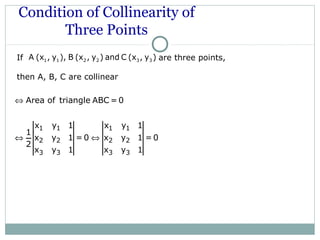
Condition of Collinearity of
Three Points
If are three points,
then A, B, C are collinear
1 1 2 2 3 3A (x , y ), B (x , y ) and C (x , y )
1 1 1 1
2 2 2 2
3 3 3 3
Area of triangle ABC = 0
x y 1 x y 1
1
x y 1 = 0 x y 1 = 0
2
x y 1 x y 1
⇔
⇔ ⇔
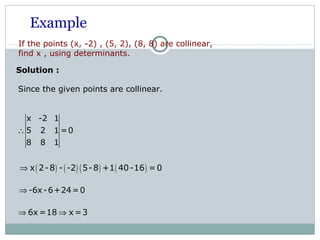
If the points (x, -2) , (5, 2), (8, 8) are collinear,
find x , using determinants.
Example
Solution :
x -2 1
5 2 1 =0
8 8 1
∴
( ) ( ) ( ) ( )x 2-8 - -2 5-8 +1 40-16 =0⇒
-6x-6+24=0⇒
6x =18 x =3⇒ ⇒
Since the given points are collinear.
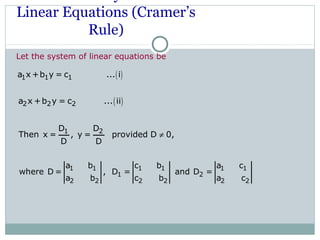
Linear Equations (Cramer’s
Rule)
Let the system of linear equations be
( )2 2 2a x +b y = c ... ii
( )1 1 1a x +b y = c ... i
1 2D D
Then x = , y = provided D 0,
D D
≠
1 1 1 1 1 1
1 2
2 2 2 2 2 2
a b c b a c
where D = , D = and D =
a b c b a c
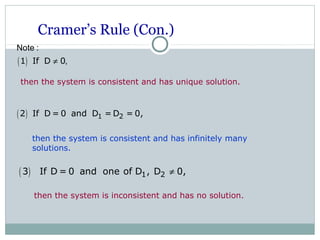
Cramer’s Rule (Con.)
then the system is consistent and has infinitely many
solutions.
( ) 1 22 If D = 0 and D = D = 0,
then the system is inconsistent and has no solution.
( )1 If D 0
Note :
,≠
then the system is consistent and has unique solution.
( ) 1 23 If D = 0 and one of D , D 0,≠
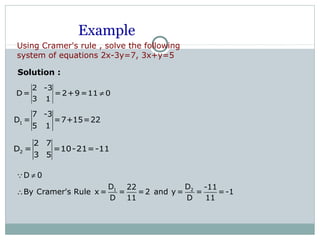
Example
2 -3
D= =2+9=11 0
3 1
≠
1
7 -3
D = =7+15=22
5 1
2
2 7
D = =10-21=-11
3 5
Solution :
1 2
D 0
D D22 -11
By Cramer's Rule x = = =2 and y = = =-1
D 11 D 11
≠
∴
Q
Using Cramer's rule , solve the following
system of equations 2x-3y=7, 3x+y=5
Linear Equations (Cramer’s
Rule)
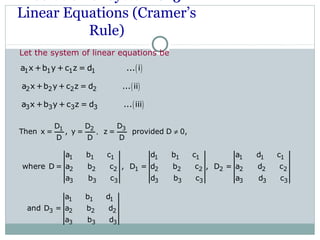
Let the system of linear equations be
( )2 2 2 2a x +b y+ c z = d ... ii
( )1 1 1 1a x +b y + c z = d ... i
( )3 3 3 3a x +b y + c z = d ... iii
31 2 DD D
Then x = , y = z = provided D 0,
D D D
, ≠
1 1 1 1 1 1 1 1 1
2 2 2 1 2 2 2 2 2 2 2
3 3 3 3 3 3 3 3 3
a b c d b c a d c
where D = a b c , D = d b c , D = a d c
a b c d b c a d c
1 1 1
3 2 2 2
3 3 3
a b d
and D = a b d
a b d
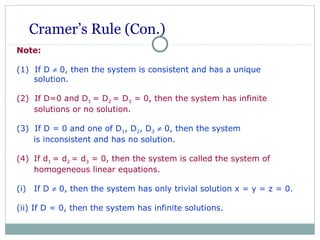
Cramer’s Rule (Con.)
Note:
(1) If D ≠ 0, then the system is consistent and has a unique
solution.
(2) If D=0 and D1 = D2 = D3 = 0, then the system has infinite
solutions or no solution.
(3) If D = 0 and one of D1, D2, D3 ≠ 0, then the system
is inconsistent and has no solution.
(4) If d1 = d2 = d3 = 0, then the system is called the system of
homogeneous linear equations.
(i) If D ≠ 0, then the system has only trivial solution x = y = z = 0.
(ii) If D = 0, then the system has infinite solutions.
Example
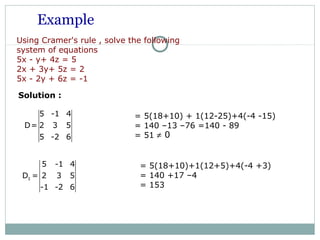
Using Cramer's rule , solve the following
system of equations
5x - y+ 4z = 5
2x + 3y+ 5z = 2
5x - 2y + 6z = -1
Solution :
5 -1 4
D= 2 3 5
5 -2 6
1
5 -1 4
D = 2 3 5
-1 -2 6
= 5(18+10)+1(12+5)+4(-4 +3)
= 140 +17 –4
= 153
= 5(18+10) + 1(12-25)+4(-4 -15)
= 140 –13 –76 =140 - 89
= 51 0≠
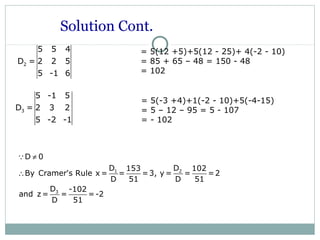
3
5 -1 5
D = 2 3 2
5 -2 -1
= 5(-3 +4)+1(-2 - 10)+5(-4-15)
= 5 – 12 – 95 = 5 - 107
= - 102
Solution Cont.
1 2
3
D 0
D D153 102
By Cramer's Rule x = = =3, y = = =2
D 51 D 51
D -102
and z= = =-2
D 51
≠
∴
Q
2
5 5 4
D = 2 2 5
5 -1 6
= 5(12 +5)+5(12 - 25)+ 4(-2 - 10)
= 85 + 65 – 48 = 150 - 48
= 102
Example
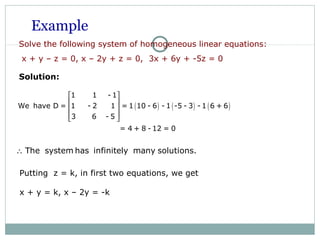
Solve the following system of homogeneous linear equations:
x + y – z = 0, x – 2y + z = 0, 3x + 6y + -5z = 0
Solution:
( ) ( ) ( )
1 1 - 1
We have D = 1 - 2 1 = 1 10 - 6 - 1 -5 - 3 - 1 6 + 6
3 6 - 5
= 4 + 8 - 12 = 0
 
 
 
  
The system has infinitely many solutions.∴
Putting z = k, in first two equations, we get
x + y = k, x – 2y = -k
Solution (Con.)
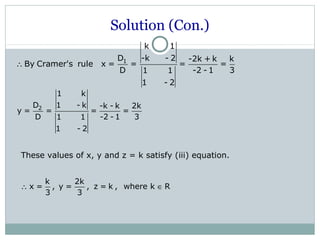
1
k 1
D -k - 2 -2k + k k
By Cramer's rule x = = = =
D -2 - 1 31 1
1 - 2
∴
2
1 k
D 1 - k -k - k 2k
y = = = =
D -2 - 1 31 1
1 - 2
k 2k
x = , y = , z = k , where k R
3 3
∴ ∈
These values of x, y and z = k satisfy (iii) equation.
Thank you

matrices and determinantes

  • 1.
  • 2.
  • 3.
    Session Objectives  Determinantof a Square Matrix  Minors and Cofactors  Properties of Determinants  Applications of Determinants Area of a Triangle Solution of System of Linear Equations (Cramer’s Rule)  Class Exercise
  • 4.
    Determinants If is asquare matrix of order 1, then |A| = | a11 | = a11 ijA = a    If is a square matrix of order 2, then 11 12 21 22 a a A = a a       |A| = = a11a22 – a21a12 a a a a 1 1 1 2 2 1 2 2
  • 5.
    Example 4 - 3 Evaluatethe determinant : 2 5 ( ) 4 - 3 Solution : = 4 ×5 - 2 × -3 = 20 + 6 = 26 2 5
  • 6.
    Solution If A =is a square matrix of order 3, then 11 12 13 21 22 23 31 32 33 a a a a a a a a a          [Expanding along first row] 11 12 13 22 23 21 23 21 22 21 22 23 11 12 13 32 33 31 33 31 32 31 32 33 a a a a a a a a a | A |= a a a = a - a + a a a a a a a a a a ( ) ( ) ( )11 22 33 32 23 12 21 33 31 23 13 21 32 31 22= a a a - a a - a a a - a a + a a a - a a ( ) ( )11 22 33 12 31 23 13 21 32 11 23 32 12 21 33 13 31 22a a a a a a a a a a a a a a a a a a= + + − + +
  • 7.
    Example 2 3 -5 Evaluate the determinant : 7 1 - 2 -3 4 1 ( ) 2 3 - 5 1 - 2 7 - 2 7 1 7 1 - 2 = 2 - 3 + -5 4 1 -3 1 -3 4 -3 4 1 ( ) ( ) ( )= 2 1 + 8 - 3 7 - 6 - 5 28 + 3 = 18 - 3 - 155 = -140 [Expanding along first row] Solution :
  • 8.
    Minors -1 4 If A= , then 2 3       21 21 22 22M = Minor of a = 4, M = Minor of a = -1 11 11 12 12M = Minor of a = 3, M = Minor of a = 2
  • 9.
    Minors 4 7 8 IfA = -9 0 0 , then 2 3 4          M11 = Minor of a11 = determinant of the order 2 × 2 square sub-matrix is obtained by leaving first row and first column of A 0 0 = = 0 3 4 Similarly, M23 = Minor of a23 4 7 = =12-14=-2 2 3 M32 = Minor of a32 etc. 4 8 = = 0+72 =72 -9 0
  • 10.
    Cofactors ( )i+ j ijij ijC = Cofactor of a in A = -1 M , ij ijwhere M is minor of a in A
  • 11.
    Cofactors (Con.) C11 =Cofactor of a11 = (–1)1 + 1 M11 = (–1)1 +1 0 0 = 0 3 4 C23 = Cofactor of a23 = (–1)2 + 3 M23 = − = 4 7 2 2 3 C32 = Cofactor of a32 = (–1)3 + 2 M32 = etc. 4 8 - =-72 -9 0 4 7 8 A = -9 0 0 2 3 4         
  • 12.
    Value of Determinantin Terms of Minors and Cofactors 11 12 13 21 22 23 31 32 33 a a a If A = a a a , then a a a          ( ) 3 3 i j ij ij ij ij j 1 j 1 A 1 a M a C + = = = − =∑ ∑ i1 i1 i2 i2 i3 i3= a C +a C + a C , for i =1 or i = 2 or i = 3
  • 13.
    Properties of Determinants 1.The value of a determinant remains unchanged, if its rows and columns are interchanged. 1 1 1 1 2 3 2 2 2 1 2 3 3 3 3 1 2 3 a b c a a a a b c = b b b a b c c c c i e A A=. . ' 2. If any two rows (or columns) of a determinant are interchanged, then the value of the determinant is changed by minus sign. [ ] 1 1 1 2 2 2 2 2 2 1 1 1 2 1 3 3 3 3 3 3 a b c a b c a b c = - a b c R R a b c a b c Applying ↔
  • 14.
    Properties (Con.) 3. Ifall the elements of a row (or column) is multiplied by a non-zero number k, then the value of the new determinant is k times the value of the original determinant. 1 1 1 1 1 1 2 2 2 2 2 2 3 3 3 3 3 3 ka kb kc a b c a b c = k a b c a b c a b c which also implies 1 1 1 1 1 1 2 2 2 2 2 2 3 3 3 3 3 3 a b c ma mb mc 1 a b c = a b c m a b c a b c
  • 15.
    Properties (Con.) 4. Ifeach element of any row (or column) consists of two or more terms, then the determinant can be expressed as the sum of two or more determinants. 1 1 1 1 1 1 1 1 2 2 2 2 2 2 2 2 3 3 3 3 3 3 3 3 a +x b c a b c x b c a +y b c = a b c + y b c a +z b c a b c z b c 5. The value of a determinant is unchanged, if any row (or column) is multiplied by a number and then added to any other row (or column). [ ] 1 1 1 1 1 1 1 1 2 2 2 2 2 2 2 2 1 1 2 3 3 3 3 3 3 3 3 3 a b c a +mb - nc b c a b c = a +mb - nc b c C C + mC -nC a b c a +mb - nc b c Applying →
  • 16.
    Properties (Con.) 6. Ifany two rows (or columns) of a determinant are identical, then its value is zero. 2 2 2 3 3 3 0 0 0 a b c = 0 a b c 7. If each element of a row (or column) of a determinant is zero, then its value is zero. 1 1 1 2 2 2 1 1 1 a b c a b c = 0 a b c
  • 17.
    Properties (Con.) ( ) a0 0 8 Let A = 0 b 0 be a diagonal matrix, then 0 0 c          a 0 0 = 0 b 0 0 0 c A abc=
  • 18.
    Row(Column) Operations Following arethe notations to evaluate a determinant: Similar notations can be used to denote column operations by replacing R with C. (i) Ri to denote ith row (ii) Ri Rj to denote the interchange of ith and jth rows. (iii) Ri Ri + λRj to denote the addition of λ times the elements of jth row to the corresponding elements of ith row. (iv) λRi to denote the multiplication of all elements of ith row by λ. ↔ ↔
  • 19.
    Evaluation of Determinants Ifa determinant becomes zero on putting is the factor of the determinant.( )x = , then x -α α 2 3 x 5 2 For example, ifΔ = x 9 4 , then at x =2 x 16 8 , because C1 and C2 are identical at x = 2 Hence, (x – 2) is a factor of determinant . ∆ = 0 ∆
  • 20.
    Sign System forExpansion of Determinant Sign System for order 2 and order 3 are given by + – + + – , – + – – + + – +
  • 21.
    ( ) 42 16 6×7 1 6 i 28 7 4 = 4×7 7 4 14 3 2 2×7 3 2 [ ]1 6 1 6 =7 4 7 4 Taking out 7 common from C 2 3 2 Example-1 6 -3 2 2 -1 2 -10 5 2 42 1 6 28 7 4 14 3 2 Find the value of the following determinants (i) (ii) Solution : 1 3= 7 × 0 C and C are identical = 0   Q
  • 22.
    Example –1 (ii) 6-3 2 2 -1 2 -10 5 2 (ii) ( ) ( ) ( ) − × − − = − × − − × − 3 2 3 2 1 2 1 2 5 2 5 2 − − = − − − −   = − ×    = 1 1 2 3 3 2 ( 2) 1 1 2 Taking out 2 common from C 5 5 2 ( 2) 0 C and C are identical 0 Q
  • 23.
    Evaluate the determinant 1a b+c 1 b c+a 1 c a+b Solution : [ ]3 2 3 1 a b+c 1 a a+b+c 1 b c+a = 1 b a+b+c Applying c c +c 1 c a+b 1 c a+b+c → ( ) ( ) 3 1 a 1 = a+b+c 1 b 1 Taking a+b+c common from C 1 c 1    Example - 2 ( ) 1 3= a + b + c × 0 C and C are identical = 0   Q
  • 24.
    2 2 2 ab c We have a b c bc ca ab [ ]2 1 1 2 2 2 3 (a-b) b-c c = (a-b)(a+b) (b-c)(b+c) c Applying C C -C and C C -C -c(a-b) -a(b-c) ab → → ( ) ( )2 1 2 1 1 c Taking a-b and b-c common =(a-b)(b-c) a+b b+c c from C and C respectively -c -a ab       Example - 3 bc 2 2 2 a b c a b c ca ab Evaluate the determinant: Solution:
  • 25.
    [ ]2 1 12 0 1 c =(a-b)(b-c) -(c-a) b+c c Applying c c -c -(c-a) -a ab → 2 0 1 c =-(a-b)(b-c)(c-a) 1 b+c c 1 -a ab [ ]2 2 2 3 0 1 c = -(a-b)(b-c)(c-a) 0 a+b+c c -ab Applying R R -R 1 -a ab → Now expanding along C1 , we get (a-b) (b-c) (c-a) [- (c2 – ab – ac – bc – c2 )] = (a-b) (b-c) (c-a) (ab + bc + ac) Solution Cont.
  • 26.
    Without expanding thedeterminant, prove that 3 3x+y 2x x 4x+3y 3x 3x =x 5x+6y 4x 6x 3x+y 2x x 3x 2x x y 2x x L.H.S= 4x+3y 3x 3x = 4x 3x 3x + 3y 3x 3x 5x+6y 4x 6x 5x 4x 6x 6y 4x 6x 3 2 3 2 1 1 2 1 = x 4 3 3 + x y 3 3 3 5 4 6 6 4 6 Example-4 Solution : [ ]3 2 1 2 3 2 1 = x 4 3 3 +x y×0 C and C are identical in II determinant 5 4 6 Q
  • 27.
    Solution Cont. [ ]3 11 2 1 2 1 = x 1 3 3 Applying C C -C 1 4 6 → [ ]3 2 2 1 3 3 2 1 2 1 = x 0 1 2 ApplyingR R -R and R R -R 0 1 3 → → [ ]3 1 3 = x ×(3-2) Expanding along C =x = R.H.S. 3 3 2 1 =x 4 3 3 5 4 6
  • 28.
    Prove that := 0 , where ω is cube root of unity. 3 5 3 4 5 5 1ω ω ω 1 ω ω ω 1 3 5 3 3 2 3 4 3 3 5 5 3 2 3 2 1ω ω 1 ω ω .ω L.H.S =ω 1 ω = ω 1 ω .ω ω ω 1 ω .ω ω .ω 1 [ ] 2 3 2 2 1 2 1 1ω = 1 1ω ω =1 ω ω 1 =0=R.H.S. C and C are identical   Q Q Example -5 Solution :
  • 29.
    Example-6 2 x+a b c ax+b c =x (x+a+b+c) a b x+C Prove that : [ ]1 1 2 3 x+a b c x+a+b+c b c L.H.S= a x+b c = x+a+b+c x+b c a b x+C x+a+b+c b x+c Applying C C +C +C→ Solution : ( ) ( ) 1 1 b c = x+a+b+c 1 x+b c 1 b x+c Taking x+a+b+c commonfrom C  
  • 30.
    Solution cont. [ ]22 1 3 3 1 1 b c =(x+a+b+c) 0 x 0 0 0 x Applying R R -R and R R -R→ → Expanding along C1 , we get (x + a + b + c) [1(x2 )] = x2 (x + a + b + c) = R.H.S
  • 31.
    [ ]1 12 3 2(a+b+c) 2(a+b+c) 2(a+b+c) = c+a a+b b+c Applying R R +R +R a+b b+c c+a → 1 1 1 =2(a+b+c) c+a a+b b+c a+b b+c c+a Example -7 Solution : Using properties of determinants, prove that 2 2 2 b+c c+a a+b c+a a+b b+c =2(a+b+c)(ab+bc+ca-a -b -c ). a+b b+c c+a b+c c+a a+b L.H.S= c+a a+b b+c a+b b+c c+a
  • 32.
    [ ]1 12 2 2 3 0 0 1 =2(a+b+c) (c-b) (a-c) b+c Applying C C -C and C C - C (a-c) (b-a) c+a → → Now expanding along R1 , we get 2 2(a+b+c) (c-b)(b-a)-(a-c)   2 2 2 =2(a+b+c) bc -b - ac+ab -(a +c -2ac)   Solution Cont. 2 2 2 =2(a+b+c) ab+bc+ac-a -b -c =R.H.S   
  • 33.
    Using properties ofdeterminants prove that 2 x+4 2x 2x 2x x+4 2x =(5x+4)(4-x) 2x 2x x+4 Example - 8 1 2x 2x =(5x+4)1 x+4 2x 1 2x x+4 Solution : [ ]1 1 2 3 x+4 2x 2x 5x+4 2x 2x L.H.S= 2x x+4 2x =5x+4 x+4 2x Applying C C +C +C 2x 2x x+4 5x+4 2x x+4 →
  • 34.
    Solution Cont. [ ]22 1 3 3 2 1 2x 2x =(5x+4) 0 -(x- 4) 0 ApplyingR R -R and R R -R 0 x- 4 -(x- 4) → → Now expanding along C1 , we get 2 (5x+4) 1(x-4) -0   2 =(5x+4)(4-x) =R.H.S
  • 35.
    Example -9 Using propertiesof determinants, prove that x+9 x x x x+9 x =243 (x+3) x x x+9 x+9 x x L.H.S= x x+9 x x x x+9 [ ]1 1 2 3 3x+9 x x = 3x+9 x+9 x Applying C C +C +C 3x+9 x x+9 → Solution :
  • 36.
    [ ]1=3(x+3) 81Expanding along C =243(x+3) =R.H.S. × 1 x x =(3x+9)1 x+9 x 1 x x+9 Solution Cont. ( ) 2 2 1 3 3 2 1 x x =3 x+3 0 9 0 Applying R R -R and R R -R 0 -9 9  → → 
  • 37.
    Example -10 Solution : 22 2 2 2 2 2 2 2 2 1 1 3 2 2 2 2 2 (b+c) a bc b +c a bc L.H.S.= (c+a) b ca = c +a b ca Applying C C -2C (a+b) c ab a +b c ab  →  [ ] 2 2 2 2 2 2 2 2 1 1 2 2 2 2 2 a +b +c a bc a +b +c b ca Applying C C +C a +b +c c ab = → 2 2 2 2 2 2 1 a bc =(a +b +c )1 b ca 1 c ab 2 2 2 2 2 2 2 2 2 (b+c) a bc (c+a) b ca =(a +b +c )(a-b)(b-c)(c-a)(a+b+c) (a+b) c ab Show that
  • 38.
    Solution Cont. [ ] 2 22 2 2 2 1 3 3 2 1 a bc =(a +b +c ) 0 (b-a)(b+a) c(a-b) Applying R R -R and R R -R 0 (c-b)(c+b) a(b-c) → → [ ]2 2 2 2 2 1=(a +b +c )(a-b)(b-c)(-ab-a +bc+c ) Expanding along C 2 2 2 =(a +b +c )(a-b)(b-c)(c-a)(a+b+c)=R.H.S. 2 2 2 2 1 a bc =(a +b +c )(a-b)(b-c) 0 -(b+a) c 0 -(b+c) a ( ) ( ) ( )2 2 2 =(a +b +c )(a-b)(b-c) b c-a + c-a c+a  
  • 39.
    Determinants (Area ofa Triangle) The area of a triangle whose vertices are is given by the expression1 1 2 2 3 3(x , y ), (x , y ) and (x , y ) 1 1 2 2 3 3 x y 1 1 Δ= x y 1 2 x y 1 1 2 3 2 3 1 3 1 2 1 = [x (y - y ) + x (y - y )+ x (y - y )] 2
  • 40.
    Example Find the areaof a triangle whose vertices are (-1, 8), (-2, -3) and (3, 2). Solution : 1 1 2 2 3 3 x y 1 -1 8 1 1 1 Area of triangle= x y 1 = -2 -3 1 2 2 x y 1 3 2 1 [ ] 1 = -1(-3-2)- 8(-2-3)+1(-4+9) 2 [ ] 1 = 5+40+5 =25 sq.units 2
  • 41.
    Condition of Collinearityof Three Points If are three points, then A, B, C are collinear 1 1 2 2 3 3A (x , y ), B (x , y ) and C (x , y ) 1 1 1 1 2 2 2 2 3 3 3 3 Area of triangle ABC = 0 x y 1 x y 1 1 x y 1 = 0 x y 1 = 0 2 x y 1 x y 1 ⇔ ⇔ ⇔
  • 42.
    If the points(x, -2) , (5, 2), (8, 8) are collinear, find x , using determinants. Example Solution : x -2 1 5 2 1 =0 8 8 1 ∴ ( ) ( ) ( ) ( )x 2-8 - -2 5-8 +1 40-16 =0⇒ -6x-6+24=0⇒ 6x =18 x =3⇒ ⇒ Since the given points are collinear.
  • 43.
    Linear Equations (Cramer’s Rule) Letthe system of linear equations be ( )2 2 2a x +b y = c ... ii ( )1 1 1a x +b y = c ... i 1 2D D Then x = , y = provided D 0, D D ≠ 1 1 1 1 1 1 1 2 2 2 2 2 2 2 a b c b a c where D = , D = and D = a b c b a c
  • 44.
    Cramer’s Rule (Con.) thenthe system is consistent and has infinitely many solutions. ( ) 1 22 If D = 0 and D = D = 0, then the system is inconsistent and has no solution. ( )1 If D 0 Note : ,≠ then the system is consistent and has unique solution. ( ) 1 23 If D = 0 and one of D , D 0,≠
  • 45.
    Example 2 -3 D= =2+9=110 3 1 ≠ 1 7 -3 D = =7+15=22 5 1 2 2 7 D = =10-21=-11 3 5 Solution : 1 2 D 0 D D22 -11 By Cramer's Rule x = = =2 and y = = =-1 D 11 D 11 ≠ ∴ Q Using Cramer's rule , solve the following system of equations 2x-3y=7, 3x+y=5
  • 46.
    Linear Equations (Cramer’s Rule) Letthe system of linear equations be ( )2 2 2 2a x +b y+ c z = d ... ii ( )1 1 1 1a x +b y + c z = d ... i ( )3 3 3 3a x +b y + c z = d ... iii 31 2 DD D Then x = , y = z = provided D 0, D D D , ≠ 1 1 1 1 1 1 1 1 1 2 2 2 1 2 2 2 2 2 2 2 3 3 3 3 3 3 3 3 3 a b c d b c a d c where D = a b c , D = d b c , D = a d c a b c d b c a d c 1 1 1 3 2 2 2 3 3 3 a b d and D = a b d a b d
  • 47.
    Cramer’s Rule (Con.) Note: (1)If D ≠ 0, then the system is consistent and has a unique solution. (2) If D=0 and D1 = D2 = D3 = 0, then the system has infinite solutions or no solution. (3) If D = 0 and one of D1, D2, D3 ≠ 0, then the system is inconsistent and has no solution. (4) If d1 = d2 = d3 = 0, then the system is called the system of homogeneous linear equations. (i) If D ≠ 0, then the system has only trivial solution x = y = z = 0. (ii) If D = 0, then the system has infinite solutions.
  • 48.
    Example Using Cramer's rule, solve the following system of equations 5x - y+ 4z = 5 2x + 3y+ 5z = 2 5x - 2y + 6z = -1 Solution : 5 -1 4 D= 2 3 5 5 -2 6 1 5 -1 4 D = 2 3 5 -1 -2 6 = 5(18+10)+1(12+5)+4(-4 +3) = 140 +17 –4 = 153 = 5(18+10) + 1(12-25)+4(-4 -15) = 140 –13 –76 =140 - 89 = 51 0≠
  • 49.
    3 5 -1 5 D= 2 3 2 5 -2 -1 = 5(-3 +4)+1(-2 - 10)+5(-4-15) = 5 – 12 – 95 = 5 - 107 = - 102 Solution Cont. 1 2 3 D 0 D D153 102 By Cramer's Rule x = = =3, y = = =2 D 51 D 51 D -102 and z= = =-2 D 51 ≠ ∴ Q 2 5 5 4 D = 2 2 5 5 -1 6 = 5(12 +5)+5(12 - 25)+ 4(-2 - 10) = 85 + 65 – 48 = 150 - 48 = 102
  • 50.
    Example Solve the followingsystem of homogeneous linear equations: x + y – z = 0, x – 2y + z = 0, 3x + 6y + -5z = 0 Solution: ( ) ( ) ( ) 1 1 - 1 We have D = 1 - 2 1 = 1 10 - 6 - 1 -5 - 3 - 1 6 + 6 3 6 - 5 = 4 + 8 - 12 = 0          The system has infinitely many solutions.∴ Putting z = k, in first two equations, we get x + y = k, x – 2y = -k
  • 51.
    Solution (Con.) 1 k 1 D-k - 2 -2k + k k By Cramer's rule x = = = = D -2 - 1 31 1 1 - 2 ∴ 2 1 k D 1 - k -k - k 2k y = = = = D -2 - 1 31 1 1 - 2 k 2k x = , y = , z = k , where k R 3 3 ∴ ∈ These values of x, y and z = k satisfy (iii) equation.
  • 52.

Editor's Notes

  • #19 If A is the determinant of order 2, then its value can be easily found. But to evaluate determinants of square matrices of higher orders, we should always try to introduce zeros at maximum number of places in a particular row (column) by using properties of determinant.