Linear Algebra for Signal Engineers, AI & ML
Enthusiasts
By
Sandip Kumar Ladi
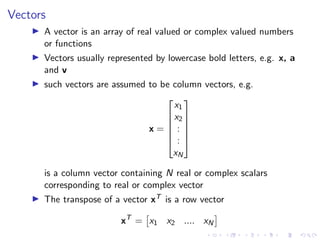
Vectors
▶ A vector is an array of real valued or complex valued numbers
or functions
▶ Vectors usually represented by lowercase bold letters, e.g. x, a
and v
▶ such vectors are assumed to be column vectors, e.g.
x =






x1
x2
:
:
xN






is a column vector containing N real or complex scalars
corresponding to real or complex vector
▶ The transpose of a vector xT is a row vector
xT
=

x1 x2 .... xN
▶ The Hermitian transpose xH is the complex conjugate of the
transpose of x
xH
= (xT
)∗
=

x∗
1 x∗
2 .... x∗
N

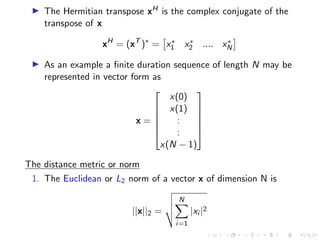
▶ As an example a finite duration sequence of length N may be
represented in vector form as
x =






x(0)
x(1)
:
:
x(N − 1)






The distance metric or norm
1. The Euclidean or L2 norm of a vector x of dimension N is
||x||2 =
v
u
u
t
N
X
i=1
|xi |2
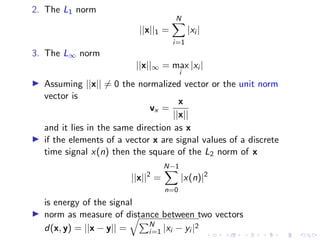
2. The L1 norm
||x||1 =
N
X
i=1
|xi |
3. The L∞ norm
||x||∞ = max
i
|xi |
▶ Assuming ||x|| ̸= 0 the normalized vector or the unit norm
vector is
vx =
x
||x||
and it lies in the same direction as x
▶ if the elements of a vector x are signal values of a discrete
time signal x(n) then the square of the L2 norm of x
||x||2
=
N−1
X
n=0
|x(n)|2
is energy of the signal
▶ norm as measure of distance between two vectors
d(x, y) = ||x − y|| =
qPN
i=1 |xi − yi |2
Inner Product
▶ If a = [a1, ...., aN]T and b = [b1, ...., bN]T are two complex
vectors, the Inner Product is a scalar defined by
 a, b = aH
b =
N
X
i=1
a∗
i bi
for real vectors inner product simplifies to
 a, b = aT
b =
N
X
i=1
ai bi
▶ Inner product defines the geometrical relationship between
two vectors, which is given by
 a, b = ||a|| ||b|| cos θ
θ: angle between the two vectors
▶ Orthogonal vectors: a ̸= 0 and b ̸= 0 but  a, b = 0
▶ Orthonormal vectors:  a, b = 0 and ||a|| = 1, ||b|| = 1
▶ The inner product between two vectors is bounded by the
product of their magnitudes
|  a, b  | ≤ ||a|| ||b||
equality holds when both the vectors are colinear (a = αb for
some constant α) and the above inequality is referred to as
Cauchy-Scwartz inequality
▶ Since ||a ± b||2 = ||a||2 ± 2  a, b  +||b||2 ≥ 0 it follows
that
2|  a, b  | ≤ ||a||2
+ ||b||2
▶ Writing the sample response of an FIR filter h(n) in vector
form given below
h = [h(0), h(1), ..., h(N − 1)]T
The output y(n) of the FIR filter may be written as the inner
product
y(n) =
N−1
X
k=0
h(k)x(n − k) = hT
x(n)
where x(n) = [x(n), x(n − 1), ..., x(n − N + 1)]T
Linear Independence
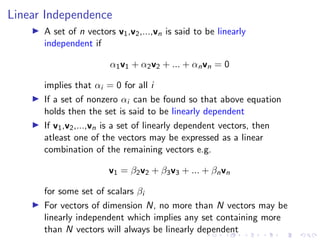
▶ A set of n vectors v1,v2,...,vn is said to be linearly
independent if
α1v1 + α2v2 + ... + αnvn = 0
implies that αi = 0 for all i
▶ If a set of nonzero αi can be found so that above equation
holds then the set is said to be linearly dependent
▶ If v1,v2,...,vn is a set of linearly dependent vectors, then
atleast one of the vectors may be expressed as a linear
combination of the remaining vectors e.g.
v1 = β2v2 + β3v3 + ... + βnvn
for some set of scalars βi
▶ For vectors of dimension N, no more than N vectors may be
linearly independent which implies any set containing more
than N vectors will always be linearly dependent
Vector Spaces and Basis Vectors
▶ Given a set of N vectors V = {v1, v2, ..., vN}, consider the set
of all vectors V that may be formed from a linear combination
of vectors vi i.e. v =
PN
i=1 αi vi and v ∈ V
▶ This set V forms a vector space
▶ The vectors vi are said to span the space V
▶ If the vectors vi are linearly independent then they are said to
form a basis for the space V
▶ The number of vectors in the basis, N, is referred to as the
dimension of the vector space V
▶ Example The set of all real vectors of the form
x = [x1, x2, ..., xN]T forms an N-dimensional vector
space,denoted by RN, that is spanned by the basis vectors,
u1 = [1, 0, 0, ..., 0]T ,u2 = [0, 1, 0, ..., 0]T ,...,uN =
[0, 0, 0, ..., 1]T . In terms of this basis, any vector
v = [v1, v2, ..., vn]T ∈ RN may be uniquely decomposed as
v =
PN
i=1 vi ui
Note:The basis for a vector space is not unique.
Matrices
▶ An n × m matrix is an array of numbers(real or complex)
functions having n rows and m columns.e.g.
A = [aij ] =






a11 a12 .. a1m
a21 a22 .. a2m
. . .
. . .
an1 an2 .. anm






is an n × m matrix of numbers aij and
A(z) = [aij (z)] =






a11(z) a12(z) .. a1m(z)
a21(z) a22(z) .. a2m(z)
. . .
. . .
an1(z) an2(z) .. anm(z)






is an n × m matrix of functions aij (z)
▶ If n = m then A is a n × n square matrix of n rows and n
columns
▶ Example: The output of an FIR-LTI filter with a unit sample
response h(n) may be written in vector form as
y(n) = hT
x(n) = xT
(n)h
if x(n) = 0 for n  0, then we may express y(n) for n ≥ 0 as
X0h = y, where X0 is a convolution matrix defined by
X0 =












x(0) 0 0 .. 0
x(1) x(0) 0 .. 0
x(2) x(1) x(0) .. 0
. . . .
. . . .
x(N − 1) x(N − 2) x(N − 3) .. x(0)
. . . .
. . . .












and y = [y(0), y(1), y(2), ...]T
Note: The elements of X0 in each diagonal are same. X0 has
N − 1 columns and an infinite number of rows.
▶ Matrices can also be represented as a set of column vectors or
row vectors, such as A = [c1, c2, ..., cm] or A =






rH
1
rH
2
.
.
rH
n






▶ A matrix may also be partitioned into submatrices. For
instance the matrix A may be partitioned into
A =

A11 A12
A21 A22

where A11 is p × q,A12 is p × (m − q),A21
is (n − p) × q and A22 is (n − p) × (m − q)
▶ If A is an n × m matrix, then the transpose denoted by AT
is
the m × n matrix that is formed by interchanging the rows
and columns of A
▶ Symmetric matrix: For a square matrix if A = AT
▶ Hermitian Transpose:AH
= (A∗
)T
= (AT
)
∗
▶ Hermitian matrix: For a square complex valued matrix if
A = AH
▶ Properties: (A + B)H = AH
+ BH
, (AH
)H = A and
(AB)H = BH
AH
Matrix Inverse
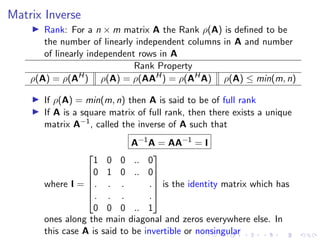
▶ Rank: For a n × m matrix A the Rank ρ(A) is defined to be
the number of linearly independent columns in A and number
of linearly independent rows in A
Rank Property
ρ(A) = ρ(AH
) ρ(A) = ρ(AAH
) = ρ(AH
A) ρ(A) ≤ min(m, n)
▶ If ρ(A) = min(m, n) then A is said to be of full rank
▶ If A is a square matrix of full rank, then there exists a unique
matrix A−1
, called the inverse of A such that
A−1
A = AA−1
= I
where I =






1 0 0 .. 0
0 1 0 .. 0
. . . .
. . . .
0 0 0 .. 1






is the identity matrix which has
ones along the main diagonal and zeros everywhere else. In
this case A is said to be invertible or nonsingular
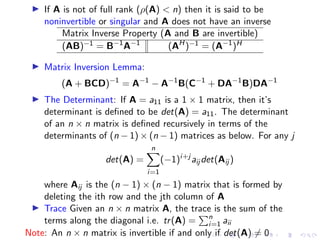
▶ If A is not of full rank (ρ(A)  n) then it is said to be
noninvertible or singular and A does not have an inverse
Matrix Inverse Property (A and B are invertible)
(AB)−1 = B−1
A−1
(AH
)−1 = (A−1
)H
▶ Matrix Inversion Lemma:
(A + BCD)−1
= A−1
− A−1
B(C−1
+ DA−1
B)DA−1
▶ The Determinant: If A = a11 is a 1 × 1 matrix, then it’s
determinant is defined to be det(A) = a11. The determinant
of an n × n matrix is defined recursively in terms of the
determinants of (n − 1) × (n − 1) matrices as below. For any j
det(A) =
n
X
i=1
(−1)i+j
aij det(Aij )
where Aij is the (n − 1) × (n − 1) matrix that is formed by
deleting the ith row and the jth column of A
▶ Trace Given an n × n matrix A, the trace is the sum of the
terms along the diagonal i.e. tr(A) =
Pn
i=1 aii
Note: An n × n matrix is invertible if and only if det(A) ̸= 0
Determinant Property
det(AB) = det(A)det(B) det(αA) = αndet(A)
det(A−1
) = 1
det(A),A is invertible det(AT
) = det(A)
▶ Example For a 2 × 2 matrix
A =

a11 a12
a21 a22

det(A) = a11a22 − a12a21
and for a 3 × 3 matrix
A =


a11 a12 a13
a21 a22 a23
a31 a32 a33


det(A) = a11det

a22 a23
a32 a33

−a12det

a21 a23
a31 a33

+a13det

a21 a22
a31 a32

= a11[a22a33−a23a32]−a12[a21a33−a31a23]+a13[a21a32−a31a22]
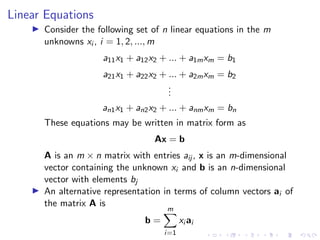
Linear Equations
▶ Consider the following set of n linear equations in the m
unknowns xi , i = 1, 2, ..., m
a11x1 + a12x2 + ... + a1mxm = b1
a21x1 + a22x2 + ... + a2mxm = b2
.
.
.
an1x1 + an2x2 + ... + anmxm = bn
These equations may be written in matrix form as
Ax = b
A is an m × n matrix with entries aij , x is an m-dimensional
vector containing the unknown xi and b is an n-dimensional
vector with elements bj
▶ An alternative representation in terms of column vectors ai of
the matrix A is
b =
m
X
i=1
xi ai
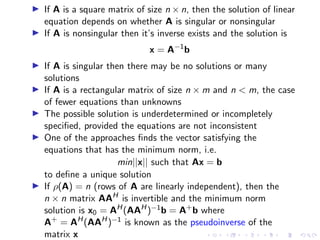
▶ If A is a square matrix of size n × n, then the solution of linear
equation depends on whether A is singular or nonsingular
▶ If A is nonsingular then it’s inverse exists and the solution is
x = A−1
b
▶ If A is singular then there may be no solutions or many
solutions
▶ If A is a rectangular matrix of size n × m and n  m, the case
of fewer equations than unknowns
▶ The possible solution is underdetermined or incompletely
specified, provided the equations are not inconsistent
▶ One of the approaches finds the vector satisfying the
equations that has the minimum norm, i.e.
min||x|| such that Ax = b
to define a unique solution
▶ If ρ(A) = n (rows of A are linearly independent), then the
n × n matrix AAH
is invertible and the minimum norm
solution is x0 = AH
(AAH
)−1b = A+
b where
A+
= AH
(AAH
)−1 is known as the pseudoinverse of the
matrix x
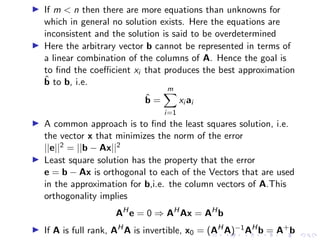
▶ If m  n then there are more equations than unknowns for
which in general no solution exists. Here the equations are
inconsistent and the solution is said to be overdetermined
▶ Here the arbitrary vector b cannot be represented in terms of
a linear combination of the columns of A. Hence the goal is
to find the coefficient xi that produces the best approximation
b̂ to b, i.e.
b̂ =
m
X
i=1
xi ai
▶ A common approach is to find the least squares solution, i.e.
the vector x that minimizes the norm of the error
||e||2 = ||b − Ax||2
▶ Least square solution has the property that the error
e = b − Ax is orthogonal to each of the Vectors that are used
in the approximation for b,i.e. the column vectors of A.This
orthogonality implies
AH
e = 0 ⇒ AH
Ax = AH
b
▶ If A is full rank, AH
A is invertible, x0 = (AH
A)−1AH
b = A+
b
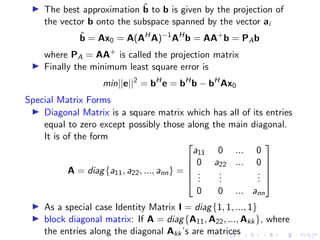
▶ The best approximation b̂ to b is given by the projection of
the vector b onto the subspace spanned by the vector ai
b̂ = Ax0 = A(AH
A)−1
AH
b = AA+
b = PAb
where PA = AA+
is called the projection matrix
▶ Finally the minimum least square error is
min||e||2
= bH
e = bH
b − bH
Ax0
Special Matrix Forms
▶ Diagonal Matrix is a square matrix which has all of its entries
equal to zero except possibly those along the main diagonal.
It is of the form
A = diag{a11, a22, ..., ann} =





a11 0 ... 0
0 a22 ... 0
.
.
.
.
.
.
.
.
.
0 0 ... ann





▶ As a special case Identity Matrix I = diag{1, 1, ..., 1}
▶ block diagonal matrix: If A = diag{A11, A22, ..., Akk}, where
the entries along the diagonal Akk’s are matrices
▶ Exchange Matrix: It is symmetric and has ones along the
cross diagonal and zeros everywhere else.i.e.
J =





0 ... 0 1
0 ... 1 0
.
.
.
.
.
.
.
.
.
1 ... 0 0





▶ Interestingly J2
= I and J−1
= J
▶ when we post multiply a vector v by the exchange matrix J
the order of the entries of v will reverse. i.e.
J[v1, v2, ..., vn]T
= [vn, vn−1, ..., v1]
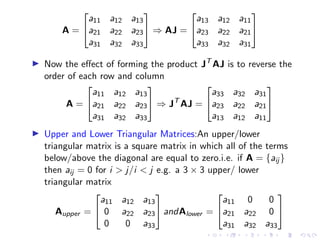
▶ If a matrix A is multiplied on the left by the exchange matrix,
the operation would reverse the order of each column. e.g.
A =


a11 a12 a13
a21 a22 a23
a31 a32 a33

 ⇒ JT
A =


a31 a32 a33
a21 a22 a23
a11 a12 a13


▶ Similarly if A is multiplied on the right by J, then the order of
the entries in each row is reversed
A =


a11 a12 a13
a21 a22 a23
a31 a32 a33

 ⇒ AJ =


a13 a12 a11
a23 a22 a21
a33 a32 a31


▶ Now the effect of forming the product JT
AJ is to reverse the
order of each row and column
A =


a11 a12 a13
a21 a22 a23
a31 a32 a33

 ⇒ JT
AJ =


a33 a32 a31
a23 a22 a21
a13 a12 a11


▶ Upper and Lower Triangular Matrices:An upper/lower
triangular matrix is a square matrix in which all of the terms
below/above the diagonal are equal to zero.i.e. if A = {aij }
then aij = 0 for i  j/i  j e.g. a 3 × 3 upper/ lower
triangular matrix
Aupper =


a11 a12 a13
0 a22 a23
0 0 a33

 andAlower =


a11 0 0
a21 a22 0
a31 a32 a33


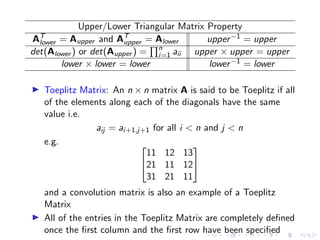
Upper/Lower Triangular Matrix Property
AT
lower = Aupper and AT
upper = Alower upper−1 = upper
det(Alower ) or det(Aupper ) =
Qn
i=1 aii upper × upper = upper
lower × lower = lower lower−1 = lower
▶ Toeplitz Matrix: An n × n matrix A is said to be Toeplitz if all
of the elements along each of the diagonals have the same
value i.e.
aij = ai+1,j+1 for all i  n and j  n
e.g. 

11 12 13
21 11 12
31 21 11


and a convolution matrix is also an example of a Toeplitz
Matrix
▶ All of the entries in the Toeplitz Matrix are completely defined
once the first column and the first row have been specified
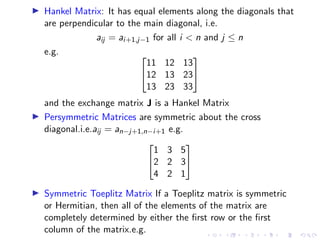
▶ Hankel Matrix: It has equal elements along the diagonals that
are perpendicular to the main diagonal, i.e.
aij = ai+1,j−1 for all i  n and j ≤ n
e.g. 

11 12 13
12 13 23
13 23 33


and the exchange matrix J is a Hankel Matrix
▶ Persymmetric Matrices are symmetric about the cross
diagonal.i.e.aij = an−j+1,n−i+1 e.g.


1 3 5
2 2 3
4 2 1


▶ Symmetric Toeplitz Matrix If a Toeplitz matrix is symmetric
or Hermitian, then all of the elements of the matrix are
completely determined by either the first row or the first
column of the matrix.e.g.


1 3 5
3 1 3
5 3 1


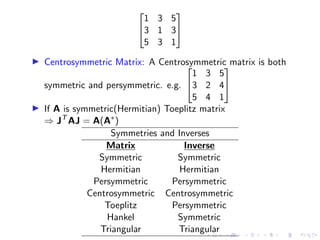
▶ Centrosymmetric Matrix: A Centrosymmetric matrix is both
symmetric and persymmetric. e.g.


1 3 5
3 2 4
5 4 1


▶ If A is symmetric(Hermitian) Toeplitz matrix
⇒ JT
AJ = A(A∗
)
Symmetries and Inverses
Matrix Inverse
Symmetric Symmetric
Hermitian Hermitian
Persymmetric Persymmetric
Centrosymmetric Centrosymmetric
Toeplitz Persymmetric
Hankel Symmetric
Triangular Triangular
▶ Orthogonal Matrix: A real n × n matrix is said to be
orthogonal if the columns(and rows) are orthonormal. i.e. if
the columns of A are ai then
A = [a1, a2, ..., an] and aT
i ai =
(
1 i = j
0 i ̸= j
▶ If A is orthogonal then AT
A = I, thus the inverse A−1
= AT
▶ Example:Exchange Matrix J is an orthogonal Matrix since
JT
J = J2
= I
▶ In a complex n × n Matrix A, if the columns(rows) are
orthogonal
aH
i ai =
(
1 i = j
0 i ̸= j
which implies AH
A = I and A is said to be Unitary matrix
▶ The inverse of a unitary matrix is same as its Hermitian
transpose
A−1
= AH
Quadratic and Hermitian Forms
▶ The quadratic form of a n × n real symmetric matrix A and a
n × n Hermitian matrix C is a scalar and is respectively
defined by
QA(x) = xT Ax =
Pn
i=1
Pn
j=1 xi aij xj
and
QC (x) = xHCx =
Pn
i=1
Pn
j=1 x∗
i aij xj
where xT = [x1, x2, ..., xn] is a vector of n real variables and
also the quadratic form is a quadratic function in the n
variables x1, x2, ..., xn
▶ Example: The quadratic form of A =

2 −1
1 2

is
QA(x) = xT Ax = 2x2
1 + 2x2
2
▶ For any x ̸= 0
Definiteness condition Definiteness condition
+ve definite QA(x)  0 -ve Semidefinite QA(x) ≤ 0
+ve semidefinite QA(x) ≥ 0 indefinite none of above
-ve definite QA(x)  0
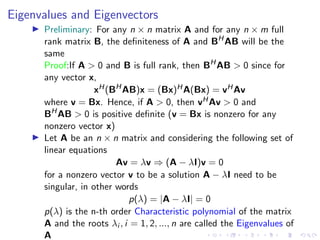
Eigenvalues and Eigenvectors
▶ Preliminary: For any n × n matrix A and for any n × m full
rank matrix B, the definiteness of A and BH
AB will be the
same
Proof:If A  0 and B is full rank, then BH
AB  0 since for
any vector x,
xH(BH
AB)x = (Bx)HA(Bx) = vHAv
where v = Bx. Hence, if A  0, then vHAv  0 and
BH
AB  0 is positive definite (v = Bx is nonzero for any
nonzero vector x)
▶ Let A be an n × n matrix and considering the following set of
linear equations
Av = λv ⇒ (A − λI)v = 0
for a nonzero vector v to be a solution A − λI need to be
singular, in other words
p(λ) = |A − λI| = 0
p(λ) is the n-th order Characteristic polynomial of the matrix
A and the roots λi , i = 1, 2, ..., n are called the Eigenvalues of
A
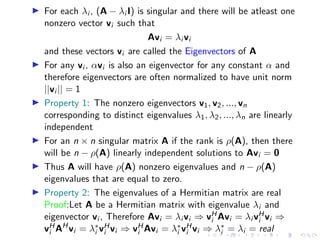
▶ For each λi , (A − λi I) is singular and there will be atleast one
nonzero vector vi such that
Avi = λi vi
and these vectors vi are called the Eigenvectors of A
▶ For any vi , αvi is also an eigenvector for any constant α and
therefore eigenvectors are often normalized to have unit norm
||vi || = 1
▶ Property 1: The nonzero eigenvectors v1, v2, ..., vn
corresponding to distinct eigenvalues λ1, λ2, ..., λn are linearly
independent
▶ For an n × n singular matrix A if the rank is ρ(A), then there
will be n − ρ(A) linearly independent solutions to Avi = 0
▶ Thus A will have ρ(A) nonzero eigenvalues and n − ρ(A)
eigenvalues that are equal to zero.
▶ Property 2: The eigenvalues of a Hermitian matrix are real
Proof:Let A be a Hermitian matrix with eigenvalue λi and
eigenvector vi , Therefore Avi = λi vi ⇒ vH
i Avi = λi vH
i vi ⇒
vH
i AH
vi = λ∗
i vH
i vi ⇒ vH
i Avi = λ∗
i vH
i vi ⇒ λ∗
i = λi = real
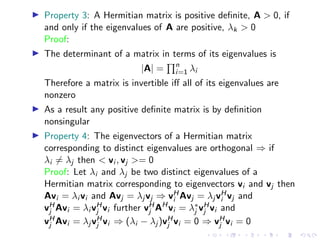
▶ Property 3: A Hermitian matrix is positive definite, A  0, if
and only if the eigenvalues of A are positive, λk  0
Proof:
▶ The determinant of a matrix in terms of its eigenvalues is
|A| =
Qn
i=1 λi
Therefore a matrix is invertible iff all of its eigenvalues are
nonzero
▶ As a result any positive definite matrix is by definition
nonsingular
▶ Property 4: The eigenvectors of a Hermitian matrix
corresponding to distinct eigenvalues are orthogonal ⇒ if
λi ̸= λj then  vi , vj = 0
Proof: Let λi and λj be two distinct eigenvalues of a
Hermitian matrix corresponding to eigenvectors vi and vj then
Avi = λi vi and Avj = λj vj ⇒ vH
i Avj = λj vH
i vj and
vH
j Avi = λi vH
j vi further vH
j AH
vi = λ∗
j vH
j vi and
vH
j Avi = λj vH
j vi ⇒ (λi − λj )vH
j vi = 0 ⇒ vH
j vi = 0
Eigenvalue Decomposition
▶ Let A be an n × n matrix with eigenvalues λk and
eigenvectors vk then
Avk = λkvk for k = 1, 2, ..., n
Matrix form of these n equations are as under
A[v1, v2, ...vn] = [λ1v1, λ2v2, ...λnvn]
Substituting V = [v1, v2, ..., vn] and Λ = diag{λ1, λ2, ..., λn}
we get
AV = VΛ
If the eigenvectors vi are independent then V is invertible and
the decomposition is as follows
A = VΛV−1
▶ Spectral Theorem When a matrix A is Hermitian then V is
unitary and the Eigenvalue Decomposition becomes
A = VΛVH
=
Pn
i=1 λi vi vH
i
This simplified Eigenvalue Decomposition is known as
Spectral Theorem where λi being the eigenvalues and vi are a
set of orthonormal vectors of A
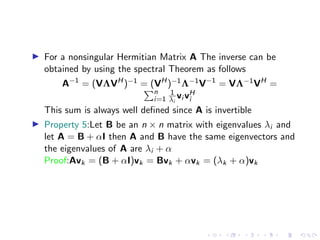
▶ For a nonsingular Hermitian Matrix A The inverse can be
obtained by using the spectral Theorem as follows
A−1
= (VΛVH
)−1 = (VH
)−1Λ−1V−1
= VΛ−1VH
=
Pn
i=1
1
λi
vi vH
i
This sum is always well defined since A is invertible
▶ Property 5:Let B be an n × n matrix with eigenvalues λi and
let A = B + αI then A and B have the same eigenvectors and
the eigenvalues of A are λi + α
Proof:Avk = (B + αI)vk = Bvk + αvk = (λk + α)vk

Linear Algebra for AI & ML

  • 1.
    Linear Algebra forSignal Engineers, AI & ML Enthusiasts By Sandip Kumar Ladi
  • 2.
    Vectors ▶ A vectoris an array of real valued or complex valued numbers or functions ▶ Vectors usually represented by lowercase bold letters, e.g. x, a and v ▶ such vectors are assumed to be column vectors, e.g. x =       x1 x2 : : xN       is a column vector containing N real or complex scalars corresponding to real or complex vector ▶ The transpose of a vector xT is a row vector xT = x1 x2 .... xN
  • 3.
    ▶ The Hermitiantranspose xH is the complex conjugate of the transpose of x xH = (xT )∗ = x∗ 1 x∗ 2 .... x∗ N ▶ As an example a finite duration sequence of length N may be represented in vector form as x =       x(0) x(1) : : x(N − 1)       The distance metric or norm 1. The Euclidean or L2 norm of a vector x of dimension N is ||x||2 = v u u t N X i=1 |xi |2
  • 4.
    2. The L1norm ||x||1 = N X i=1 |xi | 3. The L∞ norm ||x||∞ = max i |xi | ▶ Assuming ||x|| ̸= 0 the normalized vector or the unit norm vector is vx = x ||x|| and it lies in the same direction as x ▶ if the elements of a vector x are signal values of a discrete time signal x(n) then the square of the L2 norm of x ||x||2 = N−1 X n=0 |x(n)|2 is energy of the signal ▶ norm as measure of distance between two vectors d(x, y) = ||x − y|| = qPN i=1 |xi − yi |2
  • 5.
    Inner Product ▶ Ifa = [a1, ...., aN]T and b = [b1, ...., bN]T are two complex vectors, the Inner Product is a scalar defined by a, b = aH b = N X i=1 a∗ i bi for real vectors inner product simplifies to a, b = aT b = N X i=1 ai bi ▶ Inner product defines the geometrical relationship between two vectors, which is given by a, b = ||a|| ||b|| cos θ θ: angle between the two vectors ▶ Orthogonal vectors: a ̸= 0 and b ̸= 0 but a, b = 0 ▶ Orthonormal vectors: a, b = 0 and ||a|| = 1, ||b|| = 1
  • 6.
    ▶ The innerproduct between two vectors is bounded by the product of their magnitudes | a, b | ≤ ||a|| ||b|| equality holds when both the vectors are colinear (a = αb for some constant α) and the above inequality is referred to as Cauchy-Scwartz inequality ▶ Since ||a ± b||2 = ||a||2 ± 2 a, b +||b||2 ≥ 0 it follows that 2| a, b | ≤ ||a||2 + ||b||2 ▶ Writing the sample response of an FIR filter h(n) in vector form given below h = [h(0), h(1), ..., h(N − 1)]T The output y(n) of the FIR filter may be written as the inner product y(n) = N−1 X k=0 h(k)x(n − k) = hT x(n) where x(n) = [x(n), x(n − 1), ..., x(n − N + 1)]T
  • 7.
    Linear Independence ▶ Aset of n vectors v1,v2,...,vn is said to be linearly independent if α1v1 + α2v2 + ... + αnvn = 0 implies that αi = 0 for all i ▶ If a set of nonzero αi can be found so that above equation holds then the set is said to be linearly dependent ▶ If v1,v2,...,vn is a set of linearly dependent vectors, then atleast one of the vectors may be expressed as a linear combination of the remaining vectors e.g. v1 = β2v2 + β3v3 + ... + βnvn for some set of scalars βi ▶ For vectors of dimension N, no more than N vectors may be linearly independent which implies any set containing more than N vectors will always be linearly dependent
  • 8.
    Vector Spaces andBasis Vectors ▶ Given a set of N vectors V = {v1, v2, ..., vN}, consider the set of all vectors V that may be formed from a linear combination of vectors vi i.e. v = PN i=1 αi vi and v ∈ V ▶ This set V forms a vector space ▶ The vectors vi are said to span the space V ▶ If the vectors vi are linearly independent then they are said to form a basis for the space V ▶ The number of vectors in the basis, N, is referred to as the dimension of the vector space V ▶ Example The set of all real vectors of the form x = [x1, x2, ..., xN]T forms an N-dimensional vector space,denoted by RN, that is spanned by the basis vectors, u1 = [1, 0, 0, ..., 0]T ,u2 = [0, 1, 0, ..., 0]T ,...,uN = [0, 0, 0, ..., 1]T . In terms of this basis, any vector v = [v1, v2, ..., vn]T ∈ RN may be uniquely decomposed as v = PN i=1 vi ui Note:The basis for a vector space is not unique.
  • 9.
    Matrices ▶ An n× m matrix is an array of numbers(real or complex) functions having n rows and m columns.e.g. A = [aij ] =       a11 a12 .. a1m a21 a22 .. a2m . . . . . . an1 an2 .. anm       is an n × m matrix of numbers aij and A(z) = [aij (z)] =       a11(z) a12(z) .. a1m(z) a21(z) a22(z) .. a2m(z) . . . . . . an1(z) an2(z) .. anm(z)       is an n × m matrix of functions aij (z) ▶ If n = m then A is a n × n square matrix of n rows and n columns
  • 10.
    ▶ Example: Theoutput of an FIR-LTI filter with a unit sample response h(n) may be written in vector form as y(n) = hT x(n) = xT (n)h if x(n) = 0 for n 0, then we may express y(n) for n ≥ 0 as X0h = y, where X0 is a convolution matrix defined by X0 =             x(0) 0 0 .. 0 x(1) x(0) 0 .. 0 x(2) x(1) x(0) .. 0 . . . . . . . . x(N − 1) x(N − 2) x(N − 3) .. x(0) . . . . . . . .             and y = [y(0), y(1), y(2), ...]T Note: The elements of X0 in each diagonal are same. X0 has N − 1 columns and an infinite number of rows.
  • 11.
    ▶ Matrices canalso be represented as a set of column vectors or row vectors, such as A = [c1, c2, ..., cm] or A =       rH 1 rH 2 . . rH n       ▶ A matrix may also be partitioned into submatrices. For instance the matrix A may be partitioned into A = A11 A12 A21 A22 where A11 is p × q,A12 is p × (m − q),A21 is (n − p) × q and A22 is (n − p) × (m − q) ▶ If A is an n × m matrix, then the transpose denoted by AT is the m × n matrix that is formed by interchanging the rows and columns of A ▶ Symmetric matrix: For a square matrix if A = AT ▶ Hermitian Transpose:AH = (A∗ )T = (AT ) ∗ ▶ Hermitian matrix: For a square complex valued matrix if A = AH ▶ Properties: (A + B)H = AH + BH , (AH )H = A and (AB)H = BH AH
  • 12.
    Matrix Inverse ▶ Rank:For a n × m matrix A the Rank ρ(A) is defined to be the number of linearly independent columns in A and number of linearly independent rows in A Rank Property ρ(A) = ρ(AH ) ρ(A) = ρ(AAH ) = ρ(AH A) ρ(A) ≤ min(m, n) ▶ If ρ(A) = min(m, n) then A is said to be of full rank ▶ If A is a square matrix of full rank, then there exists a unique matrix A−1 , called the inverse of A such that A−1 A = AA−1 = I where I =       1 0 0 .. 0 0 1 0 .. 0 . . . . . . . . 0 0 0 .. 1       is the identity matrix which has ones along the main diagonal and zeros everywhere else. In this case A is said to be invertible or nonsingular
  • 13.
    ▶ If Ais not of full rank (ρ(A) n) then it is said to be noninvertible or singular and A does not have an inverse Matrix Inverse Property (A and B are invertible) (AB)−1 = B−1 A−1 (AH )−1 = (A−1 )H ▶ Matrix Inversion Lemma: (A + BCD)−1 = A−1 − A−1 B(C−1 + DA−1 B)DA−1 ▶ The Determinant: If A = a11 is a 1 × 1 matrix, then it’s determinant is defined to be det(A) = a11. The determinant of an n × n matrix is defined recursively in terms of the determinants of (n − 1) × (n − 1) matrices as below. For any j det(A) = n X i=1 (−1)i+j aij det(Aij ) where Aij is the (n − 1) × (n − 1) matrix that is formed by deleting the ith row and the jth column of A ▶ Trace Given an n × n matrix A, the trace is the sum of the terms along the diagonal i.e. tr(A) = Pn i=1 aii Note: An n × n matrix is invertible if and only if det(A) ̸= 0
  • 14.
    Determinant Property det(AB) =det(A)det(B) det(αA) = αndet(A) det(A−1 ) = 1 det(A),A is invertible det(AT ) = det(A) ▶ Example For a 2 × 2 matrix A = a11 a12 a21 a22 det(A) = a11a22 − a12a21 and for a 3 × 3 matrix A =   a11 a12 a13 a21 a22 a23 a31 a32 a33   det(A) = a11det a22 a23 a32 a33 −a12det a21 a23 a31 a33 +a13det a21 a22 a31 a32 = a11[a22a33−a23a32]−a12[a21a33−a31a23]+a13[a21a32−a31a22]
  • 15.
    Linear Equations ▶ Considerthe following set of n linear equations in the m unknowns xi , i = 1, 2, ..., m a11x1 + a12x2 + ... + a1mxm = b1 a21x1 + a22x2 + ... + a2mxm = b2 . . . an1x1 + an2x2 + ... + anmxm = bn These equations may be written in matrix form as Ax = b A is an m × n matrix with entries aij , x is an m-dimensional vector containing the unknown xi and b is an n-dimensional vector with elements bj ▶ An alternative representation in terms of column vectors ai of the matrix A is b = m X i=1 xi ai
  • 16.
    ▶ If Ais a square matrix of size n × n, then the solution of linear equation depends on whether A is singular or nonsingular ▶ If A is nonsingular then it’s inverse exists and the solution is x = A−1 b ▶ If A is singular then there may be no solutions or many solutions ▶ If A is a rectangular matrix of size n × m and n m, the case of fewer equations than unknowns ▶ The possible solution is underdetermined or incompletely specified, provided the equations are not inconsistent ▶ One of the approaches finds the vector satisfying the equations that has the minimum norm, i.e. min||x|| such that Ax = b to define a unique solution ▶ If ρ(A) = n (rows of A are linearly independent), then the n × n matrix AAH is invertible and the minimum norm solution is x0 = AH (AAH )−1b = A+ b where A+ = AH (AAH )−1 is known as the pseudoinverse of the matrix x
  • 17.
    ▶ If m n then there are more equations than unknowns for which in general no solution exists. Here the equations are inconsistent and the solution is said to be overdetermined ▶ Here the arbitrary vector b cannot be represented in terms of a linear combination of the columns of A. Hence the goal is to find the coefficient xi that produces the best approximation b̂ to b, i.e. b̂ = m X i=1 xi ai ▶ A common approach is to find the least squares solution, i.e. the vector x that minimizes the norm of the error ||e||2 = ||b − Ax||2 ▶ Least square solution has the property that the error e = b − Ax is orthogonal to each of the Vectors that are used in the approximation for b,i.e. the column vectors of A.This orthogonality implies AH e = 0 ⇒ AH Ax = AH b ▶ If A is full rank, AH A is invertible, x0 = (AH A)−1AH b = A+ b
  • 18.
    ▶ The bestapproximation b̂ to b is given by the projection of the vector b onto the subspace spanned by the vector ai b̂ = Ax0 = A(AH A)−1 AH b = AA+ b = PAb where PA = AA+ is called the projection matrix ▶ Finally the minimum least square error is min||e||2 = bH e = bH b − bH Ax0 Special Matrix Forms ▶ Diagonal Matrix is a square matrix which has all of its entries equal to zero except possibly those along the main diagonal. It is of the form A = diag{a11, a22, ..., ann} =      a11 0 ... 0 0 a22 ... 0 . . . . . . . . . 0 0 ... ann      ▶ As a special case Identity Matrix I = diag{1, 1, ..., 1} ▶ block diagonal matrix: If A = diag{A11, A22, ..., Akk}, where the entries along the diagonal Akk’s are matrices
  • 19.
    ▶ Exchange Matrix:It is symmetric and has ones along the cross diagonal and zeros everywhere else.i.e. J =      0 ... 0 1 0 ... 1 0 . . . . . . . . . 1 ... 0 0      ▶ Interestingly J2 = I and J−1 = J ▶ when we post multiply a vector v by the exchange matrix J the order of the entries of v will reverse. i.e. J[v1, v2, ..., vn]T = [vn, vn−1, ..., v1] ▶ If a matrix A is multiplied on the left by the exchange matrix, the operation would reverse the order of each column. e.g. A =   a11 a12 a13 a21 a22 a23 a31 a32 a33   ⇒ JT A =   a31 a32 a33 a21 a22 a23 a11 a12 a13   ▶ Similarly if A is multiplied on the right by J, then the order of the entries in each row is reversed
  • 20.
    A =   a11 a12a13 a21 a22 a23 a31 a32 a33   ⇒ AJ =   a13 a12 a11 a23 a22 a21 a33 a32 a31   ▶ Now the effect of forming the product JT AJ is to reverse the order of each row and column A =   a11 a12 a13 a21 a22 a23 a31 a32 a33   ⇒ JT AJ =   a33 a32 a31 a23 a22 a21 a13 a12 a11   ▶ Upper and Lower Triangular Matrices:An upper/lower triangular matrix is a square matrix in which all of the terms below/above the diagonal are equal to zero.i.e. if A = {aij } then aij = 0 for i j/i j e.g. a 3 × 3 upper/ lower triangular matrix Aupper =   a11 a12 a13 0 a22 a23 0 0 a33   andAlower =   a11 0 0 a21 a22 0 a31 a32 a33  
  • 21.
    Upper/Lower Triangular MatrixProperty AT lower = Aupper and AT upper = Alower upper−1 = upper det(Alower ) or det(Aupper ) = Qn i=1 aii upper × upper = upper lower × lower = lower lower−1 = lower ▶ Toeplitz Matrix: An n × n matrix A is said to be Toeplitz if all of the elements along each of the diagonals have the same value i.e. aij = ai+1,j+1 for all i n and j n e.g.   11 12 13 21 11 12 31 21 11   and a convolution matrix is also an example of a Toeplitz Matrix ▶ All of the entries in the Toeplitz Matrix are completely defined once the first column and the first row have been specified
  • 22.
    ▶ Hankel Matrix:It has equal elements along the diagonals that are perpendicular to the main diagonal, i.e. aij = ai+1,j−1 for all i n and j ≤ n e.g.   11 12 13 12 13 23 13 23 33   and the exchange matrix J is a Hankel Matrix ▶ Persymmetric Matrices are symmetric about the cross diagonal.i.e.aij = an−j+1,n−i+1 e.g.   1 3 5 2 2 3 4 2 1   ▶ Symmetric Toeplitz Matrix If a Toeplitz matrix is symmetric or Hermitian, then all of the elements of the matrix are completely determined by either the first row or the first column of the matrix.e.g.
  • 23.
      1 3 5 31 3 5 3 1   ▶ Centrosymmetric Matrix: A Centrosymmetric matrix is both symmetric and persymmetric. e.g.   1 3 5 3 2 4 5 4 1   ▶ If A is symmetric(Hermitian) Toeplitz matrix ⇒ JT AJ = A(A∗ ) Symmetries and Inverses Matrix Inverse Symmetric Symmetric Hermitian Hermitian Persymmetric Persymmetric Centrosymmetric Centrosymmetric Toeplitz Persymmetric Hankel Symmetric Triangular Triangular
  • 24.
    ▶ Orthogonal Matrix:A real n × n matrix is said to be orthogonal if the columns(and rows) are orthonormal. i.e. if the columns of A are ai then A = [a1, a2, ..., an] and aT i ai = ( 1 i = j 0 i ̸= j ▶ If A is orthogonal then AT A = I, thus the inverse A−1 = AT ▶ Example:Exchange Matrix J is an orthogonal Matrix since JT J = J2 = I ▶ In a complex n × n Matrix A, if the columns(rows) are orthogonal aH i ai = ( 1 i = j 0 i ̸= j which implies AH A = I and A is said to be Unitary matrix ▶ The inverse of a unitary matrix is same as its Hermitian transpose A−1 = AH
  • 25.
    Quadratic and HermitianForms ▶ The quadratic form of a n × n real symmetric matrix A and a n × n Hermitian matrix C is a scalar and is respectively defined by QA(x) = xT Ax = Pn i=1 Pn j=1 xi aij xj and QC (x) = xHCx = Pn i=1 Pn j=1 x∗ i aij xj where xT = [x1, x2, ..., xn] is a vector of n real variables and also the quadratic form is a quadratic function in the n variables x1, x2, ..., xn ▶ Example: The quadratic form of A = 2 −1 1 2 is QA(x) = xT Ax = 2x2 1 + 2x2 2 ▶ For any x ̸= 0 Definiteness condition Definiteness condition +ve definite QA(x) 0 -ve Semidefinite QA(x) ≤ 0 +ve semidefinite QA(x) ≥ 0 indefinite none of above -ve definite QA(x) 0
  • 26.
    Eigenvalues and Eigenvectors ▶Preliminary: For any n × n matrix A and for any n × m full rank matrix B, the definiteness of A and BH AB will be the same Proof:If A 0 and B is full rank, then BH AB 0 since for any vector x, xH(BH AB)x = (Bx)HA(Bx) = vHAv where v = Bx. Hence, if A 0, then vHAv 0 and BH AB 0 is positive definite (v = Bx is nonzero for any nonzero vector x) ▶ Let A be an n × n matrix and considering the following set of linear equations Av = λv ⇒ (A − λI)v = 0 for a nonzero vector v to be a solution A − λI need to be singular, in other words p(λ) = |A − λI| = 0 p(λ) is the n-th order Characteristic polynomial of the matrix A and the roots λi , i = 1, 2, ..., n are called the Eigenvalues of A
  • 27.
    ▶ For eachλi , (A − λi I) is singular and there will be atleast one nonzero vector vi such that Avi = λi vi and these vectors vi are called the Eigenvectors of A ▶ For any vi , αvi is also an eigenvector for any constant α and therefore eigenvectors are often normalized to have unit norm ||vi || = 1 ▶ Property 1: The nonzero eigenvectors v1, v2, ..., vn corresponding to distinct eigenvalues λ1, λ2, ..., λn are linearly independent ▶ For an n × n singular matrix A if the rank is ρ(A), then there will be n − ρ(A) linearly independent solutions to Avi = 0 ▶ Thus A will have ρ(A) nonzero eigenvalues and n − ρ(A) eigenvalues that are equal to zero. ▶ Property 2: The eigenvalues of a Hermitian matrix are real Proof:Let A be a Hermitian matrix with eigenvalue λi and eigenvector vi , Therefore Avi = λi vi ⇒ vH i Avi = λi vH i vi ⇒ vH i AH vi = λ∗ i vH i vi ⇒ vH i Avi = λ∗ i vH i vi ⇒ λ∗ i = λi = real
  • 28.
    ▶ Property 3:A Hermitian matrix is positive definite, A 0, if and only if the eigenvalues of A are positive, λk 0 Proof: ▶ The determinant of a matrix in terms of its eigenvalues is |A| = Qn i=1 λi Therefore a matrix is invertible iff all of its eigenvalues are nonzero ▶ As a result any positive definite matrix is by definition nonsingular ▶ Property 4: The eigenvectors of a Hermitian matrix corresponding to distinct eigenvalues are orthogonal ⇒ if λi ̸= λj then vi , vj = 0 Proof: Let λi and λj be two distinct eigenvalues of a Hermitian matrix corresponding to eigenvectors vi and vj then Avi = λi vi and Avj = λj vj ⇒ vH i Avj = λj vH i vj and vH j Avi = λi vH j vi further vH j AH vi = λ∗ j vH j vi and vH j Avi = λj vH j vi ⇒ (λi − λj )vH j vi = 0 ⇒ vH j vi = 0
  • 29.
    Eigenvalue Decomposition ▶ LetA be an n × n matrix with eigenvalues λk and eigenvectors vk then Avk = λkvk for k = 1, 2, ..., n Matrix form of these n equations are as under A[v1, v2, ...vn] = [λ1v1, λ2v2, ...λnvn] Substituting V = [v1, v2, ..., vn] and Λ = diag{λ1, λ2, ..., λn} we get AV = VΛ If the eigenvectors vi are independent then V is invertible and the decomposition is as follows A = VΛV−1 ▶ Spectral Theorem When a matrix A is Hermitian then V is unitary and the Eigenvalue Decomposition becomes A = VΛVH = Pn i=1 λi vi vH i This simplified Eigenvalue Decomposition is known as Spectral Theorem where λi being the eigenvalues and vi are a set of orthonormal vectors of A
  • 30.
    ▶ For anonsingular Hermitian Matrix A The inverse can be obtained by using the spectral Theorem as follows A−1 = (VΛVH )−1 = (VH )−1Λ−1V−1 = VΛ−1VH = Pn i=1 1 λi vi vH i This sum is always well defined since A is invertible ▶ Property 5:Let B be an n × n matrix with eigenvalues λi and let A = B + αI then A and B have the same eigenvectors and the eigenvalues of A are λi + α Proof:Avk = (B + αI)vk = Bvk + αvk = (λk + α)vk