Presented By:
Anuradha Verma
What is Mössbauer spectroscopy
• Named after its discoverer Rudolf
Mössbauer in 1957.
• Received a noble prize in 1961.
• Consists of the recoil-free, resonant
absorption and emission of gamma rays in
solids.
• Involves transitions between energy levels
within the nuclei of atoms.
Principle
• Heavier elements when formed by the
radioactive decay of an isotope of the same or
different element are initially produced in an
excited nuclear state.
• After a very short delay, of the order of
microseconds, the excited nucleus reverts to
the ground state and emits energy of very high
frequency, usually in the gamma-ray region of
spectrum.
• Study of this gamma-ray emission and
subsequent reabsorption constitutes Mössbauer
spectroscopy.
Interaction of spin and magnetic
field
• Charged particle spinning about an axis constitutes a circular electric
current which in turn produces a magnetic dipole.
• The spinning particle behaves as a tiny bar magnet placed along the spin
axis.
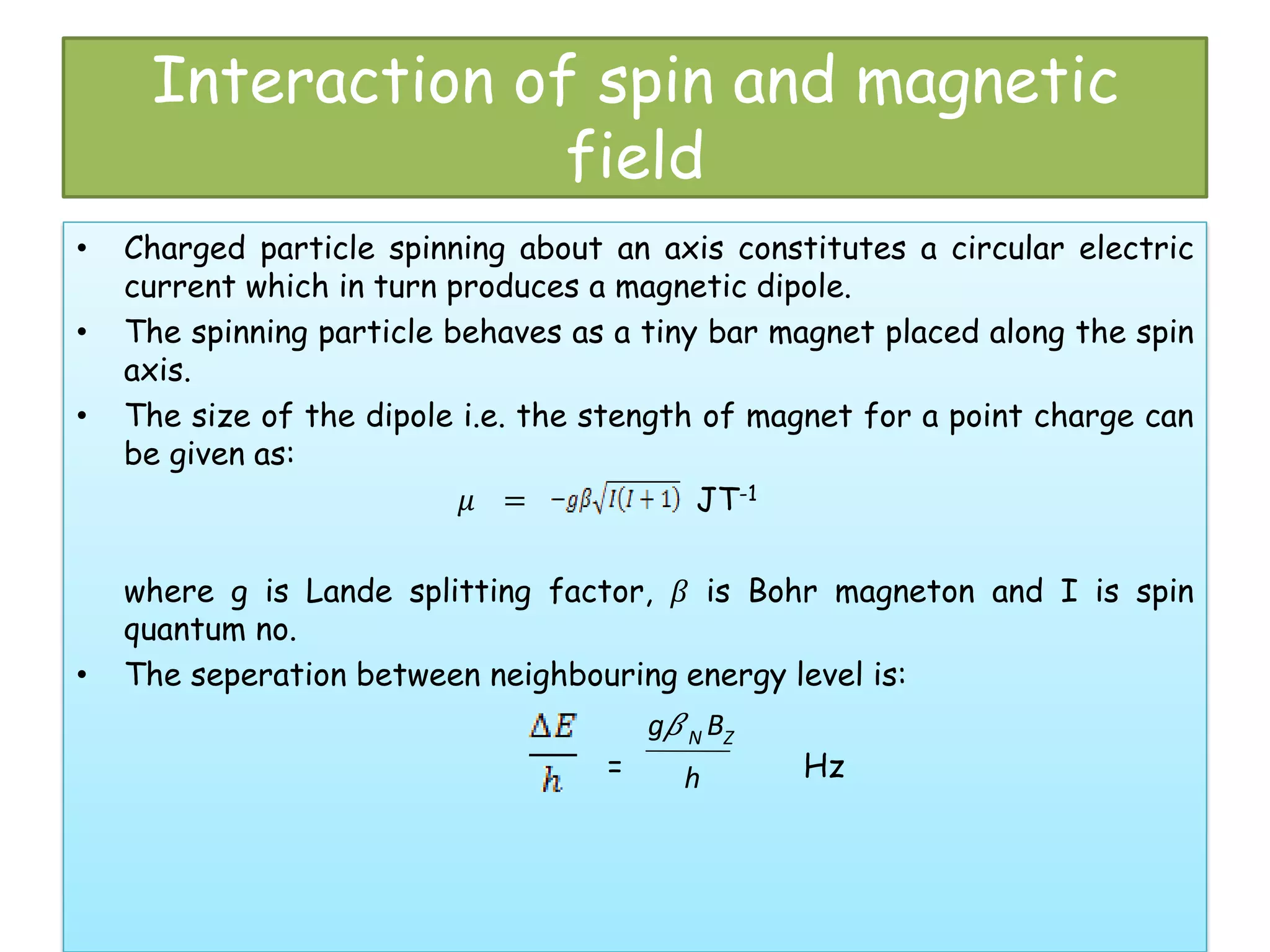
• The size of the dipole i.e. the stength of magnet for a point charge can
be given as:
� = JT-1
where g is Lande splitting factor, � is Bohr magneton and I is spin
quantum no.
• The seperation between neighbouring energy level is:
= Hz
g�N BZ
h
Effect of a Magnetic Field
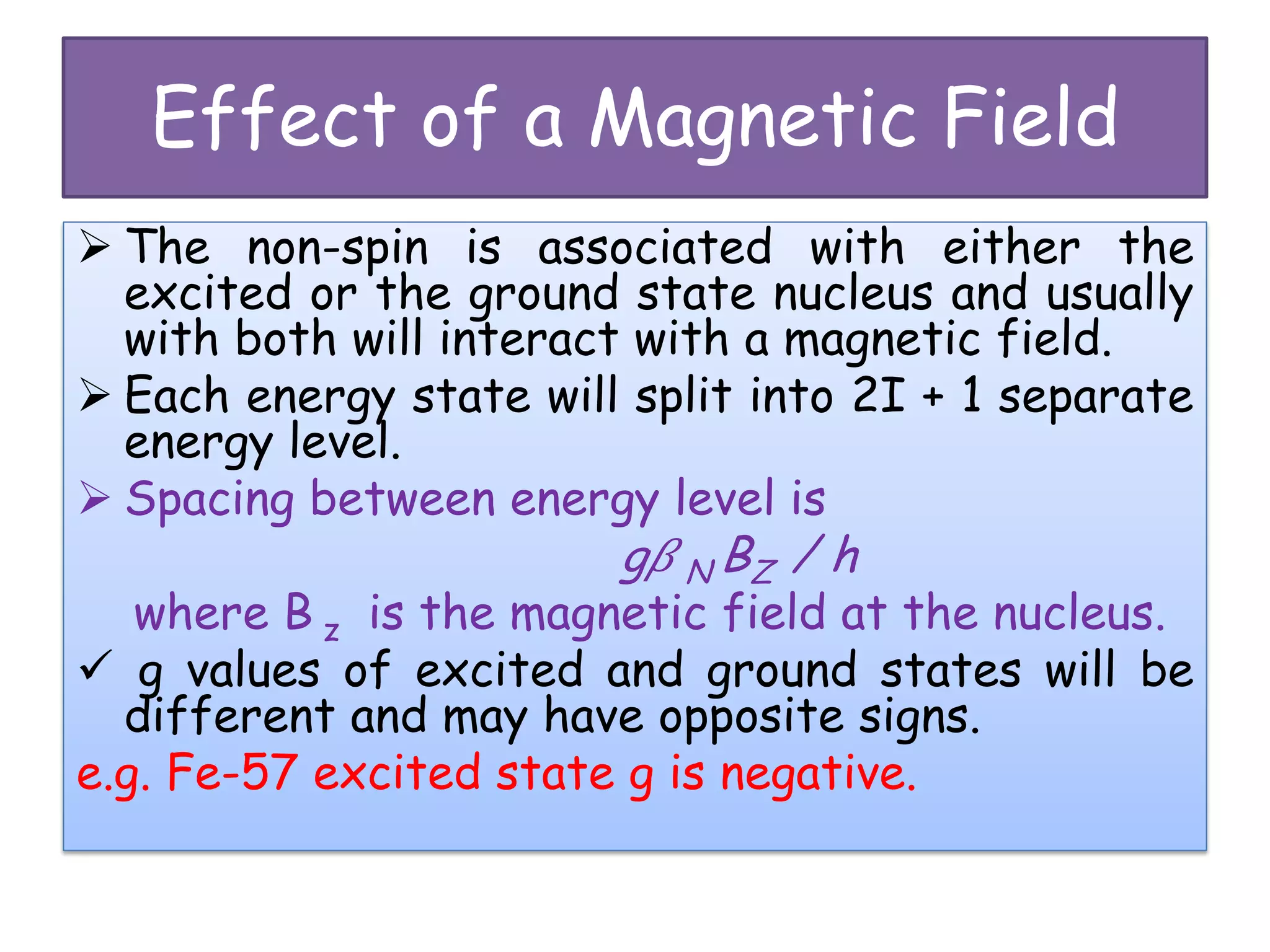
 The non-spin is associated with either the
excited or the ground state nucleus and usually
with both will interact with a magnetic field.
 Each energy state will split into 2I + 1 separate
energy level.
 Spacing between energy level is
g� N BZ / h
where B z is the magnetic field at the nucleus.
 g values of excited and ground states will be
different and may have opposite signs.
e.g. Fe-57 excited state g is negative.
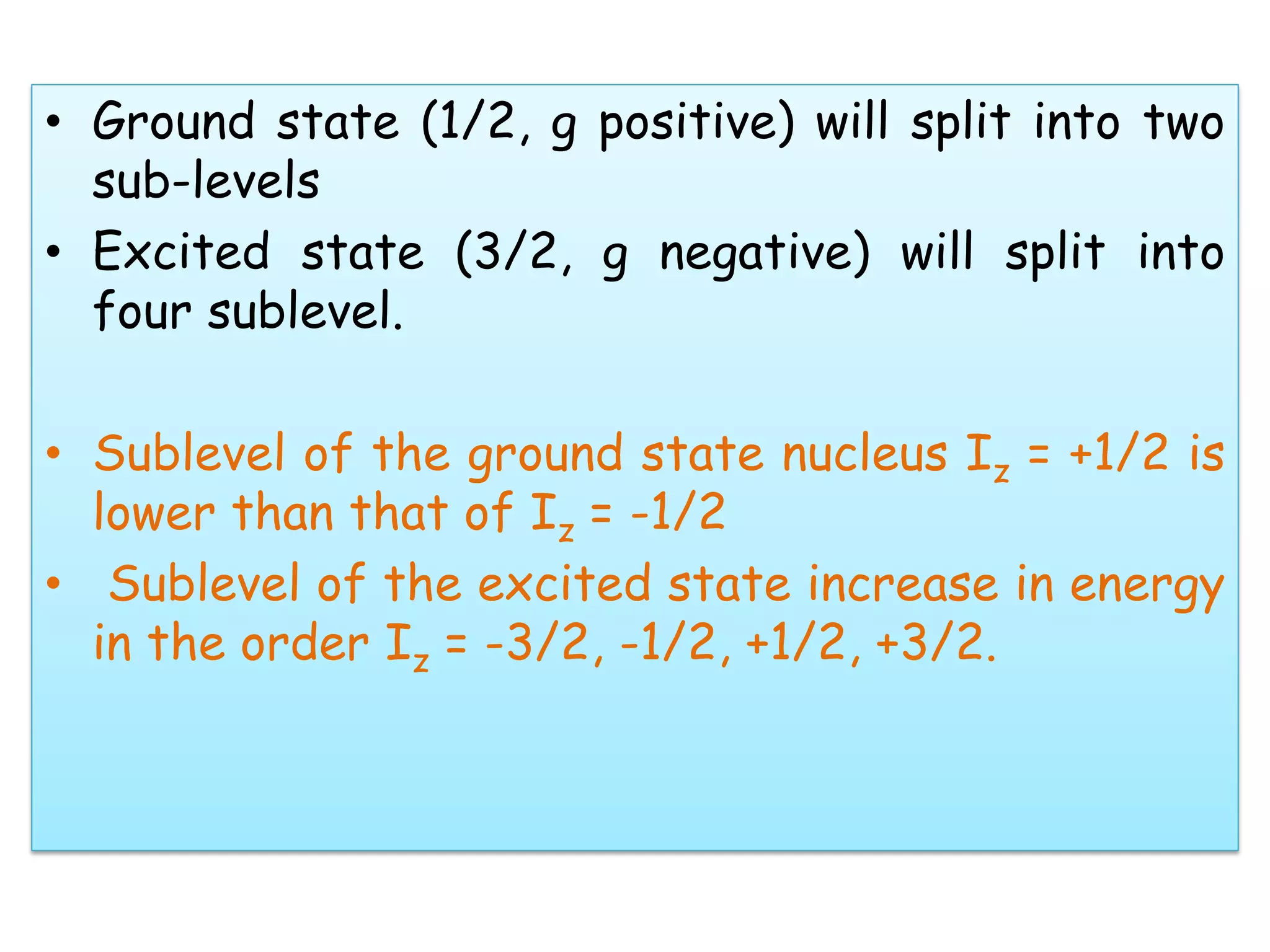
• Ground state (1/2, g positive) will split into two
sub-levels
• Excited state (3/2, g negative) will split into
four sublevel.
• Sublevel of the ground state nucleus Iz = +1/2 is
lower than that of Iz = -1/2
• Sublevel of the excited state increase in energy
in the order Iz = -3/2, -1/2, +1/2, +3/2.
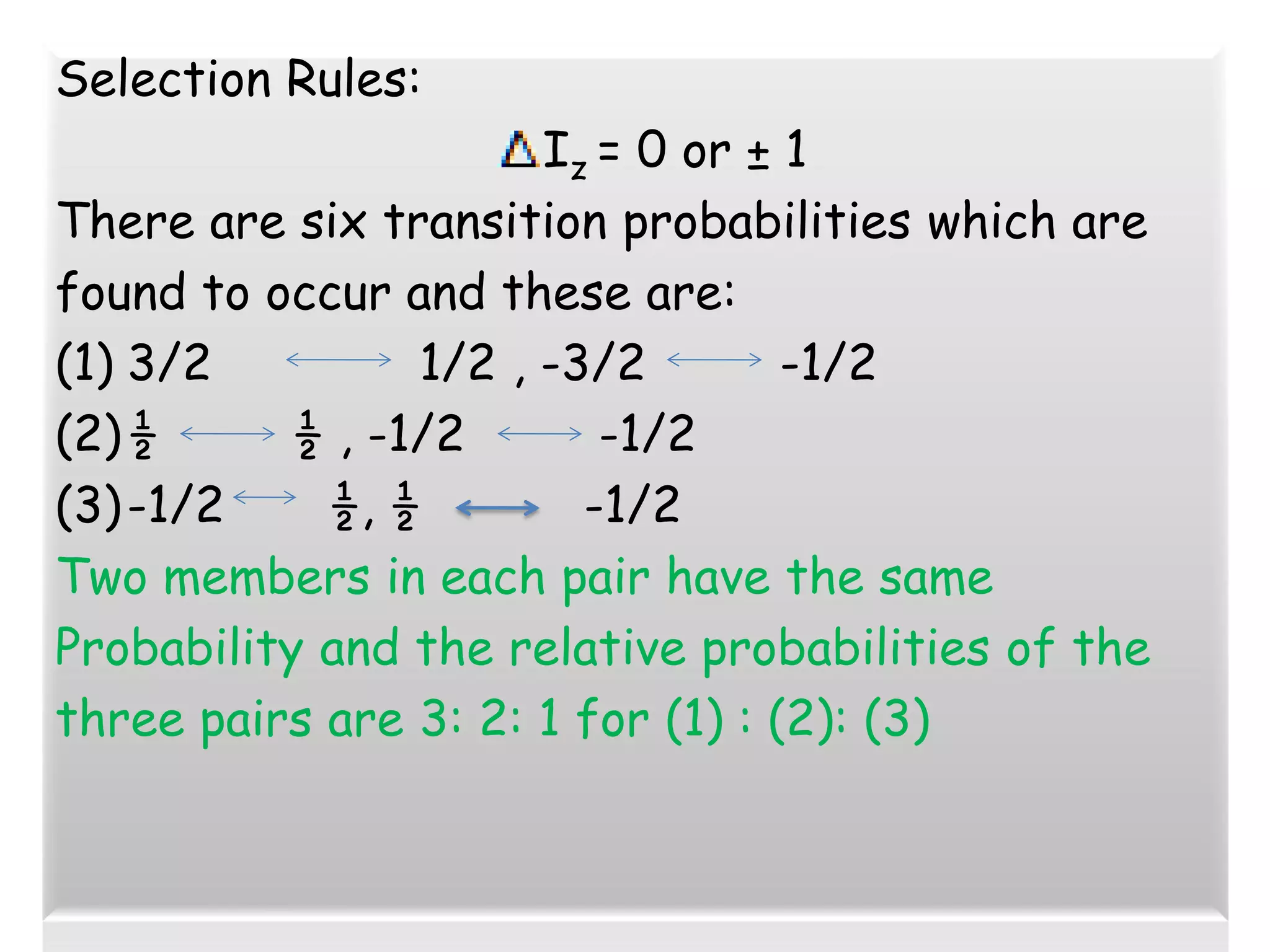
Selection Rules:
Iz = 0 or ± 1
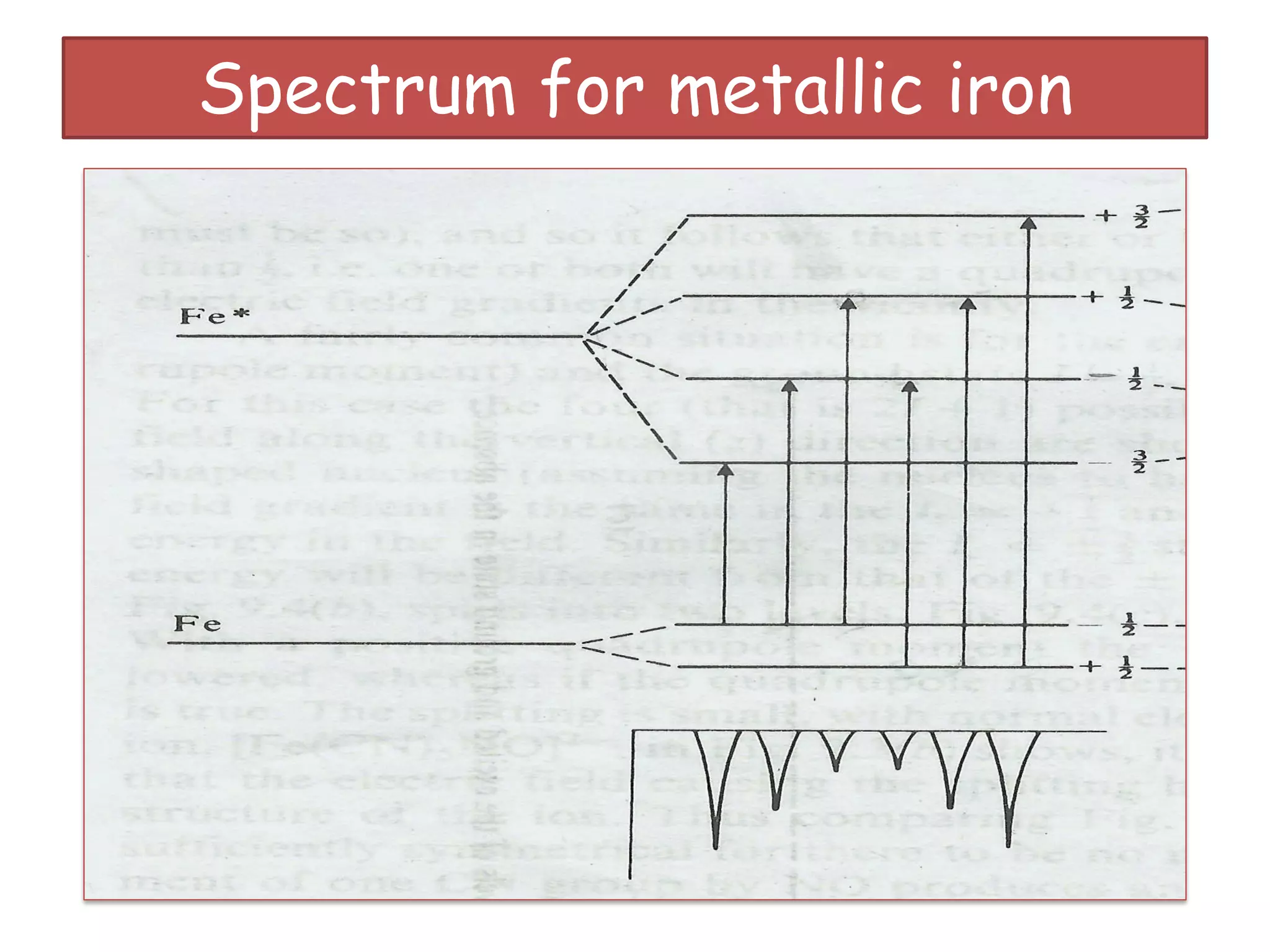
There are six transition probabilities which are
found to occur and these are:
(1) 3/2 1/2 , -3/2 -1/2
(2)½ ½ , -1/2 -1/2
(3)-1/2 ½, ½ -1/2
Two members in each pair have the same
Probability and the relative probabilities of the
three pairs are 3: 2: 1 for (1) : (2): (3)
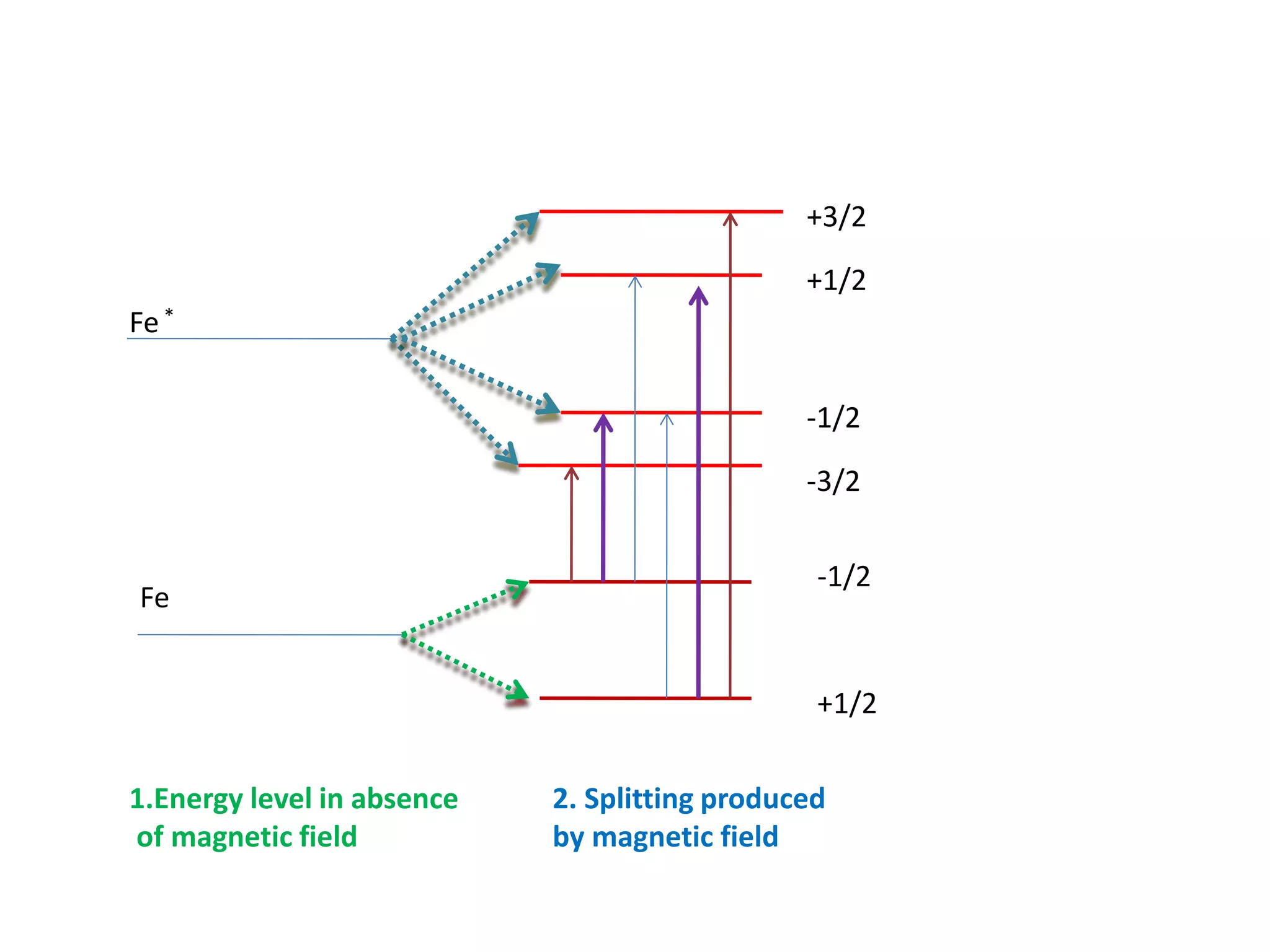
Fe*
Fe
+3/2
-3/2
-1/2
+1/2
-1/2
+1/2
1.Energy level in absence
of magnetic field
2. Splitting produced
by magnetic field
Spectrum for metallic iron
Magnetic field necessary to cause the energy
level splitting may be applied externally, but it
happens that internal effects within the sample
produce sufficient field to cause observable
splitting.
By using external field we can calibrate the
spectrum and can estimate the magnitude of
internal field.
Field of 20-50 T found for various compound of
57 Fe (Large compared to fields created by
superconducting magnets just 5-10 T)
Note:-
Internal fields does not extends
uniformly throughout the bulk sample
and is extremely localized effect.
Formed by interaction of the nucleus
with surrounding electrons.
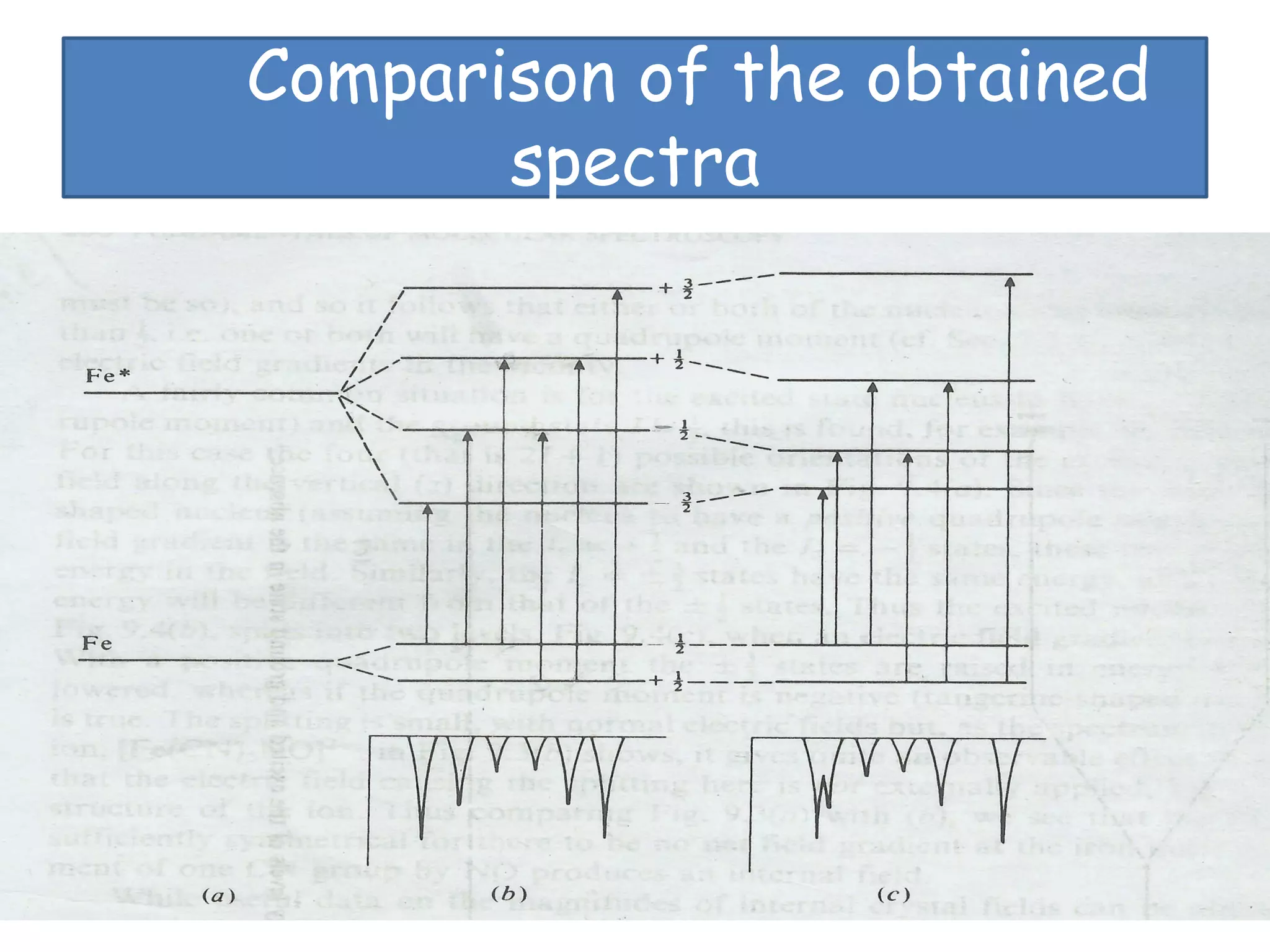
Electric Field and Magnetic Field
existing simultaneously
Quadrupolar shifts are superimposed on
magnetic splitting.
Six line spectrum is again produced with
same transition probability, but are not
equally spaced.
±3/2 states are moved upwards in energy
±1/2 states are moved down.
e.g. FeF 2 (iron difluoride) give such kind
of spectrum
Comparison of the obtained
spectra
Refrences
• Fundamentals of molecular spectroscopy
Colin N. Banwell & Elaine M. McCash
• Principles of Physical Chemistry
Puri, Sharma, Pathania
Effect of magnetic field in mössbauer spectroscopy

Effect of magnetic field in mössbauer spectroscopy

  • 1.
  • 2.
    What is Mössbauerspectroscopy • Named after its discoverer Rudolf Mössbauer in 1957. • Received a noble prize in 1961. • Consists of the recoil-free, resonant absorption and emission of gamma rays in solids. • Involves transitions between energy levels within the nuclei of atoms.
  • 3.
    Principle • Heavier elementswhen formed by the radioactive decay of an isotope of the same or different element are initially produced in an excited nuclear state. • After a very short delay, of the order of microseconds, the excited nucleus reverts to the ground state and emits energy of very high frequency, usually in the gamma-ray region of spectrum. • Study of this gamma-ray emission and subsequent reabsorption constitutes Mössbauer spectroscopy.
  • 4.
    Interaction of spinand magnetic field • Charged particle spinning about an axis constitutes a circular electric current which in turn produces a magnetic dipole. • The spinning particle behaves as a tiny bar magnet placed along the spin axis. • The size of the dipole i.e. the stength of magnet for a point charge can be given as: � = JT-1 where g is Lande splitting factor, � is Bohr magneton and I is spin quantum no. • The seperation between neighbouring energy level is: = Hz g�N BZ h
  • 5.
    Effect of aMagnetic Field  The non-spin is associated with either the excited or the ground state nucleus and usually with both will interact with a magnetic field.  Each energy state will split into 2I + 1 separate energy level.  Spacing between energy level is g� N BZ / h where B z is the magnetic field at the nucleus.  g values of excited and ground states will be different and may have opposite signs. e.g. Fe-57 excited state g is negative.
  • 6.
    • Ground state(1/2, g positive) will split into two sub-levels • Excited state (3/2, g negative) will split into four sublevel. • Sublevel of the ground state nucleus Iz = +1/2 is lower than that of Iz = -1/2 • Sublevel of the excited state increase in energy in the order Iz = -3/2, -1/2, +1/2, +3/2.
  • 7.
    Selection Rules: Iz =0 or ± 1 There are six transition probabilities which are found to occur and these are: (1) 3/2 1/2 , -3/2 -1/2 (2)½ ½ , -1/2 -1/2 (3)-1/2 ½, ½ -1/2 Two members in each pair have the same Probability and the relative probabilities of the three pairs are 3: 2: 1 for (1) : (2): (3)
  • 8.
    Fe* Fe +3/2 -3/2 -1/2 +1/2 -1/2 +1/2 1.Energy level inabsence of magnetic field 2. Splitting produced by magnetic field
  • 9.
  • 10.
    Magnetic field necessaryto cause the energy level splitting may be applied externally, but it happens that internal effects within the sample produce sufficient field to cause observable splitting. By using external field we can calibrate the spectrum and can estimate the magnitude of internal field. Field of 20-50 T found for various compound of 57 Fe (Large compared to fields created by superconducting magnets just 5-10 T)
  • 11.
    Note:- Internal fields doesnot extends uniformly throughout the bulk sample and is extremely localized effect. Formed by interaction of the nucleus with surrounding electrons.
  • 12.
    Electric Field andMagnetic Field existing simultaneously Quadrupolar shifts are superimposed on magnetic splitting. Six line spectrum is again produced with same transition probability, but are not equally spaced. ±3/2 states are moved upwards in energy ±1/2 states are moved down. e.g. FeF 2 (iron difluoride) give such kind of spectrum
  • 13.
    Comparison of theobtained spectra
  • 14.
    Refrences • Fundamentals ofmolecular spectroscopy Colin N. Banwell & Elaine M. McCash • Principles of Physical Chemistry Puri, Sharma, Pathania