Plasmons
Presented By:
Anuradha Verma
Presentation Layout
What are plasmons
Plasma Frequency
Physical meaning of surface plasmon
Bulk plasmon and surface plasmon
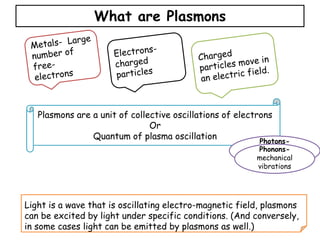
What are Plasmons
Plasmons are a unit of collective oscillations of electrons
Or
Quantum of plasma oscillation
Photons-
electromagnetic
vibrations
Light is a wave that is oscillating electro-magnetic field, plasmons
can be excited by light under specific conditions. (And conversely,
in some cases light can be emitted by plasmons as well.)
Phonons-
mechanical
vibrations
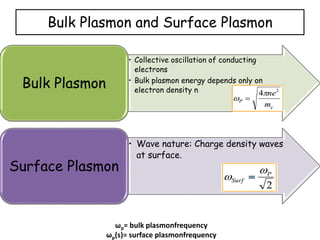
Bulk Plasmon and Surface Plasmon
• Collective oscillation of conducting
electrons
• Bulk plasmon energy depends only on
electron density n
Bulk Plasmon
• Wave nature: Charge density waves
at surface.
Surface Plasmon
ωp= bulk plasmonfrequency
ωp(s)= surface plasmonfrequency
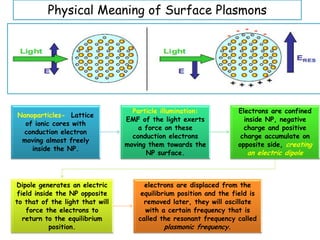
Physical Meaning of Surface Plasmons
Nanoparticles- Lattice
of ionic cores with
conduction electron
moving almost freely
inside the NP.
Particle illumination:
EMF of the light exerts
a force on these
conduction electrons
moving them towards the
NP surface.
Electrons are confined
inside NP, negative
charge and positive
charge accumulate on
opposite side, creating
an electric dipole
Dipole generates an electric
field inside the NP opposite
to that of the light that will
force the electrons to
return to the equilibrium
position.
electrons are displaced from the
equilibrium position and the field is
removed later, they will oscillate
with a certain frequency that is
called the resonant frequency called
plasmonic frequency.
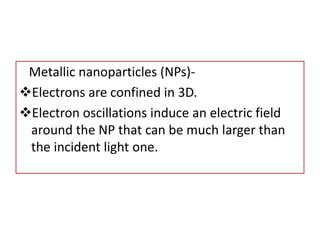
Metallic nanoparticles (NPs)-
Electrons are confined in 3D.
Electron oscillations induce an electric field
around the NP that can be much larger than
the incident light one.
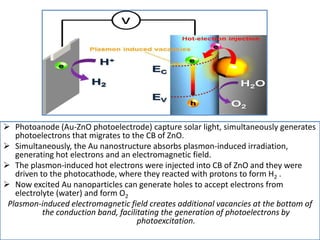
 Photoanode (Au-ZnO photoelectrode) capture solar light, simultaneously generates
photoelectrons that migrates to the CB of ZnO.
 Simultaneously, the Au nanostructure absorbs plasmon-induced irradiation,
generating hot electrons and an electromagnetic field.
 The plasmon-induced hot electrons were injected into CB of ZnO and they were
driven to the photocathode, where they reacted with protons to form H2 .
 Now excited Au nanoparticles can generate holes to accept electrons from
electrolyte (water) and form O2
Plasmon-induced electromagnetic field creates additional vacancies at the bottom of
the conduction band, facilitating the generation of photoelectrons by
photoexcitation.
Efficient energy transfer can occur between metal and
semiconductor if resonant coupling is present between the
plasmonic metal nanoparticles and semiconductor.
In case of low overall light absorption:
Plasmonic metal nanoparticles can be used to capture the light.
When the photons are not absorbed in the desired location,
metal nanoparticles can be used to absorb photons and then
transfer the energy to an adjacent semiconductor.
Metal nanoparticle be energetically coupled to the semiconductor
to transfer its excitation energy and produce an electron-hole pair
in the semiconductor.

Plasmons

  • 1.
  • 2.
    Presentation Layout What areplasmons Plasma Frequency Physical meaning of surface plasmon Bulk plasmon and surface plasmon
  • 3.
    What are Plasmons Plasmonsare a unit of collective oscillations of electrons Or Quantum of plasma oscillation Photons- electromagnetic vibrations Light is a wave that is oscillating electro-magnetic field, plasmons can be excited by light under specific conditions. (And conversely, in some cases light can be emitted by plasmons as well.) Phonons- mechanical vibrations
  • 4.
    Bulk Plasmon andSurface Plasmon • Collective oscillation of conducting electrons • Bulk plasmon energy depends only on electron density n Bulk Plasmon • Wave nature: Charge density waves at surface. Surface Plasmon ωp= bulk plasmonfrequency ωp(s)= surface plasmonfrequency
  • 5.
    Physical Meaning ofSurface Plasmons Nanoparticles- Lattice of ionic cores with conduction electron moving almost freely inside the NP. Particle illumination: EMF of the light exerts a force on these conduction electrons moving them towards the NP surface. Electrons are confined inside NP, negative charge and positive charge accumulate on opposite side, creating an electric dipole Dipole generates an electric field inside the NP opposite to that of the light that will force the electrons to return to the equilibrium position. electrons are displaced from the equilibrium position and the field is removed later, they will oscillate with a certain frequency that is called the resonant frequency called plasmonic frequency.
  • 6.
    Metallic nanoparticles (NPs)- Electronsare confined in 3D. Electron oscillations induce an electric field around the NP that can be much larger than the incident light one.
  • 7.
     Photoanode (Au-ZnOphotoelectrode) capture solar light, simultaneously generates photoelectrons that migrates to the CB of ZnO.  Simultaneously, the Au nanostructure absorbs plasmon-induced irradiation, generating hot electrons and an electromagnetic field.  The plasmon-induced hot electrons were injected into CB of ZnO and they were driven to the photocathode, where they reacted with protons to form H2 .  Now excited Au nanoparticles can generate holes to accept electrons from electrolyte (water) and form O2 Plasmon-induced electromagnetic field creates additional vacancies at the bottom of the conduction band, facilitating the generation of photoelectrons by photoexcitation.
  • 8.
    Efficient energy transfercan occur between metal and semiconductor if resonant coupling is present between the plasmonic metal nanoparticles and semiconductor. In case of low overall light absorption: Plasmonic metal nanoparticles can be used to capture the light. When the photons are not absorbed in the desired location, metal nanoparticles can be used to absorb photons and then transfer the energy to an adjacent semiconductor. Metal nanoparticle be energetically coupled to the semiconductor to transfer its excitation energy and produce an electron-hole pair in the semiconductor.