TOPIC:- MOSSBAUER
SPECTROSCOPY
CONTENT
• History
• Instrumentation of Mossbauer spectrometry
• Radioactive source
• Principle of quantization
• Resonance absorption and line width
• Principle
• Recoil Motion
• Doppler Effect
• Isomer shift
• Reason for Quadrupole Splitting
• Example of Quadrupole Splitting
• Magnetic Splitting
• Applications
• References
• In 1929 scientist Kuhn suggested γ radiation
resonance.
• Rudolf Mossbauer elaborate γ radiation
resonance in 1958. This concept is relation
with radioactive decay process of certain
unstable nuclei to achieve thermodynamic
stability.
• It is the study of γ ray emission from excited
nuclei and its absorption by other nuclei.
• The great amount of work has been done on
Fe, Ni ,Sn etc.
HISTORY
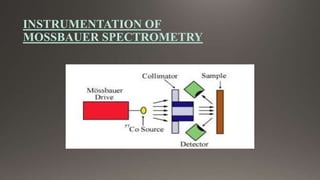
INSTRUMENTATION OF
MOSSBAUER SPECTROMETRY
RADIOACTIVE SOURCE
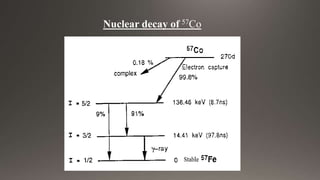
• The source for 57Fe consists of 57Co, which decay by
electron capture to an excited state of 57Fe which in
turn decays to a ground state.
• The Mossbauer spectra for this isotope is generally
studied by using the 270 days.
Nuclear decay of 57Co
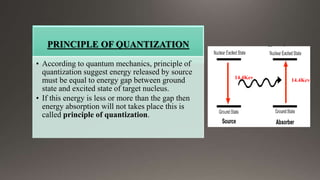
PRINCIPLE OF QUANTIZATION
• According to quantum mechanics, principle of
quantization suggest energy released by source
must be equal to energy gap between ground
state and excited state of target nucleus.
• If this energy is less or more than the gap then
energy absorption will not takes place this is
called principle of quantization.
14.4Kev 14.4Kev
RESONANCE ABSORPTION AND LINE WIDTH
• All spectral lines caused by absorption or emission have a
finite width are never “infinitely thin”.
• If gamma ray emission and absorption lines were
infinitely thin, the Mossbauer effect would not be
possible.
Where, ET = transition energy
ER= the recoil energy
EKE= kinetic energy required of the absorber
ET-ER = energy of emitted gamma ray
ET+EKE= energy required for resonance absorption
EMISSION AND ABSORPTION WITH ZERO LINE WIDTH
ET ET+EKE
ET-ER
ABSORPTION
LINE
EMISSION
LINE
INTENSITY
ENERGY
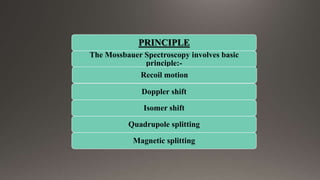
PRINCIPLE
The Mossbauer Spectroscopy involves basic
principle:-
Recoil motion
Doppler shift
Isomer shift
Quadrupole splitting
Magnetic splitting
RECOIL MOTION
• It is easily seen by applying de
Broglie relationship that a gamma
ray photon frequency 1018 c/sec has
a relatively large momentum.
• The photon is emitted by a nucleus,
the nucleus would recoil
considerably so as to conserve the
total momentum.
DOPPLER SHIFT
When a moving body emits radiation
a stationary observer sees a shifted
frequency. This is called as Doppler
effect.
The frequency shift is given by
∆v = v. v/c
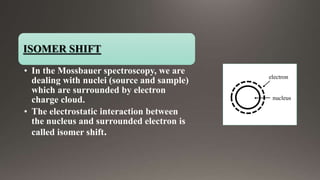
ISOMER SHIFT
• In the Mossbauer spectroscopy, we are
dealing with nuclei (source and sample)
which are surrounded by electron
charge cloud.
• The electrostatic interaction between
the nucleus and surrounded electron is
called isomer shift.
electron
nucleus
• IONICITY:
• In 1979, Bhidi and Maddok have reported
a direct linear relationship for the variation
of isomer shift with ionicity with aurous
halide.
• Ionicity is directly proportional to Isomer
shift.
• EXAMPLE:
• AuI = 0.125
• AuBr= 0.143
• AuCl = 0.167
FACTOR
AFFECTING
ISOMER SHIFT
S-ELECTRON DENSITY
• The s-electron density is inversely
proportional to isomer shift.
• If s-electron density increase the
shielded nucleus increase then the
isomer shift is decrease.
• EXAMPLE: 3 <1 <2
1 2 3
𝐹𝑒3+
𝐹𝑒2+
𝐹𝑒+
4𝑠0
3𝑑5 4𝑠03𝑑6 4𝑠13𝑑6
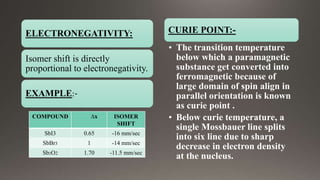
ELECTRONEGATIVITY:
Isomer shift is directly
proportional to electronegativity.
EXAMPLE:-
COMPOUND ∆x ISOMER
SHIFT
SbI3 0.65 -16 mm/sec
SbBr3 1 -14 mm/sec
Sb2O2 1.70 -11.5 mm/sec
CURIE POINT:-
• The transition temperature
below which a paramagnetic
substance get converted into
ferromagnetic because of
large domain of spin align in
parallel orientation is known
as curie point .
• Below curie temperature, a
single Mossbauer line splits
into six line due to sharp
decrease in electron density
at the nucleus.
OXIDATION STATE
OXIDATION STATE ISOMER SHIFT
𝐹𝑒2+
2 1.5 mm/sec
𝐹𝑒3+
3 0.7 mm/sec
𝐹𝑒4+ 4 0.2 mm/sec
REASONS FOR QUADRUPOLE
SPLITTING
For quadrupole splitting electric
field gradient should not be equal to
zero.
There is no quadrupole splitting if
electric field gradient is equal to zero
FACTORS OF QUADRUPOLE SPLITTING
The quadrupole splitting on the basis of these two factors:
• On the basis of geometries of complexes
For perfect octahedral and tetrahedral ,the symmetry is spherical
and there is no quadrupole splitting.
For all remaining geometries quadrupole splitting takes place ,these
is axial symmetry.
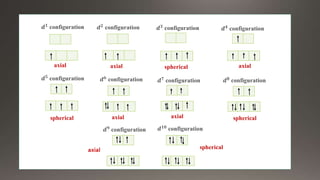
On the basis of electronic configuration:
In these the quadrupole splitting is depend upon
symmetry:
Spherical symmetry
Axial symmetry
𝒅𝟏𝟎
configuration
𝒅𝟐
configuration 𝒅𝟑 configuration 𝒅𝟒 configuration
𝒅𝟓 configuration 𝒅𝟔
configuration 𝒅𝟕 configuration 𝒅𝟖
configuration
𝒅𝟗 configuration
𝒅𝟏
configuration
axial axial axial
axial axial
axial spherical
spherical
spherical
spherical
[Mn(H2O)6]𝟐+
• ON THE BASIS OF GEOMETRIES OF COMPLEXES
• ON THE BASIS OF ELECTRONIC CONFIGURATION
EXAMPLES OF QUADRUPOLE SPLITTING
When target nucleus is placed in a
external magnetic field having
field strength B0 then irrespective
of electric field gradient each state
splitted according to 2I+1 rule this
is called as Zeeman effect
SELECTION RULE : ∆MI= 0,+1,-1
MAGNETIC SPLITTING
HYPERFINE SPLITTING
APPLICATIONS
• ELECTRONIC STRUCTURE:-
• It is the direct function of s-electron density at the
nucleus.
• The removal and addition of a valence electron may
change the s-electron density of the nucleus and the
isomer shift.
• Changes in shielding of s-electron by p-,d-, and f electron
density at the nucleus.
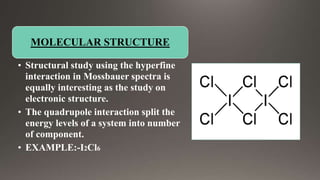
MOLECULAR STRUCTURE
• Structural study using the hyperfine
interaction in Mossbauer spectra is
equally interesting as the study on
electronic structure.
• The quadrupole interaction split the
energy levels of a system into number
of component.
• EXAMPLE:-I2Cl6
Surface study
Several important aspects can be studied by Mossbauer spectroscopy.
Though one can perform measurements in the conventional transmission
geometry, it is more appropriate to use scattering experiment for surface study.
Biological Application
It is now well accepted that many large protein molecules which control
biological function use the oxidation and reduction properties of a transition
metal atom.
EXAMPLE:- Hemoproteins
REFERENCE
Atomic structure and chemical bond by Manas Chanda
Fundamentals of molecular spectroscopy by C.N.Banwell
Physical method in inorganic chemistry by R.S.Drago
Molecular structure and spectroscopy by G.Aruldhas
Thank
you

mossbauer spectroscopy.pptx

  • 1.
  • 2.
    CONTENT • History • Instrumentationof Mossbauer spectrometry • Radioactive source • Principle of quantization • Resonance absorption and line width • Principle • Recoil Motion • Doppler Effect • Isomer shift • Reason for Quadrupole Splitting • Example of Quadrupole Splitting • Magnetic Splitting • Applications • References
  • 3.
    • In 1929scientist Kuhn suggested γ radiation resonance. • Rudolf Mossbauer elaborate γ radiation resonance in 1958. This concept is relation with radioactive decay process of certain unstable nuclei to achieve thermodynamic stability. • It is the study of γ ray emission from excited nuclei and its absorption by other nuclei. • The great amount of work has been done on Fe, Ni ,Sn etc. HISTORY
  • 4.
  • 5.
    RADIOACTIVE SOURCE • Thesource for 57Fe consists of 57Co, which decay by electron capture to an excited state of 57Fe which in turn decays to a ground state. • The Mossbauer spectra for this isotope is generally studied by using the 270 days.
  • 6.
  • 7.
    PRINCIPLE OF QUANTIZATION •According to quantum mechanics, principle of quantization suggest energy released by source must be equal to energy gap between ground state and excited state of target nucleus. • If this energy is less or more than the gap then energy absorption will not takes place this is called principle of quantization. 14.4Kev 14.4Kev
  • 8.
    RESONANCE ABSORPTION ANDLINE WIDTH • All spectral lines caused by absorption or emission have a finite width are never “infinitely thin”. • If gamma ray emission and absorption lines were infinitely thin, the Mossbauer effect would not be possible. Where, ET = transition energy ER= the recoil energy EKE= kinetic energy required of the absorber ET-ER = energy of emitted gamma ray ET+EKE= energy required for resonance absorption
  • 9.
    EMISSION AND ABSORPTIONWITH ZERO LINE WIDTH ET ET+EKE ET-ER ABSORPTION LINE EMISSION LINE INTENSITY ENERGY
  • 10.
    PRINCIPLE The Mossbauer Spectroscopyinvolves basic principle:- Recoil motion Doppler shift Isomer shift Quadrupole splitting Magnetic splitting
  • 11.
    RECOIL MOTION • Itis easily seen by applying de Broglie relationship that a gamma ray photon frequency 1018 c/sec has a relatively large momentum. • The photon is emitted by a nucleus, the nucleus would recoil considerably so as to conserve the total momentum.
  • 12.
    DOPPLER SHIFT When amoving body emits radiation a stationary observer sees a shifted frequency. This is called as Doppler effect. The frequency shift is given by ∆v = v. v/c
  • 13.
    ISOMER SHIFT • Inthe Mossbauer spectroscopy, we are dealing with nuclei (source and sample) which are surrounded by electron charge cloud. • The electrostatic interaction between the nucleus and surrounded electron is called isomer shift. electron nucleus
  • 14.
    • IONICITY: • In1979, Bhidi and Maddok have reported a direct linear relationship for the variation of isomer shift with ionicity with aurous halide. • Ionicity is directly proportional to Isomer shift. • EXAMPLE: • AuI = 0.125 • AuBr= 0.143 • AuCl = 0.167 FACTOR AFFECTING ISOMER SHIFT S-ELECTRON DENSITY • The s-electron density is inversely proportional to isomer shift. • If s-electron density increase the shielded nucleus increase then the isomer shift is decrease. • EXAMPLE: 3 <1 <2 1 2 3 𝐹𝑒3+ 𝐹𝑒2+ 𝐹𝑒+ 4𝑠0 3𝑑5 4𝑠03𝑑6 4𝑠13𝑑6
  • 15.
    ELECTRONEGATIVITY: Isomer shift isdirectly proportional to electronegativity. EXAMPLE:- COMPOUND ∆x ISOMER SHIFT SbI3 0.65 -16 mm/sec SbBr3 1 -14 mm/sec Sb2O2 1.70 -11.5 mm/sec CURIE POINT:- • The transition temperature below which a paramagnetic substance get converted into ferromagnetic because of large domain of spin align in parallel orientation is known as curie point . • Below curie temperature, a single Mossbauer line splits into six line due to sharp decrease in electron density at the nucleus.
  • 16.
    OXIDATION STATE OXIDATION STATEISOMER SHIFT 𝐹𝑒2+ 2 1.5 mm/sec 𝐹𝑒3+ 3 0.7 mm/sec 𝐹𝑒4+ 4 0.2 mm/sec
  • 17.
    REASONS FOR QUADRUPOLE SPLITTING Forquadrupole splitting electric field gradient should not be equal to zero. There is no quadrupole splitting if electric field gradient is equal to zero
  • 18.
    FACTORS OF QUADRUPOLESPLITTING The quadrupole splitting on the basis of these two factors: • On the basis of geometries of complexes For perfect octahedral and tetrahedral ,the symmetry is spherical and there is no quadrupole splitting. For all remaining geometries quadrupole splitting takes place ,these is axial symmetry.
  • 19.
    On the basisof electronic configuration: In these the quadrupole splitting is depend upon symmetry: Spherical symmetry Axial symmetry
  • 20.
    𝒅𝟏𝟎 configuration 𝒅𝟐 configuration 𝒅𝟑 configuration𝒅𝟒 configuration 𝒅𝟓 configuration 𝒅𝟔 configuration 𝒅𝟕 configuration 𝒅𝟖 configuration 𝒅𝟗 configuration 𝒅𝟏 configuration axial axial axial axial axial axial spherical spherical spherical spherical
  • 21.
    [Mn(H2O)6]𝟐+ • ON THEBASIS OF GEOMETRIES OF COMPLEXES • ON THE BASIS OF ELECTRONIC CONFIGURATION EXAMPLES OF QUADRUPOLE SPLITTING
  • 22.
    When target nucleusis placed in a external magnetic field having field strength B0 then irrespective of electric field gradient each state splitted according to 2I+1 rule this is called as Zeeman effect SELECTION RULE : ∆MI= 0,+1,-1 MAGNETIC SPLITTING
  • 23.
  • 24.
    APPLICATIONS • ELECTRONIC STRUCTURE:- •It is the direct function of s-electron density at the nucleus. • The removal and addition of a valence electron may change the s-electron density of the nucleus and the isomer shift. • Changes in shielding of s-electron by p-,d-, and f electron density at the nucleus.
  • 25.
    MOLECULAR STRUCTURE • Structuralstudy using the hyperfine interaction in Mossbauer spectra is equally interesting as the study on electronic structure. • The quadrupole interaction split the energy levels of a system into number of component. • EXAMPLE:-I2Cl6
  • 26.
    Surface study Several importantaspects can be studied by Mossbauer spectroscopy. Though one can perform measurements in the conventional transmission geometry, it is more appropriate to use scattering experiment for surface study. Biological Application It is now well accepted that many large protein molecules which control biological function use the oxidation and reduction properties of a transition metal atom. EXAMPLE:- Hemoproteins
  • 27.
    REFERENCE Atomic structure andchemical bond by Manas Chanda Fundamentals of molecular spectroscopy by C.N.Banwell Physical method in inorganic chemistry by R.S.Drago Molecular structure and spectroscopy by G.Aruldhas
  • 28.