WELCOME TO YOU ALL
PHYSICAL
CHEMISTRY
PRESENTATION
M.SC.-II –
(SEM. III )
2013–
2014
ELECTRON SPECTROSCOPY
Presented by :–
PAPER- II
Dharmendra R. Prajapati
RAMNIRANJAN JHUNJHUNWALA
COLLEGE
ELECTRON
ELECTRON
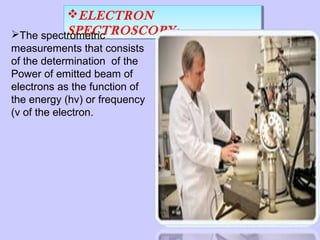
SPECTROSCOPY:SPECTROSCOPY:The spectrometric
measurements that consists
of the determination of the
Power of emitted beam of
electrons as the function of
the energy (hv) or frequency
(v of the electron.
Electron Spectroscopy:The signal produced by excitation of the analyte consists of
a beam of electrons (rather than a beam of photons).
Excitation by X-ray --XPS (X-ray photoelectron Spectroscopy)
ESCA (Electron Spectroscopy for Chemical Analysis)
Excitation by UV radiation ---UPS (Ultraviolet photoelectron Spectroscopy)
Excitation by e beam ---AES (Auger electron spectroscopy)
SAM (Scanning Auger Microscopy)
Powerful tool for the identification of all of the elements
except H and He Provide information for surface layer (20-50
A) of solid.
ESCA :(ELECTRON SPECTROSCOPY
fOR CHEMICAL ANALYSIS)
OR
XPS :(X-RAY PHOTOELECTRON
SPECTROSCOPY)
 X-ray photoelectron spectroscopy works by irradiating a
sample material with monoenergetic soft x-rays causing
electrons to be ejected.
 Identification of the elements in the sample can be made
directly from the kinetic energies of these ejected
photoelectrons.
 The relative concentrations of elements can be
determined from the photoelectron intensities.
Introduction (XPS) Analysis capabilities
 Elements detected from Li to U.
 None destructive (some damage to x-ray beam sensitive
materials)
 Quantitative.
 Surface sensitivity from 5 to 75 angstroms.
 Conducting and insulating materials.
 Detection limits that range form 0.01 to 0.5 atom
percent.
 Spatial resolution for surface mapping from >10 mm
 Depth profiling capabilities.
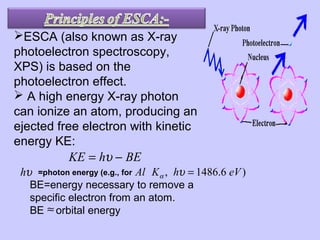
ESCA (also known as X-ray
photoelectron spectroscopy,
XPS) is based on the
photoelectron effect.
 A high energy X-ray photon
can ionize an atom, producing an
ejected free electron with kinetic
energy KE:
KE = hυ − BE
hυ

Al Kα , hυ = 1486.6 eV )
BE=energy necessary to remove a
specific electron from an atom.
BE ≈ orbital energy
=photon energy (e.g., for
Instrumentation:
How are measurements made?
•
•
•
•

•
•
•

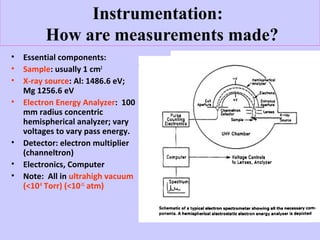
Essential components:
Sample: usually 1 cm2
X-ray source: Al: 1486.6 eV;
Mg 1256.6 eV
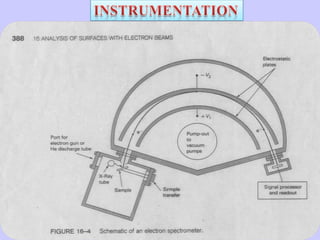
Electron Energy Analyzer: 100
mm radius concentric
hemispherical analyzer; vary
voltages to vary pass energy.
Detector: electron multiplier
(channeltron)
Electronics, Computer
Note: All in ultrahigh vacuum
(<10-8 Torr) (<10-11 atm)
 Magnetic Shielding:high-resolution work magnetic field must be reduced to
about 0.1mG (Earth’s magnetic field is roughly 500 mG)
APPLICATION:APPLICATION:ESCA can be used to detect all elements except hydrogen and
helium, with a sensitivity variation across the periodic table.
It is most useful for solids, including powders and soft materials.
The qualitative and quantitative chemical state analysis
capabilities, combined with extreme surface sensitivity (usually a
few atomic layers) have made ESCA the most broadly applicable
surface analysis technique today.
 Qualitative Analysis
low-resolution wide scan ESCA spectrum (survey
spectrum) elemental composition except H and He
Kinetic energy range 250 to 1500 eV
Binding energy range 0 to 1250 eV
Often peaks resulting from Auger e are found in ESCA
spectra, such peak are identified by comparing spectra
produced by two X-ray sources
AdvAntAges:-- surface sensitive (top few monolayers)
-- wide range of solids
-- relatively non-destructive

disAdvAntAges:-- expensive, slow, poor spatial resolution,
requires high vacuum
Auger electron
spectroscopy
Auger Electron Spectroscopy
• Auger Electron Spectroscopy (AES), is a widely used
technique to investigate the composition of surfaces.
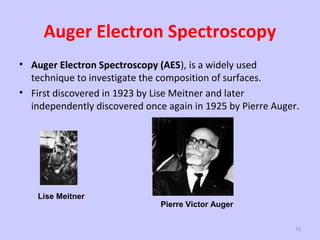
• First discovered in 1923 by Lise Meitner and later
independently discovered once again in 1925 by Pierre Auger.

Lise Meitner

Pierre Victor Auger
15
Principles of AUGER:Auger electron spectroscopy (AES; pronounced [oʒe] in French) is a
common analytical technique used specifically in the study of surfaces
and, more generally, in the area of materials science.
 Underlying the spectroscopic technique is the Auger effect, as it has
come to be called, which is based on the analysis of energetic electrons
emitted from an excited atom after a series of internal relaxation events.

PRINCIPLES OF OPERATION
(Auger Electron Spectroscopy)
• sample bombardment by electrons

•core electron removed
• electron from a higher energy level fall into the
vacancy
•release of energy.
•measured energy and defined sample
INSTRUMENTATION
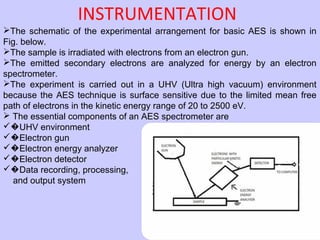
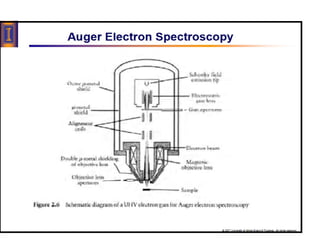
The schematic of the experimental arrangement for basic AES is shown in
Fig. below.
The sample is irradiated with electrons from an electron gun.
The emitted secondary electrons are analyzed for energy by an electron
spectrometer.
The experiment is carried out in a UHV (Ultra high vacuum) environment
because the AES technique is surface sensitive due to the limited mean free
path of electrons in the kinetic energy range of 20 to 2500 eV.
 The essential components of an AES spectrometer are
�UHV environment
�Electron gun
�Electron energy analyzer
�Electron detector
�Data recording, processing,
and output system

17
Electron Energy Analyzer & Electron Detector
The function of an electron energy analyzer is to disperse the
secondary emitted electrons from the sample according to their
energies.
An analyzer may be either magnetic or electrostatic.
Because electrons are influenced by stray magnetic fields
(including the earth�s magnetic field), it is essential to cancel
these fields within the enclosed volume of the analyzer.
 The stray magnetic field cancellation is accomplished by using
Mg metal shielding.
Electrostatic analyzers are used in all commercial
spectrometers today because of the relative ease of stray
magnetic field cancellation.
The dispersed secondary electrons are received in the electron
detector.
 Detector communicates the energy with respect to time
data to the computer attached with it. The data is analyzed to
find out the Auger peak.
17TH JAN 2009

CATSYMP19 PRESCHOOL

19
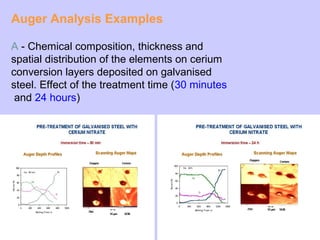
Auger Analysis Examples
A - Chemical composition, thickness and
spatial distribution of the elements on cerium
conversion layers deposited on galvanised
steel. Effect of the treatment time (30 minutes
and 24 hours)

20
 Application of Auger Electron Spectroscopy: Spatial resolution is high.
� Analysis is relatively rapid.
� Surface or subsurface analysis can be performed.
� It is sensitive to light elements (except H and He).
� It provides reliable semi quantitative analysis.
� Chemical information is available in some cases.

Limits of Technique and Disadvantages:•Surface Sensitivity: < 1 nm
•Lateral Resolution: < 50 nm
•Analytical Volume: 10-18 cm3
•Insulators are difficult to study due to surface
charging.
•Surface may be damaged by the incident electron
beam.
Comparison to XPS
Auger and X-ray photoelectron spectroscopy give similar
information, and the choice should be based on advantages and
disadvantages.
The Auger spot size is much smaller than the XPS and has the
capability of identifying fine features on the surface.
The XPS has the capability of determining surface
chemical structure and bonding through the use of chemical shifts.
 Although Auger lines also exhibit chemical shifts, these are not
generally as large or as well-documented as those obtained by
XPS.
 Also, X-radiation used in XPS imparts less damage to the
sample surface than does the electron beam used in SAM.
 As mentioned above, the spatial analysis and imaging
capabilities of the scanning Auger microprobe make it a very
useful and complementary technique to XPS.
Ultraviolet
photoelectron
spectroscopy
Principles: Ultraviolet photoelectron spectroscopy (UPS) refers to the measurement
of kinetic energy spectra of photoelectrons emitted by molecules which have
absorbed ultraviolet photons, in order to determine molecular energy levels
in the valence region.
 The ultraviolet method (UPS) was developed by David W. Turner

There are two main areas UPS is used to study:1.Electronic structure of solids
2. Adsorbed molecules on metals

Specific examples of UPS studies include:1.The measurement of molecular orbital energies that can be compared to
theortical values calculated from quantum chemistry
2. Determination and assignment of bonding, nonbonding, and/or antibonding
molecular orbitals
3. The binding and orientation of adsorbed species on the surface of solids
4. Band structure mapping in k-space with angle-resolved techniques
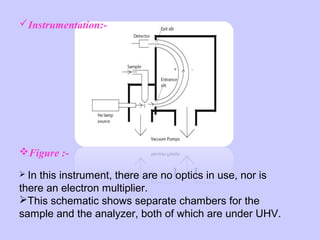
Instrumentation:-

Figure : In

this instrument, there are no optics in use, nor is
there an electron multiplier.
This schematic shows separate chambers for the
sample and the analyzer, both of which are under UHV.
 In early UPS, the sample was a gas or a vapor
that is irradiated with a narrow beam of
UV radiation.
 More modern UPS instruments are now capable
of studying solids as well.
 The photoelectrons produced are passed
through a slit into a vacuum region where they are
then deflected by magnetic or electrostatic fields to
give an energy spectrum.
 UPS is sensitive to the very near surface region,
up to around 10 nm in depth.
Applications
The UPS measures experimental molecular orbital energies for comparison with
theoretical values from quantum chemistry, which was also extensively developed
in the 1960s. The photoelectron spectrum of a molecule contains a series of peaks
each corresponding to one valence-region molecular orbital energy level. Also, the
high resolution allowed the observation of fine structure due to vibrational levels of
the molecular ion, which facilitates the assignment of peaks to bonding, nonbonding
or antibonding molecular orbitals.
The method was later extended to the study of solid surfaces where it is usually
described as photoemission spectroscopy (PES). It is particularly sensitive to the
surface region (to 10 nm depth), due to the short range of the emitted
photoelectrons (compared to X-rays). It is therefore used to study adsorbed species
and their binding to the surface, as well as their orientation on the surface.
A useful result from characterization of solids by UPS is the determination of the
work function of the material. An example of this determination is given by Park et
al.Briefly, the full width of the photoelectron spectrum (from the highest kinetic
energy/lowest binding energy point to the low kinetic energy cutoff) is measured
and subtracted from the photon energy of the exciting radiation, and the difference
is the work function. Often, the sample is electrically biased negative to separate
the low energy cutoff from the spectrometer response.
 Limitations:UPS is capable only of ionizing valence electrons, which limits the 
range and depth of UPS surface experiments.  
Conventional UPS has relatively poor resolution.

Advantages:Ultraviolet radiation has a very narrow line width and a high flux of 
photons available from simple discharge sources. 
 Higher resolution UPS scans allow for the observation of the fine 
structures that are due to vibrational levels of the molecular ion which, 
then, allows molecular orbital assignment of specific peaks.
Summary
ESCA,AUGER & UPS is
very important
analytical techniques used in
materials science to
investigate
molecular surface structures
and
their electronic properties
RefeRenceS
Reference books: phySical chemiStRy
- Skoog ,
holleR
 inStRumental method
=b.k.ShaRma

http://www.orlabs.com/AugerElectron
Spectroscopy.php

http://nanoall.blogspot.com/2011/10/a
¿Questions
?
THANK YOU
If we knew what we were doing,
It wouldn't be research, now would it?
Albert Einstein (1879-1955)

32
Electron spectroscopy

Electron spectroscopy

  • 2.
    WELCOME TO YOUALL PHYSICAL CHEMISTRY PRESENTATION M.SC.-II – (SEM. III ) 2013– 2014 ELECTRON SPECTROSCOPY Presented by :– PAPER- II Dharmendra R. Prajapati RAMNIRANJAN JHUNJHUNWALA COLLEGE
  • 3.
    ELECTRON ELECTRON SPECTROSCOPY:SPECTROSCOPY:The spectrometric measurements thatconsists of the determination of the Power of emitted beam of electrons as the function of the energy (hv) or frequency (v of the electron.
  • 4.
    Electron Spectroscopy:The signalproduced by excitation of the analyte consists of a beam of electrons (rather than a beam of photons). Excitation by X-ray --XPS (X-ray photoelectron Spectroscopy) ESCA (Electron Spectroscopy for Chemical Analysis) Excitation by UV radiation ---UPS (Ultraviolet photoelectron Spectroscopy) Excitation by e beam ---AES (Auger electron spectroscopy) SAM (Scanning Auger Microscopy) Powerful tool for the identification of all of the elements except H and He Provide information for surface layer (20-50 A) of solid.
  • 5.
    ESCA :(ELECTRON SPECTROSCOPY fORCHEMICAL ANALYSIS) OR XPS :(X-RAY PHOTOELECTRON SPECTROSCOPY)
  • 6.
     X-ray photoelectronspectroscopy works by irradiating a sample material with monoenergetic soft x-rays causing electrons to be ejected.  Identification of the elements in the sample can be made directly from the kinetic energies of these ejected photoelectrons.  The relative concentrations of elements can be determined from the photoelectron intensities.
  • 7.
    Introduction (XPS) Analysiscapabilities Introduction (XPS) Analysis capabilities  Elements detected from Li to U.  None destructive (some damage to x-ray beam sensitive materials)  Quantitative.  Surface sensitivity from 5 to 75 angstroms.  Conducting and insulating materials.  Detection limits that range form 0.01 to 0.5 atom percent.  Spatial resolution for surface mapping from >10 mm  Depth profiling capabilities.
  • 8.
    ESCA (also knownas X-ray photoelectron spectroscopy, XPS) is based on the photoelectron effect.  A high energy X-ray photon can ionize an atom, producing an ejected free electron with kinetic energy KE: KE = hυ − BE hυ Al Kα , hυ = 1486.6 eV ) BE=energy necessary to remove a specific electron from an atom. BE ≈ orbital energy =photon energy (e.g., for
  • 9.
    Instrumentation: How are measurementsmade? • • • • • • • Essential components: Sample: usually 1 cm2 X-ray source: Al: 1486.6 eV; Mg 1256.6 eV Electron Energy Analyzer: 100 mm radius concentric hemispherical analyzer; vary voltages to vary pass energy. Detector: electron multiplier (channeltron) Electronics, Computer Note: All in ultrahigh vacuum (<10-8 Torr) (<10-11 atm)
  • 11.
     Magnetic Shielding:high-resolutionwork magnetic field must be reduced to about 0.1mG (Earth’s magnetic field is roughly 500 mG)
  • 12.
    APPLICATION:APPLICATION:ESCA can beused to detect all elements except hydrogen and helium, with a sensitivity variation across the periodic table. It is most useful for solids, including powders and soft materials. The qualitative and quantitative chemical state analysis capabilities, combined with extreme surface sensitivity (usually a few atomic layers) have made ESCA the most broadly applicable surface analysis technique today.  Qualitative Analysis low-resolution wide scan ESCA spectrum (survey spectrum) elemental composition except H and He Kinetic energy range 250 to 1500 eV Binding energy range 0 to 1250 eV Often peaks resulting from Auger e are found in ESCA spectra, such peak are identified by comparing spectra produced by two X-ray sources
  • 13.
    AdvAntAges:-- surface sensitive(top few monolayers) -- wide range of solids -- relatively non-destructive disAdvAntAges:-- expensive, slow, poor spatial resolution, requires high vacuum
  • 14.
  • 15.
    Auger Electron Spectroscopy •Auger Electron Spectroscopy (AES), is a widely used technique to investigate the composition of surfaces. • First discovered in 1923 by Lise Meitner and later independently discovered once again in 1925 by Pierre Auger. Lise Meitner Pierre Victor Auger 15
  • 16.
    Principles of AUGER:Augerelectron spectroscopy (AES; pronounced [oʒe] in French) is a common analytical technique used specifically in the study of surfaces and, more generally, in the area of materials science.  Underlying the spectroscopic technique is the Auger effect, as it has come to be called, which is based on the analysis of energetic electrons emitted from an excited atom after a series of internal relaxation events. PRINCIPLES OF OPERATION (Auger Electron Spectroscopy) • sample bombardment by electrons •core electron removed • electron from a higher energy level fall into the vacancy •release of energy. •measured energy and defined sample
  • 17.
    INSTRUMENTATION The schematic ofthe experimental arrangement for basic AES is shown in Fig. below. The sample is irradiated with electrons from an electron gun. The emitted secondary electrons are analyzed for energy by an electron spectrometer. The experiment is carried out in a UHV (Ultra high vacuum) environment because the AES technique is surface sensitive due to the limited mean free path of electrons in the kinetic energy range of 20 to 2500 eV.  The essential components of an AES spectrometer are �UHV environment �Electron gun �Electron energy analyzer �Electron detector �Data recording, processing, and output system 17
  • 18.
    Electron Energy Analyzer& Electron Detector The function of an electron energy analyzer is to disperse the secondary emitted electrons from the sample according to their energies. An analyzer may be either magnetic or electrostatic. Because electrons are influenced by stray magnetic fields (including the earth�s magnetic field), it is essential to cancel these fields within the enclosed volume of the analyzer.  The stray magnetic field cancellation is accomplished by using Mg metal shielding. Electrostatic analyzers are used in all commercial spectrometers today because of the relative ease of stray magnetic field cancellation. The dispersed secondary electrons are received in the electron detector.  Detector communicates the energy with respect to time data to the computer attached with it. The data is analyzed to find out the Auger peak.
  • 19.
  • 20.
    Auger Analysis Examples A- Chemical composition, thickness and spatial distribution of the elements on cerium conversion layers deposited on galvanised steel. Effect of the treatment time (30 minutes and 24 hours) 20
  • 21.
     Application ofAuger Electron Spectroscopy: Spatial resolution is high. � Analysis is relatively rapid. � Surface or subsurface analysis can be performed. � It is sensitive to light elements (except H and He). � It provides reliable semi quantitative analysis. � Chemical information is available in some cases. Limits of Technique and Disadvantages:•Surface Sensitivity: < 1 nm •Lateral Resolution: < 50 nm •Analytical Volume: 10-18 cm3 •Insulators are difficult to study due to surface charging. •Surface may be damaged by the incident electron beam.
  • 22.
    Comparison to XPS Augerand X-ray photoelectron spectroscopy give similar information, and the choice should be based on advantages and disadvantages. The Auger spot size is much smaller than the XPS and has the capability of identifying fine features on the surface. The XPS has the capability of determining surface chemical structure and bonding through the use of chemical shifts.  Although Auger lines also exhibit chemical shifts, these are not generally as large or as well-documented as those obtained by XPS.  Also, X-radiation used in XPS imparts less damage to the sample surface than does the electron beam used in SAM.  As mentioned above, the spatial analysis and imaging capabilities of the scanning Auger microprobe make it a very useful and complementary technique to XPS.
  • 23.
  • 24.
    Principles: Ultraviolet photoelectronspectroscopy (UPS) refers to the measurement of kinetic energy spectra of photoelectrons emitted by molecules which have absorbed ultraviolet photons, in order to determine molecular energy levels in the valence region.  The ultraviolet method (UPS) was developed by David W. Turner There are two main areas UPS is used to study:1.Electronic structure of solids 2. Adsorbed molecules on metals Specific examples of UPS studies include:1.The measurement of molecular orbital energies that can be compared to theortical values calculated from quantum chemistry 2. Determination and assignment of bonding, nonbonding, and/or antibonding molecular orbitals 3. The binding and orientation of adsorbed species on the surface of solids 4. Band structure mapping in k-space with angle-resolved techniques
  • 25.
    Instrumentation:- Figure : In thisinstrument, there are no optics in use, nor is there an electron multiplier. This schematic shows separate chambers for the sample and the analyzer, both of which are under UHV.
  • 26.
     In earlyUPS, the sample was a gas or a vapor that is irradiated with a narrow beam of UV radiation.  More modern UPS instruments are now capable of studying solids as well.  The photoelectrons produced are passed through a slit into a vacuum region where they are then deflected by magnetic or electrostatic fields to give an energy spectrum.  UPS is sensitive to the very near surface region, up to around 10 nm in depth.
  • 27.
    Applications The UPS measuresexperimental molecular orbital energies for comparison with theoretical values from quantum chemistry, which was also extensively developed in the 1960s. The photoelectron spectrum of a molecule contains a series of peaks each corresponding to one valence-region molecular orbital energy level. Also, the high resolution allowed the observation of fine structure due to vibrational levels of the molecular ion, which facilitates the assignment of peaks to bonding, nonbonding or antibonding molecular orbitals. The method was later extended to the study of solid surfaces where it is usually described as photoemission spectroscopy (PES). It is particularly sensitive to the surface region (to 10 nm depth), due to the short range of the emitted photoelectrons (compared to X-rays). It is therefore used to study adsorbed species and their binding to the surface, as well as their orientation on the surface. A useful result from characterization of solids by UPS is the determination of the work function of the material. An example of this determination is given by Park et al.Briefly, the full width of the photoelectron spectrum (from the highest kinetic energy/lowest binding energy point to the low kinetic energy cutoff) is measured and subtracted from the photon energy of the exciting radiation, and the difference is the work function. Often, the sample is electrically biased negative to separate the low energy cutoff from the spectrometer response.
  • 28.
  • 29.
    Summary ESCA,AUGER & UPSis very important analytical techniques used in materials science to investigate molecular surface structures and their electronic properties
  • 30.
    RefeRenceS Reference books: phySicalchemiStRy - Skoog , holleR  inStRumental method =b.k.ShaRma  http://www.orlabs.com/AugerElectron Spectroscopy.php  http://nanoall.blogspot.com/2011/10/a
  • 31.
  • 32.
    THANK YOU If weknew what we were doing, It wouldn't be research, now would it? Albert Einstein (1879-1955) 32