STRUCTURE TYPES
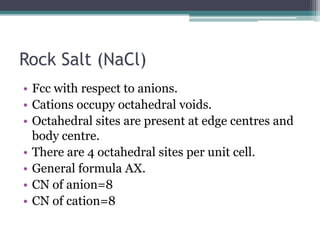
Rock Salt (NaCl)
• Fcc with respect to anions.
• Cations occupy octahedral voids.
• Octahedral sites are present at edge centres and
body centre.
• There are 4 octahedral sites per unit cell.
• General formula AX.
• CN of anion=8
• CN of cation=8
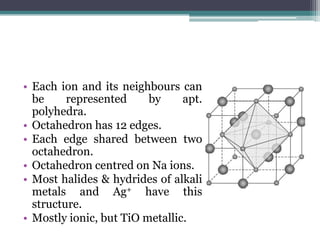
• Each ion and its neighbours can
be
represented
by
apt.
polyhedra.
• Octahedron has 12 edges.
• Each edge shared between two
octahedron.
• Octahedron centred on Na ions.
• Most halides & hydrides of alkali
metals and Ag+ have this
structure.
• Mostly ionic, but TiO metallic.
Zinc Blende or Sphalerite (ZnS)
• Fcc w.r.t anions.
• Two types of tetrahedral sites are there : T+ , T_
• Cations occupy tetrahedral sites, either T+ or T_
rest are empty.
• Tetrahedral sites are present at (1/4,1/4,3/4)
position and its equivalent points.
• There are total 8 tetrahedral sites, 4 T+ and 4 T_
• General formula AX.
• CN of anion=4
• CN of cation=4
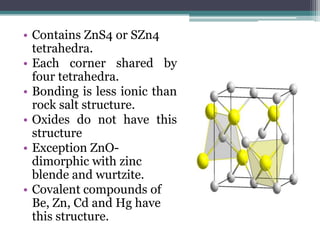
• Contains ZnS4 or SZn4
tetrahedra.
• Each corner shared by
four tetrahedra.
• Bonding is less ionic than
rock salt structure.
• Oxides do not have this
structure
• Exception ZnOdimorphic with zinc
blende and wurtzite.
• Covalent compounds of
Be, Zn, Cd and Hg have
this structure.
Antifluorite (Na O)
2

• Fcc w.r.t anions.
• Tetrahedral sites T+ and T_ are occupied by
cations. Octahedral sites are empty.
• General formula A2X
• CN of anion=8
• CN of cation=4
• Structure shown by oxides and chalcogenides of
alkali metals.
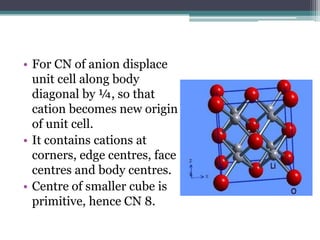
• For CN of anion displace
unit cell along body
diagonal by ¼, so that
cation becomes new origin
of unit cell.
• It contains cations at
corners, edge centres, face
centres and body centres.
• Centre of smaller cube is
primitive, hence CN 8.
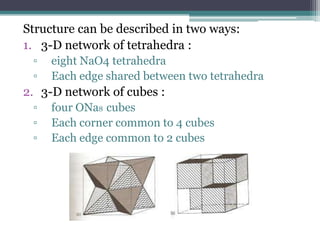
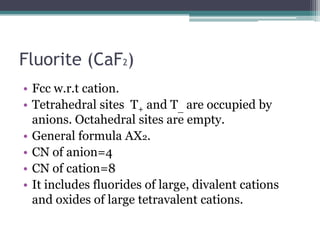
Structure can be described in two ways:
1. 3-D network of tetrahedra :
▫
▫

eight NaO4 tetrahedra
Each edge shared between two tetrahedra

2. 3-D network of cubes :
▫
▫
▫

four ONa8 cubes
Each corner common to 4 cubes
Each edge common to 2 cubes
Fluorite (CaF2)
• Fcc w.r.t cation.
• Tetrahedral sites T+ and T_ are occupied by
anions. Octahedral sites are empty.
• General formula AX2.
• CN of anion=4
• CN of cation=8
• It includes fluorides of large, divalent cations
and oxides of large tetravalent cations.
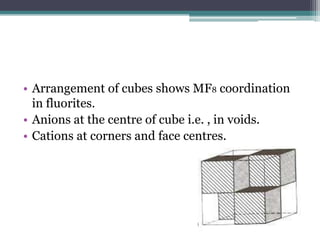
• Arrangement of cubes shows MF8 coordination
in fluorites.
• Anions at the centre of cube i.e. , in voids.
• Cations at corners and face centres.
CsCl Type
•
•
•
•
•
•

Simple cubic w.r.t anion.
Anions present at corners.
Cation present in cubic void i.e., body centre.
General formula AB.
CN of anion=8
CN of cation=8
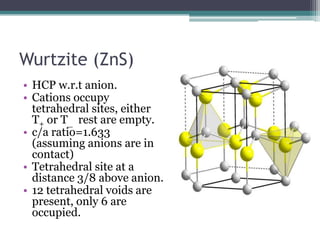
Wurtzite (ZnS)
• HCP w.r.t anion.
• Cations occupy
tetrahedral sites, either
T+ or T_ rest are empty.
• c/a ratio=1.633
(assuming anions are in
contact)
• Tetrahedral site at a
distance 3/8 above anion.
• 12 tetrahedral voids are
present, only 6 are
occupied.
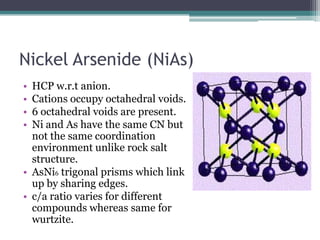
Nickel Arsenide (NiAs)
•
•
•
•

HCP w.r.t anion.
Cations occupy octahedral voids.
6 octahedral voids are present.
Ni and As have the same CN but
not the same coordination
environment unlike rock salt
structure.
• AsNi6 trigonal prisms which link
up by sharing edges.
• c/a ratio varies for different
compounds whereas same for
wurtzite.
Rutile (TiO2)
• Distorted HCP oxide array or tetragonal packed oxide
array.
• ½ octahedral sites occupied by Ti.
• Alternate rows of octahedral sites are full and empty.
• Oxides of tetravalent metal ions & fluorides of small
divalent ions exhibit this structure.
• M4+ and M2+ are too small to form fluorite structure with
O2- and F- .
In CdI2 layers of octahedral sites are occupied and these
alternate with empty layers.
In CdI2 anions are HCP whereas in CdCl2 they are CCP.
Silicate Structures
• Composed of cations and silicate anions.
• Mostly built of SiO4 tetrahedra.
Exception: In SiP2O7 , Si is octahedrally coordinated
to oxygen.
• SiO4 tetrahedra links up by sharing corners. Never
share edges or faces.
• A corner is shared by maximum of 2 tetrahedra.
• To relate formula to structure Si:O ratio is
important.
• Si:O ratio is variable.
• Two types of oxygen atoms: bridged and nonbridged.
• Exact structure cannot be determined.
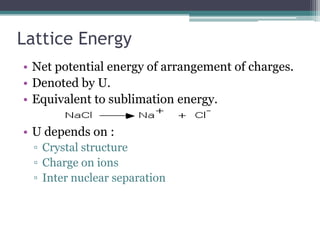
Lattice Energy
• Net potential energy of arrangement of charges.
• Denoted by U.
• Equivalent to sublimation energy.
• U depends on :
▫ Crystal structure
▫ Charge on ions
▫ Inter nuclear separation
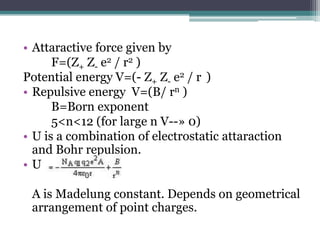
• Attaractive force given by
F=(Z+ Z- e2 / r2 )
Potential energy V=(- Z+ Z- e2 / r )
• Repulsive energy V=(B/ rn )
B=Born exponent
5<n<12 (for large n V--» 0)
• U is a combination of electrostatic attaraction
and Bohr repulsion.
•U
A is Madelung constant. Depends on geometrical
arrangement of point charges.
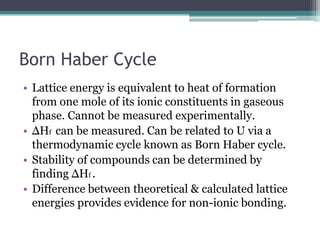
Born Haber Cycle
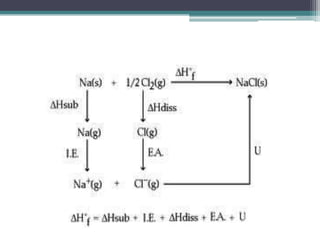
• Lattice energy is equivalent to heat of formation
from one mole of its ionic constituents in gaseous
phase. Cannot be measured experimentally.
• ΔHf can be measured. Can be related to U via a
thermodynamic cycle known as Born Haber cycle.
• Stability of compounds can be determined by
finding ΔHf .
• Difference between theoretical & calculated lattice
energies provides evidence for non-ionic bonding.
Structure types of crystals

Structure types of crystals

  • 1.
  • 2.
    Rock Salt (NaCl) •Fcc with respect to anions. • Cations occupy octahedral voids. • Octahedral sites are present at edge centres and body centre. • There are 4 octahedral sites per unit cell. • General formula AX. • CN of anion=8 • CN of cation=8
  • 3.
    • Each ionand its neighbours can be represented by apt. polyhedra. • Octahedron has 12 edges. • Each edge shared between two octahedron. • Octahedron centred on Na ions. • Most halides & hydrides of alkali metals and Ag+ have this structure. • Mostly ionic, but TiO metallic.
  • 4.
    Zinc Blende orSphalerite (ZnS) • Fcc w.r.t anions. • Two types of tetrahedral sites are there : T+ , T_ • Cations occupy tetrahedral sites, either T+ or T_ rest are empty. • Tetrahedral sites are present at (1/4,1/4,3/4) position and its equivalent points. • There are total 8 tetrahedral sites, 4 T+ and 4 T_ • General formula AX. • CN of anion=4 • CN of cation=4
  • 5.
    • Contains ZnS4or SZn4 tetrahedra. • Each corner shared by four tetrahedra. • Bonding is less ionic than rock salt structure. • Oxides do not have this structure • Exception ZnOdimorphic with zinc blende and wurtzite. • Covalent compounds of Be, Zn, Cd and Hg have this structure.
  • 6.
    Antifluorite (Na O) 2 •Fcc w.r.t anions. • Tetrahedral sites T+ and T_ are occupied by cations. Octahedral sites are empty. • General formula A2X • CN of anion=8 • CN of cation=4 • Structure shown by oxides and chalcogenides of alkali metals.
  • 7.
    • For CNof anion displace unit cell along body diagonal by ¼, so that cation becomes new origin of unit cell. • It contains cations at corners, edge centres, face centres and body centres. • Centre of smaller cube is primitive, hence CN 8.
  • 8.
    Structure can bedescribed in two ways: 1. 3-D network of tetrahedra : ▫ ▫ eight NaO4 tetrahedra Each edge shared between two tetrahedra 2. 3-D network of cubes : ▫ ▫ ▫ four ONa8 cubes Each corner common to 4 cubes Each edge common to 2 cubes
  • 9.
    Fluorite (CaF2) • Fccw.r.t cation. • Tetrahedral sites T+ and T_ are occupied by anions. Octahedral sites are empty. • General formula AX2. • CN of anion=4 • CN of cation=8 • It includes fluorides of large, divalent cations and oxides of large tetravalent cations.
  • 10.
    • Arrangement ofcubes shows MF8 coordination in fluorites. • Anions at the centre of cube i.e. , in voids. • Cations at corners and face centres.
  • 11.
    CsCl Type • • • • • • Simple cubicw.r.t anion. Anions present at corners. Cation present in cubic void i.e., body centre. General formula AB. CN of anion=8 CN of cation=8
  • 12.
    Wurtzite (ZnS) • HCPw.r.t anion. • Cations occupy tetrahedral sites, either T+ or T_ rest are empty. • c/a ratio=1.633 (assuming anions are in contact) • Tetrahedral site at a distance 3/8 above anion. • 12 tetrahedral voids are present, only 6 are occupied.
  • 13.
    Nickel Arsenide (NiAs) • • • • HCPw.r.t anion. Cations occupy octahedral voids. 6 octahedral voids are present. Ni and As have the same CN but not the same coordination environment unlike rock salt structure. • AsNi6 trigonal prisms which link up by sharing edges. • c/a ratio varies for different compounds whereas same for wurtzite.
  • 14.
    Rutile (TiO2) • DistortedHCP oxide array or tetragonal packed oxide array. • ½ octahedral sites occupied by Ti. • Alternate rows of octahedral sites are full and empty. • Oxides of tetravalent metal ions & fluorides of small divalent ions exhibit this structure. • M4+ and M2+ are too small to form fluorite structure with O2- and F- . In CdI2 layers of octahedral sites are occupied and these alternate with empty layers. In CdI2 anions are HCP whereas in CdCl2 they are CCP.
  • 15.
    Silicate Structures • Composedof cations and silicate anions. • Mostly built of SiO4 tetrahedra. Exception: In SiP2O7 , Si is octahedrally coordinated to oxygen. • SiO4 tetrahedra links up by sharing corners. Never share edges or faces. • A corner is shared by maximum of 2 tetrahedra. • To relate formula to structure Si:O ratio is important. • Si:O ratio is variable. • Two types of oxygen atoms: bridged and nonbridged. • Exact structure cannot be determined.
  • 16.
    Lattice Energy • Netpotential energy of arrangement of charges. • Denoted by U. • Equivalent to sublimation energy. • U depends on : ▫ Crystal structure ▫ Charge on ions ▫ Inter nuclear separation
  • 17.
    • Attaractive forcegiven by F=(Z+ Z- e2 / r2 ) Potential energy V=(- Z+ Z- e2 / r ) • Repulsive energy V=(B/ rn ) B=Born exponent 5<n<12 (for large n V--» 0) • U is a combination of electrostatic attaraction and Bohr repulsion. •U A is Madelung constant. Depends on geometrical arrangement of point charges.
  • 18.
    Born Haber Cycle •Lattice energy is equivalent to heat of formation from one mole of its ionic constituents in gaseous phase. Cannot be measured experimentally. • ΔHf can be measured. Can be related to U via a thermodynamic cycle known as Born Haber cycle. • Stability of compounds can be determined by finding ΔHf . • Difference between theoretical & calculated lattice energies provides evidence for non-ionic bonding.