BY: Yogesh Kumar
 Mossbauer spectroscopy is more aptly described by its alternative name;
NUCLEAR GAMMA RESONANCE SPECTROSCOPY.
 Sometimes may be abbreviated as NGR.
As Name suggests, nucleus is probed using Gamma rays as exciting
radiation; a gamma- absorption spectrum ismeasured.
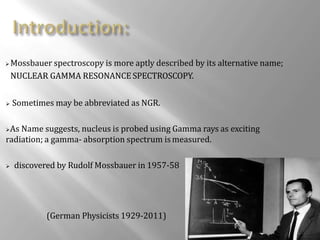
 discovered by Rudolf Mossbauer in 1957-58
(German Physicists 1929-2011)
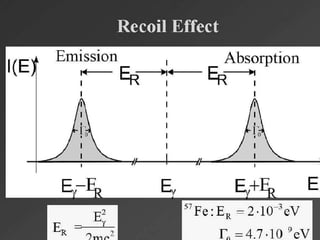
Just as gun recoils when bullet is fired, conservation of momentum requiresa
free nucleus to recoil during emission or absorption of gammarays.
 If nucleus at rest emit gamma ray , the energy of the gamma rayis
slightly less than the natural energy of the transition, but in order for anucleus
at rest to absorb a gamma ray,the gamma ray's energy mustbe
slightly greater than the natural energy, because in both cases energy is lostto
recoil.
means nuclear resonance is unobservable with free nuclei because shift in
energy is too large to have significant overlap of emission and absorption
spectra.
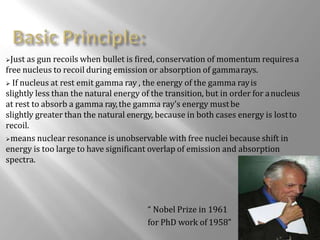
“ Nobel Prize in 1961
for PhD work of 1958”
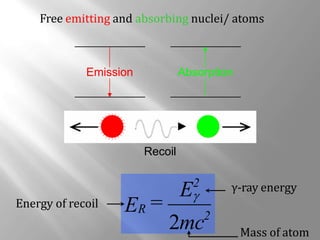
Emission Absorption
Recoil
E2
ER =
2mc2

Free emitting and absorbing nuclei/ atoms
Energy of recoil
γ-ray energy
Mass of atom
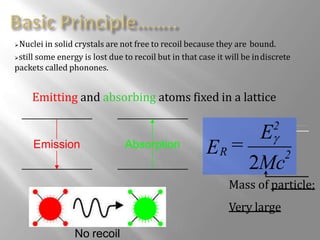
Emission Absorption
Nuclei in solid crystals are not free to recoil because they are bound.
still some energy is lost due to recoil but in that case it will be indiscrete
packets called phonones.
Emitting and absorbing atoms fixed in a lattice
No recoil
E = 2
R
E2
2Mc

Mass of particle;
Very large
 oxidation and spin state of nuclear resonanceprobe.
 molecular symmetry
 magnetic properties of material under investigation.
 solid sample exposed to beam of gammarays
 detector measures the intensity of transmitted rays through thesample.
If emitting and absorbing nuclei are in same chemical environment, the
nuclear transition energies would be exactly equal and resonant absorption
observed with both materials at rest.
difference in chemical environments, causes the nuclear energy levelsto
shift .
 Tobring the two nuclei back into resonance Doppler effect is used.
the source is accelerated through a range of velocities using alinear
motor to produce a Dopplereffect.
Several conditions have to be satisfied:
 Energy of transition have to be large but not larger than latticevibrations.
(10-150 ev)
 substantial proportions of excited state nuclei should bethere.
lifetime of excited state should be large to have precise energy of
transition, but low enough to have intense lines in spectrum.(1-100ns)
 excited state of emitter should have long lived precursor.
 ground state isotope should bestable.
 cross section of absorption should be high.
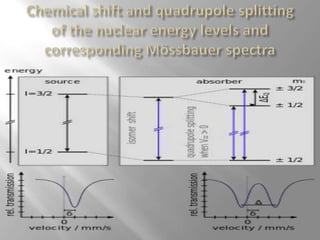
Chemical Isomer Shift (IS) (): Arises out of the interaction between
nuclear charge density and the surrounding ‘s’ electron charge cloud. IS
can give information about the spin state as well as the co-ordination
number.
Isomer shift (chemical shift, CS) can be expressed using the formula
below:
CS = K (Re
2 – Rg
2) {[Ψs
2(0)]a – [Ψs
2(0)]b}
Physical meaning of this equation:
 an increase in s electron density in 57-Fe spectrum gives a negative
shift because the change in the effective nuclear charge isnegative
 an increase in s electron density in 119-Sn gives a positive shift due to
a positive change in overall nuclear charge
Oxidised ferric ions (Fe³⁺) have lower isomer shifts than ferrous ions
(Fe²⁺) because s electron density at the nucleus of ferric ions is greater
due to a weaker screening effect by d electrons.
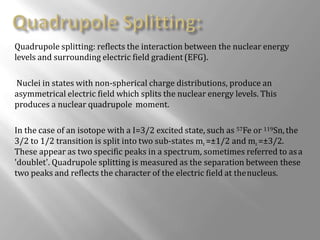
Quadrupole splitting: reflects the interaction between the nuclear energy
levels and surrounding electric field gradient(EFG).
Nuclei in states with non-spherical charge distributions, produce an
asymmetrical electric field which splits the nuclear energy levels. This
produces a nuclear quadrupole moment.
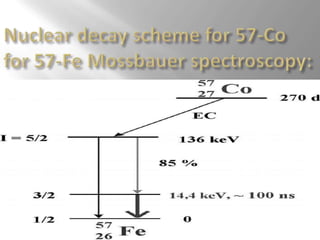
In the case of an isotope with a I=3/2 excited state, such as 57Fe or 119Sn,the
3/2 to 1/2 transition is split into two sub-states mı =±1/2 and mı =±3/2.
These appear as two specific peaks in a spectrum, sometimes referred to asa
'doublet'. Quadrupole splitting is measured as the separation between these
two peaks and reflects the character of the electric field at thenucleus.
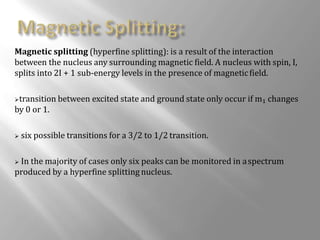
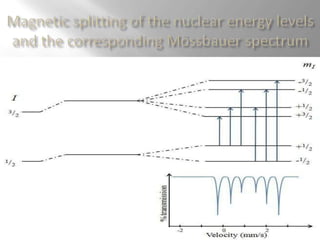
Magnetic splitting (hyperfine splitting): is a result of the interaction
between the nucleus any surrounding magnetic field. A nucleus with spin, I,
splits into 2I + 1 sub-energy levels in the presence of magneticfield.
transition between excited state and ground state only occur if m₁ changes
by 0 or 1.
 six possible transitions for a 3/2 to 1/2 transition.
 In the majority of cases only six peaks can be monitored in aspectrum
produced by a hyperfine splitting nucleus.
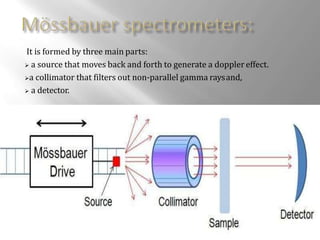
It is formed by three main parts:
 a source that moves back and forth to generate a dopplereffect.
a collimator that filters out non-parallel gamma raysand,
 a detector.
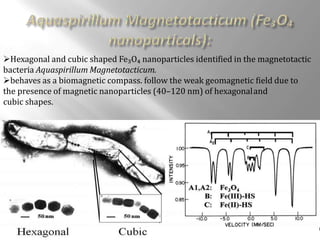
Hexagonal and cubic shaped Fe₃O₄ nanoparticles identified in the magnetotactic
bacteria Aquaspirillum Magnetotacticum.
behaves as a biomagnetic compass. follow the weak geomagnetic field due to
the presence of magnetic nanoparticles (40–120 nm) of hexagonaland
cubic shapes.
mossbauerspectroscopy-131108041016-phpapp02 (1).pptx

mossbauerspectroscopy-131108041016-phpapp02 (1).pptx

  • 1.
  • 2.
     Mossbauer spectroscopyis more aptly described by its alternative name; NUCLEAR GAMMA RESONANCE SPECTROSCOPY.  Sometimes may be abbreviated as NGR. As Name suggests, nucleus is probed using Gamma rays as exciting radiation; a gamma- absorption spectrum ismeasured.  discovered by Rudolf Mossbauer in 1957-58 (German Physicists 1929-2011)
  • 3.
    Just as gunrecoils when bullet is fired, conservation of momentum requiresa free nucleus to recoil during emission or absorption of gammarays.  If nucleus at rest emit gamma ray , the energy of the gamma rayis slightly less than the natural energy of the transition, but in order for anucleus at rest to absorb a gamma ray,the gamma ray's energy mustbe slightly greater than the natural energy, because in both cases energy is lostto recoil. means nuclear resonance is unobservable with free nuclei because shift in energy is too large to have significant overlap of emission and absorption spectra. “ Nobel Prize in 1961 for PhD work of 1958”
  • 4.
    Emission Absorption Recoil E2 ER = 2mc2  Freeemitting and absorbing nuclei/ atoms Energy of recoil γ-ray energy Mass of atom
  • 5.
    Emission Absorption Nuclei insolid crystals are not free to recoil because they are bound. still some energy is lost due to recoil but in that case it will be indiscrete packets called phonones. Emitting and absorbing atoms fixed in a lattice No recoil E = 2 R E2 2Mc  Mass of particle; Very large
  • 6.
     oxidation andspin state of nuclear resonanceprobe.  molecular symmetry  magnetic properties of material under investigation.
  • 8.
     solid sampleexposed to beam of gammarays  detector measures the intensity of transmitted rays through thesample. If emitting and absorbing nuclei are in same chemical environment, the nuclear transition energies would be exactly equal and resonant absorption observed with both materials at rest. difference in chemical environments, causes the nuclear energy levelsto shift .  Tobring the two nuclei back into resonance Doppler effect is used. the source is accelerated through a range of velocities using alinear motor to produce a Dopplereffect.
  • 9.
    Several conditions haveto be satisfied:  Energy of transition have to be large but not larger than latticevibrations. (10-150 ev)  substantial proportions of excited state nuclei should bethere. lifetime of excited state should be large to have precise energy of transition, but low enough to have intense lines in spectrum.(1-100ns)  excited state of emitter should have long lived precursor.  ground state isotope should bestable.  cross section of absorption should be high.
  • 11.
    Chemical Isomer Shift(IS) (): Arises out of the interaction between nuclear charge density and the surrounding ‘s’ electron charge cloud. IS can give information about the spin state as well as the co-ordination number. Isomer shift (chemical shift, CS) can be expressed using the formula below: CS = K (Re 2 – Rg 2) {[Ψs 2(0)]a – [Ψs 2(0)]b} Physical meaning of this equation:  an increase in s electron density in 57-Fe spectrum gives a negative shift because the change in the effective nuclear charge isnegative  an increase in s electron density in 119-Sn gives a positive shift due to a positive change in overall nuclear charge Oxidised ferric ions (Fe³⁺) have lower isomer shifts than ferrous ions (Fe²⁺) because s electron density at the nucleus of ferric ions is greater due to a weaker screening effect by d electrons.
  • 12.
    Quadrupole splitting: reflectsthe interaction between the nuclear energy levels and surrounding electric field gradient(EFG). Nuclei in states with non-spherical charge distributions, produce an asymmetrical electric field which splits the nuclear energy levels. This produces a nuclear quadrupole moment. In the case of an isotope with a I=3/2 excited state, such as 57Fe or 119Sn,the 3/2 to 1/2 transition is split into two sub-states mı =±1/2 and mı =±3/2. These appear as two specific peaks in a spectrum, sometimes referred to asa 'doublet'. Quadrupole splitting is measured as the separation between these two peaks and reflects the character of the electric field at thenucleus.
  • 14.
    Magnetic splitting (hyperfinesplitting): is a result of the interaction between the nucleus any surrounding magnetic field. A nucleus with spin, I, splits into 2I + 1 sub-energy levels in the presence of magneticfield. transition between excited state and ground state only occur if m₁ changes by 0 or 1.  six possible transitions for a 3/2 to 1/2 transition.  In the majority of cases only six peaks can be monitored in aspectrum produced by a hyperfine splitting nucleus.
  • 16.
    It is formedby three main parts:  a source that moves back and forth to generate a dopplereffect. a collimator that filters out non-parallel gamma raysand,  a detector.
  • 20.
    Hexagonal and cubicshaped Fe₃O₄ nanoparticles identified in the magnetotactic bacteria Aquaspirillum Magnetotacticum. behaves as a biomagnetic compass. follow the weak geomagnetic field due to the presence of magnetic nanoparticles (40–120 nm) of hexagonaland cubic shapes.