Mass spectrometry (MS)
By:
Dr. Ashish C Patel,
Assistant Professor,
Animal Genetics &
Breeding, Veterinary
College, Anand
Mass spectrometry (MS)
• Mass spectrometry (MS) measures the mass-to-charge ratio of ions
to identify and quantify molecules in simple and complex mixtures.
• MS has become important across a broad range of fields, including
proteomics.
• Mass spectrometry is a sensitive technique used to detect, identify
and quantitate molecules based on their mass and charge (m/z)
ratio.
• MS was first used in the biological sciences to trace heavy isotopes
through biological systems.
• Later on, MS was used to sequence oligonucleotides and peptides
and analyze nucleotide structure.
Methods for
protein
identification
How does a mass spectrometer work?
• Ionization
method
– MALDI
– Electrospray
(Proteins must be charged
and dry)
• Mass analyzer
– MALDI-TOF
• MW
– Triple Quadrapole
• AA seq
– MALDI-QqTOF
• AA seq and MW
– QqTOF
• AA seq and protein modif.
Create ions Separate ions Detect ions
• Mass spectrum
• Database
analysis
MS History
• JJ Thomson built MS prototype to measure m/z of electron, awarded
Nobel Prize in 1906
• MS concept first put into practice by Francis Aston, a physicist working
in Cambridge England in 1919. He Designed to measure mass of
elements and Aston Awarded Nobel Prize in 1922
• 1948-52 - Time of Flight (TOF) mass analyzers introduced
• 1955 - Quadrupole ion filters introduced by W. Paul, also invents the
ion trap in 1983 (wins 1989 Nobel Prize)
• 1968 - Tandem mass spectrometer appears
• Mass spectrometers are now one of the MOST POWERFUL ANALYTIC
TOOLS IN CHEMISTRY
Mass spectrometers
• Time of flight (TOF) (MALDI)
– Measures the time required for ions to fly down the length of
a chamber.
– Often combined with MALDI (MALDI-TOF). Detections from
multiple laser bursts are averaged.
• Tandem MS- MS/MS
-separation and identification of compounds in complex mixtures
- induce fragmentation and mass analyze the fragment ions.
- Uses two or more mass analyzers/filters separated by a
collision cell filled with Argon or Xenon
• Different MS-MS configurations
– Quadrupole-quadrupole (low energy)
– Magnetic sector-quadrupole (high)
– Quadrupole-time-of-flight (low energy)
– Time-of-flight-time-of-flight (low energy)
LC/LC-MS/MS-Tandem LC, Tandem MS
Principle of MS
“The basic principle of mass spectrometry (MS) is to generate ions from
either inorganic or organic compounds by any suitable method, to
separate these ions by their mass-to-charge ratio (m/z) and to detect
them qualitatively and quantitatively by their respective m/z and
abundance.
The analyte may be ionized thermally, by electric fields or by impacting
energetic electrons, ions or photons. These ions can be single ionized
atoms, clusters, molecules or their fragments or associates.
Ion separation is effected by static or dynamic electric or magnetic fields.”
Ionization of a sample can be effected not only by electrons, but also by
(atomic) ions or photons, energetic neutral atoms, electronically excited
atoms, massive cluster ions, and even electrostatically charged
microdroplets can also be used to effect.
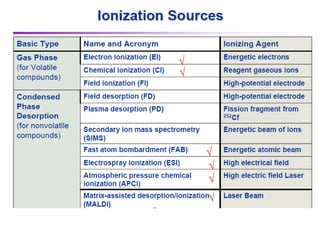
The large variety of ionization techniques and their key applications can be
roughly classified by their relative hardness or softness and (molecular)
mass of suitable analytes.
•All proteins are sorted based on a mass to charge ratio (m/z)
•Molecular weight divided by the charge on the protein
Relative Abundance
120 m/z-for singly charged ion this is the mass
Resolution & Resolving Power
• Width of peak indicates the resolution of the MS instrument
• The better the resolution or resolving power, the better the
instrument and the better the mass accuracy.
• Resolving power is defined as:
M is the mass number of the observed mass (DM) is the difference
between two masses that can be separated
DM
M
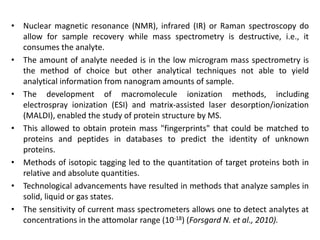
• Nuclear magnetic resonance (NMR), infrared (IR) or Raman spectroscopy do
allow for sample recovery while mass spectrometry is destructive, i.e., it
consumes the analyte.
• The amount of analyte needed is in the low microgram mass spectrometry is
the method of choice but other analytical techniques not able to yield
analytical information from nanogram amounts of sample.
• The development of macromolecule ionization methods, including
electrospray ionization (ESI) and matrix-assisted laser desorption/ionization
(MALDI), enabled the study of protein structure by MS.
• This allowed to obtain protein mass "fingerprints" that could be matched to
proteins and peptides in databases to predict the identity of unknown
proteins.
• Methods of isotopic tagging led to the quantitation of target proteins both in
relative and absolute quantities.
• Technological advancements have resulted in methods that analyze samples in
solid, liquid or gas states.
• The sensitivity of current mass spectrometers allows one to detect analytes at
concentrations in the attomolar range (10-18) (Forsgard N. et al., 2010).
Mass Spectrometer Schematic
Inlet
Ion
Source
Mass
Filter
Detector
Data
System
High Vacuum System
Turbo pumps
Diffusion pumps
Rough pumps
Rotary pumps
Sample Plate
Target
HPLC
GC
Solids probe
MALDI
ESI
IonSpray
FAB
LSIMS
EI/CI
TOF
Quadrupole
Ion Trap
Mag. Sector
FTMS
Microch plate
Electron Mult.
Hybrid Detec.
PC’s
UNIX
Mac
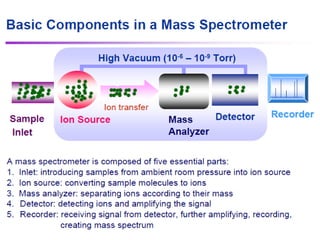
• All mass spectrometers have an ion source, a mass analyzer and an
ion detector.
• The nature of ionization components based on the type of mass
spectrometer, the type of data required, and the physical properties
of the sample.
• Samples are loaded into the mass spectrometer in liquid, gas or dried
form and then vaporized and ionized by the ion source.
• The ions encounter electric and/or magnetic fields from mass
analyzers, which deflect the paths of individual ions based on their
mass and charge (m/z).
Different Ionization Methods
• Electron Impact (EI - Hard method)
– small molecules, 1-1000 Daltons, structure
• Fast Atom Bombardment (FAB – Semi-hard)
– peptides, sugars, up to 6000 Daltons
• Electrospray Ionization (ESI - Soft)
– peptides, proteins, up to 200,000 Daltons
• Matrix Assisted Laser Desorption (MALDI-Soft)
– peptides, proteins, DNA, up to 500 kD
Electron Impact Ionization
• Sample introduced into instrument by heating it until it evaporates
• Gas phase sample is bombarded with electrons coming from rhenium
or tungsten filament.
• Molecule is “shattered” into fragments and fragments sent to mass
analyzer
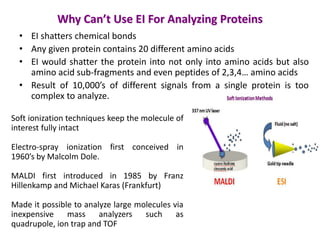
Why Can’t Use EI For Analyzing Proteins
• EI shatters chemical bonds
• Any given protein contains 20 different amino acids
• EI would shatter the protein into not only into amino acids but also
amino acid sub-fragments and even peptides of 2,3,4… amino acids
• Result of 10,000’s of different signals from a single protein is too
complex to analyze.
Soft ionization techniques keep the molecule of
interest fully intact
Electro-spray ionization first conceived in
1960’s by Malcolm Dole.
MALDI first introduced in 1985 by Franz
Hillenkamp and Michael Karas (Frankfurt)
Made it possible to analyze large molecules via
inexpensive mass analyzers such as
quadrupole, ion trap and TOF
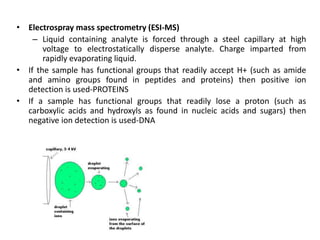
• Electrospray mass spectrometry (ESI-MS)
– Liquid containing analyte is forced through a steel capillary at high
voltage to electrostatically disperse analyte. Charge imparted from
rapidly evaporating liquid.
• If the sample has functional groups that readily accept H+ (such as amide
and amino groups found in peptides and proteins) then positive ion
detection is used-PROTEINS
• If a sample has functional groups that readily lose a proton (such as
carboxylic acids and hydroxyls as found in nucleic acids and sugars) then
negative ion detection is used-DNA
MALDI
• Matrix-assisted laser desorption ionization (MALDI)
– Analyte (protein) is mixed with large excess of matrix (small
organic molecule)
– Irradiated with short pulse of laser light. Wavelength of laser is the
same as absorbance max of matrix.
• Sample is ionized by bombarding sample with laser light
• Sample is mixed with a UV absorbant matrix
• Light wavelength matches that of absorbance maximum of matrix so
that the matrix transfers some of its energy to the analyte (leads to
ion sputtering)
Spotting on a MALDI Plate
MALDI Ionization
+
+
+
+
-
-
-
+
+
+
+
-
-
--+
+
Analyte
Matrix
Laser
+
+
+
• Absorption of UV radiation by
chromophoric matrix and ionization
of matrix
• Dissociation of matrix, phase
change to super-compressed gas,
charge transfer to analyte molecule
• Expansion of matrix at supersonic
velocity, analyte trapped in
expanding matrix plume
(explosion/”popping”)
+
+
+
Principal for MALDI-TOF MASS
Linear Time Of Flight tube
Reflector Time Of Flight tube
detector
reflector
ion source
ion source
detector
time of flight
time of flight
Mass
Filter
Mass Spectrometer Schematic
Inlet
Ion
Source
Detector
Data
System
High Vacuum System
Turbo pumps
Diffusion pumps
Rough pumps
Rotary pumps
Sample Plate
Target
HPLC
GC
Solids probe
MALDI
ESI
IonSpray
FAB
LSIMS
EI/CI
TOF
Quadrupole
Ion Trap
Mag. Sector
FTMS
Microch plate
Electron Mult.
Hybrid Detec.
PC’s
UNIX
Mac
• Commonly used mass analyzers include time-of-flight [TOF], orbitraps,
quadrupoles and ion traps, and each type has specific characteristics.
• Mass analyzers can be used to separate all analytes in a sample.
• Ions that have prevent by the mass analyzers then hit the ion detector.
• This entire process is performed under an extreme vacuum (10-6 to
108 torr) to remove gas molecules, neutrals, and contaminating non-
sample ions, which can run with sample ions and alter their paths or
produce non-specific reaction products .
• Newer orbitrap technology captures ions around a central spindle
electrode and then analyzes their m/z values as they move across the
spindle
• Orbitrap technology can achieve extremely high sensitivity and
resolution.
• Mass spectrometers are connected to computers with software that
analyzes the ion detector data and produces graphs that organize the
detected ions by their individual m/z and relative abundance.
Different Mass Analyzers
• Magnetic Sector Analyzer (MSA)
– High resolution, exact mass
• Quadrupole Analyzer (Q)
– Low resolution, fast, cheap
• Time-of-Flight Analyzer (TOF)
– No upper m/z limit, high throughput
• Ion Trap Mass Analyzer (QSTAR)
– Good resolution, all-in-one mass analyzer
• Ion Cyclotron Resonance (FT-ICR)
– Highest resolution, exact mass, costly
Different Types of MS
ESI-QTOF
Electrospray ionization source + quadrupole mass filter + time-of-flight mass
analyzer
MALDI-QTOF
Matrix-assisted laser desorption ionization + quadrupole + time-of-flight mass
analyzer
Both separate by MW and AA seq
Different Types of MS
• GC-MS - Gas Chromatography MS
– separates volatile compounds in gas column and ID’s by mass
• LC-MS - Liquid Chromatography MS
– separates delicate compounds in HPLC column and ID’s by mass
• MS-MS - Tandem Mass Spectrometry
– separates compound fragments by magnetic field and ID’s by mass
• LC/LC-MS/MS-Tandem LC and Tandem MS
– Separates by HPLC, ID’s by mass and AA sequence
Quadrupole Mass Analyzer
• A quadrupole mass filter consists of four parallel metal rods with
different charges
• Two opposite rods have an applied + potential and the other two
rods have a – potential
• The applied voltages affect the path of ions traveling down the
flight path
• For given dc and ac voltages, only ions of a certain mass-to-charge
ratio pass through the quadrupole filter and all other ions are
thrown out of their original path
Ion Trap Mass Analyzer
• Ion traps are ion trapping
devices that make use of a
three-dimensional quadrupole
field to trap and mass-analyze
ions
• Offer good mass resolving
power
FT-ICR
Fourier-transform ion cyclotron resonance
• Uses powerful magnet (5-10 Tesla) to create a miniature cyclotron
• Originally developed in Canada (UBC) in 1974
• FT approach allows many ion masses to be determined
simultaneously.
• Has higher mass resolution than any other MS analyzer available
Current Mass Spec Technologies
• Proteome profiling/separation
– 2D SDS PAGE - identify proteins
– 2-D LC or LC - high throughput analysis of lysates
(LC = Liquid Chromatography)
– 2-D LC/MS (MS= Mass spectrometry)
• Protein identification
– Peptide mass fingerprint
– Tandem Mass Spectrometry (MS/MS)
• Quantative proteomics
– ICAT (isotope-coded affinity tag)
– ITRAQ
2D – LC or LC
Study protein complexes
without gel
electrophoresis
Peptides all bind to
cation exchange
column
Peptides are
separated by
hydrophobicity on
reverse phase
column
Successive elution
with increasing salt
gradients separates
peptides by charge
Complex mixture is
simplified prior to MS/MS
by 2D LC
(trypsin)
2D – LC followed by MS
Tandem Mass Spectrometry
• Purpose is to fragment ions from parent ion to provide structural
information about a molecule
• Also allows mass separation and AA identification of compounds in
complex mixtures
• Uses two or more mass analyzers/filters separated by a collision cell
filled with Argon or Xenon
• Collision cell is where selected ions are sent for further fragmentation
• In Tandem mass spectrometry (MS/MS), distinct ions of interest are
selected based on their m/z from the first round of MS and are
fragmented by a number of methods of dissociation.
• One such method involves colliding the ions with a stream of inert gas,
which is known as collision-induced dissociation (CID) or higher energy
collision dissociation (HCD). Other methods of ion fragmentation
include electron-transfer dissociation (ETD) and electron-capture
dissociation (ECD).
• These fragments are then separated based on their
individual m/z ratios in a second round of MS. MS/MS (i.e., tandem
mass spectrometry) is commonly used to sequence proteins and
oligonucleotides and these can be match with databases such as IPI,
RefSeq and UniProtKB/Swiss-Prot.
• These sequence fragments can then be organized in silico into full-
length sequence predictions.
• Diagram of tandem mass spectrometry (MS/MS).
• A sample is injected into the mass spectrometer, ionized, accelerated
and analyzed by mass spectrometry (MS1).
• Ions from the MS1 spectra are then selectively fragmented and
analyzed by a second stage of mass spectrometry (MS2) to generate the
spectra for the ion fragments.
How Tandem MS sequencing works
• Use Tandem MS: two mass analyzers in
series with a collision cell in between
• Collision cell: a region where the ions
collide with a gas (He, Ne, Ar) resulting
in fragmentation of the ion
• Fragmentation of the peptides occur in
a predictable fashion, mainly at the
peptide bonds
• The resulting daughter ions have
masses that are consistent with known
molecular weights of dipeptides,
tripeptides, tetrapeptides…
Ser-Glu-Leu-Ile-Arg-Trp
Collision Cell
Ser-Glu-Leu-Ile-Arg
Ser-Glu-Leu
Ser-Glu-Leu-Ile
Etc…
Advantages of Tandem Mass Spec
FAST
No Gels
Determines MW and AA sequence
Can be used on complex mixtures-including low copy
Can detect post-translational modifation.
High-thoughput capability
Disadvantages of Tandem Mass Spec
Very expensive-Campus
Hardware: $1000
Setup: $300
1 run: $1000
Requires sequence databases for analysis
• Gas chromatography (GC) and liquid chromatography (LC) are
common methods of pre-MS separation that are used when analyzing
complex gas or liquid samples by MS, respectively.
• LC-MS is typically applied to the analysis of thermally unstable and
nonvolatile molecules (e.g., sensitive biological fluids),
• while GC-MS is used for the analysis of volatile compounds such as
petrochemicals.
• LC-MS and GC-MS also use different methods for ionization of the
compound.
• In LC-MS, the sample may be ionized directly by electrospray ionization
(EI) and in GC-MS, the sample may be ionized directly or indirectly via
EI.
• High performance liquid chromatography (HPLC) is the most common
separation method to study biological samples by MS or MS/MS
(termed LC-MS or LC-MS/MS, respectively), because the majority of
biological samples are liquid and nonvolatile.
• LC columns have small diameters (e.g., 75 μm; nanoHPLC) and low
flow rates (e.g., 200 nL/min), which are ideal for minute samples.
• Additionally, "in-line" liquid chromatography (LC linked directly to MS)
provides a high-throughput approach to sample analysis, enabling
multiple analytes to elute through the column at different rates to be
immediately analyzed by MS.
• For example, 1-5 peptides in a complex biological mixture can be
sequenced per second by in-line LC-MS/MS .
Quantitative Proteomics
• While mass spectrometry can detect very low analyte concentrations
in complex mixtures, MS is not inherently quantitative because of the
considerable loss of peptides and ions during analysis.
• Therefore, peptide labels or standards are parallelly analyzed with the
sample and act as a reference point for both relative or absolute
analyte quantitation, respectively.
• Commercial products are now available that allow the detection and
quantitation of multiple proteins in a single reaction, demonstrating
the high-throughput and global analytical platform that MS has
become in the field of proteomics.
• In Relative quantitation approaches, proteins or peptides are labeled
with stable isotopes that give them distinct mass shifts over unlabeled
analytes.
• This mass difference can be detected by MS and provides a ratio of
unlabeled to labeled analyte levels.
• These approaches are often used in discovery proteomics, where
many proteins are identified across a broad dynamic range using
different-sized labels.
• Absolute quantitation is performed in targeted proteomic
experiments and increases the sensitivity of detection for a limited
number of target analytes.
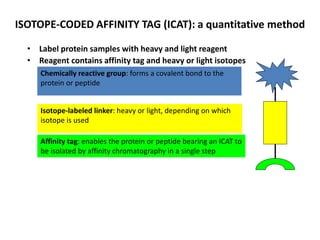
ISOTOPE-CODED AFFINITY TAG (ICAT): a quantitative method
• Label protein samples with heavy and light reagent
• Reagent contains affinity tag and heavy or light isotopes
Chemically reactive group: forms a covalent bond to the
protein or peptide
Isotope-labeled linker: heavy or light, depending on which
isotope is used
Affinity tag: enables the protein or peptide bearing an ICAT to
be isolated by affinity chromatography in a single step
How ICAT works?
Proteolysis
(ie trypsin)
Lyse &
Label
MIX
Affinity isolation on
streptavidin beads
Quantification
MS
Identification
MS/MS
100
m/z
200 400 600
0
100
550 570 590
0
m/z
Light
Heavy
NH2-EACDPLR-COOH
ICAT
Advantages vs. Disadvantages
• Estimates relative protein
levels between samples with a
reasonable level of accuracy
(within 10%)
• Can be used on complex
mixtures of proteins
• Cys-specific label reduces
sample complexity
• Peptides can be sequenced
directly if tandem MS-MS is
used
• Non specificity
• Slight chromatography differences
• Expensive
• Tag fragmentation
• Meaning of relative quantification
information
• No presence of cysteine residues or
not accessible by ICAT reagent
Mass
Filter
Mass Spectrometer Schematic
Inlet
Ion
Source
Detector
Data
System
High Vacuum System
Turbo pumps
Diffusion pumps
Rough pumps
Rotary pumps
Sample Plate
Target
HPLC
GC
Solids probe
MALDI
ESI
IonSpray
FAB
LSIMS
EI/CI
TOF
Quadrupole
Ion Trap
Mag. Sector
FTMS
Microch plate
Electron Mult.
Hybrid Detec.
PC’s
UNIX
Mac
DETECTORS
• Detection of ions is based upon their charge or momentum.
• For large signals a faraday cup is used to collect ions and measure the current.
• Older instruments used photographic plates to measure the ion abundance at
each mass to charge ratio.
• A detector is selected for it‘s speed, dynamic range, gain, and geometry.
Channeltron
• A channeltron is a horn-shaped continuous dynode structure that is coated on
the inside with a electron emissive material.
• An ion striking the channeltron creates secondary electrons that have an
avalanche effect to create more secondary electrons and finally a current
pulse.
Daly detector
• A Daly detector consists of a metal knob that emits secondary electrons when
struck by an ion.
• The secondary electrons are accelerated onto a scintillator that produces light
that is then detected by a photomultiplier tube.
Electron multiplier tube (EMT)
• Similar in design to photomultiplier tubes and consist of a series of
dynodes that eject secondary electrons when they are struck by an
ion. Multiply the ion current and can be used in analog or digital
mode.
Faraday cup
• Metal cup is placed in the path of the ion beam and is attached to an
electrometer, which measures the ion-beam current.
• Since a Faraday cup can only be used in an analog mode it is less
sensitive than other detectors that are capable of operating in pulse-
counting mode.
MS-MS & Proteomics
• Provides precise sequence-
specific data
• More informative than
Peptide mass fingerprinting
methods (>90%)
• Can be used for de-novo
sequencing (not entirely
dependent on databases)
• Can be used to identify post-
trans. modifications
• Requires more handling,
refinement and sample
manipulation
• Requires more expensive and
complicated equipment
• Requires high level expertise
• Slower, not generally high
throughput
Advantages Disadvantages
Data Interpretation:
• The mass difference between consecutive ions within a series allows
the identity of the consecutive amino acids to be determined.
• MS/MS fragment spectrum of a peptide with sequence Gly–Ile–Pro–
Thr–Leu–Leu–Leu–Phe–Lys is shown below and complete series of
bn ions, thus allowing one to deduce the peptide sequence
from the N-terminal acid to the C-terminal acid, whereas the
series of yn ions allows identification of the sequence in the
reverse direction.
• Mass difference of 97 Da between peak b2 and b3 indicates amino acid in
position 3 is proline 147 Da difference between peaks y1 and y2 indicates
amino acid in the next-to-last position is a phenylalanine.
• The m/z values of ions w3, w4, w5 and w8 imply that the amino acid in
positions 3, 4 and 5 starting from the C-terminal side are leucines, whereas
the amino acid in position 8 is an isoleucine
• The presence of a proline induces the formation of internal fragments
labelled PT, PTL and PTLL that allow one to verify the deduced sequence.
The peaks labelled P, F and X represent the immonium ions and indicate the
presence of proline, phenylalanine and leucine and/or isoleucine.
• Several algorithms have been developed to interpret tandem mass spectra
of peptides and searches the database to find the best sequence that
matches the spectrum.
• De novo spectral interpretation involves automatically interpreting the
spectra using the table of amino acid masses.
Applications of MS
Field of Study Applications
Proteomics Determine protein structure, function, folding and interactions
Identify a protein from the mass of its peptide fragments
Detect specific post-translational modifications throughout complex
biological mixtures
Quantitate (relative or absolute) proteins in a given sample
Monitor enzyme reactions, chemical modifications and protein
digestion
Drug Discovery Determine structures of drugs and metabolites
Screen for metabolites in biological systems
Clinical Testing Perform forensic analyses such as confirmation of drug abuse
Detect disease biomarkers (e.g., newborns screened for metabolic
diseases)
Genomics Sequence oligonucleotides
Environment Test water quality or food contamination
Geology Measure petroleum composition and Perform carbon dating
Limitations of MS
• It doesn't directly give structural information
• It Needs pure compounds
• It is difficult with non-volatile compounds
• A mass spectrometer cannot distinguish between isomers of a compound. If
isomers are compounds having the same molecular formula but different
structural formula; these are termed as cis and trans isomers.
• Mass spectrometers cannot distinguish between optical isomers. Optical
isomers are non-superimposible mirror images of each other and are termed
as enantiomers. For example, alanine is an amino acid that is composed of (+)
and (–) forms. Enantiomers react differently to plane polarized light.
• Mass spectrometers cannot distinguish between ortho(o-), meta(m-), and
para(p-) substituents of aromatic compounds.
• Mass spectrometers fail to identify similar fragmented ions in hydrocarbons.
The ionization process sometimes produces too much fragmentation, so we
cannot determine whether highest mass ion is a molecular ion of
hydrocarbons.
Shotgun Proteomics:
Multidimensional Protein
Identification Technology
(MudPIT)
Fractionation &
Isolation
Peptides
Mass Spectrometry
Database Search
2-DE Liquid
Chromatography
Characterization
• Identification
• Post Translational modifications
• Quantification
MALDI-TOF MS
-(LC)-ESI-MS/MS
General Strategy for Proteomics Characterization
SEQUEST®
DTASelect & Contrast
Tandem Mass Spectrometer Digestion
SCXRP
2D Chromatography
PySpzS5609 #2438 RT: 66.03 AV: 1 NL: 8.37E6
T: + c d Full ms2 729.75@35.00 [ 190.00-1470.00]
200 300 400 500 600 700 800 900 1000 1100 1200 1300 1400
m/z
0
5
10
15
20
25
30
35
40
45
50
55
60
65
70
75
80
85
90
95
100
RelativeAbundance
545.31
658.36
900.36
1031.40
913.42
1240.53
782.23
896.29
1032.43895.33
546.19 771.24
1028.41
721.31
431.15 801.38
1241.39914.34
427.27 559.13
1258.56317.17 669.39 1033.60 1312.35651.14408.74 1027.22
1142.43
915.53432.40 882.07600.24399.24
986.50 1123.49217.91 1356.10481.13 869.23 1195.44
MS/MS Spectrum
Protein Mixture
Peptide Mixture
> 1,000 Proteins Identified
Overview of Shotgun Proteomics: MudPIT
Summary of MudPIT
 It is an automated and high throughput technology.
 It is a totally unbias method for protein identification.
 It identifies proteins missed by gel-based methods (i.e. (low
abundance, membrane proteins etc.)
 Post translational modification information of proteins can be
obtained, thus allowing their functional activities to be derived
or inferred.
2-DE vs MudPIT
• Widely used, highly
commercialized
• High resolving power
• Visual presentation
• Limited dynamic range
• Only good for highly soluble and
high abundance proteins
• Large amount of sample required
• Highly automated process
• Identified proteins with extreme
pI values, low abundance and
those from membrane
• Thousands of proteins can be
identified
• Expensive
• Computationally intensive
• Quantitation
Thank You

Mass spectrometry final.pptx

  • 1.
    Mass spectrometry (MS) By: Dr.Ashish C Patel, Assistant Professor, Animal Genetics & Breeding, Veterinary College, Anand
  • 2.
    Mass spectrometry (MS) •Mass spectrometry (MS) measures the mass-to-charge ratio of ions to identify and quantify molecules in simple and complex mixtures. • MS has become important across a broad range of fields, including proteomics. • Mass spectrometry is a sensitive technique used to detect, identify and quantitate molecules based on their mass and charge (m/z) ratio. • MS was first used in the biological sciences to trace heavy isotopes through biological systems. • Later on, MS was used to sequence oligonucleotides and peptides and analyze nucleotide structure.
  • 5.
  • 6.
    How does amass spectrometer work? • Ionization method – MALDI – Electrospray (Proteins must be charged and dry) • Mass analyzer – MALDI-TOF • MW – Triple Quadrapole • AA seq – MALDI-QqTOF • AA seq and MW – QqTOF • AA seq and protein modif. Create ions Separate ions Detect ions • Mass spectrum • Database analysis
  • 7.
    MS History • JJThomson built MS prototype to measure m/z of electron, awarded Nobel Prize in 1906 • MS concept first put into practice by Francis Aston, a physicist working in Cambridge England in 1919. He Designed to measure mass of elements and Aston Awarded Nobel Prize in 1922 • 1948-52 - Time of Flight (TOF) mass analyzers introduced • 1955 - Quadrupole ion filters introduced by W. Paul, also invents the ion trap in 1983 (wins 1989 Nobel Prize) • 1968 - Tandem mass spectrometer appears • Mass spectrometers are now one of the MOST POWERFUL ANALYTIC TOOLS IN CHEMISTRY
  • 8.
    Mass spectrometers • Timeof flight (TOF) (MALDI) – Measures the time required for ions to fly down the length of a chamber. – Often combined with MALDI (MALDI-TOF). Detections from multiple laser bursts are averaged. • Tandem MS- MS/MS -separation and identification of compounds in complex mixtures - induce fragmentation and mass analyze the fragment ions. - Uses two or more mass analyzers/filters separated by a collision cell filled with Argon or Xenon • Different MS-MS configurations – Quadrupole-quadrupole (low energy) – Magnetic sector-quadrupole (high) – Quadrupole-time-of-flight (low energy) – Time-of-flight-time-of-flight (low energy)
  • 9.
  • 10.
    Principle of MS “Thebasic principle of mass spectrometry (MS) is to generate ions from either inorganic or organic compounds by any suitable method, to separate these ions by their mass-to-charge ratio (m/z) and to detect them qualitatively and quantitatively by their respective m/z and abundance. The analyte may be ionized thermally, by electric fields or by impacting energetic electrons, ions or photons. These ions can be single ionized atoms, clusters, molecules or their fragments or associates. Ion separation is effected by static or dynamic electric or magnetic fields.” Ionization of a sample can be effected not only by electrons, but also by (atomic) ions or photons, energetic neutral atoms, electronically excited atoms, massive cluster ions, and even electrostatically charged microdroplets can also be used to effect.
  • 11.
    The large varietyof ionization techniques and their key applications can be roughly classified by their relative hardness or softness and (molecular) mass of suitable analytes.
  • 12.
    •All proteins aresorted based on a mass to charge ratio (m/z) •Molecular weight divided by the charge on the protein Relative Abundance 120 m/z-for singly charged ion this is the mass
  • 13.
    Resolution & ResolvingPower • Width of peak indicates the resolution of the MS instrument • The better the resolution or resolving power, the better the instrument and the better the mass accuracy. • Resolving power is defined as: M is the mass number of the observed mass (DM) is the difference between two masses that can be separated DM M
  • 14.
    • Nuclear magneticresonance (NMR), infrared (IR) or Raman spectroscopy do allow for sample recovery while mass spectrometry is destructive, i.e., it consumes the analyte. • The amount of analyte needed is in the low microgram mass spectrometry is the method of choice but other analytical techniques not able to yield analytical information from nanogram amounts of sample. • The development of macromolecule ionization methods, including electrospray ionization (ESI) and matrix-assisted laser desorption/ionization (MALDI), enabled the study of protein structure by MS. • This allowed to obtain protein mass "fingerprints" that could be matched to proteins and peptides in databases to predict the identity of unknown proteins. • Methods of isotopic tagging led to the quantitation of target proteins both in relative and absolute quantities. • Technological advancements have resulted in methods that analyze samples in solid, liquid or gas states. • The sensitivity of current mass spectrometers allows one to detect analytes at concentrations in the attomolar range (10-18) (Forsgard N. et al., 2010).
  • 15.
    Mass Spectrometer Schematic Inlet Ion Source Mass Filter Detector Data System HighVacuum System Turbo pumps Diffusion pumps Rough pumps Rotary pumps Sample Plate Target HPLC GC Solids probe MALDI ESI IonSpray FAB LSIMS EI/CI TOF Quadrupole Ion Trap Mag. Sector FTMS Microch plate Electron Mult. Hybrid Detec. PC’s UNIX Mac
  • 17.
    • All massspectrometers have an ion source, a mass analyzer and an ion detector. • The nature of ionization components based on the type of mass spectrometer, the type of data required, and the physical properties of the sample. • Samples are loaded into the mass spectrometer in liquid, gas or dried form and then vaporized and ionized by the ion source. • The ions encounter electric and/or magnetic fields from mass analyzers, which deflect the paths of individual ions based on their mass and charge (m/z).
  • 18.
    Different Ionization Methods •Electron Impact (EI - Hard method) – small molecules, 1-1000 Daltons, structure • Fast Atom Bombardment (FAB – Semi-hard) – peptides, sugars, up to 6000 Daltons • Electrospray Ionization (ESI - Soft) – peptides, proteins, up to 200,000 Daltons • Matrix Assisted Laser Desorption (MALDI-Soft) – peptides, proteins, DNA, up to 500 kD Electron Impact Ionization • Sample introduced into instrument by heating it until it evaporates • Gas phase sample is bombarded with electrons coming from rhenium or tungsten filament. • Molecule is “shattered” into fragments and fragments sent to mass analyzer
  • 19.
    Why Can’t UseEI For Analyzing Proteins • EI shatters chemical bonds • Any given protein contains 20 different amino acids • EI would shatter the protein into not only into amino acids but also amino acid sub-fragments and even peptides of 2,3,4… amino acids • Result of 10,000’s of different signals from a single protein is too complex to analyze. Soft ionization techniques keep the molecule of interest fully intact Electro-spray ionization first conceived in 1960’s by Malcolm Dole. MALDI first introduced in 1985 by Franz Hillenkamp and Michael Karas (Frankfurt) Made it possible to analyze large molecules via inexpensive mass analyzers such as quadrupole, ion trap and TOF
  • 20.
    • Electrospray massspectrometry (ESI-MS) – Liquid containing analyte is forced through a steel capillary at high voltage to electrostatically disperse analyte. Charge imparted from rapidly evaporating liquid. • If the sample has functional groups that readily accept H+ (such as amide and amino groups found in peptides and proteins) then positive ion detection is used-PROTEINS • If a sample has functional groups that readily lose a proton (such as carboxylic acids and hydroxyls as found in nucleic acids and sugars) then negative ion detection is used-DNA
  • 21.
    MALDI • Matrix-assisted laserdesorption ionization (MALDI) – Analyte (protein) is mixed with large excess of matrix (small organic molecule) – Irradiated with short pulse of laser light. Wavelength of laser is the same as absorbance max of matrix. • Sample is ionized by bombarding sample with laser light • Sample is mixed with a UV absorbant matrix • Light wavelength matches that of absorbance maximum of matrix so that the matrix transfers some of its energy to the analyte (leads to ion sputtering) Spotting on a MALDI Plate
  • 22.
    MALDI Ionization + + + + - - - + + + + - - --+ + Analyte Matrix Laser + + + • Absorptionof UV radiation by chromophoric matrix and ionization of matrix • Dissociation of matrix, phase change to super-compressed gas, charge transfer to analyte molecule • Expansion of matrix at supersonic velocity, analyte trapped in expanding matrix plume (explosion/”popping”) + + +
  • 23.
    Principal for MALDI-TOFMASS Linear Time Of Flight tube Reflector Time Of Flight tube detector reflector ion source ion source detector time of flight time of flight
  • 24.
    Mass Filter Mass Spectrometer Schematic Inlet Ion Source Detector Data System HighVacuum System Turbo pumps Diffusion pumps Rough pumps Rotary pumps Sample Plate Target HPLC GC Solids probe MALDI ESI IonSpray FAB LSIMS EI/CI TOF Quadrupole Ion Trap Mag. Sector FTMS Microch plate Electron Mult. Hybrid Detec. PC’s UNIX Mac
  • 25.
    • Commonly usedmass analyzers include time-of-flight [TOF], orbitraps, quadrupoles and ion traps, and each type has specific characteristics. • Mass analyzers can be used to separate all analytes in a sample. • Ions that have prevent by the mass analyzers then hit the ion detector. • This entire process is performed under an extreme vacuum (10-6 to 108 torr) to remove gas molecules, neutrals, and contaminating non- sample ions, which can run with sample ions and alter their paths or produce non-specific reaction products . • Newer orbitrap technology captures ions around a central spindle electrode and then analyzes their m/z values as they move across the spindle • Orbitrap technology can achieve extremely high sensitivity and resolution. • Mass spectrometers are connected to computers with software that analyzes the ion detector data and produces graphs that organize the detected ions by their individual m/z and relative abundance.
  • 26.
    Different Mass Analyzers •Magnetic Sector Analyzer (MSA) – High resolution, exact mass • Quadrupole Analyzer (Q) – Low resolution, fast, cheap • Time-of-Flight Analyzer (TOF) – No upper m/z limit, high throughput • Ion Trap Mass Analyzer (QSTAR) – Good resolution, all-in-one mass analyzer • Ion Cyclotron Resonance (FT-ICR) – Highest resolution, exact mass, costly Different Types of MS ESI-QTOF Electrospray ionization source + quadrupole mass filter + time-of-flight mass analyzer MALDI-QTOF Matrix-assisted laser desorption ionization + quadrupole + time-of-flight mass analyzer Both separate by MW and AA seq
  • 27.
    Different Types ofMS • GC-MS - Gas Chromatography MS – separates volatile compounds in gas column and ID’s by mass • LC-MS - Liquid Chromatography MS – separates delicate compounds in HPLC column and ID’s by mass • MS-MS - Tandem Mass Spectrometry – separates compound fragments by magnetic field and ID’s by mass • LC/LC-MS/MS-Tandem LC and Tandem MS – Separates by HPLC, ID’s by mass and AA sequence
  • 29.
    Quadrupole Mass Analyzer •A quadrupole mass filter consists of four parallel metal rods with different charges • Two opposite rods have an applied + potential and the other two rods have a – potential • The applied voltages affect the path of ions traveling down the flight path • For given dc and ac voltages, only ions of a certain mass-to-charge ratio pass through the quadrupole filter and all other ions are thrown out of their original path
  • 30.
    Ion Trap MassAnalyzer • Ion traps are ion trapping devices that make use of a three-dimensional quadrupole field to trap and mass-analyze ions • Offer good mass resolving power
  • 31.
    FT-ICR Fourier-transform ion cyclotronresonance • Uses powerful magnet (5-10 Tesla) to create a miniature cyclotron • Originally developed in Canada (UBC) in 1974 • FT approach allows many ion masses to be determined simultaneously. • Has higher mass resolution than any other MS analyzer available
  • 32.
    Current Mass SpecTechnologies • Proteome profiling/separation – 2D SDS PAGE - identify proteins – 2-D LC or LC - high throughput analysis of lysates (LC = Liquid Chromatography) – 2-D LC/MS (MS= Mass spectrometry) • Protein identification – Peptide mass fingerprint – Tandem Mass Spectrometry (MS/MS) • Quantative proteomics – ICAT (isotope-coded affinity tag) – ITRAQ
  • 33.
    2D – LCor LC Study protein complexes without gel electrophoresis Peptides all bind to cation exchange column Peptides are separated by hydrophobicity on reverse phase column Successive elution with increasing salt gradients separates peptides by charge Complex mixture is simplified prior to MS/MS by 2D LC (trypsin)
  • 34.
    2D – LCfollowed by MS
  • 35.
    Tandem Mass Spectrometry •Purpose is to fragment ions from parent ion to provide structural information about a molecule • Also allows mass separation and AA identification of compounds in complex mixtures • Uses two or more mass analyzers/filters separated by a collision cell filled with Argon or Xenon • Collision cell is where selected ions are sent for further fragmentation
  • 36.
    • In Tandemmass spectrometry (MS/MS), distinct ions of interest are selected based on their m/z from the first round of MS and are fragmented by a number of methods of dissociation. • One such method involves colliding the ions with a stream of inert gas, which is known as collision-induced dissociation (CID) or higher energy collision dissociation (HCD). Other methods of ion fragmentation include electron-transfer dissociation (ETD) and electron-capture dissociation (ECD). • These fragments are then separated based on their individual m/z ratios in a second round of MS. MS/MS (i.e., tandem mass spectrometry) is commonly used to sequence proteins and oligonucleotides and these can be match with databases such as IPI, RefSeq and UniProtKB/Swiss-Prot. • These sequence fragments can then be organized in silico into full- length sequence predictions.
  • 37.
    • Diagram oftandem mass spectrometry (MS/MS). • A sample is injected into the mass spectrometer, ionized, accelerated and analyzed by mass spectrometry (MS1). • Ions from the MS1 spectra are then selectively fragmented and analyzed by a second stage of mass spectrometry (MS2) to generate the spectra for the ion fragments.
  • 38.
    How Tandem MSsequencing works • Use Tandem MS: two mass analyzers in series with a collision cell in between • Collision cell: a region where the ions collide with a gas (He, Ne, Ar) resulting in fragmentation of the ion • Fragmentation of the peptides occur in a predictable fashion, mainly at the peptide bonds • The resulting daughter ions have masses that are consistent with known molecular weights of dipeptides, tripeptides, tetrapeptides… Ser-Glu-Leu-Ile-Arg-Trp Collision Cell Ser-Glu-Leu-Ile-Arg Ser-Glu-Leu Ser-Glu-Leu-Ile Etc…
  • 39.
    Advantages of TandemMass Spec FAST No Gels Determines MW and AA sequence Can be used on complex mixtures-including low copy Can detect post-translational modifation. High-thoughput capability Disadvantages of Tandem Mass Spec Very expensive-Campus Hardware: $1000 Setup: $300 1 run: $1000 Requires sequence databases for analysis
  • 40.
    • Gas chromatography(GC) and liquid chromatography (LC) are common methods of pre-MS separation that are used when analyzing complex gas or liquid samples by MS, respectively. • LC-MS is typically applied to the analysis of thermally unstable and nonvolatile molecules (e.g., sensitive biological fluids), • while GC-MS is used for the analysis of volatile compounds such as petrochemicals. • LC-MS and GC-MS also use different methods for ionization of the compound. • In LC-MS, the sample may be ionized directly by electrospray ionization (EI) and in GC-MS, the sample may be ionized directly or indirectly via EI. • High performance liquid chromatography (HPLC) is the most common separation method to study biological samples by MS or MS/MS (termed LC-MS or LC-MS/MS, respectively), because the majority of biological samples are liquid and nonvolatile.
  • 41.
    • LC columnshave small diameters (e.g., 75 μm; nanoHPLC) and low flow rates (e.g., 200 nL/min), which are ideal for minute samples. • Additionally, "in-line" liquid chromatography (LC linked directly to MS) provides a high-throughput approach to sample analysis, enabling multiple analytes to elute through the column at different rates to be immediately analyzed by MS. • For example, 1-5 peptides in a complex biological mixture can be sequenced per second by in-line LC-MS/MS .
  • 42.
    Quantitative Proteomics • Whilemass spectrometry can detect very low analyte concentrations in complex mixtures, MS is not inherently quantitative because of the considerable loss of peptides and ions during analysis. • Therefore, peptide labels or standards are parallelly analyzed with the sample and act as a reference point for both relative or absolute analyte quantitation, respectively. • Commercial products are now available that allow the detection and quantitation of multiple proteins in a single reaction, demonstrating the high-throughput and global analytical platform that MS has become in the field of proteomics. • In Relative quantitation approaches, proteins or peptides are labeled with stable isotopes that give them distinct mass shifts over unlabeled analytes.
  • 43.
    • This massdifference can be detected by MS and provides a ratio of unlabeled to labeled analyte levels. • These approaches are often used in discovery proteomics, where many proteins are identified across a broad dynamic range using different-sized labels. • Absolute quantitation is performed in targeted proteomic experiments and increases the sensitivity of detection for a limited number of target analytes.
  • 44.
    ISOTOPE-CODED AFFINITY TAG(ICAT): a quantitative method • Label protein samples with heavy and light reagent • Reagent contains affinity tag and heavy or light isotopes Chemically reactive group: forms a covalent bond to the protein or peptide Isotope-labeled linker: heavy or light, depending on which isotope is used Affinity tag: enables the protein or peptide bearing an ICAT to be isolated by affinity chromatography in a single step
  • 45.
    How ICAT works? Proteolysis (ietrypsin) Lyse & Label MIX Affinity isolation on streptavidin beads Quantification MS Identification MS/MS 100 m/z 200 400 600 0 100 550 570 590 0 m/z Light Heavy NH2-EACDPLR-COOH
  • 46.
    ICAT Advantages vs. Disadvantages •Estimates relative protein levels between samples with a reasonable level of accuracy (within 10%) • Can be used on complex mixtures of proteins • Cys-specific label reduces sample complexity • Peptides can be sequenced directly if tandem MS-MS is used • Non specificity • Slight chromatography differences • Expensive • Tag fragmentation • Meaning of relative quantification information • No presence of cysteine residues or not accessible by ICAT reagent
  • 47.
    Mass Filter Mass Spectrometer Schematic Inlet Ion Source Detector Data System HighVacuum System Turbo pumps Diffusion pumps Rough pumps Rotary pumps Sample Plate Target HPLC GC Solids probe MALDI ESI IonSpray FAB LSIMS EI/CI TOF Quadrupole Ion Trap Mag. Sector FTMS Microch plate Electron Mult. Hybrid Detec. PC’s UNIX Mac
  • 49.
    DETECTORS • Detection ofions is based upon their charge or momentum. • For large signals a faraday cup is used to collect ions and measure the current. • Older instruments used photographic plates to measure the ion abundance at each mass to charge ratio. • A detector is selected for it‘s speed, dynamic range, gain, and geometry. Channeltron • A channeltron is a horn-shaped continuous dynode structure that is coated on the inside with a electron emissive material. • An ion striking the channeltron creates secondary electrons that have an avalanche effect to create more secondary electrons and finally a current pulse. Daly detector • A Daly detector consists of a metal knob that emits secondary electrons when struck by an ion. • The secondary electrons are accelerated onto a scintillator that produces light that is then detected by a photomultiplier tube.
  • 50.
    Electron multiplier tube(EMT) • Similar in design to photomultiplier tubes and consist of a series of dynodes that eject secondary electrons when they are struck by an ion. Multiply the ion current and can be used in analog or digital mode. Faraday cup • Metal cup is placed in the path of the ion beam and is attached to an electrometer, which measures the ion-beam current. • Since a Faraday cup can only be used in an analog mode it is less sensitive than other detectors that are capable of operating in pulse- counting mode.
  • 52.
    MS-MS & Proteomics •Provides precise sequence- specific data • More informative than Peptide mass fingerprinting methods (>90%) • Can be used for de-novo sequencing (not entirely dependent on databases) • Can be used to identify post- trans. modifications • Requires more handling, refinement and sample manipulation • Requires more expensive and complicated equipment • Requires high level expertise • Slower, not generally high throughput Advantages Disadvantages
  • 53.
    Data Interpretation: • Themass difference between consecutive ions within a series allows the identity of the consecutive amino acids to be determined. • MS/MS fragment spectrum of a peptide with sequence Gly–Ile–Pro– Thr–Leu–Leu–Leu–Phe–Lys is shown below and complete series of bn ions, thus allowing one to deduce the peptide sequence from the N-terminal acid to the C-terminal acid, whereas the series of yn ions allows identification of the sequence in the reverse direction.
  • 54.
    • Mass differenceof 97 Da between peak b2 and b3 indicates amino acid in position 3 is proline 147 Da difference between peaks y1 and y2 indicates amino acid in the next-to-last position is a phenylalanine. • The m/z values of ions w3, w4, w5 and w8 imply that the amino acid in positions 3, 4 and 5 starting from the C-terminal side are leucines, whereas the amino acid in position 8 is an isoleucine • The presence of a proline induces the formation of internal fragments labelled PT, PTL and PTLL that allow one to verify the deduced sequence. The peaks labelled P, F and X represent the immonium ions and indicate the presence of proline, phenylalanine and leucine and/or isoleucine. • Several algorithms have been developed to interpret tandem mass spectra of peptides and searches the database to find the best sequence that matches the spectrum. • De novo spectral interpretation involves automatically interpreting the spectra using the table of amino acid masses.
  • 56.
    Applications of MS Fieldof Study Applications Proteomics Determine protein structure, function, folding and interactions Identify a protein from the mass of its peptide fragments Detect specific post-translational modifications throughout complex biological mixtures Quantitate (relative or absolute) proteins in a given sample Monitor enzyme reactions, chemical modifications and protein digestion Drug Discovery Determine structures of drugs and metabolites Screen for metabolites in biological systems Clinical Testing Perform forensic analyses such as confirmation of drug abuse Detect disease biomarkers (e.g., newborns screened for metabolic diseases) Genomics Sequence oligonucleotides Environment Test water quality or food contamination Geology Measure petroleum composition and Perform carbon dating
  • 57.
    Limitations of MS •It doesn't directly give structural information • It Needs pure compounds • It is difficult with non-volatile compounds • A mass spectrometer cannot distinguish between isomers of a compound. If isomers are compounds having the same molecular formula but different structural formula; these are termed as cis and trans isomers. • Mass spectrometers cannot distinguish between optical isomers. Optical isomers are non-superimposible mirror images of each other and are termed as enantiomers. For example, alanine is an amino acid that is composed of (+) and (–) forms. Enantiomers react differently to plane polarized light. • Mass spectrometers cannot distinguish between ortho(o-), meta(m-), and para(p-) substituents of aromatic compounds. • Mass spectrometers fail to identify similar fragmented ions in hydrocarbons. The ionization process sometimes produces too much fragmentation, so we cannot determine whether highest mass ion is a molecular ion of hydrocarbons.
  • 58.
  • 59.
    Fractionation & Isolation Peptides Mass Spectrometry DatabaseSearch 2-DE Liquid Chromatography Characterization • Identification • Post Translational modifications • Quantification MALDI-TOF MS -(LC)-ESI-MS/MS General Strategy for Proteomics Characterization
  • 60.
    SEQUEST® DTASelect & Contrast TandemMass Spectrometer Digestion SCXRP 2D Chromatography PySpzS5609 #2438 RT: 66.03 AV: 1 NL: 8.37E6 T: + c d Full ms2 729.75@35.00 [ 190.00-1470.00] 200 300 400 500 600 700 800 900 1000 1100 1200 1300 1400 m/z 0 5 10 15 20 25 30 35 40 45 50 55 60 65 70 75 80 85 90 95 100 RelativeAbundance 545.31 658.36 900.36 1031.40 913.42 1240.53 782.23 896.29 1032.43895.33 546.19 771.24 1028.41 721.31 431.15 801.38 1241.39914.34 427.27 559.13 1258.56317.17 669.39 1033.60 1312.35651.14408.74 1027.22 1142.43 915.53432.40 882.07600.24399.24 986.50 1123.49217.91 1356.10481.13 869.23 1195.44 MS/MS Spectrum Protein Mixture Peptide Mixture > 1,000 Proteins Identified Overview of Shotgun Proteomics: MudPIT
  • 61.
    Summary of MudPIT It is an automated and high throughput technology.  It is a totally unbias method for protein identification.  It identifies proteins missed by gel-based methods (i.e. (low abundance, membrane proteins etc.)  Post translational modification information of proteins can be obtained, thus allowing their functional activities to be derived or inferred.
  • 62.
    2-DE vs MudPIT •Widely used, highly commercialized • High resolving power • Visual presentation • Limited dynamic range • Only good for highly soluble and high abundance proteins • Large amount of sample required • Highly automated process • Identified proteins with extreme pI values, low abundance and those from membrane • Thousands of proteins can be identified • Expensive • Computationally intensive • Quantitation
  • 63.