Reference Paper: Ghosh, S.; Avasthi, D.K.; Som, T.; Tripathi, A.; Srivastava, S.K.; Gruner,
F.; Assmann, W.; Ion velocity, charge state and substrate dependent electronic sputtering of
fullerene, Nuclear Instruments and Methods in Physics Research B ,212, 2003, 431–435.
Layout of Presentation
Sputtering- Fundamental
Effect of Ion Velocity
Effect of Charge State
Effect of Substrate
What is
sputtering? Its Types
Basic Principle
Its need
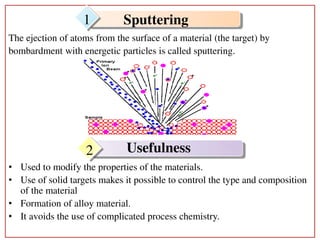
The ejection of atoms from the surface of a material (the target) by
bombardment with energetic particles is called sputtering.
• Used to modify the properties of the materials.
• Use of solid targets makes it possible to control the type and composition
of the material
• Formation of alloy material.
• It avoids the use of complicated process chemistry.
Sputtering1
Usefulness2
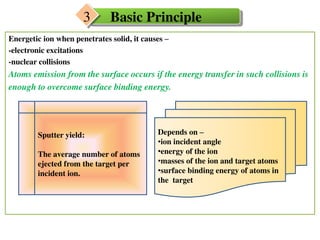
Energetic ion when penetrates solid, it causes –
-electronic excitations
-nuclear collisions
Atoms emission from the surface occurs if the energy transfer in such collisions is
enough to overcome surface binding energy.
Sputter yield:
The average number of atoms
ejected from the target per
incident ion.
Depends on –
•ion incident angle
•energy of the ion
•masses of the ion and target atoms
•surface binding energy of atoms in
the target
Basic Principle3
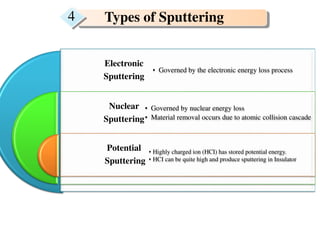
Electronic
Sputtering
Nuclear
Sputtering
Potential
Sputtering
• Governed by the electronic energy loss process
• Governed by nuclear energy loss
• Material removal occurs due to atomic collision cascade
• Highly charged ion (HCI) has stored potential energy.
• HCI can be quite high and produce sputtering in Insulator
Types of Sputtering4
Electronic Sputtering
study in fullerene
Systematic study was done to see the effect of:
 Ion Velocity
 Charge state
 Substrate Dependence
Experimental Section
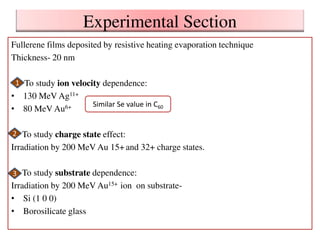
Fullerene films deposited by resistive heating evaporation technique
Thickness- 20 nm
To study ion velocity dependence:
• 130 MeV Ag11+
• 80 MeV Au6+
To study charge state effect:
Irradiation by 200 MeV Au 15+ and 32+ charge states.
To study substrate dependence:
Irradiation by 200 MeV Au15+ ion on substrate-
• Si (1 0 0)
• Borosilicate glass
Similar Se value in C60
1
2
3
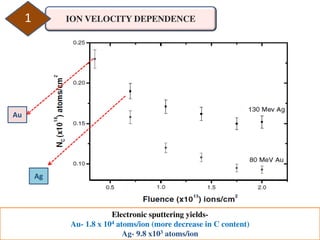
ION VELOCITY DEPENDENCE1
Electronic sputtering yields-
Au- 1.8 x 10⁴ atoms/ion (more decrease in C content)
Ag- 9.8 x10³ atoms/ion
Au
Ag
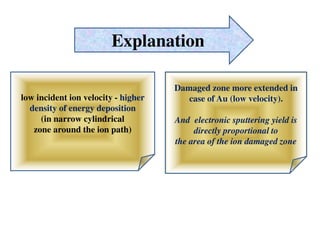
Explanation
low incident ion velocity - higher
density of energy deposition
(in narrow cylindrical
zone around the ion path)
Damaged zone more extended in
case of Au (low velocity).
And electronic sputtering yield is
directly proportional to
the area of the ion damaged zone
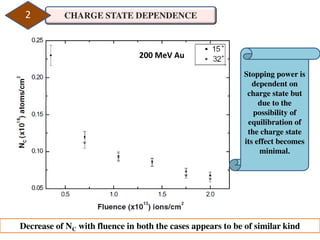
CHARGE STATE DEPENDENCE2
Decrease of NC with fluence in both the cases appears to be of similar kind
200 MeV Au
Stopping power is
dependent on
charge state but
due to the
possibility of
equilibration of
the charge state
its effect becomes
minimal.
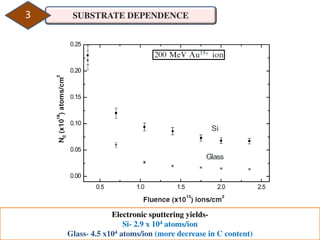
SUBSTRATE DEPENDENCE3
Electronic sputtering yields-
Si- 2.9 x 10⁴ atoms/ion
Glass- 4.5 x10⁴ atoms/ion (more decrease in C content)
Additional heat coming from the substrate will be higher in the case of glass
as compared to silicon.
Thermal spike generated in films is same
Due to ion passage- thermal spike is formed in the substrate (below the C60
film )
This temperature addition results in higher erosion.
Reason-
•Temperature in Si - smear out more efficiently (higher thermal conductivity,
nearly 40 times more)
Influencing energy confinement of the film and hence the
sputtering yield
•Poor crystallinity of glass (electron-phonon coupling strength will be stronger,
resulting in high temperature rise).
Explanation
Concluding Remarks
• Se is 1000 times more than Sn, attributing that the observed
loss of C from fullerene films is predominantly due to Se.
• On the basis of thermal spike mechanism-
Excitation energy of electrons of the material gets coupled to
the lattice via electron–phonon coupling mechanism
Results in rapid thermal spike (typically more than thousands of
Kelvin) is generated in the lattice.
It will cause vaporization of materials inside a very narrow zone
(nanodimensional) and that get released from the surface.
References-
 Avasthi, D.K.; Mehta, G.K.; Swift Heavy Ions
for Materials Engineering and Nanostructuring;
Springer Series in materials science, 2011, 145.
M2 sputtering

M2 sputtering

  • 1.
    Reference Paper: Ghosh,S.; Avasthi, D.K.; Som, T.; Tripathi, A.; Srivastava, S.K.; Gruner, F.; Assmann, W.; Ion velocity, charge state and substrate dependent electronic sputtering of fullerene, Nuclear Instruments and Methods in Physics Research B ,212, 2003, 431–435.
  • 2.
    Layout of Presentation Sputtering-Fundamental Effect of Ion Velocity Effect of Charge State Effect of Substrate
  • 3.
    What is sputtering? ItsTypes Basic Principle Its need
  • 4.
    The ejection ofatoms from the surface of a material (the target) by bombardment with energetic particles is called sputtering. • Used to modify the properties of the materials. • Use of solid targets makes it possible to control the type and composition of the material • Formation of alloy material. • It avoids the use of complicated process chemistry. Sputtering1 Usefulness2
  • 5.
    Energetic ion whenpenetrates solid, it causes – -electronic excitations -nuclear collisions Atoms emission from the surface occurs if the energy transfer in such collisions is enough to overcome surface binding energy. Sputter yield: The average number of atoms ejected from the target per incident ion. Depends on – •ion incident angle •energy of the ion •masses of the ion and target atoms •surface binding energy of atoms in the target Basic Principle3
  • 6.
    Electronic Sputtering Nuclear Sputtering Potential Sputtering • Governed bythe electronic energy loss process • Governed by nuclear energy loss • Material removal occurs due to atomic collision cascade • Highly charged ion (HCI) has stored potential energy. • HCI can be quite high and produce sputtering in Insulator Types of Sputtering4
  • 7.
    Electronic Sputtering study infullerene Systematic study was done to see the effect of:  Ion Velocity  Charge state  Substrate Dependence
  • 8.
    Experimental Section Fullerene filmsdeposited by resistive heating evaporation technique Thickness- 20 nm To study ion velocity dependence: • 130 MeV Ag11+ • 80 MeV Au6+ To study charge state effect: Irradiation by 200 MeV Au 15+ and 32+ charge states. To study substrate dependence: Irradiation by 200 MeV Au15+ ion on substrate- • Si (1 0 0) • Borosilicate glass Similar Se value in C60 1 2 3
  • 9.
    ION VELOCITY DEPENDENCE1 Electronicsputtering yields- Au- 1.8 x 10⁴ atoms/ion (more decrease in C content) Ag- 9.8 x10³ atoms/ion Au Ag
  • 10.
    Explanation low incident ionvelocity - higher density of energy deposition (in narrow cylindrical zone around the ion path) Damaged zone more extended in case of Au (low velocity). And electronic sputtering yield is directly proportional to the area of the ion damaged zone
  • 11.
    CHARGE STATE DEPENDENCE2 Decreaseof NC with fluence in both the cases appears to be of similar kind 200 MeV Au Stopping power is dependent on charge state but due to the possibility of equilibration of the charge state its effect becomes minimal.
  • 12.
    SUBSTRATE DEPENDENCE3 Electronic sputteringyields- Si- 2.9 x 10⁴ atoms/ion Glass- 4.5 x10⁴ atoms/ion (more decrease in C content)
  • 13.
    Additional heat comingfrom the substrate will be higher in the case of glass as compared to silicon. Thermal spike generated in films is same Due to ion passage- thermal spike is formed in the substrate (below the C60 film ) This temperature addition results in higher erosion. Reason- •Temperature in Si - smear out more efficiently (higher thermal conductivity, nearly 40 times more) Influencing energy confinement of the film and hence the sputtering yield •Poor crystallinity of glass (electron-phonon coupling strength will be stronger, resulting in high temperature rise). Explanation
  • 14.
    Concluding Remarks • Seis 1000 times more than Sn, attributing that the observed loss of C from fullerene films is predominantly due to Se. • On the basis of thermal spike mechanism- Excitation energy of electrons of the material gets coupled to the lattice via electron–phonon coupling mechanism Results in rapid thermal spike (typically more than thousands of Kelvin) is generated in the lattice. It will cause vaporization of materials inside a very narrow zone (nanodimensional) and that get released from the surface.
  • 15.
    References-  Avasthi, D.K.;Mehta, G.K.; Swift Heavy Ions for Materials Engineering and Nanostructuring; Springer Series in materials science, 2011, 145.