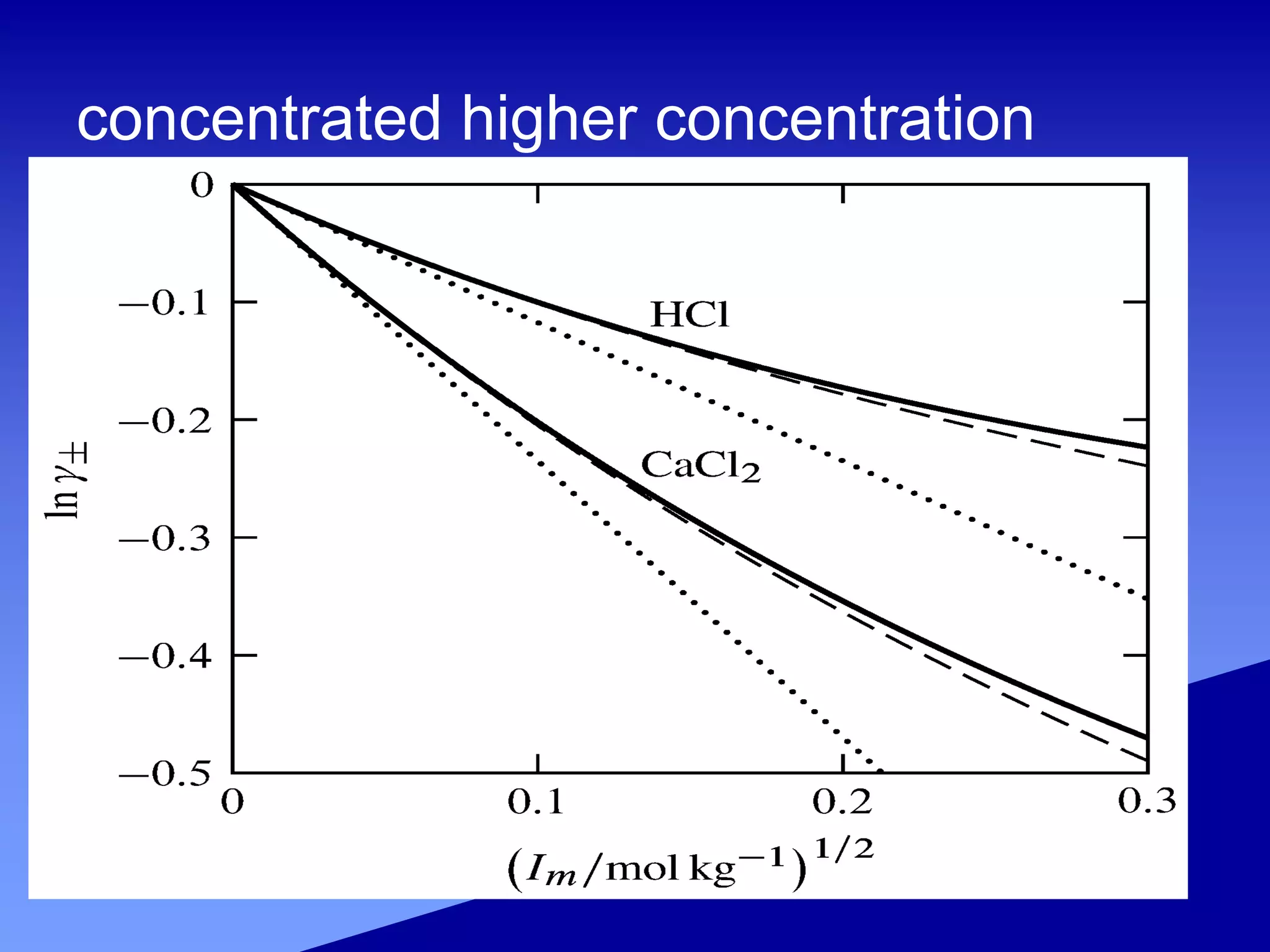
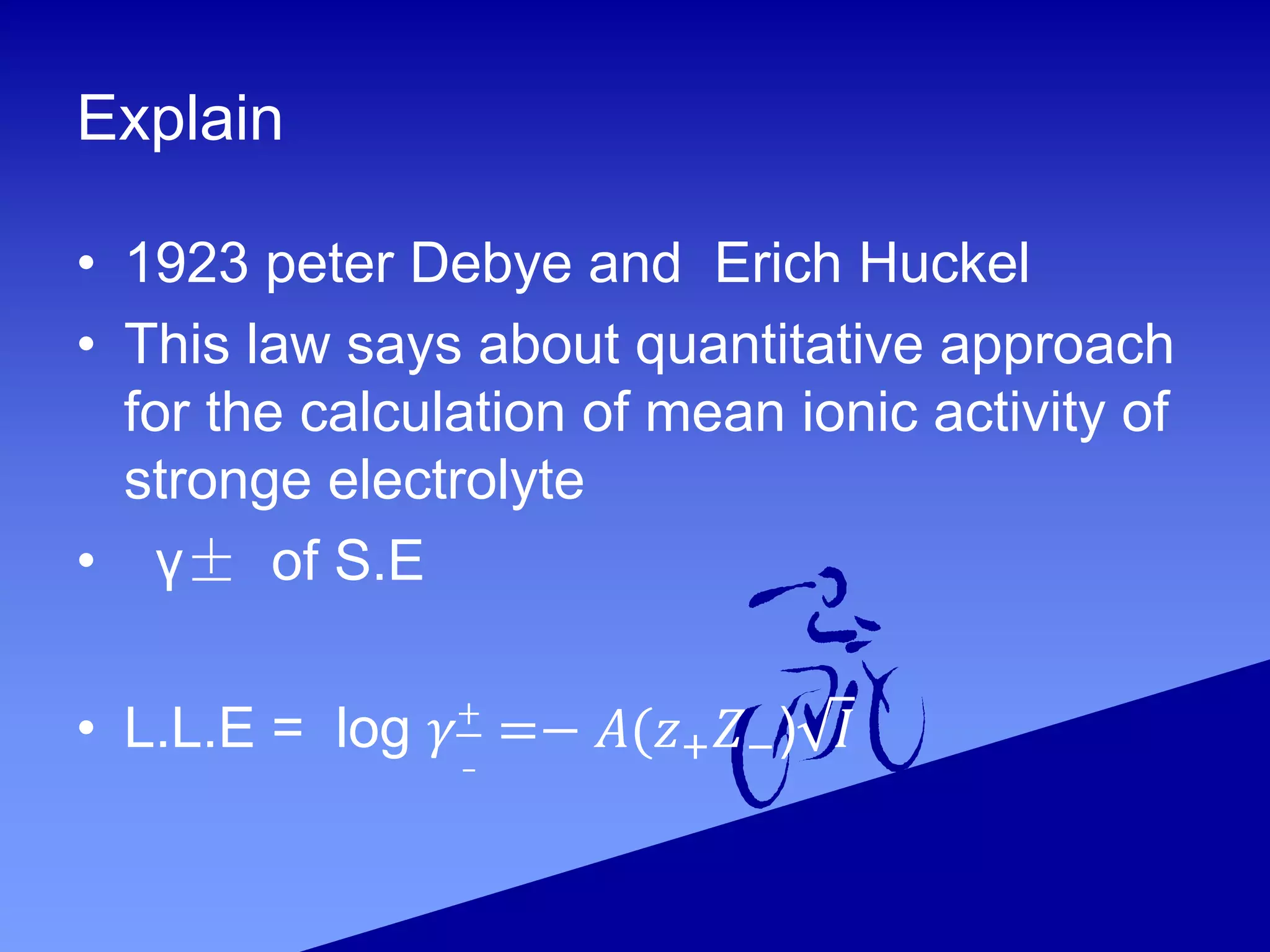
This document presents an overview of the Debye-Huckel limiting law. It explains that in 1923, Peter Debye and Erich Huckel developed a quantitative approach to calculate the mean ionic activity of strong electrolytes. The law relates the logarithm of the mean ionic activity to the ionic strength through the equation log(γ±) = -A√I, where γ± is the mean ionic activity, I is the ionic strength, and A is a constant. Several examples are provided to demonstrate how the law can be applied numerically and graphically for 1:1, 2:1, and 3:1 electrolytes like NaCl, MgCl2, and AgCl3. The key



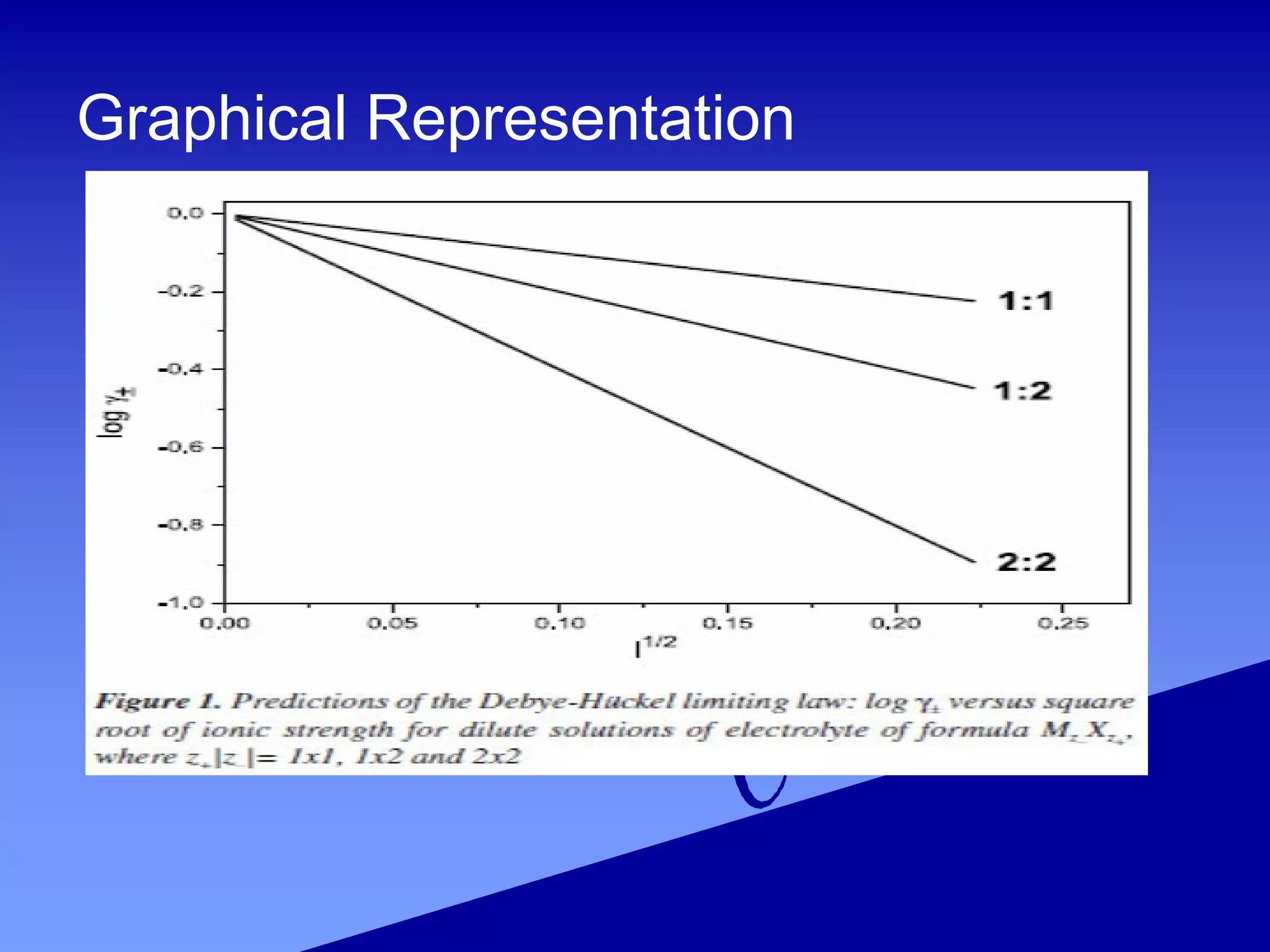

![Numarically representation
• 0.001m Nacl �+= 1 �−=1
• I=
1
2
�����
2
• I=
1
2
[(0.001× 12
)+(0.001× 12
)]
• I=
1
2
[0.001+0.001]
• I=
1
2
(0.oo2)
• I=0.001](https://image.slidesharecdn.com/debyehuckellimitinglaw1-210908050359/75/Debye-huckel-limiting-law-1-7-2048.jpg)

![• 0.002m Nacl �+=1 �− = 1
• I=
1
2
[0.002× (1)2 +0.002× (1)2]
• I=
1
2
(0.004)
• I=0.002
• �=0.04472
• log�−
+
=-0.509(1×1)×0.4473
• = -0.02276
• �−
+
= 0.9489](https://image.slidesharecdn.com/debyehuckellimitinglaw1-210908050359/75/Debye-huckel-limiting-law-1-9-2048.jpg)