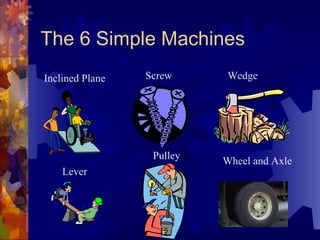
The 6 Simple Machines
Inclined Plane

Screw

Pulley
Lever

Wedge

Wheel and Axle
Definitions:
Energy: Ability to do work
Work= Force x Distance
Force: A Push or a Pull
Inclined Plane
Inclined Plane


The Egyptians used simple machines to build the
pyramids. One method was to build a very long
incline out of dirt that rose upward to the top of the
pyramid very gently. The blocks of stone were
placed on large logs (another type of simple machine
- the wheel and axle) and pushed slowly up the long,
gentle inclined plane to the top of the pyramid.
Inclined Planes
An inclined plane is
a flat surface that is
higher on one end
 Inclined planes
make the work of
moving things easier

Work input and output
 Work

input is the amount of work
done on a machine.
 Input force x input distance

 Work

output is the amount of work
done by a machine.
 Output force x output distance

Wout = Win
Fout x Dout = Fin x Din
10N x 3m = 2N x 15m

Dout
3m
10 N

Din 15 m
Fin
Inclined Plane Mechanical Advantage




The mechanical
advantage of an inclined
plane is equal to the
length of the slope
divided by the height of
the inclined plane.
While the inclined plane
produces a mechanical
advantage, it does so by
increasing the distance
through which the force
must move.
Screw

The mechanical advantage of an screw can be
calculated by dividing the circumference by the pitch of
the screw.
Pitch equals 1/ number of turns per inch.
Wedges
Two inclined
planes joined
back to back.
 Wedges are used
to split things.

Wedge – Mechanical Advantage


The mechanical advantage of a wedge can be found
by dividing the length of either slope (S) by the
thickness (T) of the big end.
S

T



As an example, assume that the length of the slope
is 10 inches and the thickness is 4 inches. The
mechanical advantage is equal to 10/4 or 2 1/2. As
with the inclined plane, the mechanical advantage
gained by using a wedge requires a corresponding
increase in distance.
First Class Lever

Fulcrum is between EF (effort) and RF (load)
Effort moves farther than Resistance.
Multiplies EF and changes its direction
The mechanical advantage of a lever is the ratio of the length
of the lever on the applied force side of the fulcrum to the
length of the lever on the resistance force side of the fulcrum.
First Class Lever
.


Common examples
of first-class levers
include crowbars,
scissors, pliers, tin
snips and seesaws.
Second Class Lever

RF (load) is between fulcrum and EF
Effort moves farther than Resistance.
Multiplies EF, but does not change its direction
The mechanical advantage of a lever is the ratio of the
distance from the applied force to the fulcrum to the
distance from the resistance force to the fulcrum.
Second Class Lever
 Examples

of
second-class
levers include
nut crackers,
wheel barrows,
doors, and bottle
openers.
Third Class Lever

EF is between fulcrum and RF (load)
Does not multiply force
Resistance moves farther than Effort.
Multiplies the distance the effort force travels
The mechanical advantage of a lever is the ratio of the
distance from the applied force to the fulcrum to the
distance of the resistance force to the fulcrum
Third Class Lever
 Examples

of

third-class
levers include
tweezers, arm
hammers, and
shovels.
Pulleys
Pulley are wheels
and axles with a
groove around the
outside
 A pulley needs a
rope, chain or belt
around the groove
to make it do work

Diagrams of Pulleys
Fixed pulley:

Movable Pulley:

A fixed pulley changes the
direction of a force;
however, it does not create
a mechanical advantage.

The mechanical advantage
of a moveable pulley is
equal to the number of
ropes that support the
moveable pulley.
COMBINED PULLEY
The effort needed to
lift the load is less
than half the weight
of the load.
 The main
disadvantage is it
travels a very long
distance.

WHEEL AND AXEL


The axle is stuck
rigidly to a large
wheel. Fan blades
are attached to the
wheel. When the
axel turns, the fan
blades spin.
Wheel and Axel


The mechanical advantage of a wheel and axle is the
ratio of the radius of the wheel to the radius of the axle.

1




5

In the wheel and axle illustrated above, the radius of the
wheel is five times larger than the radius of the axle.
Therefore, the mechanical advantage is 5:1 or 5.
The wheel and axle can also increase speed by
applying the input force to the axle rather than a wheel.
This increase is computed like mechanical advantage.
This combination would increase the speed 5 times.
GEARS-Wheel and Axel


Each gear in a
series reverses the
direction of
rotation of the
previous gear. The
smaller gear will
always turn faster
than the larger
gear.
Rube Goldberg Machines







Rube Goldberg machines are
examples of complex machines.
All complex machines are made
up of combinations of simple
machines.
Rube Goldberg machines are
usually a complicated combination
of simple machines.
By studying the components of
Rube Goldberg machines, we
learn more about simple machines
Safety Device for Walking on Icy Pavements

When you slip on ice, your foot kicks paddle (A),
lowering finger (B), snapping turtle (C) extends neck
to bite finger, opening ice tongs (D) and dropping pillow (E),
thus allowing you to fall on something soft.
Squeeze Orange Juice
Rube Goldberg Machine

6 simple machines

  • 1.
    The 6 SimpleMachines Inclined Plane Screw Pulley Lever Wedge Wheel and Axle
  • 2.
    Definitions: Energy: Ability todo work Work= Force x Distance Force: A Push or a Pull
  • 3.
  • 4.
    Inclined Plane  The Egyptiansused simple machines to build the pyramids. One method was to build a very long incline out of dirt that rose upward to the top of the pyramid very gently. The blocks of stone were placed on large logs (another type of simple machine - the wheel and axle) and pushed slowly up the long, gentle inclined plane to the top of the pyramid.
  • 5.
    Inclined Planes An inclinedplane is a flat surface that is higher on one end  Inclined planes make the work of moving things easier 
  • 7.
    Work input andoutput  Work input is the amount of work done on a machine.  Input force x input distance  Work output is the amount of work done by a machine.  Output force x output distance Wout = Win Fout x Dout = Fin x Din 10N x 3m = 2N x 15m Dout 3m 10 N Din 15 m Fin
  • 8.
    Inclined Plane MechanicalAdvantage   The mechanical advantage of an inclined plane is equal to the length of the slope divided by the height of the inclined plane. While the inclined plane produces a mechanical advantage, it does so by increasing the distance through which the force must move.
  • 9.
    Screw The mechanical advantageof an screw can be calculated by dividing the circumference by the pitch of the screw. Pitch equals 1/ number of turns per inch.
  • 10.
    Wedges Two inclined planes joined backto back.  Wedges are used to split things. 
  • 11.
    Wedge – MechanicalAdvantage  The mechanical advantage of a wedge can be found by dividing the length of either slope (S) by the thickness (T) of the big end. S T  As an example, assume that the length of the slope is 10 inches and the thickness is 4 inches. The mechanical advantage is equal to 10/4 or 2 1/2. As with the inclined plane, the mechanical advantage gained by using a wedge requires a corresponding increase in distance.
  • 12.
    First Class Lever Fulcrumis between EF (effort) and RF (load) Effort moves farther than Resistance. Multiplies EF and changes its direction The mechanical advantage of a lever is the ratio of the length of the lever on the applied force side of the fulcrum to the length of the lever on the resistance force side of the fulcrum.
  • 13.
    First Class Lever .  Commonexamples of first-class levers include crowbars, scissors, pliers, tin snips and seesaws.
  • 14.
    Second Class Lever RF(load) is between fulcrum and EF Effort moves farther than Resistance. Multiplies EF, but does not change its direction The mechanical advantage of a lever is the ratio of the distance from the applied force to the fulcrum to the distance from the resistance force to the fulcrum.
  • 15.
    Second Class Lever Examples of second-class levers include nut crackers, wheel barrows, doors, and bottle openers.
  • 16.
    Third Class Lever EFis between fulcrum and RF (load) Does not multiply force Resistance moves farther than Effort. Multiplies the distance the effort force travels The mechanical advantage of a lever is the ratio of the distance from the applied force to the fulcrum to the distance of the resistance force to the fulcrum
  • 17.
    Third Class Lever Examples of third-class levers include tweezers, arm hammers, and shovels.
  • 18.
    Pulleys Pulley are wheels andaxles with a groove around the outside  A pulley needs a rope, chain or belt around the groove to make it do work 
  • 19.
    Diagrams of Pulleys Fixedpulley: Movable Pulley: A fixed pulley changes the direction of a force; however, it does not create a mechanical advantage. The mechanical advantage of a moveable pulley is equal to the number of ropes that support the moveable pulley.
  • 20.
    COMBINED PULLEY The effortneeded to lift the load is less than half the weight of the load.  The main disadvantage is it travels a very long distance. 
  • 21.
    WHEEL AND AXEL  Theaxle is stuck rigidly to a large wheel. Fan blades are attached to the wheel. When the axel turns, the fan blades spin.
  • 22.
    Wheel and Axel  Themechanical advantage of a wheel and axle is the ratio of the radius of the wheel to the radius of the axle. 1   5 In the wheel and axle illustrated above, the radius of the wheel is five times larger than the radius of the axle. Therefore, the mechanical advantage is 5:1 or 5. The wheel and axle can also increase speed by applying the input force to the axle rather than a wheel. This increase is computed like mechanical advantage. This combination would increase the speed 5 times.
  • 23.
    GEARS-Wheel and Axel  Eachgear in a series reverses the direction of rotation of the previous gear. The smaller gear will always turn faster than the larger gear.
  • 24.
    Rube Goldberg Machines     RubeGoldberg machines are examples of complex machines. All complex machines are made up of combinations of simple machines. Rube Goldberg machines are usually a complicated combination of simple machines. By studying the components of Rube Goldberg machines, we learn more about simple machines
  • 25.
    Safety Device forWalking on Icy Pavements When you slip on ice, your foot kicks paddle (A), lowering finger (B), snapping turtle (C) extends neck to bite finger, opening ice tongs (D) and dropping pillow (E), thus allowing you to fall on something soft.
  • 26.
    Squeeze Orange Juice RubeGoldberg Machine

Editor's Notes

  • #6 A sloping surface, such as a ramp. An inclined plane can be used to alter the effort and distance involved in doing work, such as lifting loads. The trade-off is that an object must be moved a longer distance than if it was lifted straight up, but less force is needed.You can use this machine to move an object to a lower or higher place.  Inclined planes make the work of moving things easier.  You would need less energy and force to move objects with an inclined plane.