PREPARED BY MISS SALIHA RAIS
SIMPLE MACHINES
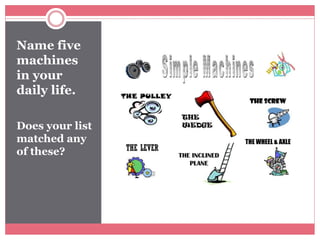
Name five
machines
in your
daily life.
Does your list
matched any
of these?
What is a simple machine?
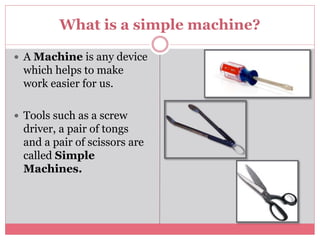
 A Machine is any device
which helps to make
work easier for us.
 Tools such as a screw
driver, a pair of tongs
and a pair of scissors are
called Simple
Machines.
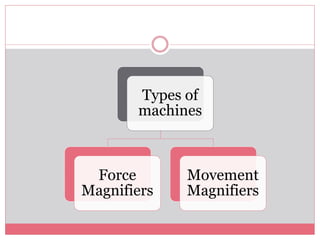
Types of
machines
Force
Magnifiers
Movement
Magnifiers
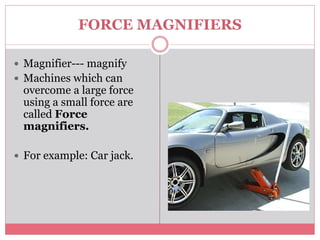
FORCE MAGNIFIERS
 Magnifier--- magnify
 Machines which can
overcome a large force
using a small force are
called Force
magnifiers.
 For example: Car jack.
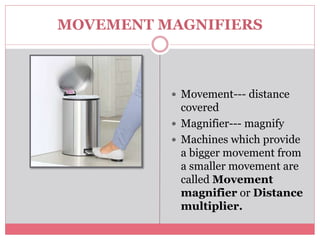
MOVEMENT MAGNIFIERS
 Movement--- distance
covered
 Magnifier--- magnify
 Machines which provide
a bigger movement from
a smaller movement are
called Movement
magnifier or Distance
multiplier.
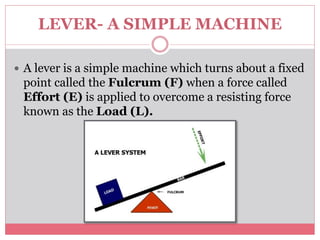
LEVER- A SIMPLE MACHINE
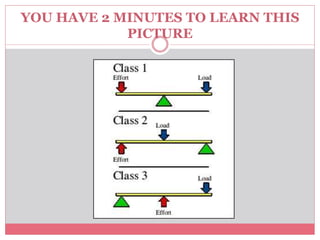
 A lever is a simple machine which turns about a fixed
point called the Fulcrum (F) when a force called
Effort (E) is applied to overcome a resisting force
known as the Load (L).
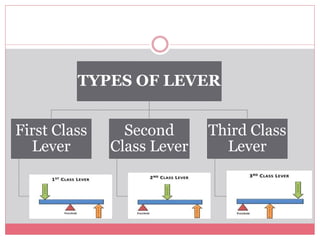
TYPES OF LEVER
First Class
Lever
Second
Class Lever
Third Class
Lever
1. FIRST CLASS LEVER
 Fulcrum is between the
effort and load.
 It produce a large force
from a small force (L>E).
 Effort moves a longer
distance than the load.
 Fulcrum is further away
from the effort than the
load to increase the
turning effect of force of
the effort.
 L>E
 Distance covered by
effort is more.
 Fulcrum is away from the
effort.
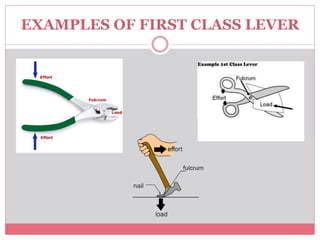
EXAMPLES OF FIRST CLASS LEVER
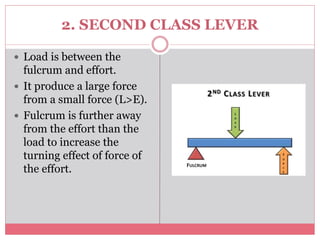
2. SECOND CLASS LEVER
 Load is between the
fulcrum and effort.
 It produce a large force
from a small force (L>E).
 Fulcrum is further away
from the effort than the
load to increase the
turning effect of force of
the effort.
 L>E
 Fulcrum is away from the
effort.
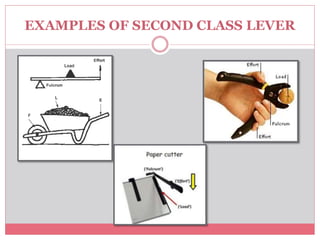
EXAMPLES OF SECOND CLASS LEVER
3. THIRD CLASS LEVER
 Effort is between the
fulcrum and Load.
 It produce a large
movement from a small
movement.
 The effort moves a
shorter distance but the
load moves a longer
distance.
 A large force is used to
move a small load (E>L)
 Produce large movement
from small movement.
 Effort moves a shorter
distance, but load a
larger distance.
 E>L
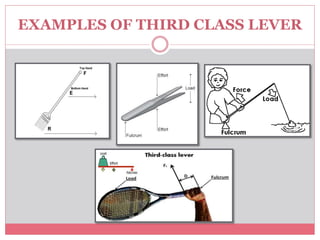
EXAMPLES OF THIRD CLASS LEVER
RAISE YOUR HANDS IF YOU
WANT TO ANSWER A
QUESTION!
LET’S HAVE A QUICK
REVIEW…..
YOU HAVE 2 MINUTES TO LEARN THIS
PICTURE
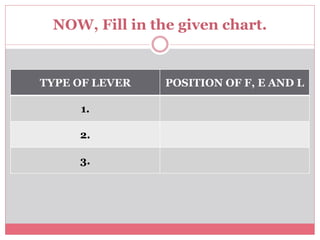
NOW, Fill in the given chart.
TYPE OF LEVER POSITION OF F, E AND L
1.
2.
3.
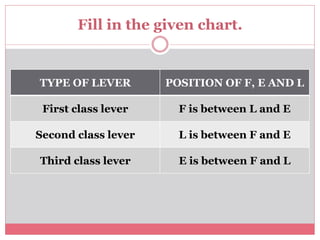
Fill in the given chart.
TYPE OF LEVER POSITION OF F, E AND L
First class lever F is between L and E
Second class lever L is between F and E
Third class lever E is between F and L
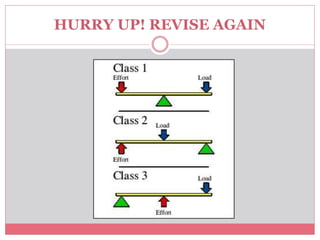
HURRY UP! REVISE AGAIN
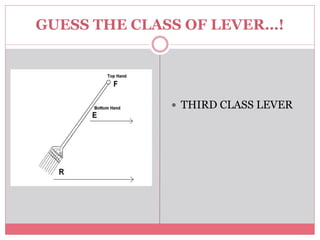
GUESS THE CLASS OF LEVER…!
 THIRD CLASS LEVER
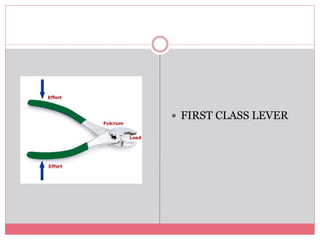
 FIRST CLASS LEVER
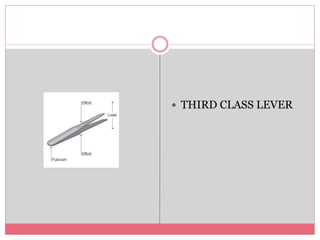
 THIRD CLASS LEVER
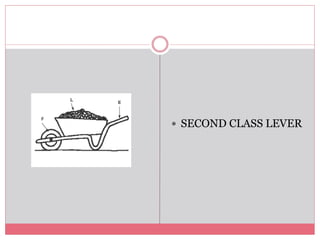
 SECOND CLASS LEVER
JAZAKALLAH!

Simple machines by Saliha Rais, for grade 5.

  • 1.
    PREPARED BY MISSSALIHA RAIS SIMPLE MACHINES
  • 2.
    Name five machines in your dailylife. Does your list matched any of these?
  • 3.
    What is asimple machine?  A Machine is any device which helps to make work easier for us.  Tools such as a screw driver, a pair of tongs and a pair of scissors are called Simple Machines.
  • 4.
  • 5.
    FORCE MAGNIFIERS  Magnifier---magnify  Machines which can overcome a large force using a small force are called Force magnifiers.  For example: Car jack.
  • 6.
    MOVEMENT MAGNIFIERS  Movement---distance covered  Magnifier--- magnify  Machines which provide a bigger movement from a smaller movement are called Movement magnifier or Distance multiplier.
  • 7.
    LEVER- A SIMPLEMACHINE  A lever is a simple machine which turns about a fixed point called the Fulcrum (F) when a force called Effort (E) is applied to overcome a resisting force known as the Load (L).
  • 8.
    TYPES OF LEVER FirstClass Lever Second Class Lever Third Class Lever
  • 9.
    1. FIRST CLASSLEVER  Fulcrum is between the effort and load.  It produce a large force from a small force (L>E).  Effort moves a longer distance than the load.  Fulcrum is further away from the effort than the load to increase the turning effect of force of the effort.
  • 10.
     L>E  Distancecovered by effort is more.  Fulcrum is away from the effort.
  • 11.
    EXAMPLES OF FIRSTCLASS LEVER
  • 12.
    2. SECOND CLASSLEVER  Load is between the fulcrum and effort.  It produce a large force from a small force (L>E).  Fulcrum is further away from the effort than the load to increase the turning effect of force of the effort.
  • 13.
     L>E  Fulcrumis away from the effort.
  • 14.
    EXAMPLES OF SECONDCLASS LEVER
  • 15.
    3. THIRD CLASSLEVER  Effort is between the fulcrum and Load.  It produce a large movement from a small movement.  The effort moves a shorter distance but the load moves a longer distance.  A large force is used to move a small load (E>L)
  • 16.
     Produce largemovement from small movement.  Effort moves a shorter distance, but load a larger distance.  E>L
  • 17.
    EXAMPLES OF THIRDCLASS LEVER
  • 18.
    RAISE YOUR HANDSIF YOU WANT TO ANSWER A QUESTION! LET’S HAVE A QUICK REVIEW…..
  • 19.
    YOU HAVE 2MINUTES TO LEARN THIS PICTURE
  • 20.
    NOW, Fill inthe given chart. TYPE OF LEVER POSITION OF F, E AND L 1. 2. 3.
  • 21.
    Fill in thegiven chart. TYPE OF LEVER POSITION OF F, E AND L First class lever F is between L and E Second class lever L is between F and E Third class lever E is between F and L
  • 22.
  • 23.
    GUESS THE CLASSOF LEVER…!  THIRD CLASS LEVER
  • 24.
  • 25.
  • 26.
  • 27.