Simple Machines
Created by Areebah Armin Ahsan and
Naayarah Nimat Ahmed
How simple machines can make your work more efficient
What are Simple Machines?
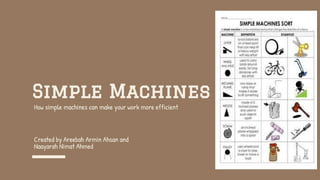
➔ Simple machines are machines that have few or no moving parts.
➔ They are manually used.
➔ They can be used to modify motion and the magnitude of a force in order to perform
work.
➔ They are the simplest mechanisms known that can provide a mechanical advantage to
increase force.
The simple machines are the inclined plane, lever, wedge, wheel and axle, pulley, and
screw.
Inclined Plane
How they make work easier:
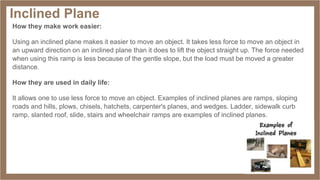
Using an inclined plane makes it easier to move an object. It takes less force to move an object in
an upward direction on an inclined plane than it does to lift the object straight up. The force needed
when using this ramp is less because of the gentle slope, but the load must be moved a greater
distance.
How they are used in daily life:
It allows one to use less force to move an object. Examples of inclined planes are ramps, sloping
roads and hills, plows, chisels, hatchets, carpenter's planes, and wedges. Ladder, sidewalk curb
ramp, slanted roof, slide, stairs and wheelchair ramps are examples of inclined planes.
Screw
How they make work easier:
The spiraling inclined plane that sticks out from the
body of the screw forms the threads of the screw.
The screw makes work easier because it increases
the distance needed and decreases the force
needed. A screw with threads that are farther apart
forms a shorter inclined plane. The work is harder to
do, but you will not have to turn the screw as many
times. Screws are used to hold things together as
they pull or push the object. Screws may also be
used for lifting heavy objects and to tighten things,
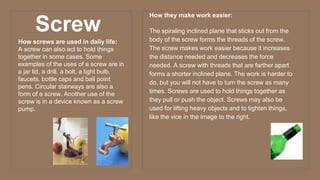
like the vice in the image to the right.
How screws are used in daily life:
A screw can also act to hold things
together in some cases. Some
examples of the uses of a screw are in
a jar lid, a drill, a bolt, a light bulb,
faucets, bottle caps and ball point
pens. Circular stairways are also a
form of a screw. Another use of the
screw is in a device known as a screw
pump.
Wheel and Axle
How screws make work easier:
The wheel and axle is a simple machine that reduces the friction involved in moving an
object, making the object easier to transport. Once the object is moving, the force of friction
opposes the force exerted on the object. The wheel and axle makes this easier by reducing
the friction involved in moving an object.
How screws are used in daily life:
Examples of wheel and axle use include electric fans, motors, revolving doors, and merry-go-
rounds, as well as the wheels used on skateboards, roller blades, cars, and many, many
more objects. As with all simple machines like the wheel and axle, they are designed to help
make work easier to do.
Lever
How does a hammer make it easier to pull a nail out of a board? First, it
changes the direction of the force applied to the hammer—the hand pushes
down on the handle while the claw end of the hammer head pulls up. Often, you
can push down with more force than you can push up because you can put your
own weight behind it. The hammer also increases the strength of the force that
is applied to it. It easily pulls the nail out of the board, which you couldn’t do with
your hands alone. On the other hand, the hammer decreases the distance over
which the force is applied. The hand pushing down on the handle moves the
handle over a distance of several inches, whereas the hammer pulls up on the
nail only an inch or two.
Wedge
It is the ratio of the output force to the input force. A wedge applies more force to the object
(output force) than the user applies to the wedge (input force), so the mechanical
advantage of a wedge is greater than 1. A longer, thinner wedge has a greater mechanical
advantage than a shorter, wider wedge. With all wedges, the trade-off is that the output
force is applied over a shorter distance, so force may need to be applied to the wedge
repeatedly to push it through the object.A knife is another example of a wedge. In the
Figure below, a knife is being used to chop tough pecans. The job is easy to do with the
knife because of the wedge shape of the blade. The very thin edge of the blade easily
enters and cuts through the pecans.
Pulley
The pulley is really a wheel and axle with a rope or chain attached.
A pulley makes work seem easier because it changes the direction
of motion to work with gravity. Let's say you have to lift a heavy
load, like a bale of hay, up to the second floor of a barn. You could
tie a rope to the bale of hay, stand on the second floor, and pull it
straight up. Or you could put a pulley at the second floor, stand at
the first floor, and lift the bale of hay by pulling straight down. It
would be the exact amount of work in either case, but the action of
pulling down feels easier because you're working with the force of
gravity.
A pulley really saves effort when you have more than one pulley
working together. By looping a rope around two, three, or even four
pulleys, you can really cut down on the effort needed to lift
something. The trade-off? Well, as you increase the number of
pulleys, you also increase the distance you have to pull the rope.
In other words, if you use two pulleys, it takes half the effort to lift
something, but you have to pull the rope twice as far. Three
pulleys will result in one-third the effort — but the distance you
have to pull the rope is tripled!
Bibliography
1. Simple
2. simple machine | Examples, List, & Facts
3. Lever | CK-12 Foundation
4. Wedge | CK-12 Foundation
5. Dirtmeister: Simple Machines -- Pulley - Scholastic
6. Simple Machines
7. https://www.softschools.com/examples/simple_machines/wheel_and_axle_examples
8. SCREW - SIMPLE MACHINES
Thank You

Simple Machines

  • 1.
    Simple Machines Created byAreebah Armin Ahsan and Naayarah Nimat Ahmed How simple machines can make your work more efficient
  • 2.
    What are SimpleMachines? ➔ Simple machines are machines that have few or no moving parts. ➔ They are manually used. ➔ They can be used to modify motion and the magnitude of a force in order to perform work. ➔ They are the simplest mechanisms known that can provide a mechanical advantage to increase force. The simple machines are the inclined plane, lever, wedge, wheel and axle, pulley, and screw.
  • 3.
    Inclined Plane How theymake work easier: Using an inclined plane makes it easier to move an object. It takes less force to move an object in an upward direction on an inclined plane than it does to lift the object straight up. The force needed when using this ramp is less because of the gentle slope, but the load must be moved a greater distance. How they are used in daily life: It allows one to use less force to move an object. Examples of inclined planes are ramps, sloping roads and hills, plows, chisels, hatchets, carpenter's planes, and wedges. Ladder, sidewalk curb ramp, slanted roof, slide, stairs and wheelchair ramps are examples of inclined planes.
  • 4.
    Screw How they makework easier: The spiraling inclined plane that sticks out from the body of the screw forms the threads of the screw. The screw makes work easier because it increases the distance needed and decreases the force needed. A screw with threads that are farther apart forms a shorter inclined plane. The work is harder to do, but you will not have to turn the screw as many times. Screws are used to hold things together as they pull or push the object. Screws may also be used for lifting heavy objects and to tighten things, like the vice in the image to the right. How screws are used in daily life: A screw can also act to hold things together in some cases. Some examples of the uses of a screw are in a jar lid, a drill, a bolt, a light bulb, faucets, bottle caps and ball point pens. Circular stairways are also a form of a screw. Another use of the screw is in a device known as a screw pump.
  • 5.
    Wheel and Axle Howscrews make work easier: The wheel and axle is a simple machine that reduces the friction involved in moving an object, making the object easier to transport. Once the object is moving, the force of friction opposes the force exerted on the object. The wheel and axle makes this easier by reducing the friction involved in moving an object. How screws are used in daily life: Examples of wheel and axle use include electric fans, motors, revolving doors, and merry-go- rounds, as well as the wheels used on skateboards, roller blades, cars, and many, many more objects. As with all simple machines like the wheel and axle, they are designed to help make work easier to do.
  • 6.
    Lever How does ahammer make it easier to pull a nail out of a board? First, it changes the direction of the force applied to the hammer—the hand pushes down on the handle while the claw end of the hammer head pulls up. Often, you can push down with more force than you can push up because you can put your own weight behind it. The hammer also increases the strength of the force that is applied to it. It easily pulls the nail out of the board, which you couldn’t do with your hands alone. On the other hand, the hammer decreases the distance over which the force is applied. The hand pushing down on the handle moves the handle over a distance of several inches, whereas the hammer pulls up on the nail only an inch or two.
  • 7.
    Wedge It is theratio of the output force to the input force. A wedge applies more force to the object (output force) than the user applies to the wedge (input force), so the mechanical advantage of a wedge is greater than 1. A longer, thinner wedge has a greater mechanical advantage than a shorter, wider wedge. With all wedges, the trade-off is that the output force is applied over a shorter distance, so force may need to be applied to the wedge repeatedly to push it through the object.A knife is another example of a wedge. In the Figure below, a knife is being used to chop tough pecans. The job is easy to do with the knife because of the wedge shape of the blade. The very thin edge of the blade easily enters and cuts through the pecans.
  • 8.
    Pulley The pulley isreally a wheel and axle with a rope or chain attached. A pulley makes work seem easier because it changes the direction of motion to work with gravity. Let's say you have to lift a heavy load, like a bale of hay, up to the second floor of a barn. You could tie a rope to the bale of hay, stand on the second floor, and pull it straight up. Or you could put a pulley at the second floor, stand at the first floor, and lift the bale of hay by pulling straight down. It would be the exact amount of work in either case, but the action of pulling down feels easier because you're working with the force of gravity. A pulley really saves effort when you have more than one pulley working together. By looping a rope around two, three, or even four pulleys, you can really cut down on the effort needed to lift something. The trade-off? Well, as you increase the number of pulleys, you also increase the distance you have to pull the rope. In other words, if you use two pulleys, it takes half the effort to lift something, but you have to pull the rope twice as far. Three pulleys will result in one-third the effort — but the distance you have to pull the rope is tripled!
  • 9.
    Bibliography 1. Simple 2. simplemachine | Examples, List, & Facts 3. Lever | CK-12 Foundation 4. Wedge | CK-12 Foundation 5. Dirtmeister: Simple Machines -- Pulley - Scholastic 6. Simple Machines 7. https://www.softschools.com/examples/simple_machines/wheel_and_axle_examples 8. SCREW - SIMPLE MACHINES
  • 10.