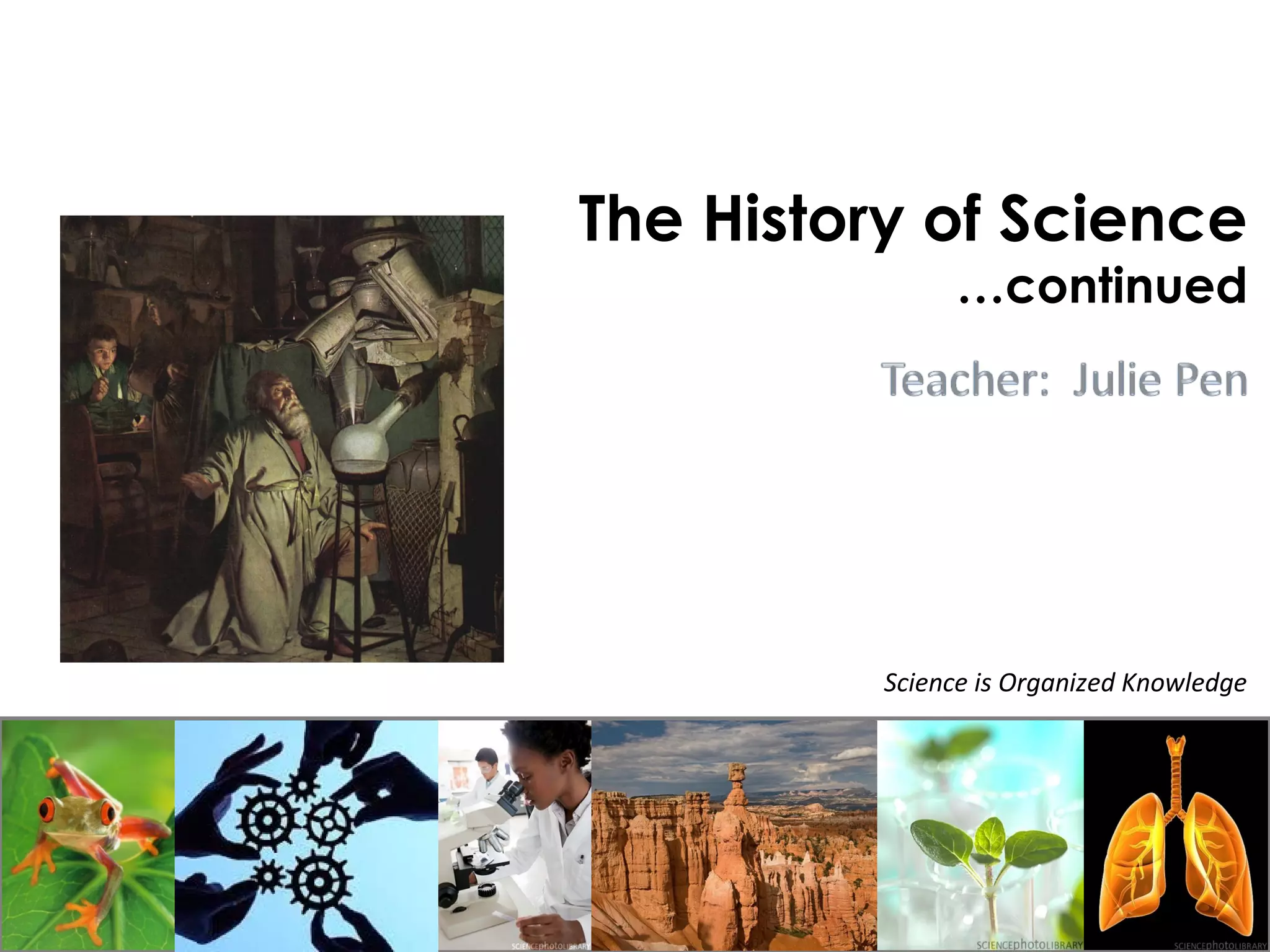
The History of Science 
…continued 
Science is Organized Knowledge
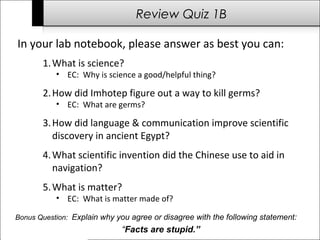
Review Quiz 1B 
In your lab notebook, please answer as best you can: 
1.What is science? 
• EC: Why is science a good/helpful thing? 
2.How did Imhotep figure out a way to kill germs? 
• EC: What are germs? 
3.How did language & communication improve scientific 
discovery in ancient Egypt? 
4.What scientific invention did the Chinese use to aid in 
navigation? 
5.What is matter? 
• EC: What is matter made of? 
Bonus Question: Explain why you agree or disagree with the following statement: 
“Facts are stupid.”
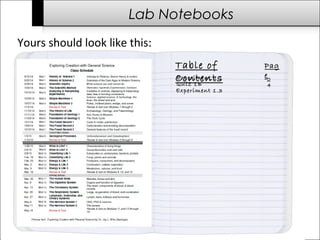
Lab Notebooks 
Table of 
CExopenritmeennt t1s.1 
Pag 
e2 
Quiz 1B 4 
Yours should look like this: 
Experiment 1.3
The History of Science, continued 
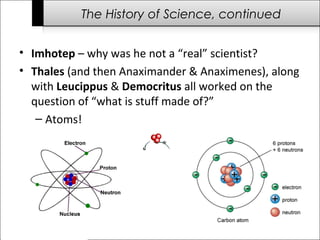
• Imhotep – why was he not a “real” scientist? 
• Thales (and then Anaximander & Anaximenes), along 
with Leucippus & Democritus all worked on the 
question of “what is stuff made of?” 
– Atoms!
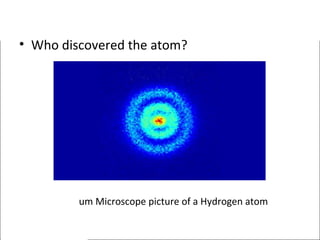
• Who discovered the atom? 
Quantum Microscope picture of a Hydrogen atom
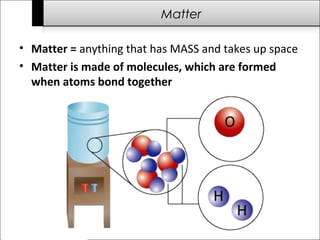
Matter 
• Matter = anything that has MASS and takes up space 
• Matter is made of molecules, which are formed 
when atoms bond together
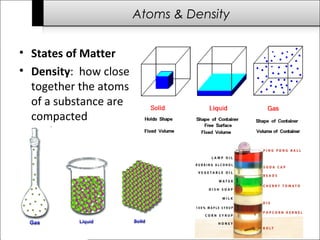
Atoms & Density 
• States of Matter 
• Density: how close 
together the atoms 
of a substance are 
compacted
Motion of Atoms 
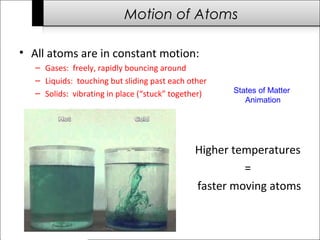
• All atoms are in constant motion: 
– Gases: freely, rapidly bouncing around 
– Liquids: touching but sliding past each other 
– Solids: vibrating in place (“stuck” together) 
States of Matter 
Animation 
Higher temperatures 
= 
faster moving atoms
Lab Safety 
• Science labs can be dangerous - how can we keep it 
safe? 
– Read, listen, and follow directions carefully. 
– NO gum, food or drinks during lab time. 
– Proper attire (shoes, hair, protective items). 
• Goggles, labs coats & gloves will be provided. 
– Sink (for eyes, skin, & spills, too). 
• Always tell the teacher IMMEDIATELY if there is a chemical spill 
or other hazardous situation during a lab. 
– Fumes. 
– Clean-up (proper disposal). 
• NOT down the drain 
Scavenger hunt & song
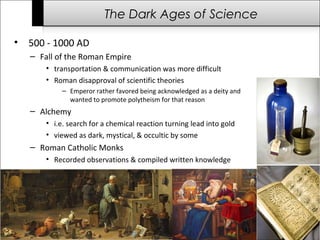
The Dark Ages of Science 
• 500 - 1000 AD 
– Fall of the Roman Empire 
• transportation & communication was more difficult 
• Roman disapproval of scientific theories 
– Emperor rather favored being acknowledged as a deity and 
wanted to promote polytheism for that reason 
– Alchemy 
• i.e. search for a chemical reaction turning lead into gold 
• viewed as dark, mystical, & occultic by some 
– Roman Catholic Monks 
• Recorded observations & compiled written knowledge
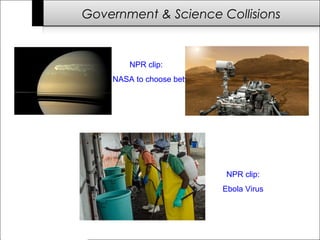
Government & Science Collisions 
NPR clip: 
NASA to choose between Mars & Saturn exploration 
NPR clip: 
Ebola Virus
Experiment 1.3 
A Chemical Reaction
Chemical Reactions 
Record in your lab notebook: 
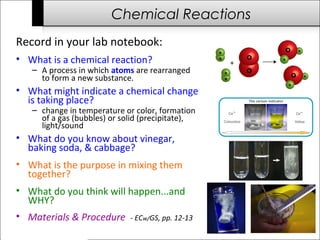
• What is a chemical reaction? 
– A process in which atoms are rearranged 
to form a new substance. 
• What might indicate a chemical change 
is taking place? 
– change in temperature or color, formation 
of a gas (bubbles) or solid (precipitate), 
light/sound 
• What do you know about vinegar, 
baking soda, & cabbage? 
• What is the purpose in mixing them 
together? 
• What do you think will happen...and 
WHY? 
• Materials & Procedure - ECw/GS, pp. 12-13
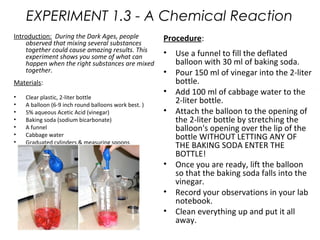
EXPERIMENT 1.3 - A Chemical Reaction 
Introduction: During the Dark Ages, people 
observed that mixing several substances 
together could cause amazing results. This 
experiment shows you some of what can 
happen when the right substances are mixed 
together. 
Materials: 
• Clear plastic, 2-liter bottle 
• A balloon (6-9 inch round balloons work best. ) 
• 5% aqueous Acetic Acid (vinegar) 
• Baking soda (sodium bicarbonate) 
• A funnel 
• Cabbage water 
• Graduated cylinders & measuring spoons 
Procedure: 
• Use a funnel to fill the deflated 
balloon with 30 ml of baking soda. 
• Pour 150 ml of vinegar into the 2-liter 
bottle. 
• Add 100 ml of cabbage water to the 
2-liter bottle. 
• Attach the balloon to the opening of 
the 2-liter bottle by stretching the 
balloon's opening over the lip of the 
bottle WITHOUT LETTING ANY OF 
THE BAKING SODA ENTER THE 
BOTTLE! 
• Once you are ready, lift the balloon 
so that the baking soda falls into the 
vinegar. 
• Record your observations in your lab 
notebook. 
• Clean everything up and put it all 
away.
Chemical Reactions 
Record in your lab notebook: 
• What is a chemical reaction? 
– A process in which atoms are rearranged to form a 
new substance. 
• What might indicate a chemical change is taking 
place? 
– change in temperature or color, formation of a gas 
(bubbles) or solid (precipitate), light/sound 
• What do you know about vinegar, baking soda, & 
cabbage? 
• What is the purpose in mixing them together? 
• What do you think will happen...and WHY? 
• Materials & Procedure - ECw/GS, pp. 12-13 
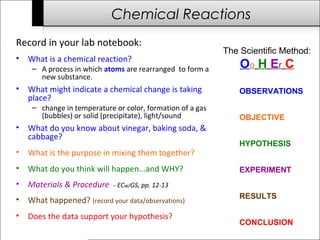
• What happened? (record your data/observations) 
• Does the data support your hypothesis? 
The Scientific Method: 
Oo H Er C 
OBSERVATIONS 
OBJECTIVE 
HYPOTHESIS 
EXPERIMENT 
RESULTS 
CONCLUSION
Science History...continued 
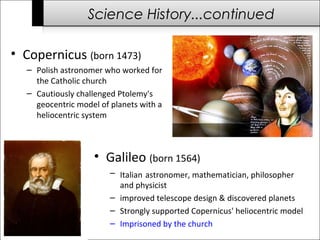
• Copernicus (born 1473) 
– Polish astronomer who worked for 
the Catholic church 
– Cautiously challenged Ptolemy's 
geocentric model of planets with a 
heliocentric system 
• Galileo (born 1564) 
– Italian astronomer, mathematician, philosopher 
and physicist 
– improved telescope design & discovered planets 
– Strongly supported Copernicus' heliocentric model 
– Imprisoned by the church
Science History 
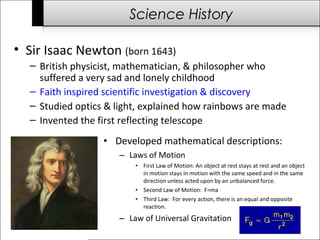
• Sir Isaac Newton (born 1643) 
– British physicist, mathematician, & philosopher who 
suffered a very sad and lonely childhood 
– Faith inspired scientific investigation & discovery 
– Studied optics & light, explained how rainbows are made 
– Invented the first reflecting telescope 
• Developed mathematical descriptions: 
– Laws of Motion 
• First Law of Motion: An object at rest stays at rest and an object 
in motion stays in motion with the same speed and in the same 
direction unless acted upon by an unbalanced force. 
• Second Law of Motion: F=ma 
• Third Law: For every action, there is an equal and opposite 
reaction. 
– Law of Universal Gravitation
Science History 
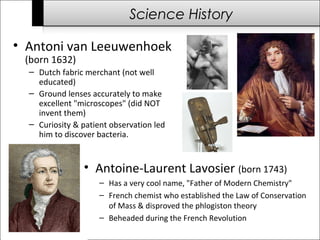
• Antoni van Leeuwenhoek 
(born 1632) 
– Dutch fabric merchant (not well 
educated) 
– Ground lenses accurately to make 
excellent "microscopes" (did NOT 
invent them) 
– Curiosity & patient observation led 
him to discover bacteria. 
• Antoine-Laurent Lavosier (born 1743) 
– Has a very cool name, "Father of Modern Chemistry" 
– French chemist who established the Law of Conservation 
of Mass & disproved the phlogiston theory 
– Beheaded during the French Revolution
Modern Science History 
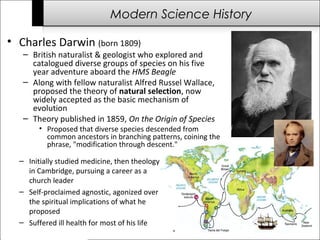
• Charles Darwin (born 1809) 
– British naturalist & geologist who explored and 
catalogued diverse groups of species on his five 
year adventure aboard the HMS Beagle 
– Along with fellow naturalist Alfred Russel Wallace, 
proposed the theory of natural selection, now 
widely accepted as the basic mechanism of 
evolution 
– Theory published in 1859, On the Origin of Species 
• Proposed that diverse species descended from 
common ancestors in branching patterns, coining the 
phrase, "modification through descent." 
– Initially studied medicine, then theology 
in Cambridge, pursuing a career as a 
church leader 
– Self-proclaimed agnostic, agonized over 
the spiritual implications of what he 
proposed 
– Suffered ill health for most of his life
Modern Science History 
• James Clerk Maxwell (born 1831) 
– Scottish mathematical physicist - "Father of Modern Physics" 
– Made groundbreaking discoveries in electromagnetism & the 
kinetic theory of gases 
– Also made discoveries in astronomy and engineering 
– Paved the way for Edison, Einstein and other modern 
geniuses with his revolutionary work 
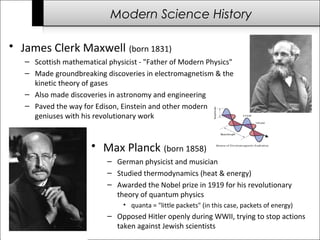
• Max Planck (born 1858) 
– German physicist and musician 
– Studied thermodynamics (heat & energy) 
– Awarded the Nobel prize in 1919 for his revolutionary 
theory of quantum physics 
• quanta = "little packets" (in this case, packets of energy) 
– Opposed Hitler openly during WWII, trying to stop actions 
taken against Jewish scientists
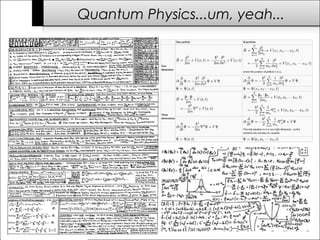
Quantum Physics...um, yeah...
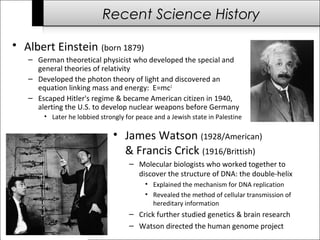
Recent Science History 
• Albert Einstein (born 1879) 
– German theoretical physicist who developed the special and 
general theories of relativity 
– Developed the photon theory of light and discovered an 
equation linking mass and energy: E=mc2 
– Escaped Hitler's regime & became American citizen in 1940, 
alerting the U.S. to develop nuclear weapons before Germany 
• Later he lobbied strongly for peace and a Jewish state in Palestine 
• James Watson (1928/American) 
& Francis Crick (1916/Brittish) 
– Molecular biologists who worked together to 
discover the structure of DNA: the double-helix 
• Explained the mechanism for DNA replication 
• Revealed the method of cellular transmission of 
hereditary information 
– Crick further studied genetics & brain research 
– Watson directed the human genome project

ECGS Module 1B

  • 1.
    The History ofScience …continued Science is Organized Knowledge
  • 2.
    Review Quiz 1B In your lab notebook, please answer as best you can: 1.What is science? • EC: Why is science a good/helpful thing? 2.How did Imhotep figure out a way to kill germs? • EC: What are germs? 3.How did language & communication improve scientific discovery in ancient Egypt? 4.What scientific invention did the Chinese use to aid in navigation? 5.What is matter? • EC: What is matter made of? Bonus Question: Explain why you agree or disagree with the following statement: “Facts are stupid.”
  • 3.
    Lab Notebooks Tableof CExopenritmeennt t1s.1 Pag e2 Quiz 1B 4 Yours should look like this: Experiment 1.3
  • 4.
    The History ofScience, continued • Imhotep – why was he not a “real” scientist? • Thales (and then Anaximander & Anaximenes), along with Leucippus & Democritus all worked on the question of “what is stuff made of?” – Atoms!
  • 5.
    • Who discoveredthe atom? Quantum Microscope picture of a Hydrogen atom
  • 6.
    Matter • Matter= anything that has MASS and takes up space • Matter is made of molecules, which are formed when atoms bond together
  • 7.
    Atoms & Density • States of Matter • Density: how close together the atoms of a substance are compacted
  • 8.
    Motion of Atoms • All atoms are in constant motion: – Gases: freely, rapidly bouncing around – Liquids: touching but sliding past each other – Solids: vibrating in place (“stuck” together) States of Matter Animation Higher temperatures = faster moving atoms
  • 9.
    Lab Safety •Science labs can be dangerous - how can we keep it safe? – Read, listen, and follow directions carefully. – NO gum, food or drinks during lab time. – Proper attire (shoes, hair, protective items). • Goggles, labs coats & gloves will be provided. – Sink (for eyes, skin, & spills, too). • Always tell the teacher IMMEDIATELY if there is a chemical spill or other hazardous situation during a lab. – Fumes. – Clean-up (proper disposal). • NOT down the drain Scavenger hunt & song
  • 10.
    The Dark Agesof Science • 500 - 1000 AD – Fall of the Roman Empire • transportation & communication was more difficult • Roman disapproval of scientific theories – Emperor rather favored being acknowledged as a deity and wanted to promote polytheism for that reason – Alchemy • i.e. search for a chemical reaction turning lead into gold • viewed as dark, mystical, & occultic by some – Roman Catholic Monks • Recorded observations & compiled written knowledge
  • 11.
    Government & ScienceCollisions NPR clip: NASA to choose between Mars & Saturn exploration NPR clip: Ebola Virus
  • 12.
    Experiment 1.3 AChemical Reaction
  • 13.
    Chemical Reactions Recordin your lab notebook: • What is a chemical reaction? – A process in which atoms are rearranged to form a new substance. • What might indicate a chemical change is taking place? – change in temperature or color, formation of a gas (bubbles) or solid (precipitate), light/sound • What do you know about vinegar, baking soda, & cabbage? • What is the purpose in mixing them together? • What do you think will happen...and WHY? • Materials & Procedure - ECw/GS, pp. 12-13
  • 14.
    EXPERIMENT 1.3 -A Chemical Reaction Introduction: During the Dark Ages, people observed that mixing several substances together could cause amazing results. This experiment shows you some of what can happen when the right substances are mixed together. Materials: • Clear plastic, 2-liter bottle • A balloon (6-9 inch round balloons work best. ) • 5% aqueous Acetic Acid (vinegar) • Baking soda (sodium bicarbonate) • A funnel • Cabbage water • Graduated cylinders & measuring spoons Procedure: • Use a funnel to fill the deflated balloon with 30 ml of baking soda. • Pour 150 ml of vinegar into the 2-liter bottle. • Add 100 ml of cabbage water to the 2-liter bottle. • Attach the balloon to the opening of the 2-liter bottle by stretching the balloon's opening over the lip of the bottle WITHOUT LETTING ANY OF THE BAKING SODA ENTER THE BOTTLE! • Once you are ready, lift the balloon so that the baking soda falls into the vinegar. • Record your observations in your lab notebook. • Clean everything up and put it all away.
  • 15.
    Chemical Reactions Recordin your lab notebook: • What is a chemical reaction? – A process in which atoms are rearranged to form a new substance. • What might indicate a chemical change is taking place? – change in temperature or color, formation of a gas (bubbles) or solid (precipitate), light/sound • What do you know about vinegar, baking soda, & cabbage? • What is the purpose in mixing them together? • What do you think will happen...and WHY? • Materials & Procedure - ECw/GS, pp. 12-13 • What happened? (record your data/observations) • Does the data support your hypothesis? The Scientific Method: Oo H Er C OBSERVATIONS OBJECTIVE HYPOTHESIS EXPERIMENT RESULTS CONCLUSION
  • 16.
    Science History...continued •Copernicus (born 1473) – Polish astronomer who worked for the Catholic church – Cautiously challenged Ptolemy's geocentric model of planets with a heliocentric system • Galileo (born 1564) – Italian astronomer, mathematician, philosopher and physicist – improved telescope design & discovered planets – Strongly supported Copernicus' heliocentric model – Imprisoned by the church
  • 17.
    Science History •Sir Isaac Newton (born 1643) – British physicist, mathematician, & philosopher who suffered a very sad and lonely childhood – Faith inspired scientific investigation & discovery – Studied optics & light, explained how rainbows are made – Invented the first reflecting telescope • Developed mathematical descriptions: – Laws of Motion • First Law of Motion: An object at rest stays at rest and an object in motion stays in motion with the same speed and in the same direction unless acted upon by an unbalanced force. • Second Law of Motion: F=ma • Third Law: For every action, there is an equal and opposite reaction. – Law of Universal Gravitation
  • 18.
    Science History •Antoni van Leeuwenhoek (born 1632) – Dutch fabric merchant (not well educated) – Ground lenses accurately to make excellent "microscopes" (did NOT invent them) – Curiosity & patient observation led him to discover bacteria. • Antoine-Laurent Lavosier (born 1743) – Has a very cool name, "Father of Modern Chemistry" – French chemist who established the Law of Conservation of Mass & disproved the phlogiston theory – Beheaded during the French Revolution
  • 19.
    Modern Science History • Charles Darwin (born 1809) – British naturalist & geologist who explored and catalogued diverse groups of species on his five year adventure aboard the HMS Beagle – Along with fellow naturalist Alfred Russel Wallace, proposed the theory of natural selection, now widely accepted as the basic mechanism of evolution – Theory published in 1859, On the Origin of Species • Proposed that diverse species descended from common ancestors in branching patterns, coining the phrase, "modification through descent." – Initially studied medicine, then theology in Cambridge, pursuing a career as a church leader – Self-proclaimed agnostic, agonized over the spiritual implications of what he proposed – Suffered ill health for most of his life
  • 20.
    Modern Science History • James Clerk Maxwell (born 1831) – Scottish mathematical physicist - "Father of Modern Physics" – Made groundbreaking discoveries in electromagnetism & the kinetic theory of gases – Also made discoveries in astronomy and engineering – Paved the way for Edison, Einstein and other modern geniuses with his revolutionary work • Max Planck (born 1858) – German physicist and musician – Studied thermodynamics (heat & energy) – Awarded the Nobel prize in 1919 for his revolutionary theory of quantum physics • quanta = "little packets" (in this case, packets of energy) – Opposed Hitler openly during WWII, trying to stop actions taken against Jewish scientists
  • 21.
  • 22.
    Recent Science History • Albert Einstein (born 1879) – German theoretical physicist who developed the special and general theories of relativity – Developed the photon theory of light and discovered an equation linking mass and energy: E=mc2 – Escaped Hitler's regime & became American citizen in 1940, alerting the U.S. to develop nuclear weapons before Germany • Later he lobbied strongly for peace and a Jewish state in Palestine • James Watson (1928/American) & Francis Crick (1916/Brittish) – Molecular biologists who worked together to discover the structure of DNA: the double-helix • Explained the mechanism for DNA replication • Revealed the method of cellular transmission of hereditary information – Crick further studied genetics & brain research – Watson directed the human genome project

Editor's Notes

  • #3 "Facts are stupid things," he would say, "until brought into connection with some general law."
  • #5 Which one can be credited with the discoverer of the atom?
  • #8 state of matter In physics, a state of matter is one of the distinct forms that matter takes on. Four states of matter are observable in everyday life: solid, liquid, gas, and plasma.
  • #9 Why did I use the same size jars, made of the same material, with the same amount of water in them?
  • #12 How is our current government and culture affecting scientific progress?
  • #14 Form groups - discuss each question and agree on an answer (write it down in lab notebook), then share with class before moving on to each step.
  • #16 Form groups - discuss each question and agree on an answer (write it down in lab notebook), then share with class before moving on to each step.
  • #17 Nicolaus Copernicus was born on 19 February 1473 in Thorn (modern day Torun) in Poland. His father was a merchant and local official. When Copernicus was 10 his father died, and his uncle, a priest, ensured that Copernicus received a good education. In 1491, he went to Krakow Academy, now the Jagiellonian University, and in 1496 travelled to Italy to study law. While a student at the University of Bologna he stayed with a mathematics professor, Domenico Maria de Novara, who encouraged Copernicus' interests in geography and astronomy. During his time in Italy, Copernicus visited Rome and studied at the universities of Padua and Ferrara, before returning to Poland in 1503. For the next seven years he worked as a private secretary to his uncle, now the bishop of Ermland. The bishop died in 1512 and Copernicus moved to Frauenberg, where he had long held a position as a canon, an administrative appointment in the church. This gave him more time to devote to astronomy. Although he did not seek fame, it is clear that he was by now well known as an astronomer. In 1514, when the Catholic church was seeking to improve the calendar, one of the experts to whom the pope appealed was Copernicus. Copernicus' major work 'De Revolutionibus Orbium Coelestium' ('On the Revolutions of the Celestial Spheres') was finished by 1530. Its central theory was that the Earth rotates daily on its axis and revolves yearly around the sun. He also argued that the planets circled the Sun. This challenged the long held view that the Earth was stationary at the centre of the universe with all the planets, the Moon and the Sun rotating around it. 'De Revolutionibus Orbium Coelestium' was published in early 1543 and Copernicus died on 24 May in the same year. Copernicus adapted physics to the demands of astronomy, believing that the principles of Ptolemy's system were incorrect, not the math or observations. He was the first person in history to create a complete and general system, combining mathematics, physics, and cosmology. (Ptolemy, for instance, had treated each planet separately.) Copernicus's system was taught in some universities in the 1500s but had not permeated the academic world until approximately 1600. Some people, among whom John Donne and William Shakespeare were the most influential, feared Copernicus's theory, feeling that it destroyed hierarchal natural order which would in turn destroy social order and bring about chaos. Indeed, some people (such as Bruno), used Copernicus's theory to justify radical theological views. astronomers had busied themselves in "saving appearances," which consisted of trying to patch it up Ptolemy's cumbersome and inaccurate model. Copernicus, however, wiped the slate clean in a single broad stroke, and proposed a fundamentally different model in which the planets all circled the Sun in De Revolutionibus Orbium Coelestium. While radically different from Ptolemy's model, Copernicus's heliocentric theory was hardly an original idea. Similar theories had been proposed by Aristarchus as early as the third century B. C., and Nicholas de Cusa, a German scholar, had independently made the same assertion in a book he published in 1440. We know for a fact that Copernicus was well aware of Aristarchus's priority, since his original draft of De Revolutionibus has survived and features a passage referring to Aristarchus which Copernicus crossed out so as not to compromise the originality of his theory. In his belief that his theory was an accurate description of nature rather than just a mathematical model, Copernicus was therefore not truly revolutionary.
  • #21 Isaac Newton was born on 4 January 1643 in Woolsthorpe, Lincolnshire. His father was a prosperous farmer, who died three months before Newton was born. His mother remarried and Newton was left in the care of his grandparents. In 1661, he went to Cambridge University where he became interested in mathematics, optics, physics and astronomy. In October 1665, a plague epidemic forced the university to close and Newton returned to Woolsthorpe. The two years he spent there were an extremely fruitful time during which he began to think about gravity. He also devoted time to optics and mathematics, working out his ideas about 'fluxions' (calculus). In 1667, Newton returned to Cambridge, where he became a fellow of Trinity College. Two years later he was appointed second Lucasian professor of mathematics. It was Newton's reflecting telescope, made in 1668, that finally brought him to the attention of the scientific community and in 1672 he was made a fellow of the Royal Society. From the mid-1660s, Newton conducted a series of experiments on the composition of light, discovering that white light is composed of the same system of colours that can be seen in a rainbow and establishing the modern study of optics (or the behaviour of light). In 1704, Newton published 'The Opticks' which dealt with light and colour. He also studied and published works on history, theology and alchemy. In 1687, with the support of his friend the astronomer Edmond Halley, Newton published his single greatest work, the 'Philosophiae Naturalis Principia Mathematica' ('Mathematical Principles of Natural Philosophy'). This showed how a universal force, gravity, applied to all objects in all parts of the universe. In 1689, Newton was elected member of parliament for Cambridge University (1689 - 1690 and 1701 - 1702). In 1696,Newton was appointed warden of the Royal Mint, settling in London. He took his duties at the Mint very seriously and campaigned against corruption and inefficiency within the organisation. In 1703, he was elected president of the Royal Society, an office he held until his death. He was knighted in 1705. Newton was a difficult man, prone to depression and often involved in bitter arguments with other scientists, but by the early 1700s he was the dominant figure in British and European science. He died on 31 March 1727 and was buried in Westminster Abbey.
  • #22 Leeuwenhoek was born in Delft on October 24, 1632. (His last name, incidentally, often is quite troublesome to non-Dutch speakers: "layu-wen-hook" is a passable English approximation.) His father was a basket-maker, while his mother's family were brewers. Antony was educated as a child in a school in the town of Warmond, then lived with his uncle at Benthuizen; in 1648 he was apprenticed in a linen-draper's shop. He set himself up in business as a draper (a fabric merchant); he is also known to have worked as a surveyor, a wine assayer, and as a minor city official. And at some time before 1668, Antony van Leeuwenhoek learned to grind lenses, made simple microscopes, and began observing with them. He seems to have been inspired to take up microscopy by having seen a copy of Robert Hooke's illustrated book Micrographia, which depicted Hooke's own observations with the microscope and was very popular. Leeuwenhoek is known to have made over 500 "microscopes," of which fewer than ten have survived to the present day. In basic design, probably all of Leeuwenhoek's instruments -- certainly all the ones that are known -- were simply powerful magnifying glasses, not compound microscopes of the type used today. A drawing of one of Leeuwenhoek's "microscopes" is shown at the left. Compared to modern microscopes, it is an extremely simple device, using only one lens, mounted in a tiny hole in the brass plate that makes up the body of the instrument. The specimen was mounted on the sharp point that sticks up in front of the lens, and its position and focus could be adjusted by turning the two screws. The entire instrument was only 3-4 inches long, and had to be held up close to the eye; it required good lighting and great patience to use. Compound microscopes (that is, microscopes using more than one lens) had been invented around 1595, nearly forty years before Leeuwenhoek was born. Several of Leeuwenhoek's predecessors and contemporaries, notably Robert Hooke in England and Jan Swammerdam in the Netherlands, had built compound microscopes and were making important discoveries with them. These were much more similar to the microscopes in use today. Thus, although Leeuwenhoek is sometimes called "the inventor of the microscope," he was no such thing. French chemist who, through a conscious revolution, became the father of modern chemistry. As a student, he stated "I am young and avid for glory." He was educated in a radical tradition, a friend of Condillac and read Maquois's dictionary. He won a prize on lighting the streets of Paris, and designed a new method for preparing saltpeter. He also married a young, beautiful 13-year-old girl named Marie-Anne, who translated from English for him and illustrated his books. Lavoisier demonstrated with careful measurements that transmutation of water to earth was not possible, but that the sediment observed from boiling water came from the container. He burnt phosphorus and sulfur in air, and proved that the products weighed more than he original. Nevertheless, the weight gained was lost from the air. Thus he established the Law of Conservation of Mass. Repeating the experiments of Priestley, he demonstrated that air is composed of two parts, one of which combines with metals to form calxes. However, he tried to take credit for Priestley's discovery. This tendency to use the results of others without acknowledgment then draw conclusions was characteristic of Lavoisier. In Considérations Générales sur la Nature des Acides (1778), he demonstrated that the "air" responsible for combustion was also the source of acidity. The next year, he named this portion oxygen (Greek for acid-former), and the other azote (Greek for no life). He also discovered that the inflammable air of Cavendish which he termed hydrogen (Greek for water-former), combined with oxygen to produce a dew, as Priestley had reported, which appeared to be water. In Reflexions sur le Phlogistique (1783), Lavoisier showed the phlogiston theory to be inconsistent. In Methods of Chemical Nomenclature (1787), he invented the system of chemical nomenclature still largely in use today, including names such as sulfuric acid, sulfates, and sulfites. His Traité Élémentaire de Chimie (Elementary Treatise of Chemistry, 1789) was the first modern chemical textbook, and presented a unified view of new theories of chemistry, contained a clear statement of the Law of Conservation of Mass, and denied the existence of phlogiston. In addition, it contained a list of elements, or substances that could not be broken down further, which included oxygen, nitrogen, hydrogen, phosphorus, mercury, zinc, and sulfur. His list, however, also included light, and caloric, which he believed to be material substances. In the work, Lavoisier underscored the observational basis of his chemistry, stating "I have tried...to arrive at the truth by linking up facts; to suppress as much as possible the use of reasoning, which is often an unreliable instrument which deceives us, in order to follow as much as possible the torch of observation and of experiment." Nevertheless, he believed that the real existence of atoms was philosophically impossible. Lavoisier demonstrated that organisms disassemble and reconstitute atmospheric air in the same manner as a burning body.
  • #23 Photo credits: The map shows the route Darwin traveled on the HMS Beagle around the world from 1831 to 1836. (S. S. Mader. Biology. Ed. 10. McGrawHill Higher Education, Boston.) Charles Robert Darwin was born on 12 February 1809 in Shrewsbury, Shropshire into a wealthy and well-connected family. His maternal grandfather was china manufacturer Josiah Wedgwood, while his paternal grandfather was Erasmus Darwin, one of the leading intellectuals of 18th century England. Darwin himself initially planned to follow a medical career, and studied at Edinburgh University but later switched to divinity at Cambridge. In 1831, he joined a five year scientific expedition on the survey ship HMS Beagle. At this time, most Europeans believed that the world was created by God in seven days as described in the bible. On the voyage, Darwin read Lyell's 'Principles of Geology' which suggested that the fossils found in rocks were actually evidence of animals that had lived many thousands or millions of years ago. Lyell's argument was reinforced in Darwin's own mind by the rich variety of animal life and the geological features he saw during his voyage. The breakthrough in his ideas came in the Galapagos Islands, 500 miles west of South America. Darwin noticed that each island supported its own form of finch which were closely related but differed in important ways. On his return to England in 1836, Darwin tried to solve the riddles of these observations and the puzzle of how species evolve. Influenced by the ideas of Malthus, he proposed a theory of evolution occurring by the process of natural selection. The animals (or plants) best suited to their environment are more likely to survive and reproduce, passing on the characteristics which helped them survive to their offspring. Gradually, the species changes over time. Darwin worked on his theory for 20 years. After learning that another naturalist, Alfred Russel Wallace, had developed similar ideas, the two made a joint announcement of their discovery in 1858. In 1859 Darwin published 'On the Origin of Species by Means of Natural Selection'. The book was extremely controversial, because the logical extension of Darwin's theory was that homo sapiens was simply another form of animal. It made it seem possible that even people might just have evolved - quite possibly from apes - and destroyed the prevailing orthodoxy on how the world was created. Darwin was vehemently attacked, particularly by the Church. However, his ideas soon gained currency and have become the new orthodoxy. Darwin died on 19 April 1882 and was buried in Westminster Abbey.
  • #24 Einstein also said: "Since Maxwell's time, physical reality has been thought of as represented by continuous fields, and not capable of any mechanical interpretation. This change in the conception of reality is the most profound and the most fruitful that physics has experienced since the time of Newton" JAMES CLERK MAXWELL - 1831-1879James Clerk Maxwell was one of the greatest scientists who have ever lived. To him we owe the most significant discovery of our age - the theory of electromagnetism. He is rightly acclaimed as the father of modern physics. He also made fundamental contributions to mathematics, astronomy and engineering.On the 13th June 1831 James Clerk Maxwell was born in Edinburgh, at 14 India Street, a house built for his father in that part of Edinburgh's elegant Georgian New Town which was developed after the Napoleonic Wars. Although the family moved to their estate at Glenlair, near Dumfries, shortly afterwards, James returned to Edinburgh to attend school at The Edinburgh Academy. He continued his education at the Universities of Edinburgh and Cambridge. In 1856, at the early age of 25, he became Professor of Physics at Marischal College, Aberdeen. From there he moved first to King's College, London, and then, in 1871, to become the first Professor of Experimental Physics at Cambridge where he directed the newly created Cavendish Laboratory. It was at the Cavendish, over the next fifty years, that so much of the physics of today continued to develop from Maxwell's inspiration.So much of our technology in the world today stems from his grasp of basic principles of the universe. Wide ranging developments in the field of electricity and electronics, including radio, television, radar and communications, derive from Maxwell's discovery - which was not a synthesis of what was known before, but rather a fundamental change in concept that departed from Newton's view and was to influence greatly the modern scientific and industrial revolution.
  • #26 "To raise new questions, new possibilities, to regard old problems from a new angle, requires creative imagination and marks real advance in science."Albert Einstein & Leopold Infeld The Evolution of Physics. London: Cambridge University Press, 1938.) Albert Einstein was born in Ulm in southwest Germany on 14 March 1879. His family later moved to Italy after his father's electrical equipment business failed. Einstein studied at the Institute of Technology in Zurich and received his doctorate in 1905 from the University of Zurich. In the same year he published four groundbreaking scientific papers. One introduced his special theory of relativity and another his equation 'E = mc²' which related mass and energy. Within a short time Einstein's work was recognised as original and important. In 1909, he became associate professor of theoretical physics at Zurich, in 1911 professor of theoretical physics at the German University in Prague and then returned to the Institute of Technology in Zurich the following year. In 1914, he was appointed director of the Kaiser Wilhelm Institute for Physics in Berlin. He became a German citizen in the same year. In 1916 he published his theory of general relativity. Einstein received the 1921 Nobel Prize in Physics for his discovery of the law of the photoelectric effect and his work in the field of theoretical physics. During the 1920's Einstein lectured in Europe, North and South America and Palestine, where he was involved in the establishment of the Hebrew University in Jerusalem. Born into a Jewish family and a supporter of pacifism and Zionism, Einstein increasingly became the focus of hostile Nazi propaganda. In 1933, the year the Nazis took power in Germany, Einstein emigrated to America. He accepted a position at the Institute of Advanced Study in Princeton and took US citizenship. Einstein retired from the institute in 1945 but worked for the rest of his life towards a unified field theory to establish a merger between quantum theory and his general theory of relativity. He continued to be active in the peace movement and in support of Zionist causes and in 1952 he was offered the presidency of Israel, which he declined. Einstein died on 18 April 1955 in Princeton, New Jersey. Crick and Watson, together with Maurice Wilkins, won the 1962 Nobel Prize in Medicine for their discovery of the structure of DNA. This was one of the most significant scientific discoveries of the 20th century. Francis Harry Compton Crick was born on 8 June 1916 near Northampton. He studied physics at University College, London, and during World War Two worked for the Admiralty on the development of mines. He changed from physics to biology and in 1947 began to work at Cambridge University. By 1949, he was working at the Medical Research Council unit at the Cavendish Laboratory in Cambridge. In 1951, an American student, James Watson, arrived at the unit and the two began to work together. James Dewey Watson was born on 6 April 1928 in Chicago and studied at the universities of Chicago, Indiana and Copenhagen. He then moved to Cambridge University. Watson and Crick worked together on studying the structure of DNA (deoxyribonucleic acid), the molecule that contains the hereditary information for cells. At that time Maurice Wilkins and Rosalind Franklin, both working at King's College, London, were using X-ray diffraction to study DNA. Crick and Watson used their findings in their own research. In April 1953, they published the news of their discovery, a molecular structure of DNA based on all its known features - the double helix. Their model served to explain how DNA replicates and how hereditary information is coded on it. This set the stage for the rapid advances in molecular biology that continue to this day. Watson, Crick and Wilkins shared the Nobel Prize in Medicine in 1962. Franklin had died in 1958 and, despite her key experimental work, the prize could not be received posthumously. Crick and Watson both received numerous other awards and prizes for their work. Francis Crick continued to work in genetics and then moved into brain research, becoming a professor at the Salk Institute for Biological Studies in California. He died on 28 July 2004. From 1988 to 1992, James Watson directed the Human Genome Project at the American National Institutes of Health. He was instrumental in obtaining funding for the project and in encouraging cooperation between governments and leading scientists.