General Chemistry 1
Monlimar Development Academy, Inc. SENIOR HIGH SCHOOL
Grade Level : Grade 11/12
Semester : 2nd Semester
School Year : 2021 – 2022
Instructor : Mr. Joshua Bong A. Bual
Department of Education
National Capital Region
Division of Taguig City and Pateros
Monlimar Development Academy, Inc.
317 Manuel L. Quezon St. Lower Bicutan, Taguig City
Let’s Get Started!
Monlimar Development Academy, Inc. SENIOR HIGH SCHOOL
Directions: The students will choose and select one theoretical question among all the provided
questions below. Students may raise or volunteer to answer and share their thoughts.
 When did time begin?
 Is there life after death?
 Which came first – the chicken or the egg?
 If we learn and improve from our mistakes, why are we so afraid to make mistakes?
 What are dreams?
 What is freedom and does it really exist?
Guide Questions:
Monlimar Development Academy, Inc. SENIOR HIGH SCHOOL
Directions: The students will choose and select one theoretical question among all the
provided questions below. Students may raise or volunteer to answer and share their thoughts.
1. Do you believe all that exists can be answered or not?
2. Do you encounter the same questions in your mind ever since?
3. What do you think is the sense of answering all these theoretical questions?
Lesson 1: Week 1
Monlimar Development Academy, Inc. SENIOR HIGH SCHOOL
Exploring the field and Historical Spectrum
of Chemistry: A Bird’s Eye Perspective
Department of Education
National Capital Region
Division of Taguig City and Pateros
Monlimar Development Academy, Inc.
317 Manuel L. Quezon St. Lower Bicutan, Taguig City
Objectives
• Defining chemistry and identifying its importance and development
through time.
• Understanding various facets of ideas of chemistry that emerged on the
continuous discoveries and development of science that helped our
society attain progress and revolutionized the way we live.
Monlimar Development Academy, Inc. SENIOR HIGH SCHOOL
Defining Chemistry
: the study of the composition, properties, and interactions of matter.
: a science that deals with the structure and properties of substances and with the
changes that they go through
: the structure and properties of a substance: the way a substance changes and reacts
with other substances
- Merriam Webster
Monlimar Development Academy, Inc. SENIOR HIGH SCHOOL
Defining Chemistry
: Chemistry, the science that deals with the properties, composition, and structure of
substances (defined as elements and compounds), the transformations they
undergo, and the energy that is released or absorbed during these processes. Every
substance, whether naturally occurring or artificially produced, consists of one or
more of the hundred-odd species of atoms that have been identified as elements.
- Britannica
Monlimar Development Academy, Inc. SENIOR HIGH SCHOOL
Chemistry is the branch of science that deals with the properties, composition, and
structure of elements and compounds, how they can change, and the energy that is
released or absorbed when they change.
Monlimar Development Academy, Inc. SENIOR HIGH SCHOOL
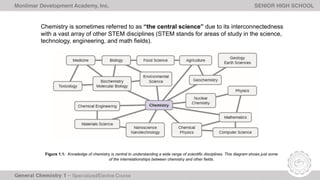
Figure 1.1: Knowledge of chemistry is central to understanding a wide range of scientific disciplines. This diagram shows just some
of the interrelationships between chemistry and other fields.
Chemistry is sometimes referred to as “the central science” due to its interconnectedness
with a vast array of other STEM disciplines (STEM stands for areas of study in the science,
technology, engineering, and math fields).
What are some changes in matter that are essential to daily life?
Monlimar Development Academy, Inc. SENIOR HIGH SCHOOL
?
Monlimar Development Academy, Inc. SENIOR HIGH SCHOOL
Brief History of Chemistry
Monlimar Development Academy, Inc. SENIOR HIGH SCHOOL
Table 1.0: Brief History of Chemistry:Timeline
Period/Time Significant Event Evidence
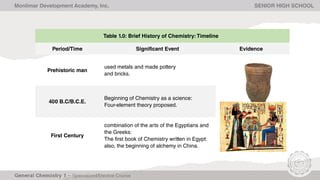
Prehistoric man
used metals and made pottery
and bricks.
400 B.C/B.C.E.
Beginning of Chemistry as a science:
Four-element theory proposed.
First Century
combination of the arts of the Egyptians and
the Greeks:
The first book of Chemistry written in Egypt:
also, the beginning of alchemy in China.
Monlimar Development Academy, Inc. SENIOR HIGH SCHOOL
Table 1.0: Brief History of Chemistry:Timeline
Period/Time Significant Event Evidence
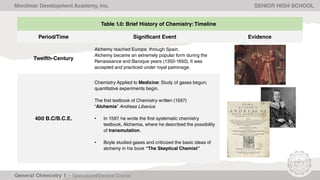
Twelfth-Century
Alchemy reached Europe, through Spain.
Alchemy became an extremely popular form during the
Renaissance and Baroque years (1350-1650). It was
accepted and practiced under royal patronage.
400 B.C/B.C.E.
Chemistry Applied to Medicine: Study of gases begun;
quantitative experiments begin.
The first textbook of Chemistry written (1597)
“Alchemia” Andreas Libavius
• In 1597, he wrote the first systematic chemistry
textbook, Alchemia, where he described the possibility
of transmutation.
• Boyle studied gases and criticized the basic ideas of
alchemy in his book “The Skeptical Chemist”
Monlimar Development Academy, Inc. SENIOR HIGH SCHOOL
Table 1.0: Brief History of Chemistry:Timeline
Period/Time Significant Event Evidence
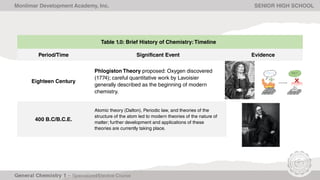
Eighteen Century
Phlogiston Theory proposed: Oxygen discovered
(1774); careful quantitative work by Lavoisier
generally described as the beginning of modern
chemistry.
400 B.C/B.C.E.
Atomic theory (Dalton), Periodic law, and theories of the
structure of the atom led to modern theories of the nature of
matter; further development and applications of these
theories are currently taking place.
Supplemental ideas:
• Early Chemists: describes that matter is composed of four important
components of nature like earth, air, fire, and water.
• The Philosopher’s Stone lapis philosophorum believes that it could turn metals
into gold, retains youth and postpone death.
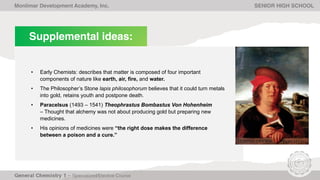
• Paracelsus (1493 – 1541) Theophrastus Bombastus Von Hohenheim
– Thought that alchemy was not about producing gold but preparing new
medicines.
• His opinions of medicines were “the right dose makes the difference
between a poison and a cure.”
Monlimar Development Academy, Inc. SENIOR HIGH SCHOOL
Emerging Ideas of Chemistry During the Greek Era:
GREEK ERA - Beliefs That Matter Was Made Up Of Single Elements
• Anaximenes (Flourished C. 545 BCE) – Asserted the matter was made of “Air”.
• Thales Of Miletus (Flourished 6th Century BCE) – Thought matter was made up of “Water”.
• Heraclitus (C. 540-480 BCE) – Believed that it was “Fire”.
• Empedocles (C. 490 – 430 BCE) – Proposed that matter was made of Four Fundamental Elements
“Earth, Air, Water, and Fire.
Monlimar Development Academy, Inc. SENIOR HIGH SCHOOL
Emerging Ideas of Chemistry During the Greek Era:
• Around 400 BCE, a new theory emerged when Greek philosophers Leucippus (flourished 5th
century BCE) and his student Democritus (c. 460 – 370 BCE).
• Wondered what would happen to a piece of gold if it is cut indefinitely.
• The two philosophers concluded that there must be the smallest unit of gold that cannot be further
broken down without ceasing to be gold.
• They called this unit “Atomos” meaning “uncuttable”
Monlimar Development Academy, Inc. SENIOR HIGH SCHOOL
The Five Main Principles of Leucippus and Democritus’Theory
Include the Following:
 All matter is made up of atoms that are too tiny to be seen by the naked eyes. They cannot be
broken down further into smaller portions. All forms of matter result from the coming together or
breaking apart of atoms.
 Atoms are in constant motion around an empty space called void.
 Atoms are completely solid.
 Atoms are uniform, with no internal structure.
 Atoms come in different shapes and sizes.
Monlimar Development Academy, Inc. SENIOR HIGH SCHOOL
Emerging Ideas of Chemistry During the Greek Era:
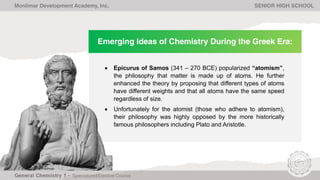
• Epicurus of Samos (341 – 270 BCE) popularized “atomism”,
the philosophy that matter is made up of atoms. He further
enhanced the theory by proposing that different types of atoms
have different weights and that all atoms have the same speed
regardless of size.
• Unfortunately for the atomist (those who adhere to atomism),
their philosophy was highly opposed by the more historically
famous philosophers including Plato and Aristotle.
Monlimar Development Academy, Inc. SENIOR HIGH SCHOOL
Emerging Ideas of Chemistry During the Greek Era:
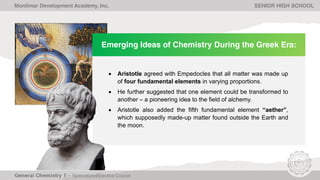
• Aristotle agreed with Empedocles that all matter was made up
of four fundamental elements in varying proportions.
• He further suggested that one element could be transformed to
another – a pioneering idea to the field of alchemy.
• Aristotle also added the fifth fundamental element “aether”,
which supposedly made-up matter found outside the Earth and
the moon.
Monlimar Development Academy, Inc. SENIOR HIGH SCHOOL
Emerging Ideas of Chemistry During the Greek Era:
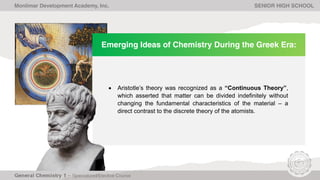
• Aristotle’s theory was recognized as a “Continuous Theory”,
which asserted that matter can be divided indefinitely without
changing the fundamental characteristics of the material – a
direct contrast to the discrete theory of the atomists.
Monlimar Development Academy, Inc. SENIOR HIGH SCHOOL
Understanding The Nature of Matter
What is Matter?
Monlimar Development Academy, Inc. SENIOR HIGH SCHOOL
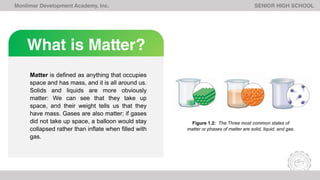
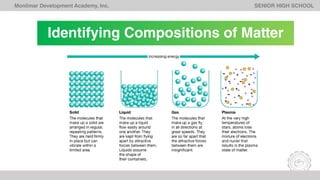
Matter is defined as anything that occupies
space and has mass, and it is all around us.
Solids and liquids are more obviously
matter: We can see that they take up
space, and their weight tells us that they
have mass. Gases are also matter; if gases
did not take up space, a balloon would stay
collapsed rather than inflate when filled with
gas.
Figure 1.2: The Three most common states of
matter or phases of matter are solid, liquid, and gas.
What is Matter?
Monlimar Development Academy, Inc. SENIOR HIGH SCHOOL
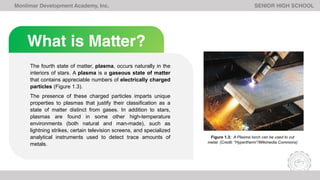
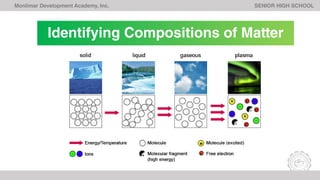
The fourth state of matter, plasma, occurs naturally in the
interiors of stars. A plasma is a gaseous state of matter
that contains appreciable numbers of electrically charged
particles (Figure 1.3).
The presence of these charged particles imparts unique
properties to plasmas that justify their classification as a
state of matter distinct from gases. In addition to stars,
plasmas are found in some other high-temperature
environments (both natural and man-made), such as
lightning strikes, certain television screens, and specialized
analytical instruments used to detect trace amounts of
metals.
Figure 1.3: A Plasma torch can be used to cut
metal. (Credit: “Hypertherm”/Wikimedia Commons)
Identifying Compositions of Matter
Monlimar Development Academy, Inc. SENIOR HIGH SCHOOL
Identifying Compositions of Matter
Monlimar Development Academy, Inc. SENIOR HIGH SCHOOL
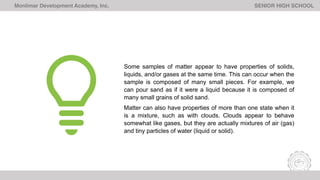
Some samples of matter appear to have properties of solids,
liquids, and/or gases at the same time. This can occur when the
sample is composed of many small pieces. For example, we
can pour sand as if it were a liquid because it is composed of
many small grains of solid sand.
Matter can also have properties of more than one state when it
is a mixture, such as with clouds. Clouds appear to behave
somewhat like gases, but they are actually mixtures of air (gas)
and tiny particles of water (liquid or solid).
Monlimar Development Academy, Inc. SENIOR HIGH SCHOOL
Chemistry deals with the composition, structure, and properties of matter, and the ways
by which various forms of matter may be interconverted. Thus, it occupies a central
place in the study and practice of science and technology.
Chemists use the scientific method to perform experiments, pose hypotheses, and
formulate laws and develop theories so that they can better understand the behavior of
the natural world. To do so, they operate in the macroscopic, microscopic, and symbolic
domains. Chemists measure, analyze, purify, and synthesize a wide variety of
substances that are important to our lives.
Monlimar Development Academy, Inc. SENIOR HIGH SCHOOL
Let’s Dig In
Monlimar Development Academy, Inc. SENIOR HIGH SCHOOL
1. The development of the theory that matter is made up of particles
traces back to the era of ancient philosophers. This philosopher is
known for his idea about matter, he asserted that matter was made up
of four elements.
Question 1
Let’s Dig In
Monlimar Development Academy, Inc. SENIOR HIGH SCHOOL
This matter has a fixed shape and volume with particles closely packed
together with little movement. It is a _______
Question 2:
Let’s Dig In
Monlimar Development Academy, Inc. SENIOR HIGH SCHOOL
This matter has a fixed shape and volume with particles closely packed
together with little movement. It is a _______
Question 2:
Let’s Dig In
Monlimar Development Academy, Inc. SENIOR HIGH SCHOOL
Aristotle proposed additional elements as the fifth fundamental element
in the principle of atomic theory, which supposedly made-up matter
found outside of Earth and the moon.
Question 3:
Let’s Dig In
Monlimar Development Academy, Inc. SENIOR HIGH SCHOOL
Alchemy principle/theory describes an object being combustible to heat
and flammable when exposed to air and oxygen.
Question 4:
Let’s Dig In
Monlimar Development Academy, Inc. SENIOR HIGH SCHOOL
The only state of matter considered as the best conductor of electricity
that results light and radiation?
Question 5:
Let’s Dig In
Monlimar Development Academy, Inc. SENIOR HIGH SCHOOL
Written Work No. 1:
Classifying Changes In Matter (Chemical and Physical Properties)
Directions: Access our Google Classroom Portal for Written Work No. 1, take note of the standard
format of your assessment.
Deadline: January 16, 2022 (Sunday)
Let’s Apply
Monlimar Development Academy, Inc. SENIOR HIGH SCHOOL
As a Monlimarian, how does understanding the timeline, contributions,
and development of chemistry affect our way of living? How do changes
in matter affect our daily lives?
Let’s Reflect!
Monlimar Development Academy, Inc. SENIOR HIGH SCHOOL
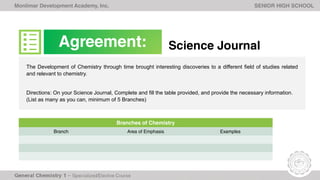
The Development of Chemistry through time brought interesting discoveries to a different field of studies related
and relevant to chemistry.
Directions: On your Science Journal, Complete and fill the table provided, and provide the necessary information.
(List as many as you can, minimum of 5 Branches)
Agreement:
Branches of Chemistry
Branch Area of Emphasis Examples
Science Journal
Monlimar Development Academy, Inc. SENIOR HIGH SCHOOL
Title of the Book: Exploring Life Through Science (Phoenix Publishing)
Author: Aristea V. Bayquen and Gardee T. Peňa
Page/s: 5 - 22
Reference:
Monlimar Development Academy, Inc. SENIOR HIGH SCHOOL
End of Lesson
Lesson 1:
Exploring the field and Historical Spectrum of
Chemistry: A Bird’s Eye Perspective

Lesson 1 - Gen Chem 1 - Week 1.pdf

  • 1.
    General Chemistry 1 MonlimarDevelopment Academy, Inc. SENIOR HIGH SCHOOL Grade Level : Grade 11/12 Semester : 2nd Semester School Year : 2021 – 2022 Instructor : Mr. Joshua Bong A. Bual Department of Education National Capital Region Division of Taguig City and Pateros Monlimar Development Academy, Inc. 317 Manuel L. Quezon St. Lower Bicutan, Taguig City
  • 2.
    Let’s Get Started! MonlimarDevelopment Academy, Inc. SENIOR HIGH SCHOOL Directions: The students will choose and select one theoretical question among all the provided questions below. Students may raise or volunteer to answer and share their thoughts.  When did time begin?  Is there life after death?  Which came first – the chicken or the egg?  If we learn and improve from our mistakes, why are we so afraid to make mistakes?  What are dreams?  What is freedom and does it really exist?
  • 3.
    Guide Questions: Monlimar DevelopmentAcademy, Inc. SENIOR HIGH SCHOOL Directions: The students will choose and select one theoretical question among all the provided questions below. Students may raise or volunteer to answer and share their thoughts. 1. Do you believe all that exists can be answered or not? 2. Do you encounter the same questions in your mind ever since? 3. What do you think is the sense of answering all these theoretical questions?
  • 4.
    Lesson 1: Week1 Monlimar Development Academy, Inc. SENIOR HIGH SCHOOL Exploring the field and Historical Spectrum of Chemistry: A Bird’s Eye Perspective Department of Education National Capital Region Division of Taguig City and Pateros Monlimar Development Academy, Inc. 317 Manuel L. Quezon St. Lower Bicutan, Taguig City
  • 5.
    Objectives • Defining chemistryand identifying its importance and development through time. • Understanding various facets of ideas of chemistry that emerged on the continuous discoveries and development of science that helped our society attain progress and revolutionized the way we live. Monlimar Development Academy, Inc. SENIOR HIGH SCHOOL
  • 6.
    Defining Chemistry : thestudy of the composition, properties, and interactions of matter. : a science that deals with the structure and properties of substances and with the changes that they go through : the structure and properties of a substance: the way a substance changes and reacts with other substances - Merriam Webster Monlimar Development Academy, Inc. SENIOR HIGH SCHOOL
  • 7.
    Defining Chemistry : Chemistry,the science that deals with the properties, composition, and structure of substances (defined as elements and compounds), the transformations they undergo, and the energy that is released or absorbed during these processes. Every substance, whether naturally occurring or artificially produced, consists of one or more of the hundred-odd species of atoms that have been identified as elements. - Britannica Monlimar Development Academy, Inc. SENIOR HIGH SCHOOL
  • 8.
    Chemistry is thebranch of science that deals with the properties, composition, and structure of elements and compounds, how they can change, and the energy that is released or absorbed when they change. Monlimar Development Academy, Inc. SENIOR HIGH SCHOOL
  • 9.
    Monlimar Development Academy,Inc. SENIOR HIGH SCHOOL Figure 1.1: Knowledge of chemistry is central to understanding a wide range of scientific disciplines. This diagram shows just some of the interrelationships between chemistry and other fields. Chemistry is sometimes referred to as “the central science” due to its interconnectedness with a vast array of other STEM disciplines (STEM stands for areas of study in the science, technology, engineering, and math fields).
  • 10.
    What are somechanges in matter that are essential to daily life? Monlimar Development Academy, Inc. SENIOR HIGH SCHOOL ?
  • 11.
    Monlimar Development Academy,Inc. SENIOR HIGH SCHOOL Brief History of Chemistry
  • 12.
    Monlimar Development Academy,Inc. SENIOR HIGH SCHOOL Table 1.0: Brief History of Chemistry:Timeline Period/Time Significant Event Evidence Prehistoric man used metals and made pottery and bricks. 400 B.C/B.C.E. Beginning of Chemistry as a science: Four-element theory proposed. First Century combination of the arts of the Egyptians and the Greeks: The first book of Chemistry written in Egypt: also, the beginning of alchemy in China.
  • 13.
    Monlimar Development Academy,Inc. SENIOR HIGH SCHOOL Table 1.0: Brief History of Chemistry:Timeline Period/Time Significant Event Evidence Twelfth-Century Alchemy reached Europe, through Spain. Alchemy became an extremely popular form during the Renaissance and Baroque years (1350-1650). It was accepted and practiced under royal patronage. 400 B.C/B.C.E. Chemistry Applied to Medicine: Study of gases begun; quantitative experiments begin. The first textbook of Chemistry written (1597) “Alchemia” Andreas Libavius • In 1597, he wrote the first systematic chemistry textbook, Alchemia, where he described the possibility of transmutation. • Boyle studied gases and criticized the basic ideas of alchemy in his book “The Skeptical Chemist”
  • 14.
    Monlimar Development Academy,Inc. SENIOR HIGH SCHOOL Table 1.0: Brief History of Chemistry:Timeline Period/Time Significant Event Evidence Eighteen Century Phlogiston Theory proposed: Oxygen discovered (1774); careful quantitative work by Lavoisier generally described as the beginning of modern chemistry. 400 B.C/B.C.E. Atomic theory (Dalton), Periodic law, and theories of the structure of the atom led to modern theories of the nature of matter; further development and applications of these theories are currently taking place.
  • 15.
    Supplemental ideas: • EarlyChemists: describes that matter is composed of four important components of nature like earth, air, fire, and water. • The Philosopher’s Stone lapis philosophorum believes that it could turn metals into gold, retains youth and postpone death. • Paracelsus (1493 – 1541) Theophrastus Bombastus Von Hohenheim – Thought that alchemy was not about producing gold but preparing new medicines. • His opinions of medicines were “the right dose makes the difference between a poison and a cure.” Monlimar Development Academy, Inc. SENIOR HIGH SCHOOL
  • 16.
    Emerging Ideas ofChemistry During the Greek Era: GREEK ERA - Beliefs That Matter Was Made Up Of Single Elements • Anaximenes (Flourished C. 545 BCE) – Asserted the matter was made of “Air”. • Thales Of Miletus (Flourished 6th Century BCE) – Thought matter was made up of “Water”. • Heraclitus (C. 540-480 BCE) – Believed that it was “Fire”. • Empedocles (C. 490 – 430 BCE) – Proposed that matter was made of Four Fundamental Elements “Earth, Air, Water, and Fire. Monlimar Development Academy, Inc. SENIOR HIGH SCHOOL
  • 17.
    Emerging Ideas ofChemistry During the Greek Era: • Around 400 BCE, a new theory emerged when Greek philosophers Leucippus (flourished 5th century BCE) and his student Democritus (c. 460 – 370 BCE). • Wondered what would happen to a piece of gold if it is cut indefinitely. • The two philosophers concluded that there must be the smallest unit of gold that cannot be further broken down without ceasing to be gold. • They called this unit “Atomos” meaning “uncuttable” Monlimar Development Academy, Inc. SENIOR HIGH SCHOOL
  • 18.
    The Five MainPrinciples of Leucippus and Democritus’Theory Include the Following:  All matter is made up of atoms that are too tiny to be seen by the naked eyes. They cannot be broken down further into smaller portions. All forms of matter result from the coming together or breaking apart of atoms.  Atoms are in constant motion around an empty space called void.  Atoms are completely solid.  Atoms are uniform, with no internal structure.  Atoms come in different shapes and sizes. Monlimar Development Academy, Inc. SENIOR HIGH SCHOOL
  • 19.
    Emerging Ideas ofChemistry During the Greek Era: • Epicurus of Samos (341 – 270 BCE) popularized “atomism”, the philosophy that matter is made up of atoms. He further enhanced the theory by proposing that different types of atoms have different weights and that all atoms have the same speed regardless of size. • Unfortunately for the atomist (those who adhere to atomism), their philosophy was highly opposed by the more historically famous philosophers including Plato and Aristotle. Monlimar Development Academy, Inc. SENIOR HIGH SCHOOL
  • 20.
    Emerging Ideas ofChemistry During the Greek Era: • Aristotle agreed with Empedocles that all matter was made up of four fundamental elements in varying proportions. • He further suggested that one element could be transformed to another – a pioneering idea to the field of alchemy. • Aristotle also added the fifth fundamental element “aether”, which supposedly made-up matter found outside the Earth and the moon. Monlimar Development Academy, Inc. SENIOR HIGH SCHOOL
  • 21.
    Emerging Ideas ofChemistry During the Greek Era: • Aristotle’s theory was recognized as a “Continuous Theory”, which asserted that matter can be divided indefinitely without changing the fundamental characteristics of the material – a direct contrast to the discrete theory of the atomists. Monlimar Development Academy, Inc. SENIOR HIGH SCHOOL
  • 22.
    Monlimar Development Academy,Inc. SENIOR HIGH SCHOOL Understanding The Nature of Matter
  • 23.
    What is Matter? MonlimarDevelopment Academy, Inc. SENIOR HIGH SCHOOL Matter is defined as anything that occupies space and has mass, and it is all around us. Solids and liquids are more obviously matter: We can see that they take up space, and their weight tells us that they have mass. Gases are also matter; if gases did not take up space, a balloon would stay collapsed rather than inflate when filled with gas. Figure 1.2: The Three most common states of matter or phases of matter are solid, liquid, and gas.
  • 24.
    What is Matter? MonlimarDevelopment Academy, Inc. SENIOR HIGH SCHOOL The fourth state of matter, plasma, occurs naturally in the interiors of stars. A plasma is a gaseous state of matter that contains appreciable numbers of electrically charged particles (Figure 1.3). The presence of these charged particles imparts unique properties to plasmas that justify their classification as a state of matter distinct from gases. In addition to stars, plasmas are found in some other high-temperature environments (both natural and man-made), such as lightning strikes, certain television screens, and specialized analytical instruments used to detect trace amounts of metals. Figure 1.3: A Plasma torch can be used to cut metal. (Credit: “Hypertherm”/Wikimedia Commons)
  • 25.
    Identifying Compositions ofMatter Monlimar Development Academy, Inc. SENIOR HIGH SCHOOL
  • 26.
    Identifying Compositions ofMatter Monlimar Development Academy, Inc. SENIOR HIGH SCHOOL
  • 27.
    Monlimar Development Academy,Inc. SENIOR HIGH SCHOOL Some samples of matter appear to have properties of solids, liquids, and/or gases at the same time. This can occur when the sample is composed of many small pieces. For example, we can pour sand as if it were a liquid because it is composed of many small grains of solid sand. Matter can also have properties of more than one state when it is a mixture, such as with clouds. Clouds appear to behave somewhat like gases, but they are actually mixtures of air (gas) and tiny particles of water (liquid or solid).
  • 28.
    Monlimar Development Academy,Inc. SENIOR HIGH SCHOOL Chemistry deals with the composition, structure, and properties of matter, and the ways by which various forms of matter may be interconverted. Thus, it occupies a central place in the study and practice of science and technology. Chemists use the scientific method to perform experiments, pose hypotheses, and formulate laws and develop theories so that they can better understand the behavior of the natural world. To do so, they operate in the macroscopic, microscopic, and symbolic domains. Chemists measure, analyze, purify, and synthesize a wide variety of substances that are important to our lives.
  • 29.
    Monlimar Development Academy,Inc. SENIOR HIGH SCHOOL Let’s Dig In
  • 30.
    Monlimar Development Academy,Inc. SENIOR HIGH SCHOOL 1. The development of the theory that matter is made up of particles traces back to the era of ancient philosophers. This philosopher is known for his idea about matter, he asserted that matter was made up of four elements. Question 1 Let’s Dig In
  • 31.
    Monlimar Development Academy,Inc. SENIOR HIGH SCHOOL This matter has a fixed shape and volume with particles closely packed together with little movement. It is a _______ Question 2: Let’s Dig In
  • 32.
    Monlimar Development Academy,Inc. SENIOR HIGH SCHOOL This matter has a fixed shape and volume with particles closely packed together with little movement. It is a _______ Question 2: Let’s Dig In
  • 33.
    Monlimar Development Academy,Inc. SENIOR HIGH SCHOOL Aristotle proposed additional elements as the fifth fundamental element in the principle of atomic theory, which supposedly made-up matter found outside of Earth and the moon. Question 3: Let’s Dig In
  • 34.
    Monlimar Development Academy,Inc. SENIOR HIGH SCHOOL Alchemy principle/theory describes an object being combustible to heat and flammable when exposed to air and oxygen. Question 4: Let’s Dig In
  • 35.
    Monlimar Development Academy,Inc. SENIOR HIGH SCHOOL The only state of matter considered as the best conductor of electricity that results light and radiation? Question 5: Let’s Dig In
  • 36.
    Monlimar Development Academy,Inc. SENIOR HIGH SCHOOL Written Work No. 1: Classifying Changes In Matter (Chemical and Physical Properties) Directions: Access our Google Classroom Portal for Written Work No. 1, take note of the standard format of your assessment. Deadline: January 16, 2022 (Sunday) Let’s Apply
  • 37.
    Monlimar Development Academy,Inc. SENIOR HIGH SCHOOL As a Monlimarian, how does understanding the timeline, contributions, and development of chemistry affect our way of living? How do changes in matter affect our daily lives? Let’s Reflect!
  • 38.
    Monlimar Development Academy,Inc. SENIOR HIGH SCHOOL The Development of Chemistry through time brought interesting discoveries to a different field of studies related and relevant to chemistry. Directions: On your Science Journal, Complete and fill the table provided, and provide the necessary information. (List as many as you can, minimum of 5 Branches) Agreement: Branches of Chemistry Branch Area of Emphasis Examples Science Journal
  • 39.
    Monlimar Development Academy,Inc. SENIOR HIGH SCHOOL Title of the Book: Exploring Life Through Science (Phoenix Publishing) Author: Aristea V. Bayquen and Gardee T. Peňa Page/s: 5 - 22 Reference:
  • 40.
    Monlimar Development Academy,Inc. SENIOR HIGH SCHOOL End of Lesson Lesson 1: Exploring the field and Historical Spectrum of Chemistry: A Bird’s Eye Perspective