AN INTRODUCTION TO
CHEMISTRY
UNIT 1
PREPARING NOTEBOOK
SHEET 1 Write TABLE OF CONTENTS
SHEET 2: IN THE TOP MARGIN
LESSON 1: INTRODUCTION TO SCIENCE AND
CHEMISTRY
TODAYS DATE
LECTURE
AN INTRODUCTION TO
SCIENCE AND
CHEMISTRY
LESSON 1
LEQ’S AND OBJECTIVES FOR
LESSON 1
What is science?
What is chemistry?
Distinguish hypothesis, theory, law, variable, controls,
Identify the steps of the scientific method
Define science and chemistry
Identify the contributions of alchemist, Lavoisier, and Pauling.
SCIENCE IS A WAY OF THINKING
Question your
observations
Investigate Further
Be skeptical
Try to refute your own
ideas
Seek out more evidence
Be open-minded
Think creativelygraphic from: The Foundation for Critical Thinking, The Thinker’s Guide to Scientific Thought
Habits of Mind
THE STEPS IN THE SCIENTIFIC
METHOD
THEORY VS LAW THE FINE
POINT
Theory= WHY
Examples: big bang theory, evolution, relativity
Law = WHAT
Example: Hubble law of expansion (v=H*d)
universal gravity (F=G (m1*m2/r^2),
thermodynamics
EXPERIMENTAL DESIGN
The effect of the independant variable on dependent variable
If this happens, then it means this
(Independent, x, or manipulated) name it
here
How will the variable be changes. Enter each level, may need
more of less
How many times will the variable be tested at each level?
Name it. (Dependent, y, responding)
List of things that will be the same. NOT Variables
COLLABORATION AND
COMMUNICATION
Collaboration and
communication increases the
likelihood of positive
outcomes.
WHAT IS CHEMISTRY?
Chemistry is the study of Matter and the
Changes that it undergoes.
Matter is anything that has mass and
takes up space.
Energy is involved in the behavior and
changes.
ENERGY IS
INVOLVED:
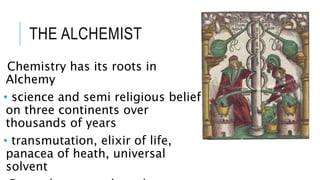
THE ALCHEMIST
Chemistry has its roots in
Alchemy
• science and semi religious belief
on three continents over
thousands of years
• transmutation, elixir of life,
panacea of heath, universal
solvent
ANTIONE LAVOISIER
The “Father of Modern Chemistry”
Largely changing from a qualitative
to quantitate field.
He names oxygen and hydrogen,
uncovered oxygen’s role in
combustion, determined sulfur was
an element, made contributions to
the metric system
Discovered that matter can change
its size and shape but not its mass.
Guillotined during the French
Revolution
LINUS PAULING
The “Father of Molecular Biology”
Pioneered the use of quantum
physics in chemistry, discovered the
hybridization of orbitals in carbon,
developed the electronegativity
scale, write the book on bonds.
Crystallography analysis lead DNA
Found the cause of sickle-cell
anemia lead to molecular medicine
BEYOND THE REQUIRMENTS
If you want an “A”, then you also need to be able to:
Distinguish between the five areas of study in chemistry
Distinguish pure and applied science
SO MUCH CHEMISTRY…
WHAT ARE THE 5 TRADITIONAL
AREAS OF CHEMISTRY?
Analytical
Biochemical
Inorganic
Organic
Physical
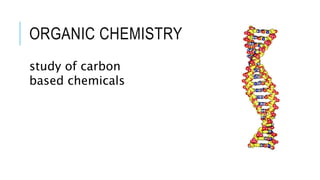
ORGANIC CHEMISTRY
study of carbon
based chemicals
BIOCHEMISTRY
Focuses on the
processes that
take place in an
organism.
INORGANIC
Inorganic
chemistry deals
with non-carbon
chemistry, like
rocks.
ANALYTICAL
Analytical
chemistry
is focuses
on the
compositio
n of
materials
PHYSICAL
Physical
chemistry- deals
with mechanisms,
rates, and energy
changes that
matter undergoes
in change.
PURE AND APPLIED CHEMISTRY
Pure chemistry is the pursuit of
knowledge for its own sake.
Applied is directed toward a practical goal
or application
APPLIED OR PURE
“During the period of 1914-1918 (World
War I), Edison became concerned with
America's reliance on foreign supplies of
rubber. He partnered with Harvey Firestone
and his good friend Henry Ford to try to
find a rubber tree or plant that could grow
quickly in the United States and, above all,
contain enough latex to support his
research endeavor. In 1927, the three men
contributed $25,000 each and created the
Edison Botanic Research Corporation in an
attempt to find a solution to this problem.
In 1928, the Edison Botanic Research
Corporation laboratory was constructed. It
was in Fort Myers, Florida that Mr. Edison
would do the majority of his research and
planting of his exotic plants and trees,
sending any results or sample rubber
residues up to West Orange, New Jersey, to
his large Thomas A. Edison "Invention
Factory".
After testing 17,000 plant samples, Edison
eventually discovered a source in the plant
Goldenrod (Solidago leavenworthii).
APPLIED OR PURE
He is widely considered in popular
literature as the "father of modern
chemistry".[3] It is generally accepted that
Lavoisier's great accomplishments in
chemistry largely stem from his changing
the science from a qualitative to a
quantitative one.
Lavoisier is most noted for his discovery
of the role oxygen plays in combustion.
He recognized and named oxygen (1778)
and hydrogen (1783) and opposed the
phlogiston theory. He wrote the first
extensive list of elements, and helped to
reform chemical nomenclature. He
predicted the existence of silicon
(1787)[5] and was also the first to
establish that sulfur was an element
(1777) rather than a compound.[6] He
discovered that, although matter may
change its form or shape, its mass always
remains the same.
~from Wikipedia
WHY STUDY CHEMISTRY?
BECAUSE YOU NEVER KNOW THE
FUTURE
WHEN IS IT THE SCIENTIFIC
MEANING?
HOW DO YOU MEASURE UP? CAN
YOU
Distinguish hypothesis, theory, law, variable, controls,
Identify the steps of the scientific method
Define science and chemistry
Identify the contributions of alchemist, Lavoisier, and Pauling.
If you want an “A”, then you also need to be able to:
Match a description to five areas of study in chemistry
Distinguish an experiment as pure or applied science
PROPERTIES OF MATTER LESSON 2
LEQ
How are Elements, Compounds, and mixtures
different?
What are the states of matter?
OBJECTIVES (CAN I…?)
 explain the difference between an element and a
compound
Classify matter as elements, compounds and
mixtures by name or diagram
 Classify mixtures homogeneous and heterogeneous
Identify common elements and symbols
Count atoms in a formula
LESSON
OVERVIEW:
TYPES OF MATTER
ELEMENTS
Elements are the
simplest form of
matter that has a
unique set of
properties
There are 92 naturally
occurring elements
and including man-
made ones.
ELEMENTS ARE REPRESENTED BY
SYMBOLS
1. One or two letters.
2. Only First letter is a capitalized.
Co is an element and CO is NOT!
3. Sometimes they are obvious…
C, Cr, H, He, B, Br
Other times…
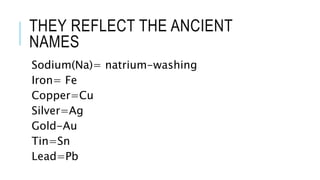
THEY REFLECT THE ANCIENT
NAMES
Sodium(Na)= natrium-washing
Iron= Fe
Copper=Cu
Silver=Ag
Gold-Au
Tin=Sn
Lead=Pb
AN ATOM
The smallest unit of an element that retains the
properties of an element.
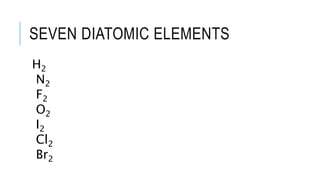
SEVEN DIATOMIC ELEMENTS
H2
N2
F2
O2
I2
Cl2
Br2
COMPOUNDS CONTAIN TWO OR
MORE ELEMENTS CHEMICALLY
COMBINED. THE ELEMENTS ARE
ALWAYS IN THE SAME
PROPORTIONS.
CO carbon monoxide – odorless colorless gas, toxic
byproduct of combustion
CO2 carbon dioxide- used by plants to produce glucose,
byproduct of respiration.
H2O water- most important compound for living things.
H2O2 peroxide- used as a disinfectant.
THE PROPERTIES OF A COMPOUND
ARE DIFFERENT THAN THE
ELEMENTS
Cl is a greenish poisonous gas.
Na is a soft metal that reacts violently with
oxygen.
Together NaCl is table salt.
LEQ:
WHAT IS A MIXTURE AND HOW CAN
IT BE SEPARATED INTO ELEMENTS
AND COMPOUNDS?
HOW ARE MIXTURES CLASSIFIED?
MIXTURE-THE PHYSICAL COMBINATION
OF TWO OR MORE COMPOUNDS OR
ELEMENTS.
MIXTURES ARE SEPARATED BY
PHYSICAL PROPERTIES…
Boiling Point
Size of particle
Solubility
Magetism
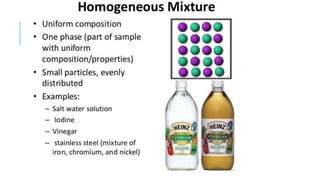
HOMOGENEOUS- SAME PROPERTIES
THROUGHOUT
HETEROGENEOUS- PARTS WITH DIFFERENT
PROPERTIES
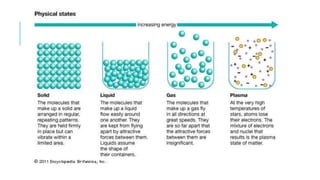
LEQ: WHAT ARE THE STATES OF
MATTER
PROPERTIES
You are
responsible for
knowing the
properties of
the three basic
states of
matter.
INCREASING ENERGY
PHASE CHANGES INVOLVE ENERGY
CHANGES
LEQ: WHAT IS CHEMICAL
CHANGE AND PHYSICAL
CHANGE? WHAT ARE
CHEMICAL PROPERTIES
AND PHYSICAL
PROPERTIES?
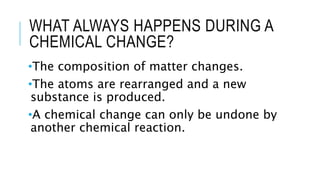
WHAT ALWAYS HAPPENS DURING A
CHEMICAL CHANGE?
•The composition of matter changes.
•The atoms are rearranged and a new
substance is produced.
•A chemical change can only be undone by
another chemical reaction.
HERE’S A PICTURE
t
The PRODUCTS are on the
right. In this picture, two
molecules of water.
The REACTANTS are
written on the left. In this
picture, the element
oxygen and hydrogen.
The Arrow is read “yields”. In situation
problems you might see: reacts, forms,
decomposes, produces, and may more.
EXAMPLES OF CHEMICAL CHANGE
• burning
• cooking
• iron
• digesting
• rotting
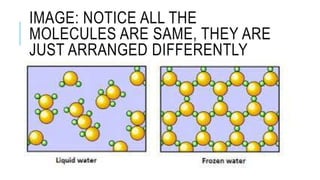
WHAT IS A PHYSICAL CHANGE?
No new chemical species are formed
The same molecules are present but the
form changes:
Phase change-boiling, freezing, etc.
Shape change- rolling, bending,
breaking..
IMAGE: NOTICE ALL THE
MOLECULES ARE SAME, THEY ARE
JUST ARRANGED DIFFERENTLY
SIGNS OF CHEMICAL REACTIONS?
Generate a Gas – baking soda and vinegar
Change in Color- rusting steel
Precipitate- solid forming when two
liquids mix
Change in Energy-
Temperature: ice pack or heat pack
Light: glow stick
PHYSICAL-VS-CHEMICAL
PROPERTIES
Chemical and physical properties are
related to the chemical and physical
changes that the material can undergo.
So…
Physical properties can be observed
without changing the matter
Chemical properties are tested by chemical
reactions
UNIT 1 NOTES

UNIT 1 NOTES

  • 1.
  • 2.
    PREPARING NOTEBOOK SHEET 1Write TABLE OF CONTENTS SHEET 2: IN THE TOP MARGIN LESSON 1: INTRODUCTION TO SCIENCE AND CHEMISTRY TODAYS DATE LECTURE
  • 3.
    AN INTRODUCTION TO SCIENCEAND CHEMISTRY LESSON 1
  • 4.
    LEQ’S AND OBJECTIVESFOR LESSON 1 What is science? What is chemistry? Distinguish hypothesis, theory, law, variable, controls, Identify the steps of the scientific method Define science and chemistry Identify the contributions of alchemist, Lavoisier, and Pauling.
  • 5.
    SCIENCE IS AWAY OF THINKING Question your observations Investigate Further Be skeptical Try to refute your own ideas Seek out more evidence Be open-minded Think creativelygraphic from: The Foundation for Critical Thinking, The Thinker’s Guide to Scientific Thought Habits of Mind
  • 6.
    THE STEPS INTHE SCIENTIFIC METHOD
  • 7.
    THEORY VS LAWTHE FINE POINT Theory= WHY Examples: big bang theory, evolution, relativity Law = WHAT Example: Hubble law of expansion (v=H*d) universal gravity (F=G (m1*m2/r^2), thermodynamics
  • 8.
    EXPERIMENTAL DESIGN The effectof the independant variable on dependent variable If this happens, then it means this (Independent, x, or manipulated) name it here How will the variable be changes. Enter each level, may need more of less How many times will the variable be tested at each level? Name it. (Dependent, y, responding) List of things that will be the same. NOT Variables
  • 9.
    COLLABORATION AND COMMUNICATION Collaboration and communicationincreases the likelihood of positive outcomes.
  • 10.
    WHAT IS CHEMISTRY? Chemistryis the study of Matter and the Changes that it undergoes. Matter is anything that has mass and takes up space. Energy is involved in the behavior and changes.
  • 11.
  • 12.
    THE ALCHEMIST Chemistry hasits roots in Alchemy • science and semi religious belief on three continents over thousands of years • transmutation, elixir of life, panacea of heath, universal solvent
  • 13.
    ANTIONE LAVOISIER The “Fatherof Modern Chemistry” Largely changing from a qualitative to quantitate field. He names oxygen and hydrogen, uncovered oxygen’s role in combustion, determined sulfur was an element, made contributions to the metric system Discovered that matter can change its size and shape but not its mass. Guillotined during the French Revolution
  • 14.
    LINUS PAULING The “Fatherof Molecular Biology” Pioneered the use of quantum physics in chemistry, discovered the hybridization of orbitals in carbon, developed the electronegativity scale, write the book on bonds. Crystallography analysis lead DNA Found the cause of sickle-cell anemia lead to molecular medicine
  • 15.
    BEYOND THE REQUIRMENTS Ifyou want an “A”, then you also need to be able to: Distinguish between the five areas of study in chemistry Distinguish pure and applied science
  • 16.
  • 17.
    WHAT ARE THE5 TRADITIONAL AREAS OF CHEMISTRY? Analytical Biochemical Inorganic Organic Physical
  • 18.
    ORGANIC CHEMISTRY study ofcarbon based chemicals
  • 19.
    BIOCHEMISTRY Focuses on the processesthat take place in an organism.
  • 20.
  • 21.
  • 22.
    PHYSICAL Physical chemistry- deals with mechanisms, rates,and energy changes that matter undergoes in change.
  • 23.
    PURE AND APPLIEDCHEMISTRY Pure chemistry is the pursuit of knowledge for its own sake. Applied is directed toward a practical goal or application
  • 24.
    APPLIED OR PURE “Duringthe period of 1914-1918 (World War I), Edison became concerned with America's reliance on foreign supplies of rubber. He partnered with Harvey Firestone and his good friend Henry Ford to try to find a rubber tree or plant that could grow quickly in the United States and, above all, contain enough latex to support his research endeavor. In 1927, the three men contributed $25,000 each and created the Edison Botanic Research Corporation in an attempt to find a solution to this problem. In 1928, the Edison Botanic Research Corporation laboratory was constructed. It was in Fort Myers, Florida that Mr. Edison would do the majority of his research and planting of his exotic plants and trees, sending any results or sample rubber residues up to West Orange, New Jersey, to his large Thomas A. Edison "Invention Factory". After testing 17,000 plant samples, Edison eventually discovered a source in the plant Goldenrod (Solidago leavenworthii).
  • 25.
    APPLIED OR PURE Heis widely considered in popular literature as the "father of modern chemistry".[3] It is generally accepted that Lavoisier's great accomplishments in chemistry largely stem from his changing the science from a qualitative to a quantitative one. Lavoisier is most noted for his discovery of the role oxygen plays in combustion. He recognized and named oxygen (1778) and hydrogen (1783) and opposed the phlogiston theory. He wrote the first extensive list of elements, and helped to reform chemical nomenclature. He predicted the existence of silicon (1787)[5] and was also the first to establish that sulfur was an element (1777) rather than a compound.[6] He discovered that, although matter may change its form or shape, its mass always remains the same. ~from Wikipedia
  • 26.
  • 27.
    BECAUSE YOU NEVERKNOW THE FUTURE
  • 28.
    WHEN IS ITTHE SCIENTIFIC MEANING?
  • 29.
    HOW DO YOUMEASURE UP? CAN YOU Distinguish hypothesis, theory, law, variable, controls, Identify the steps of the scientific method Define science and chemistry Identify the contributions of alchemist, Lavoisier, and Pauling. If you want an “A”, then you also need to be able to: Match a description to five areas of study in chemistry Distinguish an experiment as pure or applied science
  • 31.
  • 32.
    LEQ How are Elements,Compounds, and mixtures different? What are the states of matter?
  • 33.
    OBJECTIVES (CAN I…?) explain the difference between an element and a compound Classify matter as elements, compounds and mixtures by name or diagram  Classify mixtures homogeneous and heterogeneous Identify common elements and symbols Count atoms in a formula
  • 34.
  • 35.
    ELEMENTS Elements are the simplestform of matter that has a unique set of properties There are 92 naturally occurring elements and including man- made ones.
  • 36.
    ELEMENTS ARE REPRESENTEDBY SYMBOLS 1. One or two letters. 2. Only First letter is a capitalized. Co is an element and CO is NOT! 3. Sometimes they are obvious… C, Cr, H, He, B, Br Other times…
  • 37.
    THEY REFLECT THEANCIENT NAMES Sodium(Na)= natrium-washing Iron= Fe Copper=Cu Silver=Ag Gold-Au Tin=Sn Lead=Pb
  • 38.
    AN ATOM The smallestunit of an element that retains the properties of an element.
  • 39.
  • 40.
    COMPOUNDS CONTAIN TWOOR MORE ELEMENTS CHEMICALLY COMBINED. THE ELEMENTS ARE ALWAYS IN THE SAME PROPORTIONS. CO carbon monoxide – odorless colorless gas, toxic byproduct of combustion CO2 carbon dioxide- used by plants to produce glucose, byproduct of respiration. H2O water- most important compound for living things. H2O2 peroxide- used as a disinfectant.
  • 41.
    THE PROPERTIES OFA COMPOUND ARE DIFFERENT THAN THE ELEMENTS Cl is a greenish poisonous gas. Na is a soft metal that reacts violently with oxygen. Together NaCl is table salt.
  • 42.
    LEQ: WHAT IS AMIXTURE AND HOW CAN IT BE SEPARATED INTO ELEMENTS AND COMPOUNDS? HOW ARE MIXTURES CLASSIFIED?
  • 43.
    MIXTURE-THE PHYSICAL COMBINATION OFTWO OR MORE COMPOUNDS OR ELEMENTS.
  • 44.
    MIXTURES ARE SEPARATEDBY PHYSICAL PROPERTIES… Boiling Point Size of particle Solubility Magetism
  • 45.
  • 49.
    LEQ: WHAT ARETHE STATES OF MATTER
  • 50.
    PROPERTIES You are responsible for knowingthe properties of the three basic states of matter.
  • 52.
    INCREASING ENERGY PHASE CHANGESINVOLVE ENERGY CHANGES
  • 53.
    LEQ: WHAT ISCHEMICAL CHANGE AND PHYSICAL CHANGE? WHAT ARE CHEMICAL PROPERTIES AND PHYSICAL PROPERTIES?
  • 54.
    WHAT ALWAYS HAPPENSDURING A CHEMICAL CHANGE? •The composition of matter changes. •The atoms are rearranged and a new substance is produced. •A chemical change can only be undone by another chemical reaction.
  • 55.
    HERE’S A PICTURE t ThePRODUCTS are on the right. In this picture, two molecules of water. The REACTANTS are written on the left. In this picture, the element oxygen and hydrogen. The Arrow is read “yields”. In situation problems you might see: reacts, forms, decomposes, produces, and may more.
  • 56.
    EXAMPLES OF CHEMICALCHANGE • burning • cooking • iron • digesting • rotting
  • 57.
    WHAT IS APHYSICAL CHANGE? No new chemical species are formed The same molecules are present but the form changes: Phase change-boiling, freezing, etc. Shape change- rolling, bending, breaking..
  • 58.
    IMAGE: NOTICE ALLTHE MOLECULES ARE SAME, THEY ARE JUST ARRANGED DIFFERENTLY
  • 59.
    SIGNS OF CHEMICALREACTIONS? Generate a Gas – baking soda and vinegar Change in Color- rusting steel Precipitate- solid forming when two liquids mix Change in Energy- Temperature: ice pack or heat pack Light: glow stick
  • 60.
    PHYSICAL-VS-CHEMICAL PROPERTIES Chemical and physicalproperties are related to the chemical and physical changes that the material can undergo. So… Physical properties can be observed without changing the matter Chemical properties are tested by chemical reactions

Editor's Notes

  • #6 Habits of Mind from https://undsci.berkeley.edu/article/think_science
  • #27 It explains the natural word. Preparation for career. Informed citizen
  • #35 Seseme Street Video
  • #52 https://www.youtube.com/watch?v=1RpLOKqTcSk video on bose-eisten condensate
  • #53 ADAPTED FROM WIKIPEDIA PAGE ON PHASE CHANGES