International Journal of Engineering Research and Development
ISSN: 2278-067X, Volume 1, Issue 4 (June 2012), PP.34-37
www.ijerd.com

  Fractal Image Compression of Satellite Imageries using range
                   and domain technique
                                      Saema Enjela1, Dr.A.G.Ananth2
                    1         th
                     MTech 4 sem, Digital communication, R V College of Engineering, Bangalore, India
              2
                  Professor, Department of Telecommunication, R V College of Engineering, Bangalore, India


Abstract––Fractal coding is a novel method to compress images, which was proposed by Barnsley, and implemented by
Jacquin. It offers many advantages. Fractal image coding has the advantage of higher compression ratio, but is a lossy
compression scheme. The encoding procedure consists of dividing the image into range blocks and domain blocks and
then it takes a range block and matches it with the domain block. The image is encoded by partitioning the domain block
and using affine transformation to achieve fractal compression. The image is reconstructed using iterative functions and
inverse transforms. In the present work the fractal coding techniques are applied for the compression of satellite
imageries. The Peak Signal to Noise Ratio (PSNR) values are determined for images namely Satellite Rural image and
Satellite Urban image. The Matlab simulation results for the reconstructed image for 4 iterations show that PSNR values
achievable for Satellite Rural image ~17.0 and for Satellite urban image ~22.

Keywords––Fractal; quad-tree; iterated function system (IFS); image compression

                                             I.        INTRODUCTION
           Fractal image compression is a new method to compress images. Unlike conventional method its purpose is to
reduce redundancy between blocks. It was proposed by Barnsley in 1988 [1], and implemented by Jacquin [6, 7]. It is
based on the theory of iterated function systems (IFS) theory developed by Hutchinson [4] and Barnsley [2]. By far there
are lots of published work, such as [5, 8, 9], and the book [3]. The basic idea of the method is as follows. At first, an
image is partitioned into non-overlapping blocks, which are called range blocks. Then for each range block a contractive
affine transformation and a domain block are determined so that the result block generated by applying the affine
transformation to the domain block is similar enough to the range block. The domain block of a transformation should be
larger in area than its corresponding range block in order for the transformation to be contractive. At last, all the
contractive affine transformations, which just compose contractive IFS, consist of a code of the image. When decoding,
the code is iterated repeatedly on any starting image, and the result image is just the decoded image. In general the
number of iterates is 6 to 8. Simulation results show that the runtime of the proposed algorithm is reduced greatly
compared to the existing methods. At the same time, the new algorithm also achieved high PSNR values. Fractal coding
is a novel method to compress images. It offers many advantages. In [10] proposes a new method using best polynomial
approximation to decide whether a domain block is similar enough to a given range block. Also gives a kind of domain
pool. It is found that the probability distribution of 8 isometrics in the fractal code is not average. And consequently it is
proposed to use only 2 or 4 isometrics to speed up compression.

          The paper is organized as follows. Section 2 describes the Fractal compression technique. After this, section 3
presents the affine transform. Then section 4 gives mathematical foundation of IFS in [2].

Section 5 describes the proposed algorithm used in this paper.

                                      II.         FRACTAL COMPRESSION
          There are several different ways to approach the fractal compression. One way is to use the fixed point
transformation. A function f (.) is said to have a fixed point x0 if f(x0) = x0. Suppose the function f (.) to be of the form
ax + b. Then, except for when a = 1, this equation always has a fixed point.

ax0 + b = x0 then x0 =b/ (1-a)     ……… (1)

This means that to transmit the value of x0, using the values of „a‟ and „b‟ and obtain x0 at the receiver using (1). Instead
of solve this equation to obtain x0, we could take a guess at what x0 using recursion

X0 (n+1) = a x0(n) + b               ……….. (2)

Thus, the value of x0 is accurately specified by fixed point equation. The receiver can retrieve the value either b the
solution of (1) or via the recursion (2). In this paper we partition the image into blocks Rk, called range blocks, and
obtain a transformation fk for each block. The transformations fk are not fixed point transformations since they do not
satisfy the equation fk (Rk) = Rk. Instead, they are a mapping from a block of pixels Dk from some other part of the
image. While each individual mapping fk is not a fixed point mapping, that can combine all these mappings to generate a
fixed point mapping. The image blocks Dk are called domain blocks, and they are chosen to be larger than the range

                                                             34
Fractal Image Compression of Satellite Imageries using range and domain technique

blocks. The domain blocks are obtained by sliding a K X K window over the image in steps of K/2 or K/4 pixels. The
transformations fk are composed of a geometric transformation gk and a massif transformation mk. The geometric
transformation consists of moving the domain block to the location of the range block and adjusting the size of the
domain block to match the size of the range block.

Řk = fk (Dk) = mk (gk (Dk))                ..... (3)

Řk instead of Rk in (3) because it is not possible to find an exact functional between domain and range blocks, since
some loss of information. This loss is measured in terms of mean squared error. In order to reduce the computations,
restrict the number of domain blocks to search. However, in order to get the best possible approximation, the pool of
domain blocks to be as large as possible. The elements of the domain pool are then divided in to shade blocks, edge
blocks, and midrange blocks. The shade blocks are those in which the variance of pixel values within the block is small.
The edge block, contains those blocks that have a sharp change of intensity values. The midrange blocks are those that fit
into not too smooth but with no well defined edges. The encoding procedure proceeds as a range block is classified into
one of the three categories described above. If it is a shade block, send the average value of the block. If it is a midrange
block, the massic transformation is of the form ( αk tij + Δk )
where Tk = gk ( Dk ), and tij as the ijth pixel in Tk i, j = 0, 1, …..M-1, αk is selected from a small set of values. Thus the
possible values of α and the midrange domain blocks in the domain poolin order to find the (αk, Dk ) pair that will
minimize d ( Rk, αk Tk ). The value of Δk is then selected as the difference of the average values of Rk, αk Tk . If the
range block Rk is classified as an edge block. The block is first divided into a bright and a dark region. The dynamic
range of the block rd (Rk ) is the computed as the difference of the average values of the light and dark regions. For a
given domain block, then used to compute
the value of αk by

αk=min{(rd(Rk))/(rd(Tk)),αmax}              …(4)

In (4) where αmax is an upper bound on the scaling factor.

           The work carried out in the paper is based on range and domain technique. Taking different images such as
satellite Rural and satellite urban images of size 128 X 128 pixels for fractal compression. The PSNR is calculated for the
reconstructed image for the various Range block.

                                    III.         AFFINE TRANSFORMATION
          An affine transformation w: Rn → Rn can always be written as w = Ax + b, where A € Rn x n is an n x n
matrix and b € Rn is an offset vector. Such transformation will be contractive exactly when its linear part is contractive,
and this depends on the metric used to measure distances. A linear transformation can scale with As, stretch with At,
skew with Au, and rotate with Aθ.

                           IV.       MATHEMATICAL FOUNDATION OF IFS
           Let (M, d) is a complete metric space. A transformation ω: M→ M is contractive if there exists a constant Sԑ
[0, 1), such that
D (ω(μ), ω(ν))≤s d(μ, ν ), -/ μ, ν Є M,
s is called contractility factor. An iterated function systems (IFS) consists of a complete metric space (M, d) and a set of
contractive transformations Ԏi, i=1, 2,….., N, where contractility factor of Ԏi is si. We define Ԏ : M → M as Ԏ(ν) =
ᴜ(i=1→N) Ԏi (ν), -/ ν Є M
It can be proved that Ԏ is a contractive transformation, and its contractility factor is s=max {si, i=I,2, ... ,N} [2].
According Banach's fixed point theorem, Ԏ has a unique fixed point μ Є M, such that Ԏ(μ)= μ.
The IFS model generates a geometrical shape with an iterative process. An IFS based modelling system is defined by a
triple (x, d, s) where (x d) is a complete metric space, x is called iterative space. S is a semi group acting on points of x
such that p → Tp where T is a contractive operator, s is called iterative semi group. An IFS I is a finite subset of s: I =
{T0, T1, TN-1} with operators Ti € s

                                  V.           THE PROPOSED ALGORITHM
The algorithm steps are as follows.
  1.     Divides the original image into Range block size, do not overlap. Taking of fixed dimension of Range block as
         16x16, 8x8, 4 X 4.
  2.     Taken Domain block Di twice the size of the Range block Ri in the original image.
  3.     Partitioning the Domain blocks doing scaling, averaging, rotation and calculating contrast that is affine
         transformations D1i to Domain block Di
  4.     Calculate the root of mean square of Range block Ri and each corresponding transformed Domain block D1i ,
         as the matching error d between the two blocks. If the matching error to satisfy d < Є, Є is a present tolerable
         error, skip to step6.
  5.     If a full search completed, and did not meet the conditions d < Є, segment the original block Ri into four equal,
         repeat (2) to (6) operations.
  6.     Record the fractal coding information to complete a fractal encoding.

                                                             35
Fractal Image Compression of Satellite Imageries using range and domain technique

  7.      For the encoding image applying iterations and inverse transform to reconstruct the image and calculating
          PSNR.

                                   VI.         RESULTS AND DISCUSSIONS
           The algorithm realized in Matlab to code and to decode the satellite image of Urban of size 1377 X 955, rural
image of size 995 X 57. But all these images are resized to 128 X 128. Experimental parameters are listed as Range block
of size is 4, 8, 16 and number of iterations. The compression ratios and the PSNR values obtained for the reconstructed
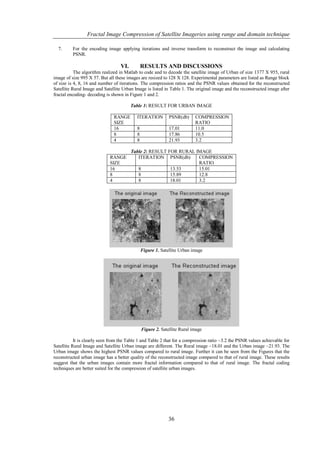
Satellite Rural Image and Satellite Urban Image is listed in Table 1. The original image and the reconstructed image after
fractal encoding- decoding is shown in Figure 1 and 2.

                                         Table 1: RESULT FOR URBAN IMAGE

                               RANGE       ITERATION         PSNR(db)     COMPRESSION
                               SIZE                                       RATIO
                               16          8                 17.01        11.0
                               8           8                 17.86        10.5
                               4           8                 21.93        3.2

                                         Table 2: RESULT FOR RURAL IMAGE
                             RANGE          ITERATION PSNR(db)      COMPRESSION
                             SIZE                                   RATIO
                             16             8             13.53     15.01
                             8              8             15.89     12.8
                             4              8             18.01     3.2


                                               Figure 1. Satellite Urban image


                                               Figure 2. Satellite Rural image

           It is clearly seen from the Table 1 and Table 2 that for a compression ratio ~3.2 the PSNR values achievable for
Satellite Rural Image and Satellite Urban image are different. The Rural image ~18.01 and the Urban image ~21.93. The
Urban image shows the highest PSNR values compared to rural image. Further it can be seen from the Figures that the
reconstructed urban image has a better quality of the reconstructed image compared to that of rural image. These results
suggest that the urban images contain more fractal information compared to that of rural image. The fractal coding
techniques are better suited for the compression of satellite urban images.


                                                             36
Fractal Image Compression of Satellite Imageries using range and domain technique

                                         VII.        ACKNOWLEDGEMENTS
           I thank my guide Dr.A.G.Ananth, the Staff and Department and HOD of Telecommunication Engineering, RV
  College of Engineering, Bangalore for providing me an opportunity and resource to carry out the work.

                                                        REFERENCES
 [1].      M. F. Barnsley and A. A. Sian, "Better Way to Compress Images", BYTE, Jan. 1988, pp. 2 15-223.
 [2].      M. F. Bamsley, Fractals Everywhere, New York: Academic Press, 1988.
 [3].      Y. Fisher, Fractal Image Compression: Theory and Applications to Digital Images, (ed.), Springer-Verlag, 1995.
 [4].      J. E. Hutchinson, "Fractals and Self-Similarity", Indiana University Mathematics Journal, vol. 35, no. 5, 198 1, pp. 73-747.
 [5].      B. Hurtgen and C. Stiller, "Fast Hierarchical Codebook Search for Fractal Coding of Still Images", in EOS/SPIE Visual
           Communications and PACS for Medical Application'93, Berlin, Germany, pp. 397-408.
 [6].      A. E. Jacquin, A Fractal Theory of Iterated Markov Operators with Applications to Digital Image Coding, Ph.D. thesis,
           Georgia Institute of Technology, Atlanta, GA, 1989
 [7].      A. E. Jacquin, "Image Coding Based on a Fractal Theory of Iterated Contractive Image Transformations", IEEE Transactions
           on Image Processing, vol. I, no. I, Jan. 1992, pp. 18-30.
 [8].      D. M. Monro, "A Hybrid Fractal Transform", in IEEE Proceedings of ICASSP, vol. 5, 1993, pp. 169-172.
 [9].      D. M. Monro and S. J. Wooley, "Fractal Image Compression Without Searching", in IEEE Proceedings ofiCASSP, 1994
[10].      Zhuang Wu, Bixi Yan, “An effective fractal image compression algorithm”. IEEE International conference on ICCASM,
           2010, pp.139-143.


                                                                  37

www.ijerd.com

  • 1.
    International Journal ofEngineering Research and Development ISSN: 2278-067X, Volume 1, Issue 4 (June 2012), PP.34-37 www.ijerd.com Fractal Image Compression of Satellite Imageries using range and domain technique Saema Enjela1, Dr.A.G.Ananth2 1 th MTech 4 sem, Digital communication, R V College of Engineering, Bangalore, India 2 Professor, Department of Telecommunication, R V College of Engineering, Bangalore, India Abstract––Fractal coding is a novel method to compress images, which was proposed by Barnsley, and implemented by Jacquin. It offers many advantages. Fractal image coding has the advantage of higher compression ratio, but is a lossy compression scheme. The encoding procedure consists of dividing the image into range blocks and domain blocks and then it takes a range block and matches it with the domain block. The image is encoded by partitioning the domain block and using affine transformation to achieve fractal compression. The image is reconstructed using iterative functions and inverse transforms. In the present work the fractal coding techniques are applied for the compression of satellite imageries. The Peak Signal to Noise Ratio (PSNR) values are determined for images namely Satellite Rural image and Satellite Urban image. The Matlab simulation results for the reconstructed image for 4 iterations show that PSNR values achievable for Satellite Rural image ~17.0 and for Satellite urban image ~22. Keywords––Fractal; quad-tree; iterated function system (IFS); image compression I. INTRODUCTION Fractal image compression is a new method to compress images. Unlike conventional method its purpose is to reduce redundancy between blocks. It was proposed by Barnsley in 1988 [1], and implemented by Jacquin [6, 7]. It is based on the theory of iterated function systems (IFS) theory developed by Hutchinson [4] and Barnsley [2]. By far there are lots of published work, such as [5, 8, 9], and the book [3]. The basic idea of the method is as follows. At first, an image is partitioned into non-overlapping blocks, which are called range blocks. Then for each range block a contractive affine transformation and a domain block are determined so that the result block generated by applying the affine transformation to the domain block is similar enough to the range block. The domain block of a transformation should be larger in area than its corresponding range block in order for the transformation to be contractive. At last, all the contractive affine transformations, which just compose contractive IFS, consist of a code of the image. When decoding, the code is iterated repeatedly on any starting image, and the result image is just the decoded image. In general the number of iterates is 6 to 8. Simulation results show that the runtime of the proposed algorithm is reduced greatly compared to the existing methods. At the same time, the new algorithm also achieved high PSNR values. Fractal coding is a novel method to compress images. It offers many advantages. In [10] proposes a new method using best polynomial approximation to decide whether a domain block is similar enough to a given range block. Also gives a kind of domain pool. It is found that the probability distribution of 8 isometrics in the fractal code is not average. And consequently it is proposed to use only 2 or 4 isometrics to speed up compression. The paper is organized as follows. Section 2 describes the Fractal compression technique. After this, section 3 presents the affine transform. Then section 4 gives mathematical foundation of IFS in [2]. Section 5 describes the proposed algorithm used in this paper. II. FRACTAL COMPRESSION There are several different ways to approach the fractal compression. One way is to use the fixed point transformation. A function f (.) is said to have a fixed point x0 if f(x0) = x0. Suppose the function f (.) to be of the form ax + b. Then, except for when a = 1, this equation always has a fixed point. ax0 + b = x0 then x0 =b/ (1-a) ……… (1) This means that to transmit the value of x0, using the values of „a‟ and „b‟ and obtain x0 at the receiver using (1). Instead of solve this equation to obtain x0, we could take a guess at what x0 using recursion X0 (n+1) = a x0(n) + b ……….. (2) Thus, the value of x0 is accurately specified by fixed point equation. The receiver can retrieve the value either b the solution of (1) or via the recursion (2). In this paper we partition the image into blocks Rk, called range blocks, and obtain a transformation fk for each block. The transformations fk are not fixed point transformations since they do not satisfy the equation fk (Rk) = Rk. Instead, they are a mapping from a block of pixels Dk from some other part of the image. While each individual mapping fk is not a fixed point mapping, that can combine all these mappings to generate a fixed point mapping. The image blocks Dk are called domain blocks, and they are chosen to be larger than the range 34
  • 2.
    Fractal Image Compressionof Satellite Imageries using range and domain technique blocks. The domain blocks are obtained by sliding a K X K window over the image in steps of K/2 or K/4 pixels. The transformations fk are composed of a geometric transformation gk and a massif transformation mk. The geometric transformation consists of moving the domain block to the location of the range block and adjusting the size of the domain block to match the size of the range block. Řk = fk (Dk) = mk (gk (Dk)) ..... (3) Řk instead of Rk in (3) because it is not possible to find an exact functional between domain and range blocks, since some loss of information. This loss is measured in terms of mean squared error. In order to reduce the computations, restrict the number of domain blocks to search. However, in order to get the best possible approximation, the pool of domain blocks to be as large as possible. The elements of the domain pool are then divided in to shade blocks, edge blocks, and midrange blocks. The shade blocks are those in which the variance of pixel values within the block is small. The edge block, contains those blocks that have a sharp change of intensity values. The midrange blocks are those that fit into not too smooth but with no well defined edges. The encoding procedure proceeds as a range block is classified into one of the three categories described above. If it is a shade block, send the average value of the block. If it is a midrange block, the massic transformation is of the form ( αk tij + Δk ) where Tk = gk ( Dk ), and tij as the ijth pixel in Tk i, j = 0, 1, …..M-1, αk is selected from a small set of values. Thus the possible values of α and the midrange domain blocks in the domain poolin order to find the (αk, Dk ) pair that will minimize d ( Rk, αk Tk ). The value of Δk is then selected as the difference of the average values of Rk, αk Tk . If the range block Rk is classified as an edge block. The block is first divided into a bright and a dark region. The dynamic range of the block rd (Rk ) is the computed as the difference of the average values of the light and dark regions. For a given domain block, then used to compute the value of αk by αk=min{(rd(Rk))/(rd(Tk)),αmax} …(4) In (4) where αmax is an upper bound on the scaling factor. The work carried out in the paper is based on range and domain technique. Taking different images such as satellite Rural and satellite urban images of size 128 X 128 pixels for fractal compression. The PSNR is calculated for the reconstructed image for the various Range block. III. AFFINE TRANSFORMATION An affine transformation w: Rn → Rn can always be written as w = Ax + b, where A € Rn x n is an n x n matrix and b € Rn is an offset vector. Such transformation will be contractive exactly when its linear part is contractive, and this depends on the metric used to measure distances. A linear transformation can scale with As, stretch with At, skew with Au, and rotate with Aθ. IV. MATHEMATICAL FOUNDATION OF IFS Let (M, d) is a complete metric space. A transformation ω: M→ M is contractive if there exists a constant Sԑ [0, 1), such that D (ω(μ), ω(ν))≤s d(μ, ν ), -/ μ, ν Є M, s is called contractility factor. An iterated function systems (IFS) consists of a complete metric space (M, d) and a set of contractive transformations Ԏi, i=1, 2,….., N, where contractility factor of Ԏi is si. We define Ԏ : M → M as Ԏ(ν) = ᴜ(i=1→N) Ԏi (ν), -/ ν Є M It can be proved that Ԏ is a contractive transformation, and its contractility factor is s=max {si, i=I,2, ... ,N} [2]. According Banach's fixed point theorem, Ԏ has a unique fixed point μ Є M, such that Ԏ(μ)= μ. The IFS model generates a geometrical shape with an iterative process. An IFS based modelling system is defined by a triple (x, d, s) where (x d) is a complete metric space, x is called iterative space. S is a semi group acting on points of x such that p → Tp where T is a contractive operator, s is called iterative semi group. An IFS I is a finite subset of s: I = {T0, T1, TN-1} with operators Ti € s V. THE PROPOSED ALGORITHM The algorithm steps are as follows. 1. Divides the original image into Range block size, do not overlap. Taking of fixed dimension of Range block as 16x16, 8x8, 4 X 4. 2. Taken Domain block Di twice the size of the Range block Ri in the original image. 3. Partitioning the Domain blocks doing scaling, averaging, rotation and calculating contrast that is affine transformations D1i to Domain block Di 4. Calculate the root of mean square of Range block Ri and each corresponding transformed Domain block D1i , as the matching error d between the two blocks. If the matching error to satisfy d < Є, Є is a present tolerable error, skip to step6. 5. If a full search completed, and did not meet the conditions d < Є, segment the original block Ri into four equal, repeat (2) to (6) operations. 6. Record the fractal coding information to complete a fractal encoding. 35
  • 3.
    Fractal Image Compressionof Satellite Imageries using range and domain technique 7. For the encoding image applying iterations and inverse transform to reconstruct the image and calculating PSNR. VI. RESULTS AND DISCUSSIONS The algorithm realized in Matlab to code and to decode the satellite image of Urban of size 1377 X 955, rural image of size 995 X 57. But all these images are resized to 128 X 128. Experimental parameters are listed as Range block of size is 4, 8, 16 and number of iterations. The compression ratios and the PSNR values obtained for the reconstructed Satellite Rural Image and Satellite Urban Image is listed in Table 1. The original image and the reconstructed image after fractal encoding- decoding is shown in Figure 1 and 2. Table 1: RESULT FOR URBAN IMAGE RANGE ITERATION PSNR(db) COMPRESSION SIZE RATIO 16 8 17.01 11.0 8 8 17.86 10.5 4 8 21.93 3.2 Table 2: RESULT FOR RURAL IMAGE RANGE ITERATION PSNR(db) COMPRESSION SIZE RATIO 16 8 13.53 15.01 8 8 15.89 12.8 4 8 18.01 3.2 Figure 1. Satellite Urban image Figure 2. Satellite Rural image It is clearly seen from the Table 1 and Table 2 that for a compression ratio ~3.2 the PSNR values achievable for Satellite Rural Image and Satellite Urban image are different. The Rural image ~18.01 and the Urban image ~21.93. The Urban image shows the highest PSNR values compared to rural image. Further it can be seen from the Figures that the reconstructed urban image has a better quality of the reconstructed image compared to that of rural image. These results suggest that the urban images contain more fractal information compared to that of rural image. The fractal coding techniques are better suited for the compression of satellite urban images. 36
  • 4.
    Fractal Image Compressionof Satellite Imageries using range and domain technique VII. ACKNOWLEDGEMENTS I thank my guide Dr.A.G.Ananth, the Staff and Department and HOD of Telecommunication Engineering, RV College of Engineering, Bangalore for providing me an opportunity and resource to carry out the work. REFERENCES [1]. M. F. Barnsley and A. A. Sian, "Better Way to Compress Images", BYTE, Jan. 1988, pp. 2 15-223. [2]. M. F. Bamsley, Fractals Everywhere, New York: Academic Press, 1988. [3]. Y. Fisher, Fractal Image Compression: Theory and Applications to Digital Images, (ed.), Springer-Verlag, 1995. [4]. J. E. Hutchinson, "Fractals and Self-Similarity", Indiana University Mathematics Journal, vol. 35, no. 5, 198 1, pp. 73-747. [5]. B. Hurtgen and C. Stiller, "Fast Hierarchical Codebook Search for Fractal Coding of Still Images", in EOS/SPIE Visual Communications and PACS for Medical Application'93, Berlin, Germany, pp. 397-408. [6]. A. E. Jacquin, A Fractal Theory of Iterated Markov Operators with Applications to Digital Image Coding, Ph.D. thesis, Georgia Institute of Technology, Atlanta, GA, 1989 [7]. A. E. Jacquin, "Image Coding Based on a Fractal Theory of Iterated Contractive Image Transformations", IEEE Transactions on Image Processing, vol. I, no. I, Jan. 1992, pp. 18-30. [8]. D. M. Monro, "A Hybrid Fractal Transform", in IEEE Proceedings of ICASSP, vol. 5, 1993, pp. 169-172. [9]. D. M. Monro and S. J. Wooley, "Fractal Image Compression Without Searching", in IEEE Proceedings ofiCASSP, 1994 [10]. Zhuang Wu, Bixi Yan, “An effective fractal image compression algorithm”. IEEE International conference on ICCASM, 2010, pp.139-143. 37