

OECD Artificial Intelligence
Review of Germany
11 June 2024
Jerry Sheehan,
STI Director
Stefano Scarpetta,
ELS Director
Overview and methodology
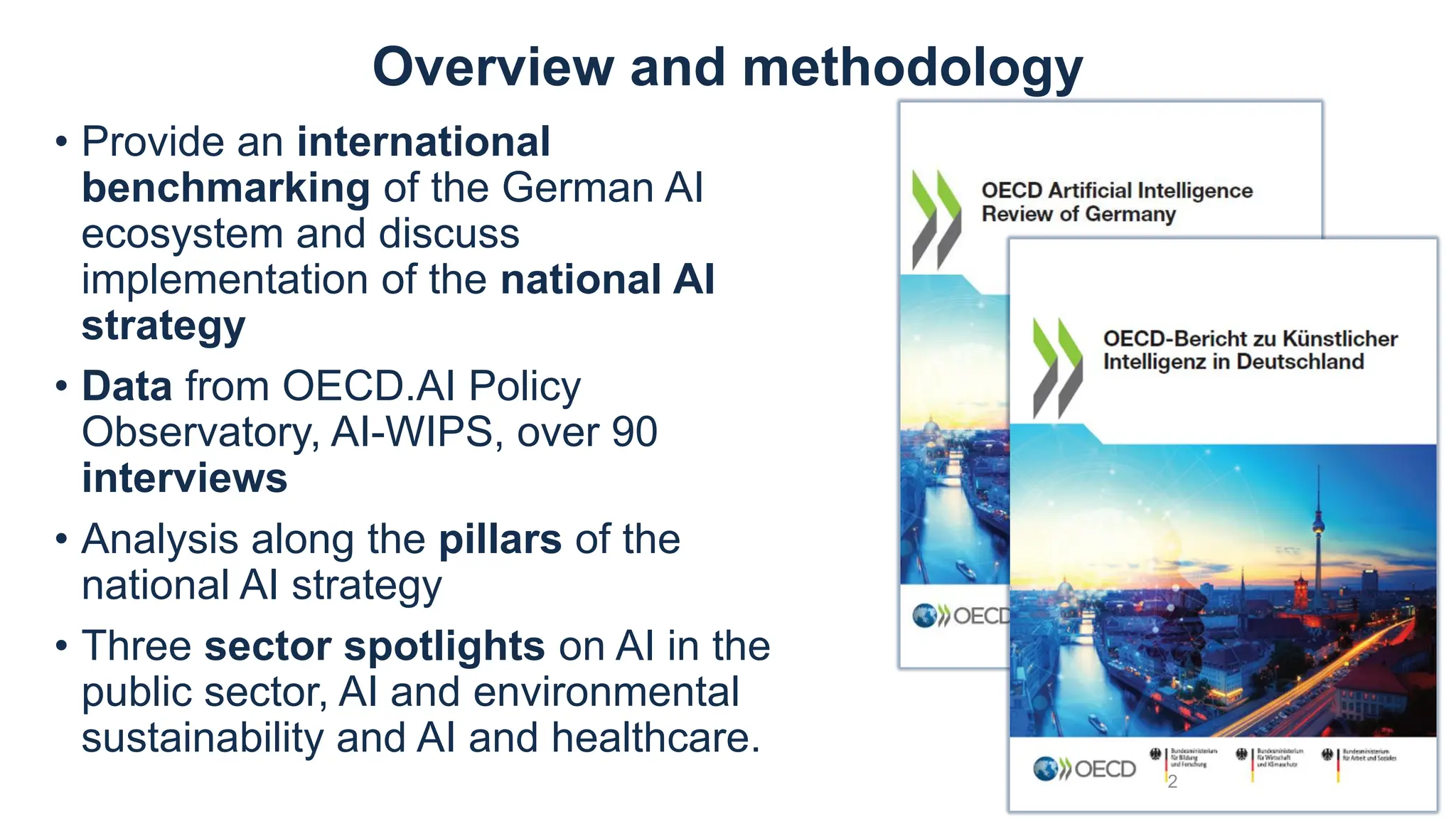
• Provide an international
benchmarking of the German AI
ecosystem and discuss
implementation of the national AI
strategy
• Data from OECD.AI Policy
Observatory, AI-WIPS, over 90
interviews
• Analysis along the pillars of the
national AI strategy
• Three sector spotlights on AI in the
public sector, AI and environmental
sustainability and AI and healthcare.
2
Where does Germany stand today in AI?
S W
O T
Germany’s AI
ecosystem
3
Strengths
4
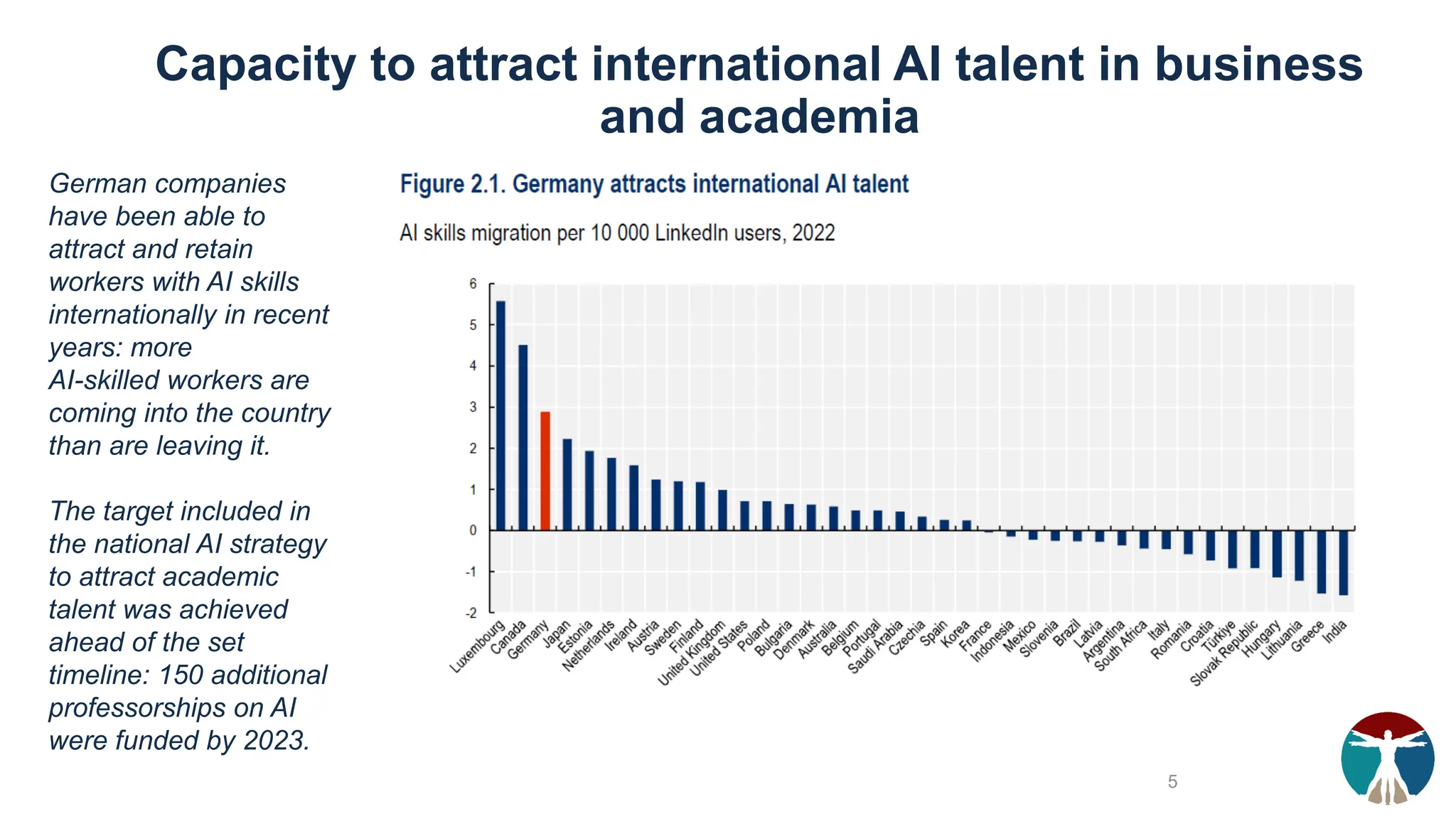
Capacity to attract international AI talent in business
and academia
German companies
have been able to
attract and retain
workers with AI skills
internationally in recent
years: more
AI-skilled workers are
coming into the country
than are leaving it.
The target included in
the national AI strategy
to attract academic
talent was achieved
ahead of the set
timeline: 150 additional
professorships on AI
were funded by 2023.
5
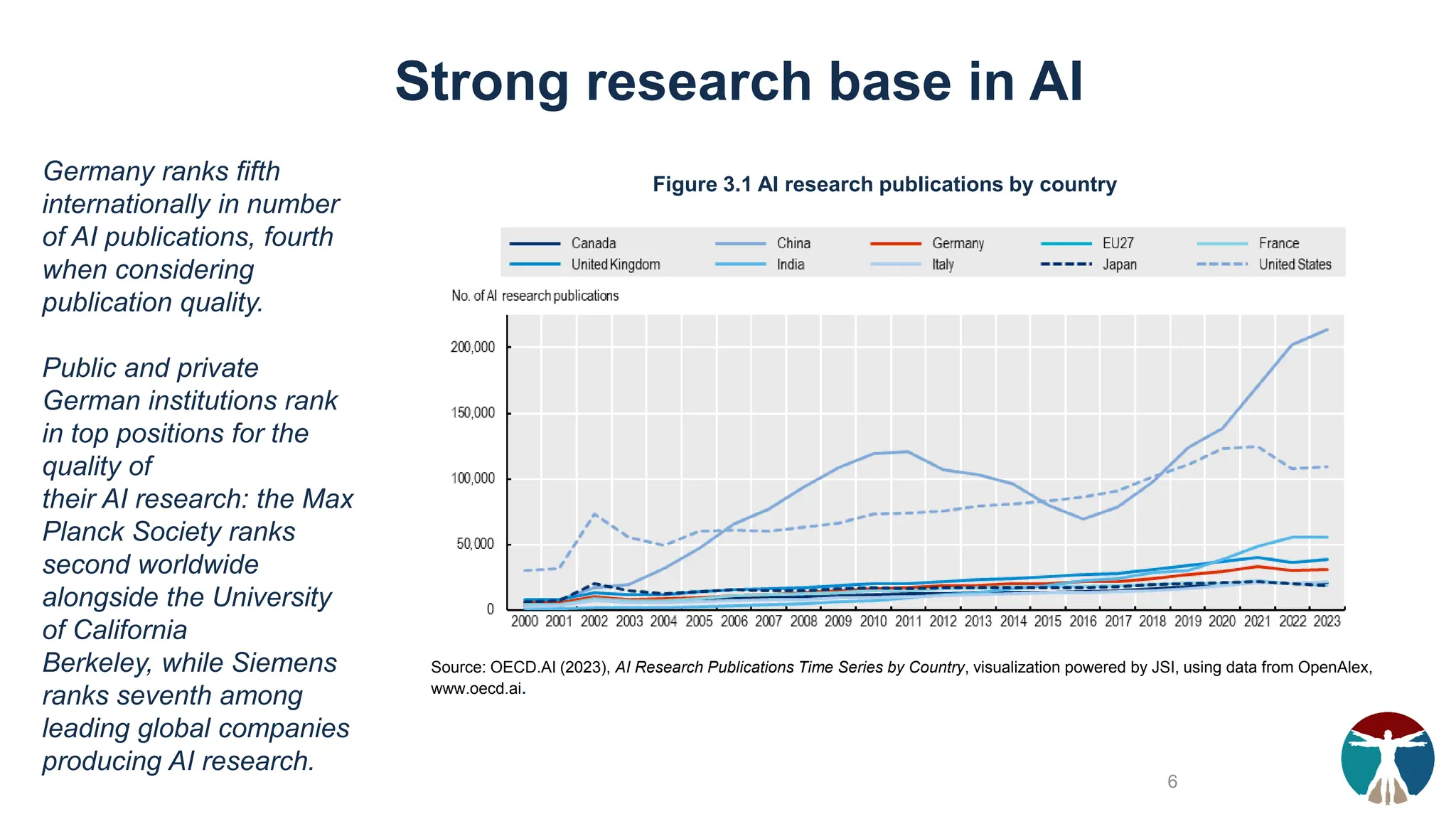
Strong research base in AI
Germany ranks fifth
internationally in number
of AI publications, fourth
when considering
publication quality.
Public and private
German institutions rank
in top positions for the
quality of
their AI research: the Max
Planck Society ranks
second worldwide
alongside the University
of California
Berkeley, while Siemens
ranks seventh among
leading global companies
producing AI research.
Source: OECD.AI (2023), AI Research Publications Time Series by Country, visualization powered by JSI, using data from OpenAlex,
www.oecd.ai.
Figure 3.1 AI research publications by country
6
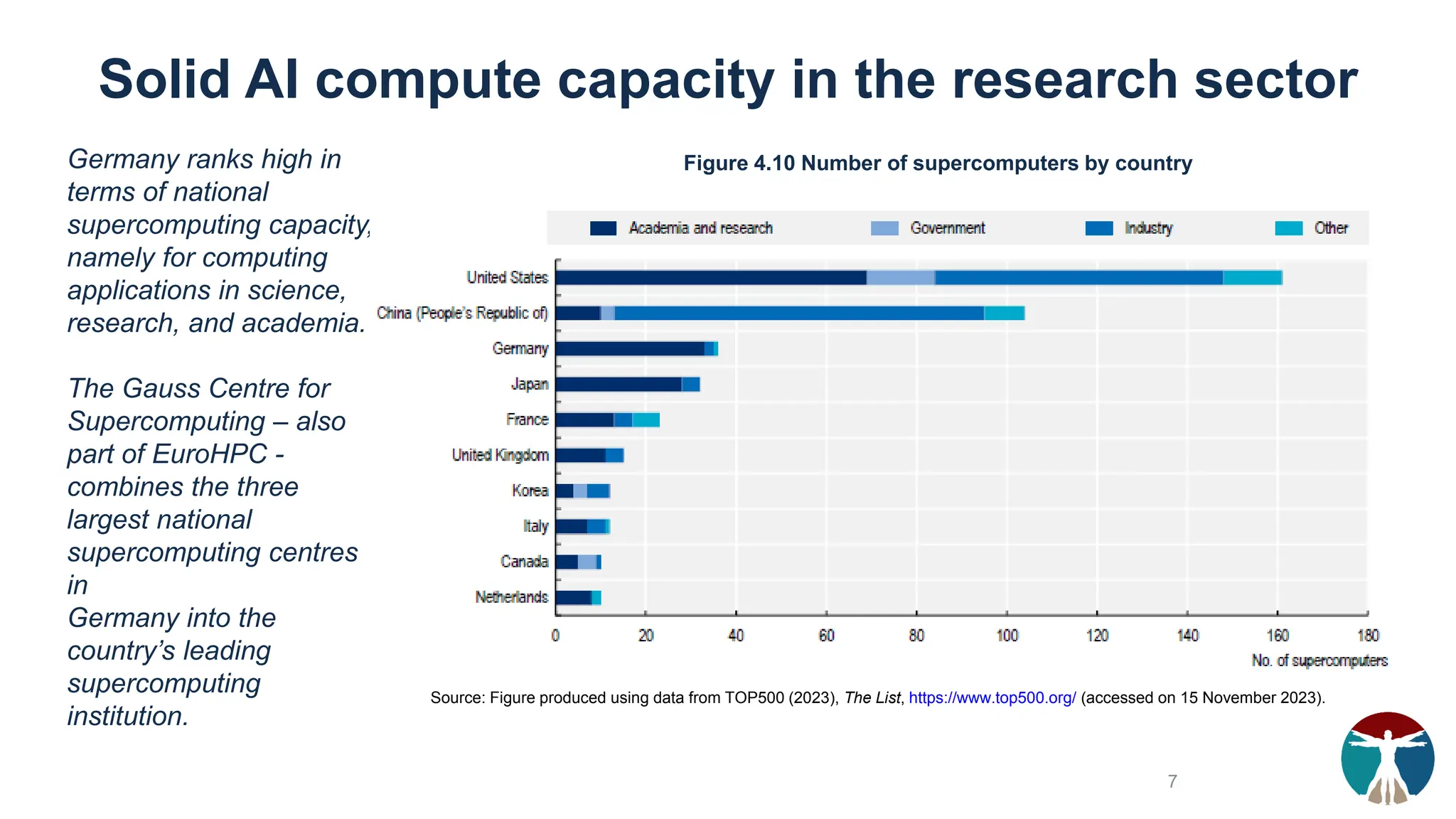
Solid AI compute capacity in the research sector
Source: Figure produced using data from TOP500 (2023), The List, https://www.top500.org/ (accessed on 15 November 2023).
Germany ranks high in
terms of national
supercomputing capacity,
namely for computing
applications in science,
research, and academia.
The Gauss Centre for
Supercomputing – also
part of EuroHPC -
combines the three
largest national
supercomputing centres
in
Germany into the
country’s leading
supercomputing
institution.
Figure 4.10 Number of supercomputers by country
7
Weaknesses
8
AI use by firms lower than in EU frontrunners
In 2023, 12% of
German firms used
AI, above the EU27
average of 8%, but
below EU countries at
the forefront in AI
adoption, including
for large firms.
Challenges reported
by firms for wider
adoption include skill
shortages, data
protection concerns,
low digitalisation, and
limited awareness of
AI use cases.
Source: Eurostat (2023[2]), Digital Economy and Society Database, https://ec.europa.eu/eurostat/databrowser/explore/all/science?lang=en&su
btheme=isoc&display=list&sort=category.
Figure 4.1 Firms using at least one AI system in EU selected countries
9
Limited availability of open government data
Germany lags
considerably in open
government data
availability and support
to data re-use, even
though data
accessibility is
relatively high.
Industrial data are also
reported to be largely
underutilized.
Source: OECD (2023[36]), 2023 OECD Open, Useful and Re-usable data (OURdata) Index: Results and key findings,
https://doi.org/10.1787/a37f51c3-en..
Figure 8.1 Open government data availability, re-use and accessibility in OECD countries
10
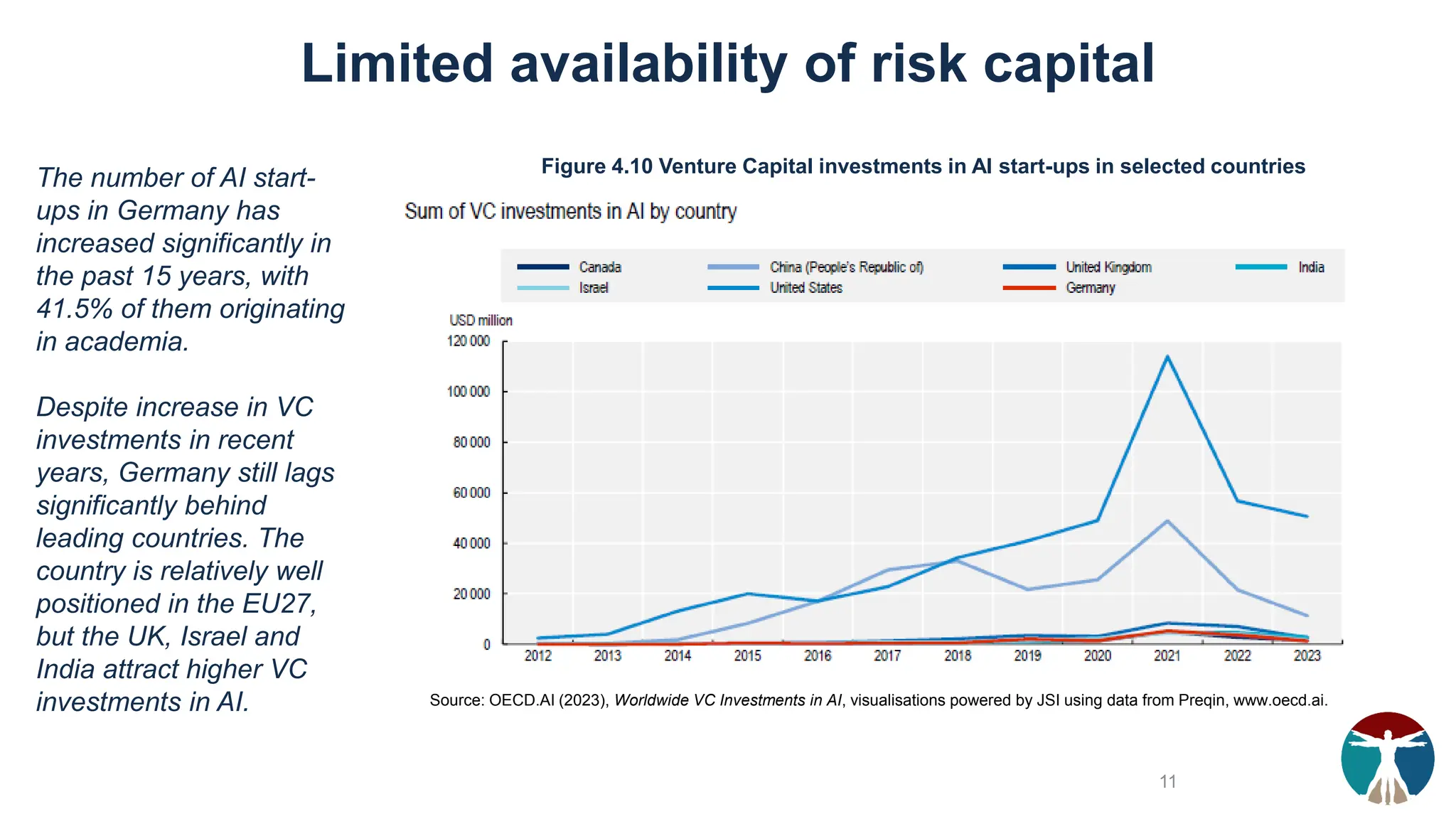
Limited availability of risk capital
The number of AI start-
ups in Germany has
increased significantly in
the past 15 years, with
41.5% of them originating
in academia.
Despite increase in VC
investments in recent
years, Germany still lags
significantly behind
leading countries. The
country is relatively well
positioned in the EU27,
but the UK, Israel and
India attract higher VC
investments in AI. Source: OECD.AI (2023), Worldwide VC Investments in AI, visualisations powered by JSI using data from Preqin, www.oecd.ai.
Figure 4.10 Venture Capital investments in AI start-ups in selected countries
11
Opportunities
12
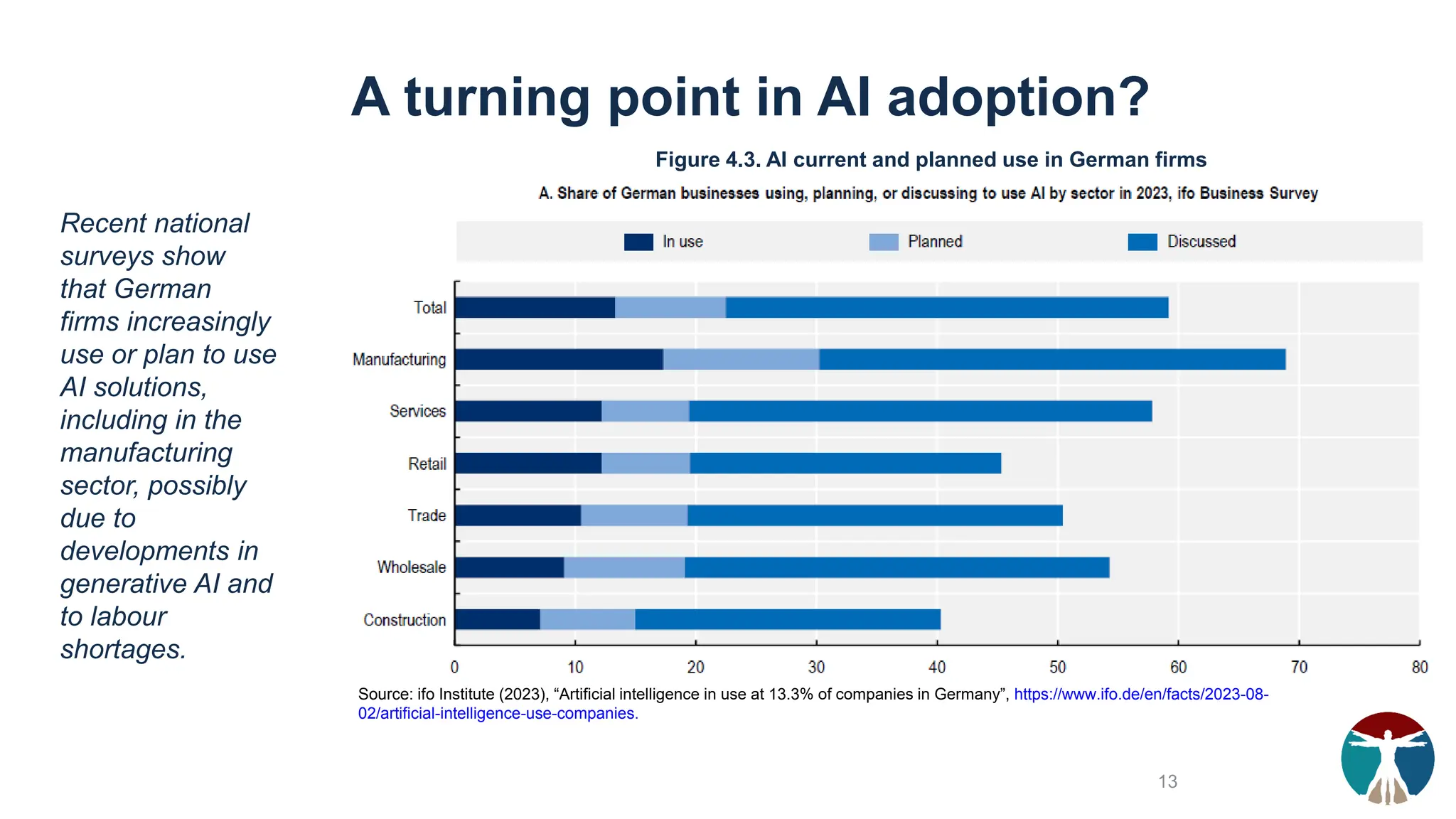
A turning point in AI adoption?
Source: ifo Institute (2023), “Artificial intelligence in use at 13.3% of companies in Germany”, https://www.ifo.de/en/facts/2023-08-
02/artificial-intelligence-use-companies.
Recent national
surveys show
that German
firms increasingly
use or plan to use
AI solutions,
including in the
manufacturing
sector, possibly
due to
developments in
generative AI and
to labour
shortages.
Figure 4.3. AI current and planned use in German firms
13
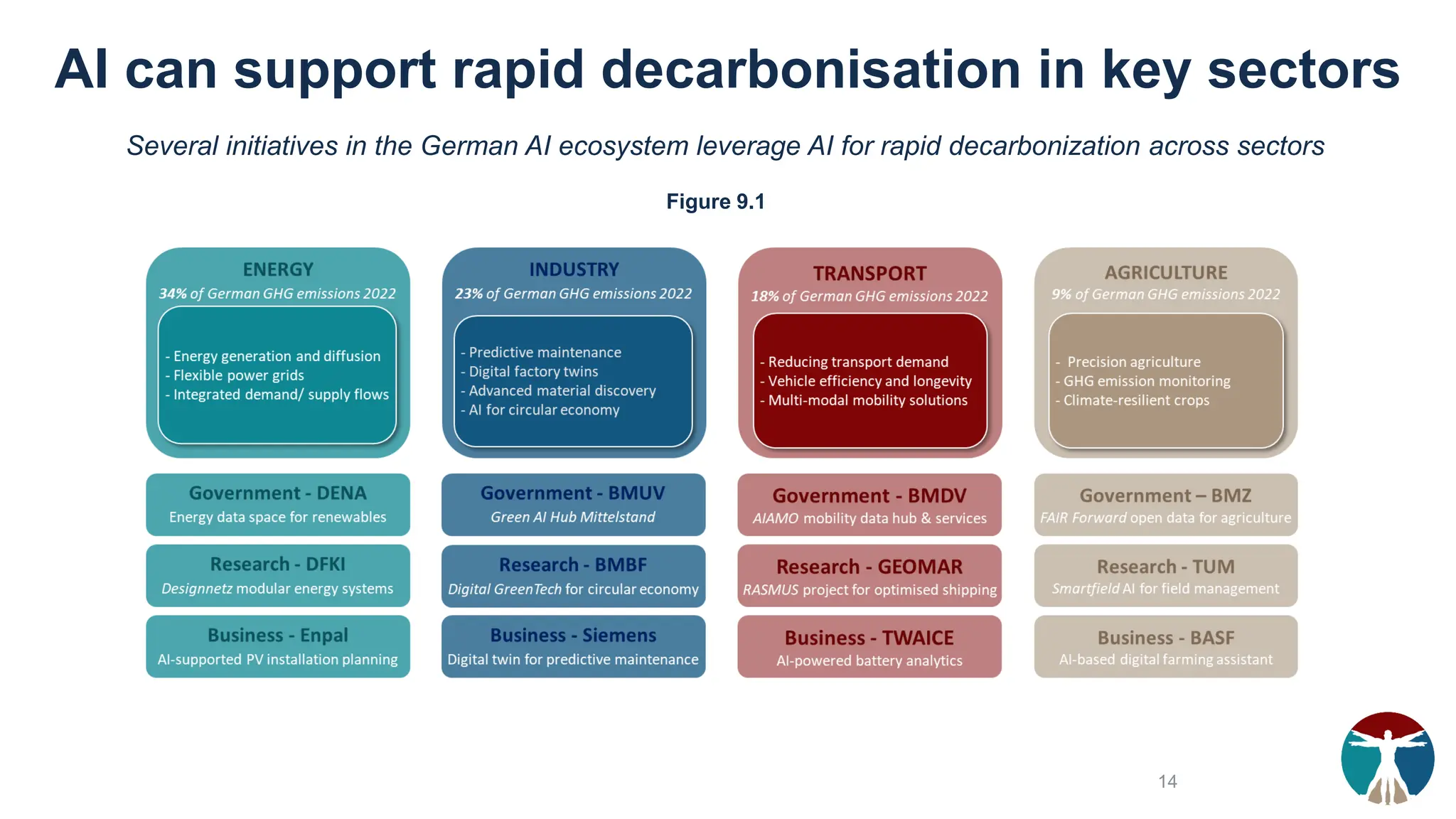
AI can support rapid decarbonisation in key sectors
Several initiatives in the German AI ecosystem leverage AI for rapid decarbonization across sectors
Figure 9.1
14
Threats
15
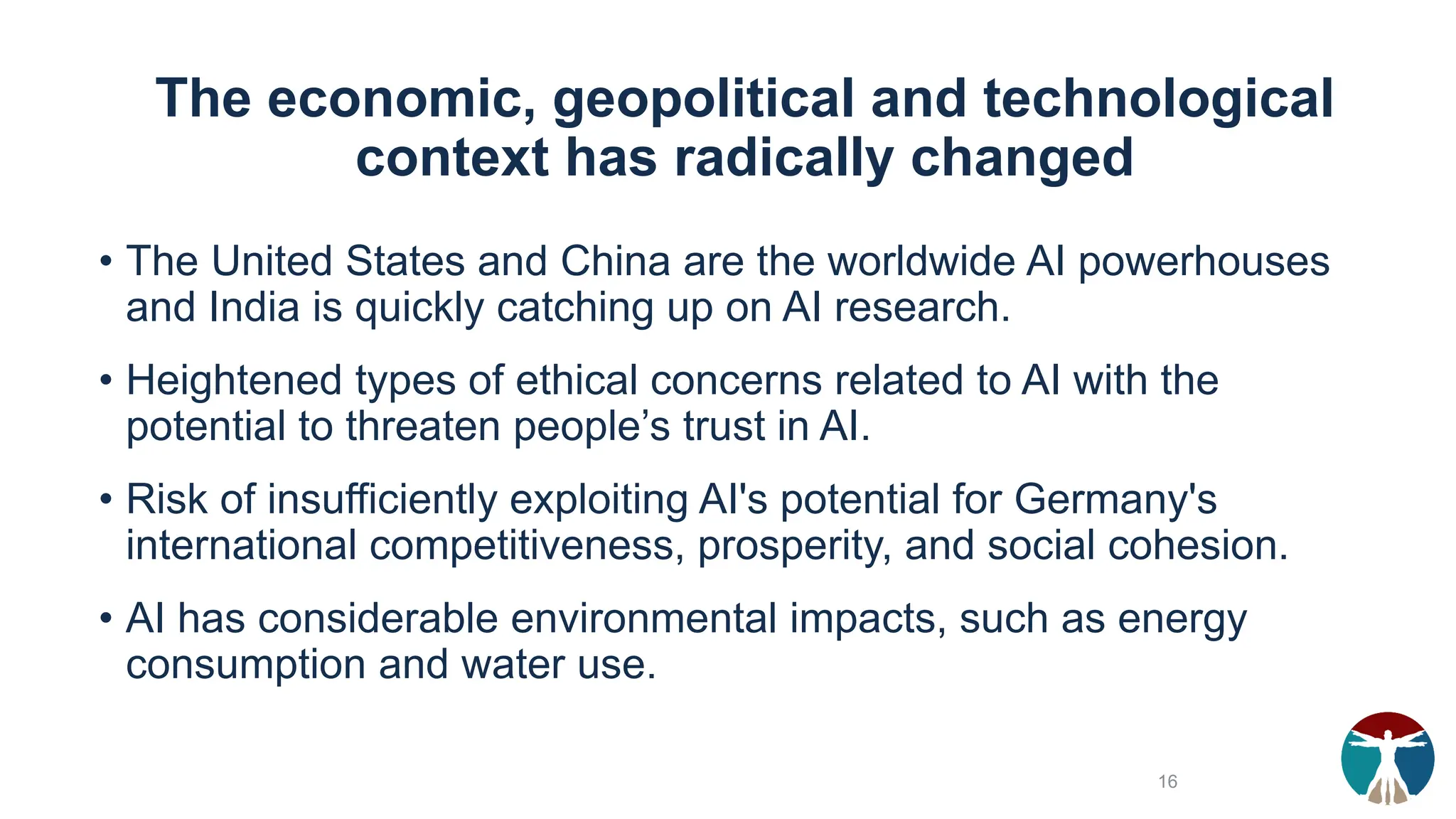
The economic, geopolitical and technological
context has radically changed
• The United States and China are the worldwide AI powerhouses
and India is quickly catching up on AI research.
• Heightened types of ethical concerns related to AI with the
potential to threaten people’s trust in AI.
• Risk of insufficiently exploiting AI's potential for Germany's
international competitiveness, prosperity, and social cohesion.
• AI has considerable environmental impacts, such as energy
consumption and water use.
16
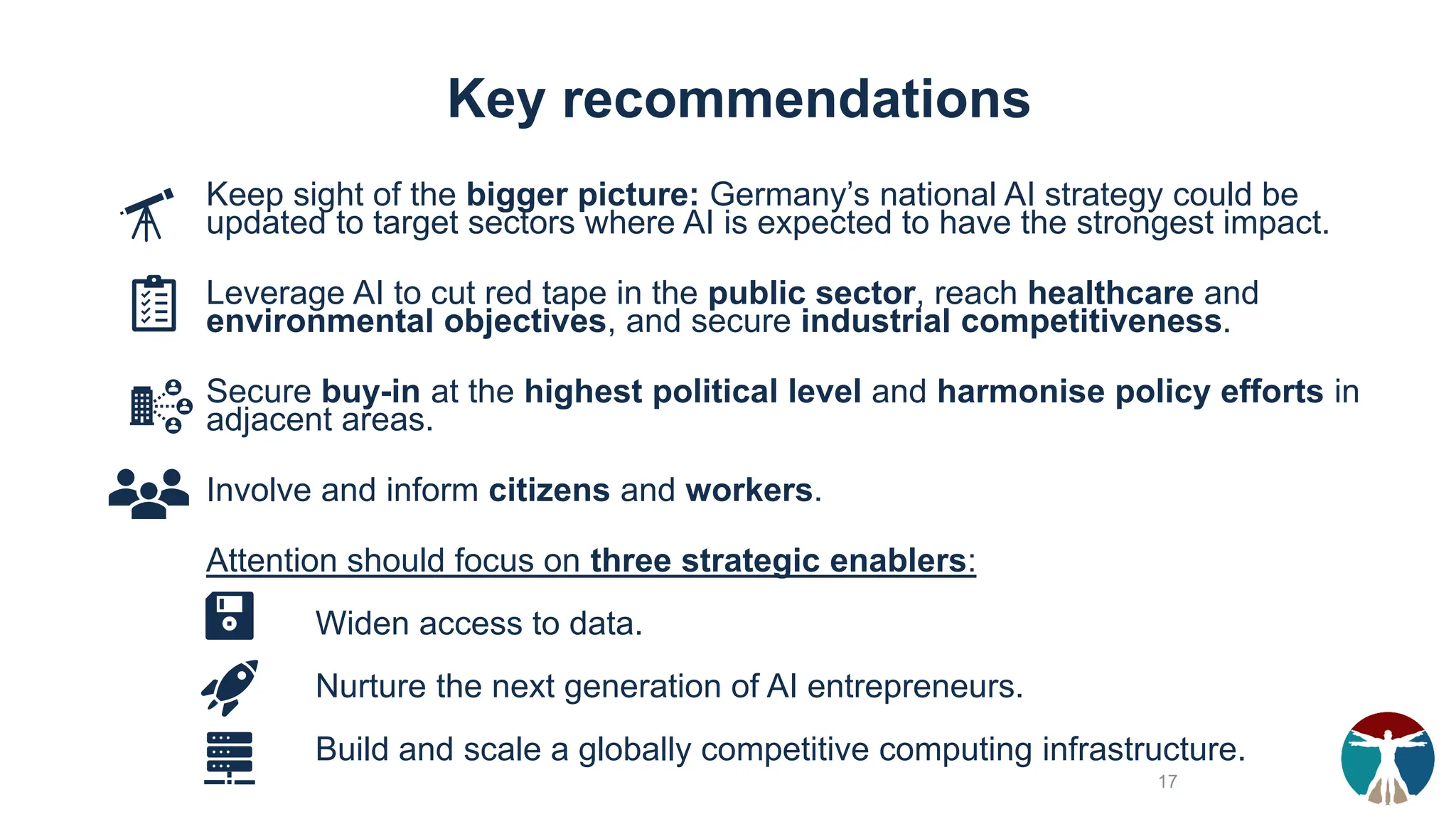
Key recommendations
Keep sight of the bigger picture: Germany’s national AI strategy could be
updated to target sectors where AI is expected to have the strongest impact.
Leverage AI to cut red tape in the public sector, reach healthcare and
environmental objectives, and secure industrial competitiveness.
Secure buy-in at the highest political level and harmonise policy efforts in
adjacent areas.
Involve and inform citizens and workers.
Attention should focus on three strategic enablers:
Widen access to data.
Nurture the next generation of AI entrepreneurs.
Build and scale a globally competitive computing infrastructure.
17
AI and the World of Work
18
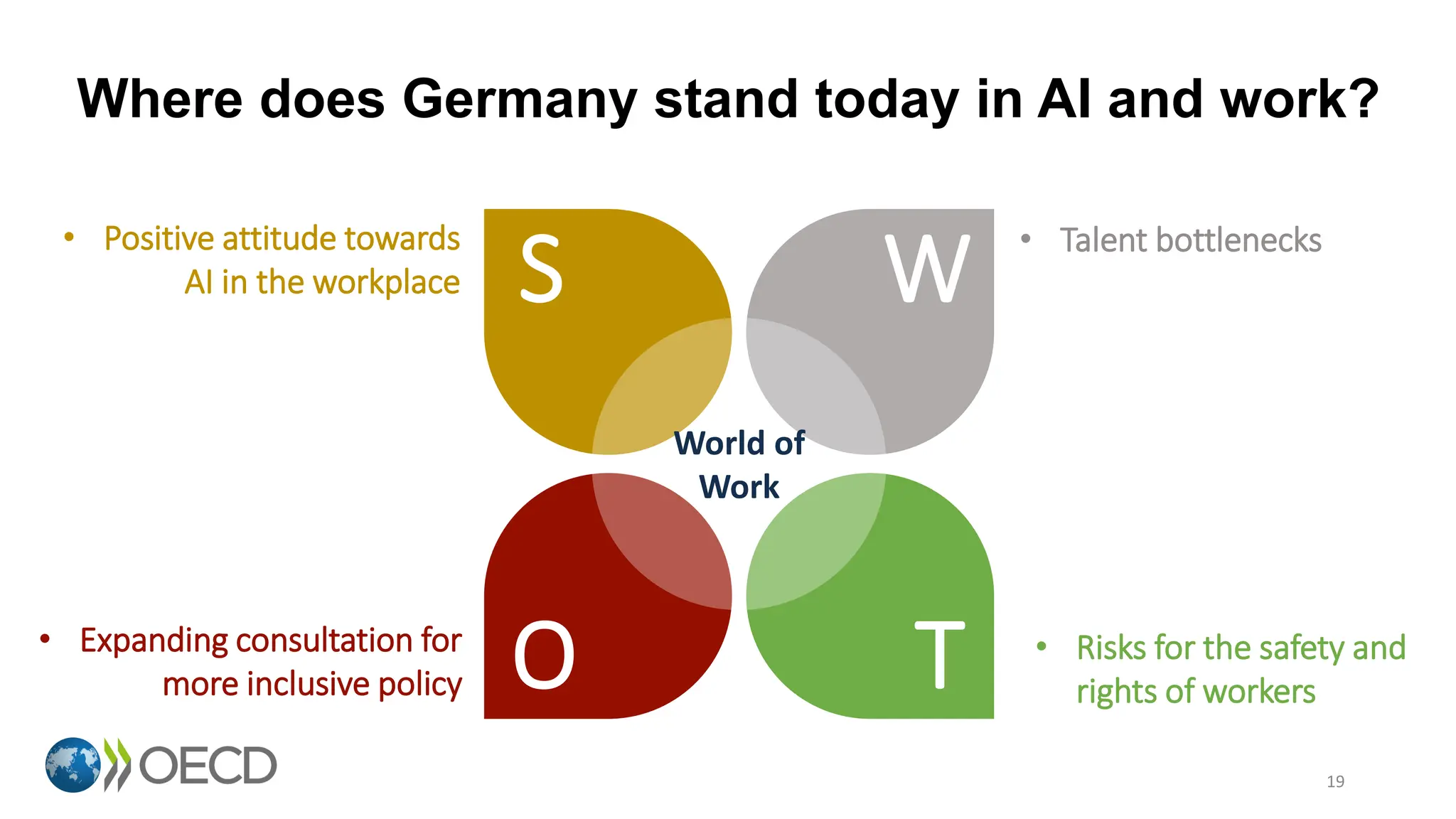
Where does Germany stand today in AI and work?
S W
O T
World of
Work
19
• Positive attitude towards
AI in the workplace
• Talent bottlenecks
• Expanding consultation for
more inclusive policy
• Risks for the safety and
rights of workers
Demand for AI skills in Germany is relatively low
but growing
20
0.0
0.1
0.2
0.3
0.4
0.5
0.6
0.7
0.8
0.9
Mean (2019 to 2022) 2019 2022
Percentage of online vacancies advertising positions requiring AI skills, by country
Notes: The figure shows the total number of online vacancies requiring AI skills relative to all vacancies advertised in a country. Vacancies requiring AI skills are vacancies in which at
least two generic AI skills or at least one AI-specific skill were required on generic and specific skills). Countries are sorted in descending order by the highest average share across
2019 to 2022 of vacancies requiring AI skills. Average refers to the average across countries with available data.
Source: Borgonovi, F. et al. (2023[13]), “Emerging Trends in AI Skill Demand Across 14 OECD Countries”, https://doi.org/10.1787/7c691b9a-en.
Note: Data based on the following question to employers : “I’m going to list a few potential barriers to the adoption of artificial intelligence. In each case, please tell me whether it has ever
been a barrier to adopting artificial intelligence in your company: High costs/Lack of skills to adopt artificial intelligence/Government regulation/Not convinced by the technology/Any other
barriers not previously mentioned”. Source: Lane, M., M. Williams and S. Broecke (2023[2]), “The impact of AI on the workplace: Main findings from the OECD AI surveys of employers and
workers”, https://doi.org/10.1787/ea0a0fe1-en
Lack of skills is a key barrier to AI adoption
21
0
10
20
30
40
50
60
70
UK France Canada Ireland Austria Germany USA
Lack of skills Cost Government Regulation Not convinced by technology
Share of employers who cite the following reasons as barriers to the adoption of AI, 2022
0
10
20
30
40
50
60
70
Productivity Satisfaction Management Health and
safety
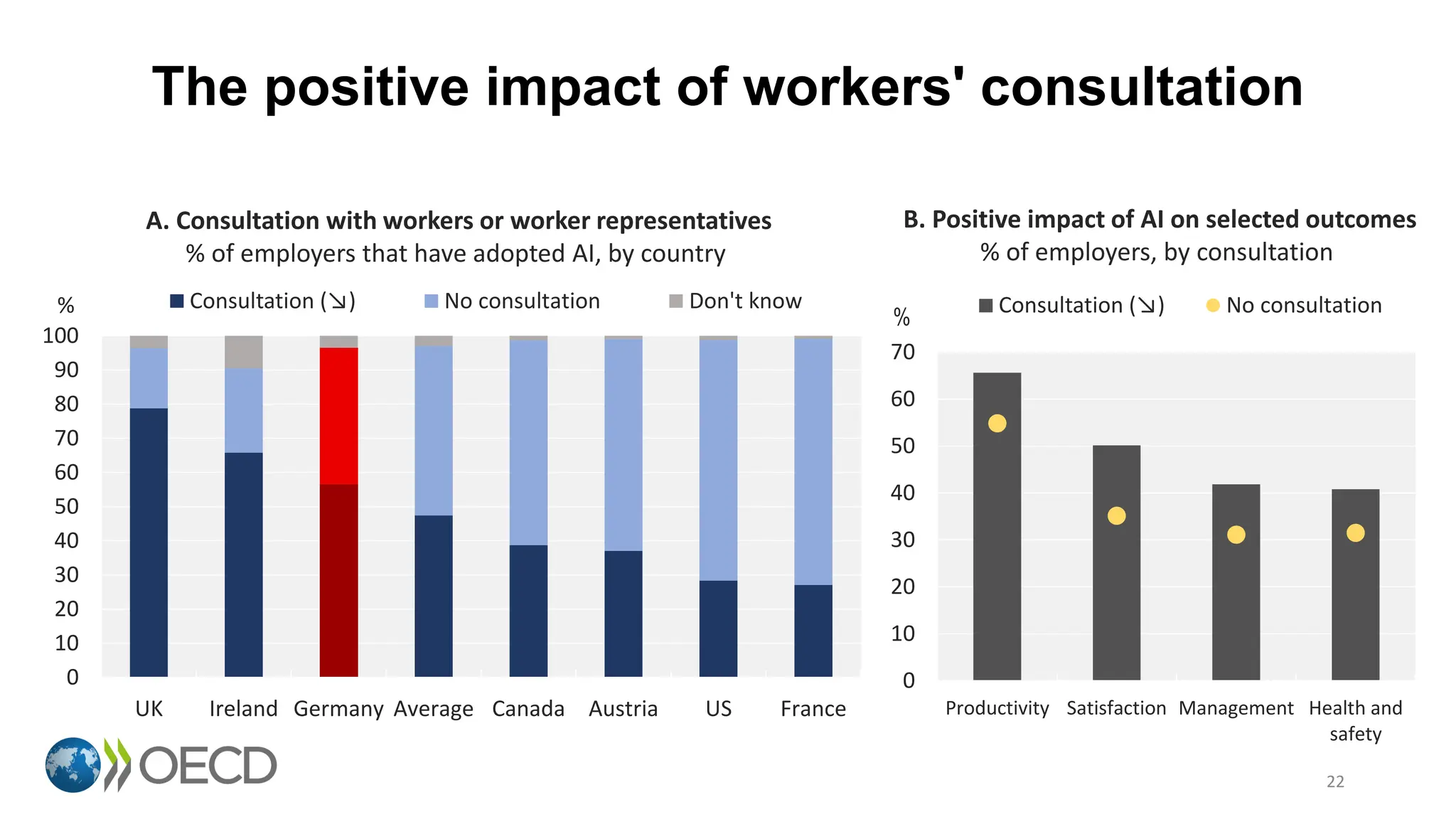
%
Consultation (↘) No consultation
B. Positive impact of AI on selected outcomes
% of employers, by consultation
0
10
20
30
40
50
60
70
80
90
100
UK Ireland Germany Average Canada Austria US France
% Consultation (↘) No consultation Don't know
A. Consultation with workers or worker representatives
% of employers that have adopted AI, by country
The positive impact of workers' consultation
22
Recommendations
23
• Strengthen information collection on the supply and demand of AI skills
• Promote education and training opportunities in AI through PES and career guidance
• Increase flexibility and modularity of adult learning
• Incentive for employers to provide AI-related training
• Encourage co-creation, consultation and co-operation with social partners, works councils
and employees
• Foster AI-related knowledge in the workplace and secure external expertise when relevant
• Monitor and fill policy gaps for a trustworthy use of AI in the workplace
Learn more
Read the report – English
Den Bericht lesen – Deutsch
https://oecd.ai/
Follow us on LinkedIn @OECD.AI
24

Presentation of the OECD Artificial Intelligence Review of Germany

  • 1.
    OECD Artificial Intelligence Reviewof Germany 11 June 2024 Jerry Sheehan, STI Director Stefano Scarpetta, ELS Director
  • 2.
    Overview and methodology •Provide an international benchmarking of the German AI ecosystem and discuss implementation of the national AI strategy • Data from OECD.AI Policy Observatory, AI-WIPS, over 90 interviews • Analysis along the pillars of the national AI strategy • Three sector spotlights on AI in the public sector, AI and environmental sustainability and AI and healthcare. 2
  • 3.
    Where does Germanystand today in AI? S W O T Germany’s AI ecosystem 3
  • 4.
  • 5.
    Capacity to attractinternational AI talent in business and academia German companies have been able to attract and retain workers with AI skills internationally in recent years: more AI-skilled workers are coming into the country than are leaving it. The target included in the national AI strategy to attract academic talent was achieved ahead of the set timeline: 150 additional professorships on AI were funded by 2023. 5
  • 6.
    Strong research basein AI Germany ranks fifth internationally in number of AI publications, fourth when considering publication quality. Public and private German institutions rank in top positions for the quality of their AI research: the Max Planck Society ranks second worldwide alongside the University of California Berkeley, while Siemens ranks seventh among leading global companies producing AI research. Source: OECD.AI (2023), AI Research Publications Time Series by Country, visualization powered by JSI, using data from OpenAlex, www.oecd.ai. Figure 3.1 AI research publications by country 6
  • 7.
    Solid AI computecapacity in the research sector Source: Figure produced using data from TOP500 (2023), The List, https://www.top500.org/ (accessed on 15 November 2023). Germany ranks high in terms of national supercomputing capacity, namely for computing applications in science, research, and academia. The Gauss Centre for Supercomputing – also part of EuroHPC - combines the three largest national supercomputing centres in Germany into the country’s leading supercomputing institution. Figure 4.10 Number of supercomputers by country 7
  • 8.
  • 9.
    AI use byfirms lower than in EU frontrunners In 2023, 12% of German firms used AI, above the EU27 average of 8%, but below EU countries at the forefront in AI adoption, including for large firms. Challenges reported by firms for wider adoption include skill shortages, data protection concerns, low digitalisation, and limited awareness of AI use cases. Source: Eurostat (2023[2]), Digital Economy and Society Database, https://ec.europa.eu/eurostat/databrowser/explore/all/science?lang=en&su btheme=isoc&display=list&sort=category. Figure 4.1 Firms using at least one AI system in EU selected countries 9
  • 10.
    Limited availability ofopen government data Germany lags considerably in open government data availability and support to data re-use, even though data accessibility is relatively high. Industrial data are also reported to be largely underutilized. Source: OECD (2023[36]), 2023 OECD Open, Useful and Re-usable data (OURdata) Index: Results and key findings, https://doi.org/10.1787/a37f51c3-en.. Figure 8.1 Open government data availability, re-use and accessibility in OECD countries 10
  • 11.
    Limited availability ofrisk capital The number of AI start- ups in Germany has increased significantly in the past 15 years, with 41.5% of them originating in academia. Despite increase in VC investments in recent years, Germany still lags significantly behind leading countries. The country is relatively well positioned in the EU27, but the UK, Israel and India attract higher VC investments in AI. Source: OECD.AI (2023), Worldwide VC Investments in AI, visualisations powered by JSI using data from Preqin, www.oecd.ai. Figure 4.10 Venture Capital investments in AI start-ups in selected countries 11
  • 12.
  • 13.
    A turning pointin AI adoption? Source: ifo Institute (2023), “Artificial intelligence in use at 13.3% of companies in Germany”, https://www.ifo.de/en/facts/2023-08- 02/artificial-intelligence-use-companies. Recent national surveys show that German firms increasingly use or plan to use AI solutions, including in the manufacturing sector, possibly due to developments in generative AI and to labour shortages. Figure 4.3. AI current and planned use in German firms 13
  • 14.
    AI can supportrapid decarbonisation in key sectors Several initiatives in the German AI ecosystem leverage AI for rapid decarbonization across sectors Figure 9.1 14
  • 15.
  • 16.
    The economic, geopoliticaland technological context has radically changed • The United States and China are the worldwide AI powerhouses and India is quickly catching up on AI research. • Heightened types of ethical concerns related to AI with the potential to threaten people’s trust in AI. • Risk of insufficiently exploiting AI's potential for Germany's international competitiveness, prosperity, and social cohesion. • AI has considerable environmental impacts, such as energy consumption and water use. 16
  • 17.
    Key recommendations Keep sightof the bigger picture: Germany’s national AI strategy could be updated to target sectors where AI is expected to have the strongest impact. Leverage AI to cut red tape in the public sector, reach healthcare and environmental objectives, and secure industrial competitiveness. Secure buy-in at the highest political level and harmonise policy efforts in adjacent areas. Involve and inform citizens and workers. Attention should focus on three strategic enablers: Widen access to data. Nurture the next generation of AI entrepreneurs. Build and scale a globally competitive computing infrastructure. 17
  • 18.
    AI and theWorld of Work 18
  • 19.
    Where does Germanystand today in AI and work? S W O T World of Work 19 • Positive attitude towards AI in the workplace • Talent bottlenecks • Expanding consultation for more inclusive policy • Risks for the safety and rights of workers
  • 20.
    Demand for AIskills in Germany is relatively low but growing 20 0.0 0.1 0.2 0.3 0.4 0.5 0.6 0.7 0.8 0.9 Mean (2019 to 2022) 2019 2022 Percentage of online vacancies advertising positions requiring AI skills, by country Notes: The figure shows the total number of online vacancies requiring AI skills relative to all vacancies advertised in a country. Vacancies requiring AI skills are vacancies in which at least two generic AI skills or at least one AI-specific skill were required on generic and specific skills). Countries are sorted in descending order by the highest average share across 2019 to 2022 of vacancies requiring AI skills. Average refers to the average across countries with available data. Source: Borgonovi, F. et al. (2023[13]), “Emerging Trends in AI Skill Demand Across 14 OECD Countries”, https://doi.org/10.1787/7c691b9a-en.
  • 21.
    Note: Data basedon the following question to employers : “I’m going to list a few potential barriers to the adoption of artificial intelligence. In each case, please tell me whether it has ever been a barrier to adopting artificial intelligence in your company: High costs/Lack of skills to adopt artificial intelligence/Government regulation/Not convinced by the technology/Any other barriers not previously mentioned”. Source: Lane, M., M. Williams and S. Broecke (2023[2]), “The impact of AI on the workplace: Main findings from the OECD AI surveys of employers and workers”, https://doi.org/10.1787/ea0a0fe1-en Lack of skills is a key barrier to AI adoption 21 0 10 20 30 40 50 60 70 UK France Canada Ireland Austria Germany USA Lack of skills Cost Government Regulation Not convinced by technology Share of employers who cite the following reasons as barriers to the adoption of AI, 2022
  • 22.
    0 10 20 30 40 50 60 70 Productivity Satisfaction ManagementHealth and safety % Consultation (↘) No consultation B. Positive impact of AI on selected outcomes % of employers, by consultation 0 10 20 30 40 50 60 70 80 90 100 UK Ireland Germany Average Canada Austria US France % Consultation (↘) No consultation Don't know A. Consultation with workers or worker representatives % of employers that have adopted AI, by country The positive impact of workers' consultation 22
  • 23.
    Recommendations 23 • Strengthen informationcollection on the supply and demand of AI skills • Promote education and training opportunities in AI through PES and career guidance • Increase flexibility and modularity of adult learning • Incentive for employers to provide AI-related training • Encourage co-creation, consultation and co-operation with social partners, works councils and employees • Foster AI-related knowledge in the workplace and secure external expertise when relevant • Monitor and fill policy gaps for a trustworthy use of AI in the workplace
  • 24.
    Learn more Read thereport – English Den Bericht lesen – Deutsch https://oecd.ai/ Follow us on LinkedIn @OECD.AI 24