International Research Journal of Engineering and Technology (IRJET) e-ISSN: 2395 -0056
Volume: 04 Issue: 01 | Jan -2017 www.irjet.net p-ISSN: 2395-0072
© 2017, IRJET | Impact Factor value: 5.181 | ISO 9001:2008 Certified Journal | Page 525
Fractal Image Compression By Range Block Classification
Miss. Gauri R. Desai1, Dr. Mahesh S. Chavan2
1 PG Student, Department of Electronics Engineering
KIT’s COE Kolhapur, Maharashtra, India
2 Professor, Department of Electronics Engineering
KIT’s COE Kolhapur, Maharashtra, India
---------------------------------------------------------------------***---------------------------------------------------------------------
Abstract - Image compression is a technique in which we
can store the huge amount of images, videos in less memory.
Which will helpful to increase storage capacity and
transmission performance, FortheFractalimagecompression
lossy compression is used. Mainly the fractal image
compression involves partitioning the images into Range
Blocks and Domain blocks. Then each range blocksearchesfor
best domain block by using particle swarm optimization
Algorithm.
Key Words: Fitness function, Fractal block coding, Image
data compression, Particle swarm optimization, reduced
domain block.
1. INTRODUCTION
Mainly there are two types of compression techniques
namely lossy and lossless data compression. Here in fractal
image compression lossy technique is used it gives the
constructed image is actually an approximation of input
image that is original image. Fractal image code is
implemented by Barnsley and Jacquin. The main advantage
of fractal image compression it gives high data compression
ratio, and less decompression time. But the main
disadvantage with this technique is large encoding time for
image data compression. At present in this paper we have
focused on enhancing the data compression ratio and
improves the image quality after the decompression.Fractal
means the geometrical figure obtained by partitioning the
original image into range blocks and domain blocks then
each range block finds the best matching domain block
iteratively by using particle swarm optimization algorithm.
Particle swarm optimization algorithm is mainly
population based algorithm. Introduced by Kennedy &
Eberhart in 1995. Inspired by social behavior of birds and
fish. All the particles searches for the best result.Ifoneofthe
particle finds the best results then remaining all will follow
the same. Every particle has own memory, it searches for
best matched range block with domain block iteratively by
self-similar property.
2. PARTICLE SWARM OPTIMIZATION ALGORITHM
Particle swarm optimization algorithm is population based
algorithm introduced by KennedyandEberhartin1995.PSO
idea emerged from group of birds, schools of fish, or swarm
of bees. As it is population based method solves various
function optimization problems. When the swarm of birds
searches for food in different places ,if anyone has found the
food then remaining all will follow to that bird for food this
idea is implemented for particle swarm optimization here
swarm of birds means the swarm of particles, each particle
has its own position and velocity. Individual particle
searches for best optimizationsolutionthatiscalledposition
best solution (pbest). Again the particle update its position
and velocity for best results. Particle every time update its
position and velocity iterativelyandfinal optimization result
called as Gbest.
Fig- 1: PSO Algorithm
International Research Journal of Engineering and Technology (IRJET) e-ISSN: 2395 -0056
Volume: 04 Issue: 01 | Jan -2017 www.irjet.net p-ISSN: 2395-0072
© 2017, IRJET | Impact Factor value: 5.181 | ISO 9001:2008 Certified Journal | Page 526
3. IMPLEMENTATION OF FRACTAL IMAGE
COMPRESSION USING PSO ALGORITHM
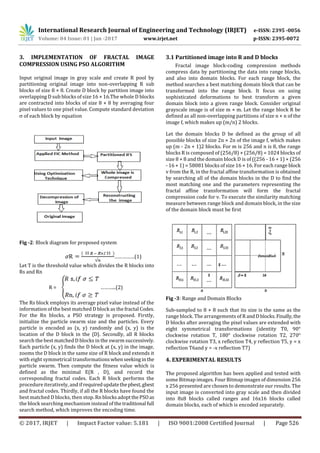
Input original image in gray scale and create R pool by
partitioning original image into non-overlapping R sub
blocks of size 8 × 8. Create D block by partition image into
overlapping D sub blocks of size 16 × 16.The whole D blocks
are contracted into blocks of size 8 × 8 by averaging four
pixel values to one pixel value. Compute standard deviation
 of each block by equation
Fig -2: Block diagram for proposed system
……………(1)
Let T is the threshold value which divides the R blocks into
Rs and Rn
R = ………...(2)
The Rs block employs its average pixel value instead of the
information of the best matched D block as the fractal Codes.
For the Rn blocks, a PSO strategy is proposed. Firstly,
initialize the particle swarm size and the particles. Every
particle is encoded as (x, y) randomly and (x, y) is the
location of the D block in the {D}. Secondly, all R blocks
search the best matched D blocks in the swarm successively.
Each particle (x, y) finds the D block at (x, y) in the image,
zooms the D block in the same size of R block and extends it
with eight symmetrical transformationswhenseekinginthe
particle swarm. Then compute the fitness value which is
defined as the minimal E(R , D), and record the
corresponding fractal codes. Each R block performs the
procedure iteratively, and if requiredupdatethepbest,gbest
and fractal codes. Thirdly, if all the R blocks have found the
best matched D blocks, then stop. Rn blocksadoptthePSOas
the block searching mechanism instead ofthetraditional full
search method, which improves the encoding time.
3.1 Partitioned image into R and D blocks
Fractal image block-coding compression methods
compress data by partitioning the data into range blocks,
and also into domain blocks. For each range block, the
method searches a best matching domain block that can be
transformed into the range block. It focus on using
sophisticated deformations to best transform a given
domain block into a given range block. Consider original
grayscale image is of size m × m. Let the range block R be
defined as all non-overlapping partitions of size n × n of the
image f, which makes up (m/n) 2 blocks.
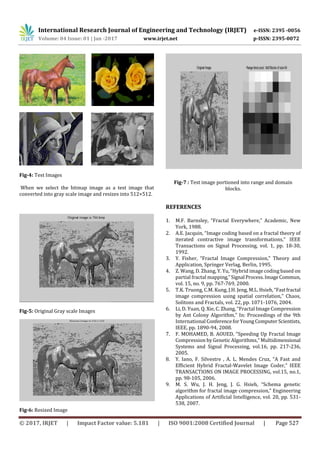
Let the domain blocks D be defined as the group of all
possible blocks of size 2n × 2n of the image f, which makes
up (m - 2n + 1)2 blocks. For m is 256 and n is 8, the range
blocks R is composed of (256/8) × (256/8) = 1024 blocks of
size 8 × 8 and the domain block D is of ((256 - 16 + 1) × (256
- 16 + 1) = 58081 blocks of size 16 × 16. For each range block
v from the R, in the fractal affine transformation is obtained
by searching all of the domain blocks in the D to find the
most matching one and the parameters representing the
fractal affine transformation will form the fractal
compression code for v. To execute the similarity matching
measure between range block and domain block, in the size
of the domain block must be first
Fig -3: Range and Domain Blocks
Sub-sampled to 8 × 8 such that its size is the same as the
range block. The arrangements of R andDblocks.Finally,the
D blocks after averaging the pixel values are extended with
eight symmetrical transformations (identity T0, 90°
clockwise rotation T, 180° clockwise rotation T2, 270°
clockwise rotation T3, x reflection T4, y reflection T5, y = x
reflection T6and y = -x reflection T7)
4. EXPERIMENTAL RESULTS
The proposed algorithm has been applied and tested with
some Bitmap images. Four Bitmap images of dimension 256
x 256 presented are chosen to demonstrate our results. The
input image is converted into gray scale and then divided
into 8x8 blocks called ranges and 16x16 blocks called
domain blocks, each of which is encoded separately.
International Research Journal of Engineering and Technology (IRJET) e-ISSN: 2395 -0056
Volume: 04 Issue: 01 | Jan -2017 www.irjet.net p-ISSN: 2395-0072
© 2017, IRJET | Impact Factor value: 5.181 | ISO 9001:2008 Certified Journal | Page 527
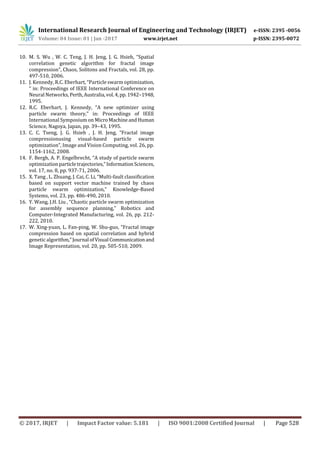
Fig-4: Test Images
When we select the bitmap image as a test image that
converted into gray scale image and resizes into 512×512.
Fig-5: Original Gray scale Images
Fig-6: Resized Image
Fig-7 : Test image portioned into range and domain
blocks.
REFERENCES
1. M.F. Barnsley, “Fractal Everywhere,” Academic, New
York, 1988.
2. A.E. Jacquin, “Image coding based on a fractal theory of
iterated contractive image transformations,” IEEE
Transactions on Signal Processing, vol. 1, pp. 18-30,
1992.
3. Y. Fisher, “Fractal Image Compression,” Theory and
Application, Springer Verlag, Berlin, 1995.
4. Z. Wang, D. Zhang, Y. Yu, “Hybrid image coding based on
partial fractal mapping,”Signal Process.ImageCommun,
vol. 15, no. 9, pp. 767-769, 2000.
5. T.K. Truong, C.M. Kung, J.H. Jeng, M.L. Hsieh,“Fastfractal
image compression using spatial correlation,” Chaos,
Solitons and Fractals, vol. 22, pp. 1071-1076, 2004.
6. Li, D. Yuan, Q. Xie, C. Zhang, “Fractal Image Compression
by Ant Colony Algorithm,” In: Proceedings of the 9th
International Conferencefor YoungComputer Scientists,
IEEE, pp. 1890-94, 2008.
7. F. MOHAMED, B. AOUED, “Speeding Up Fractal Image
Compression by Genetic Algorithms,” Multidimensional
Systems and Signal Processing, vol.16, pp. 217-236,
2005.
8. Y. Iano, F. Silvestre , A. L. Mendes Cruz, “A Fast and
Efficient Hybrid Fractal-Wavelet Image Coder,” IEEE
TRANSACTIONS ON IMAGE PROCESSING, vol.15, no.1,
pp. 98-105, 2006.
9. M. S. Wu, J. H. Jeng, J. G. Hsieh, “Schema genetic
algorithm for fractal image compression,” Engineering
Applications of Artificial Intelligence, vol. 20, pp. 531-
538, 2007.
International Research Journal of Engineering and Technology (IRJET) e-ISSN: 2395 -0056
Volume: 04 Issue: 01 | Jan -2017 www.irjet.net p-ISSN: 2395-0072
© 2017, IRJET | Impact Factor value: 5.181 | ISO 9001:2008 Certified Journal | Page 528
10. M. S. Wu , W. C. Teng, J. H. Jeng, J. G. Hsieh, “Spatial
correlation genetic algorithm for fractal image
compression”, Chaos, Solitons and Fractals, vol. 28, pp.
497-510, 2006.
11. J. Kennedy, R.C. Eberhart, “Particle swarm optimization,
“ in: Proceedings of IEEE International Conference on
Neural Networks,Perth,Australia,vol.4,pp.1942–1948,
1995.
12. R.C. Eberhart, J. Kennedy, “A new optimizer using
particle swarm theory,” in: Proceedings of IEEE
International Symposium on MicroMachineandHuman
Science, Nagoya, Japan, pp. 39–43, 1995.
13. C. C. Tseng, J. G. Hsieh , J. H. Jeng, “Fractal image
compressionusing visual-based particle swarm
optimization”, Image and Vision Computing, vol. 26, pp.
1154-1162, 2008.
14. F. Bergh, A. P. Engelbrecht, “A study of particle swarm
optimizationparticletrajectories,”InformationSciences,
vol. 17, no. 8, pp. 937-71, 2006.
15. X. Tang , L. Zhuang, J. Cai, C. Li, “Multi-fault classification
based on support vector machine trained by chaos
particle swarm optimization,” Knowledge-Based
Systems, vol. 23, pp. 486-490, 2010.
16. Y. Wang, J.H. Liu , “Chaotic particle swarm optimization
for assembly sequence planning,” Robotics and
Computer-Integrated Manufacturing, vol. 26, pp. 212-
222, 2010.
17. W. Xing-yuan, L. Fan-ping, W. Shu-guo, “Fractal image
compression based on spatial correlation and hybrid
genetic algorithm,”Journal ofVisual Communicationand
Image Representation, vol. 20, pp. 505-510, 2009.

Fractal Image Compression By Range Block Classification

  • 1.
    International Research Journalof Engineering and Technology (IRJET) e-ISSN: 2395 -0056 Volume: 04 Issue: 01 | Jan -2017 www.irjet.net p-ISSN: 2395-0072 © 2017, IRJET | Impact Factor value: 5.181 | ISO 9001:2008 Certified Journal | Page 525 Fractal Image Compression By Range Block Classification Miss. Gauri R. Desai1, Dr. Mahesh S. Chavan2 1 PG Student, Department of Electronics Engineering KIT’s COE Kolhapur, Maharashtra, India 2 Professor, Department of Electronics Engineering KIT’s COE Kolhapur, Maharashtra, India ---------------------------------------------------------------------***--------------------------------------------------------------------- Abstract - Image compression is a technique in which we can store the huge amount of images, videos in less memory. Which will helpful to increase storage capacity and transmission performance, FortheFractalimagecompression lossy compression is used. Mainly the fractal image compression involves partitioning the images into Range Blocks and Domain blocks. Then each range blocksearchesfor best domain block by using particle swarm optimization Algorithm. Key Words: Fitness function, Fractal block coding, Image data compression, Particle swarm optimization, reduced domain block. 1. INTRODUCTION Mainly there are two types of compression techniques namely lossy and lossless data compression. Here in fractal image compression lossy technique is used it gives the constructed image is actually an approximation of input image that is original image. Fractal image code is implemented by Barnsley and Jacquin. The main advantage of fractal image compression it gives high data compression ratio, and less decompression time. But the main disadvantage with this technique is large encoding time for image data compression. At present in this paper we have focused on enhancing the data compression ratio and improves the image quality after the decompression.Fractal means the geometrical figure obtained by partitioning the original image into range blocks and domain blocks then each range block finds the best matching domain block iteratively by using particle swarm optimization algorithm. Particle swarm optimization algorithm is mainly population based algorithm. Introduced by Kennedy & Eberhart in 1995. Inspired by social behavior of birds and fish. All the particles searches for the best result.Ifoneofthe particle finds the best results then remaining all will follow the same. Every particle has own memory, it searches for best matched range block with domain block iteratively by self-similar property. 2. PARTICLE SWARM OPTIMIZATION ALGORITHM Particle swarm optimization algorithm is population based algorithm introduced by KennedyandEberhartin1995.PSO idea emerged from group of birds, schools of fish, or swarm of bees. As it is population based method solves various function optimization problems. When the swarm of birds searches for food in different places ,if anyone has found the food then remaining all will follow to that bird for food this idea is implemented for particle swarm optimization here swarm of birds means the swarm of particles, each particle has its own position and velocity. Individual particle searches for best optimizationsolutionthatiscalledposition best solution (pbest). Again the particle update its position and velocity for best results. Particle every time update its position and velocity iterativelyandfinal optimization result called as Gbest. Fig- 1: PSO Algorithm
  • 2.
    International Research Journalof Engineering and Technology (IRJET) e-ISSN: 2395 -0056 Volume: 04 Issue: 01 | Jan -2017 www.irjet.net p-ISSN: 2395-0072 © 2017, IRJET | Impact Factor value: 5.181 | ISO 9001:2008 Certified Journal | Page 526 3. IMPLEMENTATION OF FRACTAL IMAGE COMPRESSION USING PSO ALGORITHM Input original image in gray scale and create R pool by partitioning original image into non-overlapping R sub blocks of size 8 × 8. Create D block by partition image into overlapping D sub blocks of size 16 × 16.The whole D blocks are contracted into blocks of size 8 × 8 by averaging four pixel values to one pixel value. Compute standard deviation  of each block by equation Fig -2: Block diagram for proposed system ……………(1) Let T is the threshold value which divides the R blocks into Rs and Rn R = ………...(2) The Rs block employs its average pixel value instead of the information of the best matched D block as the fractal Codes. For the Rn blocks, a PSO strategy is proposed. Firstly, initialize the particle swarm size and the particles. Every particle is encoded as (x, y) randomly and (x, y) is the location of the D block in the {D}. Secondly, all R blocks search the best matched D blocks in the swarm successively. Each particle (x, y) finds the D block at (x, y) in the image, zooms the D block in the same size of R block and extends it with eight symmetrical transformationswhenseekinginthe particle swarm. Then compute the fitness value which is defined as the minimal E(R , D), and record the corresponding fractal codes. Each R block performs the procedure iteratively, and if requiredupdatethepbest,gbest and fractal codes. Thirdly, if all the R blocks have found the best matched D blocks, then stop. Rn blocksadoptthePSOas the block searching mechanism instead ofthetraditional full search method, which improves the encoding time. 3.1 Partitioned image into R and D blocks Fractal image block-coding compression methods compress data by partitioning the data into range blocks, and also into domain blocks. For each range block, the method searches a best matching domain block that can be transformed into the range block. It focus on using sophisticated deformations to best transform a given domain block into a given range block. Consider original grayscale image is of size m × m. Let the range block R be defined as all non-overlapping partitions of size n × n of the image f, which makes up (m/n) 2 blocks. Let the domain blocks D be defined as the group of all possible blocks of size 2n × 2n of the image f, which makes up (m - 2n + 1)2 blocks. For m is 256 and n is 8, the range blocks R is composed of (256/8) × (256/8) = 1024 blocks of size 8 × 8 and the domain block D is of ((256 - 16 + 1) × (256 - 16 + 1) = 58081 blocks of size 16 × 16. For each range block v from the R, in the fractal affine transformation is obtained by searching all of the domain blocks in the D to find the most matching one and the parameters representing the fractal affine transformation will form the fractal compression code for v. To execute the similarity matching measure between range block and domain block, in the size of the domain block must be first Fig -3: Range and Domain Blocks Sub-sampled to 8 × 8 such that its size is the same as the range block. The arrangements of R andDblocks.Finally,the D blocks after averaging the pixel values are extended with eight symmetrical transformations (identity T0, 90° clockwise rotation T, 180° clockwise rotation T2, 270° clockwise rotation T3, x reflection T4, y reflection T5, y = x reflection T6and y = -x reflection T7) 4. EXPERIMENTAL RESULTS The proposed algorithm has been applied and tested with some Bitmap images. Four Bitmap images of dimension 256 x 256 presented are chosen to demonstrate our results. The input image is converted into gray scale and then divided into 8x8 blocks called ranges and 16x16 blocks called domain blocks, each of which is encoded separately.
  • 3.
    International Research Journalof Engineering and Technology (IRJET) e-ISSN: 2395 -0056 Volume: 04 Issue: 01 | Jan -2017 www.irjet.net p-ISSN: 2395-0072 © 2017, IRJET | Impact Factor value: 5.181 | ISO 9001:2008 Certified Journal | Page 527 Fig-4: Test Images When we select the bitmap image as a test image that converted into gray scale image and resizes into 512×512. Fig-5: Original Gray scale Images Fig-6: Resized Image Fig-7 : Test image portioned into range and domain blocks. REFERENCES 1. M.F. Barnsley, “Fractal Everywhere,” Academic, New York, 1988. 2. A.E. Jacquin, “Image coding based on a fractal theory of iterated contractive image transformations,” IEEE Transactions on Signal Processing, vol. 1, pp. 18-30, 1992. 3. Y. Fisher, “Fractal Image Compression,” Theory and Application, Springer Verlag, Berlin, 1995. 4. Z. Wang, D. Zhang, Y. Yu, “Hybrid image coding based on partial fractal mapping,”Signal Process.ImageCommun, vol. 15, no. 9, pp. 767-769, 2000. 5. T.K. Truong, C.M. Kung, J.H. Jeng, M.L. Hsieh,“Fastfractal image compression using spatial correlation,” Chaos, Solitons and Fractals, vol. 22, pp. 1071-1076, 2004. 6. Li, D. Yuan, Q. Xie, C. Zhang, “Fractal Image Compression by Ant Colony Algorithm,” In: Proceedings of the 9th International Conferencefor YoungComputer Scientists, IEEE, pp. 1890-94, 2008. 7. F. MOHAMED, B. AOUED, “Speeding Up Fractal Image Compression by Genetic Algorithms,” Multidimensional Systems and Signal Processing, vol.16, pp. 217-236, 2005. 8. Y. Iano, F. Silvestre , A. L. Mendes Cruz, “A Fast and Efficient Hybrid Fractal-Wavelet Image Coder,” IEEE TRANSACTIONS ON IMAGE PROCESSING, vol.15, no.1, pp. 98-105, 2006. 9. M. S. Wu, J. H. Jeng, J. G. Hsieh, “Schema genetic algorithm for fractal image compression,” Engineering Applications of Artificial Intelligence, vol. 20, pp. 531- 538, 2007.
  • 4.
    International Research Journalof Engineering and Technology (IRJET) e-ISSN: 2395 -0056 Volume: 04 Issue: 01 | Jan -2017 www.irjet.net p-ISSN: 2395-0072 © 2017, IRJET | Impact Factor value: 5.181 | ISO 9001:2008 Certified Journal | Page 528 10. M. S. Wu , W. C. Teng, J. H. Jeng, J. G. Hsieh, “Spatial correlation genetic algorithm for fractal image compression”, Chaos, Solitons and Fractals, vol. 28, pp. 497-510, 2006. 11. J. Kennedy, R.C. Eberhart, “Particle swarm optimization, “ in: Proceedings of IEEE International Conference on Neural Networks,Perth,Australia,vol.4,pp.1942–1948, 1995. 12. R.C. Eberhart, J. Kennedy, “A new optimizer using particle swarm theory,” in: Proceedings of IEEE International Symposium on MicroMachineandHuman Science, Nagoya, Japan, pp. 39–43, 1995. 13. C. C. Tseng, J. G. Hsieh , J. H. Jeng, “Fractal image compressionusing visual-based particle swarm optimization”, Image and Vision Computing, vol. 26, pp. 1154-1162, 2008. 14. F. Bergh, A. P. Engelbrecht, “A study of particle swarm optimizationparticletrajectories,”InformationSciences, vol. 17, no. 8, pp. 937-71, 2006. 15. X. Tang , L. Zhuang, J. Cai, C. Li, “Multi-fault classification based on support vector machine trained by chaos particle swarm optimization,” Knowledge-Based Systems, vol. 23, pp. 486-490, 2010. 16. Y. Wang, J.H. Liu , “Chaotic particle swarm optimization for assembly sequence planning,” Robotics and Computer-Integrated Manufacturing, vol. 26, pp. 212- 222, 2010. 17. W. Xing-yuan, L. Fan-ping, W. Shu-guo, “Fractal image compression based on spatial correlation and hybrid genetic algorithm,”Journal ofVisual Communicationand Image Representation, vol. 20, pp. 505-510, 2009.