Disaster Risk Reduction &
School Safety
Bibhuti Bhusan Gadanayak
State DRR Coordinator
UNICEF, Guwahati, Assam
bibhuti.undmt@gmail.com
Source Munich Re, Topics Geo 2009
Number of natural catastrophes
1980-2009
bibhuti.undmt@gmail.com
Risk and Risk Reduction
Risk = probability * consequences
In DRR terms (disaster risks): The potential disaster losses, in lives, health status, livelihoods,
assets and services, which could occur to a particular community or society over some specified
future time period, caused by a natural event or a technical failure.
(Disaster) risk = Hazard * Vulnerability / Coping Capacity
Consequently, disaster risk reduction is "the concept and practice of reducing disaster risks
through systematic efforts to analyze and manage the causal factors of disasters, including
through reduced exposure to hazards, lessened vulnerability of people and property, wise
management of land and the environment, and improved preparedness for adverse events".
In short, DRR aims to:
• Avoid human losses (dead, injured, homeless)
• Prevent economic damage (private assets, public infrastructure)
• Secure livelihood (household, community, business)
bibhuti.undmt@gmail.com
Recovery, Mitigation and
response
Mitigation measures aim at reducing existing and
preventing the building-up of new risks;
Response measures aim at reducing the impact of disasters
through emergency relief (rescue and survival);
Recovery measures aims at reducing possible future losses
with an adapted recovery approach
A disaster occurs when a natural event coincides with vulnerable human conditions and with insufficient capacities of the affected community
to reduce the adverse impacts of the event. Although natural events cannot be fully avoided, there are effective measures to reduce disaster
risks.
They aim at:
 reducing existing risks (reducing vulnerabilities and hazards as well as strengthening coping mechanisms)
 adapting to changing risk factors (e.g. climate change)
 preventing a further increase of risks through risk-conscious development (do no harm principle).
Efforts to reduce disaster risks require an integrated approach, which is based on the risk concept, considers the principles of sustainability
and aims at creating multi-stakeholder partnerships. For this purpose, good governance is a prerequisite.
Methodological risk concept
A systematic procedure to deal with risks from natural events on an operational level comprises three steps:
1.A sound risk assessment (What may happen?)
This includes the analysis of all prevailing hazards and the respective vulnerability as well as the coping mechanisms of the
communities concerned.
2.A comprehensive risk evaluation (What risk is acceptable?)
This is a socio-political process based on livelihood conditions, values, beliefs and experiences.
3.The integral planning of measures (What has to be done?)
This planning gives equal weight to the measures in the risk cycle.
Conceptual framework
bibhuti.undmt@gmail.com
There is no such thing as a 'natural'
disaster, only natural hazards.
• Disaster Risk Reduction (DRR) aims to reduce the damage caused by
natural hazards like earthquakes, floods, droughts and cyclones,
through an ethic of prevention.
• Disaster risk reduction is the concept and practice of reducing
disaster risks through
• systematic efforts to analyze and reduce the causal factors of disasters
• Reducing exposure to hazards,
• lessening vulnerability of people and property,
• wise management of land and the environment, and improving preparedness for adverse
events
bibhuti.undmt@gmail.com
Definition:
• Disaster risk reduction (DRR) is a systematic approach to
identifying, assessing and reducing the risks of disaster. It aims
to reduce socio-economic vulnerabilities to disaster as well as
dealing with the environmental and other hazards that trigger
them.
• It is the responsibility of development and relief agencies
alike.
• It should be an integral part of the way such organisations do
their work, not an add-on or one-off action.
• DRR is very wide-ranging: Its scope is much broader and
deeper than conventional emergency management. There is
potential for DRR initiatives in just about every sector of
development and humanitarian work.
bibhuti.undmt@gmail.com
Aspects of DRR:
Disaster Mitigation
Early warning
Disaster preparedness
Recovery
Support to livelihoods
DRR Mechanism
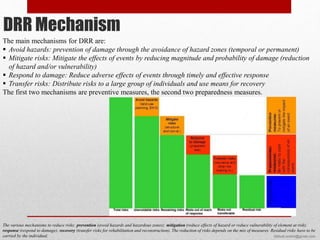
The main mechanisms for DRR are:
 Avoid hazards: prevention of damage through the avoidance of hazard zones (temporal or permanent)
 Mitigate risks: Mitigate the effects of events by reducing magnitude and probability of damage (reduction
of hazard and/or vulnerability)
 Respond to damage: Reduce adverse effects of events through timely and effective response
 Transfer risks: Distribute risks to a large group of individuals and use means for recovery
The first two mechanisms are preventive measures, the second two preparedness measures.
The various mechanisms to reduce risks: prevention (avoid hazards and hazardous zones); mitigation (reduce effects of hazard or reduce vulnerability of element at risk);
response (respond to damage); recovery (transfer risks for rehabilitation and reconstruction). The reduction of risks depends on the mix of measures. Residual risks have to be
carried by the individual. bibhuti.undmt@gmail.com
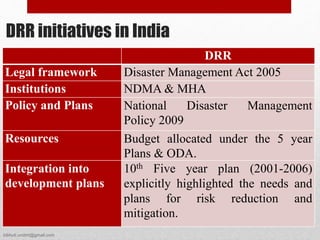
DRR initiatives in India
DRR
Legal framework Disaster Management Act 2005
Institutions NDMA & MHA
Policy and Plans National Disaster Management
Policy 2009
Resources Budget allocated under the 5 year
Plans & ODA.
Integration into
development plans
10th Five year plan (2001-2006)
explicitly highlighted the needs and
plans for risk reduction and
mitigation.
bibhuti.undmt@gmail.com
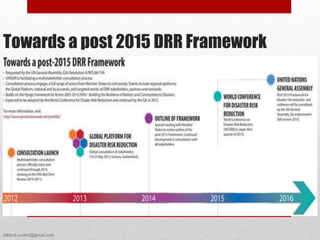
Towards a post 2015 DRR Framework
bibhuti.undmt@gmail.com
Sendai FW for DRR 2015-30
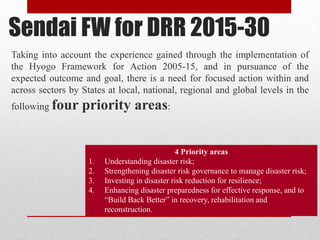
Taking into account the experience gained through the implementation of
the Hyogo Framework for Action 2005-15, and in pursuance of the
expected outcome and goal, there is a need for focused action within and
across sectors by States at local, national, regional and global levels in the
following four priority areas:
4 Priority areas
1. Understanding disaster risk;
2. Strengthening disaster risk governance to manage disaster risk;
3. Investing in disaster risk reduction for resilience;
4. Enhancing disaster preparedness for effective response, and to
“Build Back Better” in recovery, rehabilitation and
reconstruction.
“Implementation of the Sendai Framework for Disaster Risk Reduction over the next 15
years will require strong commitment and political leadership and will be vital to the
achievement of future agreements on sustainable development goals and climate later this
year. As the UN Secretary-General said here on the opening day, sustainability starts in
Sendai.”
The framework outlines seven global targets to be achieved over the next 15 years:
1. A substantial reduction in global disaster mortality;
2. A substantial reduction in numbers of affected people;
3. A reduction in economic losses in relation to global GDP;
4. substantial reduction in disaster damage to critical infrastructure and disruption of
basic services, including health and education facilities;
5. an increase in the number of countries with national and local disaster risk reduction
strategies by 2020;
6. enhanced international cooperation; and
7. increased access to multi-hazard early warning systems and disaster risk information
and assessments.
Sendai FW outline 7 global targets
bibhuti.undmt@gmail.com
Children affected by disasters in India
• The fire accident in a private school in Kumbakonam
town in Tamil Nadu on 16th July ‘2004 charred 93
children to death and severely injured another 30.
• 971 students perished and 1,051 were injured in the Bhuj
earthquake of 2001.
Major concerns during disaster at School
• School being used for relief camp
• School being damage
• School being used as storage
• Loss of teaching learning material including books etc.
• Teaching and non-teaching staffs getting involved in relief and
rehabilitation work
• Psychological impact
• Pushing children out of Schools due to engagement in livelihood
etc.
• Use of children in conflict e.g LWE
• Loss of School days which may miss some of the content in
syllabus
• Abandonment of school buildings
• Environment health hazard, Unhygienic environment
School Safety plan/SDMP
The Objectives of the SDMP is
• To identify the vulnerable places and reduce vulnerability of
school children
• To initiate a planning exercise to ensure the safety of the students
and the staff during a disaster
• To provide a framework for protecting students, staff and school
facilities
• To describe the responsibilities of staff members, for a wide range
of emergency and disaster situations that may occur
• To make the school self-sufficient and
• To provide shelter to the immediate community.
SDMP
• Vital Information of the School; Name of the School, Location, address
• Map of School (Layout Plan)(Building)
• Vulnerability & Hazard Assessment:
• Assessment of School Building Vulnerability & Preparedness?
• School Disaster Management Committee:
• Structure of Disaster Management of School:
• School DM Control room
• SDMC
• A. Response Teams:
• B. Mitigation Teams:
Response Plan:
• A. Response Team:
• 1.Warning and Information Coordination dissemination Team: Role Pre-During-After
• 2. Evacuation Team:
• 3. Search & Rescue Team:
• 4. First Aid Team:
• B. Mitigation:
• 1. Awareness Generation Team:
• 2. Site Security Team:
• Non Structural Measure
• Capacity Building and Training:
• Once in week or fortnight class on Disaster
• Emergency Contact Numbers:
1. http://www.unisdr.org/who-we-are/what-is-drr
2. Gadanayak, BB and Routray, JK (2010), A path to Disaster resilient Communities, Lambert
Academic Publishing, Germany
3. http://www.sdc-drr.net/what
4. http://www.sdc-drr.net/disasters_rise
5.Sendai Frame Work for DRR 2015-2030
6.Political declaration WCDRR
References:
bibhuti.undmt@gmail.com
Thank you

DRR & School Safety

  • 1.
    Disaster Risk Reduction& School Safety Bibhuti Bhusan Gadanayak State DRR Coordinator UNICEF, Guwahati, Assam bibhuti.undmt@gmail.com
  • 2.
    Source Munich Re,Topics Geo 2009 Number of natural catastrophes 1980-2009 bibhuti.undmt@gmail.com
  • 3.
    Risk and RiskReduction Risk = probability * consequences In DRR terms (disaster risks): The potential disaster losses, in lives, health status, livelihoods, assets and services, which could occur to a particular community or society over some specified future time period, caused by a natural event or a technical failure. (Disaster) risk = Hazard * Vulnerability / Coping Capacity Consequently, disaster risk reduction is "the concept and practice of reducing disaster risks through systematic efforts to analyze and manage the causal factors of disasters, including through reduced exposure to hazards, lessened vulnerability of people and property, wise management of land and the environment, and improved preparedness for adverse events". In short, DRR aims to: • Avoid human losses (dead, injured, homeless) • Prevent economic damage (private assets, public infrastructure) • Secure livelihood (household, community, business) bibhuti.undmt@gmail.com
  • 4.
    Recovery, Mitigation and response Mitigationmeasures aim at reducing existing and preventing the building-up of new risks; Response measures aim at reducing the impact of disasters through emergency relief (rescue and survival); Recovery measures aims at reducing possible future losses with an adapted recovery approach A disaster occurs when a natural event coincides with vulnerable human conditions and with insufficient capacities of the affected community to reduce the adverse impacts of the event. Although natural events cannot be fully avoided, there are effective measures to reduce disaster risks. They aim at:  reducing existing risks (reducing vulnerabilities and hazards as well as strengthening coping mechanisms)  adapting to changing risk factors (e.g. climate change)  preventing a further increase of risks through risk-conscious development (do no harm principle). Efforts to reduce disaster risks require an integrated approach, which is based on the risk concept, considers the principles of sustainability and aims at creating multi-stakeholder partnerships. For this purpose, good governance is a prerequisite. Methodological risk concept A systematic procedure to deal with risks from natural events on an operational level comprises three steps: 1.A sound risk assessment (What may happen?) This includes the analysis of all prevailing hazards and the respective vulnerability as well as the coping mechanisms of the communities concerned. 2.A comprehensive risk evaluation (What risk is acceptable?) This is a socio-political process based on livelihood conditions, values, beliefs and experiences. 3.The integral planning of measures (What has to be done?) This planning gives equal weight to the measures in the risk cycle. Conceptual framework bibhuti.undmt@gmail.com
  • 5.
    There is nosuch thing as a 'natural' disaster, only natural hazards. • Disaster Risk Reduction (DRR) aims to reduce the damage caused by natural hazards like earthquakes, floods, droughts and cyclones, through an ethic of prevention. • Disaster risk reduction is the concept and practice of reducing disaster risks through • systematic efforts to analyze and reduce the causal factors of disasters • Reducing exposure to hazards, • lessening vulnerability of people and property, • wise management of land and the environment, and improving preparedness for adverse events bibhuti.undmt@gmail.com
  • 6.
    Definition: • Disaster riskreduction (DRR) is a systematic approach to identifying, assessing and reducing the risks of disaster. It aims to reduce socio-economic vulnerabilities to disaster as well as dealing with the environmental and other hazards that trigger them. • It is the responsibility of development and relief agencies alike. • It should be an integral part of the way such organisations do their work, not an add-on or one-off action. • DRR is very wide-ranging: Its scope is much broader and deeper than conventional emergency management. There is potential for DRR initiatives in just about every sector of development and humanitarian work. bibhuti.undmt@gmail.com
  • 7.
    Aspects of DRR: DisasterMitigation Early warning Disaster preparedness Recovery Support to livelihoods
  • 8.
    DRR Mechanism The mainmechanisms for DRR are:  Avoid hazards: prevention of damage through the avoidance of hazard zones (temporal or permanent)  Mitigate risks: Mitigate the effects of events by reducing magnitude and probability of damage (reduction of hazard and/or vulnerability)  Respond to damage: Reduce adverse effects of events through timely and effective response  Transfer risks: Distribute risks to a large group of individuals and use means for recovery The first two mechanisms are preventive measures, the second two preparedness measures. The various mechanisms to reduce risks: prevention (avoid hazards and hazardous zones); mitigation (reduce effects of hazard or reduce vulnerability of element at risk); response (respond to damage); recovery (transfer risks for rehabilitation and reconstruction). The reduction of risks depends on the mix of measures. Residual risks have to be carried by the individual. bibhuti.undmt@gmail.com
  • 9.
    DRR initiatives inIndia DRR Legal framework Disaster Management Act 2005 Institutions NDMA & MHA Policy and Plans National Disaster Management Policy 2009 Resources Budget allocated under the 5 year Plans & ODA. Integration into development plans 10th Five year plan (2001-2006) explicitly highlighted the needs and plans for risk reduction and mitigation. bibhuti.undmt@gmail.com
  • 10.
    Towards a post2015 DRR Framework bibhuti.undmt@gmail.com
  • 11.
    Sendai FW forDRR 2015-30 Taking into account the experience gained through the implementation of the Hyogo Framework for Action 2005-15, and in pursuance of the expected outcome and goal, there is a need for focused action within and across sectors by States at local, national, regional and global levels in the following four priority areas: 4 Priority areas 1. Understanding disaster risk; 2. Strengthening disaster risk governance to manage disaster risk; 3. Investing in disaster risk reduction for resilience; 4. Enhancing disaster preparedness for effective response, and to “Build Back Better” in recovery, rehabilitation and reconstruction.
  • 12.
    “Implementation of theSendai Framework for Disaster Risk Reduction over the next 15 years will require strong commitment and political leadership and will be vital to the achievement of future agreements on sustainable development goals and climate later this year. As the UN Secretary-General said here on the opening day, sustainability starts in Sendai.” The framework outlines seven global targets to be achieved over the next 15 years: 1. A substantial reduction in global disaster mortality; 2. A substantial reduction in numbers of affected people; 3. A reduction in economic losses in relation to global GDP; 4. substantial reduction in disaster damage to critical infrastructure and disruption of basic services, including health and education facilities; 5. an increase in the number of countries with national and local disaster risk reduction strategies by 2020; 6. enhanced international cooperation; and 7. increased access to multi-hazard early warning systems and disaster risk information and assessments. Sendai FW outline 7 global targets bibhuti.undmt@gmail.com
  • 13.
    Children affected bydisasters in India • The fire accident in a private school in Kumbakonam town in Tamil Nadu on 16th July ‘2004 charred 93 children to death and severely injured another 30. • 971 students perished and 1,051 were injured in the Bhuj earthquake of 2001.
  • 14.
    Major concerns duringdisaster at School • School being used for relief camp • School being damage • School being used as storage • Loss of teaching learning material including books etc. • Teaching and non-teaching staffs getting involved in relief and rehabilitation work • Psychological impact • Pushing children out of Schools due to engagement in livelihood etc. • Use of children in conflict e.g LWE • Loss of School days which may miss some of the content in syllabus • Abandonment of school buildings • Environment health hazard, Unhygienic environment
  • 15.
    School Safety plan/SDMP TheObjectives of the SDMP is • To identify the vulnerable places and reduce vulnerability of school children • To initiate a planning exercise to ensure the safety of the students and the staff during a disaster • To provide a framework for protecting students, staff and school facilities • To describe the responsibilities of staff members, for a wide range of emergency and disaster situations that may occur • To make the school self-sufficient and • To provide shelter to the immediate community.
  • 16.
    SDMP • Vital Informationof the School; Name of the School, Location, address • Map of School (Layout Plan)(Building) • Vulnerability & Hazard Assessment: • Assessment of School Building Vulnerability & Preparedness? • School Disaster Management Committee: • Structure of Disaster Management of School: • School DM Control room • SDMC • A. Response Teams: • B. Mitigation Teams: Response Plan: • A. Response Team: • 1.Warning and Information Coordination dissemination Team: Role Pre-During-After • 2. Evacuation Team: • 3. Search & Rescue Team: • 4. First Aid Team: • B. Mitigation: • 1. Awareness Generation Team: • 2. Site Security Team: • Non Structural Measure • Capacity Building and Training: • Once in week or fortnight class on Disaster • Emergency Contact Numbers:
  • 17.
    1. http://www.unisdr.org/who-we-are/what-is-drr 2. Gadanayak,BB and Routray, JK (2010), A path to Disaster resilient Communities, Lambert Academic Publishing, Germany 3. http://www.sdc-drr.net/what 4. http://www.sdc-drr.net/disasters_rise 5.Sendai Frame Work for DRR 2015-2030 6.Political declaration WCDRR References: bibhuti.undmt@gmail.com
  • 18.

Editor's Notes

  • #8 Disaster Mitigation: Structural and non-structural measures undertaken to limit the adverse impact of natural hazards; for example, planting mangroves to reduce the risk posed by tidal surges or raising awareness of natural hazards through school-based education projects. Early warning – The provision of timely information enabling people to take steps to reduce the impact of hazards. Early warning is typically multi-hazard and requires genuine ownership of, and participation by, communities and other stakeholders, e.g., access to information by local people concerning an approaching typhoon or tropical storm. Disaster preparedness – Measures that help ensure a timely and effective ‘first line’ of response supported by National Societies’ volunteers, branches, regional and national capacities, e.g., community action teams backed up by National Society contingency planning and regional and/or international response teams. Recovery – Decisions and actions taken after a disaster with a view to restoring or improving the pre-disaster living conditions of the affected community, while facilitating necessary adjustments to reduce disaster risk, e.g., assessing levels of future risk when planning housing projects in the aftermath of a disaster. Support to livelihoods – Projects that strengthen or diversify livelihoods that enable individuals or households to develop strategies to reduce risk, e.g. home gardening can improve nutrition and increase reserves in the time of drought.