Disaster Risk
Reduction
Management
Contemporary Issues
Disaster Risk Reduction
Management
The Philippines, being
situated in the Pacific
Ring of Fire and
topping the list of
countries experiencing
extreme weather
conditions, highly
needs its own disaster
risk reduction
management program
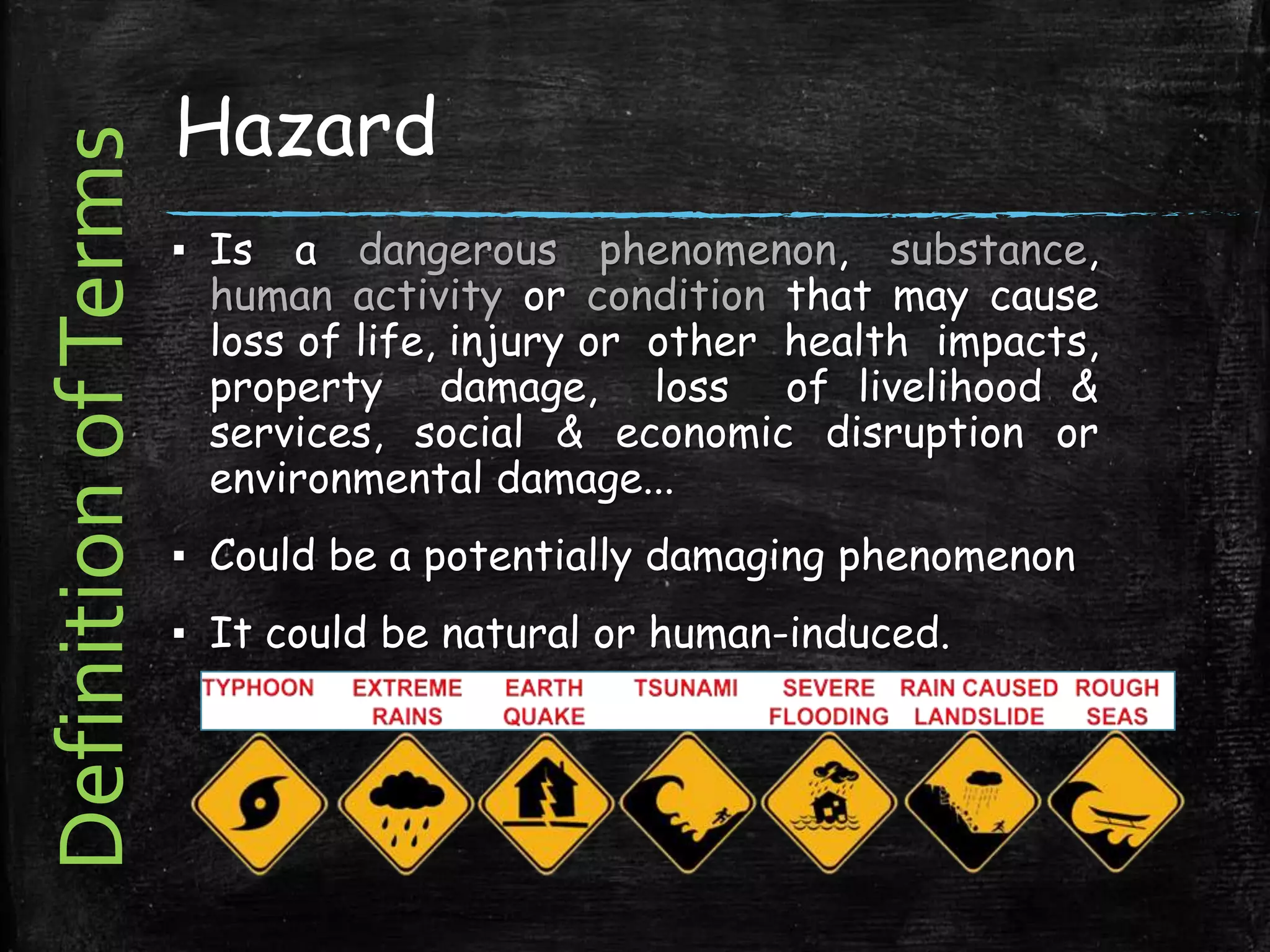
Hazard
▪ Is a dangerous phenomenon, substance,
human activity or condition that may cause
loss of life, injury or other health impacts,
property damage, loss of livelihood &
services, social & economic disruption or
environmental damage...
▪ Could be a potentially damaging phenomenon
▪ It could be natural or human-induced.
DefinitionofTerms
Exposure
▪ The degree to which the element
at risk are likely to experience
hazard events of different
magnitude.
DefinitionofTerms
Vulnerability
▪ Is the characteristics and
circumstances of a community,
system or asset that make it
susceptible to the damaging
effects of a hazard.
▪ This may arise from various
physical, social, economic &
environmental factors.
DefinitionofTerms
Capacity
▪ Is the combination of all
strengths and resources
available within the community,
society or organization that can
reduce the level of risk or effects
of a disaster.
DefinitionofTerms
Risk
▪ Is the combination of
Probability of an event to
happen and its negative
consequences...
DefinitionofTerms
R = HAZARD x VULNERABILITY (exposure)
CAPACITY
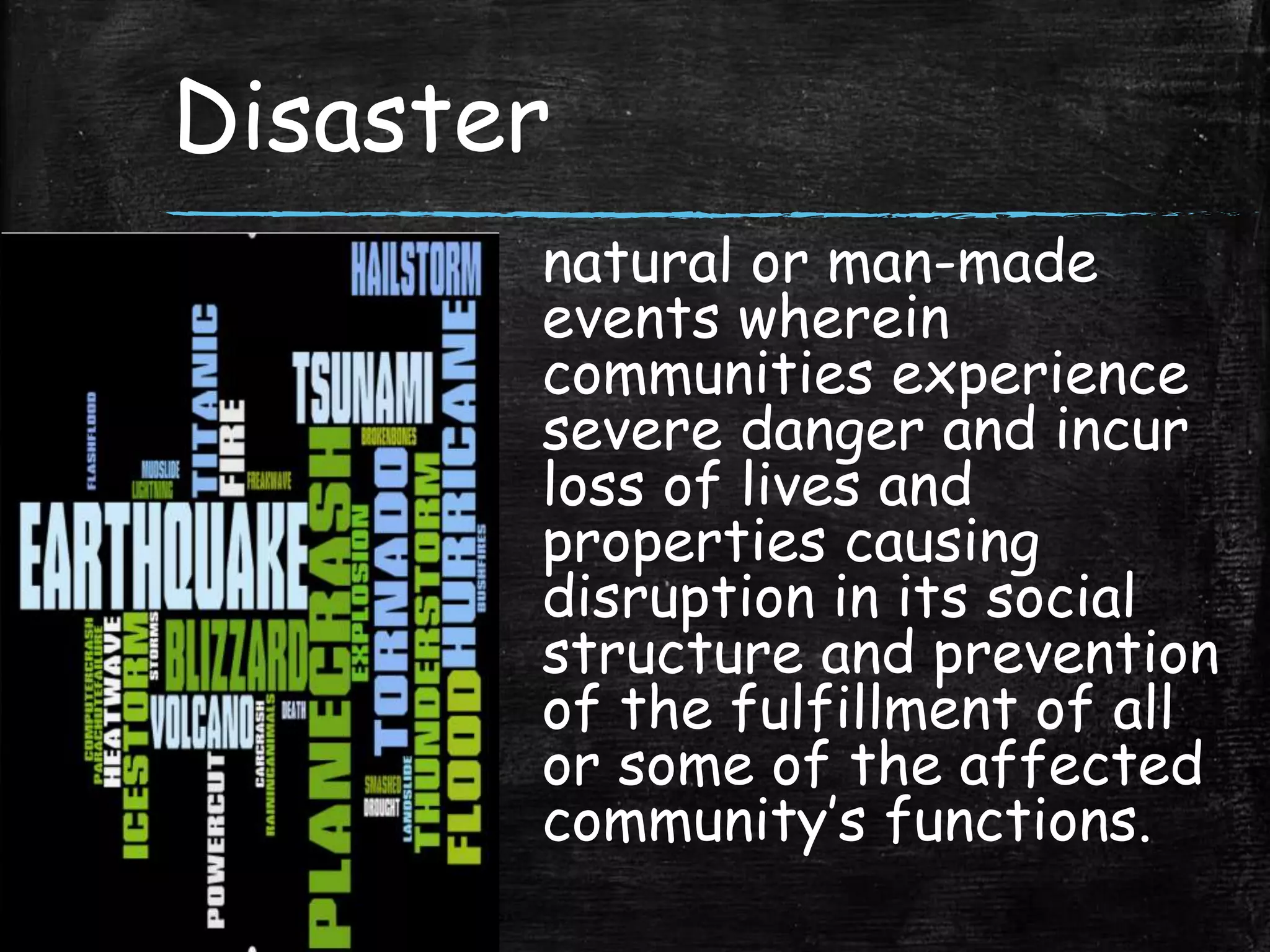
Disaster
natural or man-made
events wherein
communities experience
severe danger and incur
loss of lives and
properties causing
disruption in its social
structure and prevention
of the fulfillment of all
or some of the affected
community’s functions.
Natural Disaster
▪ disasters caused by nature such as
floods, typhoons, storm surges,
climatic variability’s (El Nino. La Nina)
earthquake, tsunami, volcanic
eruptions, landslides and ground
subsidence.
ClassificationofDisaster
Man-made Disaster
disasters caused by man or involving
human intervention such as fire, sea and
air accidents, terrorist-initiated
activities (radioactive fall-out, gas
leaks), Civil strife, Oil Spill, pollution
(solid waste, air, water, thermal),
industrial accidents, red tide.
ClassificationofDisaster
Disaster
Disasters, whether
natural or human-made,
affect everyone,
especially the poor,
children, women and
elderly who have the least
capability to deal with
disasters.
Typhoon Haiyan
DisasterExample
Locally known as
YOLANDA, which was
placed in the highest
disaster classification
(Category 5), has
awaken the Phil.
Government to
aggressively work on
its disaster
preparedness program
to lessen the impact of
disaster on the people16 million – number of
affected people
Why Are Disaster Impacts
Increasing?
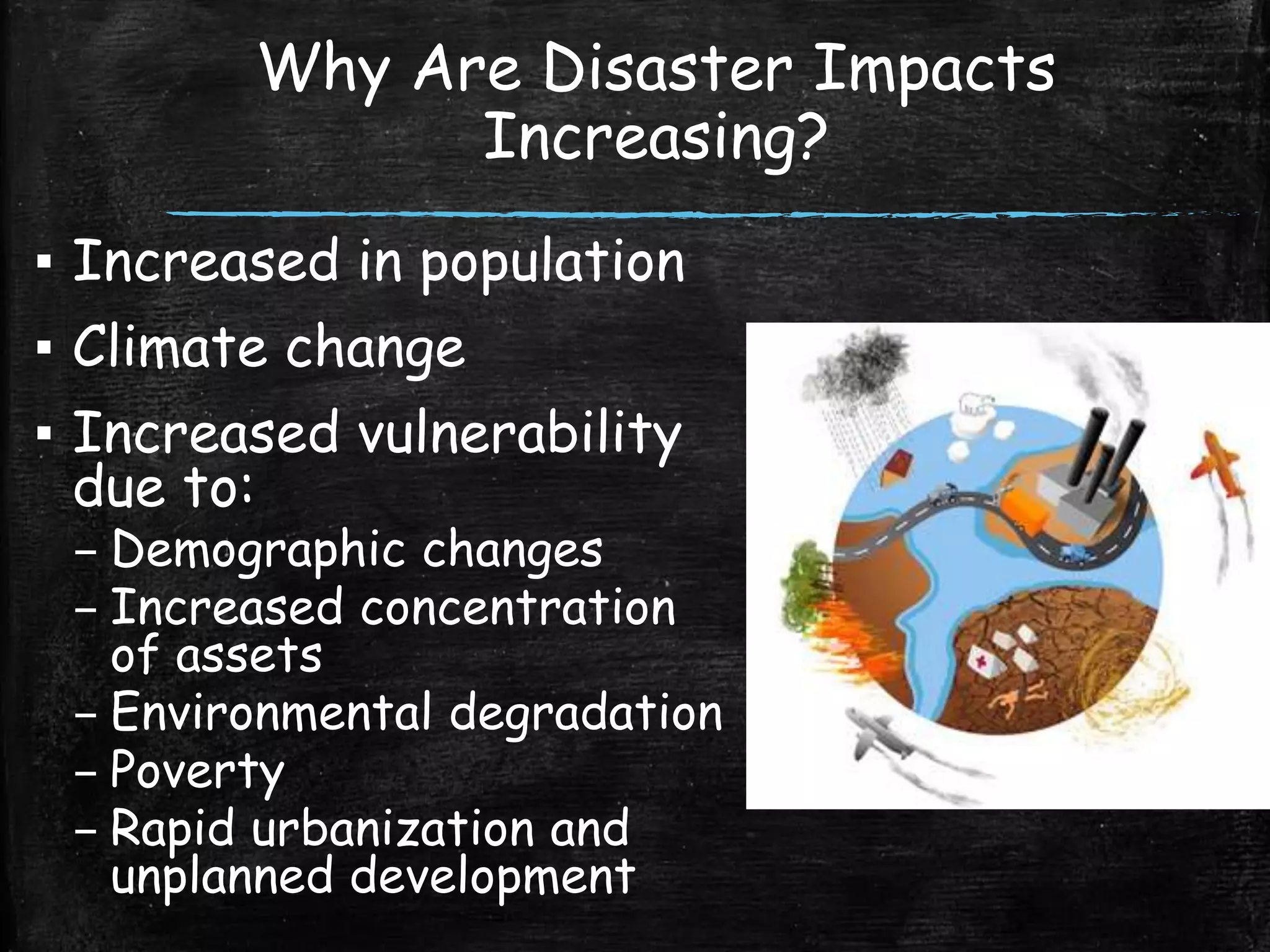
▪ Increased in population
▪ Climate change
▪ Increased vulnerability
due to:
– Demographic changes
– Increased concentration
of assets
– Environmental degradation
– Poverty
– Rapid urbanization and
unplanned development
“AN ACT STRENGTHENING THE
PHILIPPINE DISASTER RISK
REDUCTION AND MANAGEMENT
SYSTEM, PROVIDING FOR THE
NATIONAL DISASTER RISK
REDUCTION AND MANAGEMENT
FRAMEWORK AND
INSTITUTIONALIZING THE
NATIONAL DISASTER RISK
REDUCTION AND MANAGEMENT
PLAN, APPROPRIATING FUNDS
THEREFOR AND FOR OTHER
PURPOSES”.
Republic Act 10121 - The Philippine Disaster
Risk Reduction and Management Act
Republic Act 10121
DISASTER RISK REDUCTION
means reducing disaster risk
through systematic efforts to analyze
and manage the causal factors of
disasters through reduced exposures to
hazards, lessened vulnerability of
people and property, wise management
of land and the environment and
improved preparedness for adverse
events
Republic Act 10121
DISASTER RISK REDUCTION
MANAGEMENT
▪ - the systematic process of
using administrative directives,
organizations, and operational skills
and capacities to implement
strategies, policies and improved
coping capacities in order to lessen
the adverse impacts of hazards and
the possibility of disaster.
▪
Republic Act 10121
▪ The law gives importance to the
reduction of the adverse impact
of disaster through
preparedness. It is a proactive
law that empowers local
government units to use 70% of
their calamity fund for risk
reduction and the remaining 30%
for immediate response
activities.
DRRMC ORGANIZATIONAL NETWORK
NATIONAL DISASTER RISK
REDUCTION & MANAGEMENT COUNCIL
17 REGIONAL DISASTER RISK REDUCTION &
MANAGEMENT COUNCILS
80 PROVINCIAL DISASTER RISK REDUCTION &
MANAGEMENT COUNCILS
117 CITY DISASTER RISK REDUCTION &
MANAGEMENT COUNCILS
1,496 MUNICIPAL DISASTER RISK REDUCTION &
MANAGEMENT COUNCILS
41,945 BARANGAY DISASTER RISK REDUCTION &
MANAGEMENT COUNCILS
Preparedness
A PERSONAL
RESPONSIBILITY
Disaster Preparedness
▪ - the knowledge effectively
anticipate, respond to, and
recover from, the impacts of
likely, imminent or current
hazard events or conditions.
Makes a difference
Preparedness
Changing
attitudes…
Knowing hazards…
Doing something
to minimize the
hazards.
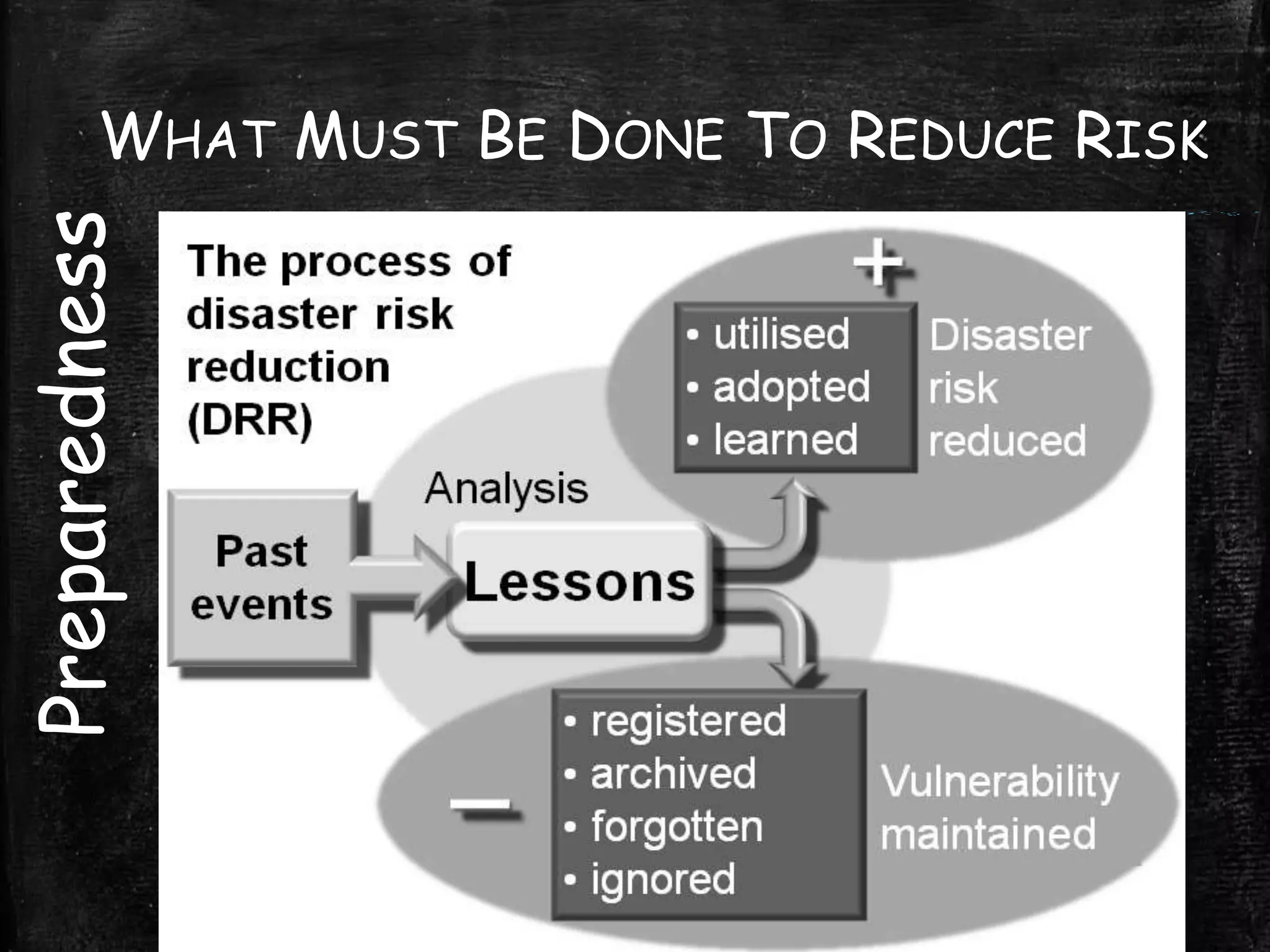
WHAT MUST BE DONE TO REDUCE RISK
Preparedness
POTENTIAL RISK TREATMENTS
Once risks have been identified and
assessed, all techniques to manage the risk
fall into one or more of these four major
categories:
Avoidance (eliminate, withdraw from the
risk area)
Reduction (optimize resources to
mitigate effects )
Sharing (risk transfer or enrol in
insurance)
Retention (accept, plan - Evac Plan and
provision of budget and etc)
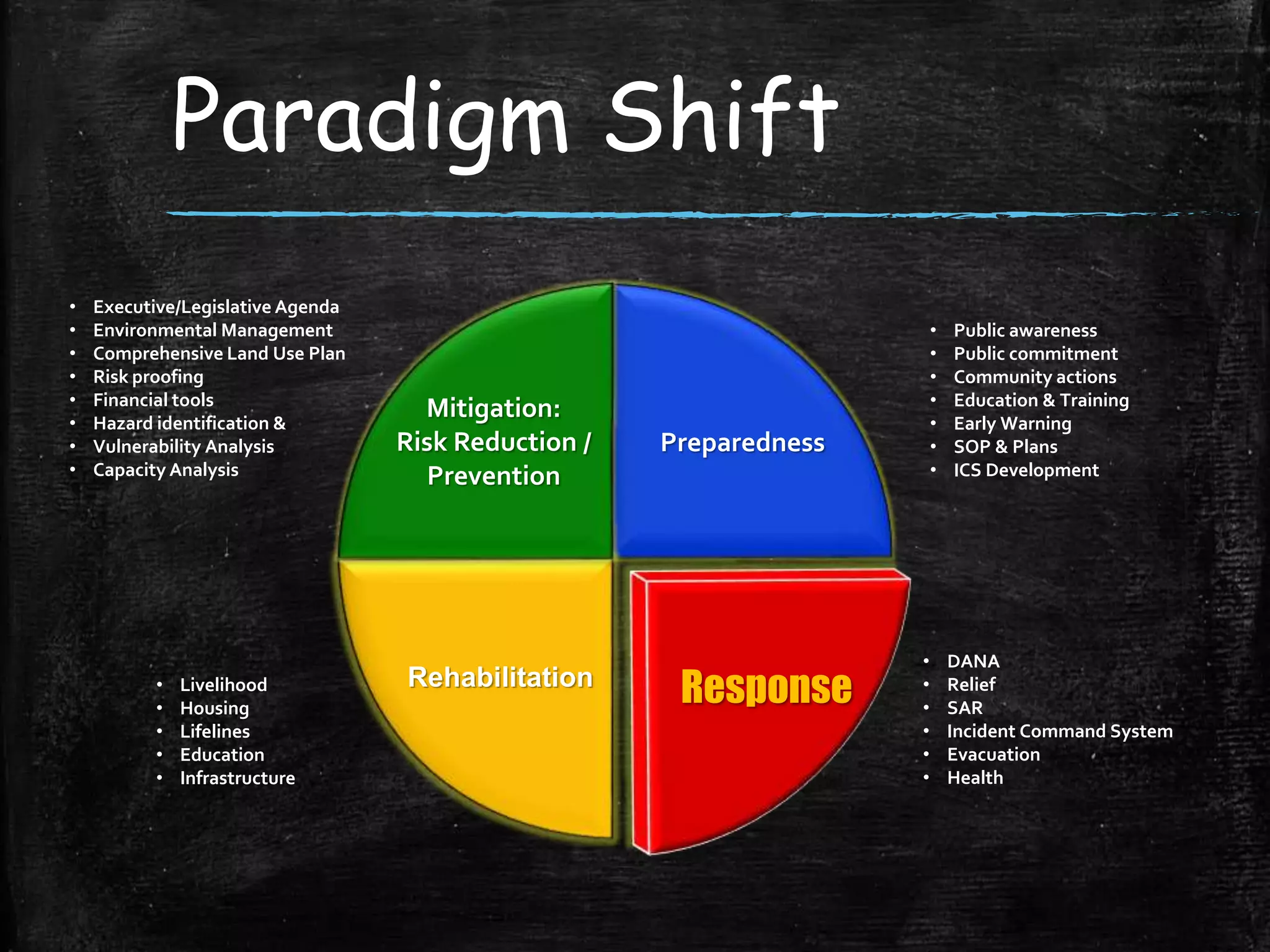
Paradigm Shift
▪ The enactment of the
Philippine Disaster Risk
Reduction and Management Act
of 2010 (also known as Republic
Act 10121), aims to achieve a
paradigm shift from reactive
to proactive approach in
disaster risk reduction and
management.
Paradigm Shift
Preparedness
Mitigation:
Risk Reduction /
Prevention
Rehabilitation
Response
• Executive/Legislative Agenda
• Environmental Management
• Comprehensive Land Use Plan
• Risk proofing
• Financial tools
• Hazard identification &
• Vulnerability Analysis
• Capacity Analysis
• Public awareness
• Public commitment
• Community actions
• Education & Training
• Early Warning
• SOP & Plans
• ICS Development
• Livelihood
• Housing
• Lifelines
• Education
• Infrastructure
• DANA
• Relief
• SAR
• Incident Command System
• Evacuation
• Health
Important Aspects In Disaster Management
“We are not preparing for the world
we live in - we are preparing for the
world we find ourselves in.”
– Michael Mabee
Questions

Disaster Risk Reduction Management

  • 1.
  • 2.
    Disaster Risk Reduction Management ThePhilippines, being situated in the Pacific Ring of Fire and topping the list of countries experiencing extreme weather conditions, highly needs its own disaster risk reduction management program
  • 3.
    Hazard ▪ Is adangerous phenomenon, substance, human activity or condition that may cause loss of life, injury or other health impacts, property damage, loss of livelihood & services, social & economic disruption or environmental damage... ▪ Could be a potentially damaging phenomenon ▪ It could be natural or human-induced. DefinitionofTerms
  • 4.
    Exposure ▪ The degreeto which the element at risk are likely to experience hazard events of different magnitude. DefinitionofTerms
  • 5.
    Vulnerability ▪ Is thecharacteristics and circumstances of a community, system or asset that make it susceptible to the damaging effects of a hazard. ▪ This may arise from various physical, social, economic & environmental factors. DefinitionofTerms
  • 6.
    Capacity ▪ Is thecombination of all strengths and resources available within the community, society or organization that can reduce the level of risk or effects of a disaster. DefinitionofTerms
  • 7.
    Risk ▪ Is thecombination of Probability of an event to happen and its negative consequences... DefinitionofTerms R = HAZARD x VULNERABILITY (exposure) CAPACITY
  • 8.
    Disaster natural or man-made eventswherein communities experience severe danger and incur loss of lives and properties causing disruption in its social structure and prevention of the fulfillment of all or some of the affected community’s functions.
  • 9.
    Natural Disaster ▪ disasterscaused by nature such as floods, typhoons, storm surges, climatic variability’s (El Nino. La Nina) earthquake, tsunami, volcanic eruptions, landslides and ground subsidence. ClassificationofDisaster
  • 10.
    Man-made Disaster disasters causedby man or involving human intervention such as fire, sea and air accidents, terrorist-initiated activities (radioactive fall-out, gas leaks), Civil strife, Oil Spill, pollution (solid waste, air, water, thermal), industrial accidents, red tide. ClassificationofDisaster
  • 11.
    Disaster Disasters, whether natural orhuman-made, affect everyone, especially the poor, children, women and elderly who have the least capability to deal with disasters.
  • 12.
    Typhoon Haiyan DisasterExample Locally knownas YOLANDA, which was placed in the highest disaster classification (Category 5), has awaken the Phil. Government to aggressively work on its disaster preparedness program to lessen the impact of disaster on the people16 million – number of affected people
  • 13.
    Why Are DisasterImpacts Increasing? ▪ Increased in population ▪ Climate change ▪ Increased vulnerability due to: – Demographic changes – Increased concentration of assets – Environmental degradation – Poverty – Rapid urbanization and unplanned development
  • 15.
    “AN ACT STRENGTHENINGTHE PHILIPPINE DISASTER RISK REDUCTION AND MANAGEMENT SYSTEM, PROVIDING FOR THE NATIONAL DISASTER RISK REDUCTION AND MANAGEMENT FRAMEWORK AND INSTITUTIONALIZING THE NATIONAL DISASTER RISK REDUCTION AND MANAGEMENT PLAN, APPROPRIATING FUNDS THEREFOR AND FOR OTHER PURPOSES”. Republic Act 10121 - The Philippine Disaster Risk Reduction and Management Act
  • 16.
    Republic Act 10121 DISASTERRISK REDUCTION means reducing disaster risk through systematic efforts to analyze and manage the causal factors of disasters through reduced exposures to hazards, lessened vulnerability of people and property, wise management of land and the environment and improved preparedness for adverse events
  • 17.
    Republic Act 10121 DISASTERRISK REDUCTION MANAGEMENT ▪ - the systematic process of using administrative directives, organizations, and operational skills and capacities to implement strategies, policies and improved coping capacities in order to lessen the adverse impacts of hazards and the possibility of disaster. ▪
  • 18.
    Republic Act 10121 ▪The law gives importance to the reduction of the adverse impact of disaster through preparedness. It is a proactive law that empowers local government units to use 70% of their calamity fund for risk reduction and the remaining 30% for immediate response activities.
  • 19.
    DRRMC ORGANIZATIONAL NETWORK NATIONALDISASTER RISK REDUCTION & MANAGEMENT COUNCIL 17 REGIONAL DISASTER RISK REDUCTION & MANAGEMENT COUNCILS 80 PROVINCIAL DISASTER RISK REDUCTION & MANAGEMENT COUNCILS 117 CITY DISASTER RISK REDUCTION & MANAGEMENT COUNCILS 1,496 MUNICIPAL DISASTER RISK REDUCTION & MANAGEMENT COUNCILS 41,945 BARANGAY DISASTER RISK REDUCTION & MANAGEMENT COUNCILS
  • 21.
  • 22.
    Disaster Preparedness ▪ -the knowledge effectively anticipate, respond to, and recover from, the impacts of likely, imminent or current hazard events or conditions.
  • 23.
    Makes a difference Preparedness Changing attitudes… Knowinghazards… Doing something to minimize the hazards.
  • 24.
    WHAT MUST BEDONE TO REDUCE RISK Preparedness
  • 25.
    POTENTIAL RISK TREATMENTS Oncerisks have been identified and assessed, all techniques to manage the risk fall into one or more of these four major categories: Avoidance (eliminate, withdraw from the risk area) Reduction (optimize resources to mitigate effects ) Sharing (risk transfer or enrol in insurance) Retention (accept, plan - Evac Plan and provision of budget and etc)
  • 26.
    Paradigm Shift ▪ Theenactment of the Philippine Disaster Risk Reduction and Management Act of 2010 (also known as Republic Act 10121), aims to achieve a paradigm shift from reactive to proactive approach in disaster risk reduction and management.
  • 27.
    Paradigm Shift Preparedness Mitigation: Risk Reduction/ Prevention Rehabilitation Response • Executive/Legislative Agenda • Environmental Management • Comprehensive Land Use Plan • Risk proofing • Financial tools • Hazard identification & • Vulnerability Analysis • Capacity Analysis • Public awareness • Public commitment • Community actions • Education & Training • Early Warning • SOP & Plans • ICS Development • Livelihood • Housing • Lifelines • Education • Infrastructure • DANA • Relief • SAR • Incident Command System • Evacuation • Health
  • 28.
    Important Aspects InDisaster Management
  • 29.
    “We are notpreparing for the world we live in - we are preparing for the world we find ourselves in.” – Michael Mabee
  • 30.