Social
Development
Issues and
Role of
Development
Professionals
Bibhuti Bhusan Gadanayak
Senior Technical Advisor, DRM & Emergency
UNDP – MINEMA, Kigali – Nyarugemge
KN 3 Rd. – KN 1 Av – Pension Plazza
Rwanda
Saturday Lecture Series (SLS) of Gyanalok 17th June 2023
Contents
• What is social development
• Understanding social issues in Development
• Educational Issues in Development
• Educational issues and concern
• Health issues in development
• Some alarming facts about status of healthcare infrastructure
in rural areas vis- A-vis urban areas are
• Nutritional issues in development
• Nutrition status in India
• Nutrition and SDG
• Gender issues in development
• Sex ration in India
• Issues of marginalization and eexclusion in development
• The Most Vulnerable Marginalized and Excluded Groups
• Cultural issues in development
• Cultural barriers
• Role of developmental professionals
• Thank U
Social development is about improving
the well-being of every individual in
society so they can reach their full
potential.
-The success of society is linked
to the well-being of each and every
citizen. Social development means
investing in people.
Social development is measured through
elements that affect the well-being of
people, so indicators of
Health
Education
Employment, and
Gender equality
are used and can be quantified through
measurements such as life expectancy
and the adult literacy rate.
Social development is about the way
society is changing.
Understanding social issues in
Development
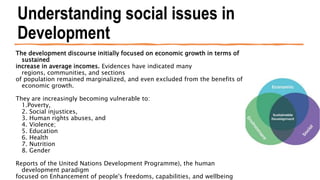
The development discourse initially focused on economic growth in terms of
sustained
increase in average incomes. Evidences have indicated many
regions, communities, and sections
of population remained marginalized, and even excluded from the benefits of
economic growth.
They are increasingly becoming vulnerable to:
1.Poverty,
2. Social injustices,
3. Human rights abuses, and
4. Violence;
5. Education
6. Health
7. Nutrition
8. Gender
Reports of the United Nations Development Programme), the human
development paradigm
focused on Enhancement of people's freedoms, capabilities, and wellbeing
Educational Issues in Development
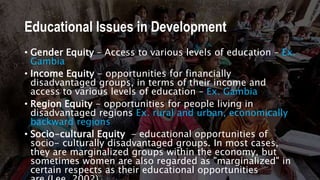
• Gender Equity – Access to various levels of education – Ex.
Gambia
• Income Equity - opportunities for financially
disadvantaged groups, in terms of their income and
access to various levels of education – Ex. Gambia
• Region Equity - opportunities for people living in
disadvantaged regions Ex. rural and urban, economically
backward regions
• Socio-cultural Equity - educational opportunities of
socio- culturally disadvantaged groups. In most cases,
they are marginalized groups within the economy, but
sometimes women are also regarded as "marginalized" in
certain respects as their educational opportunities
Educational issues and concern
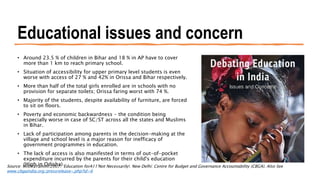
• Around 23.5 % of children in Bihar and 18 % in AP have to cover
more than 1 km to reach primary school.
• Situation of accessibility for upper primary level students is even
worse with access of 27 % and 42% in Orissa and Bihar respectively.
• More than half of the total girls enrolled are in schools with no
provision for separate toilets; Orissa faring worst with 74 %.
• Majority of the students, despite availability of furniture, are forced
to sit on floors.
• Poverty and economic backwardness - the condition being
especially worse in case of SC/ST across all the states and Muslims
in Bihar.
• Lack of participation among parents in the decision-making at the
village and school level is a major reason for inefficacy of
government programmes in education.
• The lack of access is also manifested in terms of out-of-pocket
expenditure incurred by the parents for their child's education
(High in Odisha)
Source: MishraYamini.2007. 'Education forA11'Not Necessarily!. New Delhi: Centre for Budget and Governance Accountability (CBGA). Also See
www.cbgaindia.org/pressrelease~.php?id=6
Health issues in development
Health, as
World
Health
Organizatio
n (WHO,
2006)
defines it, is
more than
just the
absence of
It is a state
of complete
physical,
mental and
social well-
being.
There is
both direct
and indirect
relationship
between
health and
developmen
t. – Ex.
Ebola in WA
Health has a
direct
association
with labour
productivity
.
Illness and
malnutrition
lead to loss
of strength
and energy
and
productive
capacity
which
ultimately
Some alarming facts about status of healthcare
infrastructure in rural areas vis- A-vis urban areas
are:
Rural doctors to population ratio is lower.
Rural beds to population ratio is lower .
Seven out of ten medicines in rural areas are substandard / counterfeit.
Rural population lack access to critical medicine .
Rural population travels for over 30 kms for medical treatment.
Nutritional
issues in
developme
nt
Nutrition is an outcome, a result of access to food, dietary intake,
health and
care of the individual. It is also a precondition to the development of
human
resources; fulfilling most human aspirations as individual development,
good
health, and self-fulfillment.
The development policies since 1990s have explicitly emphasized
three-fold principles.
-First, economic growth, that deliberately involves participation
of the poor, is the long-term solution to poverty.
-Second, social security is required to maintain a basic level of
living ("safety net") for the poor; sustained access to adequate food
("food security") is a central feature of this.
-Third, development of human resources is an essential
Nutrition and SDG
• SDG Target 2.2 End all forms of malnutrition, including
achieving, by 2025, the internationally agreed targets on
stunting and wasting in children under 5 years of age,
and address the nutritional needs of adolescent girls,
pregnant and lactating women and older persons.
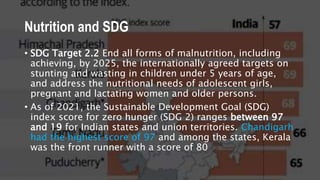
• As of 2021, the Sustainable Development Goal (SDG)
index score for zero hunger (SDG 2) ranges between 97
and 19 for Indian states and union territories. Chandigarh
had the highest score of 97 and among the states, Kerala
was the front runner with a score of 80
Nutrition status in India
• According to the NFHS 2019-21, the 5th in the series India has seen no
significant improvement in health and nutritional status
• The latest data shows, 7.7% of children are severely wasted,
• 19.3% are wasted and 35.5% are stunted.
• At the same time, 3.4% children are overweight which was 2.1% in NFHS-
4 (fig 2).
• Anemia among children under-5 has become significantly worse with the
current prevalence as 67.1% compared to 58.6% according to NFHS-4.
57% of women of reproductive age are anaemic in the country.
NFHS: National family Health Survey
https://www.orfonline.org/expert-speak/global-nutrition-report-2021/
Gender issues in development
• Like race, ethnicity and class, gender as a social category shapes and
establishes one's life chances in society and development.
• The term gender refers to a set of roles, attributes behaviours expected from
women and men by their societies.
• Gender relations represent the ways in which the socially constructed
categories of women and men relate over a wide range of social interactions
within family, community as well as in all economic and political relations in a
given society.
• Gender relations are institutionally constructed. It creates and reproduces
systemic differences in the positioning of women and men in the society.
• Rules, norms and practices of gender relations have a strong ideological
content as it reflects the normative or prescriptive version of female and male
roles.
• Gender relations are constituted in terms of relations of power and
dominance; therefore, the nature of gender relations is one of opposition and
Sex ratio in India
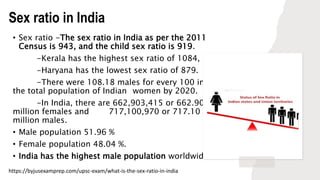
• Sex ratio -The sex ratio in India as per the 2011
Census is 943, and the child sex ratio is 919.
-Kerala has the highest sex ratio of 1084, and
-Haryana has the lowest sex ratio of 879.
-There were 108.18 males for every 100 in
the total population of Indian women by 2020.
-In India, there are 662,903,415 or 662.90
million females and 717,100,970 or 717.10
million males.
• Male population 51.96 %
• Female population 48.04 %.
• India has the highest male population worldwide.
https://byjusexamprep.com/upsc-exam/what-is-the-sex-ratio-in-india
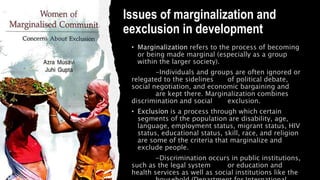
Issues of marginalization and
eexclusion in development
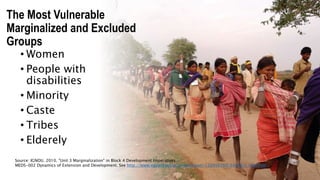
The Most Vulnerable
Marginalized and Excluded
Groups
• Women
• People with
disabilities
• Minority
• Caste
• Tribes
• Elderely
Source: IGNOU. 2010. "Unit 3 Marginalization" in Block 4 Development Imperatives.
MEDS-002 Dynamics of Extension and Development. See http://www.egyankosh.ac.in/bitstream/123456789/34923/1/Unit3.pd
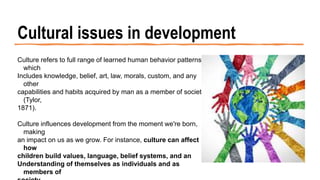
Cultural issues in development
Culture refers to full range of learned human behavior patterns
which
Includes knowledge, belief, art, law, morals, custom, and any
other
capabilities and habits acquired by man as a member of society
(Tylor,
1871).
Culture influences development from the moment we're born,
making
an impact on us as we grow. For instance, culture can affect
how
children build values, language, belief systems, and an
Understanding of themselves as individuals and as
members of
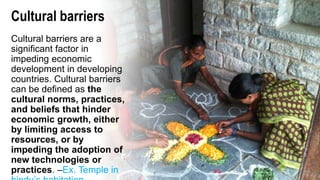
Cultural barriers
Cultural barriers are a
significant factor in
impeding economic
development in developing
countries. Cultural barriers
can be defined as the
cultural norms, practices,
and beliefs that hinder
economic growth, either
by limiting access to
resources, or by
impeding the adoption of
new technologies or
practices. –Ex. Temple in
Role of developmental
professionals
• Capacity building – Ex. DM Policy with elected
representatives in Gambia for CC policy
• Knowledge Management: Ex. DM Policy with elected
representatives in Gambia
• Advocacy: Advocacy is an important part of the
social worker's role in the process of social
change, which is critical for social welfare and
development. As an advocate, he examines the
essence of a given issue, provides advice to the
public, and advocates on their behalf for the public
good. – Ex. Ministrial conference on Social Protection
at ECA area (Barbados)
• Give people ways to voice their opinions
• Raise awareness about local and global issues.
• Help local people to take united action
• Research existing projects aimed at similar problems
References
• https://byjusexamprep.com/upsc-exam/social-issues-in-india#toc-1
• Gadanayak, BB and Routray, JK (2010), A path to Disaster resilient Communities, Lambert
Academic Publishing, Germany https://www.lap-
publishing.com/catalog/details/store/hu/book/978-3-8433-6666-3/a-path-to-
disaster-resilient-communities?search=Bibhuti%20Bhusan%20Gadanayak
• https://www.studysmarter.co.uk/explanations/geography/changing-economic-
world/social-development-of-
india/#:~:text=Social%20development%20is%20measured%20through,the%20way%20socie
ty%20is%20changing.
• https://www.worldbank.org/en/news/press-release/2023/04/04/indian-economy-
continues-to-show-resilience-amid-global-uncertainties
• ADB-UNICEF. 2010. Non-State Education and Public-Private Partnerships. Background
Report. http://www.adb.org/documents/events/201O/ADB-UNICEF-Regional-Workshop/
Education-background-paper.pdf Accessed in June 20 11.
• IGNOU. 2010. Unit 3 Marginalization. 12345678913492311IUnit3.pdf-Accessed in June
201 1.
• IGNOU. 2010a. Unit 2 Health and Development. http://www.egyankosh.ac.in/bitstread
123456789/34934/1/Unit2.pdf -Accessed in June 201 1.
Social Development Issues and Role of Development Professionals

Social Development Issues and Role of Development Professionals

  • 1.
    Social Development Issues and Role of Development Professionals BibhutiBhusan Gadanayak Senior Technical Advisor, DRM & Emergency UNDP – MINEMA, Kigali – Nyarugemge KN 3 Rd. – KN 1 Av – Pension Plazza Rwanda Saturday Lecture Series (SLS) of Gyanalok 17th June 2023
  • 2.
    Contents • What issocial development • Understanding social issues in Development • Educational Issues in Development • Educational issues and concern • Health issues in development • Some alarming facts about status of healthcare infrastructure in rural areas vis- A-vis urban areas are • Nutritional issues in development • Nutrition status in India • Nutrition and SDG • Gender issues in development • Sex ration in India • Issues of marginalization and eexclusion in development • The Most Vulnerable Marginalized and Excluded Groups • Cultural issues in development • Cultural barriers • Role of developmental professionals • Thank U
  • 3.
    Social development isabout improving the well-being of every individual in society so they can reach their full potential. -The success of society is linked to the well-being of each and every citizen. Social development means investing in people. Social development is measured through elements that affect the well-being of people, so indicators of Health Education Employment, and Gender equality are used and can be quantified through measurements such as life expectancy and the adult literacy rate. Social development is about the way society is changing.
  • 4.
    Understanding social issuesin Development The development discourse initially focused on economic growth in terms of sustained increase in average incomes. Evidences have indicated many regions, communities, and sections of population remained marginalized, and even excluded from the benefits of economic growth. They are increasingly becoming vulnerable to: 1.Poverty, 2. Social injustices, 3. Human rights abuses, and 4. Violence; 5. Education 6. Health 7. Nutrition 8. Gender Reports of the United Nations Development Programme), the human development paradigm focused on Enhancement of people's freedoms, capabilities, and wellbeing
  • 5.
    Educational Issues inDevelopment • Gender Equity – Access to various levels of education – Ex. Gambia • Income Equity - opportunities for financially disadvantaged groups, in terms of their income and access to various levels of education – Ex. Gambia • Region Equity - opportunities for people living in disadvantaged regions Ex. rural and urban, economically backward regions • Socio-cultural Equity - educational opportunities of socio- culturally disadvantaged groups. In most cases, they are marginalized groups within the economy, but sometimes women are also regarded as "marginalized" in certain respects as their educational opportunities
  • 6.
    Educational issues andconcern • Around 23.5 % of children in Bihar and 18 % in AP have to cover more than 1 km to reach primary school. • Situation of accessibility for upper primary level students is even worse with access of 27 % and 42% in Orissa and Bihar respectively. • More than half of the total girls enrolled are in schools with no provision for separate toilets; Orissa faring worst with 74 %. • Majority of the students, despite availability of furniture, are forced to sit on floors. • Poverty and economic backwardness - the condition being especially worse in case of SC/ST across all the states and Muslims in Bihar. • Lack of participation among parents in the decision-making at the village and school level is a major reason for inefficacy of government programmes in education. • The lack of access is also manifested in terms of out-of-pocket expenditure incurred by the parents for their child's education (High in Odisha) Source: MishraYamini.2007. 'Education forA11'Not Necessarily!. New Delhi: Centre for Budget and Governance Accountability (CBGA). Also See www.cbgaindia.org/pressrelease~.php?id=6
  • 7.
    Health issues indevelopment Health, as World Health Organizatio n (WHO, 2006) defines it, is more than just the absence of It is a state of complete physical, mental and social well- being. There is both direct and indirect relationship between health and developmen t. – Ex. Ebola in WA Health has a direct association with labour productivity . Illness and malnutrition lead to loss of strength and energy and productive capacity which ultimately
  • 8.
    Some alarming factsabout status of healthcare infrastructure in rural areas vis- A-vis urban areas are: Rural doctors to population ratio is lower. Rural beds to population ratio is lower . Seven out of ten medicines in rural areas are substandard / counterfeit. Rural population lack access to critical medicine . Rural population travels for over 30 kms for medical treatment.
  • 9.
    Nutritional issues in developme nt Nutrition isan outcome, a result of access to food, dietary intake, health and care of the individual. It is also a precondition to the development of human resources; fulfilling most human aspirations as individual development, good health, and self-fulfillment. The development policies since 1990s have explicitly emphasized three-fold principles. -First, economic growth, that deliberately involves participation of the poor, is the long-term solution to poverty. -Second, social security is required to maintain a basic level of living ("safety net") for the poor; sustained access to adequate food ("food security") is a central feature of this. -Third, development of human resources is an essential
  • 10.
    Nutrition and SDG •SDG Target 2.2 End all forms of malnutrition, including achieving, by 2025, the internationally agreed targets on stunting and wasting in children under 5 years of age, and address the nutritional needs of adolescent girls, pregnant and lactating women and older persons. • As of 2021, the Sustainable Development Goal (SDG) index score for zero hunger (SDG 2) ranges between 97 and 19 for Indian states and union territories. Chandigarh had the highest score of 97 and among the states, Kerala was the front runner with a score of 80
  • 11.
    Nutrition status inIndia • According to the NFHS 2019-21, the 5th in the series India has seen no significant improvement in health and nutritional status • The latest data shows, 7.7% of children are severely wasted, • 19.3% are wasted and 35.5% are stunted. • At the same time, 3.4% children are overweight which was 2.1% in NFHS- 4 (fig 2). • Anemia among children under-5 has become significantly worse with the current prevalence as 67.1% compared to 58.6% according to NFHS-4. 57% of women of reproductive age are anaemic in the country. NFHS: National family Health Survey https://www.orfonline.org/expert-speak/global-nutrition-report-2021/
  • 12.
    Gender issues indevelopment • Like race, ethnicity and class, gender as a social category shapes and establishes one's life chances in society and development. • The term gender refers to a set of roles, attributes behaviours expected from women and men by their societies. • Gender relations represent the ways in which the socially constructed categories of women and men relate over a wide range of social interactions within family, community as well as in all economic and political relations in a given society. • Gender relations are institutionally constructed. It creates and reproduces systemic differences in the positioning of women and men in the society. • Rules, norms and practices of gender relations have a strong ideological content as it reflects the normative or prescriptive version of female and male roles. • Gender relations are constituted in terms of relations of power and dominance; therefore, the nature of gender relations is one of opposition and
  • 13.
    Sex ratio inIndia • Sex ratio -The sex ratio in India as per the 2011 Census is 943, and the child sex ratio is 919. -Kerala has the highest sex ratio of 1084, and -Haryana has the lowest sex ratio of 879. -There were 108.18 males for every 100 in the total population of Indian women by 2020. -In India, there are 662,903,415 or 662.90 million females and 717,100,970 or 717.10 million males. • Male population 51.96 % • Female population 48.04 %. • India has the highest male population worldwide. https://byjusexamprep.com/upsc-exam/what-is-the-sex-ratio-in-india
  • 14.
    Issues of marginalizationand eexclusion in development
  • 15.
    The Most Vulnerable Marginalizedand Excluded Groups • Women • People with disabilities • Minority • Caste • Tribes • Elderely Source: IGNOU. 2010. "Unit 3 Marginalization" in Block 4 Development Imperatives. MEDS-002 Dynamics of Extension and Development. See http://www.egyankosh.ac.in/bitstream/123456789/34923/1/Unit3.pd
  • 16.
    Cultural issues indevelopment Culture refers to full range of learned human behavior patterns which Includes knowledge, belief, art, law, morals, custom, and any other capabilities and habits acquired by man as a member of society (Tylor, 1871). Culture influences development from the moment we're born, making an impact on us as we grow. For instance, culture can affect how children build values, language, belief systems, and an Understanding of themselves as individuals and as members of
  • 17.
    Cultural barriers Cultural barriersare a significant factor in impeding economic development in developing countries. Cultural barriers can be defined as the cultural norms, practices, and beliefs that hinder economic growth, either by limiting access to resources, or by impeding the adoption of new technologies or practices. –Ex. Temple in
  • 18.
    Role of developmental professionals •Capacity building – Ex. DM Policy with elected representatives in Gambia for CC policy • Knowledge Management: Ex. DM Policy with elected representatives in Gambia • Advocacy: Advocacy is an important part of the social worker's role in the process of social change, which is critical for social welfare and development. As an advocate, he examines the essence of a given issue, provides advice to the public, and advocates on their behalf for the public good. – Ex. Ministrial conference on Social Protection at ECA area (Barbados) • Give people ways to voice their opinions • Raise awareness about local and global issues. • Help local people to take united action • Research existing projects aimed at similar problems
  • 19.
    References • https://byjusexamprep.com/upsc-exam/social-issues-in-india#toc-1 • Gadanayak,BB and Routray, JK (2010), A path to Disaster resilient Communities, Lambert Academic Publishing, Germany https://www.lap- publishing.com/catalog/details/store/hu/book/978-3-8433-6666-3/a-path-to- disaster-resilient-communities?search=Bibhuti%20Bhusan%20Gadanayak • https://www.studysmarter.co.uk/explanations/geography/changing-economic- world/social-development-of- india/#:~:text=Social%20development%20is%20measured%20through,the%20way%20socie ty%20is%20changing. • https://www.worldbank.org/en/news/press-release/2023/04/04/indian-economy- continues-to-show-resilience-amid-global-uncertainties • ADB-UNICEF. 2010. Non-State Education and Public-Private Partnerships. Background Report. http://www.adb.org/documents/events/201O/ADB-UNICEF-Regional-Workshop/ Education-background-paper.pdf Accessed in June 20 11. • IGNOU. 2010. Unit 3 Marginalization. 12345678913492311IUnit3.pdf-Accessed in June 201 1. • IGNOU. 2010a. Unit 2 Health and Development. http://www.egyankosh.ac.in/bitstread 123456789/34934/1/Unit2.pdf -Accessed in June 201 1.