The DRRM Modules in
Relation to School Disaster
Risk Reduction Management
(SDRRM) Manual
DEPARTMENT OF EDUCATION
Objectives
• To be familiarized of the features of School Disaster Risk
Reduction Manual, Booklet 1 & 2;
• To know how DRRM Modules supplement the content of the
manuals in order to support the schools in the DRRM
implementation process; and
2
How do you implement
DRRM in your school?
What are the DRRM
policies/programs/
activities you do/use to
ensure safety and learning
continuity in your school?
DEPARTMENT OF EDUCATION
Purpose of SDRRM Manual
• To serve as a common template for localization,
contextualization, and adaptation at the sub-national
context.
• It is expected that the content will be reviewed by
education and disaster management authorities, and
education sector partners working on disaster and risk
reduction and who have adapted policy and practices for
the school environment.
5
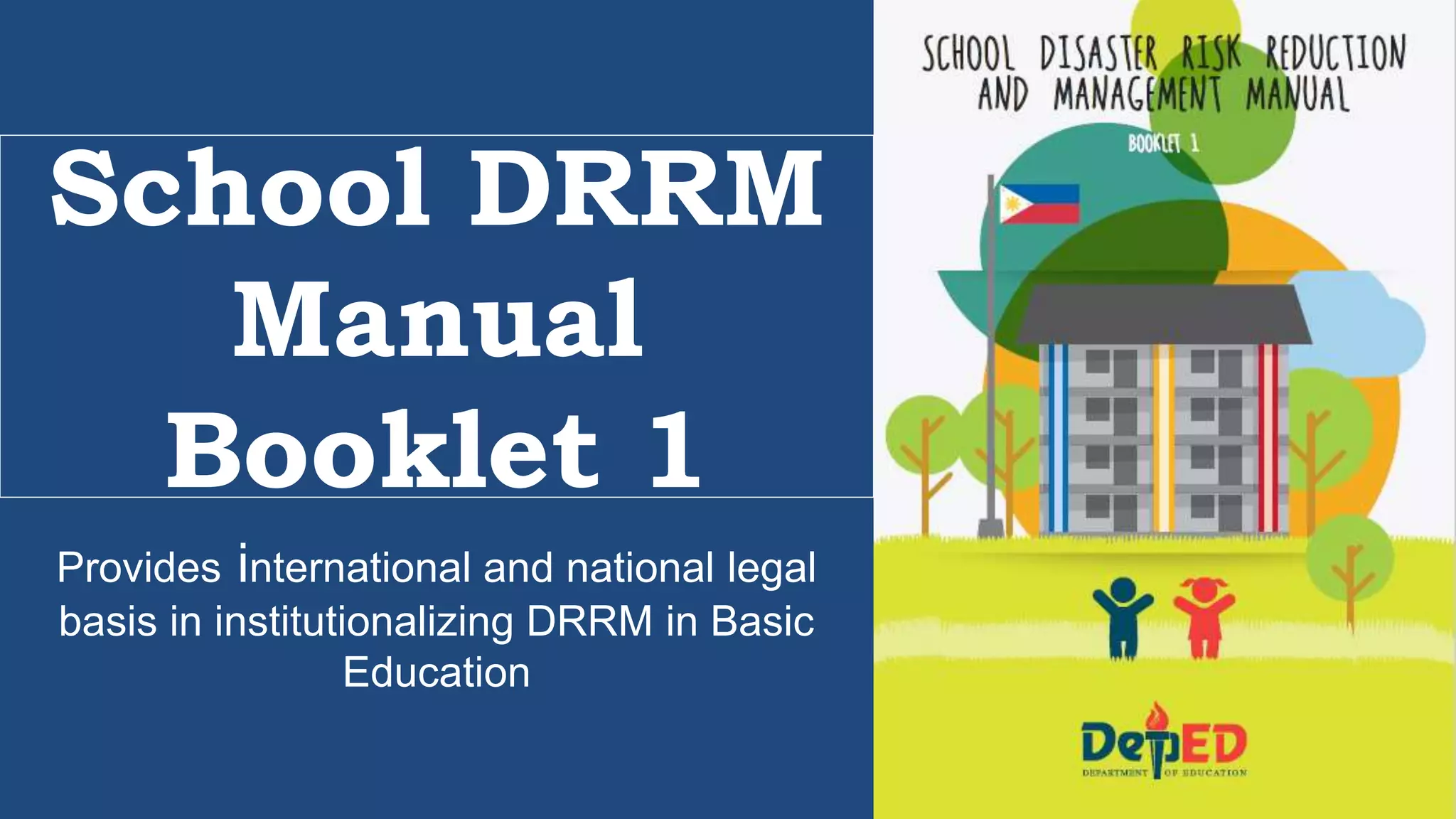
Provides international and national legal
basis in institutionalizing DRRM in Basic
Education
School DRRM
Manual
Booklet 1
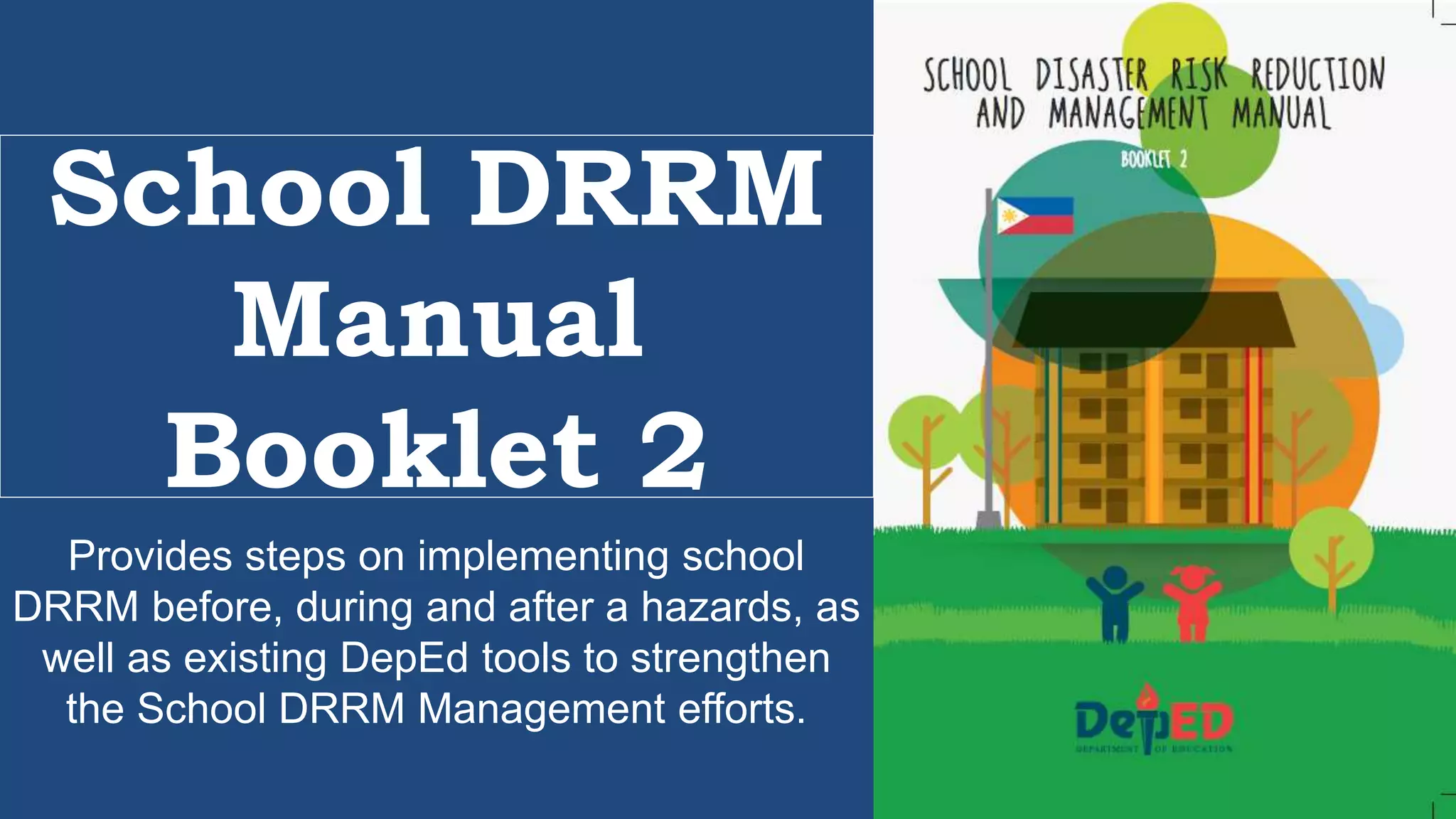
Provides steps on implementing school
DRRM before, during and after a hazards, as
well as existing DepEd tools to strengthen
the School DRRM Management efforts.
School DRRM
Manual
Booklet 2
DEPARTMENT OF EDUCATION 8
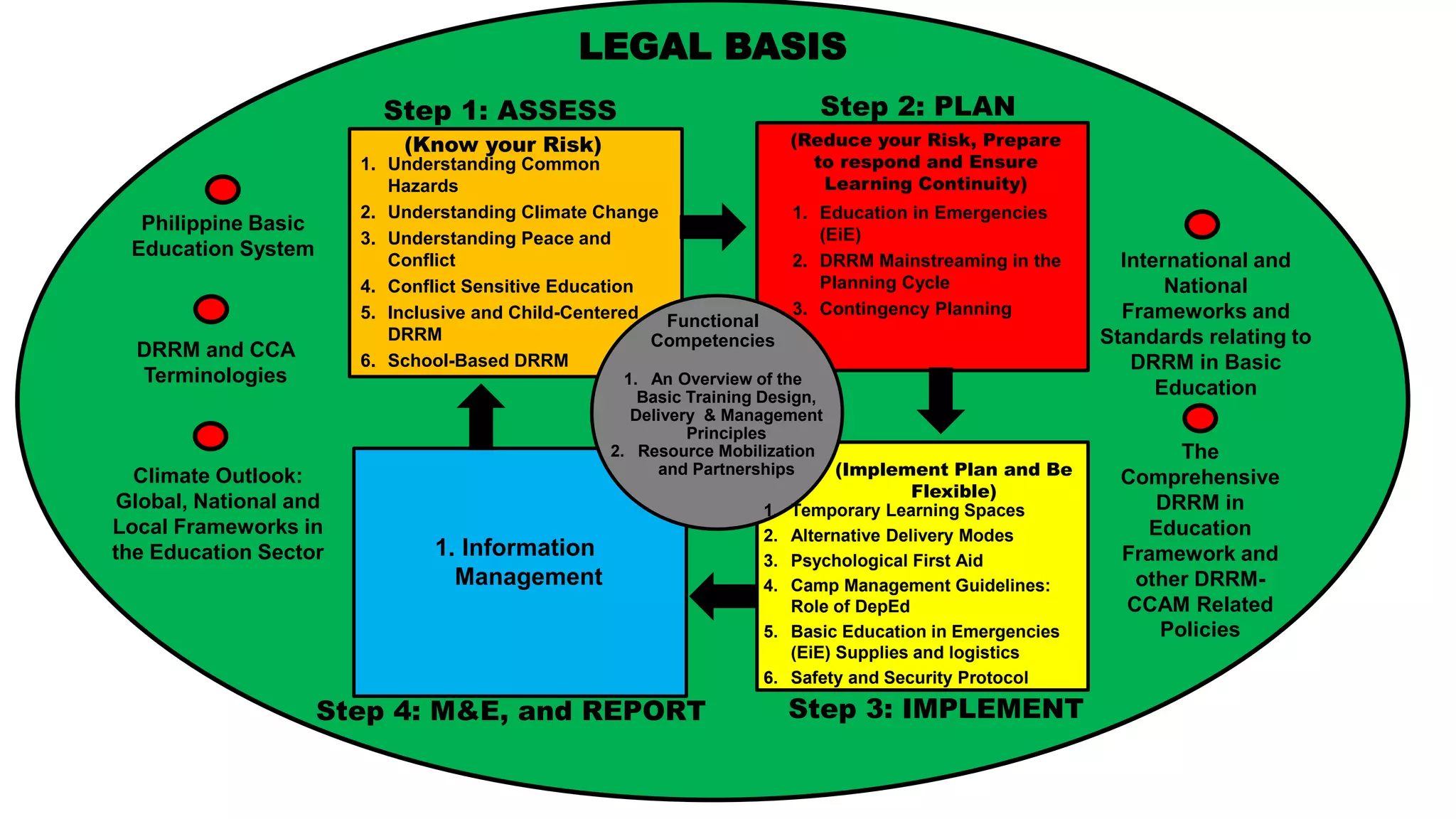
Step 1: ASSESS Step 2: PLAN
Step 3: IMPLEMENT
Step 4: M&E, and REPORT
1. Understanding Common
Hazards
2. Understanding Climate Change
3. Understanding Peace and
Conflict
4. Conflict Sensitive Education
5. Inclusive and Child-Centered
DRRM
6. School-Based DRRM
1. Education in Emergencies
(EiE)
2. DRRM Mainstreaming in the
Planning Cycle
3. Contingency Planning
(Know your Risk) (Reduce your Risk, Prepare
to respond and Ensure
Learning Continuity)
(Implement Plan and Be
Flexible)
1. Temporary Learning Spaces
2. Alternative Delivery Modes
3. Psychological First Aid
4. Camp Management Guidelines:
Role of DepEd
5. Basic Education in Emergencies
(EiE) Supplies and logistics
6. Safety and Security Protocol
Functional
Competencies
1. An Overview of the
Basic Training Design,
Delivery & Management
Principles
2. Resource Mobilization
and Partnerships
Philippine Basic
Education System
International and
National
Frameworks and
Standards relating to
DRRM in Basic
Education
DRRM and CCA
Terminologies
The
Comprehensive
DRRM in
Education
Framework and
other DRRM-
CCAM Related
Policies
LEGAL BASIS
1. Information
Management
Climate Outlook:
Global, National and
Local Frameworks in
the Education Sector
DEPARTMENT OF EDUCATION
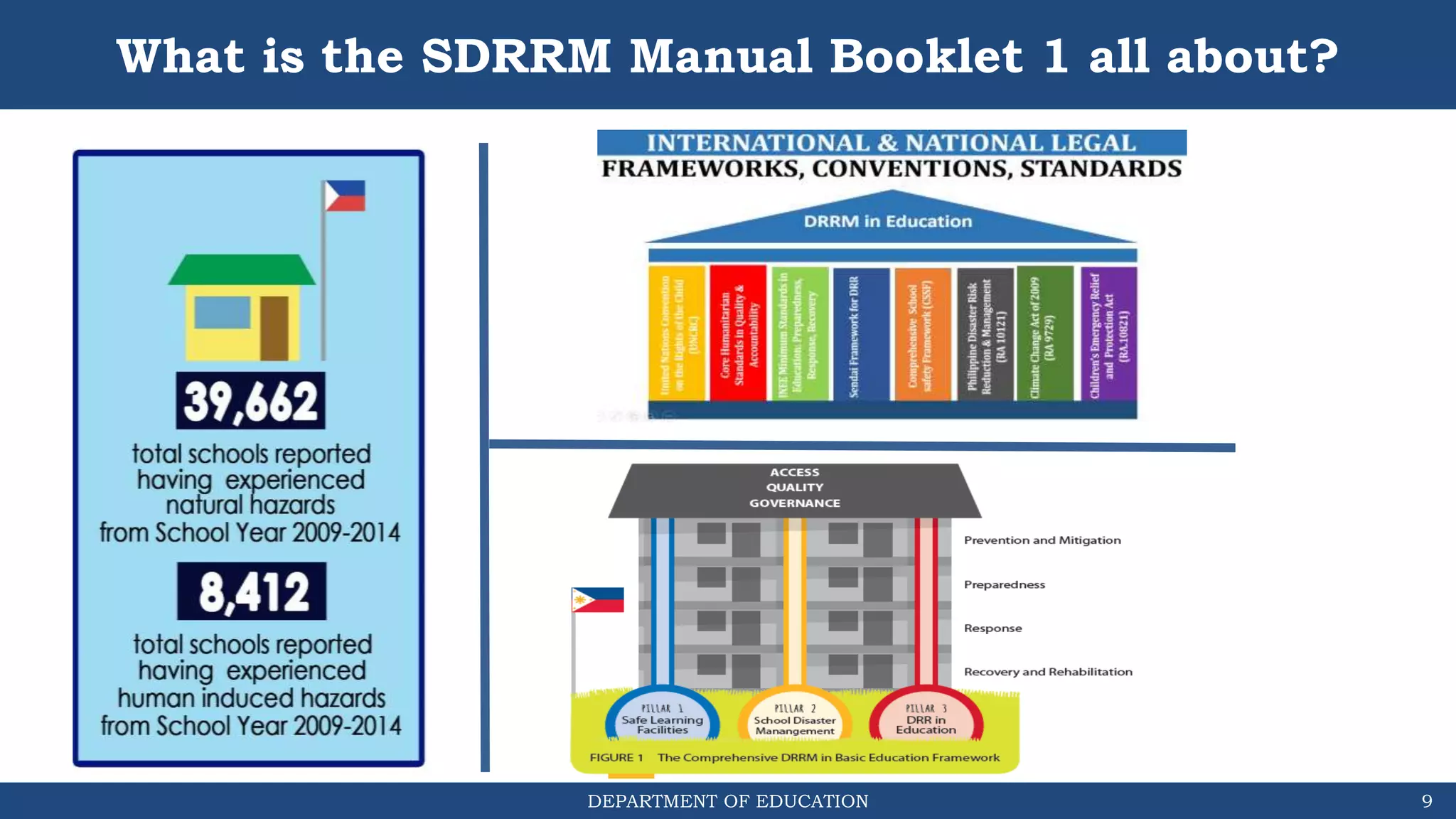
What is the SDRRM Manual Booklet 1 all about?
9
How DRRM Modules
Support SDRRM
Manual?
DEPARTMENT OF EDUCATION
Competencies Provided by DRRM Modules
1. Philippine Basic Education System
• Locate DRRM and its relevance in the entire DepEd System
• Learn about partnership of DRRMS with different bureaus/offices of
DepEd
2. DRRM and CCA Terminologies
• Present the DRRM and CC agreed definitions according to RA 10121-
Philippine Disaster Risk Reduction and Management Act of 2010, the
2009 UNISDR Terminology on Disaster Risk Reduction, the
Intergovernmental Panel on Climate Change (IPCC), and the United
Nations Framework Convention on Climate Change (UNFCCC);
• Gain understanding and right application of the DRRM and CC related
terminologies;
11
DEPARTMENT OF EDUCATION
Competencies Provided by DRRM Modules
3. International and National Frameworks and Standards relating to DRRM in
Basic Education
• Gain familiarization and understanding of the different international and national
frameworks, conventions and standards in DRRM, and how these relate to DRRM
in Basic Education.
4. The Comprehensive DRRM in Education Framework and other DRRM-
CCAM Related Policies
• Provide guidance on how DepEd localized these frameworks through DO 37, s.
2015, as well as other DepEd DRRM-CCAM policies
5. Climate Outlook: Global, National and Local Frameworks in the
Education Sector
• Relevance of integrating climate change issues in the formulation of public policies,
particularly in the education sector.
12
DEPARTMENT OF EDUCATION
What is SDRRM MANUAL BOOKLET 2 all about?
13
What are the
4 steps
in implementing
School DRRM?
STEP1: ASSESS
STEP3:
IMPLEMENT
PLAN
STEP4:
MONITOR,
EVALUATE, &
REPORT
PREPAREDNESS/RESPONSE/EARLY RECOVERY:
BEFORE/DURING/AFTER A DISASTER
STEP2: PLAN
STEP1: ASSESS
Know your risks
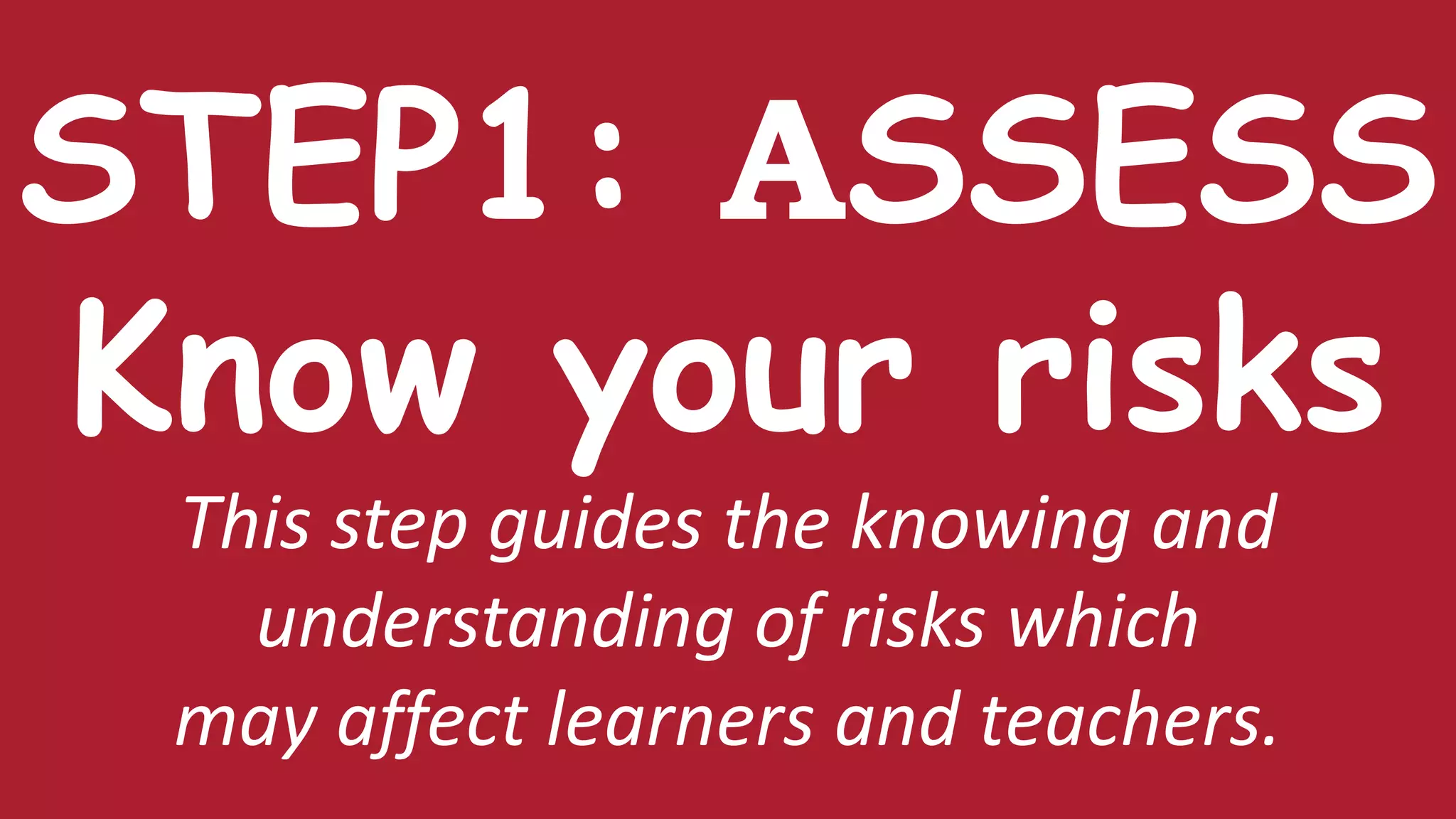
This step guides the knowing and
understanding of risks which
may affect learners and teachers.
DEPARTMENT OF EDUCATION
Competencies Provided by DRRM Modules
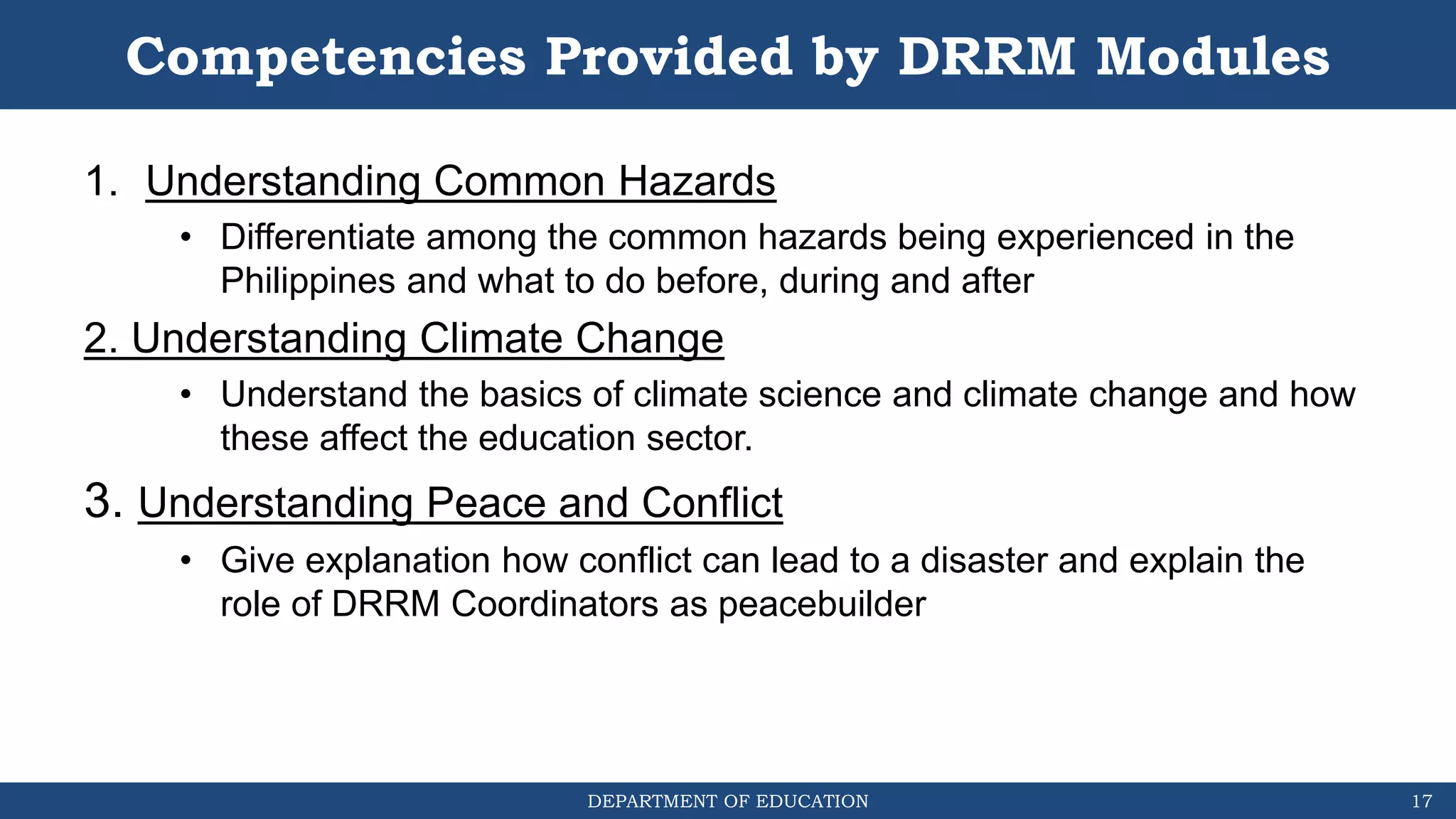
1. Understanding Common Hazards
• Differentiate among the common hazards being experienced in the
Philippines and what to do before, during and after
2. Understanding Climate Change
• Understand the basics of climate science and climate change and how
these affect the education sector.
3. Understanding Peace and Conflict
• Give explanation how conflict can lead to a disaster and explain the
role of DRRM Coordinators as peacebuilder
17
DEPARTMENT OF EDUCATION
Competencies Provided by DRRM Modules
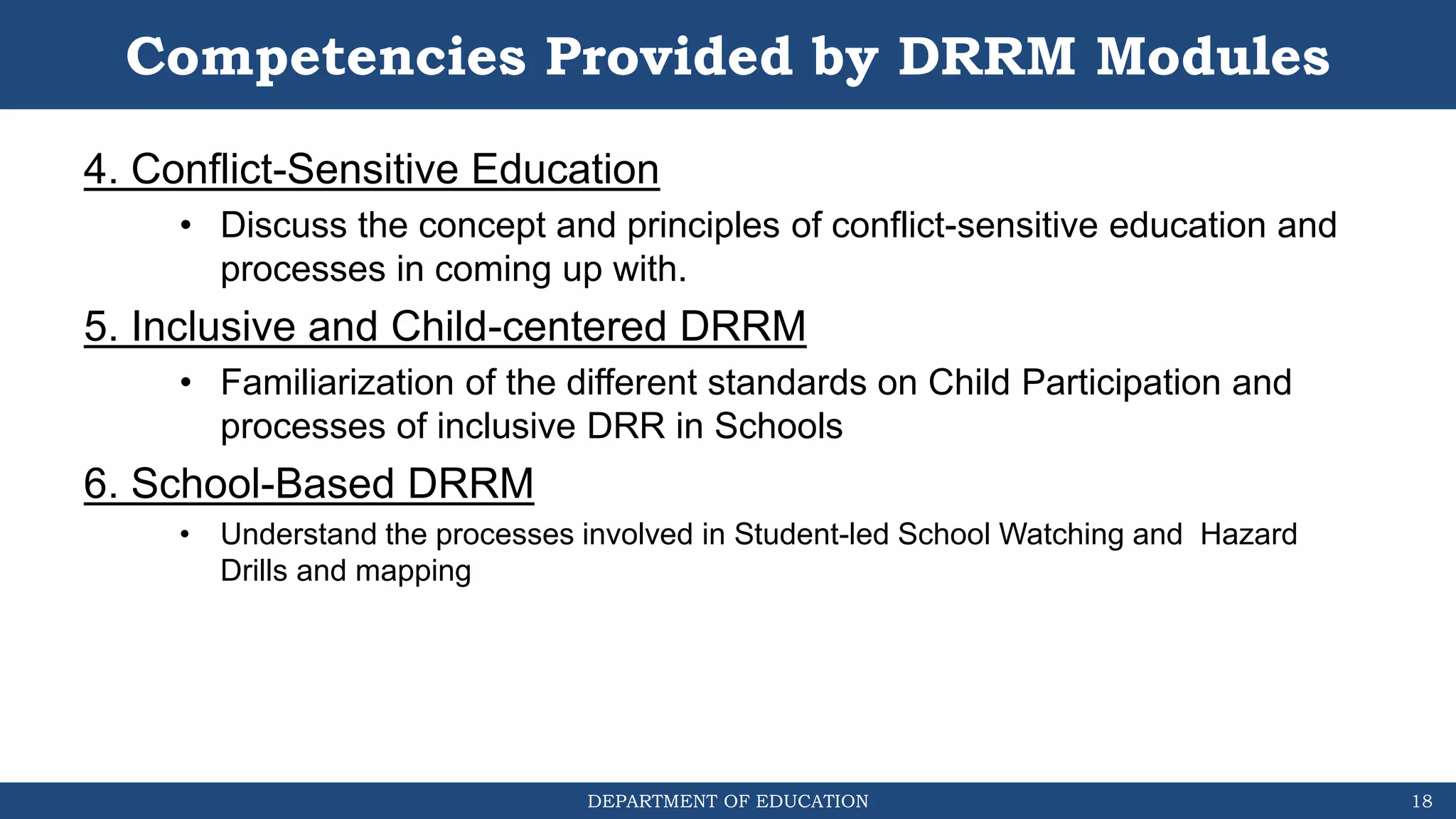
4. Conflict-Sensitive Education
• Discuss the concept and principles of conflict-sensitive education and
processes in coming up with.
5. Inclusive and Child-centered DRRM
• Familiarization of the different standards on Child Participation and
processes of inclusive DRR in Schools
6. School-Based DRRM
• Understand the processes involved in Student-led School Watching and Hazard
Drills and mapping
18
STEP2: PLAN
(Reduce your risks
Prepare to respond
Ensure educational continuity)
DEPARTMENT OF EDUCATION
Competencies Provided by DRRM Modules
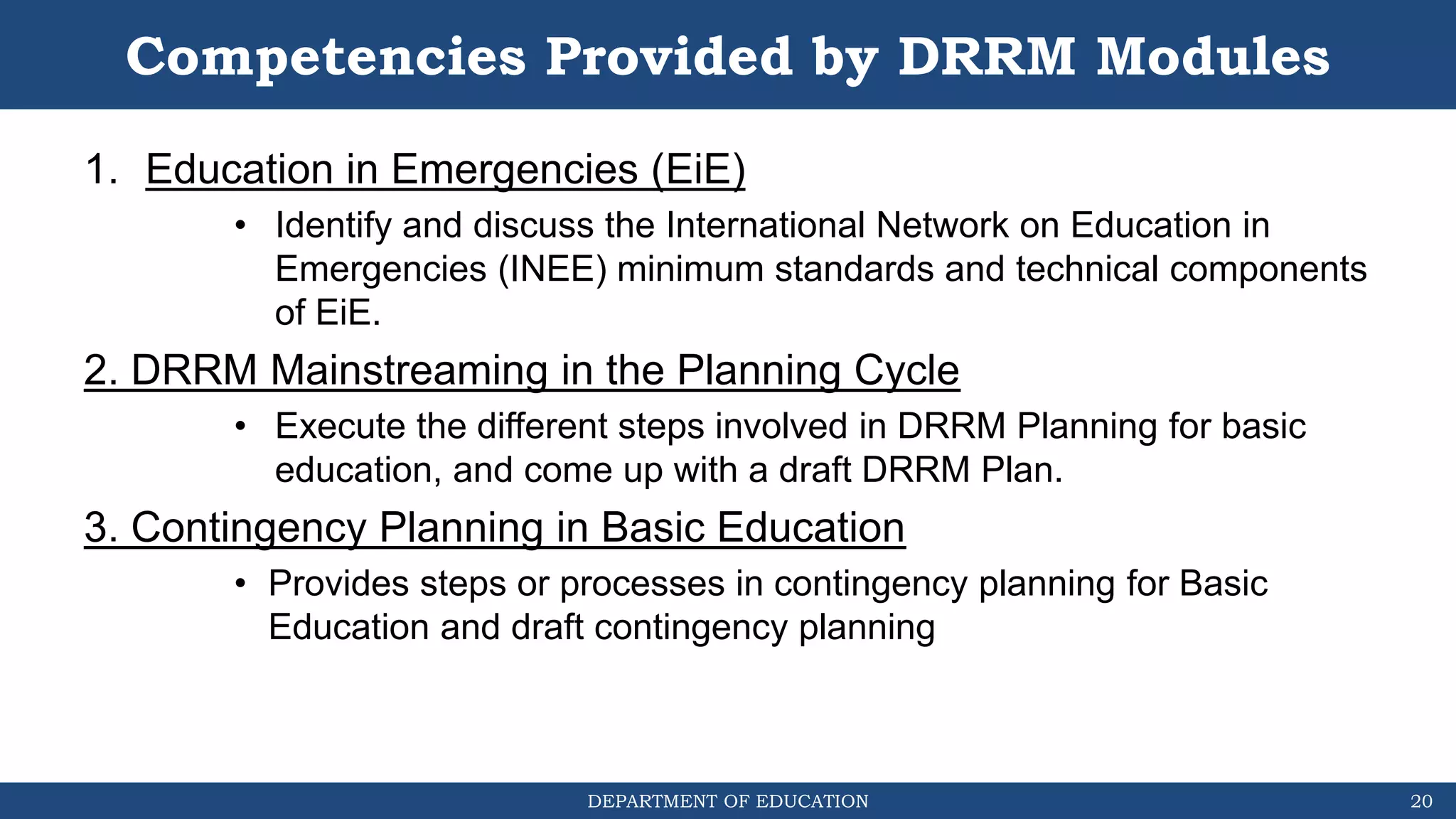
1. Education in Emergencies (EiE)
• Identify and discuss the International Network on Education in
Emergencies (INEE) minimum standards and technical components
of EiE.
2. DRRM Mainstreaming in the Planning Cycle
• Execute the different steps involved in DRRM Planning for basic
education, and come up with a draft DRRM Plan.
3. Contingency Planning in Basic Education
• Provides steps or processes in contingency planning for Basic
Education and draft contingency planning
20
STEP3:
IMPLEMENT
PLAN & BE
FLEXIBLE
DEPARTMENT OF EDUCATION
Competencies Provided by DRRM Modules
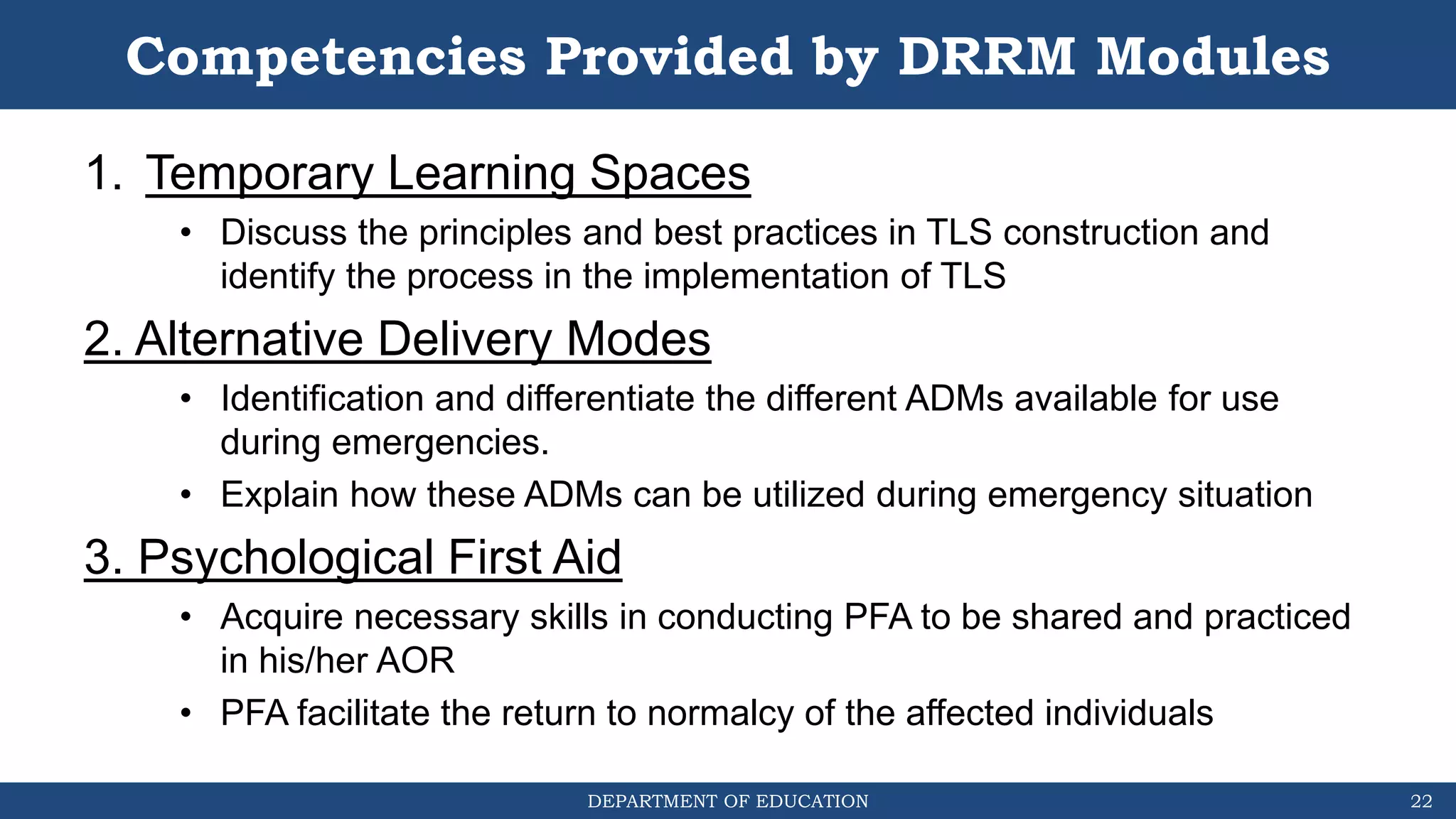
1. Temporary Learning Spaces
• Discuss the principles and best practices in TLS construction and
identify the process in the implementation of TLS
2. Alternative Delivery Modes
• Identification and differentiate the different ADMs available for use
during emergencies.
• Explain how these ADMs can be utilized during emergency situation
3. Psychological First Aid
• Acquire necessary skills in conducting PFA to be shared and practiced
in his/her AOR
• PFA facilitate the return to normalcy of the affected individuals
22
DEPARTMENT OF EDUCATION
Competencies Provided by DRRM Modules
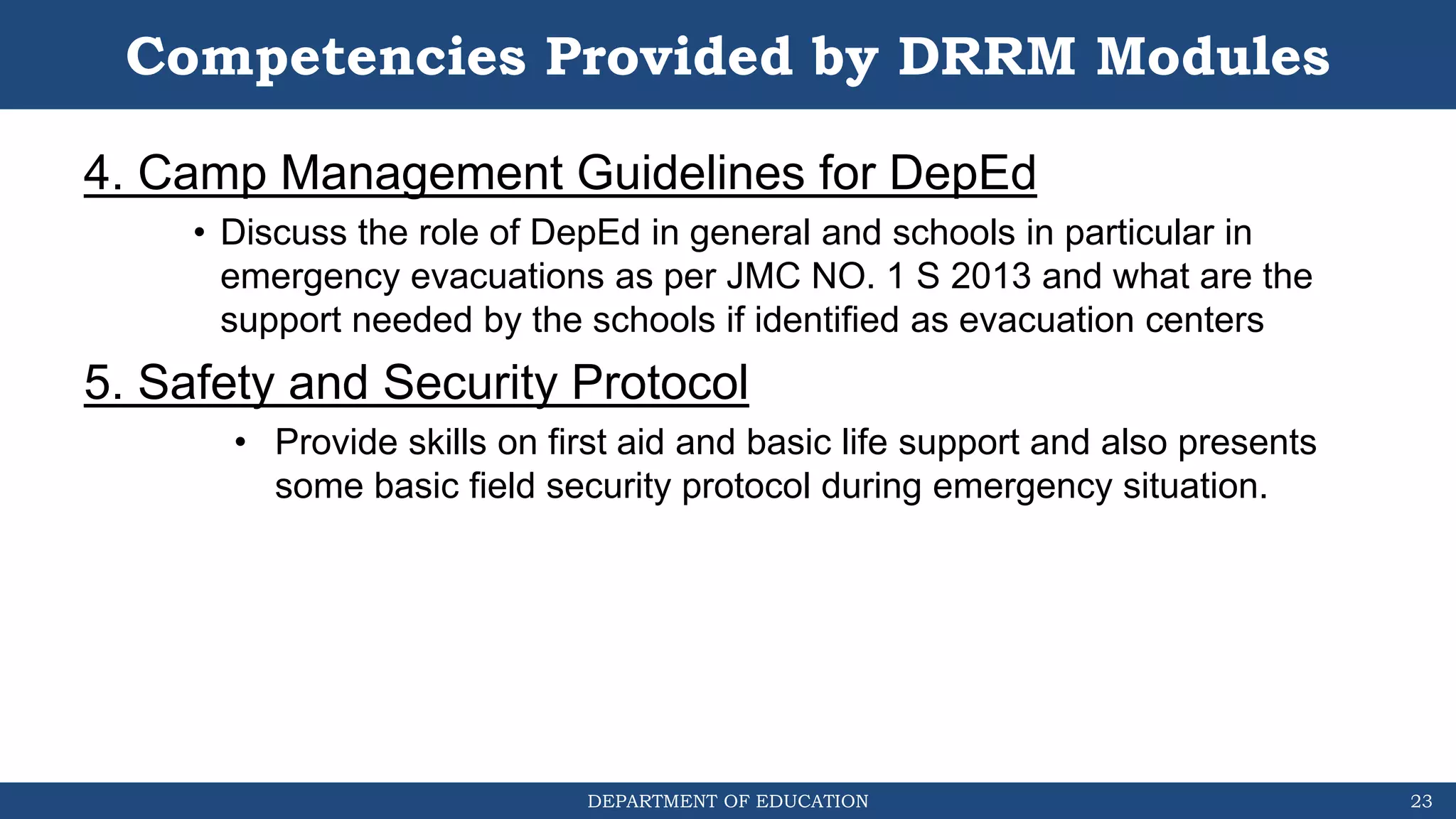
4. Camp Management Guidelines for DepEd
• Discuss the role of DepEd in general and schools in particular in
emergency evacuations as per JMC NO. 1 S 2013 and what are the
support needed by the schools if identified as evacuation centers
5. Safety and Security Protocol
• Provide skills on first aid and basic life support and also presents
some basic field security protocol during emergency situation.
23
STEP4:
MONITOR,
EVALUATE &
REPORT
DEPARTMENT OF EDUCATION
Competencies Provided by DRRM Modules
1. Information Management
• Explain the importance of information management in DRRM
• Understanding how RADaR works
25
DEPARTMENT OF EDUCATION
Synthesis
1. Capacity building plays an important role in carrying out
the roles and responsibilities of the DRRM Coordinators;
and
2. The support of the schools through the implementation of
the SDRRM Manual contributes to the accomplishments
of the different frameworks, conventions and standards
in DRRM in Basic Education.
26
20170927_DRRMS_SDRRM Manual in Relation to DRRM Modules.pptx

20170927_DRRMS_SDRRM Manual in Relation to DRRM Modules.pptx

  • 1.
    The DRRM Modulesin Relation to School Disaster Risk Reduction Management (SDRRM) Manual
  • 2.
    DEPARTMENT OF EDUCATION Objectives •To be familiarized of the features of School Disaster Risk Reduction Manual, Booklet 1 & 2; • To know how DRRM Modules supplement the content of the manuals in order to support the schools in the DRRM implementation process; and 2
  • 3.
    How do youimplement DRRM in your school?
  • 4.
    What are theDRRM policies/programs/ activities you do/use to ensure safety and learning continuity in your school?
  • 5.
    DEPARTMENT OF EDUCATION Purposeof SDRRM Manual • To serve as a common template for localization, contextualization, and adaptation at the sub-national context. • It is expected that the content will be reviewed by education and disaster management authorities, and education sector partners working on disaster and risk reduction and who have adapted policy and practices for the school environment. 5
  • 6.
    Provides international andnational legal basis in institutionalizing DRRM in Basic Education School DRRM Manual Booklet 1
  • 7.
    Provides steps onimplementing school DRRM before, during and after a hazards, as well as existing DepEd tools to strengthen the School DRRM Management efforts. School DRRM Manual Booklet 2
  • 8.
    DEPARTMENT OF EDUCATION8 Step 1: ASSESS Step 2: PLAN Step 3: IMPLEMENT Step 4: M&E, and REPORT 1. Understanding Common Hazards 2. Understanding Climate Change 3. Understanding Peace and Conflict 4. Conflict Sensitive Education 5. Inclusive and Child-Centered DRRM 6. School-Based DRRM 1. Education in Emergencies (EiE) 2. DRRM Mainstreaming in the Planning Cycle 3. Contingency Planning (Know your Risk) (Reduce your Risk, Prepare to respond and Ensure Learning Continuity) (Implement Plan and Be Flexible) 1. Temporary Learning Spaces 2. Alternative Delivery Modes 3. Psychological First Aid 4. Camp Management Guidelines: Role of DepEd 5. Basic Education in Emergencies (EiE) Supplies and logistics 6. Safety and Security Protocol Functional Competencies 1. An Overview of the Basic Training Design, Delivery & Management Principles 2. Resource Mobilization and Partnerships Philippine Basic Education System International and National Frameworks and Standards relating to DRRM in Basic Education DRRM and CCA Terminologies The Comprehensive DRRM in Education Framework and other DRRM- CCAM Related Policies LEGAL BASIS 1. Information Management Climate Outlook: Global, National and Local Frameworks in the Education Sector
  • 9.
    DEPARTMENT OF EDUCATION Whatis the SDRRM Manual Booklet 1 all about? 9
  • 10.
  • 11.
    DEPARTMENT OF EDUCATION CompetenciesProvided by DRRM Modules 1. Philippine Basic Education System • Locate DRRM and its relevance in the entire DepEd System • Learn about partnership of DRRMS with different bureaus/offices of DepEd 2. DRRM and CCA Terminologies • Present the DRRM and CC agreed definitions according to RA 10121- Philippine Disaster Risk Reduction and Management Act of 2010, the 2009 UNISDR Terminology on Disaster Risk Reduction, the Intergovernmental Panel on Climate Change (IPCC), and the United Nations Framework Convention on Climate Change (UNFCCC); • Gain understanding and right application of the DRRM and CC related terminologies; 11
  • 12.
    DEPARTMENT OF EDUCATION CompetenciesProvided by DRRM Modules 3. International and National Frameworks and Standards relating to DRRM in Basic Education • Gain familiarization and understanding of the different international and national frameworks, conventions and standards in DRRM, and how these relate to DRRM in Basic Education. 4. The Comprehensive DRRM in Education Framework and other DRRM- CCAM Related Policies • Provide guidance on how DepEd localized these frameworks through DO 37, s. 2015, as well as other DepEd DRRM-CCAM policies 5. Climate Outlook: Global, National and Local Frameworks in the Education Sector • Relevance of integrating climate change issues in the formulation of public policies, particularly in the education sector. 12
  • 13.
    DEPARTMENT OF EDUCATION Whatis SDRRM MANUAL BOOKLET 2 all about? 13
  • 14.
    What are the 4steps in implementing School DRRM?
  • 15.
  • 16.
    STEP1: ASSESS Know yourrisks This step guides the knowing and understanding of risks which may affect learners and teachers.
  • 17.
    DEPARTMENT OF EDUCATION CompetenciesProvided by DRRM Modules 1. Understanding Common Hazards • Differentiate among the common hazards being experienced in the Philippines and what to do before, during and after 2. Understanding Climate Change • Understand the basics of climate science and climate change and how these affect the education sector. 3. Understanding Peace and Conflict • Give explanation how conflict can lead to a disaster and explain the role of DRRM Coordinators as peacebuilder 17
  • 18.
    DEPARTMENT OF EDUCATION CompetenciesProvided by DRRM Modules 4. Conflict-Sensitive Education • Discuss the concept and principles of conflict-sensitive education and processes in coming up with. 5. Inclusive and Child-centered DRRM • Familiarization of the different standards on Child Participation and processes of inclusive DRR in Schools 6. School-Based DRRM • Understand the processes involved in Student-led School Watching and Hazard Drills and mapping 18
  • 19.
    STEP2: PLAN (Reduce yourrisks Prepare to respond Ensure educational continuity)
  • 20.
    DEPARTMENT OF EDUCATION CompetenciesProvided by DRRM Modules 1. Education in Emergencies (EiE) • Identify and discuss the International Network on Education in Emergencies (INEE) minimum standards and technical components of EiE. 2. DRRM Mainstreaming in the Planning Cycle • Execute the different steps involved in DRRM Planning for basic education, and come up with a draft DRRM Plan. 3. Contingency Planning in Basic Education • Provides steps or processes in contingency planning for Basic Education and draft contingency planning 20
  • 21.
  • 22.
    DEPARTMENT OF EDUCATION CompetenciesProvided by DRRM Modules 1. Temporary Learning Spaces • Discuss the principles and best practices in TLS construction and identify the process in the implementation of TLS 2. Alternative Delivery Modes • Identification and differentiate the different ADMs available for use during emergencies. • Explain how these ADMs can be utilized during emergency situation 3. Psychological First Aid • Acquire necessary skills in conducting PFA to be shared and practiced in his/her AOR • PFA facilitate the return to normalcy of the affected individuals 22
  • 23.
    DEPARTMENT OF EDUCATION CompetenciesProvided by DRRM Modules 4. Camp Management Guidelines for DepEd • Discuss the role of DepEd in general and schools in particular in emergency evacuations as per JMC NO. 1 S 2013 and what are the support needed by the schools if identified as evacuation centers 5. Safety and Security Protocol • Provide skills on first aid and basic life support and also presents some basic field security protocol during emergency situation. 23
  • 24.
  • 25.
    DEPARTMENT OF EDUCATION CompetenciesProvided by DRRM Modules 1. Information Management • Explain the importance of information management in DRRM • Understanding how RADaR works 25
  • 26.
    DEPARTMENT OF EDUCATION Synthesis 1.Capacity building plays an important role in carrying out the roles and responsibilities of the DRRM Coordinators; and 2. The support of the schools through the implementation of the SDRRM Manual contributes to the accomplishments of the different frameworks, conventions and standards in DRRM in Basic Education. 26

Editor's Notes

  • #8 This is the Booklet 2 of the School DRRM Manual which is for printing by Book Media.
  • #9 - Illustration of how DRRM Modules support SDRRM Manual in terms of the needed DRRM competencies by the end users in order to carry out DRRM implementation in Schools
  • #10 The SDRRM Manual Booklet 1 provides the following: What are the accompanying risk of our schools in terms on natural and humans induce hazards. What are the different international and national frameworks, conventions and standards that support DRRM in basic education. How DepEd localized these frameworks, convention and standards to help the schools in the implementation of DRRM.
  • #11 DRRM Modules support SDRRM Manual in terms of providing DRRM needed competencies to the end users (DRRM Coordinators). This is to carry out what is in the manual and what has not included in the manual that is also important in the school DRRM implementation.
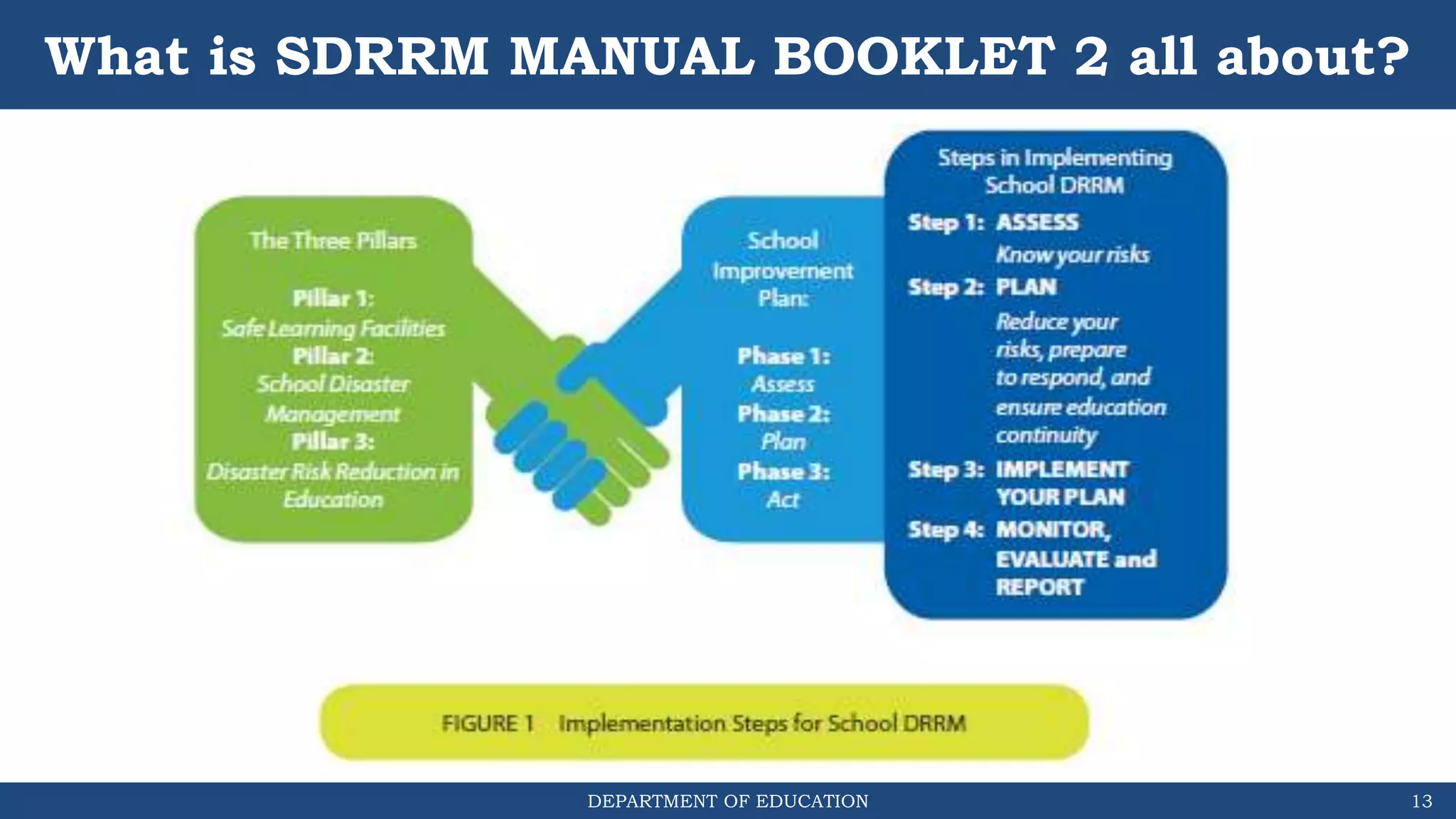
  • #14 Figure 1 illustrates the basis for Booklet 2 of the SDRRM Manual, showing the interrelationship of the three pillars of DRRM in education and implementation steps in line with the SIP cycle. Given the broad scope of DRRM in education, this is largely focused on Pillar 2. Action steps and tools provided for Pillars 1 and 3 are those related to School Disaster Management. Existing DepEd tools as well as recommended ones are in here, which may be used to strengthen school disaster management efforts.
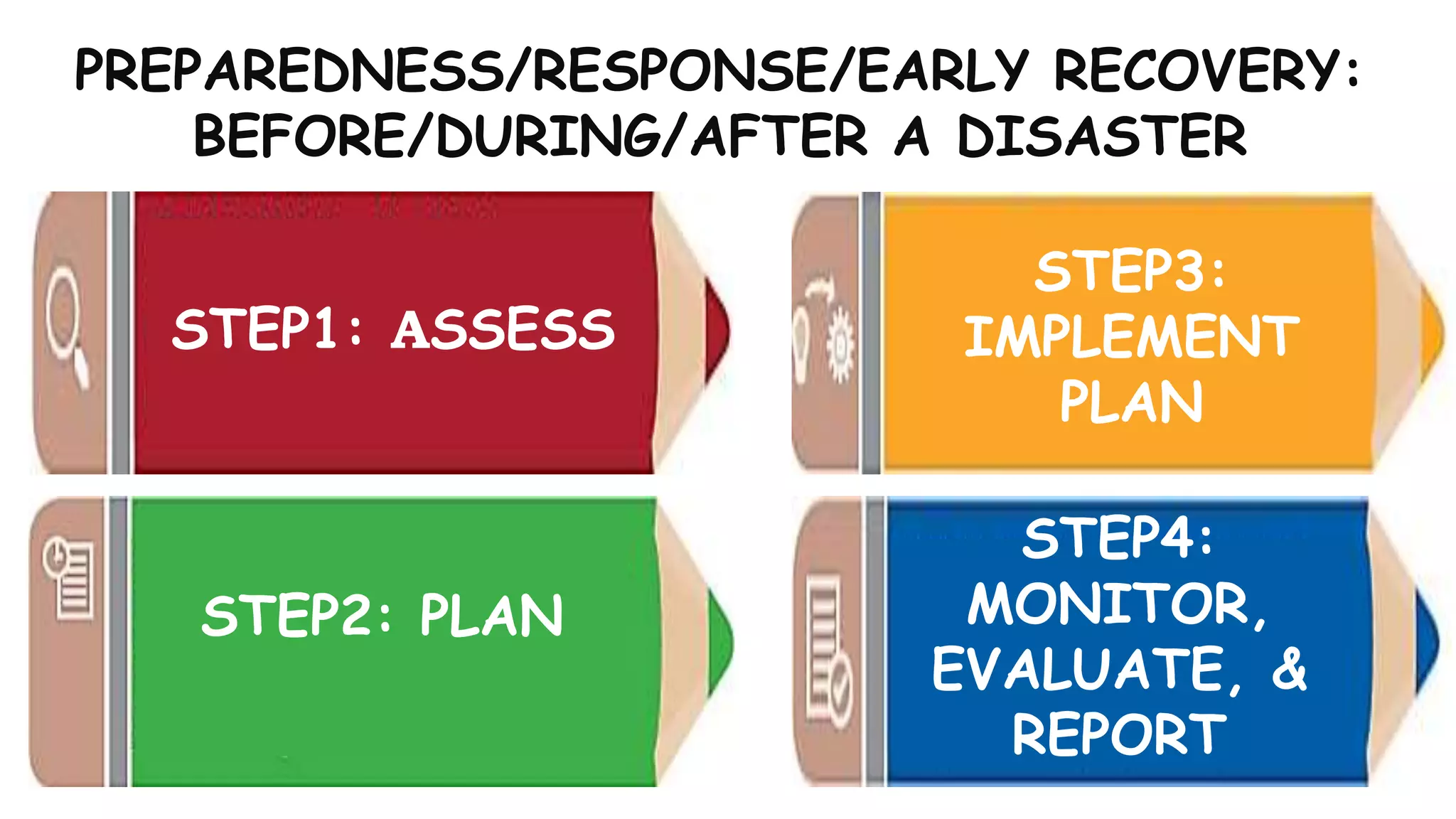
  • #16 Step 1 guides the knowing and understanding of risks which may affect learners and teachers. Step 2 involves the formulation of strategy, addressing identified risks and establishment of protocols which will be implemented before and during disasters including ensuring education continuity. Step 3 provides a list of things to consider in response to and early recovery in basic education. Step 4 puts importance in assessing the execution of plans and protocols and sharing of experiences and practices.
  • #20 After the students have presented and submitted the hazard map to the SPT and risk assessment has been completed, this maybe used in identifying action plans for the school. The integration of assessment results to the SIP should be done in consideration of the strategies among the three pillars of the Comprehensive DRRM Framework and across the four thematic areas: prevention and mitigation, preparedness, response and recovery.
  • #22 After the students have presented and submitted the hazard map to the SPT and risk assessment has been completed, this maybe used in identifying action plans for the school. The integration of assessment results to the SIP should be done in consideration of the strategies among the three pillars of the Comprehensive DRRM Framework and across the four thematic areas: prevention and mitigation, preparedness, response and recovery.
  • #25 The school DRRM team should regularly assess ALL safety and preparedness measures, including related projects and activities conducted. This is to ensure that DRRM interventions are updated, relevant and appropriate. The following checklist can be used as a starting point in reviewing school DRRM interventions: STEP 4 MONITOR, EVALUATE, AND REPORT SCHOOL DISASTER READINESS AND RESILIENCE CHECKLIST 1. Ongoing committee guides the school disaster management process An ongoing committee is tasked with leading school disaster management on an ongoing basis. School disaster management has the full support of the school leadership. School disaster management committee takes lead in ongoing planning for prevention, mitigation, response and recovery. School disaster and emergency management plan is reviewed and updated at least annually. 2. Assessment and Planning for Disaster Mitigation takes place continuously Hazards, vulnerabilities, risks, capacities and resources are researched and assessed. Mitigation measures are identified and prioritized for action. Building evacuation routes and safe assembly areas are identified. Area evacuation and safe havens for student-family reunification are identified, as needed. Educational continuity plans are in place for recurring hazards and high impact hazards (including alternate locations and transitional learning spaces as needed). 3. Physical Protection Measures are Taken to Protect Students and Staff and Facilities School buildings and grounds are maintained and repaired for disaster resilience (eg. against moisture, termites, fungus). Fire prevention and fire suppression measures are maintained and checked regularly. Safety measures related to building non-structural elements, furnishings and equipment are taken to protect students and staff from hazards within the building (especially due to earthquakes, severe weather etc.) Measures are taken to protect equipment and materials from wind and water damage (from floods, storms) After the students have presented and submitted the hazard map to the SPT and risk assessment has been completed, this maybe used in identifying action plans for the school. The integration of assessment results to the SIP should be done in consideration of the strategies among the three pillars of the Comprehensive DRRM Framework and across the four thematic areas: prevention and mitigation, preparedness, response and recovery.