Bibhuti Bhusan Gadanayak
Senior Technical Advisor, DRM & Emergency
UNDP – MINEMA, Kigali – Nyarugemge
KN 3 Rd. – KN 1 Av – Pension Plazza
Rwanda
Presented before the students of PG Department of
Social Work, NISWASS, Utkal University, Odisha, India on 9th April 2023
CONTENTS
• Disaster Management: Definition, Typology of
disasters, major disasters in India
• Disaster Management Cycle: Paradigm Shift in
Disaster Management, Pre-Disaster – Risk
Assessment and Analysis, Risk Mapping: Zonation
and Microzonation, Prevention and Mitigation of
Disasters, Early Warning System; Preparedness,
Capacity Development; Awareness. During Disaster
– Evacuation – Disaster Communication – Search
and Rescue – Emergency Operation Centre –
Incident Command System – Relief and
Rehabilitation.
• Post-disaster – Damage and Needs Assessment,
Restoration of Critical Infrastructure – Early
Recovery – Reconstruction and Redevelopment.
Disaster Management: Definition,
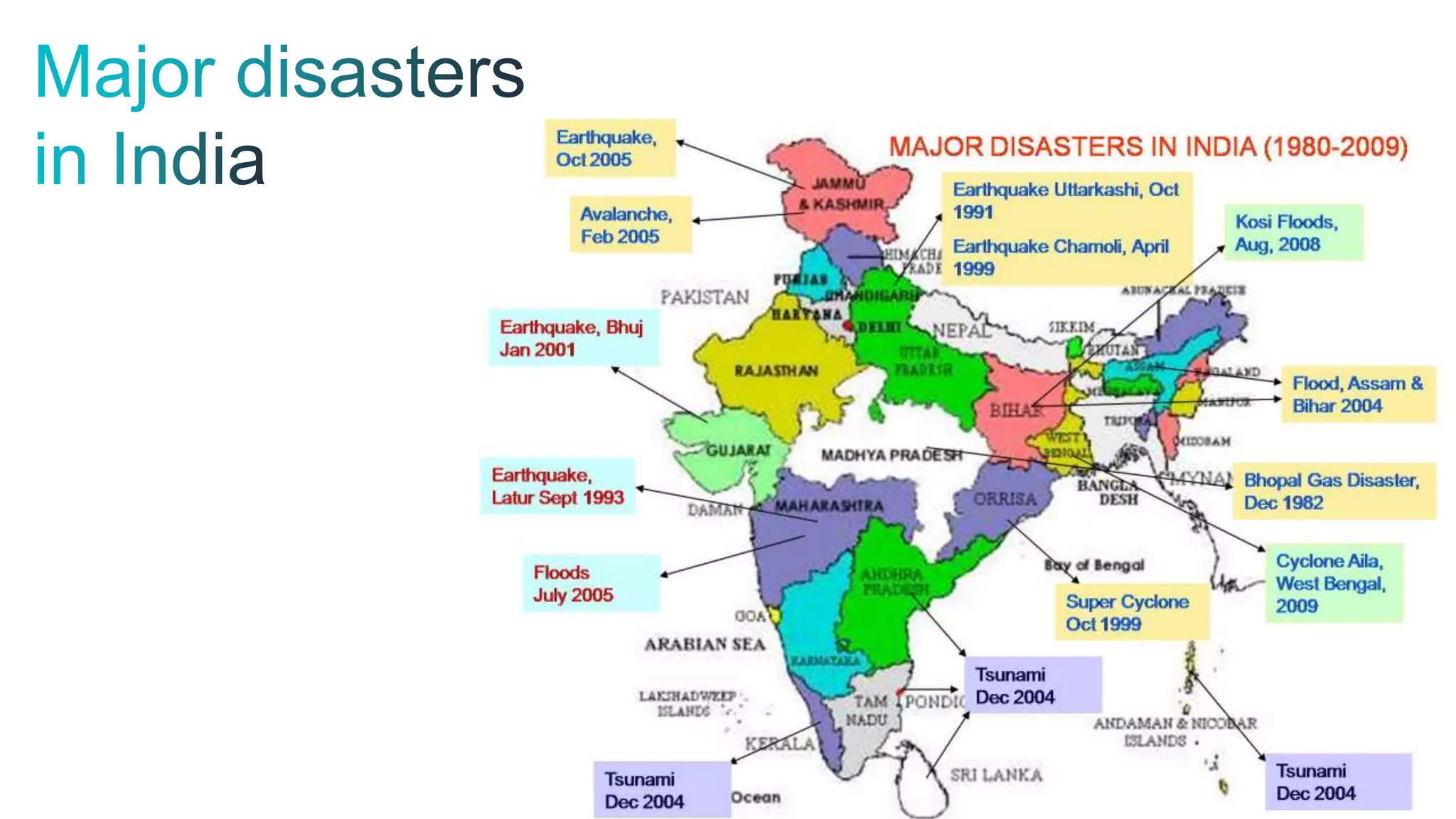
Typology of disasters, major disasters in
India
Disaster management is a collective term encompassing all aspects of planning for and
responding to
emergencies and disasters, including both pre- and post-event activities. It refers to the
management of
both the risk and the consequences of an event.
Disaster Management is the collective term for all activities that contribute to increasing
capacities and will
lead to reducing immediate and long-term vulnerabilities. It covers activities before,
during and after a
disaster.
In essence, disaster management is more than just response and relief; it is a systematic
process aimed at reducing the negative impact and/or consequences of adverse events.
https://www.linkedin.com/pulse/disaster-management-definition-process-various-
phases-chatterjee/
The organization, planning and application of measures preparing for, responding to and
recovering from disasters.
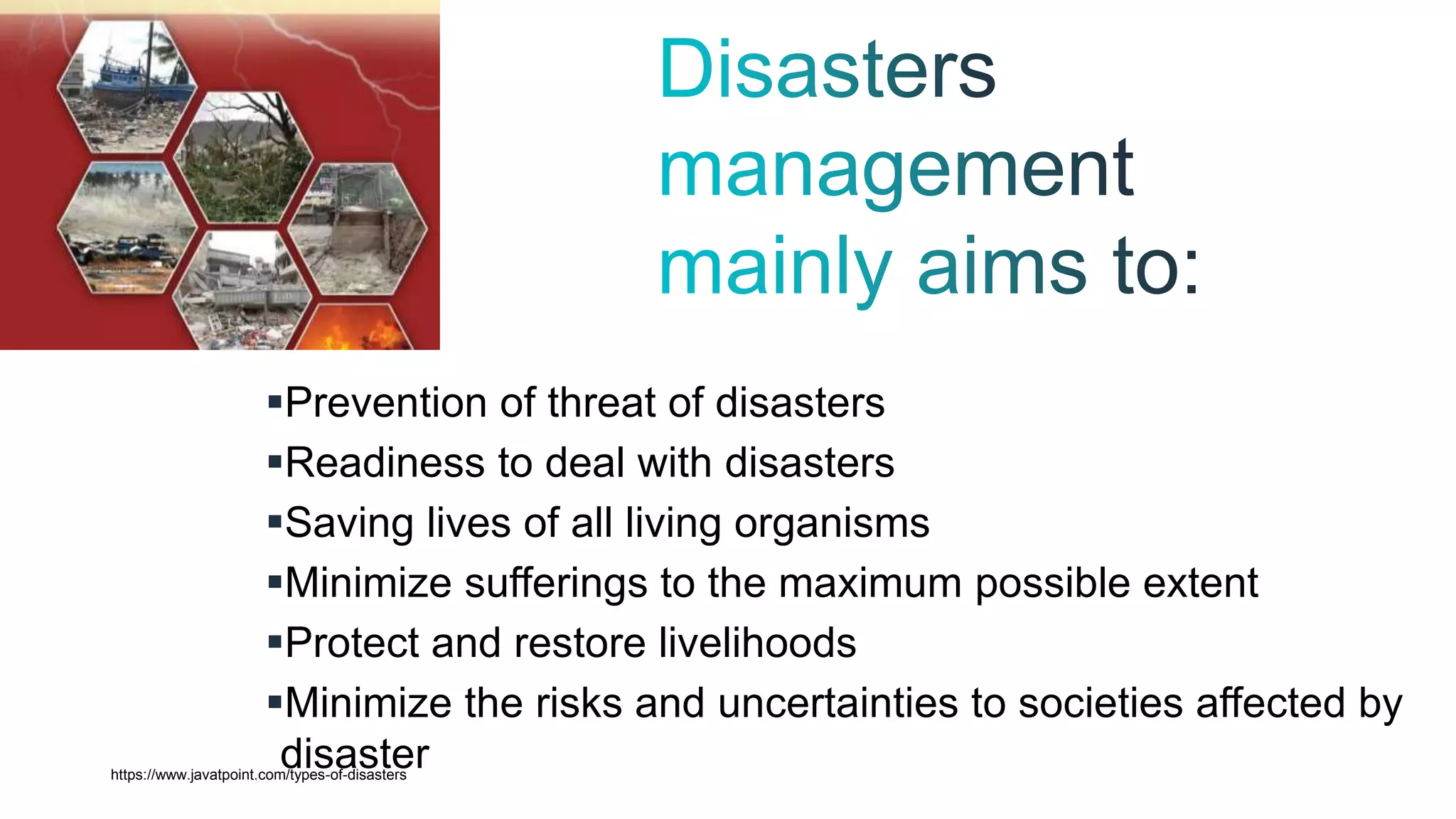
Prevention of threat of disasters
Readiness to deal with disasters
Saving lives of all living organisms
Minimize sufferings to the maximum possible extent
Protect and restore livelihoods
Minimize the risks and uncertainties to societies affected by
disaster
https://www.javatpoint.com/types-of-disasters
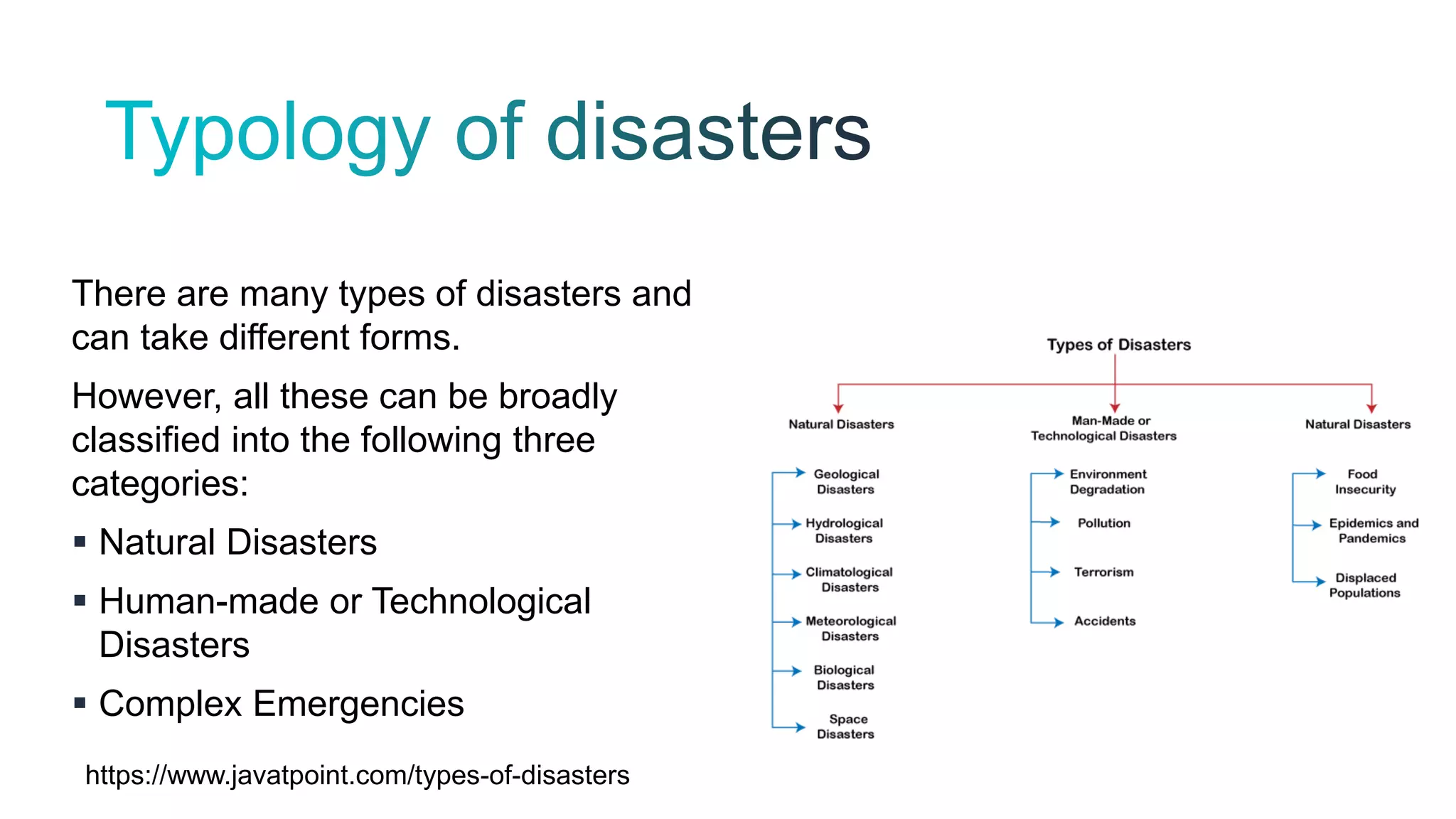
There are many types of disasters and
can take different forms.
However, all these can be broadly
classified into the following three
categories:
 Natural Disasters
 Human-made or Technological
Disasters
 Complex Emergencies
https://www.javatpoint.com/types-of-disasters
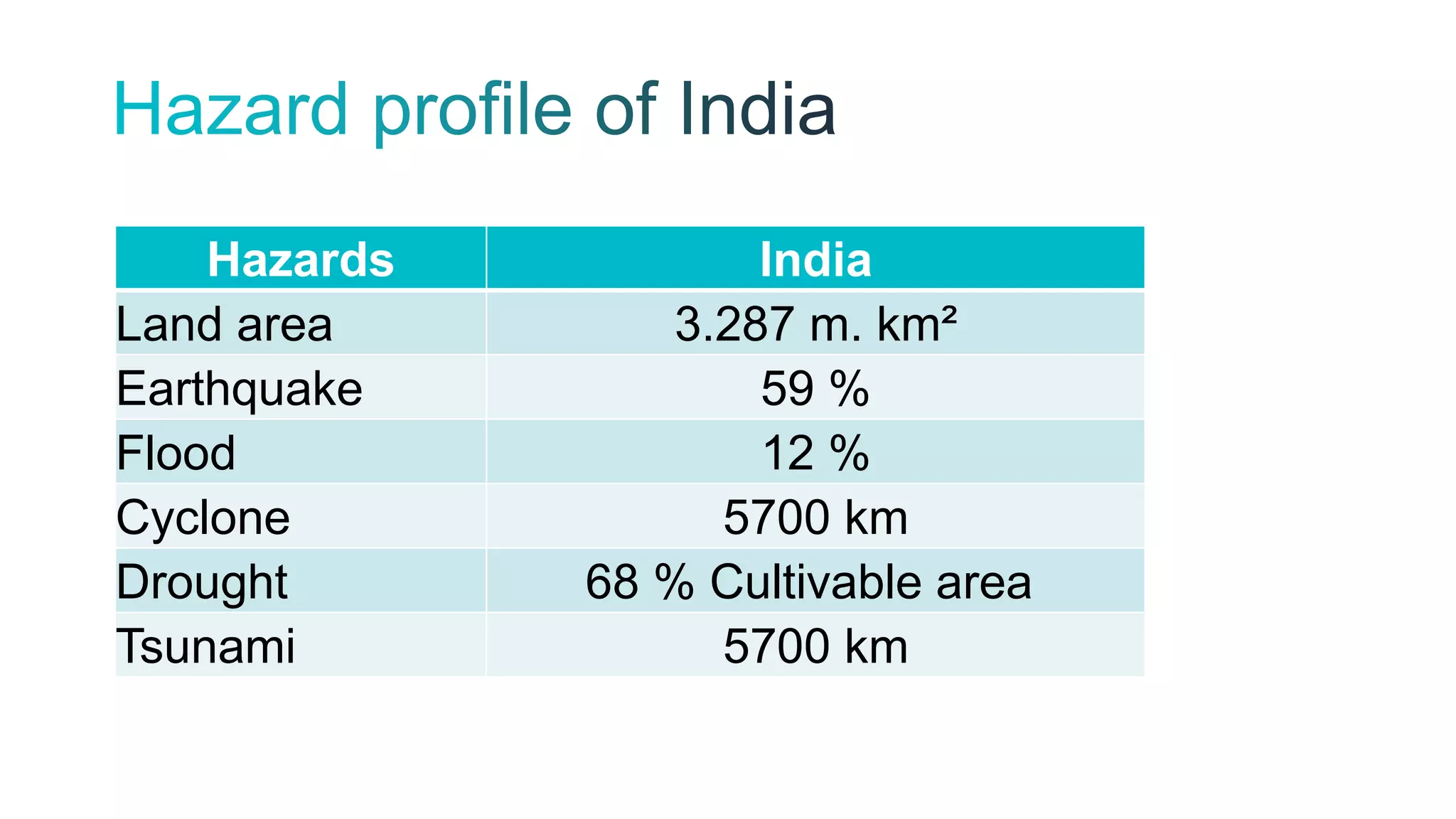
Hazards India
Land area 3.287 m. km²
Earthquake 59 %
Flood 12 %
Cyclone 5700 km
Drought 68 % Cultivable area
Tsunami 5700 km
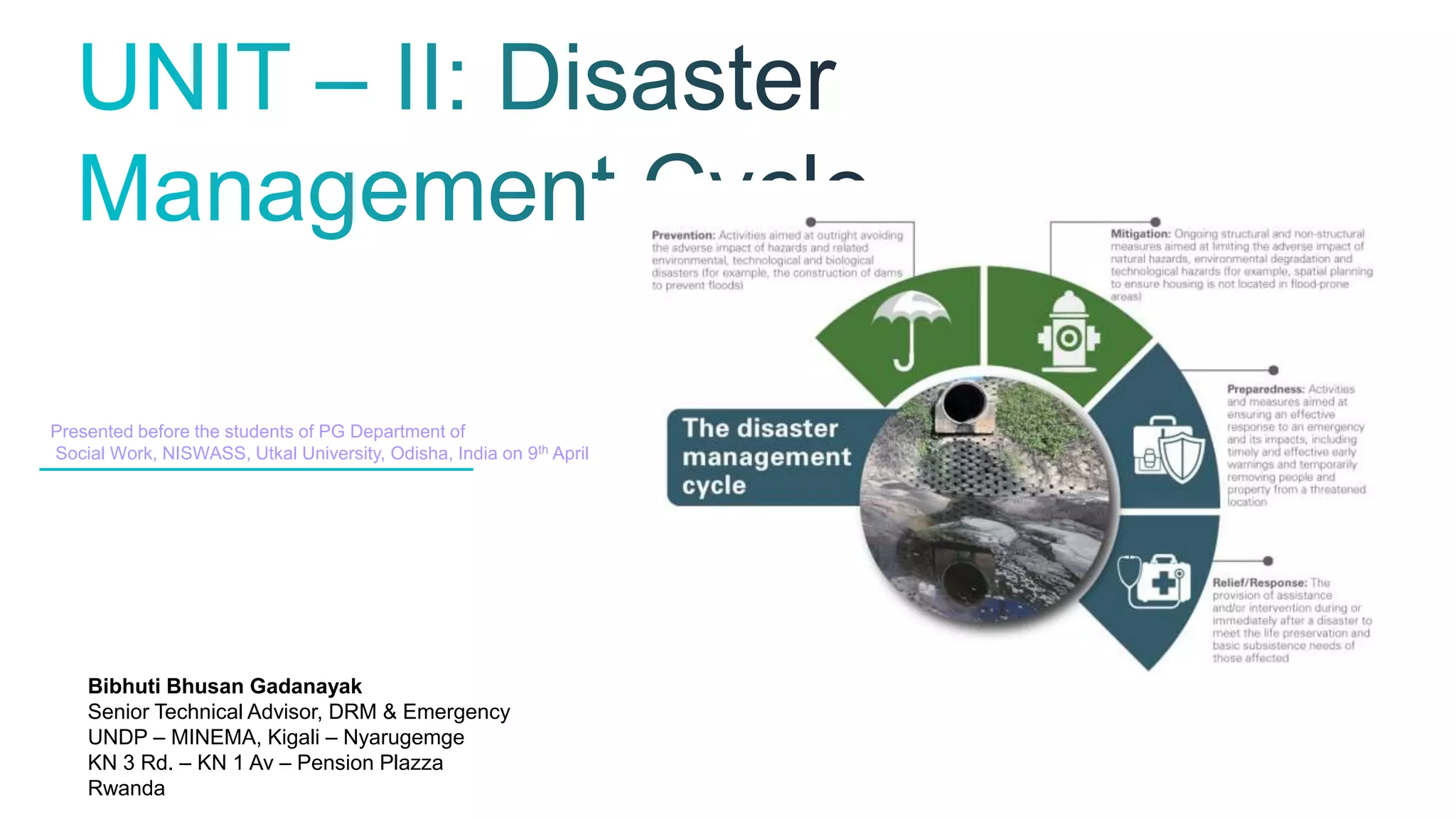
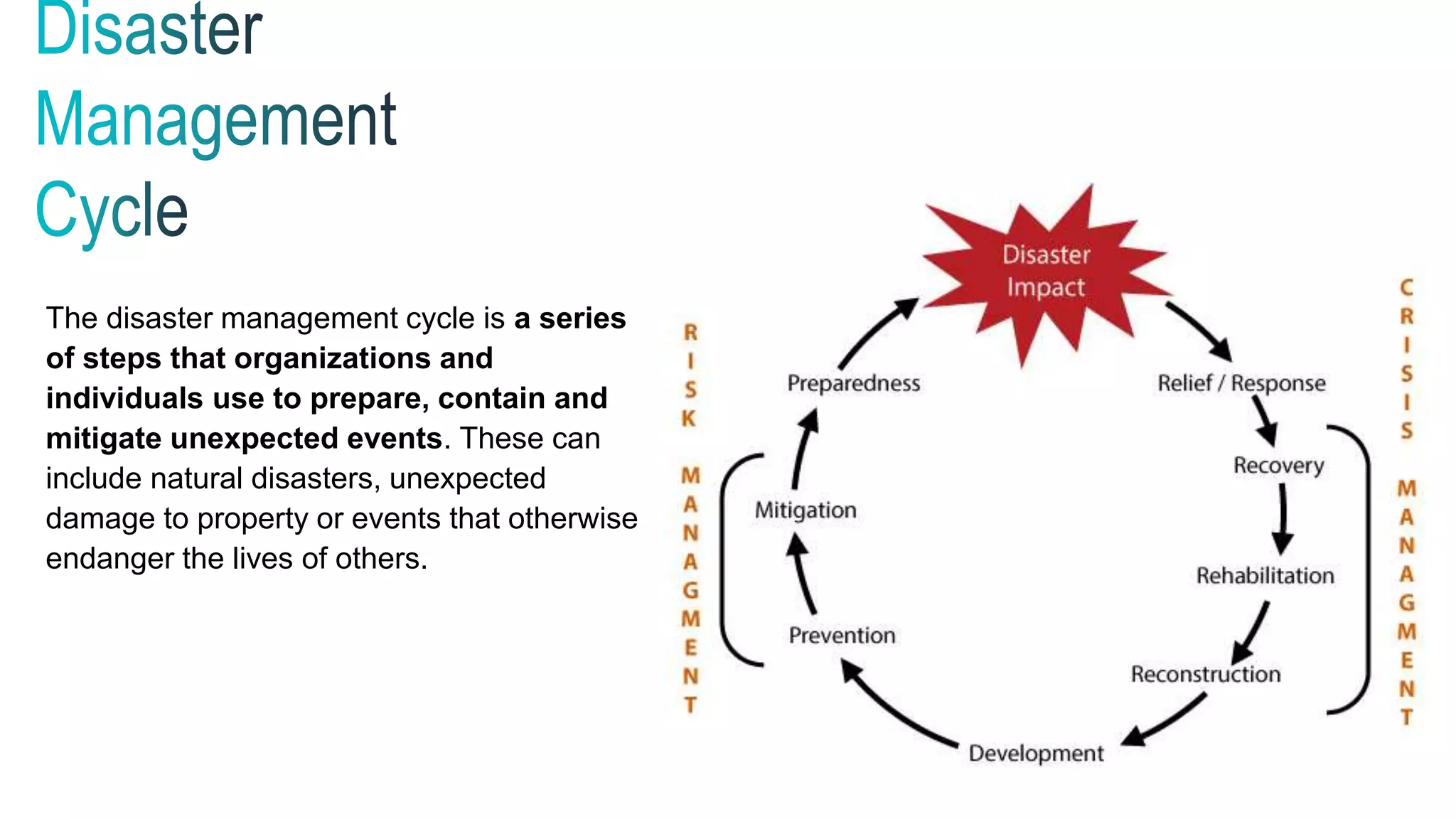
The disaster management cycle is a series
of steps that organizations and
individuals use to prepare, contain and
mitigate unexpected events. These can
include natural disasters, unexpected
damage to property or events that otherwise
endanger the lives of others.
The paradigm shift in disaster
management is a change of
practices from the erstwhile relief
centric response to pro-active
prevention, preparedness,
mitigation as well as recovery
and rehabilitation driven
approaches so as to conserve
the development gains and also
minimize losses to life, livelihood
and property.
In the last decade there has been a paradigm shift in Disaster Management in India, a distinct
move from the earlier approach of post disaster relief to pre-disaster preparedness, mitigation
and risk reduction. The 10th Five Year Plan document emphasised that “while hazards, both natural
or otherwise, are inevitable, the disasters that follow need not be so and the society can be prepared
to cope with them effectively whenever they occur” and called for a “multi-pronged strategy for total
risk management, comprising prevention, preparedness, response and recovery, on the one hand,
and for initiating development efforts aimed towards risk reduction and mitigation, on the other”. It
is stated that only then we can look forward to “sustainable development.” The country is also
committed to mainstream disaster risk reduction into the process of development planning at
all levels for sustainable development, as stated in Hyogo Framework of Action 2005-15: Building
the Resilience of Nations and Communities to Disasters.
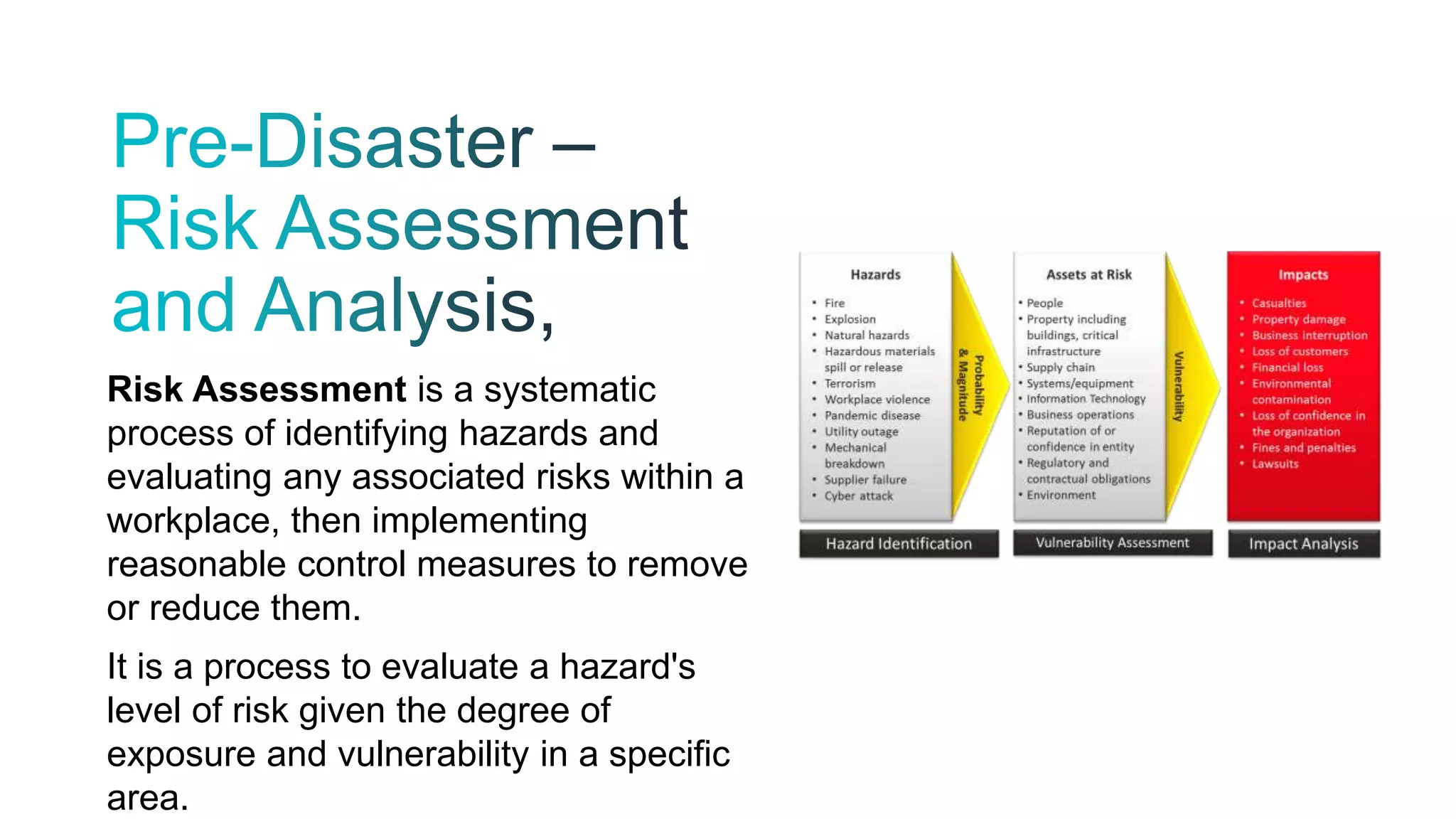
Risk Assessment is a systematic
process of identifying hazards and
evaluating any associated risks within a
workplace, then implementing
reasonable control measures to remove
or reduce them.
It is a process to evaluate a hazard's
level of risk given the degree of
exposure and vulnerability in a specific
area.
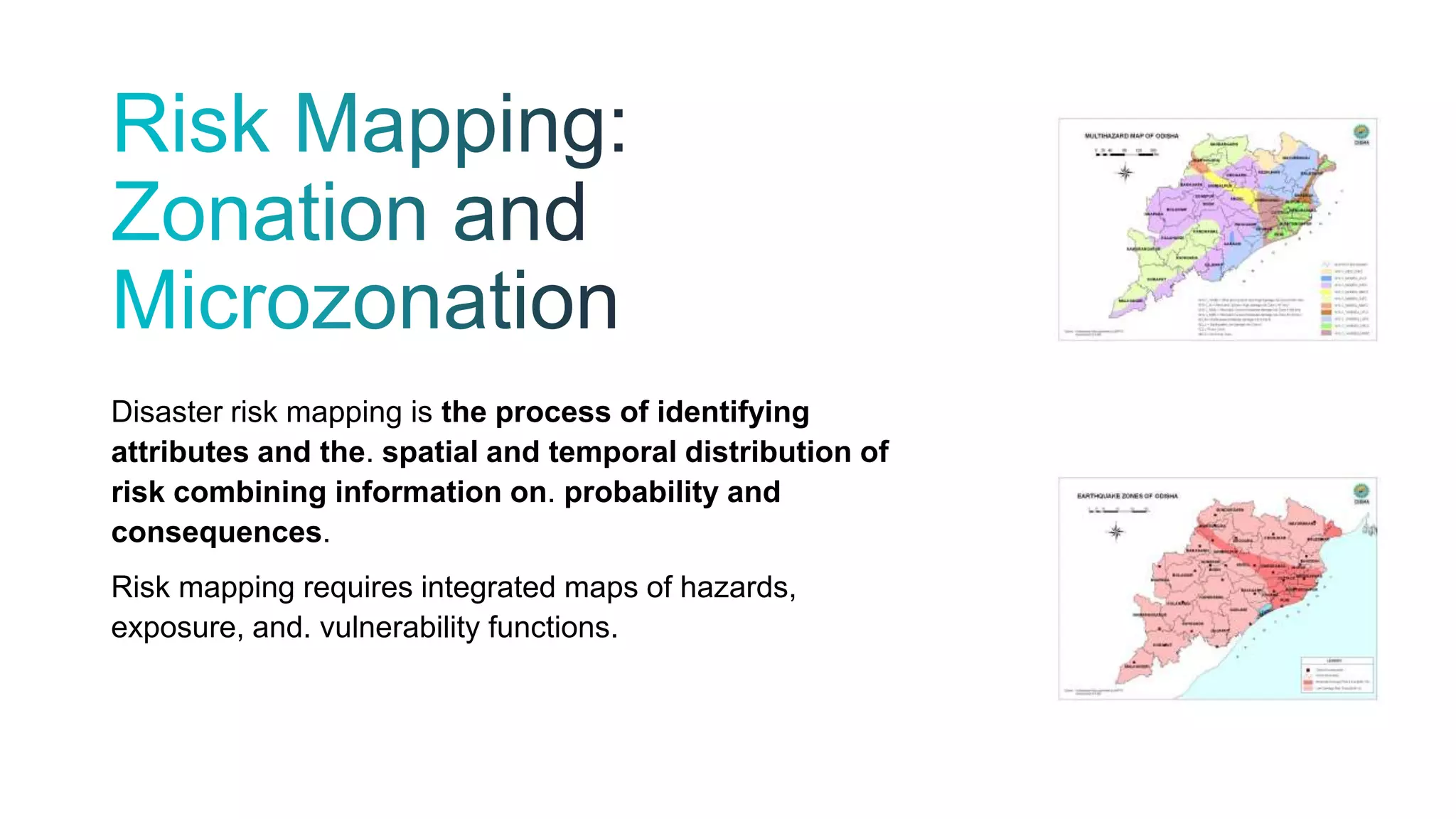
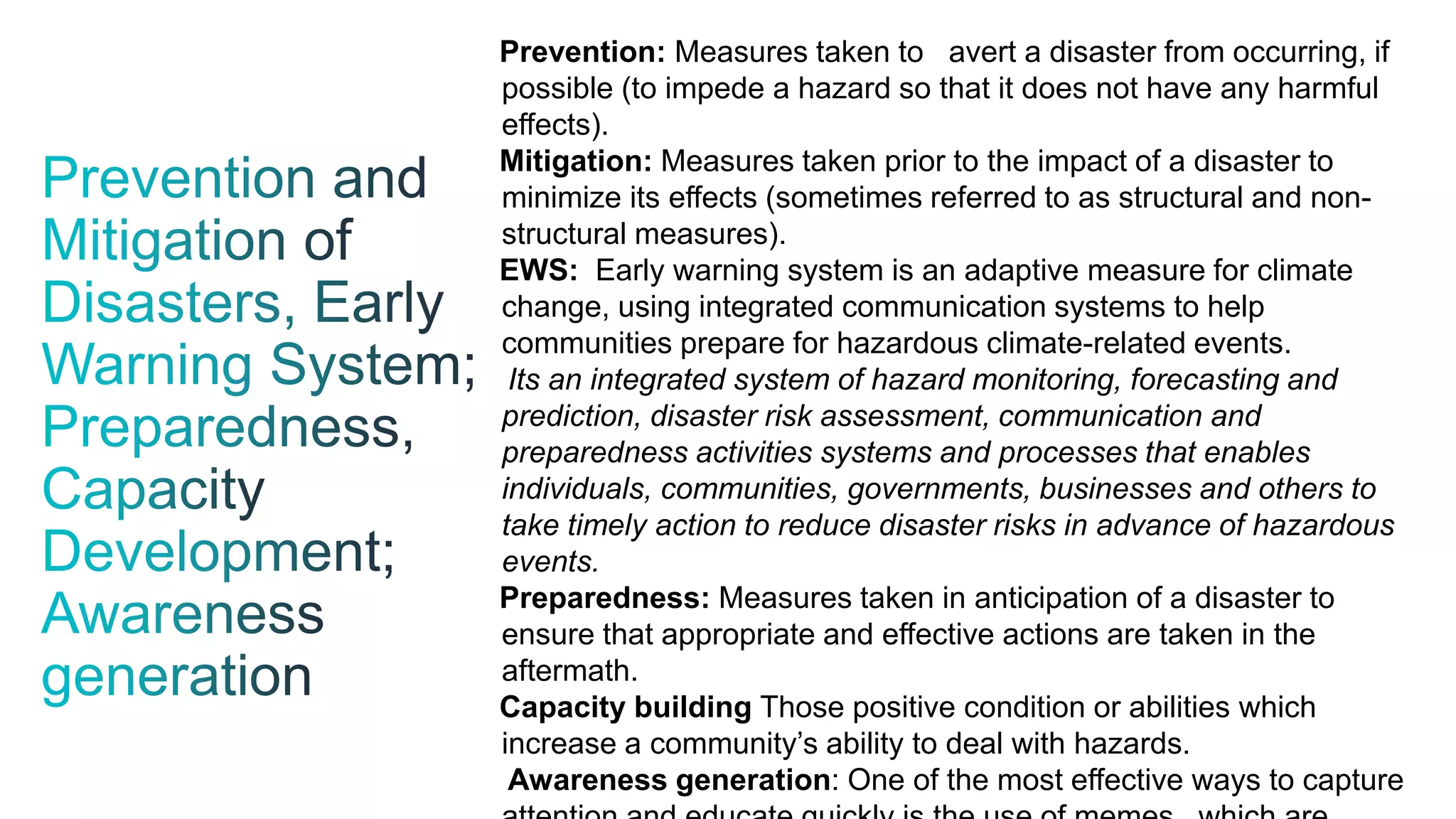
Disaster risk mapping is the process of identifying
attributes and the. spatial and temporal distribution of
risk combining information on. probability and
consequences.
Risk mapping requires integrated maps of hazards,
exposure, and. vulnerability functions.
Prevention: Measures taken to avert a disaster from occurring, if
possible (to impede a hazard so that it does not have any harmful
effects).
Mitigation: Measures taken prior to the impact of a disaster to
minimize its effects (sometimes referred to as structural and non-
structural measures).
EWS: Early warning system is an adaptive measure for climate
change, using integrated communication systems to help
communities prepare for hazardous climate-related events.
Its an integrated system of hazard monitoring, forecasting and
prediction, disaster risk assessment, communication and
preparedness activities systems and processes that enables
individuals, communities, governments, businesses and others to
take timely action to reduce disaster risks in advance of hazardous
events.
Preparedness: Measures taken in anticipation of a disaster to
ensure that appropriate and effective actions are taken in the
aftermath.
Capacity building Those positive condition or abilities which
increase a community’s ability to deal with hazards.
Awareness generation: One of the most effective ways to capture
Disaster Communication: Communication during and immediately after a disaster situation is an important.
component of response and recovery, in that it connects affected people, families, and communities with
first responders, support systems, and other family. Members.
Search and rescue is a technical activity rendered by a group of specially trained personnel, who rescue and
attend to the casualties under adverse conditions, where life is at threat.
EOC: Emergency Operation Center monitors different disaster mitigation programme and co-ordinates
with different organization. It also conducts evaluation of the programmes, and immediately takes up
necessary measures.
ICS consists of a standard management hierarchy and procedures for managing temporary incident(s)
of any size. ICS procedures should be pre-established and sanctioned by participating authorities, and
personnel should be well-trained prior to an incident.
Relief Measures that are required in search and rescue of survivors, as well to meet the basic
needs for shelter, water, food and health care.
Rehabilitation: The restoration of basic services and facilities for the functioning of a community or a society
affected by a disaster.
Critical Infrastructure: Critical Infrastructure and Systems
(CIS) are key to Disaster Recovery. CIS are key to
ensuring people receive the help they need during and
immediately after a disaster. Support for any one of these
sectors will help speed recovery in every case. Pre-Disaster
grants in these sectors can make a significant difference.
Critical infrastructure. Communications systems and
networks, health facilities, emergency evacuation shelters,
elements of transportation systems, waste disposal, water
supplies. UNDRR
Early Recovery (ER) is an approach that addresses
recovery needs that arise during the humanitarian phase of
an emergency; using humanitarian mechanisms that align
with development principles.
The reconstruction is a rebuilding measure and that is
applicable after certain disasters. The reconstruction
involves building the confidence, self-respect, self- esteem,
self-dependency, mutual support, and mutual trust and
What is PDNA - objectives
The Post-Disaster Needs Assessment (PDNA) is an
internationally accepted methodology for determining the
physical damages, economic losses, and costs of meeting
recovery needs after a natural disaster through a
government-led process.
Objectives of PDNA
1
PDNA is a mechanism for joint
assessment and recovery planning
after a disaster
2
The joint assessment analyses the damage,
economic loss, effects and impact of the
disaster and identifies recovery needs across
identified sectors
3
The assessment also highlights the macro-
economic and human impacts of the
disaster
4
The recovery needs identified helps to
mobilize resources and develop a
comprehensive recovery strategy
The PDNA is envisaged as a country owned and led
process, supported by international agencies and
other stakeholders
By bringing together key stakeholders engaged in
recovery, the PDNA aims to avoid duplication and
harmonize assessment efforts
The multi-stakeholder approach leads to the
development of a single PDNA report that can be
used as a tool for planning and programming
recovery, as well for resource mobilization
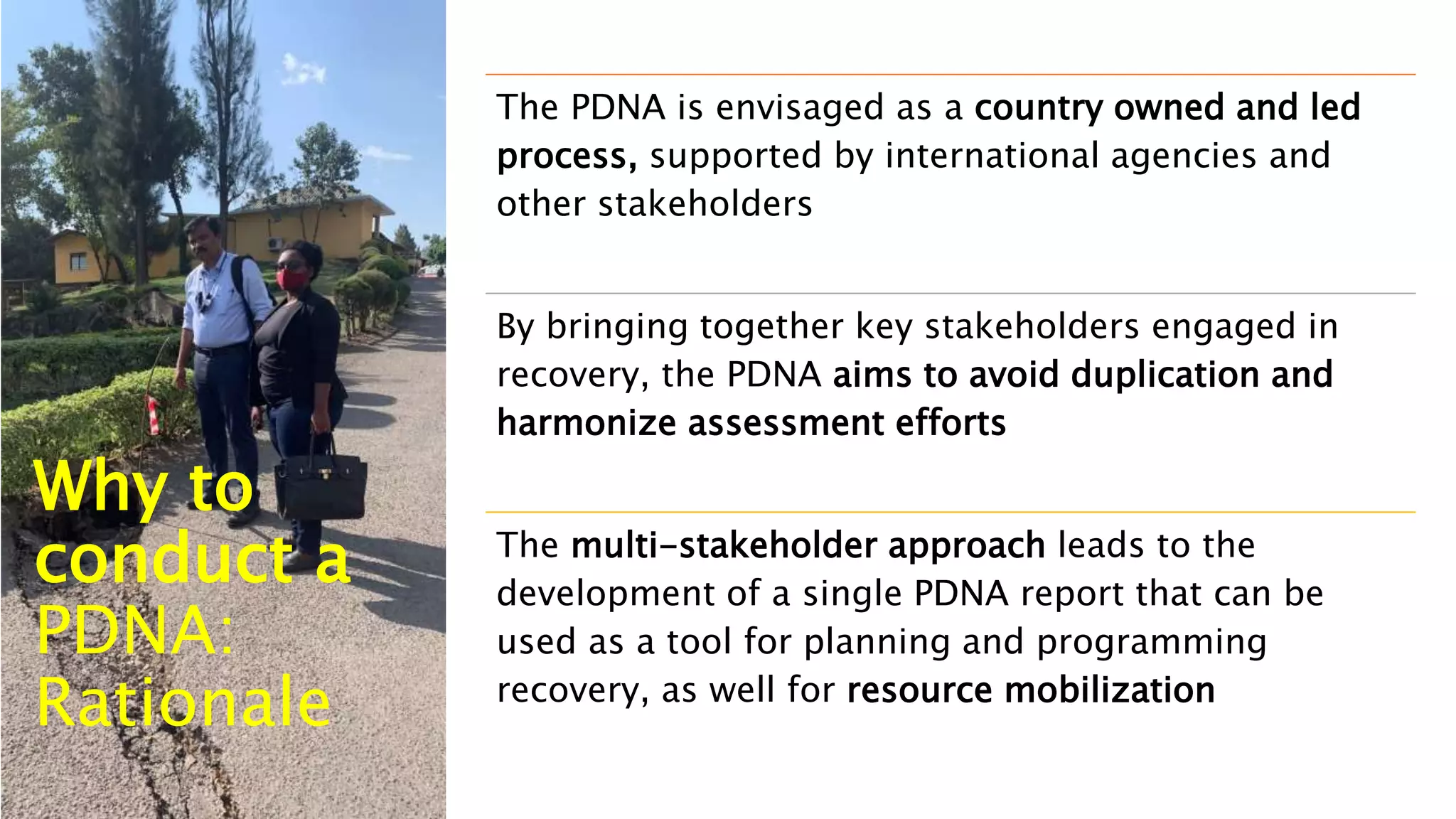
Why to
conduct a
PDNA:
Rationale
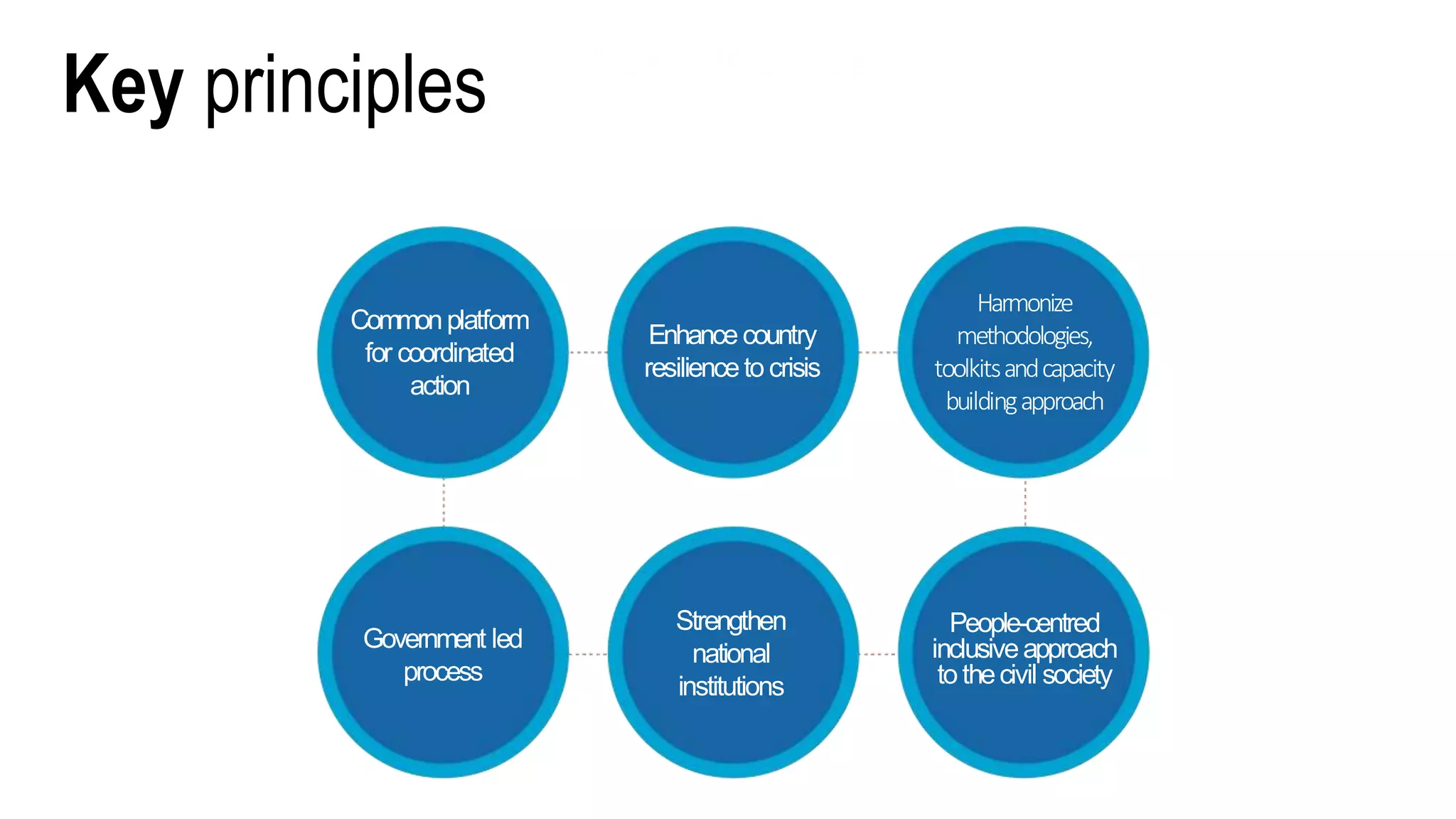
Commonplatform
for coordinated
action
Enhance country
resilienceto crisis
People-centred
inclusiveapproach
to thecivil society
Government led
process
Strengthen
national
institutions
Harmonize
methodologies,
toolkitsandcapacity
buildingapproach
Key principles
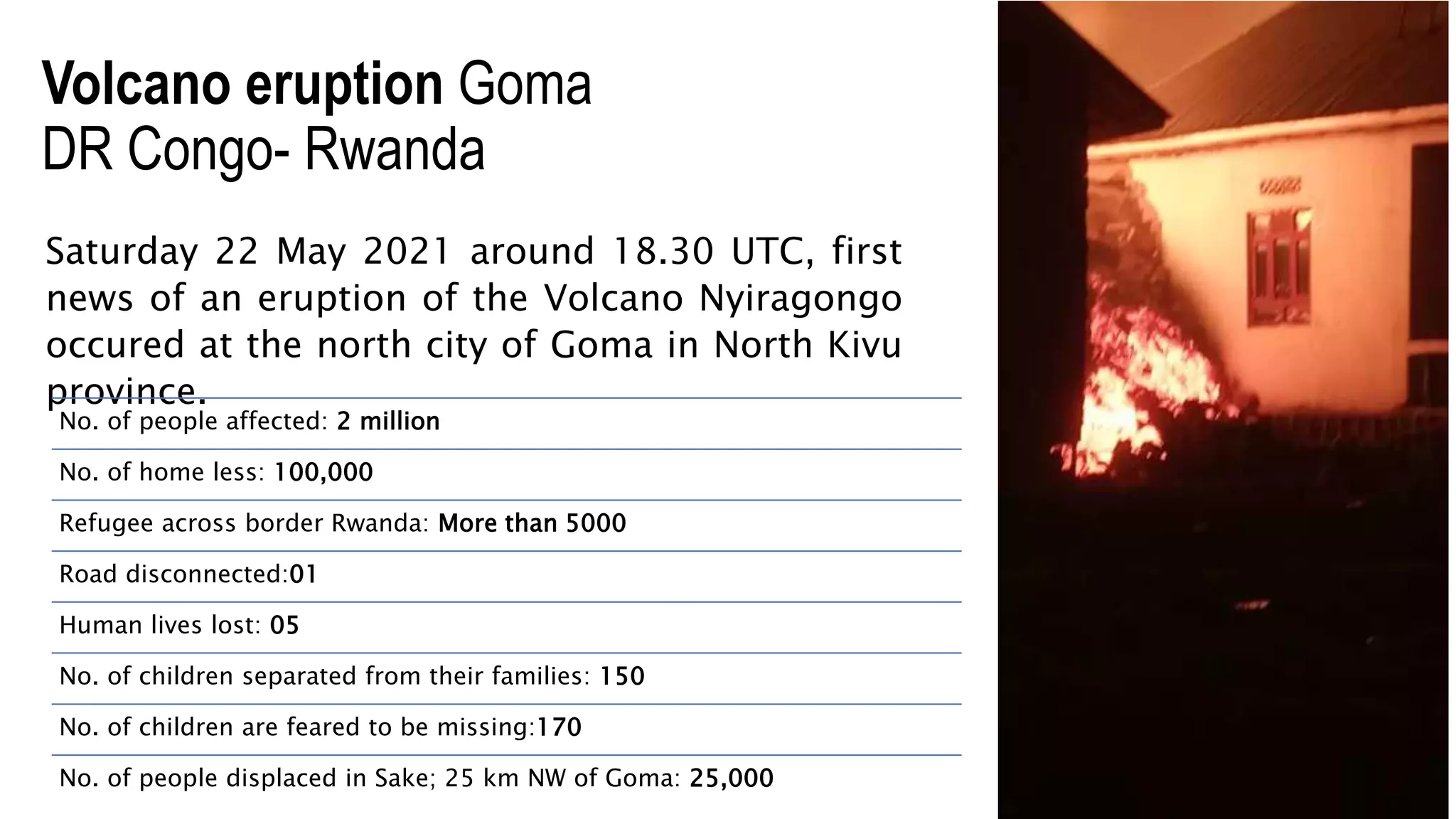
Volcano eruption Goma
DR Congo- Rwanda
Saturday 22 May 2021 around 18.30 UTC, first
news of an eruption of the Volcano Nyiragongo
occured at the north city of Goma in North Kivu
province.
No. of people affected: 2 million
No. of home less: 100,000
Refugee across border Rwanda: More than 5000
Road disconnected:01
Human lives lost: 05
No. of children separated from their families: 150
No. of children are feared to be missing:170
No. of people displaced in Sake; 25 km NW of Goma: 25,000
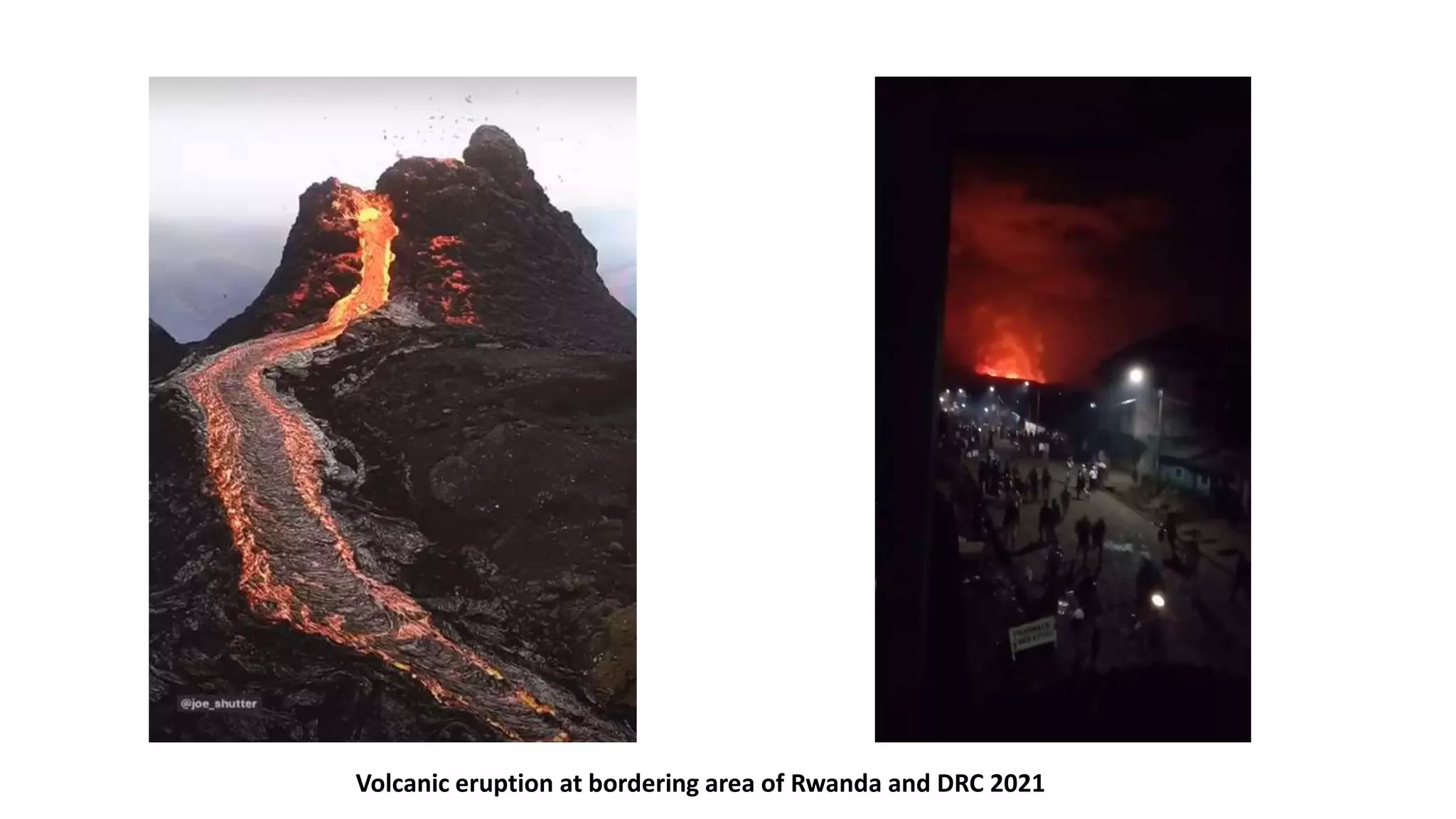
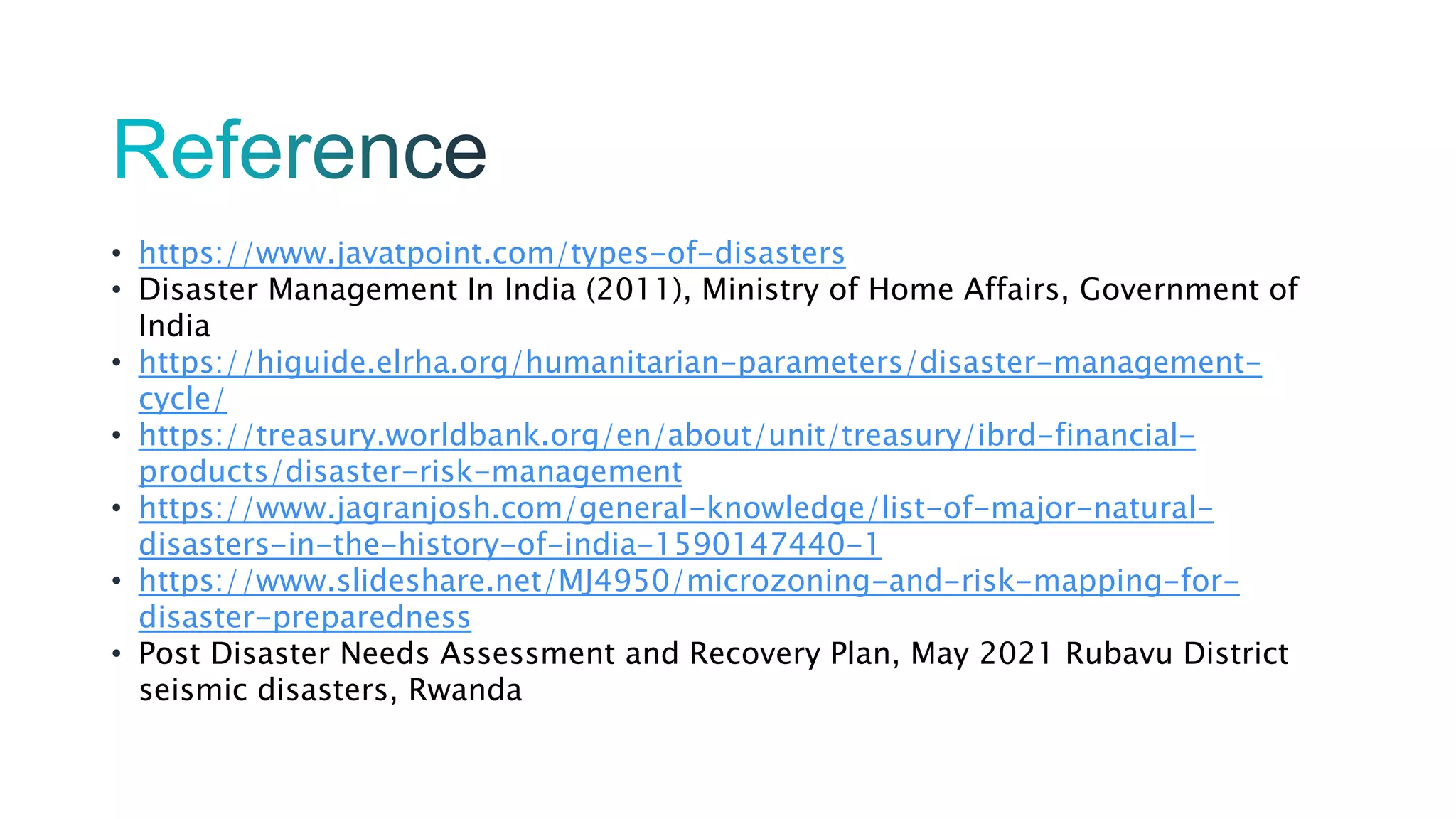
Volcanic eruption at bordering area of Rwanda and DRC 2021
• https://www.javatpoint.com/types-of-disasters
• Disaster Management In India (2011), Ministry of Home Affairs, Government of
India
• https://higuide.elrha.org/humanitarian-parameters/disaster-management-
cycle/
• https://treasury.worldbank.org/en/about/unit/treasury/ibrd-financial-
products/disaster-risk-management
• https://www.jagranjosh.com/general-knowledge/list-of-major-natural-
disasters-in-the-history-of-india-1590147440-1
• https://www.slideshare.net/MJ4950/microzoning-and-risk-mapping-for-
disaster-preparedness
• Post Disaster Needs Assessment and Recovery Plan, May 2021 Rubavu District
seismic disasters, Rwanda
Thank you

UNIT-II-Disaster Management Cycle

  • 1.
    Bibhuti Bhusan Gadanayak SeniorTechnical Advisor, DRM & Emergency UNDP – MINEMA, Kigali – Nyarugemge KN 3 Rd. – KN 1 Av – Pension Plazza Rwanda Presented before the students of PG Department of Social Work, NISWASS, Utkal University, Odisha, India on 9th April 2023
  • 2.
    CONTENTS • Disaster Management:Definition, Typology of disasters, major disasters in India • Disaster Management Cycle: Paradigm Shift in Disaster Management, Pre-Disaster – Risk Assessment and Analysis, Risk Mapping: Zonation and Microzonation, Prevention and Mitigation of Disasters, Early Warning System; Preparedness, Capacity Development; Awareness. During Disaster – Evacuation – Disaster Communication – Search and Rescue – Emergency Operation Centre – Incident Command System – Relief and Rehabilitation. • Post-disaster – Damage and Needs Assessment, Restoration of Critical Infrastructure – Early Recovery – Reconstruction and Redevelopment.
  • 3.
    Disaster Management: Definition, Typologyof disasters, major disasters in India Disaster management is a collective term encompassing all aspects of planning for and responding to emergencies and disasters, including both pre- and post-event activities. It refers to the management of both the risk and the consequences of an event. Disaster Management is the collective term for all activities that contribute to increasing capacities and will lead to reducing immediate and long-term vulnerabilities. It covers activities before, during and after a disaster. In essence, disaster management is more than just response and relief; it is a systematic process aimed at reducing the negative impact and/or consequences of adverse events. https://www.linkedin.com/pulse/disaster-management-definition-process-various- phases-chatterjee/ The organization, planning and application of measures preparing for, responding to and recovering from disasters.
  • 4.
    Prevention of threatof disasters Readiness to deal with disasters Saving lives of all living organisms Minimize sufferings to the maximum possible extent Protect and restore livelihoods Minimize the risks and uncertainties to societies affected by disaster https://www.javatpoint.com/types-of-disasters
  • 5.
    There are manytypes of disasters and can take different forms. However, all these can be broadly classified into the following three categories:  Natural Disasters  Human-made or Technological Disasters  Complex Emergencies https://www.javatpoint.com/types-of-disasters
  • 6.
    Hazards India Land area3.287 m. km² Earthquake 59 % Flood 12 % Cyclone 5700 km Drought 68 % Cultivable area Tsunami 5700 km
  • 8.
    The disaster managementcycle is a series of steps that organizations and individuals use to prepare, contain and mitigate unexpected events. These can include natural disasters, unexpected damage to property or events that otherwise endanger the lives of others.
  • 9.
    The paradigm shiftin disaster management is a change of practices from the erstwhile relief centric response to pro-active prevention, preparedness, mitigation as well as recovery and rehabilitation driven approaches so as to conserve the development gains and also minimize losses to life, livelihood and property. In the last decade there has been a paradigm shift in Disaster Management in India, a distinct move from the earlier approach of post disaster relief to pre-disaster preparedness, mitigation and risk reduction. The 10th Five Year Plan document emphasised that “while hazards, both natural or otherwise, are inevitable, the disasters that follow need not be so and the society can be prepared to cope with them effectively whenever they occur” and called for a “multi-pronged strategy for total risk management, comprising prevention, preparedness, response and recovery, on the one hand, and for initiating development efforts aimed towards risk reduction and mitigation, on the other”. It is stated that only then we can look forward to “sustainable development.” The country is also committed to mainstream disaster risk reduction into the process of development planning at all levels for sustainable development, as stated in Hyogo Framework of Action 2005-15: Building the Resilience of Nations and Communities to Disasters.
  • 10.
    Risk Assessment isa systematic process of identifying hazards and evaluating any associated risks within a workplace, then implementing reasonable control measures to remove or reduce them. It is a process to evaluate a hazard's level of risk given the degree of exposure and vulnerability in a specific area.
  • 11.
    Disaster risk mappingis the process of identifying attributes and the. spatial and temporal distribution of risk combining information on. probability and consequences. Risk mapping requires integrated maps of hazards, exposure, and. vulnerability functions.
  • 12.
    Prevention: Measures takento avert a disaster from occurring, if possible (to impede a hazard so that it does not have any harmful effects). Mitigation: Measures taken prior to the impact of a disaster to minimize its effects (sometimes referred to as structural and non- structural measures). EWS: Early warning system is an adaptive measure for climate change, using integrated communication systems to help communities prepare for hazardous climate-related events. Its an integrated system of hazard monitoring, forecasting and prediction, disaster risk assessment, communication and preparedness activities systems and processes that enables individuals, communities, governments, businesses and others to take timely action to reduce disaster risks in advance of hazardous events. Preparedness: Measures taken in anticipation of a disaster to ensure that appropriate and effective actions are taken in the aftermath. Capacity building Those positive condition or abilities which increase a community’s ability to deal with hazards. Awareness generation: One of the most effective ways to capture
  • 13.
    Disaster Communication: Communicationduring and immediately after a disaster situation is an important. component of response and recovery, in that it connects affected people, families, and communities with first responders, support systems, and other family. Members. Search and rescue is a technical activity rendered by a group of specially trained personnel, who rescue and attend to the casualties under adverse conditions, where life is at threat. EOC: Emergency Operation Center monitors different disaster mitigation programme and co-ordinates with different organization. It also conducts evaluation of the programmes, and immediately takes up necessary measures. ICS consists of a standard management hierarchy and procedures for managing temporary incident(s) of any size. ICS procedures should be pre-established and sanctioned by participating authorities, and personnel should be well-trained prior to an incident. Relief Measures that are required in search and rescue of survivors, as well to meet the basic needs for shelter, water, food and health care. Rehabilitation: The restoration of basic services and facilities for the functioning of a community or a society affected by a disaster.
  • 14.
    Critical Infrastructure: CriticalInfrastructure and Systems (CIS) are key to Disaster Recovery. CIS are key to ensuring people receive the help they need during and immediately after a disaster. Support for any one of these sectors will help speed recovery in every case. Pre-Disaster grants in these sectors can make a significant difference. Critical infrastructure. Communications systems and networks, health facilities, emergency evacuation shelters, elements of transportation systems, waste disposal, water supplies. UNDRR Early Recovery (ER) is an approach that addresses recovery needs that arise during the humanitarian phase of an emergency; using humanitarian mechanisms that align with development principles. The reconstruction is a rebuilding measure and that is applicable after certain disasters. The reconstruction involves building the confidence, self-respect, self- esteem, self-dependency, mutual support, and mutual trust and
  • 15.
    What is PDNA- objectives The Post-Disaster Needs Assessment (PDNA) is an internationally accepted methodology for determining the physical damages, economic losses, and costs of meeting recovery needs after a natural disaster through a government-led process. Objectives of PDNA 1 PDNA is a mechanism for joint assessment and recovery planning after a disaster 2 The joint assessment analyses the damage, economic loss, effects and impact of the disaster and identifies recovery needs across identified sectors 3 The assessment also highlights the macro- economic and human impacts of the disaster 4 The recovery needs identified helps to mobilize resources and develop a comprehensive recovery strategy
  • 16.
    The PDNA isenvisaged as a country owned and led process, supported by international agencies and other stakeholders By bringing together key stakeholders engaged in recovery, the PDNA aims to avoid duplication and harmonize assessment efforts The multi-stakeholder approach leads to the development of a single PDNA report that can be used as a tool for planning and programming recovery, as well for resource mobilization Why to conduct a PDNA: Rationale
  • 17.
    Commonplatform for coordinated action Enhance country resiliencetocrisis People-centred inclusiveapproach to thecivil society Government led process Strengthen national institutions Harmonize methodologies, toolkitsandcapacity buildingapproach Key principles
  • 18.
    Volcano eruption Goma DRCongo- Rwanda Saturday 22 May 2021 around 18.30 UTC, first news of an eruption of the Volcano Nyiragongo occured at the north city of Goma in North Kivu province. No. of people affected: 2 million No. of home less: 100,000 Refugee across border Rwanda: More than 5000 Road disconnected:01 Human lives lost: 05 No. of children separated from their families: 150 No. of children are feared to be missing:170 No. of people displaced in Sake; 25 km NW of Goma: 25,000
  • 19.
    Volcanic eruption atbordering area of Rwanda and DRC 2021
  • 20.
    • https://www.javatpoint.com/types-of-disasters • DisasterManagement In India (2011), Ministry of Home Affairs, Government of India • https://higuide.elrha.org/humanitarian-parameters/disaster-management- cycle/ • https://treasury.worldbank.org/en/about/unit/treasury/ibrd-financial- products/disaster-risk-management • https://www.jagranjosh.com/general-knowledge/list-of-major-natural- disasters-in-the-history-of-india-1590147440-1 • https://www.slideshare.net/MJ4950/microzoning-and-risk-mapping-for- disaster-preparedness • Post Disaster Needs Assessment and Recovery Plan, May 2021 Rubavu District seismic disasters, Rwanda
  • 21.