timely warnings on shocks using
better data and mobile technology
Rwanda experience
1st April 2021
Bibhuti Bhusan Gadanayak
Senior Technical Advisor
UNDP, Kigali – Nyarugemge
KN 3 Rd. – KN 1 Av – Pension Plazza
Rwanda
Presented at; Rwanda National Dialogue: Food Systems Summit Action Track 5:
Toward Resilient and Inclusive Food Systems in Rwanda:
CONTENTS
1. EWS
2. EWS and Global link;
3. Disaster scenario and
trends in Rwanda;
4. EWS Programme in
Rwanda
5. EW Programme
achievement in Rwanda
6. In pipeline
7. Way forward
4
EARLY WARNING SYSTEM
Early warning is a major element of DRR and CCA.
Effective, early warning systems need to actively involve the people
and communities at risk from a range of hazards, facilitate public education and awareness of risks, disseminate messages and
warnings efficiently and ensure that there is a constant state of preparedness and that early action is enabled.
“end-to-end” and “people-centred” EWS may include 4interrelated key
elements: 1. Disaster risk knowledge based on collection of data and disaster
risk assessments;
2. Detection, monitoring, analysis and forecasting of the hazards
and possible consequences;
3. Dissemination and communication, by an official source, of
authoritative, timely, accurate and actionable warnings and
associated information on likelihood and impact; and
4. Preparedness at all levels to respond to the warnings received;
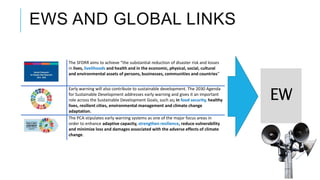
EWS AND GLOBAL LINKS
The SFDRR aims to achieve “the substantial reduction of disaster risk and losses
in lives, livelihoods and health and in the economic, physical, social, cultural
and environmental assets of persons, businesses, communities and countries”
Early warning will also contribute to sustainable development. The 2030 Agenda
for Sustainable Development addresses early warning and gives it an important
role across the Sustainable Development Goals, such as; in food security, healthy
lives, resilient cities, environmental management and climate change
adaptation.
The PCA stipulates early warning systems as one of the major focus areas in
order to enhance adaptive capacity, strengthen resilience, reduce vulnerability
and minimize loss and damages associated with the adverse effects of climate
change.
EW
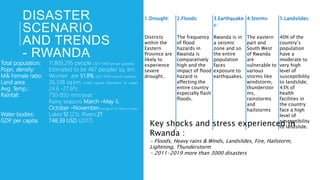
DISASTER
SCENARIO
AND TRENDS
- RWANDA
1.Drought: 2.Floods: 3.Earthquake
s:
4.Storms: 5.Landslides:
Districts
within the
Eastern
Province are
likely to
experience
severe
drought.
The frequency
of flood
hazards in
Rwanda is
comparatively
high and the
impact of flood
hazard is
affecting the
entire country
especially flash
floods.
Rwanda is in
a seismic
zone and so
the entire
population
faces
exposure to
earthquakes.
The eastern
part and
South West
of Rwanda
are
vulnerable to
various
storms like
windstorm,
thunderstor
ms,
rainstorms
and
hailstorms
40% of the
country’s
population
have a
moderate to
very high
level of
susceptibility
to landslide;
43% of
health
facilities in
the country
face a high
level of
susceptibility
to landslide.
Key shocks and stress experienced in
Rwanda :
- Floods, Heavy rains & Winds, Landslides, Fire, Hailstorm,
Lightning, Thunderstorm
- 2011-2019 more than 3000 disasters
Total population: 11,809,295 people (2017 NISR annual updates)
Popn. density: Estimated to be 467 people/ sq. km.
M& Female ratio: Women are 51.8% (2017 NISR annual updates)
Land area: 26,338 sq.km. (1,400 square kilometres of water)
Avg. Temp.: 24.6 -27.6ºc.
Rainfall: 750-850 mm/year.
Rainy seasons March –May &
October –November(Average of 110-200mm./month)
Water bodies: Lakes:12 (23), Rivers:21
GDP per capita: 748.39 USD (2017)
EWS PROGRAMME IN RWANDA
2018-2023
“Strengthening National and Local DRM Capacity, Resilience and Enhancing
Preparedness and EWS in Rwanda” 2018-2023
Implemented jointly by MINEMA and METEO Rwanda
Output 1: Institutions at national, district and community level have improved technical
capacities to reduce risks, manage and respond to natural disasters and limit gender-
differentiated impacts;
Output 2: Population, local authorities and national institutions have increased
knowledge and skills of risks from evidence-based disaster risk assessments;
Output 3: Enhanced multi hazard early warning systems to
enable effective preparedness, response and recovery;
Output 4: Communities in selected high-risk districts have strengthened capacity to
mitigate, adapt and respond to disaster risks.
EW PROG. ACHIEVEMENT-
RWANDA
Structural
Rwanda Meteorology Agency (METEO)
 METEO Rwanda enabled decision makers to relocate 11,000 households from
hazard prone areas due to availability of EWS
 Weather EWs by SMS; The warning network has been so successful in Rwanda.
The government has decided to expand it to increase the number of SMS
subscribers from 800 to more than 19,000.
 Installation of Lightening arrester in Rutsiro district has saved loss of lives
 Disaster Risk database for Rwanda in place
 EWS ensured food security
 85% of population in 10 districts prone to disasters are aware of disaster risk
 More than 82% of popn. issued weather EW warning 24 hours before
 EWS is linked to NSDRR
 Installation of EWS helped in Rapid need Assessment
 CERF Rapid Response project initiated
IN PIPELINE - EW
1. Developing scalable technology platform for
 Weather EW for end user
 Rain fall EW contributing food security
 Lightening EW
 Multi-hazard mapping and risk analysis
2. Implementation of the National Framework for Climate
Services
3. Implementation of the Common Alerting Protocol (CAP)-
WMO recommended platform
WAY FORWARD
 Hazard mapping
 Strengthening Hydro metrology Department
 Strengthening community-based EW structures
 Ensuring last mile connectivity
 Strengthening partnership and coordination
 Early Warning, early action and early financing
 Linking EW with shock responsive social protection and
safety nets
 Strengthen Public Private Partnership
THANK
YOU

Timely warnings on shocks using better data and mobile technology

  • 1.
    timely warnings onshocks using better data and mobile technology Rwanda experience 1st April 2021 Bibhuti Bhusan Gadanayak Senior Technical Advisor UNDP, Kigali – Nyarugemge KN 3 Rd. – KN 1 Av – Pension Plazza Rwanda Presented at; Rwanda National Dialogue: Food Systems Summit Action Track 5: Toward Resilient and Inclusive Food Systems in Rwanda:
  • 2.
    CONTENTS 1. EWS 2. EWSand Global link; 3. Disaster scenario and trends in Rwanda; 4. EWS Programme in Rwanda 5. EW Programme achievement in Rwanda 6. In pipeline 7. Way forward
  • 3.
    4 EARLY WARNING SYSTEM Earlywarning is a major element of DRR and CCA. Effective, early warning systems need to actively involve the people and communities at risk from a range of hazards, facilitate public education and awareness of risks, disseminate messages and warnings efficiently and ensure that there is a constant state of preparedness and that early action is enabled. “end-to-end” and “people-centred” EWS may include 4interrelated key elements: 1. Disaster risk knowledge based on collection of data and disaster risk assessments; 2. Detection, monitoring, analysis and forecasting of the hazards and possible consequences; 3. Dissemination and communication, by an official source, of authoritative, timely, accurate and actionable warnings and associated information on likelihood and impact; and 4. Preparedness at all levels to respond to the warnings received;
  • 4.
    EWS AND GLOBALLINKS The SFDRR aims to achieve “the substantial reduction of disaster risk and losses in lives, livelihoods and health and in the economic, physical, social, cultural and environmental assets of persons, businesses, communities and countries” Early warning will also contribute to sustainable development. The 2030 Agenda for Sustainable Development addresses early warning and gives it an important role across the Sustainable Development Goals, such as; in food security, healthy lives, resilient cities, environmental management and climate change adaptation. The PCA stipulates early warning systems as one of the major focus areas in order to enhance adaptive capacity, strengthen resilience, reduce vulnerability and minimize loss and damages associated with the adverse effects of climate change. EW
  • 5.
    DISASTER SCENARIO AND TRENDS - RWANDA 1.Drought:2.Floods: 3.Earthquake s: 4.Storms: 5.Landslides: Districts within the Eastern Province are likely to experience severe drought. The frequency of flood hazards in Rwanda is comparatively high and the impact of flood hazard is affecting the entire country especially flash floods. Rwanda is in a seismic zone and so the entire population faces exposure to earthquakes. The eastern part and South West of Rwanda are vulnerable to various storms like windstorm, thunderstor ms, rainstorms and hailstorms 40% of the country’s population have a moderate to very high level of susceptibility to landslide; 43% of health facilities in the country face a high level of susceptibility to landslide. Key shocks and stress experienced in Rwanda : - Floods, Heavy rains & Winds, Landslides, Fire, Hailstorm, Lightning, Thunderstorm - 2011-2019 more than 3000 disasters Total population: 11,809,295 people (2017 NISR annual updates) Popn. density: Estimated to be 467 people/ sq. km. M& Female ratio: Women are 51.8% (2017 NISR annual updates) Land area: 26,338 sq.km. (1,400 square kilometres of water) Avg. Temp.: 24.6 -27.6ºc. Rainfall: 750-850 mm/year. Rainy seasons March –May & October –November(Average of 110-200mm./month) Water bodies: Lakes:12 (23), Rivers:21 GDP per capita: 748.39 USD (2017)
  • 6.
    EWS PROGRAMME INRWANDA 2018-2023 “Strengthening National and Local DRM Capacity, Resilience and Enhancing Preparedness and EWS in Rwanda” 2018-2023 Implemented jointly by MINEMA and METEO Rwanda Output 1: Institutions at national, district and community level have improved technical capacities to reduce risks, manage and respond to natural disasters and limit gender- differentiated impacts; Output 2: Population, local authorities and national institutions have increased knowledge and skills of risks from evidence-based disaster risk assessments; Output 3: Enhanced multi hazard early warning systems to enable effective preparedness, response and recovery; Output 4: Communities in selected high-risk districts have strengthened capacity to mitigate, adapt and respond to disaster risks.
  • 7.
    EW PROG. ACHIEVEMENT- RWANDA Structural RwandaMeteorology Agency (METEO)  METEO Rwanda enabled decision makers to relocate 11,000 households from hazard prone areas due to availability of EWS  Weather EWs by SMS; The warning network has been so successful in Rwanda. The government has decided to expand it to increase the number of SMS subscribers from 800 to more than 19,000.  Installation of Lightening arrester in Rutsiro district has saved loss of lives  Disaster Risk database for Rwanda in place  EWS ensured food security  85% of population in 10 districts prone to disasters are aware of disaster risk  More than 82% of popn. issued weather EW warning 24 hours before  EWS is linked to NSDRR  Installation of EWS helped in Rapid need Assessment  CERF Rapid Response project initiated
  • 8.
    IN PIPELINE -EW 1. Developing scalable technology platform for  Weather EW for end user  Rain fall EW contributing food security  Lightening EW  Multi-hazard mapping and risk analysis 2. Implementation of the National Framework for Climate Services 3. Implementation of the Common Alerting Protocol (CAP)- WMO recommended platform
  • 9.
    WAY FORWARD  Hazardmapping  Strengthening Hydro metrology Department  Strengthening community-based EW structures  Ensuring last mile connectivity  Strengthening partnership and coordination  Early Warning, early action and early financing  Linking EW with shock responsive social protection and safety nets  Strengthen Public Private Partnership
  • 10.