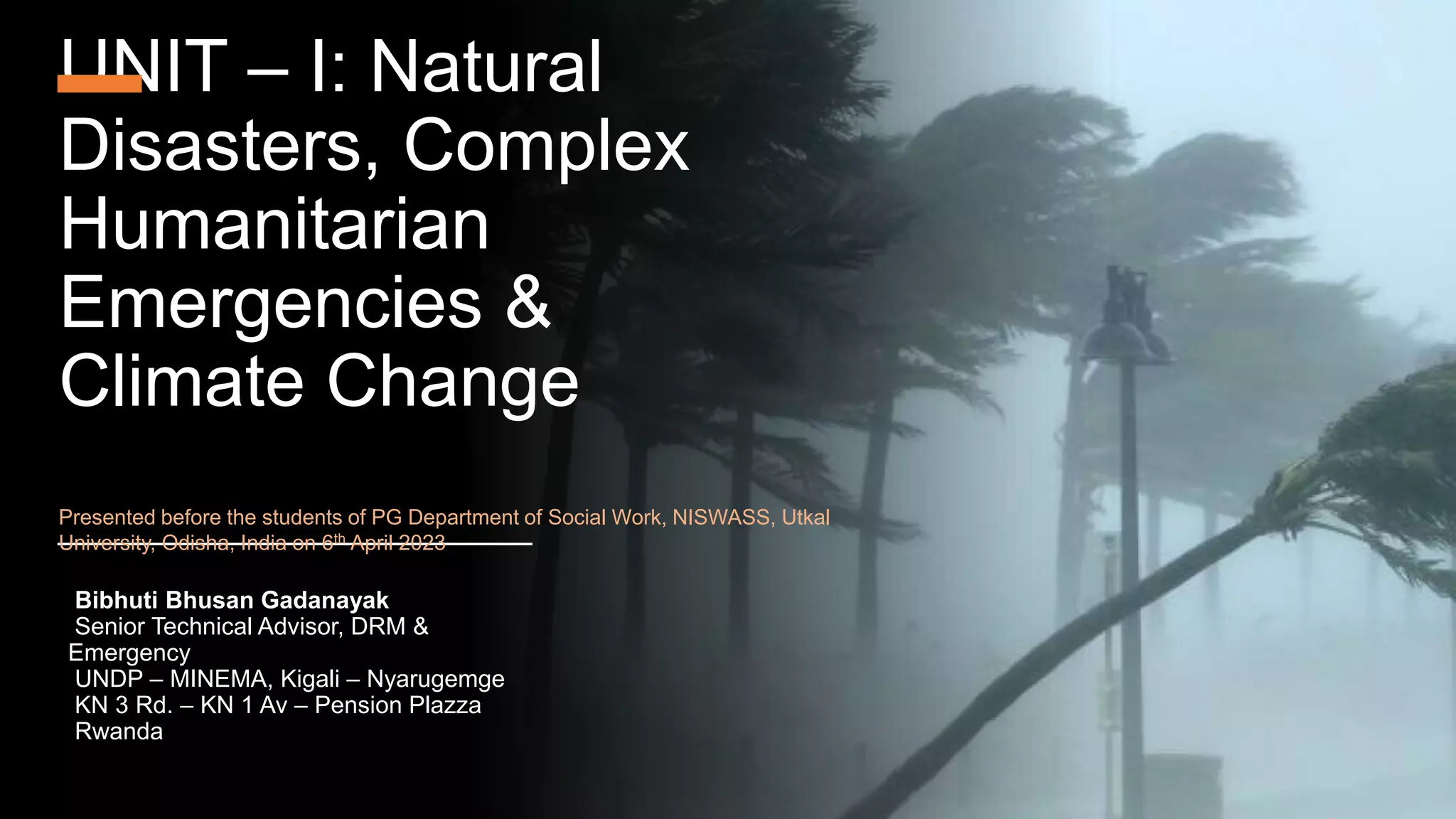
UNIT – I: Natural
Disasters, Complex
Humanitarian
Emergencies &
Climate Change
Bibhuti Bhusan Gadanayak
Senior Technical Advisor, DRM &
Emergency
UNDP – MINEMA, Kigali – Nyarugemge
KN 3 Rd. – KN 1 Av – Pension Plazza
Rwanda
Presented before the students of PG Department of Social Work, NISWASS, Utkal
University, Odisha, India on 6th April 2023
• Natural Disaster – Definition and
associated terminology, Complex
Humanitarian Emergency
• Origin and evolution of the definition,
difference between man-made and
natural disasters: characteristics
• Concept, nature and severity of climate
change.
• Causes of climate change. Impact of
climate change: globally in general and
Odisha in particular.
• Greenhouse effect, climate change and
disasters.
Flood – Bukavu – DRC-
Africa, Jan. 2022
Under water volcanic eruption –Sumatra
– Indonesia
Natural
disaster
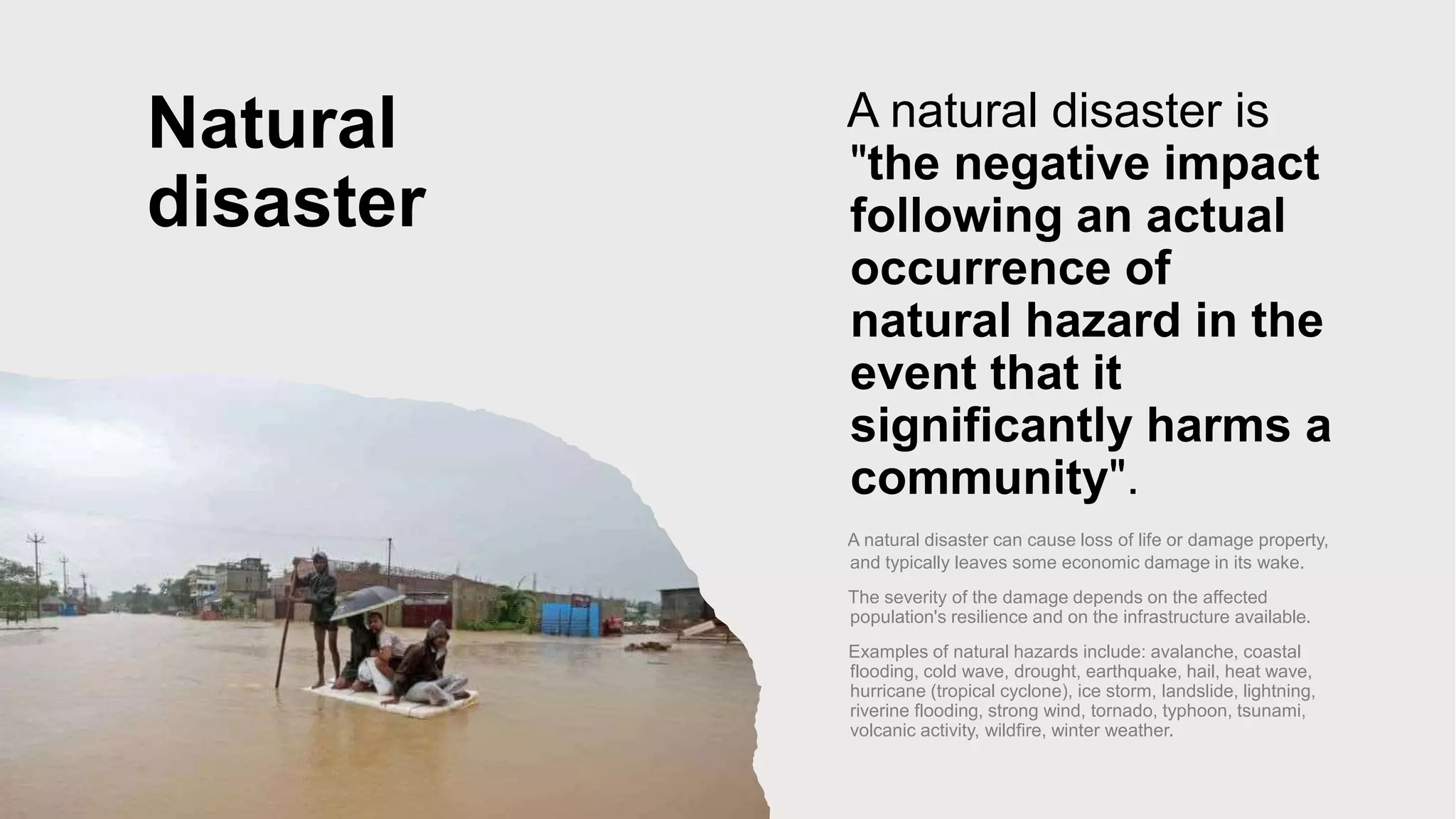
A natural disaster is
"the negative impact
following an actual
occurrence of
natural hazard in the
event that it
significantly harms a
community".
A natural disaster can cause loss of life or damage property,
and typically leaves some economic damage in its wake.
The severity of the damage depends on the affected
population's resilience and on the infrastructure available.
Examples of natural hazards include: avalanche, coastal
flooding, cold wave, drought, earthquake, hail, heat wave,
hurricane (tropical cyclone), ice storm, landslide, lightning,
riverine flooding, strong wind, tornado, typhoon, tsunami,
volcanic activity, wildfire, winter weather.
Associated terminology
The term "disaster" is defined as follows:
Disasters are serious disruptions to the
functioning of a community that exceed its
capacity to cope using its own resources.
Disasters can be caused by natural, man-made
and technological hazards, as well as various
factors that influence the exposure and
vulnerability of a community.
— International Federation of Red Cross and Red Crescent Societies (IFRC)
Natural hazard
Natural hazards and natural disasters are related
but are not the same.
A natural hazard is the threat of an event that will
likely have a negative impact. A natural disaster is
the negative impact following an actual
occurrence of natural hazard in the event that it
significantly harms a community.
— Federal Emergency Management Agency (FEMA) of the United States
Humanitarian Emergency
A humanitarian
emergency is an event
or series of events that
represents a critical
threat to the health,
safety, security or
wellbeing of a
community or other
large group of people,
usually over a wide
area.
Humanitarian crises can be grouped under the
following headings:
Natural disasters, which can be geophysical (e.g. earthquakes,
tsunamis and volcanic eruptions), hydrological (e.g. floods,
avalanches), climatological (e.g. droughts), meteorological (e.g.
storms, cyclones), or biological (e.g. epidemics, plagues).
Man-made emergencies, such as armed conflicts, plane and train
crashes, fires and industrial accidents.
Complex emergencies, which often have a combination of natural and
man-made elements, and different causes of vulnerability and a
combination of factors leads to a humanitarian crisis.
- Examples include food insecurity, armed conflicts, and displaced
populations.
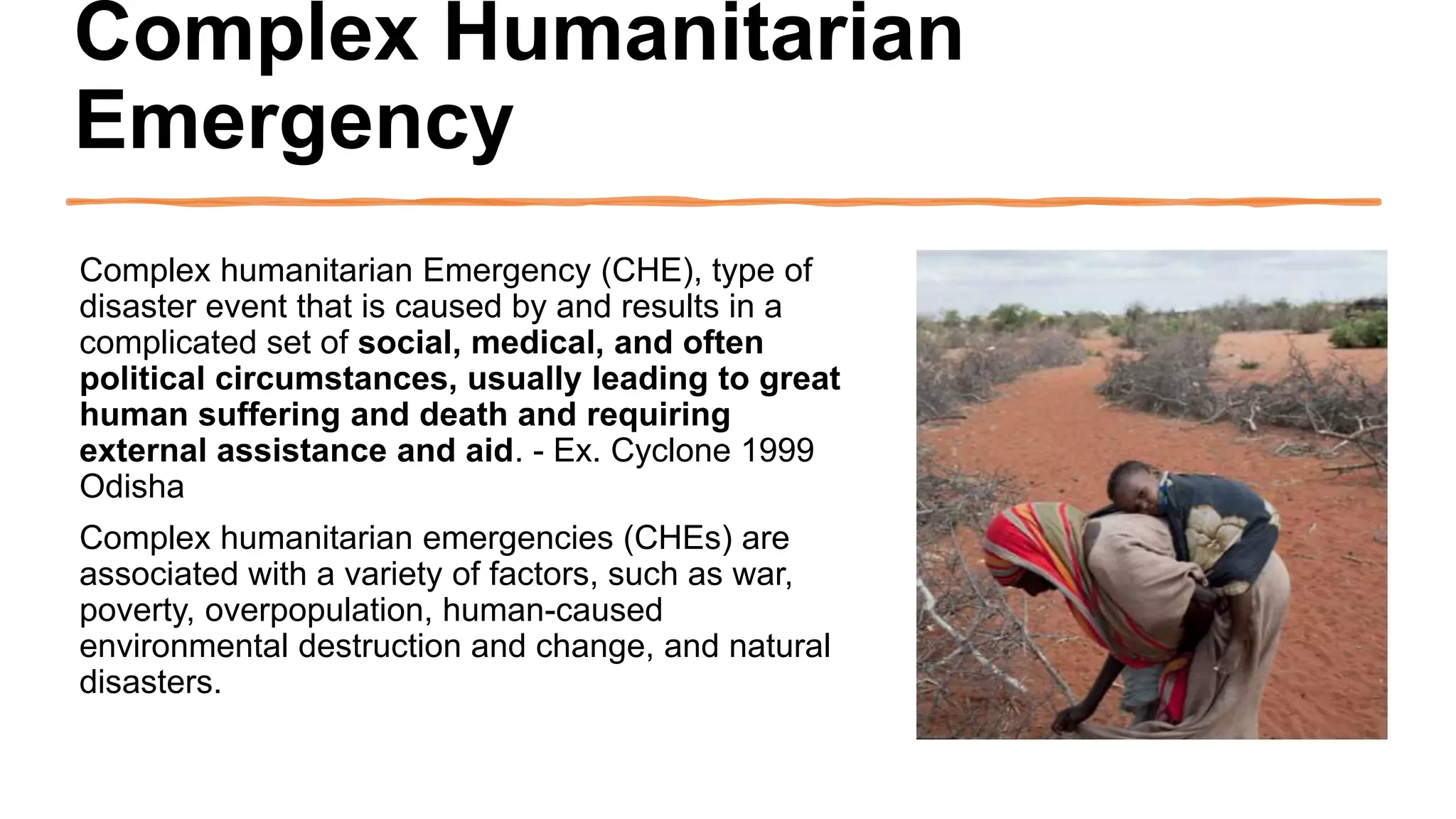
Complex Humanitarian
Emergency
Complex humanitarian Emergency (CHE), type of
disaster event that is caused by and results in a
complicated set of social, medical, and often
political circumstances, usually leading to great
human suffering and death and requiring
external assistance and aid. - Ex. Cyclone 1999
Odisha
Complex humanitarian emergencies (CHEs) are
associated with a variety of factors, such as war,
poverty, overpopulation, human-caused
environmental destruction and change, and natural
disasters.
Complex emergencies are typically
characterized by
 Extensive violence and loss of life
 Displacements of populations
 Widespread damage to societies and economies
 The need for large-scale, multi-faceted humanitarian assistance
 The hindrance or prevention of humanitarian assistance by
political and military constraints
 Significant security risks for humanitarian relief workers in some
areas
Disaster
The serious disruption of the functioning of
society, causing widespread human, material or
environmental losses, which exceed the ability of
the affected people to cope using their own
resources.
An event, either man-made or natural, sudden or progressive, causing
widespread human, material or environmental losses
Types of Disaster:
 Natural Disaster
 Man-Made Disaster
Natural Disaster: A natural disaster is a major adverse event
resulting from natural processes of the Earth; examples include
floods, volcanic eruptions, earthquakes, tsunamis, and other
geologic processes.
Man Made Disaster: Anthropogenic hazards or human-made
hazards can result in the form of a human-made disaster. In
this case, anthropogenic means threats having an element of
human intent, negligence, or error; or involving a failure of a
human-made system. It results in huge loss of life and
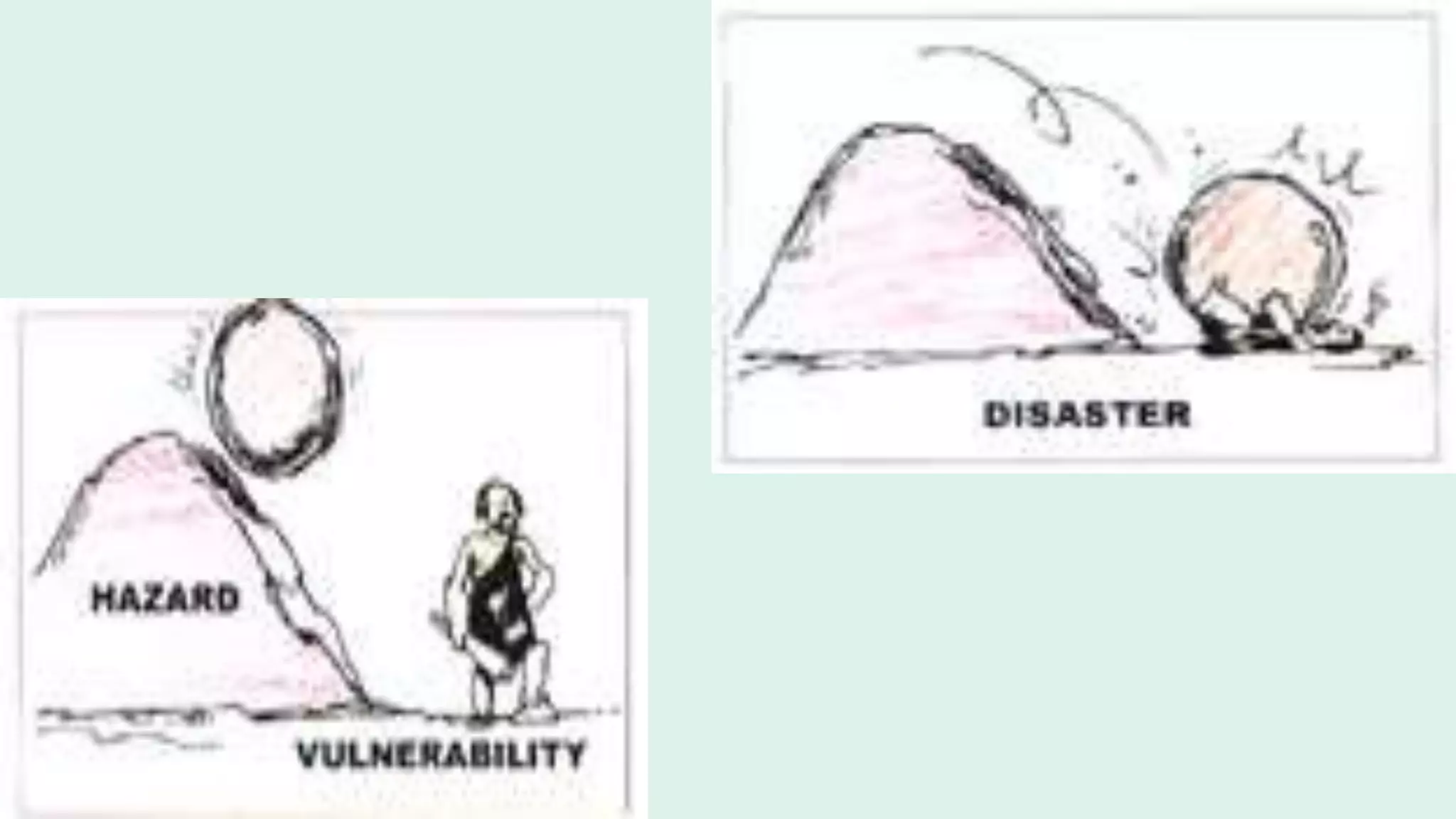
Hazard
Phenomenon or situation, which has the
potential to cause disruption or damage to
people, their property, their services and
their environment
There is a potential for occurrence of an event
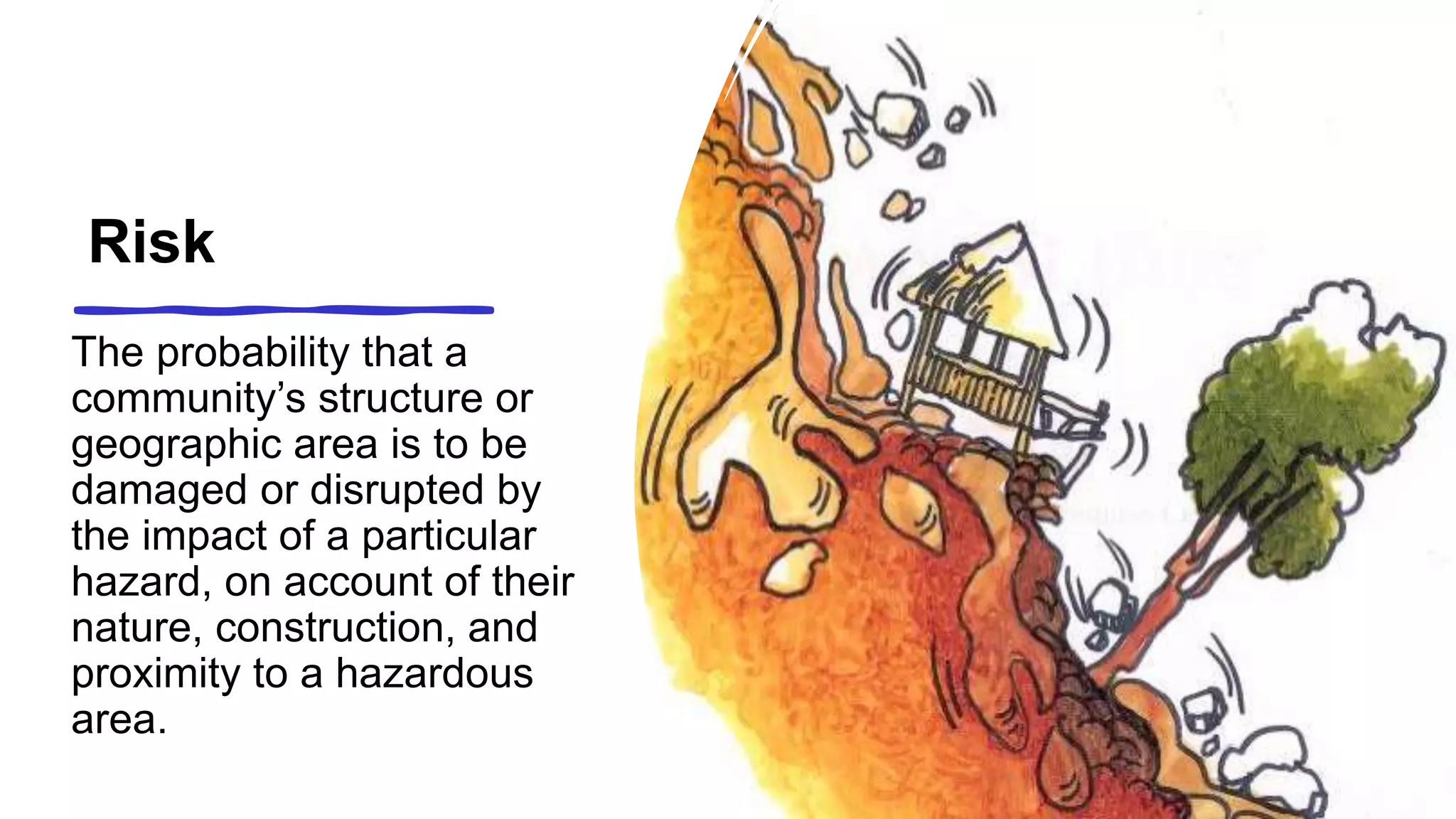
The probability that a
community’s structure or
geographic area is to be
damaged or disrupted by
the impact of a particular
hazard, on account of their
nature, construction, and
proximity to a hazardous
area.
Risk
Persons, buildings, crops or
other such like societal
components exposed to known
hazard, which are likely to be
adversely affected by the impact
of the hazard.
Elements at Risk
Is a condition or sets of
conditions that reduces people’s
ability to prepare for, withstand or
respond to a hazard
Vulnerability
Those positive condition or
abilities which increase a
community’s ability to deal
with hazards.
Capacity
Hazard Vulnerability
x Disaster Risk
Capacity
=
Disaster Risk
Response
Relief
Recovery
The process undertaken by a
disaster affected community to
fully restore itself to pre-disaster
level of functioning.
Rehabilitation
Actions taken in the aftermath of a disaster to:
• assist victims to repair their dwellings;
• re-establish essential services;
• revive key economic and social activities
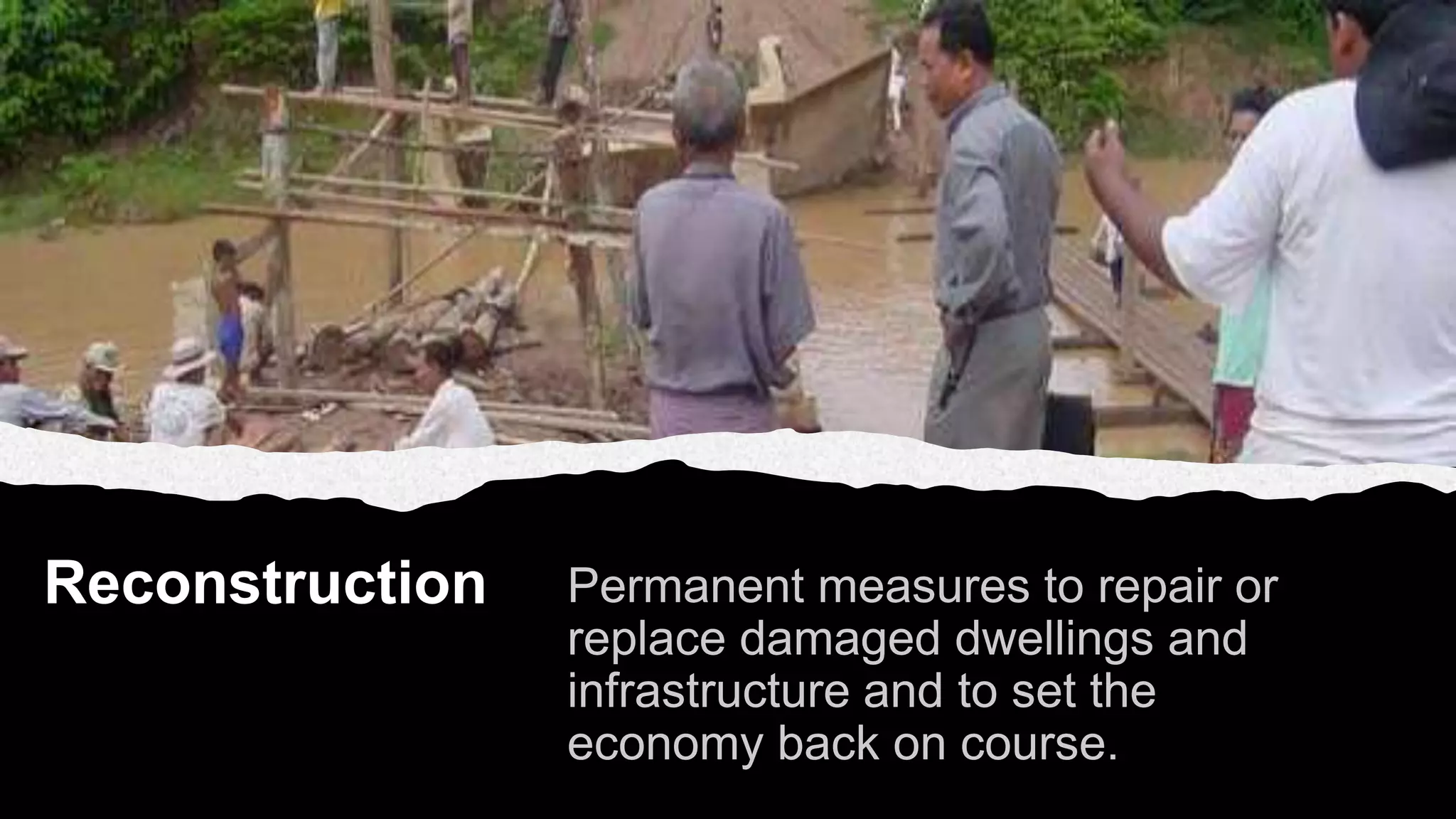
Reconstruction​
Prevention
Measures taken to avert a disaster
from occurring, if possible (to impede
a hazard so that it does not have any
harmful effects).
Mitigation​
Measures taken prior to the impact of a
disaster to minimize its effects (sometimes
referred to as structural and non-structural measures).
Preparedness
Measures taken in
anticipation of a disaster to
ensure that appropriate
and effective actions are
taken in the aftermath.
Disaster Risk
Reduction
There is no such thing as a 'natural'
disaster, only natural hazards.
• DRR aims to reduce the damage caused by
natural hazards like; earthquakes, floods,
droughts and cyclones, through an ethic of
prevention.
• DRR is the concept and practice of reducing
disaster risks through
• systematic efforts to analyze and reduce
the causal factors of disasters
• reducing exposure to hazards,
• lessening vulnerability of people and
property,
• wise management of land and the
environment, and improving
preparedness for adverse events
Disaster
Management
…...is the collective term for
all activities that contribute
to increasing capacities and
will lead to reducing
immediate and long-term
vulnerabilities. It covers
activities before, during and
after a disaster.
Disaster
Risk
Management​
…........is the systematic process of using administrative
decisions, organization, operational skills and
capacities to implement policies, strategies and
coping capacities of the society and communities to
lessen the impacts of natural hazards and related
environmental and technological disasters; this
comprises all forms of activities, including structural and
non-structural measures to avoid (prevention) or to limit
(mitigation and preparedness) adverse effects of hazards
Disaster
Risk
Management
Disaster Risk Management
DRR initiatives in India
DRR
Legal framework Disaster Management Act 2005
Institutions NDMA & MHA
Policy and Plans National Disaster Management Policy 2009
Resources Budget allocated under the 5 year Plans.
Integration into
development plans
10th Five-year plan (2001-2006) explicitly highlighted the
needs and plans for risk reduction and mitigation.
DM Plan National Disaster Management Plan (NDMP) 2016
National Disaster Management Plan aims to make India disaster resilient and significantly reduce the loss of lives and
assets. ... NDMP covers all phases of disaster management: prevention, mitigation, response and recovery.
Climate Change
• Climate Change means significant difference in weather pattern
over an extended period of time
• Scientific consensus links current climate change primarily;
• emissions of carbon dioxide and other
• greenhouse gases from human activity, such as;
• the burning of fossil fuels,
• loss of forests and unsustainable production and
• consumption in the industrialized world
The effects include higher global temperatures,
• an increase in frequency and intensity of extreme weather events and
• related natural disasters,
• severe impacts to the sustainability of ecosystems.
Alaska's Columbia Glacier recedes rapidly
One of the most dramatic ways we're transforming the planet is through global warming. And a great place to see its
effects is through the melting of glaciers and ice sheets around the world.
The images above show the Columbia Glacier in Alaska, which flows directly into the sea. The glacier had stayed
more or less fixed in place between its discovery in 1794 and 1980, but then suddenly began shrinking. Between 1986
and 2014, its nose had retreated 12 miles north, making it one of the fastest-receding glaciers in the world.
Alaska's Columbia Glacier, seen on July 28, 1986 and July 2, 2014. (NASA, Images of Change)
Source: http://www.vox.com/2015/4/7/8352381/anthropocene-NASA-images
1986
2014
Major projections of CC
The IPCC has examined the published results from many different models and on
the basis of the evidence has estimated that by 2100
• The global average surface warming (surface air temperature change), will increase by 1.1 - 6.4 °C.
• The sea level will rise between 18 and 59 cm.•
• The oceans will become more acidic.
• It is very likely that hot extremes, heat waves and heavy precipitation events will
continue to become more frequent.
• It is very likely that there will be more precipitation at higher latitudes and it is likely that
there will be less precipitation in most subtropical land areas.
• It is likely that tropical cyclones (typhoons and hurricanes) will become more intense,
with larger peak wind speeds and more heavy precipitation associated with on-going
increases of tropical sea surface temperatures.
Issue Impacts of Climate Change
Natural resources:
food, water, fuel & land
• Drought and/or flooding from temperature changes and erratic weather
• Decreased soil fertility
• Decreased crop yields or crop failure
• Resource scarcity
• Shortage of clean, potable water
Natural disasters • Warming oceans
• Changing weather patterns/seasons
• Erratic and more intense weather events
Health • Increase in infectious, water-borne or vector-borne diseases, e.g., malaria, due to increased temperatures
and intensified storms
• Heat-related illness
• Malnutrition
• Increased air pollution, allergies and asthma
• Mental disorders such as anxiety and depression
Urbanization • Rural-to-urban migration increases due to environmental degradation, reduced productivity and conflict
over resources
• Informal shelters and communities expand
Migration &
displacement
• Disaster events can lead to displacement,19 temporary and permanent, internal and international
• Environmental degradation and competition for resources prompts women and men to move
• Forced migration due to regional vulnerability possible
H/H composition • Loss of/change in family composition due to migration/displacement and/or fatalities from natural
disasters
Conflict & violence • Competition over limited resources can trigger conflict or displacement
• Shortages in regular rainfall and overall scarcity of natural resources can increase civil war by 50 per cent
• Increased anxiety and distress over livelihood insecurity
Impact of Climate Change
Source: Climate Change, Connections, UNFPA
How climate change will affect key sectors,
It will affect the major sectors like; Water, Food, Industry, settlement and society, Health
WATER: DROUGHT-
AFFECTED AREAS
WILL LIKELY
BECOME MORE
WIDELY
DISTRIBUTED.
HEAVIER
PRECIPITATION
EVENTS ARE VERY
LIKELY TO INCREASE
IN FREQUENCY
LEADING TO
HIGHER FLOOD
RISKS.
FOOD: INCREASES
IN TEMPERATURE
AND THE
FREQUENCY OF
DROUGHTS AND
FLOODS ARE LIKELY
TO AFFECT CROP
PRODUCTION
NEGATIVELY, WHICH
COULD INCREASE
THE NUMBER OF
PEOPLE AT RISK
FROM HUNGER
AND INCREASED
LEVELS OF
DISPLACEMENT
AND MIGRATION.
INDUSTRY, SETTLEMENT
AND SOCIETY: THE MOST
VULNERABLE INDUSTRIES,
SETTLEMENTS AND
SOCIETIES ARE GENERALLY
THOSE LOCATED IN COASTAL
AREAS AND RIVER FLOOD
PLAINS, AND THOSE WHOSE
ECONOMIES ARE CLOSELY
LINKED WITH CLIMATE
SENSITIVE RESOURCES. THIS
APPLIES PARTICULARLY TO
LOCATIONS ALREADY PRONE
TO EXTREME WEATHER
EVENTS, AND ESPECIALLY
AREAS UNDERGOING RAPID
URBANIZATION. WHERE
EXTREME WEATHER EVENTS
BECOME MORE INTENSE OR
MORE FREQUENT, THE
ECONOMIC AND SOCIAL
COSTS OF THOSE EVENTS
WILL INCREASE.
HEALTH: THE PROJECTED
CHANGES IN CLIMATE ARE
LIKELY TO ALTER THE HEALTH
STATUS OF MILLIONS OF
PEOPLE, INCLUDING THROUGH
INCREASED DEATHS, DISEASE
AND INJURY DUE TO HEAT
WAVES, FLOODS, STORMS,
FIRES AND DROUGHTS.
INCREASED MALNUTRITION,
DIARRHOEAL DISEASE AND
MALARIA IN SOME AREAS WILL
INCREASE VULNERABILITY TO
EXTREME PUBLIC HEALTH AND
DEVELOPMENT GOALS WILL BE
THREATENED BY LONGER
TERM DAMAGE TO HEALTH
SYSTEMS FROM DISASTERS
CC initiatives in India
CC
Legal framework NAPCC
Institutions Ministry of Forest & Env.
Policy and Plans The CC plans are
prepared
Resources
Integration into development
plans
Under the SAPCC at the
state level
ADPC, Participants Hand book CBDRM for Local Authorities
ADPC, CBDRM -13 Training Course Materials, 2005
ADPC, CBDRM 11 Course Materials, 2003
ADPC, Hazard Assessment and Vulnerability Assessment, DMC Hand-out, 1995
Abarquez Imelda and Zubair Murshed, Community-Based Disaster Risk Management: Field Practitioners’
Gadanayak, B B & Routray J K (2010), A path to disaster resilient Communities, https://www.lap-
publishing.com/catalog/details/store/gb/book/978-3-8433-6666-3/a-path-to-disaster-resilient-communities
Handbook. ADPC (Adapted from CBDRM-II course materials), 2004
Anbalagan, R. and B. Singh, Landslide Hazard and Risk Mapping in the Himalaya IN: Landslide Hazard
Mitigation in the Hindukush Himalayas, Li Tianchi, Suresh Raj Chalise, and Bishal nath Upreti (editors).
ICIMOD/UNDP, Nepal, 2001
Anderson, M. and P. Woodrow, Rising from the Ashes: Development Strategies in Times of Disaster, UNESCO
and West view Press, Inc., Colorado, 1990
Astrid Von Kotze, Learning For Risk Reduction in Risk. Sustainable Development & Disasters: Southern
Perspectives. Peri-peri Publications, South Africa, 1999
Bellers, R., Workshop on Risk Assessment, organized by South Bank University, ECHO and Center for
Disaster Preparedness, Manila, 28-30 January 1999.
Kafle, Shesh Kanta, Syangja District Disaster Management Action Plan, DDC Syangja (Unpublished
document). Nepal. PP. 120, 2005
Thank you

UNIT – I: Natural Disasters, Complex Humanitarian Emergencies & Climate Change

  • 1.
    UNIT – I:Natural Disasters, Complex Humanitarian Emergencies & Climate Change Bibhuti Bhusan Gadanayak Senior Technical Advisor, DRM & Emergency UNDP – MINEMA, Kigali – Nyarugemge KN 3 Rd. – KN 1 Av – Pension Plazza Rwanda Presented before the students of PG Department of Social Work, NISWASS, Utkal University, Odisha, India on 6th April 2023
  • 2.
    • Natural Disaster– Definition and associated terminology, Complex Humanitarian Emergency • Origin and evolution of the definition, difference between man-made and natural disasters: characteristics • Concept, nature and severity of climate change. • Causes of climate change. Impact of climate change: globally in general and Odisha in particular. • Greenhouse effect, climate change and disasters.
  • 3.
    Flood – Bukavu– DRC- Africa, Jan. 2022 Under water volcanic eruption –Sumatra – Indonesia
  • 4.
    Natural disaster A natural disasteris "the negative impact following an actual occurrence of natural hazard in the event that it significantly harms a community". A natural disaster can cause loss of life or damage property, and typically leaves some economic damage in its wake. The severity of the damage depends on the affected population's resilience and on the infrastructure available. Examples of natural hazards include: avalanche, coastal flooding, cold wave, drought, earthquake, hail, heat wave, hurricane (tropical cyclone), ice storm, landslide, lightning, riverine flooding, strong wind, tornado, typhoon, tsunami, volcanic activity, wildfire, winter weather.
  • 5.
    Associated terminology The term"disaster" is defined as follows: Disasters are serious disruptions to the functioning of a community that exceed its capacity to cope using its own resources. Disasters can be caused by natural, man-made and technological hazards, as well as various factors that influence the exposure and vulnerability of a community. — International Federation of Red Cross and Red Crescent Societies (IFRC)
  • 6.
    Natural hazard Natural hazardsand natural disasters are related but are not the same. A natural hazard is the threat of an event that will likely have a negative impact. A natural disaster is the negative impact following an actual occurrence of natural hazard in the event that it significantly harms a community. — Federal Emergency Management Agency (FEMA) of the United States
  • 7.
    Humanitarian Emergency A humanitarian emergencyis an event or series of events that represents a critical threat to the health, safety, security or wellbeing of a community or other large group of people, usually over a wide area.
  • 8.
    Humanitarian crises canbe grouped under the following headings: Natural disasters, which can be geophysical (e.g. earthquakes, tsunamis and volcanic eruptions), hydrological (e.g. floods, avalanches), climatological (e.g. droughts), meteorological (e.g. storms, cyclones), or biological (e.g. epidemics, plagues). Man-made emergencies, such as armed conflicts, plane and train crashes, fires and industrial accidents. Complex emergencies, which often have a combination of natural and man-made elements, and different causes of vulnerability and a combination of factors leads to a humanitarian crisis. - Examples include food insecurity, armed conflicts, and displaced populations.
  • 9.
    Complex Humanitarian Emergency Complex humanitarianEmergency (CHE), type of disaster event that is caused by and results in a complicated set of social, medical, and often political circumstances, usually leading to great human suffering and death and requiring external assistance and aid. - Ex. Cyclone 1999 Odisha Complex humanitarian emergencies (CHEs) are associated with a variety of factors, such as war, poverty, overpopulation, human-caused environmental destruction and change, and natural disasters.
  • 10.
    Complex emergencies aretypically characterized by  Extensive violence and loss of life  Displacements of populations  Widespread damage to societies and economies  The need for large-scale, multi-faceted humanitarian assistance  The hindrance or prevention of humanitarian assistance by political and military constraints  Significant security risks for humanitarian relief workers in some areas
  • 14.
    Disaster The serious disruptionof the functioning of society, causing widespread human, material or environmental losses, which exceed the ability of the affected people to cope using their own resources. An event, either man-made or natural, sudden or progressive, causing widespread human, material or environmental losses Types of Disaster:  Natural Disaster  Man-Made Disaster Natural Disaster: A natural disaster is a major adverse event resulting from natural processes of the Earth; examples include floods, volcanic eruptions, earthquakes, tsunamis, and other geologic processes. Man Made Disaster: Anthropogenic hazards or human-made hazards can result in the form of a human-made disaster. In this case, anthropogenic means threats having an element of human intent, negligence, or error; or involving a failure of a human-made system. It results in huge loss of life and
  • 15.
    Hazard Phenomenon or situation,which has the potential to cause disruption or damage to people, their property, their services and their environment There is a potential for occurrence of an event
  • 16.
    The probability thata community’s structure or geographic area is to be damaged or disrupted by the impact of a particular hazard, on account of their nature, construction, and proximity to a hazardous area. Risk
  • 17.
    Persons, buildings, cropsor other such like societal components exposed to known hazard, which are likely to be adversely affected by the impact of the hazard. Elements at Risk
  • 18.
    Is a conditionor sets of conditions that reduces people’s ability to prepare for, withstand or respond to a hazard Vulnerability
  • 20.
    Those positive conditionor abilities which increase a community’s ability to deal with hazards. Capacity
  • 21.
    Hazard Vulnerability x DisasterRisk Capacity = Disaster Risk
  • 22.
  • 23.
  • 24.
    Recovery The process undertakenby a disaster affected community to fully restore itself to pre-disaster level of functioning.
  • 25.
    Rehabilitation Actions taken inthe aftermath of a disaster to: • assist victims to repair their dwellings; • re-establish essential services; • revive key economic and social activities
  • 26.
  • 27.
    Prevention Measures taken toavert a disaster from occurring, if possible (to impede a hazard so that it does not have any harmful effects).
  • 28.
    Mitigation​ Measures taken priorto the impact of a disaster to minimize its effects (sometimes referred to as structural and non-structural measures).
  • 29.
    Preparedness Measures taken in anticipationof a disaster to ensure that appropriate and effective actions are taken in the aftermath.
  • 31.
    Disaster Risk Reduction There isno such thing as a 'natural' disaster, only natural hazards. • DRR aims to reduce the damage caused by natural hazards like; earthquakes, floods, droughts and cyclones, through an ethic of prevention. • DRR is the concept and practice of reducing disaster risks through • systematic efforts to analyze and reduce the causal factors of disasters • reducing exposure to hazards, • lessening vulnerability of people and property, • wise management of land and the environment, and improving preparedness for adverse events
  • 32.
    Disaster Management …...is the collectiveterm for all activities that contribute to increasing capacities and will lead to reducing immediate and long-term vulnerabilities. It covers activities before, during and after a disaster.
  • 33.
    Disaster Risk Management​ …........is the systematicprocess of using administrative decisions, organization, operational skills and capacities to implement policies, strategies and coping capacities of the society and communities to lessen the impacts of natural hazards and related environmental and technological disasters; this comprises all forms of activities, including structural and non-structural measures to avoid (prevention) or to limit (mitigation and preparedness) adverse effects of hazards
  • 34.
  • 35.
    DRR initiatives inIndia DRR Legal framework Disaster Management Act 2005 Institutions NDMA & MHA Policy and Plans National Disaster Management Policy 2009 Resources Budget allocated under the 5 year Plans. Integration into development plans 10th Five-year plan (2001-2006) explicitly highlighted the needs and plans for risk reduction and mitigation. DM Plan National Disaster Management Plan (NDMP) 2016 National Disaster Management Plan aims to make India disaster resilient and significantly reduce the loss of lives and assets. ... NDMP covers all phases of disaster management: prevention, mitigation, response and recovery.
  • 36.
    Climate Change • ClimateChange means significant difference in weather pattern over an extended period of time • Scientific consensus links current climate change primarily; • emissions of carbon dioxide and other • greenhouse gases from human activity, such as; • the burning of fossil fuels, • loss of forests and unsustainable production and • consumption in the industrialized world The effects include higher global temperatures, • an increase in frequency and intensity of extreme weather events and • related natural disasters, • severe impacts to the sustainability of ecosystems.
  • 37.
    Alaska's Columbia Glacierrecedes rapidly One of the most dramatic ways we're transforming the planet is through global warming. And a great place to see its effects is through the melting of glaciers and ice sheets around the world. The images above show the Columbia Glacier in Alaska, which flows directly into the sea. The glacier had stayed more or less fixed in place between its discovery in 1794 and 1980, but then suddenly began shrinking. Between 1986 and 2014, its nose had retreated 12 miles north, making it one of the fastest-receding glaciers in the world. Alaska's Columbia Glacier, seen on July 28, 1986 and July 2, 2014. (NASA, Images of Change) Source: http://www.vox.com/2015/4/7/8352381/anthropocene-NASA-images 1986 2014
  • 38.
    Major projections ofCC The IPCC has examined the published results from many different models and on the basis of the evidence has estimated that by 2100 • The global average surface warming (surface air temperature change), will increase by 1.1 - 6.4 °C. • The sea level will rise between 18 and 59 cm.• • The oceans will become more acidic. • It is very likely that hot extremes, heat waves and heavy precipitation events will continue to become more frequent. • It is very likely that there will be more precipitation at higher latitudes and it is likely that there will be less precipitation in most subtropical land areas. • It is likely that tropical cyclones (typhoons and hurricanes) will become more intense, with larger peak wind speeds and more heavy precipitation associated with on-going increases of tropical sea surface temperatures.
  • 39.
    Issue Impacts ofClimate Change Natural resources: food, water, fuel & land • Drought and/or flooding from temperature changes and erratic weather • Decreased soil fertility • Decreased crop yields or crop failure • Resource scarcity • Shortage of clean, potable water Natural disasters • Warming oceans • Changing weather patterns/seasons • Erratic and more intense weather events Health • Increase in infectious, water-borne or vector-borne diseases, e.g., malaria, due to increased temperatures and intensified storms • Heat-related illness • Malnutrition • Increased air pollution, allergies and asthma • Mental disorders such as anxiety and depression Urbanization • Rural-to-urban migration increases due to environmental degradation, reduced productivity and conflict over resources • Informal shelters and communities expand Migration & displacement • Disaster events can lead to displacement,19 temporary and permanent, internal and international • Environmental degradation and competition for resources prompts women and men to move • Forced migration due to regional vulnerability possible H/H composition • Loss of/change in family composition due to migration/displacement and/or fatalities from natural disasters Conflict & violence • Competition over limited resources can trigger conflict or displacement • Shortages in regular rainfall and overall scarcity of natural resources can increase civil war by 50 per cent • Increased anxiety and distress over livelihood insecurity Impact of Climate Change Source: Climate Change, Connections, UNFPA
  • 40.
    How climate changewill affect key sectors, It will affect the major sectors like; Water, Food, Industry, settlement and society, Health WATER: DROUGHT- AFFECTED AREAS WILL LIKELY BECOME MORE WIDELY DISTRIBUTED. HEAVIER PRECIPITATION EVENTS ARE VERY LIKELY TO INCREASE IN FREQUENCY LEADING TO HIGHER FLOOD RISKS. FOOD: INCREASES IN TEMPERATURE AND THE FREQUENCY OF DROUGHTS AND FLOODS ARE LIKELY TO AFFECT CROP PRODUCTION NEGATIVELY, WHICH COULD INCREASE THE NUMBER OF PEOPLE AT RISK FROM HUNGER AND INCREASED LEVELS OF DISPLACEMENT AND MIGRATION. INDUSTRY, SETTLEMENT AND SOCIETY: THE MOST VULNERABLE INDUSTRIES, SETTLEMENTS AND SOCIETIES ARE GENERALLY THOSE LOCATED IN COASTAL AREAS AND RIVER FLOOD PLAINS, AND THOSE WHOSE ECONOMIES ARE CLOSELY LINKED WITH CLIMATE SENSITIVE RESOURCES. THIS APPLIES PARTICULARLY TO LOCATIONS ALREADY PRONE TO EXTREME WEATHER EVENTS, AND ESPECIALLY AREAS UNDERGOING RAPID URBANIZATION. WHERE EXTREME WEATHER EVENTS BECOME MORE INTENSE OR MORE FREQUENT, THE ECONOMIC AND SOCIAL COSTS OF THOSE EVENTS WILL INCREASE. HEALTH: THE PROJECTED CHANGES IN CLIMATE ARE LIKELY TO ALTER THE HEALTH STATUS OF MILLIONS OF PEOPLE, INCLUDING THROUGH INCREASED DEATHS, DISEASE AND INJURY DUE TO HEAT WAVES, FLOODS, STORMS, FIRES AND DROUGHTS. INCREASED MALNUTRITION, DIARRHOEAL DISEASE AND MALARIA IN SOME AREAS WILL INCREASE VULNERABILITY TO EXTREME PUBLIC HEALTH AND DEVELOPMENT GOALS WILL BE THREATENED BY LONGER TERM DAMAGE TO HEALTH SYSTEMS FROM DISASTERS
  • 41.
    CC initiatives inIndia CC Legal framework NAPCC Institutions Ministry of Forest & Env. Policy and Plans The CC plans are prepared Resources Integration into development plans Under the SAPCC at the state level
  • 43.
    ADPC, Participants Handbook CBDRM for Local Authorities ADPC, CBDRM -13 Training Course Materials, 2005 ADPC, CBDRM 11 Course Materials, 2003 ADPC, Hazard Assessment and Vulnerability Assessment, DMC Hand-out, 1995 Abarquez Imelda and Zubair Murshed, Community-Based Disaster Risk Management: Field Practitioners’ Gadanayak, B B & Routray J K (2010), A path to disaster resilient Communities, https://www.lap- publishing.com/catalog/details/store/gb/book/978-3-8433-6666-3/a-path-to-disaster-resilient-communities Handbook. ADPC (Adapted from CBDRM-II course materials), 2004 Anbalagan, R. and B. Singh, Landslide Hazard and Risk Mapping in the Himalaya IN: Landslide Hazard Mitigation in the Hindukush Himalayas, Li Tianchi, Suresh Raj Chalise, and Bishal nath Upreti (editors). ICIMOD/UNDP, Nepal, 2001 Anderson, M. and P. Woodrow, Rising from the Ashes: Development Strategies in Times of Disaster, UNESCO and West view Press, Inc., Colorado, 1990 Astrid Von Kotze, Learning For Risk Reduction in Risk. Sustainable Development & Disasters: Southern Perspectives. Peri-peri Publications, South Africa, 1999 Bellers, R., Workshop on Risk Assessment, organized by South Bank University, ECHO and Center for Disaster Preparedness, Manila, 28-30 January 1999. Kafle, Shesh Kanta, Syangja District Disaster Management Action Plan, DDC Syangja (Unpublished document). Nepal. PP. 120, 2005
  • 44.