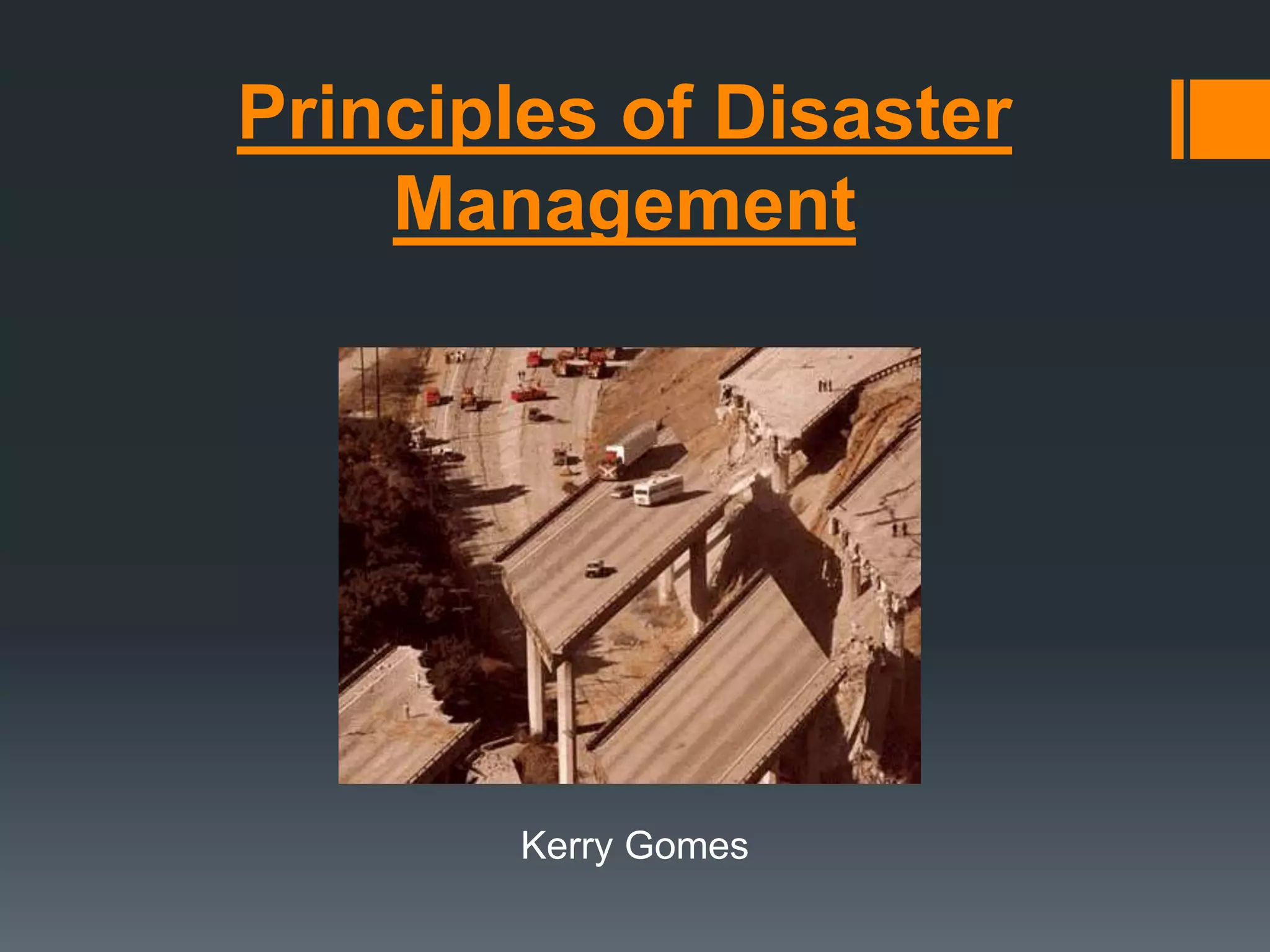
Principles of Disaster
Management
Kerry Gomes
Perspective
• Each day 20,000 Australians are treated at hospital
Emergency Departments and 5000 are transported by
ambulance.
• “We have never had an event with 20,000 casualties in
Australia, Except every day!”
• So what do we need to do that is different in disasters?
Outline
• Definitions. ‰
• History and epidemiology ‰
• Risk assessment and management ‰
• Disaster Management Principles ‰
• Response Management Framework ‰
• Issues, Myths and Problems ‰
• Questions
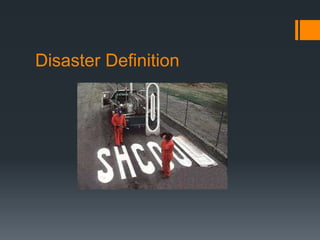
Disaster Definition
Disaster Definition
“A serious disruption to community life which threatens or
causes death or injury in that community, and damage to
property which is beyond the day-to-day capacity of the
prescribed statutory authorities and which requires special
mobilisation and organisation of resources other than those
normally available to those authorities.”
EMA – Australian Emergency Manuals Series
Types of Disaster
Natural
• Seismic
• Earthquake
• Volcanic eruption
• Tsunami
• Celestial collision
• Climatic
• High winds (Storm, Cyclones, Tornado)
• Precipitation (Rain, snow, Ice)
• Lightning (fire)
• Temperature extremes (Hot and cold)
• Erosion
• Drought
• Desertification
• Floods
• Avalanches
Man-made
• Technological
• Release of substances
(Chemicals, Biological, Nuclear)
• Transport
• Structural failure
• Explosions
• Fire
• Environmental interference
• Conflict
• Conventional war
• Armed conflict/Civil conflict
• Complex human emergency
• Terrorism
• Unarmed conflict (Sanctions,
embargos)
Disaster Epidemiology
• In the past 50 years
• - more than 10,000 disasters reported.
• - more than 5 billion people affected.
• - more than 12 million persons killed.
• - economic costs > $ 4 trillion USD.
(Note: By comparison Australia’s GDP in 2006 was US$ 0.75
trillion)
 Centre for Research on the Epidemiology of Disasters - CRED
Are disasters Increasing?
• Improved reporting
• CNN as first responder
• Increased population and
density
• 3m people now live in the vicinity
of Vesuvius
• Cities in high risk areas
• 64 of the largest cities in world in
seismic zones or flood plains.
• Global warming
• Increased storm activity
• Increased technologies
• Mass transport
• Chemical industrialisation
• Transport of dangerous goods
• Economic stress
• Urban slums in dangerous
environments
• Armed conflict
• Terrorism
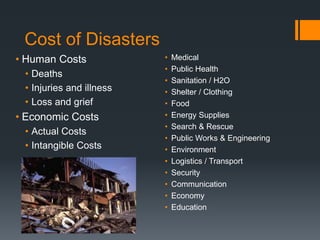
Cost of Disasters
• Medical
• Public Health
• Sanitation / H2O
• Shelter / Clothing
• Food
• Energy Supplies
• Search & Rescue
• Public Works & Engineering
• Environment
• Logistics / Transport
• Security
• Communication
• Economy
• Education
• Human Costs
• Deaths
• Injuries and illness
• Loss and grief
• Economic Costs
• Actual Costs
• Intangible Costs
Why are Disasters Different?
• Number and variety of casualties.
• Initial disorder.
• Initial lack of resources.
• Effects on health system / community.
• Loss of infrastructure
• Need for multidisciplinary teams.
• Multiplicity of tasks.
It is not just an increase in medical effort that is needed but a
different medical approach also.
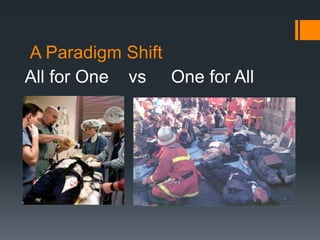
A Paradigm Shift
All for One vs One for All
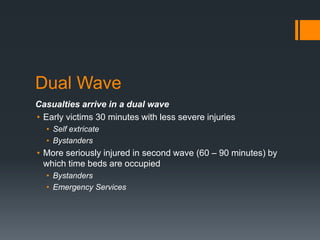
Dual Wave
Casualties arrive in a dual wave
• Early victims 30 minutes with less severe injuries
• Self extricate
• Bystanders
• More seriously injured in second wave (60 – 90 minutes) by
which time beds are occupied
• Bystanders
• Emergency Services
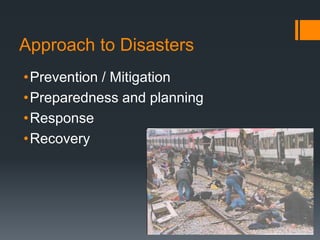
Approach to Disasters
•Prevention / Mitigation
•Preparedness and planning
•Response
•Recovery
Prevention / Mitigation
“Regulatory and
physical measures to
ensure that
emergencies are
prevented, or their
effects mitigated”
EMA – Australian Emergency Manuals
Series.
• Activities which eliminate or reduce
the likelihood or impact of a
disaster.
• Includes long term activities which
reduce the effects of unavoidable
disasters. e.g. building standards
• Cost effective mitigation measures
are the key to reducing disaster
losses in the long term.
Prevention / Mitigation
• Zoning / land use management
• Building codes
• Building use regulations
• Relocation
• Safety improvements
• Legislation
• Public Information
• Community awareness and education
• Tax, insurance incentives or disincentives
Preparedness and planning
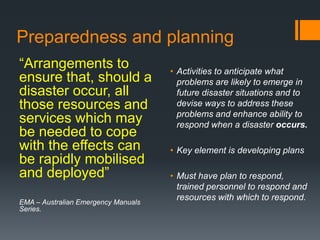
“Arrangements to
ensure that, should a
disaster occur, all
those resources and
services which may
be needed to cope
with the effects can
be rapidly mobilised
and deployed”
EMA – Australian Emergency Manuals
Series.
• Activities to anticipate what
problems are likely to emerge in
future disaster situations and to
devise ways to address these
problems and enhance ability to
respond when a disaster occurs.
• Key element is developing plans
• Must have plan to respond,
trained personnel to respond and
resources with which to respond.
Preparedness and planning
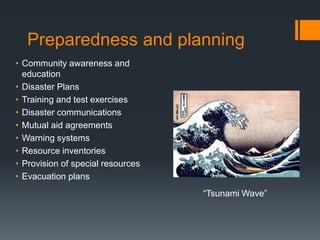
• Community awareness and
education
• Disaster Plans
• Training and test exercises
• Disaster communications
• Mutual aid agreements
• Warning systems
• Resource inventories
• Provision of special resources
• Evacuation plans
“Tsunami Wave”
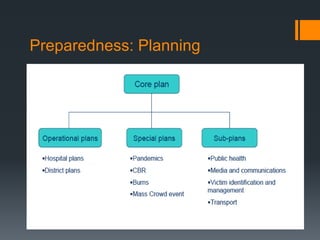
Preparedness: Planning
Preparedness: Disaster Teams
• Teams must be self sufficient
• If not then may be a “second disaster”
• victim country forced to feed and shelter extra people from
already limited resources
• limited usefulness if no supplies / power e.g. Bam earthquake no
power for 2 days
• Should include base camp equipment, field hospital, medical
supplies, water, food, sanitation, power.
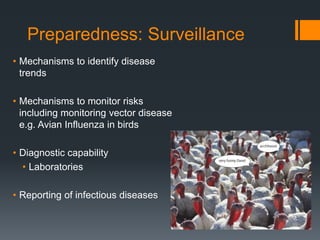
Preparedness: Surveillance
• Mechanisms to identify disease
trends
• Mechanisms to monitor risks
including monitoring vector disease
e.g. Avian Influenza in birds
• Diagnostic capability
• Laboratories
• Reporting of infectious diseases
Response
“Actions taken in
anticipation of,
during and
immediately after
impact to ensure
that its effects are
minimised and
that people are
given immediate
relief and support”
EMA – Australian Emergency
Manuals Series.
• Implementing plans
• Implementing disaster
legislation or
• declarations
• Issuing warnings
• Activating disaster operations
centres
• Mobilizing resources
• Notifying public authorities
• Providing medical assistance
• Providing immediate relief
• Search and rescue
The Response Management
Framework
A set of principles which provide a framework for managing
any event.
• Command
• Control
• Coordination
• Communication
• Clinical Management
• Containment
• Continuity
• Capability
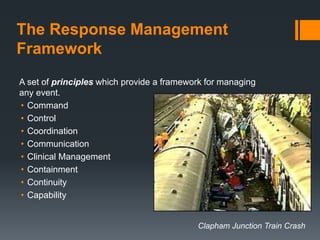
Clapham Junction Train Crash
Command, Control & Coordination
COMMAND : The direction of members of an organisation in the
performance of roles and tasks.
• Operate vertically within an organisation.
CONTROL : Overall direction of emergency management activities in an
emergency situation.
• Operates horizontally across organisations.
COORDINATION : The bringing together of organisations and elements
to ensure an effective response, mainly concerned with systematic
acquisition and application of resources in accordance with threat or
impact.
• Operates both vertically and horizontally as functions of authority to
command and control.
Communication
• The message
• Clarity of message (pre-
considered)
• The means
• Consider the vulnerability of
normal channels (e.g.
mobile phones)
• Remember “the runner”
• Radio codes
• The manner
• Pathways of communication
Most common problem in any disaster is a failure in communication
1995 Oklahoma City Bombing
Hospital called in “code black”
their disaster active code
EMS understood this as code
for overloaded and sent them
no patients resulting in
overload of nearby hospital
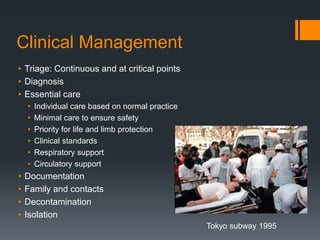
Clinical Management
• Triage: Continuous and at critical points
• Diagnosis
• Essential care
• Individual care based on normal practice
• Minimal care to ensure safety
• Priority for life and limb protection
• Clinical standards
• Respiratory support
• Circulatory support
• Documentation
• Family and contacts
• Decontamination
• Isolation
Tokyo subway 1995
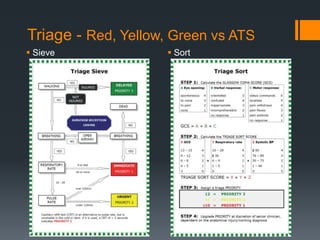
Triage - Red, Yellow, Green vs ATS
 Sieve  Sort
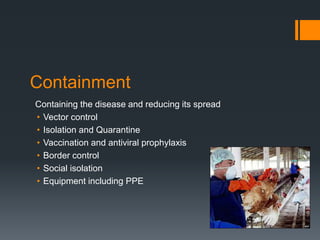
Containment
Containing the disease and reducing its spread
• Vector control
• Isolation and Quarantine
• Vaccination and antiviral prophylaxis
• Border control
• Social isolation
• Equipment including PPE
Continuity
Maintenance of essential services
• Workforce protection with enhanced infection control, PPE,
isolation of patients and anti-viral’s
• Access to business
• Maintenance of the food supply
• Creating capacity
• Protecting essential services
Capability
Increasing the capability of
the system to manage by
preparation
• Information and awareness
of personnel through
education
• Vaccination
• Preparation and possible
stockpiling of equipment
and consumables.
Health Capability
• Level 1 concentrate expertise
utilising existing infrastructure
• Level 2 Preserve infrastructure
for the event by early discharge,
limiting non-urgent activity
• Level 3 Expand health
infrastructure through system
wide management, growing
capacity and importing capacity
• Level 4 Ration access to health
infrastructure through triage of
patients
Recovery
“The coordinated
process of supporting
disaster affected
communities in
reconstructing their
physical infrastructure
and restoration of
emotional, social,
economic and physical
well being”
EMA – Australian Emergency Manuals Series.
• Restore infrastructure and
the social and economic life
of a community to normal
• Restore vital life support
systems to minimum
operating standards.
• Long term recovery to
restore economic activity and
rebuilding infrastructure.
• It should include mitigation
as a goal
Recovery
• Restore essential services
• Community rehabilitation
• Counselling
• Temporary housing
• Financial support or assistance
• Health and safety information
• Long-term medical care
• Physical restoration/re-construction
• Public information
• Conducting economic impact studies
Transport Principles
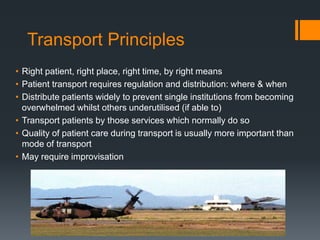
• Right patient, right place, right time, by right means
• Patient transport requires regulation and distribution: where & when
• Distribute patients widely to prevent single institutions from becoming
overwhelmed whilst others underutilised (if able to)
• Transport patients by those services which normally do so
• Quality of patient care during transport is usually more important than
mode of transport
• May require improvisation
After the Disaster
• Equipment Review
• Debriefing
• Review of Plans
• Documentation
• Education and Training
• Research
• Rehabilitation
• Restoration Function
• Safety Assessment
• Emotional Impact
• Recovery Process
• Research Opportunities
We need to ensure that we
learn from our experiences
as well as ensuring the well
being and recovery of our
community.
Take home
 Major Incident Medical Management and Support
Approach (MIMMS)
 C – Command and Control
 S – Safety
 C – Communications
 A – Assessment
 T – Triage
 T – Treatment
 T – Transport

Principles of disaster management

  • 1.
  • 2.
    Perspective • Each day20,000 Australians are treated at hospital Emergency Departments and 5000 are transported by ambulance. • “We have never had an event with 20,000 casualties in Australia, Except every day!” • So what do we need to do that is different in disasters?
  • 3.
    Outline • Definitions. ‰ •History and epidemiology ‰ • Risk assessment and management ‰ • Disaster Management Principles ‰ • Response Management Framework ‰ • Issues, Myths and Problems ‰ • Questions
  • 4.
  • 5.
    Disaster Definition “A seriousdisruption to community life which threatens or causes death or injury in that community, and damage to property which is beyond the day-to-day capacity of the prescribed statutory authorities and which requires special mobilisation and organisation of resources other than those normally available to those authorities.” EMA – Australian Emergency Manuals Series
  • 6.
    Types of Disaster Natural •Seismic • Earthquake • Volcanic eruption • Tsunami • Celestial collision • Climatic • High winds (Storm, Cyclones, Tornado) • Precipitation (Rain, snow, Ice) • Lightning (fire) • Temperature extremes (Hot and cold) • Erosion • Drought • Desertification • Floods • Avalanches Man-made • Technological • Release of substances (Chemicals, Biological, Nuclear) • Transport • Structural failure • Explosions • Fire • Environmental interference • Conflict • Conventional war • Armed conflict/Civil conflict • Complex human emergency • Terrorism • Unarmed conflict (Sanctions, embargos)
  • 7.
    Disaster Epidemiology • Inthe past 50 years • - more than 10,000 disasters reported. • - more than 5 billion people affected. • - more than 12 million persons killed. • - economic costs > $ 4 trillion USD. (Note: By comparison Australia’s GDP in 2006 was US$ 0.75 trillion)  Centre for Research on the Epidemiology of Disasters - CRED
  • 8.
    Are disasters Increasing? •Improved reporting • CNN as first responder • Increased population and density • 3m people now live in the vicinity of Vesuvius • Cities in high risk areas • 64 of the largest cities in world in seismic zones or flood plains. • Global warming • Increased storm activity • Increased technologies • Mass transport • Chemical industrialisation • Transport of dangerous goods • Economic stress • Urban slums in dangerous environments • Armed conflict • Terrorism
  • 9.
    Cost of Disasters •Medical • Public Health • Sanitation / H2O • Shelter / Clothing • Food • Energy Supplies • Search & Rescue • Public Works & Engineering • Environment • Logistics / Transport • Security • Communication • Economy • Education • Human Costs • Deaths • Injuries and illness • Loss and grief • Economic Costs • Actual Costs • Intangible Costs
  • 10.
    Why are DisastersDifferent? • Number and variety of casualties. • Initial disorder. • Initial lack of resources. • Effects on health system / community. • Loss of infrastructure • Need for multidisciplinary teams. • Multiplicity of tasks. It is not just an increase in medical effort that is needed but a different medical approach also.
  • 11.
    A Paradigm Shift Allfor One vs One for All
  • 12.
    Dual Wave Casualties arrivein a dual wave • Early victims 30 minutes with less severe injuries • Self extricate • Bystanders • More seriously injured in second wave (60 – 90 minutes) by which time beds are occupied • Bystanders • Emergency Services
  • 13.
    Approach to Disasters •Prevention/ Mitigation •Preparedness and planning •Response •Recovery
  • 14.
    Prevention / Mitigation “Regulatoryand physical measures to ensure that emergencies are prevented, or their effects mitigated” EMA – Australian Emergency Manuals Series. • Activities which eliminate or reduce the likelihood or impact of a disaster. • Includes long term activities which reduce the effects of unavoidable disasters. e.g. building standards • Cost effective mitigation measures are the key to reducing disaster losses in the long term.
  • 15.
    Prevention / Mitigation •Zoning / land use management • Building codes • Building use regulations • Relocation • Safety improvements • Legislation • Public Information • Community awareness and education • Tax, insurance incentives or disincentives
  • 16.
    Preparedness and planning “Arrangementsto ensure that, should a disaster occur, all those resources and services which may be needed to cope with the effects can be rapidly mobilised and deployed” EMA – Australian Emergency Manuals Series. • Activities to anticipate what problems are likely to emerge in future disaster situations and to devise ways to address these problems and enhance ability to respond when a disaster occurs. • Key element is developing plans • Must have plan to respond, trained personnel to respond and resources with which to respond.
  • 17.
    Preparedness and planning •Community awareness and education • Disaster Plans • Training and test exercises • Disaster communications • Mutual aid agreements • Warning systems • Resource inventories • Provision of special resources • Evacuation plans “Tsunami Wave”
  • 18.
  • 19.
    Preparedness: Disaster Teams •Teams must be self sufficient • If not then may be a “second disaster” • victim country forced to feed and shelter extra people from already limited resources • limited usefulness if no supplies / power e.g. Bam earthquake no power for 2 days • Should include base camp equipment, field hospital, medical supplies, water, food, sanitation, power.
  • 20.
    Preparedness: Surveillance • Mechanismsto identify disease trends • Mechanisms to monitor risks including monitoring vector disease e.g. Avian Influenza in birds • Diagnostic capability • Laboratories • Reporting of infectious diseases
  • 21.
    Response “Actions taken in anticipationof, during and immediately after impact to ensure that its effects are minimised and that people are given immediate relief and support” EMA – Australian Emergency Manuals Series. • Implementing plans • Implementing disaster legislation or • declarations • Issuing warnings • Activating disaster operations centres • Mobilizing resources • Notifying public authorities • Providing medical assistance • Providing immediate relief • Search and rescue
  • 22.
    The Response Management Framework Aset of principles which provide a framework for managing any event. • Command • Control • Coordination • Communication • Clinical Management • Containment • Continuity • Capability Clapham Junction Train Crash
  • 23.
    Command, Control &Coordination COMMAND : The direction of members of an organisation in the performance of roles and tasks. • Operate vertically within an organisation. CONTROL : Overall direction of emergency management activities in an emergency situation. • Operates horizontally across organisations. COORDINATION : The bringing together of organisations and elements to ensure an effective response, mainly concerned with systematic acquisition and application of resources in accordance with threat or impact. • Operates both vertically and horizontally as functions of authority to command and control.
  • 24.
    Communication • The message •Clarity of message (pre- considered) • The means • Consider the vulnerability of normal channels (e.g. mobile phones) • Remember “the runner” • Radio codes • The manner • Pathways of communication Most common problem in any disaster is a failure in communication 1995 Oklahoma City Bombing Hospital called in “code black” their disaster active code EMS understood this as code for overloaded and sent them no patients resulting in overload of nearby hospital
  • 25.
    Clinical Management • Triage:Continuous and at critical points • Diagnosis • Essential care • Individual care based on normal practice • Minimal care to ensure safety • Priority for life and limb protection • Clinical standards • Respiratory support • Circulatory support • Documentation • Family and contacts • Decontamination • Isolation Tokyo subway 1995
  • 26.
    Triage - Red,Yellow, Green vs ATS  Sieve  Sort
  • 27.
    Containment Containing the diseaseand reducing its spread • Vector control • Isolation and Quarantine • Vaccination and antiviral prophylaxis • Border control • Social isolation • Equipment including PPE
  • 28.
    Continuity Maintenance of essentialservices • Workforce protection with enhanced infection control, PPE, isolation of patients and anti-viral’s • Access to business • Maintenance of the food supply • Creating capacity • Protecting essential services
  • 29.
    Capability Increasing the capabilityof the system to manage by preparation • Information and awareness of personnel through education • Vaccination • Preparation and possible stockpiling of equipment and consumables. Health Capability • Level 1 concentrate expertise utilising existing infrastructure • Level 2 Preserve infrastructure for the event by early discharge, limiting non-urgent activity • Level 3 Expand health infrastructure through system wide management, growing capacity and importing capacity • Level 4 Ration access to health infrastructure through triage of patients
  • 30.
    Recovery “The coordinated process ofsupporting disaster affected communities in reconstructing their physical infrastructure and restoration of emotional, social, economic and physical well being” EMA – Australian Emergency Manuals Series. • Restore infrastructure and the social and economic life of a community to normal • Restore vital life support systems to minimum operating standards. • Long term recovery to restore economic activity and rebuilding infrastructure. • It should include mitigation as a goal
  • 31.
    Recovery • Restore essentialservices • Community rehabilitation • Counselling • Temporary housing • Financial support or assistance • Health and safety information • Long-term medical care • Physical restoration/re-construction • Public information • Conducting economic impact studies
  • 32.
    Transport Principles • Rightpatient, right place, right time, by right means • Patient transport requires regulation and distribution: where & when • Distribute patients widely to prevent single institutions from becoming overwhelmed whilst others underutilised (if able to) • Transport patients by those services which normally do so • Quality of patient care during transport is usually more important than mode of transport • May require improvisation
  • 33.
    After the Disaster •Equipment Review • Debriefing • Review of Plans • Documentation • Education and Training • Research • Rehabilitation • Restoration Function • Safety Assessment • Emotional Impact • Recovery Process • Research Opportunities We need to ensure that we learn from our experiences as well as ensuring the well being and recovery of our community.
  • 34.
    Take home  MajorIncident Medical Management and Support Approach (MIMMS)  C – Command and Control  S – Safety  C – Communications  A – Assessment  T – Triage  T – Treatment  T – Transport