DISASTER
RISK REDUCTION & MANAGEMENT

Supplemented by Ryann U. Castro
SCOPE:
1.

2.

3.
4.
5.
6.
7.
8.

2

DEFINITION OF TERMS
•
HAZARD
•
EXPOSURE
•
VULNERABILITY
•
CAPACITY
•
RISK
•
DISASTER
BAGUIO CITY: EFFECTS OF DISASTERS
•
EARTHQUAKE
•
TROPICAL CYCLONE
•
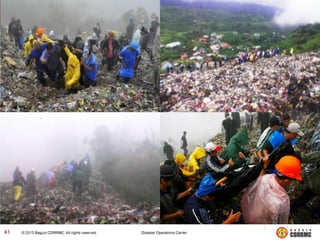
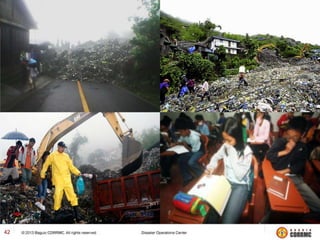
TRASHSLIDE
PHILIPPINES RISK PROFILE
PREPAREDNESS
NEW FRAMEWORK ON DISASTER RISK REDUCTION & MANAGEMENT
SALIENT PROVISION OF R. A. 10121 (DRRM ACT OF 2010)
STRENGTHENING DISASTER RISK REDUCTION
EMERGENCY/DISASTER OPERATIONS CENTER
•
SITUATIONAL ISSUES
•
INCIDENT MANAGEMENT
DEFINITION OF TERMS
HAZARD
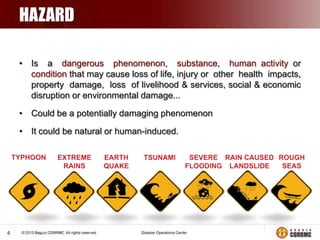
• Is a dangerous phenomenon, substance, human activity or
condition that may cause loss of life, injury or other health impacts,
property damage, loss of livelihood & services, social & economic
disruption or environmental damage...
• Could be a potentially damaging phenomenon
• It could be natural or human-induced.

4
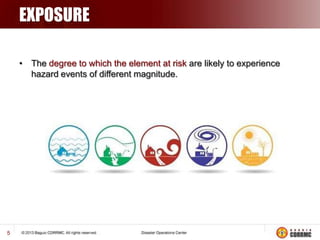
EXPOSURE
• The degree to which the element at risk are likely to experience
hazard events of different magnitude.

5
VULNERABILITY
• Is the characteristics and circumstances of a community,
system or asset that make it susceptible to the damaging effects of a
hazard.
• This may arise from
environmental factors.

6

various

physical,

social, economic &
VULNERABILITY

…Continued

VULNERABILITY HAS BEEN RELATED TO THE FOLLOWING FACTORS:
 Social Integration
 Ethnicity
 Age
 Gender
 Location
 Status
 Wealth
 Income
 Education
 Family type

 Psychological & Physiological
 Locus of control
 Disability
 Coping-style
 Individual’s perception
 Lifestyle
 Agility
 Mobility
 Experience

Britton and Walker 1991

7
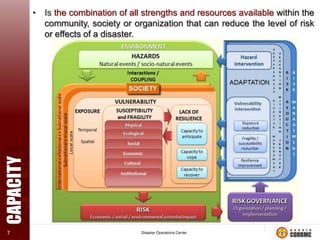
CAPACITY

• Is the combination of all strengths and resources available within the
community, society or organization that can reduce the level of risk
or effects of a disaster.

8
RISK
• Is the combination of Probability of an event to happen and its
negative consequences...

R=

9

HAZARD x VULNERABILITY (exposure)

CAPACITY
DISASTER
• A disaster is a natural or man-made (or technological) hazard
resulting in an event of substantial extent causing significant
physical damage or destruction, loss of life, or drastic change to the
environment. A disaster can be ostensively defined as any tragic
event stemming from events such as earthquakes, floods,
catastrophic accidents, fires, or explosions. It is a phenomenon that
can cause damage to life and property and destroy the economic,
social and cultural life of people.
• In contemporary academia, disasters are seen as the consequence
of inappropriately managed risk. These risks are the product of a
combination of both hazard/s and vulnerability. Hazards that strike in
areas with low vulnerability will never become disasters, as is the
case in uninhabited regions.
11
DISASTER

…Continued
12

CLASSIFICATIONS
Natural Disaster
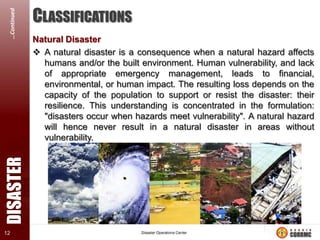
 A natural disaster is a consequence when a natural hazard affects
humans and/or the built environment. Human vulnerability, and lack
of appropriate emergency management, leads to financial,
environmental, or human impact. The resulting loss depends on the
capacity of the population to support or resist the disaster: their
resilience. This understanding is concentrated in the formulation:
"disasters occur when hazards meet vulnerability". A natural hazard
will hence never result in a natural disaster in areas without
vulnerability.
DISASTER

…Continued
13

CLASSIFICATIONS
Man-made or Human Induced Disaster
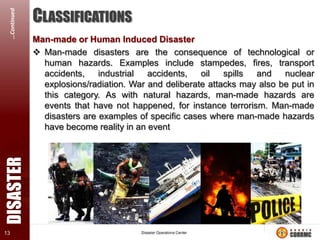
 Man-made disasters are the consequence of technological or
human hazards. Examples include stampedes, fires, transport
accidents,
industrial
accidents,
oil
spills
and
nuclear
explosions/radiation. War and deliberate attacks may also be put in
this category. As with natural hazards, man-made hazards are
events that have not happened, for instance terrorism. Man-made
disasters are examples of specific cases where man-made hazards
have become reality in an event
…Continued

WHEN IS AN EVENT A DISASTER?
1. At least 20% of the population are affected & in need of
emergency assistance or those dwelling units have been
destroyed.

2. A great number or at least 40% of the means of livelihood such
as bancas, fishing boats, vehicles and the like are destroyed.

DISASTER

3. Major roads and bridges are destroyed and impassable for at
least a week, thus disrupting the flow of transport and commerce.

14

4. Widespread destruction of fishponds, crops, poultry and
livestock, and other agricultural products, and
5. Epidemics

NDCC Memo Order No. 4, dated 04 March 1998
…Continued

WHY ARE DISASTER IMPACTS INCREASING?
1. Increased in population

DISASTER

2. Climate change

15

3. Increased vulnerability due to:
• Demographic changes
• Increased concentration of assets
• Environmental degradation
• Poverty
• Rapid urbanization and unplanned development
BAGUIO CITY
EFFECTS OF DISASTERS
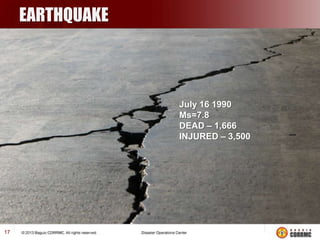
EARTHQUAKE

July 16 1990
Ms=7.8
DEAD – 1,666
INJURED – 3,500

17
…continued

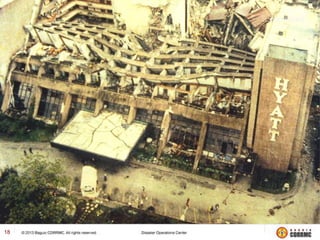
Hyatt Terraces

18
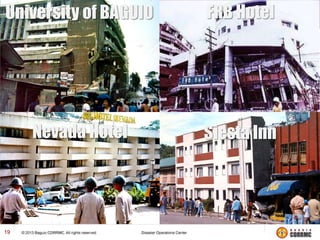
University of BAGUIO

FRB Hotel

Nevada Hotel

Siesta Inn

19
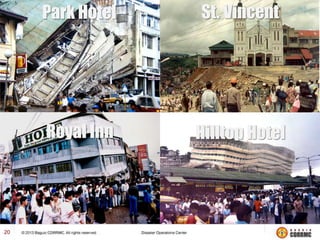
Park Hotel

Royal Inn

20

St. Vincent

Hilltop Hotel
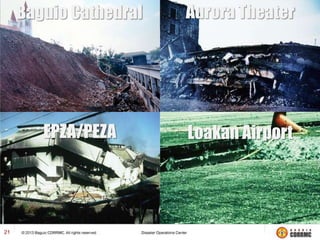
Baguio Cathedral

EPZA/PEZA

21

Aurora Theater

Loakan Airport
Burnham Park

22
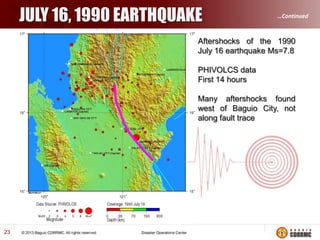
JULY 16, 1990 EARTHQUAKE

…Continued

Aftershocks of the 1990
July 16 earthquake Ms=7.8
PHIVOLCS data
First 14 hours
Many aftershocks found
west of Baguio City, not
along fault trace

23
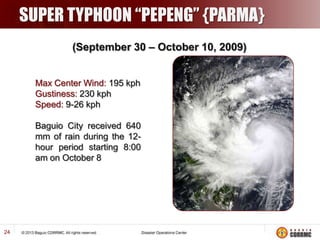
SUPER TYPHOON ā€œPEPENGā€ {PARMA}
(September 30 – October 10, 2009)

Max Center Wind: 195 kph
Gustiness: 230 kph
Speed: 9-26 kph
Baguio City received 640
mm of rain during the 12hour period starting 8:00
am on October 8

24
EFFECTS ST ā€œPEPENGā€ {PARMA}
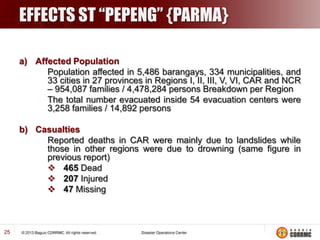
a) Affected Population
Population affected in 5,486 barangays, 334 municipalities, and
33 cities in 27 provinces in Regions I, II, III, V, VI, CAR and NCR
– 954,087 families / 4,478,284 persons Breakdown per Region
The total number evacuated inside 54 evacuation centers were
3,258 families / 14,892 persons
b) Casualties
Reported deaths in CAR were mainly due to landslides while
those in other regions were due to drowning (same figure in
previous report)
 465 Dead
 207 Injured
 47 Missing

25
EFFECTS ST ā€œPEPENGā€ {PARMA}

…Continued

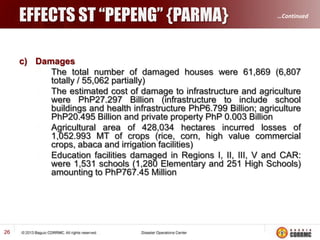
c) Damages
The total number of damaged houses were 61,869 (6,807
totally / 55,062 partially)
The estimated cost of damage to infrastructure and agriculture
were PhP27.297 Billion (infrastructure to include school
buildings and health infrastructure PhP6.799 Billion; agriculture
PhP20.495 Billion and private property PhP 0.003 Billion
Agricultural area of 428,034 hectares incurred losses of
1,052.993 MT of crops (rice, corn, high value commercial
crops, abaca and irrigation facilities)
Education facilities damaged in Regions I, II, III, V and CAR:
were 1,531 schools (1,280 Elementary and 251 High Schools)
amounting to PhP767.45 Million

26
EFFECTS ST ā€œPEPENGā€ {PARMA}
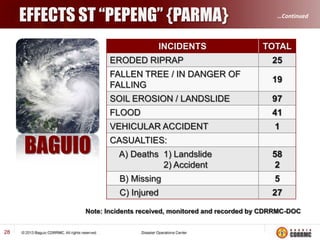
INCIDENTS

…Continued

TOTAL

ERODED RIPRAP
FALLEN TREE / IN DANGER OF
FALLING

19

SOIL EROSION / LANDSLIDE

97

FLOOD

BAGUIO

25

41

VEHICULAR ACCIDENT

1

CASUALTIES:
A) Deaths 1) Landslide
2) Accident

58
2

B) Missing

5

C) Injured

27

Note: Incidents received, monitored and recorded by CDRRMC-DOC
28
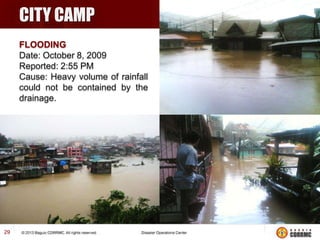
CITY CAMP
FLOODING
Date: October 8, 2009
Reported: 2:55 PM
Cause: Heavy volume of rainfall
could not be contained by the
drainage.

29
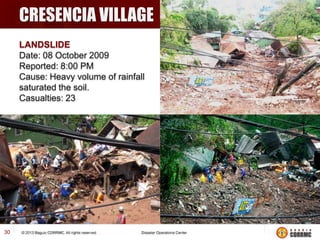
CRESENCIA VILLAGE
LANDSLIDE
Date: 08 October 2009
Reported: 8:00 PM
Cause: Heavy volume of rainfall
saturated the soil.
Casualties: 23

30
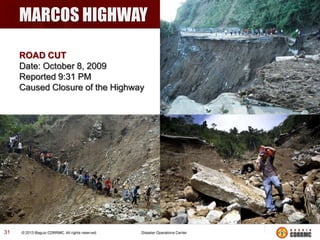
MARCOS HIGHWAY
ROAD CUT
Date: October 8, 2009
Reported 9:31 PM
Caused Closure of the Highway

31
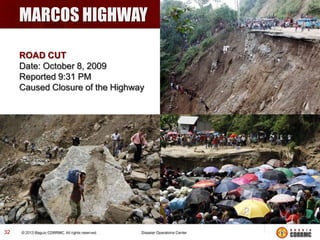
MARCOS HIGHWAY
ROAD CUT
Date: October 8, 2009
Reported 9:31 PM
Caused Closure of the Highway

32
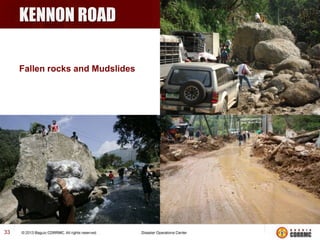
KENNON ROAD
Fallen rocks and Mudslides

33
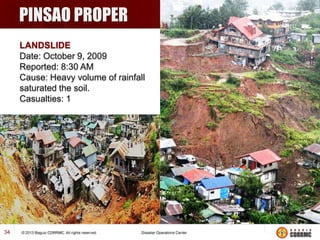
PINSAO PROPER
LANDSLIDE
Date: October 9, 2009
Reported: 8:30 AM
Cause: Heavy volume of rainfall
saturated the soil.
Casualties: 1

34
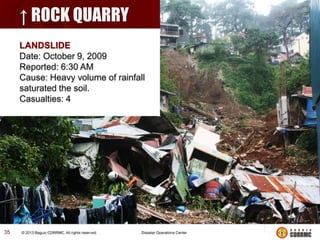
↑ ROCK QUARRY
LANDSLIDE
Date: October 9, 2009
Reported: 6:30 AM
Cause: Heavy volume of rainfall
saturated the soil.
Casualties: 4

35
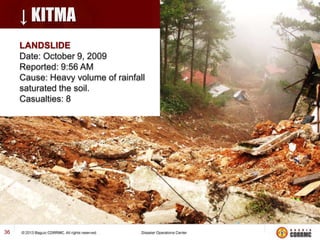
↓ KITMA
LANDSLIDE
Date: October 9, 2009
Reported: 9:56 AM
Cause: Heavy volume of rainfall
saturated the soil.
Casualties: 8

36
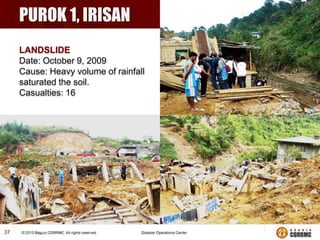
PUROK 1, IRISAN
LANDSLIDE
Date: October 9, 2009
Cause: Heavy volume of rainfall
saturated the soil.
Casualties: 16

37
38

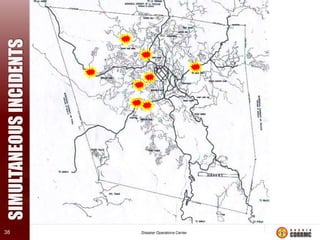
SIMULTANEOUS INCIDENTS
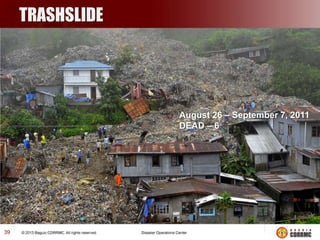
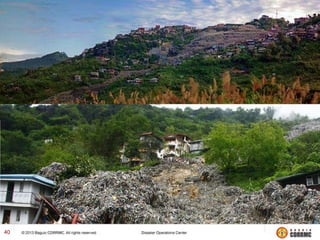
TRASHSLIDE

August 26 – September 7, 2011
DEAD – 6

39
40
41
42
PREVIOUS DISASTERS IN C.A.R.
43

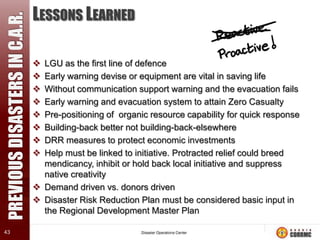
LESSONS LEARNED









LGU as the first line of defence
Early warning devise or equipment are vital in saving life
Without communication support warning and the evacuation fails
Early warning and evacuation system to attain Zero Casualty
Pre-positioning of organic resource capability for quick response
Building-back better not building-back-elsewhere
DRR measures to protect economic investments
Help must be linked to initiative. Protracted relief could breed
mendicancy, inhibit or hold back local initiative and suppress
native creativity
 Demand driven vs. donors driven
 Disaster Risk Reduction Plan must be considered basic input in
the Regional Development Master Plan
RISK PROFILE
45

RISK PROFILE
…Continued

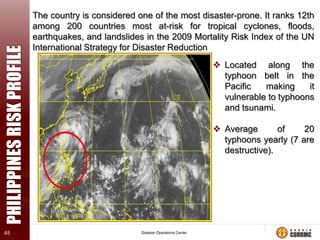
The country is considered one of the most disaster-prone. It ranks 12th
among 200 countries most at-risk for tropical cyclones, floods,
earthquakes, and landslides in the 2009 Mortality Risk Index of the UN
International Strategy for Disaster Reduction

RISK PROFILE

 Located along the
typhoon belt in the
Pacific
making
it
vulnerable to typhoons
and tsunami.

47

 Average
of
20
typhoons yearly (7 are
destructive).
RISK PROFILE

…Continued
48

1851-2006 TYPHOON SEASON
Tracks and Intensity of Tropical Cyclones, 1851-2006

TD

TS

1

2

3

Saffir-Simpson Hurricane Intensity Scale

4

5
RISK PROFILE

…Continued
49

1980-2005 TYPHOON SEASON
RISK PROFILE

…Continued
50

1980-2005 TYPHOON SEASON
51

RISK PROFILE
…Continued
RISK PROFILE

…Continued
52

AREAS SUSCEPTIBLE TO
LANDSLIDE, FLOODING, AND
SUBSIDENCE DUE TO KARST
DEVELOPMENT
RISK PROFILE

…Continued
54

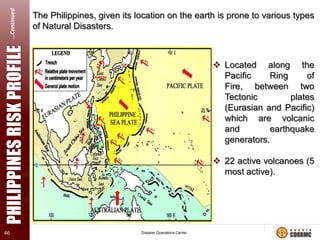
The Philippines, given its location on the earth is prone to various types
of Natural Disasters.

 Located along the
Pacific Ring of Fire,
between two Tectonic
plates (Eurasian and
Pacific) which are
volcanic
and
earthquake
generators.

 22 active volcanoes (5
most active).
RISK PROFILE

…Continued
55

Fact:
The Philippine Archipelago
has a complex tectonic
setting with several trenches
and many active faults
56

RISK PROFILE
…Continued
57

RISK PROFILE
…Continued
Northwest segments of the
Philippine Fault Zone (PFZ):
 Digdig Fault
 San Manuel Fault
 Tebbo Fault
 Tuba Fault
 Bangui Fault
 Abra River Fault

Source: Phivolcs

50

100 km

N
South
China
Sea

Pacific
Ocean

Abra River

RISK PROFILE

…Continued

EARTHQUAKE GENERATORS
WITHIN CORDILLERA

Manila Trench

58

0

Baguio City
…Continued

0

2 SEISMIC GENERATORS
NEAR BAGUIO CITY

RISK PROFILE

Source: Phivolcs

South
China
Sea

Pacific
Ocean

Abra River

59

Tebbo Fault
 located approximately
10 km Southeast of
Baguio City
 70 km long
 could generate a Ms 7.4
earthquake max

100 km

N

Manila Trench

Tuba Fault
 West of Baguio City,
approximately 5 km
away, NW trending
 50 km long
 could generate a Ms
7.25 earthquake max

50

Baguio City
…Continued

0

Burnham Fault

100

N

LEGEND:

RISK PROFILE

Mirador Fault

60

Fault

San Vicente Fault
Tuba Fault
Bued Fault

Loakan Fault

Source: Office of the City Planning & Development Coordinator

300 km
RISK PROFILE

…Continued
61

HISTORICAL SEISMICITY
The PHIVOLCS earthquake and catalogue seismicity maps shows
so far, seven (7) historically and instrumentally recorded destructive
earthquakes (Intensity VII-IX in the adapted Rossi-Forel scale) have
affected Baguio City for the past 356 years (1645-2001). This
roughly translate into a return period of at least one destructive
earthquake (Intensity VII to IX) for every 50 years. In addition, there
were four very destructive earthquakes during the 356-year period
for a return period of at least one very destructive earthquake
(Intensity VIII to IX) for every 89 years. In comparison, regional
probabilistic seismic hazard calculations by Thenhaus (1994)
yielded annual probability rates of Ms:
• 6.4 to <7.0 (1 in 23 years)
• 7.0 to <7.3 (1 in 62 years)
• Ms <8.2 (1 in 166 years)
RISK PROFILE

…Continued
63

The
Philippine
Archipelago
occupies
the
western
ring
of
the Pacific Ocean (Western Segment of the Pacific Ring of Fire), a most active part
of the earth that is characterized by an ocean-encircling belt of active volcanoes
and earthquake generators (faults).
…Continued

ACTIVE, INACTIVE AND
POTENTIALLY ACTIVE
VOLCANOES OF THE
PHILIPPINES

RISK PROFILE

 300 volcanoes
 22 active
 7 inactive in CAR

64
…Continued

VOLCANOES OF THE CORDILLERA REGION
Benguet Province:

Kalinga Province:

1. Santo Tomas, Baguio City

4. Bumabag, Batong Buhay

2. Daclan, Bokod

5. Podakan, Batong Buhay

3. Pulag, Kabayan

6. Ambalatungan, Batong Buhay

RISK PROFILE

7. Binuluan

65

All of the above volcanoes are inactive or has no record of
eruption during historic times.
PREPAREDNESS
A PERSONAL RESPONSIBILITY
MAKE A DIFFERENCE…

PREPAREDNESS

 Changing attitudes…

67

 Knowing hazards…
 Doing something to
minimize the hazards.
PREPAREDNESS

…Continued
68

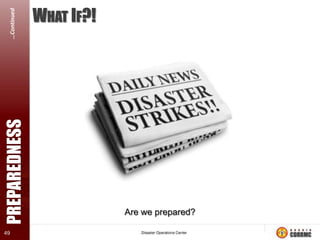
WHAT IF?!

Are we prepared?
PREPAREDNESS

…Continued
69

CRITICAL CONCERNS
1. Does your institution have an existing Disaster Response Team /
Safety Committee?
2. If yes, is it functional?
3. Do we conduct emergency / disaster drills regularly?
4. Do we have Emergency Response Plan?
5. Do we have a Preparedness / Contingency Plan in the event of any
disaster?
6. Are there personnel / employees trained in first aid, fire fighting or
rescue?
7. Does the institution have any rescue equipment and other
emergency paraphernalia?
8. Do we have an institutionalized warning system?
9. Are there identified evacuation areas within the premises of the
institution?
…Continued

PREPAREDNESS CYCLE

PREPAREDNESS

Evaluate/
Improve

70

Plan

Organize
&
Equip
Exercise
Train
PREPAREDNESS

…Continued
71

72-HOUR SURVIVAL KIT
1.
2.
3.
4.
5.
6.
7.

Food
Clothing
Communications
Documents
Medicines
Other Essential Needs
Emergency Money

*Kit depends on the number of family members, health status, gender and age.
R.A. 10121
THE PHILIPPINE DRRM SYSTEM

DRRM

 Disaster legislation in the Philippines dates back in 1978, primarily
reactive approach to disasters, focusing heavily on preparedness
and response. Other relevant legislation for mainstreaming of
disaster risk reduction into development includes land-use controls
and building codes. However, building codes are not strictly
enforced and zoning ordinances which are reported to have been
relaxed over time.

73

 With the approval of the DRRM (Republic Act
No. 10121) expect that there would be a
paradigm shift
emphasizing disaster
management to a disaster risk management
approach, with much greater importance given
to reducing risk. The RA was approved on 27
May 2010, and the Implementing Rules and
Regulations was crafted by the Task Force RA
10121 headed by the OCD.
…Continued

RISK REDUCTION AND MANAGEMENT
 Systematic process of using administrative decisions,
organization, operational skills and capacities to implement
policies, strategies and coping capacities of the society and
communities
 Setting of related goals and objectives in development and land use
areas.

DRRM

 It involves the formulation of strategies and Plans, Programs and
Activities (PPAs)

74
…Continued

WHAT MUST BE DONE TO REDUCE RISK
 Institutionalize Local Disaster Risk Reduction & Management Office

 Establish Early Warning System
 Formulation of Communication Protocol
 Formulation of Evacuation Procedures at the community level and
establishments
 Organize Local DRRMC and define the functional roles and
responsibilities of the members and task units

DRRM

 Establish Standard Operating Procedures (SOP)

75

 Hazard awareness
seminars

through

Community-Based

trainings

and
…Continued

WHAT MUST BE DONE TO REDUCE RISK
 Integrate disaster risk reduction into the Comprehensive Land Use
Plan (CLUP) and land use planning
 Integrate hazard, risk and vulnerability assessment into the
development plan
 Cluster Approach on Recovery Program
 Good working relationship with Warning Agencies and the Local
Media

DRRM

 Installation of rain gauges on mountain slopes

76

(DENR-MGB CAR recommended that 150 mm of rainfall observed
within 24 hours would already trigger evacuation of communities in
high risk areas)
…Continued

WHAT MUST BE DONE TO REDUCE RISK
 Strengthening of the LGU capabilities on disaster management;

 Updating the hazard profile of all municipalities and to analyse data
on human induced disasters for public safety studies

DRRM

 Effective flow of communication system to ensure that accurate flow
of information before, during and after disasters

77
DRRM

…Continued
78

WHAT MUST BE DONE TO REDUCE RISK
…Continued

RISK REDUCTION METHOD
In the following order
1. Identify, characterize, and assess threats
2. Assess the vulnerability of critical assets to specific threats
3. Determine the risk (i.e. the expected consequences of specific
types of attacks on specific assets)
4. Identify ways to reduce those risks

DRRM

5. Prioritize risk reduction measures based on a strategy

79
…Continued

POTENTIAL RISK TREATMENTS
Once risks have been identified and assessed, all techniques to
manage the risk fall into one or more of these four major categories:

DRRM






80

Avoidance (eliminate, withdraw from the risk area)
Reduction (optimize resources to mitigate effects )
Sharing (risk transfer or enrol in insurance)
Retention (accept, plan - formulate ConPlan, Evac Plan, ICS and
provision of budget)
…Continued

DISASTER RISK MANAGEMENT STRATEGY
 A comprehensive disaster risk management strategy, actively
involving stakeholders at all levels of government as well as the
private sector, local communities and civil society, is required to
implement the legislative framework and to provide coordination and
monitoring mechanisms and arrangements.

DRRM

 Individual disaster risk reduction actions and programs need to be
located within this strategy, rather than treated as discrete, individual
measures. Moreover, the strategy needs to indicate specific entry
points and mechanisms for mainstreaming disaster risk reduction
concerns into both the broader development agenda and the design
and implementation of individual development initiatives.

81
DRRM

…Continued
82

DISASTER RISK MANAGEMENT STRATEGY
 Individual line agencies and local governments are legally
responsible for implementing disaster management, as it is still
commonly referred to in department circulars and executive orders,
within their own areas of responsibility. In practice, some LGUs have
yet to even establish their disaster coordinating councils (DCCs),
while those DCCs that have been established vary in quality. In
addition, reflecting Presidential Decree (PD) 1566’s reactive
approach to DCC meetings are commonly held only on an ad hoc
basis, in response to crisis situations, rather than on a more regular
basis to discuss ongoing risk reduction initiatives, and DCCs’ risk
reduction and mainstreaming capacity and capabilities are often
very limited.
…Continued

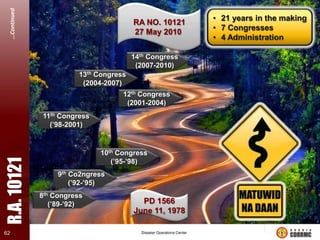
RA NO. 10121
27 May 2010
14th Congress
(2007-2010)
13th Congress
(2004-2007)
12th Congress
(2001-2004)

R.A. 10121

11th Congress
(’98-2001)

83

10th Congress
(’95-’98)
9th Co2ngress
(’92-’95)
8th Congress
(’89-’92)

PD 1566
June 11, 1978

• 21 years in the
making
• 7 Congresses
• 4 Administration
…Continued

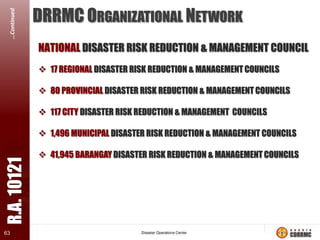
DRRMC ORGANIZATIONAL NETWORK
NATIONAL DISASTER RISK REDUCTION & MANAGEMENT COUNCIL
 17 REGIONAL DISASTER RISK REDUCTION & MANAGEMENT COUNCILS
 80 PROVINCIAL DISASTER RISK REDUCTION & MANAGEMENT COUNCILS

 117 CITY DISASTER RISK REDUCTION & MANAGEMENT COUNCILS

R.A. 10121

 1,496 MUNICIPAL DISASTER RISK REDUCTION & MANAGEMENT COUNCILS

84

 41,945 BARANGAY DISASTER RISK REDUCTION & MANAGEMENT COUNCILS
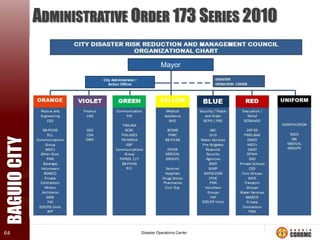
ADMINISTRATIVE ORDER 173 SERIES 2010
Mayor

BAGUIO CITY

City Administrator /
Action Officer

85
R.A. 10121

…Continued
86

THE PHILIPPINE DISASTER RISK REDUCTION AND
MANAGEMENT SYSTEM MAY 27, 2010
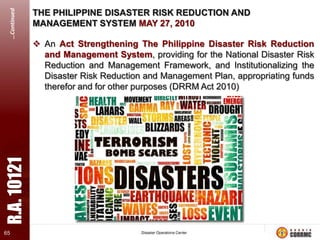
 An Act Strengthening The Philippine Disaster Risk Reduction
and Management System, providing for the National Disaster Risk
Reduction and Management Framework, and Institutionalizing the
Disaster Risk Reduction and Management Plan, appropriating funds
therefor and for other purposes (DRRM Act 2010)
…Continued

DISASTER RISK REDUCTION

…Continued

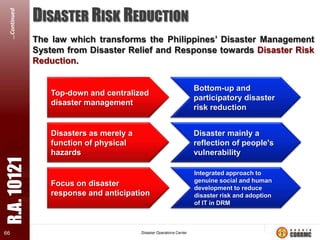
The law which transforms the Philippines’ Disaster Management
System from Disaster Relief and Response towards Disaster Risk
Reduction.

87

Bottom-up and
participatory disaster
risk reduction

Disasters as merely a
function of physical
hazards

R.A. 10121

Top-down and centralized
disaster management

Disaster mainly a
reflection of people's
vulnerability

Focus on disaster
response and anticipation

Integrated approach to
genuine social and human
development to reduce
disaster risk and adoption
of IT in DRM
…Continued

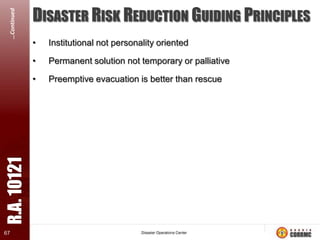
DISASTER RISK REDUCTION GUIDING PRINCIPLES
 Institutional not personality oriented
 Permanent solution not temporary or palliative

R.A. 10121

 Preemptive evacuation is better than rescue

88
R.A. 10121

…Continued

The enactment of the Philippine Disaster Risk Reduction and
Management Act of 2010 (also known as Republic Act 10121), aims to
achieve a paradigm shift from reactive to proactive approach in
disaster risk reduction and management.
 One of the main objectives of Disaster Preparedness it to ā€œEnhance
the community with the necessary skills to cope with the negative
impacts of a disasterā€.
 The state of readiness for PDRRMC, MDRRMC and CDRRMC is
greatly determines the extent to which potential casualties and
damages can be reduced.

89
…Continued

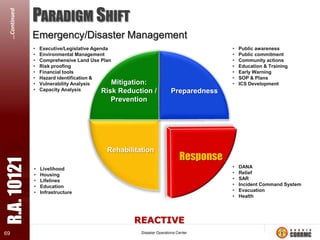
PARADIGM SHIFT
Emergency/Disaster Management
•
•
•
•
•
•
•
•

•
•
•
•
•
•
•

/

Public awareness
Public commitment
Community actions
Education & Training
Early Warning
SOP & Plans
ICS Development

•
•
•
•
•
•

Executive/Legislative Agenda
Environmental Management
Comprehensive Land Use Plan
Risk proofing
Financial tools
Hazard identification &
Mitigation:
Vulnerability Analysis
Capacity Analysis
Risk Reduction

DANA
Relief
SAR
Incident Command System
Evacuation
Health

Preparedness

Prevention

R.A. 10121

Rehabilitation

90

•
•
•
•
•

Response

Livelihood
Housing
Lifelines
Education
Infrastructure

REACTIVE
91

R.A. 10121
…Continued

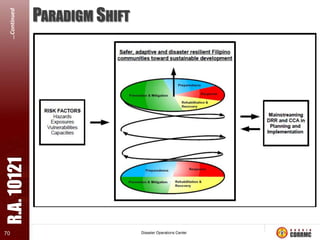
PARADIGM SHIFT
…Continued

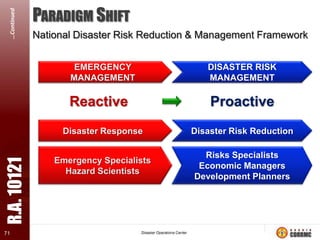
PARADIGM SHIFT
National Disaster Risk Reduction & Management Framework
EMERGENCY
MANAGEMENT

DISASTER RISK
MANAGEMENT

Reactive

Proactive

R.A. 10121

Disaster Response

92

Disaster Risk Reduction

Emergency Specialists
Hazard Scientists

Risks Specialists
Economic Managers
Development Planners
…Continued

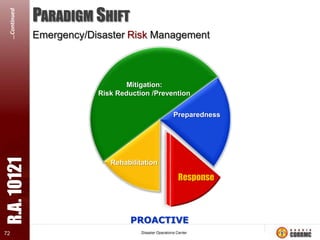
PARADIGM SHIFT
Emergency/Disaster Risk Management

Mitigation:
Risk Reduction /Prevention

R.A. 10121

Preparedness

93

Rehabilitation

Response

PROACTIVE
EMERGENCY/DISASTER
OPERATIONS CENTER
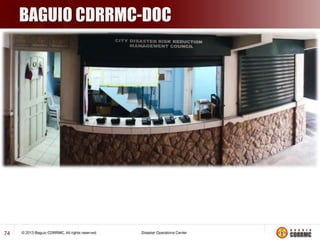
BAGUIO CDRRMC-DOC

95
DISASTER OR EMERGENCY OPCEN
• Is a central command and control facility responsible for carrying out
the principles or functions of emergency / disaster
preparedness and management at a strategic level in an emergency
situation, and ensuring the continuity of operation of a company,
political subdivision or other organization.
• An Emergency / Disaster OPCEN is responsible for the strategic
overview, or "big picture", of the disaster.
• Used in varying ways at all levels of government and within private
industry to provide coordination, direction and control during
emergencies.

96
DISASTER OR EMERGENCY OPCEN

…Continued

• The common functions of all E/D OPCEN is to collect, gather and
analyze data; make decisions that protect life and property, maintain
continuity of the organization, within the scope of applicable laws;
and disseminate those decisions to all concerned agencies and
individuals.
• In most E/DOC's, there is one individual in charge, and that is
the Emergency/Disaster Manager.

97
DISASTER OR EMERGENCY OPCEN

…Continued

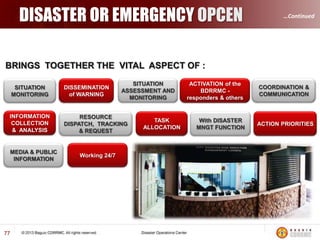
BRINGS TOGETHER THE VITAL ASPECT OF :
SITUATION
ASSESSMENT AND
MONITORING

SITUATION
MONITORING

DISSEMINATION
of WARNING

INFORMATION
COLLECTION
& ANALYSIS

RESOURCE
DISPATCH, TRACKING
& REQUEST

MEDIA & PUBLIC
INFORMATION

98

Working 24/7

TASK
ALLOCATION

ACTIVATION of the
BDRRMC responders & others

With DISASTER
MNGT FUNCTION

COORDINATION &
COMMUNICATION

ACTION PRIORITIES
ACTIVATION
ACTIVATION
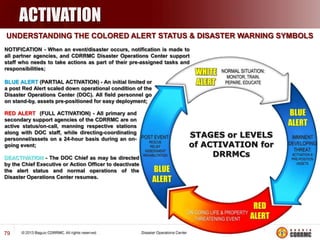
UNDERSTANDING THE COLORED ALERT STATUS & DISASTER WARNING SYMBOLS
NOTIFICATION - When an event/disaster occurs, notification is made to
all partner agencies, and CDRRMC Disaster Operations Center support
staff who needs to take actions as part of their pre-assigned tasks and
responsibilities;
BLUE ALERT (PARTIAL ACTIVATION) - An initial limited or
a post Red Alert scaled down operational condition of the
Disaster Operations Center (DOC). All field personnel go
on stand-by, assets pre-positioned for easy deployment;
RED ALERT (FULL ACTIVATION) - All primary and
secondary support agencies of the CDRRMC are on
active status/on-call, manning respective stations
along with DOC staff, while directing-coordinating
personnel/assets on a 24-hour basis during an ongoing event;
DEACTIVATION - The DOC Chief as may be directed
by the Chief Executive or Action Officer to deactivate
the alert status and normal operations of the
Disaster Operations Center resumes.

100

STAGES or LEVELS
of ACTIVATION for
DRRMCs
ACTIVATION
RED

…Continued

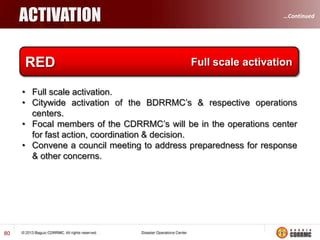
Full scale activation

• Full scale activation.
• Citywide activation of the BDRRMC’s & respective operations
centers.
• Focal members of the CDRRMC’s will be in the operations center
for fast action, coordination & decision.
• Convene a council meeting to address preparedness for response
& other concerns.

101
ACTIVATION
BLUE

…Continued

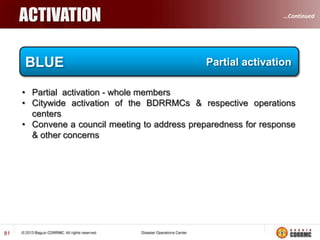
Partial activation

• Partial activation - whole members
• Citywide activation of the BDRRMCs & respective operations
centers
• Convene a council meeting to address preparedness for response
& other concerns

102
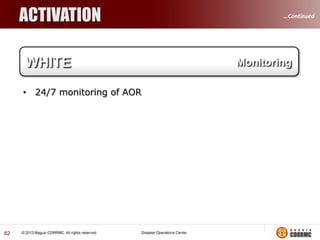
ACTIVATION
WHITE
• 24/7 monitoring of AOR

103

…Continued

Monitoring
SITUATIONAL ISSUES
THINGS TO CONSIDER
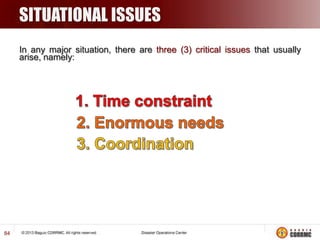
SITUATIONAL ISSUES
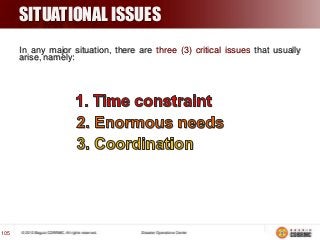
In any major situation, there are three (3) critical issues that usually
arise, namely:

105
SITUATIONAL ISSUES

…Continued
106

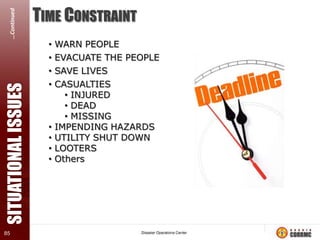
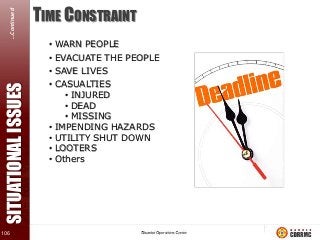
TIME CONSTRAINT
•
•
•
•

•
•
•
•

WARN PEOPLE
EVACUATE THE PEOPLE
SAVE LIVES
CASUALTIES
• INJURED
• DEAD
• MISSING
IMPENDING HAZARDS
UTILITY SHUT DOWN
LOOTERS
Others

…Continued
SITUATIONAL ISSUES

…Continued
108

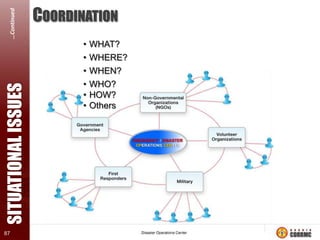
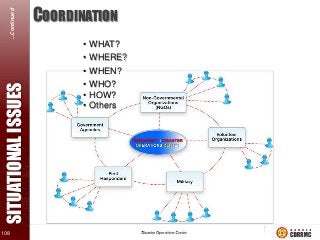
COORDINATION
•
•
•
•
•
•

WHAT?
WHERE?
WHEN?
WHO?
HOW?
Others

…Continued
INCIDENT MANAGEMENT
SIX (6) BUILDING BLOCKS
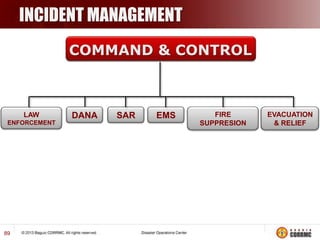
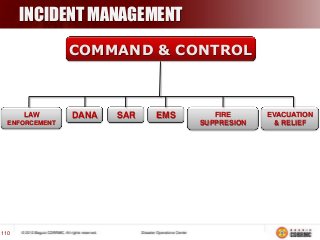
INCIDENT MANAGEMENT
COMMAND & CONTROL

LAW
ENFORCEMENT

110

DANA

SAR

EMS

FIRE
SUPPRESION

EVACUATION
& RELIEF
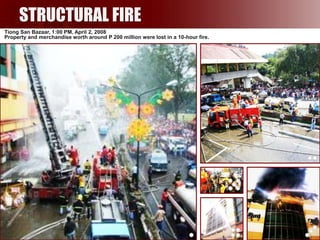
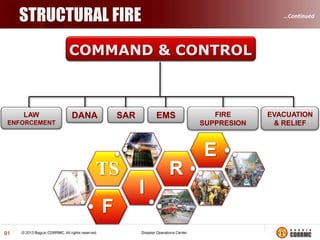
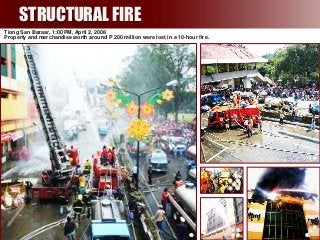
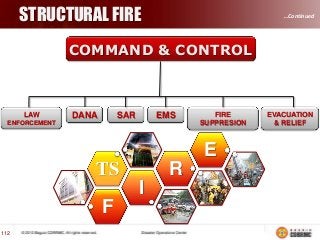
STRUCTURAL FIRE
Tiong San Bazaar, 1:00 PM, April 2, 2008
Property and merchandise worth around P 200 million were lost in a 10-hour fire.

111
STRUCTURAL FIRE

…Continued

COMMAND & CONTROL

LAW

DANA

SAR

EMS

ENFORCEMENT

FIRE
SUPPRESION

E
R

TS
I

F
112

EVACUATION
& RELIEF
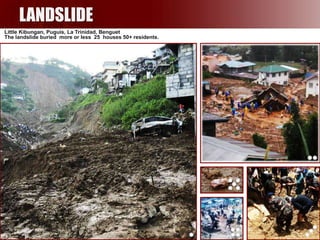
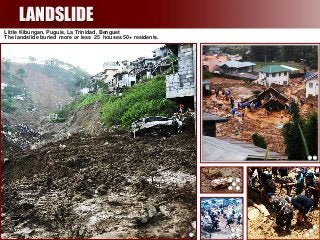
LANDSLIDE
Little Kibungan, Puguis, La Trinidad, Benguet
The landslide buried more or less 25 houses 50+ residents.

113
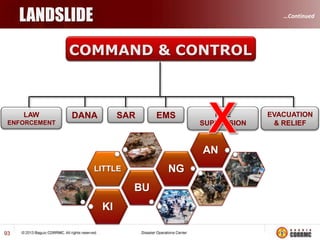
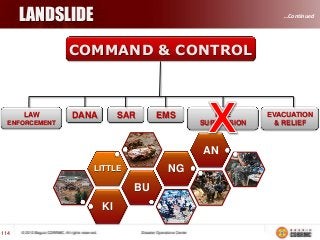
LANDSLIDE

…Continued

COMMAND & CONTROL

LAW

DANA

SAR

EMS

ENFORCEMENT

FIRE
SUPPRESION

AN

NG

LITTLE

BU
KI
114

EVACUATION
& RELIEF
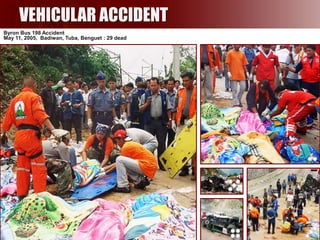
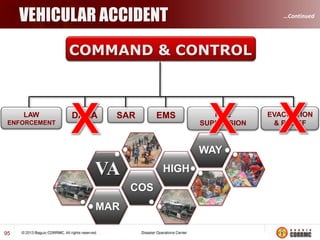
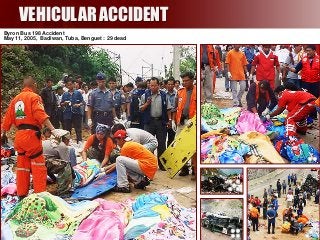
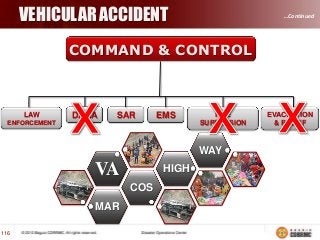
VEHICULAR ACCIDENT
Byron Bus 198 Accident
May 11, 2005, Badiwan, Tuba, Benguet : 29 dead

115
VEHICULAR ACCIDENT

…Continued

COMMAND & CONTROL

LAW

DANA

SAR

EMS

ENFORCEMENT

FIRE
SUPPRESION

WAY

VA

HIGH
COS

MAR
116

EVACUATION
& RELIEF
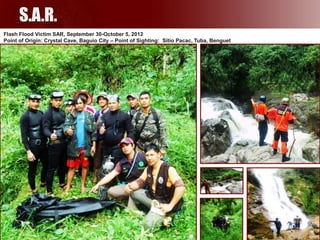
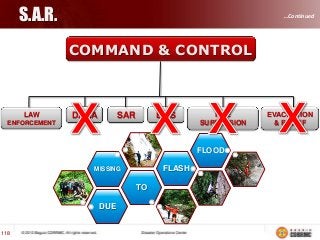
S.A.R.
Flash Flood Victim SAR, September 30-October 5, 2012
Point of Origin: Crystal Cave, Baguio City – Point of Sighting: Sitio Pacac, Tuba, Benguet

117
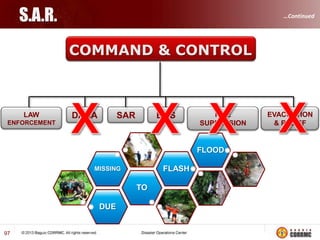
S.A.R.

…Continued

COMMAND & CONTROL

LAW

DANA

SAR

EMS

ENFORCEMENT

FIRE
SUPPRESION

FLOOD

FLASH

MISSING

TO
DUE

118

EVACUATION
& RELIEF
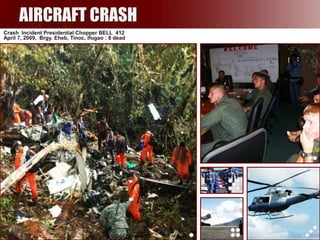
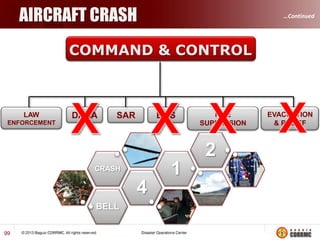
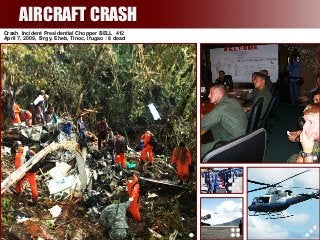
AIRCRAFT CRASH
Crash Incident Presidential Chopper BELL 412
April 7, 2009, Brgy. Eheb, Tinoc, Ifugao : 8 dead

119
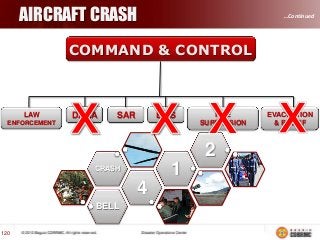
AIRCRAFT CRASH

…Continued

COMMAND & CONTROL

LAW

DANA

SAR

EMS

ENFORCEMENT

FIRE
SUPPRESION

2
1

CRASH

4
BELL
120

EVACUATION
& RELIEF
INCIDENT
REPORTING / RECIEVING
WHAT TO DO
1.
2.
3.
4.
5.

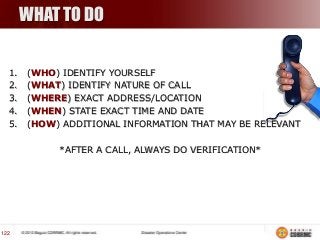
(WHO) IDENTIFY YOURSELF
(WHAT) IDENTIFY NATURE OF CALL
(WHERE) EXACT ADDRESS/LOCATION
(WHEN) STATE EXACT TIME AND DATE
(HOW) ADDITIONAL INFORMATION THAT MAY BE RELEVANT

*AFTER A CALL, ALWAYS DO VERIFICATION*

122
INCIDENT
PROFILING
INCIDENT PROFILING
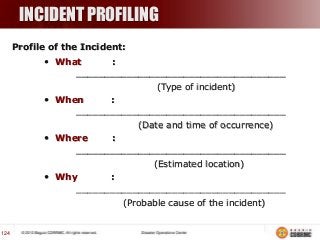
Profile of the Incident:
ļ‚— What
:
_____________________________________
(Type of incident)

ļ‚— When
:
_____________________________________
(Date and time of occurrence)
ļ‚— Where
:
_____________________________________
(Estimated location)
ļ‚— Why
:
_____________________________________
(Probable cause of the incident)

124
INCIDENT PROFILING

…Continued

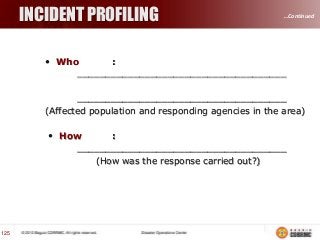
ļ‚— Who
:
_____________________________________
_____________________________________
(Affected population and responding agencies in the area)
ļ‚— How
:
_____________________________________
(How was the response carried out?)

125
QUESTIONS?

126
ā€œWe are not preparing for the world we live in - we
are preparing for the world we find ourselves in.ā€
– Michael Mabee
Prepping for a Suburban or Rural Community: Building a Civil Defense Plan for a Long-Term Catastrophe

127
THANK YOU!

128
REFERENCES
•

Andrew Alex Uy
OCD-CAR/CRDRRMC

•

Hazard
http://www.backgroundalpha.com/Hazards.html

•

Risk
http://bcalliance-international.com/select-services/risk-management-and-iso-31000/risk-management-services
http://dilipchandra12.hubpages.com/hub/Risk-Treatment-Plan

•

Disaster
http://en.wikipedia.org/wiki/Disaster

•

Trashslide
http://msnbcmedia.msn.com/i/MSNBC/Components/Photo/_new/pb-110828-garbage-cannon.jpg
http://www.interaksyon.com/article/12111/mina-toll-rises-to-26-six-more-missing
http://mghelman.tumblr.com/
http://www.sunstar.com.ph/baguio/local-news/2011/08/29/typhoon-mina-leaves-8-dead-cordillera-176058
http://newsinfo.inquirer.net/51141/state-of-calamity-declared-in-trash-swamped-baguio
http://bulatlat.com/main/2013/06/25/baguios-garbage-woe-affects-classes/
http://richardbalonglong.wordpress.com/2012/10/03/wall-es-plant-2/

•

Typhoon Parma
http://www.typhoon2000.ph/stormarchives/2009/trax/pepeng09_16tx.gif

•

Climate Change
http://mncgreens.blogspot.com/2012/02/event-australian-attitudes-to-climate.html
http://www.climate-speakers.org.uk/

129

Disaster Risk Reduction and Management

  • 1.
    DISASTER RISK REDUCTION &MANAGEMENT Supplemented by Ryann U. Castro
  • 2.
    SCOPE: 1. 2. 3. 4. 5. 6. 7. 8. 2 DEFINITION OF TERMS • HAZARD • EXPOSURE • VULNERABILITY • CAPACITY • RISK • DISASTER BAGUIOCITY: EFFECTS OF DISASTERS • EARTHQUAKE • TROPICAL CYCLONE • TRASHSLIDE PHILIPPINES RISK PROFILE PREPAREDNESS NEW FRAMEWORK ON DISASTER RISK REDUCTION & MANAGEMENT SALIENT PROVISION OF R. A. 10121 (DRRM ACT OF 2010) STRENGTHENING DISASTER RISK REDUCTION EMERGENCY/DISASTER OPERATIONS CENTER • SITUATIONAL ISSUES • INCIDENT MANAGEMENT
  • 3.
  • 4.
    HAZARD • Is adangerous phenomenon, substance, human activity or condition that may cause loss of life, injury or other health impacts, property damage, loss of livelihood & services, social & economic disruption or environmental damage... • Could be a potentially damaging phenomenon • It could be natural or human-induced. 4
  • 5.
    EXPOSURE • The degreeto which the element at risk are likely to experience hazard events of different magnitude. 5
  • 6.
    VULNERABILITY • Is thecharacteristics and circumstances of a community, system or asset that make it susceptible to the damaging effects of a hazard. • This may arise from environmental factors. 6 various physical, social, economic &
  • 7.
    VULNERABILITY …Continued VULNERABILITY HAS BEENRELATED TO THE FOLLOWING FACTORS:  Social Integration  Ethnicity  Age  Gender  Location  Status  Wealth  Income  Education  Family type  Psychological & Physiological  Locus of control  Disability  Coping-style  Individual’s perception  Lifestyle  Agility  Mobility  Experience Britton and Walker 1991 7
  • 8.
    CAPACITY • Is thecombination of all strengths and resources available within the community, society or organization that can reduce the level of risk or effects of a disaster. 8
  • 9.
    RISK • Is thecombination of Probability of an event to happen and its negative consequences... R= 9 HAZARD x VULNERABILITY (exposure) CAPACITY
  • 11.
    DISASTER • A disasteris a natural or man-made (or technological) hazard resulting in an event of substantial extent causing significant physical damage or destruction, loss of life, or drastic change to the environment. A disaster can be ostensively defined as any tragic event stemming from events such as earthquakes, floods, catastrophic accidents, fires, or explosions. It is a phenomenon that can cause damage to life and property and destroy the economic, social and cultural life of people. • In contemporary academia, disasters are seen as the consequence of inappropriately managed risk. These risks are the product of a combination of both hazard/s and vulnerability. Hazards that strike in areas with low vulnerability will never become disasters, as is the case in uninhabited regions. 11
  • 12.
    DISASTER …Continued 12 CLASSIFICATIONS Natural Disaster  Anatural disaster is a consequence when a natural hazard affects humans and/or the built environment. Human vulnerability, and lack of appropriate emergency management, leads to financial, environmental, or human impact. The resulting loss depends on the capacity of the population to support or resist the disaster: their resilience. This understanding is concentrated in the formulation: "disasters occur when hazards meet vulnerability". A natural hazard will hence never result in a natural disaster in areas without vulnerability.
  • 13.
    DISASTER …Continued 13 CLASSIFICATIONS Man-made or HumanInduced Disaster  Man-made disasters are the consequence of technological or human hazards. Examples include stampedes, fires, transport accidents, industrial accidents, oil spills and nuclear explosions/radiation. War and deliberate attacks may also be put in this category. As with natural hazards, man-made hazards are events that have not happened, for instance terrorism. Man-made disasters are examples of specific cases where man-made hazards have become reality in an event
  • 14.
    …Continued WHEN IS ANEVENT A DISASTER? 1. At least 20% of the population are affected & in need of emergency assistance or those dwelling units have been destroyed. 2. A great number or at least 40% of the means of livelihood such as bancas, fishing boats, vehicles and the like are destroyed. DISASTER 3. Major roads and bridges are destroyed and impassable for at least a week, thus disrupting the flow of transport and commerce. 14 4. Widespread destruction of fishponds, crops, poultry and livestock, and other agricultural products, and 5. Epidemics NDCC Memo Order No. 4, dated 04 March 1998
  • 15.
    …Continued WHY ARE DISASTERIMPACTS INCREASING? 1. Increased in population DISASTER 2. Climate change 15 3. Increased vulnerability due to: • Demographic changes • Increased concentration of assets • Environmental degradation • Poverty • Rapid urbanization and unplanned development
  • 16.
  • 17.
    EARTHQUAKE July 16 1990 Ms=7.8 DEAD– 1,666 INJURED – 3,500 17
  • 18.
  • 19.
    University of BAGUIO FRBHotel Nevada Hotel Siesta Inn 19
  • 20.
    Park Hotel Royal Inn 20 St.Vincent Hilltop Hotel
  • 21.
  • 22.
  • 23.
    JULY 16, 1990EARTHQUAKE …Continued Aftershocks of the 1990 July 16 earthquake Ms=7.8 PHIVOLCS data First 14 hours Many aftershocks found west of Baguio City, not along fault trace 23
  • 24.
    SUPER TYPHOON ā€œPEPENGā€{PARMA} (September 30 – October 10, 2009) Max Center Wind: 195 kph Gustiness: 230 kph Speed: 9-26 kph Baguio City received 640 mm of rain during the 12hour period starting 8:00 am on October 8 24
  • 25.
    EFFECTS ST ā€œPEPENGā€{PARMA} a) Affected Population Population affected in 5,486 barangays, 334 municipalities, and 33 cities in 27 provinces in Regions I, II, III, V, VI, CAR and NCR – 954,087 families / 4,478,284 persons Breakdown per Region The total number evacuated inside 54 evacuation centers were 3,258 families / 14,892 persons b) Casualties Reported deaths in CAR were mainly due to landslides while those in other regions were due to drowning (same figure in previous report)  465 Dead  207 Injured  47 Missing 25
  • 26.
    EFFECTS ST ā€œPEPENGā€{PARMA} …Continued c) Damages The total number of damaged houses were 61,869 (6,807 totally / 55,062 partially) The estimated cost of damage to infrastructure and agriculture were PhP27.297 Billion (infrastructure to include school buildings and health infrastructure PhP6.799 Billion; agriculture PhP20.495 Billion and private property PhP 0.003 Billion Agricultural area of 428,034 hectares incurred losses of 1,052.993 MT of crops (rice, corn, high value commercial crops, abaca and irrigation facilities) Education facilities damaged in Regions I, II, III, V and CAR: were 1,531 schools (1,280 Elementary and 251 High Schools) amounting to PhP767.45 Million 26
  • 28.
    EFFECTS ST ā€œPEPENGā€{PARMA} INCIDENTS …Continued TOTAL ERODED RIPRAP FALLEN TREE / IN DANGER OF FALLING 19 SOIL EROSION / LANDSLIDE 97 FLOOD BAGUIO 25 41 VEHICULAR ACCIDENT 1 CASUALTIES: A) Deaths 1) Landslide 2) Accident 58 2 B) Missing 5 C) Injured 27 Note: Incidents received, monitored and recorded by CDRRMC-DOC 28
  • 29.
    CITY CAMP FLOODING Date: October8, 2009 Reported: 2:55 PM Cause: Heavy volume of rainfall could not be contained by the drainage. 29
  • 30.
    CRESENCIA VILLAGE LANDSLIDE Date: 08October 2009 Reported: 8:00 PM Cause: Heavy volume of rainfall saturated the soil. Casualties: 23 30
  • 31.
    MARCOS HIGHWAY ROAD CUT Date:October 8, 2009 Reported 9:31 PM Caused Closure of the Highway 31
  • 32.
    MARCOS HIGHWAY ROAD CUT Date:October 8, 2009 Reported 9:31 PM Caused Closure of the Highway 32
  • 33.
    KENNON ROAD Fallen rocksand Mudslides 33
  • 34.
    PINSAO PROPER LANDSLIDE Date: October9, 2009 Reported: 8:30 AM Cause: Heavy volume of rainfall saturated the soil. Casualties: 1 34
  • 35.
    ↑ ROCK QUARRY LANDSLIDE Date:October 9, 2009 Reported: 6:30 AM Cause: Heavy volume of rainfall saturated the soil. Casualties: 4 35
  • 36.
    ↓ KITMA LANDSLIDE Date: October9, 2009 Reported: 9:56 AM Cause: Heavy volume of rainfall saturated the soil. Casualties: 8 36
  • 37.
    PUROK 1, IRISAN LANDSLIDE Date:October 9, 2009 Cause: Heavy volume of rainfall saturated the soil. Casualties: 16 37
  • 38.
  • 39.
    TRASHSLIDE August 26 –September 7, 2011 DEAD – 6 39
  • 40.
  • 41.
  • 42.
  • 43.
    PREVIOUS DISASTERS INC.A.R. 43 LESSONS LEARNED         LGU as the first line of defence Early warning devise or equipment are vital in saving life Without communication support warning and the evacuation fails Early warning and evacuation system to attain Zero Casualty Pre-positioning of organic resource capability for quick response Building-back better not building-back-elsewhere DRR measures to protect economic investments Help must be linked to initiative. Protracted relief could breed mendicancy, inhibit or hold back local initiative and suppress native creativity  Demand driven vs. donors driven  Disaster Risk Reduction Plan must be considered basic input in the Regional Development Master Plan
  • 44.
  • 45.
  • 47.
    …Continued The country isconsidered one of the most disaster-prone. It ranks 12th among 200 countries most at-risk for tropical cyclones, floods, earthquakes, and landslides in the 2009 Mortality Risk Index of the UN International Strategy for Disaster Reduction RISK PROFILE  Located along the typhoon belt in the Pacific making it vulnerable to typhoons and tsunami. 47  Average of 20 typhoons yearly (7 are destructive).
  • 48.
    RISK PROFILE …Continued 48 1851-2006 TYPHOONSEASON Tracks and Intensity of Tropical Cyclones, 1851-2006 TD TS 1 2 3 Saffir-Simpson Hurricane Intensity Scale 4 5
  • 49.
  • 50.
  • 51.
  • 52.
    RISK PROFILE …Continued 52 AREAS SUSCEPTIBLETO LANDSLIDE, FLOODING, AND SUBSIDENCE DUE TO KARST DEVELOPMENT
  • 54.
    RISK PROFILE …Continued 54 The Philippines,given its location on the earth is prone to various types of Natural Disasters.  Located along the Pacific Ring of Fire, between two Tectonic plates (Eurasian and Pacific) which are volcanic and earthquake generators.  22 active volcanoes (5 most active).
  • 55.
    RISK PROFILE …Continued 55 Fact: The PhilippineArchipelago has a complex tectonic setting with several trenches and many active faults
  • 56.
  • 57.
  • 58.
    Northwest segments ofthe Philippine Fault Zone (PFZ):  Digdig Fault  San Manuel Fault  Tebbo Fault  Tuba Fault  Bangui Fault  Abra River Fault Source: Phivolcs 50 100 km N South China Sea Pacific Ocean Abra River RISK PROFILE …Continued EARTHQUAKE GENERATORS WITHIN CORDILLERA Manila Trench 58 0 Baguio City
  • 59.
    …Continued 0 2 SEISMIC GENERATORS NEARBAGUIO CITY RISK PROFILE Source: Phivolcs South China Sea Pacific Ocean Abra River 59 Tebbo Fault  located approximately 10 km Southeast of Baguio City  70 km long  could generate a Ms 7.4 earthquake max 100 km N Manila Trench Tuba Fault  West of Baguio City, approximately 5 km away, NW trending  50 km long  could generate a Ms 7.25 earthquake max 50 Baguio City
  • 60.
    …Continued 0 Burnham Fault 100 N LEGEND: RISK PROFILE MiradorFault 60 Fault San Vicente Fault Tuba Fault Bued Fault Loakan Fault Source: Office of the City Planning & Development Coordinator 300 km
  • 61.
    RISK PROFILE …Continued 61 HISTORICAL SEISMICITY ThePHIVOLCS earthquake and catalogue seismicity maps shows so far, seven (7) historically and instrumentally recorded destructive earthquakes (Intensity VII-IX in the adapted Rossi-Forel scale) have affected Baguio City for the past 356 years (1645-2001). This roughly translate into a return period of at least one destructive earthquake (Intensity VII to IX) for every 50 years. In addition, there were four very destructive earthquakes during the 356-year period for a return period of at least one very destructive earthquake (Intensity VIII to IX) for every 89 years. In comparison, regional probabilistic seismic hazard calculations by Thenhaus (1994) yielded annual probability rates of Ms: • 6.4 to <7.0 (1 in 23 years) • 7.0 to <7.3 (1 in 62 years) • Ms <8.2 (1 in 166 years)
  • 63.
    RISK PROFILE …Continued 63 The Philippine Archipelago occupies the western ring of the PacificOcean (Western Segment of the Pacific Ring of Fire), a most active part of the earth that is characterized by an ocean-encircling belt of active volcanoes and earthquake generators (faults).
  • 64.
    …Continued ACTIVE, INACTIVE AND POTENTIALLYACTIVE VOLCANOES OF THE PHILIPPINES RISK PROFILE  300 volcanoes  22 active  7 inactive in CAR 64
  • 65.
    …Continued VOLCANOES OF THECORDILLERA REGION Benguet Province: Kalinga Province: 1. Santo Tomas, Baguio City 4. Bumabag, Batong Buhay 2. Daclan, Bokod 5. Podakan, Batong Buhay 3. Pulag, Kabayan 6. Ambalatungan, Batong Buhay RISK PROFILE 7. Binuluan 65 All of the above volcanoes are inactive or has no record of eruption during historic times.
  • 66.
  • 67.
    MAKE A DIFFERENCE… PREPAREDNESS Changing attitudes… 67  Knowing hazards…  Doing something to minimize the hazards.
  • 68.
  • 69.
    PREPAREDNESS …Continued 69 CRITICAL CONCERNS 1. Doesyour institution have an existing Disaster Response Team / Safety Committee? 2. If yes, is it functional? 3. Do we conduct emergency / disaster drills regularly? 4. Do we have Emergency Response Plan? 5. Do we have a Preparedness / Contingency Plan in the event of any disaster? 6. Are there personnel / employees trained in first aid, fire fighting or rescue? 7. Does the institution have any rescue equipment and other emergency paraphernalia? 8. Do we have an institutionalized warning system? 9. Are there identified evacuation areas within the premises of the institution?
  • 70.
  • 71.
    PREPAREDNESS …Continued 71 72-HOUR SURVIVAL KIT 1. 2. 3. 4. 5. 6. 7. Food Clothing Communications Documents Medicines OtherEssential Needs Emergency Money *Kit depends on the number of family members, health status, gender and age.
  • 72.
  • 73.
    THE PHILIPPINE DRRMSYSTEM DRRM  Disaster legislation in the Philippines dates back in 1978, primarily reactive approach to disasters, focusing heavily on preparedness and response. Other relevant legislation for mainstreaming of disaster risk reduction into development includes land-use controls and building codes. However, building codes are not strictly enforced and zoning ordinances which are reported to have been relaxed over time. 73  With the approval of the DRRM (Republic Act No. 10121) expect that there would be a paradigm shift emphasizing disaster management to a disaster risk management approach, with much greater importance given to reducing risk. The RA was approved on 27 May 2010, and the Implementing Rules and Regulations was crafted by the Task Force RA 10121 headed by the OCD.
  • 74.
    …Continued RISK REDUCTION ANDMANAGEMENT  Systematic process of using administrative decisions, organization, operational skills and capacities to implement policies, strategies and coping capacities of the society and communities  Setting of related goals and objectives in development and land use areas. DRRM  It involves the formulation of strategies and Plans, Programs and Activities (PPAs) 74
  • 75.
    …Continued WHAT MUST BEDONE TO REDUCE RISK  Institutionalize Local Disaster Risk Reduction & Management Office  Establish Early Warning System  Formulation of Communication Protocol  Formulation of Evacuation Procedures at the community level and establishments  Organize Local DRRMC and define the functional roles and responsibilities of the members and task units DRRM  Establish Standard Operating Procedures (SOP) 75  Hazard awareness seminars through Community-Based trainings and
  • 76.
    …Continued WHAT MUST BEDONE TO REDUCE RISK  Integrate disaster risk reduction into the Comprehensive Land Use Plan (CLUP) and land use planning  Integrate hazard, risk and vulnerability assessment into the development plan  Cluster Approach on Recovery Program  Good working relationship with Warning Agencies and the Local Media DRRM  Installation of rain gauges on mountain slopes 76 (DENR-MGB CAR recommended that 150 mm of rainfall observed within 24 hours would already trigger evacuation of communities in high risk areas)
  • 77.
    …Continued WHAT MUST BEDONE TO REDUCE RISK  Strengthening of the LGU capabilities on disaster management;  Updating the hazard profile of all municipalities and to analyse data on human induced disasters for public safety studies DRRM  Effective flow of communication system to ensure that accurate flow of information before, during and after disasters 77
  • 78.
  • 79.
    …Continued RISK REDUCTION METHOD Inthe following order 1. Identify, characterize, and assess threats 2. Assess the vulnerability of critical assets to specific threats 3. Determine the risk (i.e. the expected consequences of specific types of attacks on specific assets) 4. Identify ways to reduce those risks DRRM 5. Prioritize risk reduction measures based on a strategy 79
  • 80.
    …Continued POTENTIAL RISK TREATMENTS Oncerisks have been identified and assessed, all techniques to manage the risk fall into one or more of these four major categories: DRRM     80 Avoidance (eliminate, withdraw from the risk area) Reduction (optimize resources to mitigate effects ) Sharing (risk transfer or enrol in insurance) Retention (accept, plan - formulate ConPlan, Evac Plan, ICS and provision of budget)
  • 81.
    …Continued DISASTER RISK MANAGEMENTSTRATEGY  A comprehensive disaster risk management strategy, actively involving stakeholders at all levels of government as well as the private sector, local communities and civil society, is required to implement the legislative framework and to provide coordination and monitoring mechanisms and arrangements. DRRM  Individual disaster risk reduction actions and programs need to be located within this strategy, rather than treated as discrete, individual measures. Moreover, the strategy needs to indicate specific entry points and mechanisms for mainstreaming disaster risk reduction concerns into both the broader development agenda and the design and implementation of individual development initiatives. 81
  • 82.
    DRRM …Continued 82 DISASTER RISK MANAGEMENTSTRATEGY  Individual line agencies and local governments are legally responsible for implementing disaster management, as it is still commonly referred to in department circulars and executive orders, within their own areas of responsibility. In practice, some LGUs have yet to even establish their disaster coordinating councils (DCCs), while those DCCs that have been established vary in quality. In addition, reflecting Presidential Decree (PD) 1566’s reactive approach to DCC meetings are commonly held only on an ad hoc basis, in response to crisis situations, rather than on a more regular basis to discuss ongoing risk reduction initiatives, and DCCs’ risk reduction and mainstreaming capacity and capabilities are often very limited.
  • 83.
    …Continued RA NO. 10121 27May 2010 14th Congress (2007-2010) 13th Congress (2004-2007) 12th Congress (2001-2004) R.A. 10121 11th Congress (’98-2001) 83 10th Congress (’95-’98) 9th Co2ngress (’92-’95) 8th Congress (’89-’92) PD 1566 June 11, 1978 • 21 years in the making • 7 Congresses • 4 Administration
  • 84.
    …Continued DRRMC ORGANIZATIONAL NETWORK NATIONALDISASTER RISK REDUCTION & MANAGEMENT COUNCIL  17 REGIONAL DISASTER RISK REDUCTION & MANAGEMENT COUNCILS  80 PROVINCIAL DISASTER RISK REDUCTION & MANAGEMENT COUNCILS  117 CITY DISASTER RISK REDUCTION & MANAGEMENT COUNCILS R.A. 10121  1,496 MUNICIPAL DISASTER RISK REDUCTION & MANAGEMENT COUNCILS 84  41,945 BARANGAY DISASTER RISK REDUCTION & MANAGEMENT COUNCILS
  • 85.
    ADMINISTRATIVE ORDER 173SERIES 2010 Mayor BAGUIO CITY City Administrator / Action Officer 85
  • 86.
    R.A. 10121 …Continued 86 THE PHILIPPINEDISASTER RISK REDUCTION AND MANAGEMENT SYSTEM MAY 27, 2010  An Act Strengthening The Philippine Disaster Risk Reduction and Management System, providing for the National Disaster Risk Reduction and Management Framework, and Institutionalizing the Disaster Risk Reduction and Management Plan, appropriating funds therefor and for other purposes (DRRM Act 2010)
  • 87.
    …Continued DISASTER RISK REDUCTION …Continued Thelaw which transforms the Philippines’ Disaster Management System from Disaster Relief and Response towards Disaster Risk Reduction. 87 Bottom-up and participatory disaster risk reduction Disasters as merely a function of physical hazards R.A. 10121 Top-down and centralized disaster management Disaster mainly a reflection of people's vulnerability Focus on disaster response and anticipation Integrated approach to genuine social and human development to reduce disaster risk and adoption of IT in DRM
  • 88.
    …Continued DISASTER RISK REDUCTIONGUIDING PRINCIPLES  Institutional not personality oriented  Permanent solution not temporary or palliative R.A. 10121  Preemptive evacuation is better than rescue 88
  • 89.
    R.A. 10121 …Continued The enactmentof the Philippine Disaster Risk Reduction and Management Act of 2010 (also known as Republic Act 10121), aims to achieve a paradigm shift from reactive to proactive approach in disaster risk reduction and management.  One of the main objectives of Disaster Preparedness it to ā€œEnhance the community with the necessary skills to cope with the negative impacts of a disasterā€.  The state of readiness for PDRRMC, MDRRMC and CDRRMC is greatly determines the extent to which potential casualties and damages can be reduced. 89
  • 90.
    …Continued PARADIGM SHIFT Emergency/Disaster Management • • • • • • • • • • • • • • • / Publicawareness Public commitment Community actions Education & Training Early Warning SOP & Plans ICS Development • • • • • • Executive/Legislative Agenda Environmental Management Comprehensive Land Use Plan Risk proofing Financial tools Hazard identification & Mitigation: Vulnerability Analysis Capacity Analysis Risk Reduction DANA Relief SAR Incident Command System Evacuation Health Preparedness Prevention R.A. 10121 Rehabilitation 90 • • • • • Response Livelihood Housing Lifelines Education Infrastructure REACTIVE
  • 91.
  • 92.
    …Continued PARADIGM SHIFT National DisasterRisk Reduction & Management Framework EMERGENCY MANAGEMENT DISASTER RISK MANAGEMENT Reactive Proactive R.A. 10121 Disaster Response 92 Disaster Risk Reduction Emergency Specialists Hazard Scientists Risks Specialists Economic Managers Development Planners
  • 93.
    …Continued PARADIGM SHIFT Emergency/Disaster RiskManagement Mitigation: Risk Reduction /Prevention R.A. 10121 Preparedness 93 Rehabilitation Response PROACTIVE
  • 94.
  • 95.
  • 96.
    DISASTER OR EMERGENCYOPCEN • Is a central command and control facility responsible for carrying out the principles or functions of emergency / disaster preparedness and management at a strategic level in an emergency situation, and ensuring the continuity of operation of a company, political subdivision or other organization. • An Emergency / Disaster OPCEN is responsible for the strategic overview, or "big picture", of the disaster. • Used in varying ways at all levels of government and within private industry to provide coordination, direction and control during emergencies. 96
  • 97.
    DISASTER OR EMERGENCYOPCEN …Continued • The common functions of all E/D OPCEN is to collect, gather and analyze data; make decisions that protect life and property, maintain continuity of the organization, within the scope of applicable laws; and disseminate those decisions to all concerned agencies and individuals. • In most E/DOC's, there is one individual in charge, and that is the Emergency/Disaster Manager. 97
  • 98.
    DISASTER OR EMERGENCYOPCEN …Continued BRINGS TOGETHER THE VITAL ASPECT OF : SITUATION ASSESSMENT AND MONITORING SITUATION MONITORING DISSEMINATION of WARNING INFORMATION COLLECTION & ANALYSIS RESOURCE DISPATCH, TRACKING & REQUEST MEDIA & PUBLIC INFORMATION 98 Working 24/7 TASK ALLOCATION ACTIVATION of the BDRRMC responders & others With DISASTER MNGT FUNCTION COORDINATION & COMMUNICATION ACTION PRIORITIES
  • 99.
  • 100.
    ACTIVATION UNDERSTANDING THE COLOREDALERT STATUS & DISASTER WARNING SYMBOLS NOTIFICATION - When an event/disaster occurs, notification is made to all partner agencies, and CDRRMC Disaster Operations Center support staff who needs to take actions as part of their pre-assigned tasks and responsibilities; BLUE ALERT (PARTIAL ACTIVATION) - An initial limited or a post Red Alert scaled down operational condition of the Disaster Operations Center (DOC). All field personnel go on stand-by, assets pre-positioned for easy deployment; RED ALERT (FULL ACTIVATION) - All primary and secondary support agencies of the CDRRMC are on active status/on-call, manning respective stations along with DOC staff, while directing-coordinating personnel/assets on a 24-hour basis during an ongoing event; DEACTIVATION - The DOC Chief as may be directed by the Chief Executive or Action Officer to deactivate the alert status and normal operations of the Disaster Operations Center resumes. 100 STAGES or LEVELS of ACTIVATION for DRRMCs
  • 101.
    ACTIVATION RED …Continued Full scale activation •Full scale activation. • Citywide activation of the BDRRMC’s & respective operations centers. • Focal members of the CDRRMC’s will be in the operations center for fast action, coordination & decision. • Convene a council meeting to address preparedness for response & other concerns. 101
  • 102.
    ACTIVATION BLUE …Continued Partial activation • Partialactivation - whole members • Citywide activation of the BDRRMCs & respective operations centers • Convene a council meeting to address preparedness for response & other concerns 102
  • 103.
    ACTIVATION WHITE • 24/7 monitoringof AOR 103 …Continued Monitoring
  • 104.
  • 105.
    SITUATIONAL ISSUES In anymajor situation, there are three (3) critical issues that usually arise, namely: 105
  • 106.
    SITUATIONAL ISSUES …Continued 106 TIME CONSTRAINT • • • • • • • • WARNPEOPLE EVACUATE THE PEOPLE SAVE LIVES CASUALTIES • INJURED • DEAD • MISSING IMPENDING HAZARDS UTILITY SHUT DOWN LOOTERS Others …Continued
  • 108.
  • 109.
  • 110.
    INCIDENT MANAGEMENT COMMAND &CONTROL LAW ENFORCEMENT 110 DANA SAR EMS FIRE SUPPRESION EVACUATION & RELIEF
  • 111.
    STRUCTURAL FIRE Tiong SanBazaar, 1:00 PM, April 2, 2008 Property and merchandise worth around P 200 million were lost in a 10-hour fire. 111
  • 112.
    STRUCTURAL FIRE …Continued COMMAND &CONTROL LAW DANA SAR EMS ENFORCEMENT FIRE SUPPRESION E R TS I F 112 EVACUATION & RELIEF
  • 113.
    LANDSLIDE Little Kibungan, Puguis,La Trinidad, Benguet The landslide buried more or less 25 houses 50+ residents. 113
  • 114.
  • 115.
    VEHICULAR ACCIDENT Byron Bus198 Accident May 11, 2005, Badiwan, Tuba, Benguet : 29 dead 115
  • 116.
    VEHICULAR ACCIDENT …Continued COMMAND &CONTROL LAW DANA SAR EMS ENFORCEMENT FIRE SUPPRESION WAY VA HIGH COS MAR 116 EVACUATION & RELIEF
  • 117.
    S.A.R. Flash Flood VictimSAR, September 30-October 5, 2012 Point of Origin: Crystal Cave, Baguio City – Point of Sighting: Sitio Pacac, Tuba, Benguet 117
  • 118.
  • 119.
    AIRCRAFT CRASH Crash IncidentPresidential Chopper BELL 412 April 7, 2009, Brgy. Eheb, Tinoc, Ifugao : 8 dead 119
  • 120.
    AIRCRAFT CRASH …Continued COMMAND &CONTROL LAW DANA SAR EMS ENFORCEMENT FIRE SUPPRESION 2 1 CRASH 4 BELL 120 EVACUATION & RELIEF
  • 121.
  • 122.
    WHAT TO DO 1. 2. 3. 4. 5. (WHO)IDENTIFY YOURSELF (WHAT) IDENTIFY NATURE OF CALL (WHERE) EXACT ADDRESS/LOCATION (WHEN) STATE EXACT TIME AND DATE (HOW) ADDITIONAL INFORMATION THAT MAY BE RELEVANT *AFTER A CALL, ALWAYS DO VERIFICATION* 122
  • 123.
  • 124.
    INCIDENT PROFILING Profile ofthe Incident: ļ‚— What : _____________________________________ (Type of incident) ļ‚— When : _____________________________________ (Date and time of occurrence) ļ‚— Where : _____________________________________ (Estimated location) ļ‚— Why : _____________________________________ (Probable cause of the incident) 124
  • 125.
    INCIDENT PROFILING …Continued ļ‚— Who : _____________________________________ _____________________________________ (Affectedpopulation and responding agencies in the area) ļ‚— How : _____________________________________ (How was the response carried out?) 125
  • 126.
  • 127.
    ā€œWe are notpreparing for the world we live in - we are preparing for the world we find ourselves in.ā€ – Michael Mabee Prepping for a Suburban or Rural Community: Building a Civil Defense Plan for a Long-Term Catastrophe 127
  • 128.
  • 129.
    REFERENCES • Andrew Alex Uy OCD-CAR/CRDRRMC • Hazard http://www.backgroundalpha.com/Hazards.html • Risk http://bcalliance-international.com/select-services/risk-management-and-iso-31000/risk-management-services http://dilipchandra12.hubpages.com/hub/Risk-Treatment-Plan • Disaster http://en.wikipedia.org/wiki/Disaster • Trashslide http://msnbcmedia.msn.com/i/MSNBC/Components/Photo/_new/pb-110828-garbage-cannon.jpg http://www.interaksyon.com/article/12111/mina-toll-rises-to-26-six-more-missing http://mghelman.tumblr.com/ http://www.sunstar.com.ph/baguio/local-news/2011/08/29/typhoon-mina-leaves-8-dead-cordillera-176058 http://newsinfo.inquirer.net/51141/state-of-calamity-declared-in-trash-swamped-baguio http://bulatlat.com/main/2013/06/25/baguios-garbage-woe-affects-classes/ http://richardbalonglong.wordpress.com/2012/10/03/wall-es-plant-2/ • TyphoonParma http://www.typhoon2000.ph/stormarchives/2009/trax/pepeng09_16tx.gif • Climate Change http://mncgreens.blogspot.com/2012/02/event-australian-attitudes-to-climate.html http://www.climate-speakers.org.uk/ 129

Editor's Notes

  • #8Ā In parallel to this shift in disaster management, the health sector is recognizing that better health within a community cannot be achieved through the provision of health care alone. The health sector is looking to models of population health and health promotion to address the determinants of health just as disaster management has evolved from treating the harmful agent to strengthening the community’s resilience to harm.
  • #25Ā Tropical Storm ā€œOndoyā€ {Ketsana} was quickly followed by Super Typhoon ā€œPepengā€ {Parma} (affected Northern Luzon October 2 – 10, 2009).
  • #28Ā Super Typhoon ā€œPepengā€ {Parma}affected Northern Luzon October 2 – 10, 2009.
  • #44Ā Based your presentation with your observation and experiences from previous disasters Demand driven vs. donors driven means relief or assistance extended by fit the requirements of the victims and not according to the desire of the donor
  • #71Ā Preparedness cycle helps in the development/improvement of a plan.The advantage of continuous training or the execution of the preparation cycle is that it becomes part of their (the participants) routine and reflex.
  • #72Ā 72-Hour Survival Kit depends on the needs of a family or an individualThe kit is should be good for 72-hours (3 days) or longerNote the word ā€œneedsā€ and not wants
  • #75Ā DRR is a systematic approach and application of policies, strategies and practices to minimize vulnerabilities and disasters in the community-To avoid (prevent) or limit (mitigate and prepare) the adverse impacts of hazards -DRR policies 2 fold aims: to be resilient to natural hazards while ensuring that development efforts do not increase vulnerability to these hazards
  • #76Ā Institutionalize Local Disaster Risk Reduction &amp; Management Office. The establishment of this independent body or office to ensure continuity of the programs on disaster management and strengthened the effective coordination of the various institutions for more efficient management. Likewise, the office will serve as a venue for disaster management seminars and trainings, and conduct of drills and exercise due to the availability of facilities and resources and competent staff.
  • #77Ā 90% of the Cordillera consists of mountain slopes, the steeper the slope it is more vulnerable to mass movement DENR-MGB CAR has recommended that 150 mm of rainfall observed within 24 hours would already trigger evacuation of communities in high risk areas)The Oct 2009 incident will serve as the bench mark for the susceptibility of the region from massive slides.Baguio City received an average 17 mm normal rainfall everyday if the span of 24 hours 685 mm of rainfall will already trigger slides
  • #81Ā Risk avoidanceThis includes not performing an activity that could carry risk. An example would be not buying a property or business in order to not take on the Legal liability that comes with it. Another would be not be flying in order to not take the risk that the airplane were to be hijacked. Avoidance may seem the answer to all risks, but avoiding risks also means losing out on the potential gain that accepting (retaining) the risk may have allowed. Not entering a business to avoid the risk of loss also avoids the possibility of earning profits. Hazard PreventionHazard prevention refers to the prevention of risks in an emergency. The first and most effective stage of hazard prevention is the elimination of hazards. If this takes too long, is too costly, or is otherwise impractical, the second stage is mitigation.Risk reductionRisk reduction or &quot;optimization&quot; involves reducing the severity of the loss or the likelihood of the loss from occurring. For example, sprinklers are designed to put out a fire to reduce the risk of loss by fire. This method may cause a greater loss by water damage and therefore may not be suitable. Holon fire suppression systems may mitigate that risk, but the cost may be prohibitive as a strategy.Acknowledging that risks can be positive or negative, optimizing risks means finding a balance between negative risk and the benefit of the operation or activity; and between risk reduction and effort applied. By an offshore drilling contractor effectively applying HSE Management in its organization, it can optimize risk to achieve levels of residual risk that are tolerable.Ā  Modern software development methodologies reduce risk by developing and delivering software incrementally. Early methodologies suffered from the fact that they only delivered software in the final phase of development; any problems encountered in earlier phases meant costly rework and often jeopardized the whole project. Ā Outsourcing could be an example of risk reduction if the outsourcer can demonstrate higher capability at managing or reducing risks. For example, a company may outsource only its software development, the manufacturing of hard goods, or customer support needs to another company, while handling the business management itself. This way, the company can concentrate more on business development without having to worry as much about the manufacturing process, managing the development team, or finding a physical location for a call center.Risk sharingBriefly defined as &quot;sharing with another party the burden of loss or the benefit of gain, from a risk, and the measures to reduce a risk.&quot;The term of &apos;risk transfer&apos; is often used in place of risk sharing in the mistaken belief that you can transfer a risk to a third party through insurance or outsourcing. In practice if the insurance company or contractor go bankrupt or end up in court, the original risk is likely to still revert to the first party. As such in the terminology of practitioners and scholars alike, the purchase of an insurance contract is often described as a &quot;transfer of risk.&quot; However, technically speaking, the buyer of the contract generally retains legal responsibility for the losses &quot;transferred&quot;, meaning that insurance may be described more accurately as a post-event compensatory mechanism. For example, a personal injuries insurance policy does not transfer the risk of a car accident to the insurance company. The risk still lies with the policy holder namely the person who has been in the accident. The insurance policy simply provides that if an accident (the event) occurs involving the policy holder then some compensation may be payable to the policy holder that is commensurate to the suffering/damage.Some ways of managing risk fall into multiple categories. Risk retention pools are technically retaining the risk for the group, but spreading it over the whole group involves transfer among individual members of the group. This is different from traditional insurance, in that no premium is exchanged between members of the group up front, but instead losses are assessed to all members of the group. Risk retentionInvolves accepting the loss, or benefit of gain, from a risk when it occurs. True self insurance falls in this category. Risk retention is a viable strategy for small risks where the cost of insuring against the risk would be greater over time than the total losses sustained. All risks that are not avoided or transferred are retained by default. This includes risks that are so large or catastrophic that they either cannot be insured against or the premiums would be infeasible. War is an example since most property and risks are not insured against war, so the loss attributed by war is retained by the insured. Also any amount of potential loss (risk) over the amount insured is retained risk. This may also be acceptable if the chance of a very large loss is small or if the cost to insure for greater coverage amounts is so great it would hinder the goals of the organization too much.