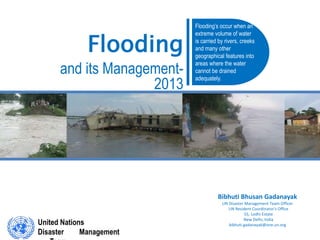
Flooding
and its Management-
2013
Flooding’s occur when an
extreme volume of water
is carried by rivers, creeks
and many other
geographical features into
areas where the water
cannot be drained
adequately.
United Nations
Disaster Management
Bibhuti Bhusan Gadanayak
UN Disaster Management Team Officer
UN Resident Coordinator's Office
55, Lodhi Estate
New Delhi, India
bibhuti.gadanayak@one.un.org
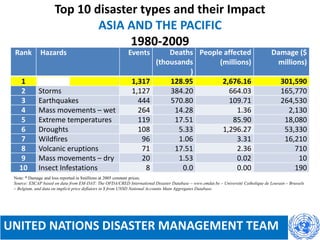
Top 10 disaster types and their Impact
ASIA AND THE PACIFIC
1980-2009
Rank Hazards Events Deaths
(thousands
)
People affected
(millions)
Damage ($
millions)
1 Floods 1,317 128.95 2,676.16 301,590
2 Storms 1,127 384.20 664.03 165,770
3 Earthquakes 444 570.80 109.71 264,530
4 Mass movements – wet 264 14.28 1.36 2,130
5 Extreme temperatures 119 17.51 85.90 18,080
6 Droughts 108 5.33 1,296.27 53,330
7 Wildfires 96 1.06 3.31 16,210
8 Volcanic eruptions 71 17.51 2.36 710
9 Mass movements – dry 20 1.53 0.02 10
10 Insect Infestations 8 0.0 0.00 190
Note: * Damage and loss reported in $millions at 2005 constant prices.
Source: ESCAP based on data from EM-DAT: The OFDA/CRED International Disaster Database – www.emdat.be – Université Catholique de Louvain – Brussels
– Belgium, and data on implicit price deflators in $ from UNSD National Accounts Main Aggregates Database.
UNITED NATIONS DISASTER MANAGEMENT TEAM
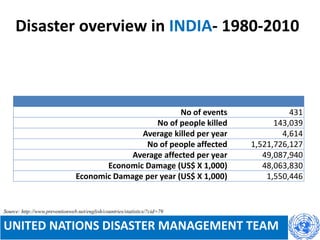
Disaster overview in INDIA- 1980-2010
UNITED NATIONS DISASTER MANAGEMENT TEAM
No of events 431
No of people killed 143,039
Average killed per year 4,614
No of people affected 1,521,726,127
Average affected per year 49,087,940
Economic Damage (US$ X 1,000) 48,063,830
Economic Damage per year (US$ X 1,000) 1,550,446
Source: http://www.preventionweb.net/english/countries/statistics/?cid=79
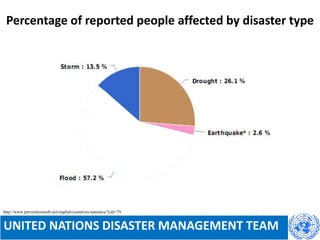
Percentage of reported people affected by disaster type
http://www.preventionweb.net/english/countries/statistics/?cid=79
UNITED NATIONS DISASTER MANAGEMENT TEAM
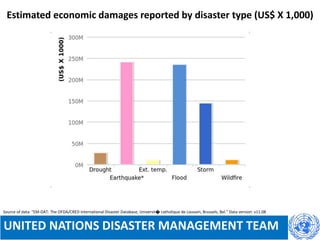
Estimated economic damages reported by disaster type (US$ X 1,000)
Source of data: "EM-DAT: The OFDA/CRED International Disaster Database, Universit� catholique de Louvain, Brussels, Bel." Data version: v11.08
UNITED NATIONS DISASTER MANAGEMENT TEAM
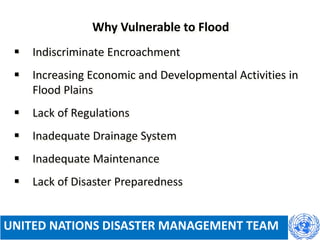
 Indiscriminate Encroachment
 Increasing Economic and Developmental Activities in
Flood Plains
 Lack of Regulations
 Inadequate Drainage System
 Inadequate Maintenance
 Lack of Disaster Preparedness
Why Vulnerable to Flood
UNITED NATIONS DISASTER MANAGEMENT TEAM
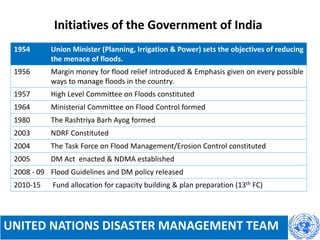
Initiatives of the Government of India
UNITED NATIONS DISASTER MANAGEMENT TEAM
1954 Union Minister (Planning, Irrigation & Power) sets the objectives of reducing
the menace of floods.
1956 Margin money for flood relief introduced & Emphasis given on every possible
ways to manage floods in the country.
1957 High Level Committee on Floods constituted
1964 Ministerial Committee on Flood Control formed
1980 The Rashtriya Barh Ayog formed
2003 NDRF Constituted
2004 The Task Force on Flood Management/Erosion Control constituted
2005 DM Act enacted & NDMA established
2008 - 09 Flood Guidelines and DM policy released
2010-15 Fund allocation for capacity building & plan preparation (13th FC)
Flood forecasting and management
UNITED NATIONS DISASTER MANAGEMENT TEAM
• Central Water Commission
• Flood forecasting modeling
• IMD (Doppler whether radar)
• Weather forecasting modeling
• Ganga flood control commission
• Brahmaputra board
• MHA - NDM DIVISION
• Ministry of Agriculture
• State flood control departments
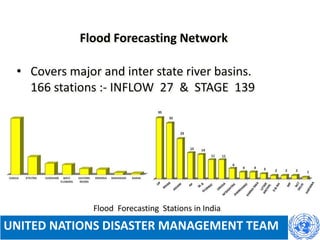
Flood Forecasting Network
• Covers major and inter state river basins.
166 stations :- INFLOW 27 & STAGE 139
Flood Forecasting Stations in India
UNITED NATIONS DISASTER MANAGEMENT TEAM
UN Interventions
 Capacity building of local governance institutions
and empowerment of communities
 Reduce vulnerability to natural disasters through
community preparedness
 Institutionalizing disaster management at all levels
UNITED NATIONS DISASTER MANAGEMENT TEAM
UN Interventions
 Multi-hazard preparedness and mitigation plans for
disaster risk management at State, District, Block,
GP & Village levels in 176 districts of 17 most
hazard prone states
 Networking knowledge on effective approaches,
methods and tools for disaster risk management,
developing and promoting policy frameworks at
State and National levels
UNITED NATIONS DISASTER MANAGEMENT TEAM
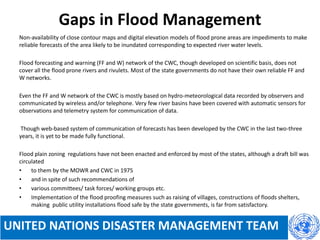
Gaps in Flood Management
Non-availability of close contour maps and digital elevation models of flood prone areas are impediments to make
reliable forecasts of the area likely to be inundated corresponding to expected river water levels.
Flood forecasting and warning (FF and W) network of the CWC, though developed on scientific basis, does not
cover all the flood prone rivers and rivulets. Most of the state governments do not have their own reliable FF and
W networks.
Even the FF and W network of the CWC is mostly based on hydro-meteorological data recorded by observers and
communicated by wireless and/or telephone. Very few river basins have been covered with automatic sensors for
observations and telemetry system for communication of data.
Though web-based system of communication of forecasts has been developed by the CWC in the last two-three
years, it is yet to be made fully functional.
Flood plain zoning regulations have not been enacted and enforced by most of the states, although a draft bill was
circulated
• to them by the MOWR and CWC in 1975
• and in spite of such recommendations of
• various committees/ task forces/ working groups etc.
• Implementation of the flood proofing measures such as raising of villages, constructions of floods shelters,
making public utility installations flood safe by the state governments, is far from satisfactory.
UNITED NATIONS DISASTER MANAGEMENT TEAM
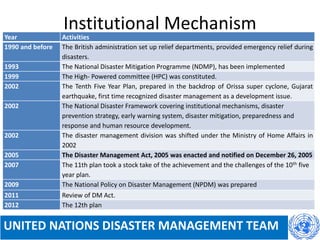
Institutional Mechanism
UNITED NATIONS DISASTER MANAGEMENT TEAM
Year Activities
1990 and before The British administration set up relief departments, provided emergency relief during
disasters.
1993 The National Disaster Mitigation Programme (NDMP), has been implemented
1999 The High- Powered committee (HPC) was constituted.
2002 The Tenth Five Year Plan, prepared in the backdrop of Orissa super cyclone, Gujarat
earthquake, first time recognized disaster management as a development issue.
2002 The National Disaster Framework covering institutional mechanisms, disaster
prevention strategy, early warning system, disaster mitigation, preparedness and
response and human resource development.
2002 The disaster management division was shifted under the Ministry of Home Affairs in
2002
2005 The Disaster Management Act, 2005 was enacted and notified on December 26, 2005
2007 The 11th plan took a stock take of the achievement and the challenges of the 10th five
year plan.
2009 The National Policy on Disaster Management (NPDM) was prepared
2011 Review of DM Act.
2012 The 12th plan
Institutional Set-up at the National, State
and District level-Refere DM Act.
UNITED NATIONS DISASTER MANAGEMENT TEAM
Institution Chairperson
National level NDMA Prime Minister
State level SDMA Chief Minister
District level DDMA District Magistrate, President Zila Parishad
as Co-Chair
NIDM Trining and capacity building
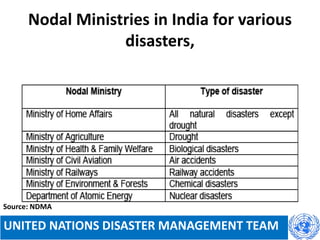
Nodal Ministries in India for various
disasters,
Source: NDMA
UNITED NATIONS DISASTER MANAGEMENT TEAM
Way forward
• Disaster resilient development planning in line
departments ministries for resilience building.
• Dedicated human resources (expertise) for
recovery planning in line departments and
ministries.
• Financial allocation for medium and long term
recovery
• Need for coordinated action: Inter-ministerial
National platform to forge national action plan
for DRR
UNITED NATIONS DISASTER MANAGEMENT TEAM
Thank you
UNITED NATIONS DISASTER MANAGEMENT TEAM