Downloaded 98 times

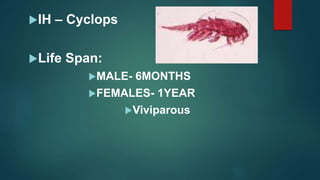





The document describes Dracunculus medinensis, commonly known as the Guinea worm. It provides details on the morphology of the female and male worms, noting females are elongated and cylindrical with a recurved caudal end, while males are smaller and coiled posteriorly. The life cycle involves a cyclops intermediate host, with larvae released from females when submerged in water and infecting humans who ingest water contaminated with the larvae. Infection causes the painful disease dracunculiasis, presenting as a cutaneous blister that emerges from the skin, often followed by secondary bacterial infections like tetanus.


