Loa-Loa
Apalin, Ruth Rendell D.
BSN 2A1-3
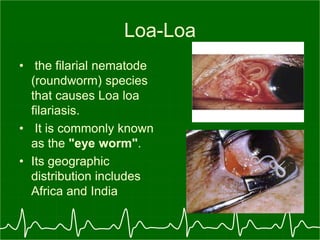
Loa-Loa
• the filarial nematode
(roundworm) species
that causes Loa loa
filariasis.
• It is commonly known
as the "eye worm".
• Its geographic
distribution includes
Africa and India
•L. loa is one of three parasitic filarial
nematodes that
cause subcutaneous filariasis in
humans.
•The two other filarial nematodes are
Mansonella streptocerca and Onchocerca
volvulus (causes river blindness).
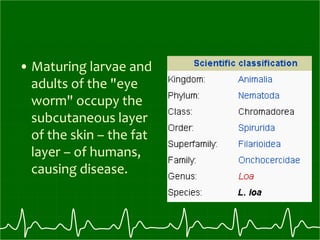
• Maturing larvae and
adults of the "eye
worm" occupy the
subcutaneous layer
of the skin – the fat
layer – of humans,
causing disease.
Morphology
• Loa loa worms have a
simple body including
a head, body, and tail.
• Males range from
20mm to 34mm long
and 350μm to 430μm
wide. Females range
from 20mm to 70mm
long and are about
425mm wide
Life cycle
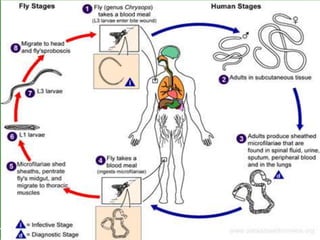
• Three species involved in the life cycle
include the parasite Loa loa, the fly vector,
and the human host:
– A vector fly bites an infected human host and
ingests microfilariae.
– Microfilariae move to the fat body of the insect
host.
– Microfilariae develop into first stage larvae,
second stage, then third stage larvae.
– Third stage larvae (infective) travel to the
proboscis of fly.
– An infected vector fly bites an uninfected
human host and the third stage larvae
penetrates the skin and enters human
subcutaneous tissue.
– Larvae mature into adults, who produce
microfilariae that have been found in spinal
fluid, urine, peripheral blood, and lungs
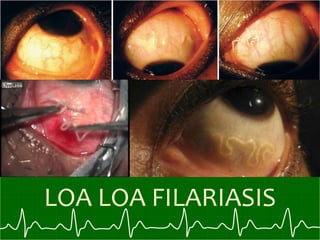
LOA LOA FILARIASIS
Loa Loa Filiriasis
•a skin and eye disease caused by
the nematode worm, loa loa.
•Humans contract this disease
through the bite of a Deer fly or
Mango fly (Chrysops spp),
the vectors for Loa loa.
Signs and symptoms
• The common symptoms include itching and
non-painful swelling around the joints. These
are called Calabar swellings. These are
caused by migration of the worm under the
skin. Also, the worm is visible when this
migration occurs under the surface of the
eye and so the name "Eye Worm".
Signs and symptoms
•There is redness, pain and itching in the
eye but does not result in any long term
symptoms.
•The patients may also experience hives,
itching, muscle pain and fatigue.
•Sometimes, it can cause swollen glands
and fluid collection around the lungs.
Transmission
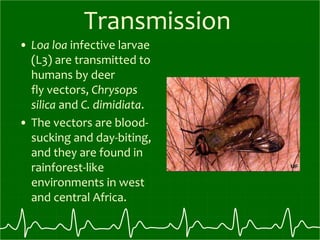
• Loa loa infective larvae
(L3) are transmitted to
humans by deer
fly vectors, Chrysops
silica and C. dimidiata.
• The vectors are blood-
sucking and day-biting,
and they are found in
rainforest-like
environments in west
and central Africa.
• Infective larvae (L3) mature to adults (L5) in
the subcutaneous tissues of the human host,
after which the adult worms—assuming
presence of a male and female worm—mate
and produce microfilaria.
• The cycle of infection continues when a non-
infected mango or deer fly takes a blood
meal from a microfilaremic human host, and
this stage of the transmission is possible due
to the combination of the diurnal periodicity
of microfilaria and the day-biting tendencies
of the Chrysops spp.
Reservoir
• Humans are the primary reservoir for Loa
loa.
• Other minor potential reservoirs have been
indicated in various fly biting habit studies:
hippopotamus, wild ruminants (e.g.,
buffalo), rodents, and lizards
Diagnosis
• Identification of microfilariae by microscopic
examination is a practical diagnostic
procedure.
• Examination of blood samples will allow
identification of microfilariae of Loa loa. It is
important to time the blood collection with the
known periodicity of the microfilariae. The
blood sample can be a thick smear, stained
with Giemsa or haematoxylin and eosin
Prevention
• Diethylcarbamazine has been shown as an
effective prophylaxis for Loa loa infection
• No vaccine has been developed for loiasis
and there is little report on this possibility.
Treatment
•Treatment of loiasis involves
chemotherapy or, in some cases,
surgical removal of adult worms
followed by systemic treatment.
• The current drug of choice for therapy is
diethylcarbamazine (DEC), though
ivermectin use is not unwarranted. The
recommend dosage of DEC is 6 mg/kg/d
taken three times daily for 12 days. The
pediatric dose is the same. DEC is effective
against microfilariae and somewhat
effective against macrofilariae (adult
worms)

Loa-Loa in Microbiology & Parasitology

  • 1.
  • 2.
    Loa-Loa • the filarialnematode (roundworm) species that causes Loa loa filariasis. • It is commonly known as the "eye worm". • Its geographic distribution includes Africa and India
  • 3.
    •L. loa isone of three parasitic filarial nematodes that cause subcutaneous filariasis in humans. •The two other filarial nematodes are Mansonella streptocerca and Onchocerca volvulus (causes river blindness).
  • 4.
    • Maturing larvaeand adults of the "eye worm" occupy the subcutaneous layer of the skin – the fat layer – of humans, causing disease.
  • 5.
    Morphology • Loa loaworms have a simple body including a head, body, and tail. • Males range from 20mm to 34mm long and 350μm to 430μm wide. Females range from 20mm to 70mm long and are about 425mm wide
  • 6.
    Life cycle • Threespecies involved in the life cycle include the parasite Loa loa, the fly vector, and the human host: – A vector fly bites an infected human host and ingests microfilariae. – Microfilariae move to the fat body of the insect host.
  • 7.
    – Microfilariae developinto first stage larvae, second stage, then third stage larvae. – Third stage larvae (infective) travel to the proboscis of fly. – An infected vector fly bites an uninfected human host and the third stage larvae penetrates the skin and enters human subcutaneous tissue.
  • 8.
    – Larvae matureinto adults, who produce microfilariae that have been found in spinal fluid, urine, peripheral blood, and lungs
  • 10.
  • 11.
    Loa Loa Filiriasis •askin and eye disease caused by the nematode worm, loa loa. •Humans contract this disease through the bite of a Deer fly or Mango fly (Chrysops spp), the vectors for Loa loa.
  • 12.
    Signs and symptoms •The common symptoms include itching and non-painful swelling around the joints. These are called Calabar swellings. These are caused by migration of the worm under the skin. Also, the worm is visible when this migration occurs under the surface of the eye and so the name "Eye Worm".
  • 13.
    Signs and symptoms •Thereis redness, pain and itching in the eye but does not result in any long term symptoms. •The patients may also experience hives, itching, muscle pain and fatigue. •Sometimes, it can cause swollen glands and fluid collection around the lungs.
  • 14.
    Transmission • Loa loainfective larvae (L3) are transmitted to humans by deer fly vectors, Chrysops silica and C. dimidiata. • The vectors are blood- sucking and day-biting, and they are found in rainforest-like environments in west and central Africa.
  • 15.
    • Infective larvae(L3) mature to adults (L5) in the subcutaneous tissues of the human host, after which the adult worms—assuming presence of a male and female worm—mate and produce microfilaria. • The cycle of infection continues when a non- infected mango or deer fly takes a blood meal from a microfilaremic human host, and this stage of the transmission is possible due to the combination of the diurnal periodicity of microfilaria and the day-biting tendencies of the Chrysops spp.
  • 16.
    Reservoir • Humans arethe primary reservoir for Loa loa. • Other minor potential reservoirs have been indicated in various fly biting habit studies: hippopotamus, wild ruminants (e.g., buffalo), rodents, and lizards
  • 17.
    Diagnosis • Identification ofmicrofilariae by microscopic examination is a practical diagnostic procedure. • Examination of blood samples will allow identification of microfilariae of Loa loa. It is important to time the blood collection with the known periodicity of the microfilariae. The blood sample can be a thick smear, stained with Giemsa or haematoxylin and eosin
  • 18.
    Prevention • Diethylcarbamazine hasbeen shown as an effective prophylaxis for Loa loa infection • No vaccine has been developed for loiasis and there is little report on this possibility.
  • 19.
    Treatment •Treatment of loiasisinvolves chemotherapy or, in some cases, surgical removal of adult worms followed by systemic treatment.
  • 20.
    • The currentdrug of choice for therapy is diethylcarbamazine (DEC), though ivermectin use is not unwarranted. The recommend dosage of DEC is 6 mg/kg/d taken three times daily for 12 days. The pediatric dose is the same. DEC is effective against microfilariae and somewhat effective against macrofilariae (adult worms)