Human Pinworm

ENTEROBIUS VERMICULARIS
 Causes enterobiasis or oxyuriasis
 Not fatal but worms might go beyond
  perianal region
 Intestinal nematode

 Meromyarian – in somatic muscles, there are
  two to five cells per dorsal or ventral half
PARASITE BIOLOGY
 Adults have cuticular alar expansions at the anterior
  and a prominent esophageal bulb
 Female has a long pointed tail and uteri is distended
  with eggs
 Males have a curved tail and a single spicule and
  because they
  die after copulation
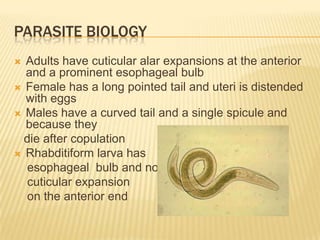
 Rhabditiform larva has
   esophageal bulb and no
   cuticular expansion
   on the anterior end
PARASITE BIOLOGY
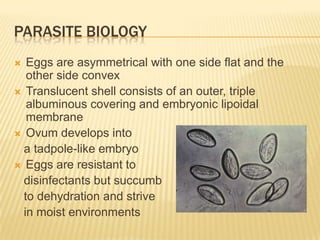
  Eggs are asymmetrical with one side flat and the
   other side convex
 Translucent shell consists of an outer, triple
   albuminous covering and embryonic lipoidal
   membrane
 Ovum develops into
  a tadpole-like embryo
 Eggs are resistant to
  disinfectants but succumb
  to dehydration and strive
  in moist environments
PATHOGENESIS AND CLINICAL MANIFESTATIONS

 An innocuous parasite, rarely produces
  serious lesions
 Attachment of worms=Mild catarrhal
  inflammation of the intestinal mucosa
 Mechanical irritation and secondary bacterial
  invasion= inflammation of the deeper layers
  of the intestines
 Migration of egg-laying females to the anus=
  irritation of perianal region
 Intense itching = secondary bacterial
  infection
 Pruritus= insomia

 Adult worm migration=
  appendicitis, endometritis, salpingitis and
  peritonitis
 Other signs: poor appetite, weight
  loss, irritability, grinding of teeth, abdominal
  pain
 Familial disease
DIAGNOSIS

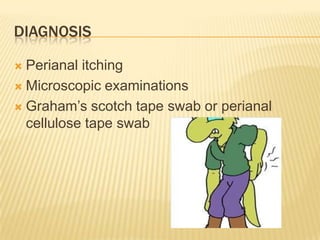
 Perianal itching
 Microscopic examinations

 Graham’s scotch tape swab or perianal
  cellulose tape swab
TREATMENT
 Pyarantel pamoate, albendazole, mebendazole
 Secondary dose may be necessary
 Cure only after seven perianal smears
 Egg reduction rate are hard to determine
  because eggs are from perianal area and not
  from feces
 Contradictions to drugs: pregnancy and
  hypersensitivity
 Effects of drugs: gastrointestinal distrubance,
  headache
EPIDEMIOLOGY

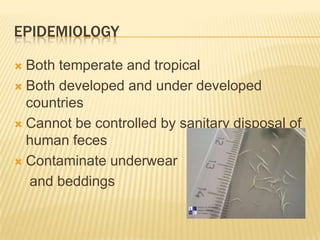
 Both temperate and tropical
 Both developed and under developed
  countries
 Cannot be controlled by sanitary disposal of
  human feces
 Contaminate underwear

   and beddings
EPIDEMIOLOGY

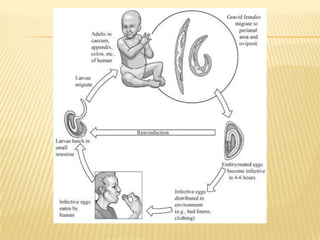
 route of infection: mouth, respiratory
   system -> anus
 Retroinfection: when they go back to large
  intestine
 208.8 million people are infected

 In Philippines: 29% schoolchildren from
  private schools; 56% from public school
EPIDEMIOLGY

 Prevalence is higher in females
 Eggs from nails

 Migration of female worms to perianal area
  during night time
PREVENTION AND CONTROL

 Personal cleanliness and hygeine
 Short nail

 Frequent handwashing
PREVENTION AND CONTROL

 Showers and not bath tubs
 Underwear, night clothes, blankets
  bedsheets- handled with care, boiled,
  laundered
 Chemotherapy for entire family
THE END :>

Enterobius vermicularis

  • 1.
  • 2.
     Causes enterobiasisor oxyuriasis  Not fatal but worms might go beyond perianal region  Intestinal nematode  Meromyarian – in somatic muscles, there are two to five cells per dorsal or ventral half
  • 3.
    PARASITE BIOLOGY  Adultshave cuticular alar expansions at the anterior and a prominent esophageal bulb  Female has a long pointed tail and uteri is distended with eggs  Males have a curved tail and a single spicule and because they die after copulation  Rhabditiform larva has esophageal bulb and no cuticular expansion on the anterior end
  • 4.
    PARASITE BIOLOGY  Eggs are asymmetrical with one side flat and the other side convex  Translucent shell consists of an outer, triple albuminous covering and embryonic lipoidal membrane  Ovum develops into a tadpole-like embryo  Eggs are resistant to disinfectants but succumb to dehydration and strive in moist environments
  • 6.
    PATHOGENESIS AND CLINICALMANIFESTATIONS  An innocuous parasite, rarely produces serious lesions  Attachment of worms=Mild catarrhal inflammation of the intestinal mucosa  Mechanical irritation and secondary bacterial invasion= inflammation of the deeper layers of the intestines  Migration of egg-laying females to the anus= irritation of perianal region
  • 7.
     Intense itching= secondary bacterial infection  Pruritus= insomia  Adult worm migration= appendicitis, endometritis, salpingitis and peritonitis  Other signs: poor appetite, weight loss, irritability, grinding of teeth, abdominal pain  Familial disease
  • 8.
    DIAGNOSIS  Perianal itching Microscopic examinations  Graham’s scotch tape swab or perianal cellulose tape swab
  • 9.
    TREATMENT  Pyarantel pamoate,albendazole, mebendazole  Secondary dose may be necessary  Cure only after seven perianal smears  Egg reduction rate are hard to determine because eggs are from perianal area and not from feces  Contradictions to drugs: pregnancy and hypersensitivity  Effects of drugs: gastrointestinal distrubance, headache
  • 10.
    EPIDEMIOLOGY  Both temperateand tropical  Both developed and under developed countries  Cannot be controlled by sanitary disposal of human feces  Contaminate underwear and beddings
  • 11.
    EPIDEMIOLOGY  route ofinfection: mouth, respiratory system -> anus  Retroinfection: when they go back to large intestine  208.8 million people are infected  In Philippines: 29% schoolchildren from private schools; 56% from public school
  • 12.
    EPIDEMIOLGY  Prevalence ishigher in females  Eggs from nails  Migration of female worms to perianal area during night time
  • 13.
    PREVENTION AND CONTROL Personal cleanliness and hygeine  Short nail  Frequent handwashing
  • 14.
    PREVENTION AND CONTROL Showers and not bath tubs  Underwear, night clothes, blankets bedsheets- handled with care, boiled, laundered  Chemotherapy for entire family
  • 15.