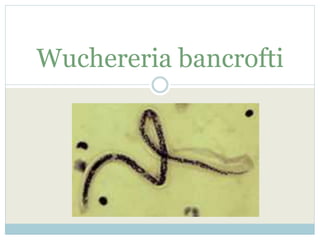
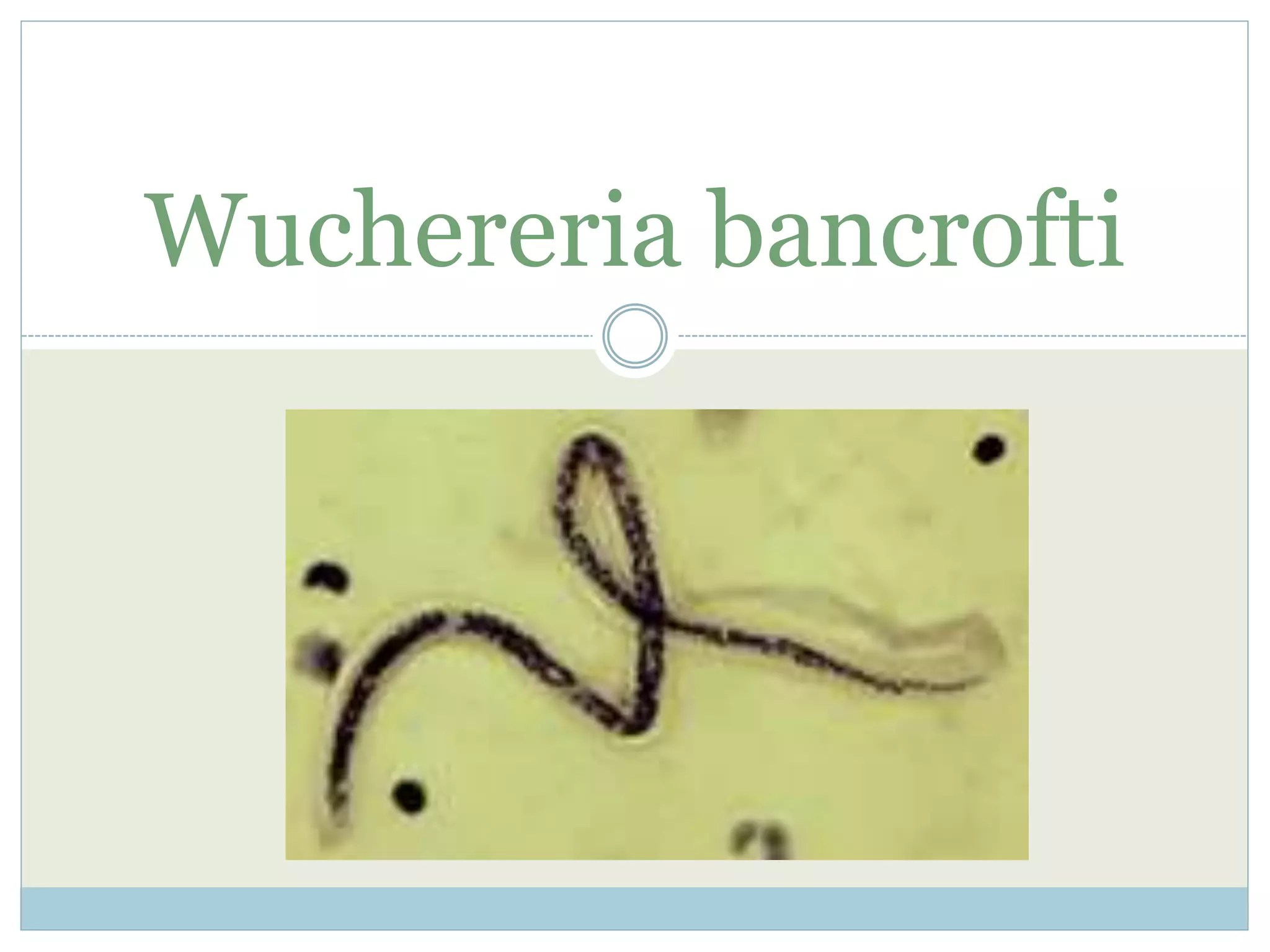
Wuchereria bancrofti
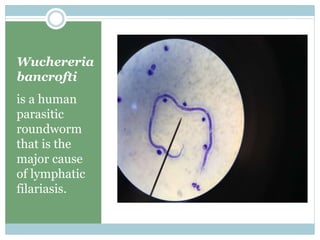
Wuchereria
bancrofti
is a human
parasitic
roundworm
that is the
major cause
of lymphatic
filariasis.
Superfamily: Filariodea
Subfamily: Acanthocheilonematinae
Genus: Wuchereria
Specie: W. bancrofti
Otto Wucherer Joseph Bancroft
W. bancrofti was named after physician Otto
Wucherer and parasitologist Joseph Bancroft.
Morphology
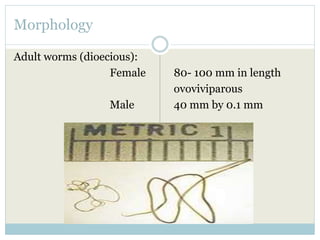
Adult worms (dioecious):
Female 80- 100 mm in length
ovoviviparous
Male 40 mm by 0.1 mm
Morphology
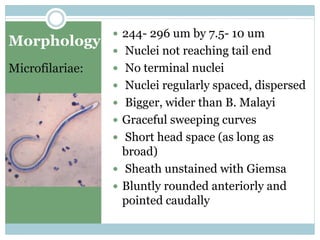
Microfilariae:
 244- 296 um by 7.5- 10 um
 Nuclei not reaching tail end
 No terminal nuclei
 Nuclei regularly spaced, dispersed
 Bigger, wider than B. Malayi
 Graceful sweeping curves
 Short head space (as long as
broad)
 Sheath unstained with Giemsa
 Bluntly rounded anteriorly and
pointed caudally
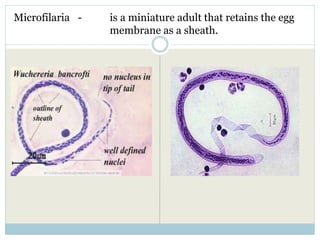
Microfilaria - is a miniature adult that retains the egg
membrane as a sheath.
Characteristics
Habitat of Adult worm : Lymphatic system
Habitat of Microfilaria: Blood
Intermediate Host : Anopheles minimus
var. Flavirostris
- principal vector for malaria in
Philippines
- bite indoors, night- biters
Others: Aedes poecilus ( in axils of plants)
Definitive Host : Man
Characteristics
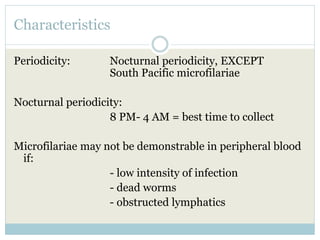
Periodicity: Nocturnal periodicity, EXCEPT
South Pacific microfilariae
Nocturnal periodicity:
8 PM- 4 AM = best time to collect
Microfilariae may not be demonstrable in peripheral blood
if:
- low intensity of infection
- dead worms
- obstructed lymphatics
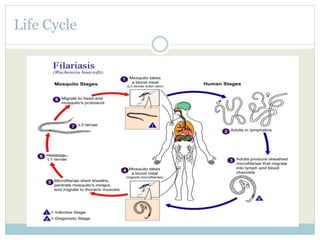
Life Cycle
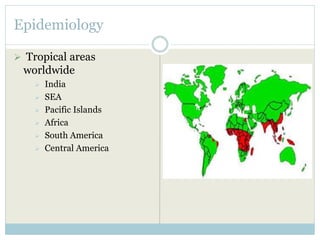
Epidemiology
 Tropical areas
worldwide
 India
 SEA
 Pacific Islands
 Africa
 South America
 Central America
Epidemiology
 Philippines
 Camarines Sur/ Norte
 Albay
 Sorsogon
 Mindoro
 Masbate
 Romblon
 Marinduque
 Bohol
 Samar
 Leyte
 Palawan
 Mountain Province
 All provinces of Mindanao
Pathogenesis
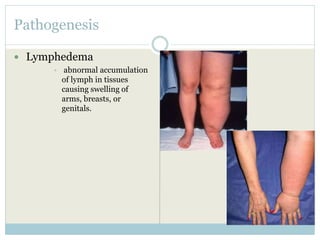
 Lymphedema
• abnormal accumulation
of lymph in tissues
causing swelling of
arms, breasts, or
genitals.
Pathogenesis
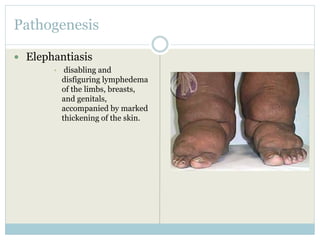
 Elephantiasis
• disabling and
disfiguring lymphedema
of the limbs, breasts,
and genitals,
accompanied by marked
thickening of the skin.
Pathogenesis
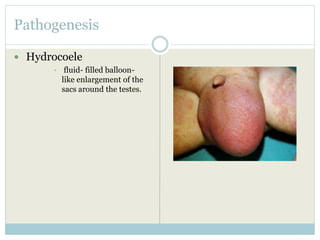
 Hydrocoele
• fluid- filled balloon-
like enlargement of the
sacs around the testes.
Diagnosis
 Direct methods (visualization of larval stage or
microfilaria and adult worm)
Microfilaria can be seen on peripheral blood or other body fluids (eg.
urine, ascitic, hydrocoele, or lymph fluid).
 Wet smear examination under the microscope where motility
can also be seen
 Examination of stained peripheral blood smear which is also
useful in species identification based on morphologic features
of organism, especially the tail end
 Thick or concentrated blood smears
 concentration smears are useful in patients with low parasetimia
 blood sample is taken during the period in the day when the
juveniles are in the peripheral circulation.
Diagnosis
 Direct Methods
 X- ray
 adult worms can be demonstrated in lymph node biopsy
 calcified adult worms are visualized
 Doppler Ultrasonography
 detect presence of motile adult worms in dilated lymphatics
Diagnosis
 Indirect Methods
 Peripheral blood eosinophilia
 Elevated serum IgE concentration
 Presence of antifilarial serum antibody
 Intradermal complement fixation tests
Treatment
 diethylcarbamazine (DEC)
 ivermectin
 oralbendazole
Prevention and Control
 Insect repellants
 Use of mosquito nets
 Public education
END

Wuchereria bancrofti