Onchocerca volvulus
GROUP 7
Musah Mohammed (PS/LBT/13/0027)
Macben Denchie (PS/LBT/13/0018)
Ebenezer Tetteh (PS/LBT/13/0008)
TABLE OF CONTENTS
 TAXONOMY
 MORPHOLOGY
 EPIDEMIOLOGY AND GEOGRAPHICAL
DISTRIBUTION
 LIFE CYCLE
 CLINICAL MANIFESTATION
 DIAGNOSIS
 TREATMENT
 PREVENTION
 SOURCES
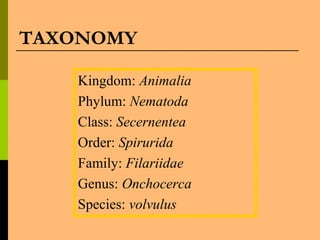
TAXONOMY
Kingdom: Animalia
Phylum: Nematoda
Class: Secernentea
Order: Spirurida
Family: Filariidae
Genus: Onchocerca
Species: volvulus
MORPHOLOGY
 Onchocerca volvulus is a filarial worm that
causes onchocerciasis
 Has a five-stage life cycle; 4 larval stages
and an adult stage
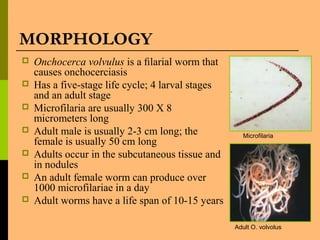
 Microfilaria are usually 300 X 8
micrometers long
 Adult male is usually 2-3 cm long; the
female is usually 50 cm long
 Adults occur in the subcutaneous tissue and
in nodules
 An adult female worm can produce over
1000 microfilariae in a day
 Adult worms have a life span of 10-15 years
Adult O. volvolus
Microfilaria
EPIDEMIOLOGY AND
GEOGRAPHICAL DISTRIBUTION
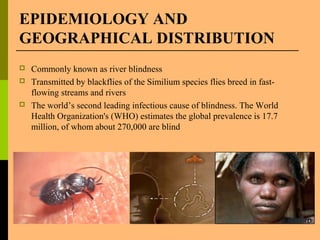
 Commonly known as river blindness
 Transmitted by blackflies of the Similium species flies breed in fast-
flowing streams and rivers
 The world’s second leading infectious cause of blindness. The World
Health Organization's (WHO) estimates the global prevalence is 17.7
million, of whom about 270,000 are blind
 Predominantly located in rural agricultural villages located
near rapidly flowing streams
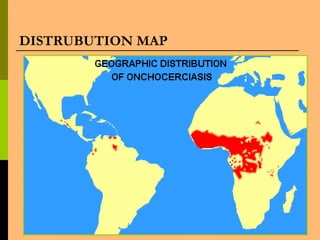
 Tropical Africa between the 15° north and the 13° south (high
endemicity in Burkina Faso and Ghana)
 Foci are present in Southern Arabia, Yemen and in America
(Mexico, Guatemala, Colombia, Ecuador, Brazil, Venezuela)
 In Ghana Onchocerciasis has an estimated at risk population
of 3,400,000 in 3204 communities in 66 endemic districts in
nine out of ten regions. Greater Accra Region the only region
that is not endemic for Onchocerciasis.
CONTINUATION
DISTRUBUTION MAP
LIFE CYCLE
 Similium fly ingest microfilariae during feeds
 Microfilariae undergoes development in the fly
 Development in the fly takes about 15 days
 Larval forms are transmitted to humans during feeds
 The larva migrates to the subcutaneous tissue of the new host
 They mature into adult worms over six to twelve months
 Mature adult worms mate in the subcutaneous tissue
producing microfilaria
 Microfilaria migrate to the skin where they are fed on by the
Similium flies
 The cycle then starts again
CONTINUATION
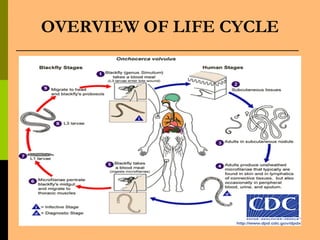
OVERVIEW OF LIFE CYCLE
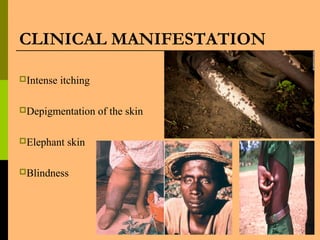
CLINICAL MANIFESTATION
Intense itching
Depigmentation of the skin
Elephant skin
Blindness
DIAGNOSIS
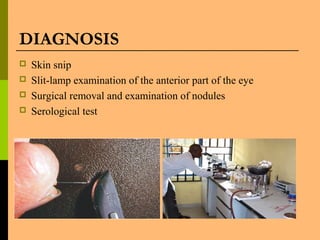
 Skin snip
 Slit-lamp examination of the anterior part of the eye
 Surgical removal and examination of nodules
 Serological test
TREATMENT
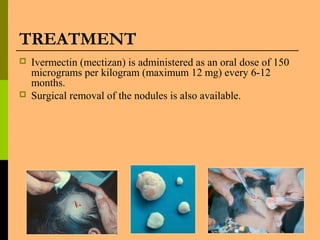
 Ivermectin (mectizan) is administered as an oral dose of 150
micrograms per kilogram (maximum 12 mg) every 6-12
months.
 Surgical removal of the nodules is also available.
PREVENTION
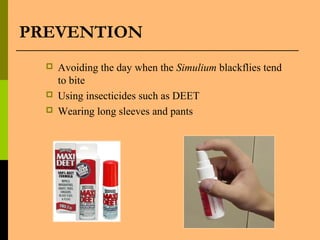
 Avoiding the day when the Simulium blackflies tend
to bite
 Using insecticides such as DEET
 Wearing long sleeves and pants
SOURCES
Centers for Disease Control and Prevention. (2011). Onchocerciasis: Prevention and
Control. http://www.cdc.gov/parasites/onchocerciasis/prevention.html
Levine, R. (2007). Controlling Onchocerciasis (River Blindness) in Sub-Saharan Africa. In
Series Editor: Richard Riegelman. Case Studies in Global Health: Millions saved, 49-56.
Sudbury, Massachusetts: Jones and Bartlett.
Lucas, A., & Gills, H. (1990). A new short textbook of preventive medicine for the tropics.
(3rd ed.). Kent, UK: Edward Arnold
World Health Organization. (2011). Onchocerciasis disease information: Prevention of
Blindness and visual impairment.
fromhttp://www.who.int/blindness/partnerships/onchocerciasis_disease_information/en
/index.html
www.moh-ghana.org/
Onchocerca volvulus

Onchocerca volvulus

  • 1.
    Onchocerca volvulus GROUP 7 MusahMohammed (PS/LBT/13/0027) Macben Denchie (PS/LBT/13/0018) Ebenezer Tetteh (PS/LBT/13/0008)
  • 2.
    TABLE OF CONTENTS TAXONOMY  MORPHOLOGY  EPIDEMIOLOGY AND GEOGRAPHICAL DISTRIBUTION  LIFE CYCLE  CLINICAL MANIFESTATION  DIAGNOSIS  TREATMENT  PREVENTION  SOURCES
  • 3.
    TAXONOMY Kingdom: Animalia Phylum: Nematoda Class:Secernentea Order: Spirurida Family: Filariidae Genus: Onchocerca Species: volvulus
  • 4.
    MORPHOLOGY  Onchocerca volvulusis a filarial worm that causes onchocerciasis  Has a five-stage life cycle; 4 larval stages and an adult stage  Microfilaria are usually 300 X 8 micrometers long  Adult male is usually 2-3 cm long; the female is usually 50 cm long  Adults occur in the subcutaneous tissue and in nodules  An adult female worm can produce over 1000 microfilariae in a day  Adult worms have a life span of 10-15 years Adult O. volvolus Microfilaria
  • 5.
    EPIDEMIOLOGY AND GEOGRAPHICAL DISTRIBUTION Commonly known as river blindness  Transmitted by blackflies of the Similium species flies breed in fast- flowing streams and rivers  The world’s second leading infectious cause of blindness. The World Health Organization's (WHO) estimates the global prevalence is 17.7 million, of whom about 270,000 are blind
  • 6.
     Predominantly locatedin rural agricultural villages located near rapidly flowing streams  Tropical Africa between the 15° north and the 13° south (high endemicity in Burkina Faso and Ghana)  Foci are present in Southern Arabia, Yemen and in America (Mexico, Guatemala, Colombia, Ecuador, Brazil, Venezuela)  In Ghana Onchocerciasis has an estimated at risk population of 3,400,000 in 3204 communities in 66 endemic districts in nine out of ten regions. Greater Accra Region the only region that is not endemic for Onchocerciasis. CONTINUATION
  • 7.
  • 8.
    LIFE CYCLE  Similiumfly ingest microfilariae during feeds  Microfilariae undergoes development in the fly  Development in the fly takes about 15 days  Larval forms are transmitted to humans during feeds  The larva migrates to the subcutaneous tissue of the new host
  • 9.
     They matureinto adult worms over six to twelve months  Mature adult worms mate in the subcutaneous tissue producing microfilaria  Microfilaria migrate to the skin where they are fed on by the Similium flies  The cycle then starts again CONTINUATION
  • 10.
  • 11.
    CLINICAL MANIFESTATION Intense itching Depigmentationof the skin Elephant skin Blindness
  • 12.
    DIAGNOSIS  Skin snip Slit-lamp examination of the anterior part of the eye  Surgical removal and examination of nodules  Serological test
  • 13.
    TREATMENT  Ivermectin (mectizan)is administered as an oral dose of 150 micrograms per kilogram (maximum 12 mg) every 6-12 months.  Surgical removal of the nodules is also available.
  • 14.
    PREVENTION  Avoiding theday when the Simulium blackflies tend to bite  Using insecticides such as DEET  Wearing long sleeves and pants
  • 15.
    SOURCES Centers for DiseaseControl and Prevention. (2011). Onchocerciasis: Prevention and Control. http://www.cdc.gov/parasites/onchocerciasis/prevention.html Levine, R. (2007). Controlling Onchocerciasis (River Blindness) in Sub-Saharan Africa. In Series Editor: Richard Riegelman. Case Studies in Global Health: Millions saved, 49-56. Sudbury, Massachusetts: Jones and Bartlett. Lucas, A., & Gills, H. (1990). A new short textbook of preventive medicine for the tropics. (3rd ed.). Kent, UK: Edward Arnold World Health Organization. (2011). Onchocerciasis disease information: Prevention of Blindness and visual impairment. fromhttp://www.who.int/blindness/partnerships/onchocerciasis_disease_information/en /index.html www.moh-ghana.org/

Editor's Notes

  • #5 Picture of Onchocerca volvulus.
  • #6 blackfly
  • #11 This diagram shows the full lifecycle of Onchocerca volvulus
  • #17 I hope you found the presentation useful, and thank you all very much for attending and listening to me