DRACUNCULIASIS
MODERATED BY: Dr. ROHUL JABEEN SHAH
S.R. INCHARGE : Dr. FEROZ AHMAD WANI
PRESENTED BY : Dr. UROOSA FAROOQ
TABLE OF CONTENTS:
1.Definitions
2.Introduction
3.Problem statement
4.Epidemiology
5.Life cycle of Guinea worm
6.Clinical features
7.Preventive measures
8.Treatment
9.National Guinea worm Eradication Programme
CONTROL :The reduction of disease
incidence, prevalence, morbidity or
mortality to a locally acceptable level
as a result of deliberate efforts;
continued intervention measures are
required to maintain the reduction.
e.g., diarrhoeal diseases.
 ELIMINATION OF DISEASE :
Reduction to zero of the incidence of
a specified disease in a defined
geographical area as a result of
deliberate efforts; continued
intervention measures are required.
e.g., neonatal tetanus.
ELIMINATION OF INFECTIONS:
Reduction to zero of the incidence of
infection caused by a specific agent in a
defined geographical area as a result of
deliberate efforts; continued measures
to prevent re-establishment of
transmission are required. e.g.,
measles, poliomyelitis, guinea worm and
diphtheria.
ERADICATION: Permanent reduction
to zero of the worldwide incidence of
infection caused by a specific agent as a
result of deliberate efforts;
intervention measures are no longer
needed. e.g., smallpox.
EXTINCTION: The specific infectious
agent no longer exists in nature or in
the laboratory.
ERADICATED DISEASES:
Small pox
Rinderpest
GLOBAL ERADICATION UNDERWAY:
 Polio
 Dracunculiasis
 Yaws
 Malaria
REGIONAL ELIMINATION ESTABLISHED
OR UNDER WAY:
 Hookworm
 Measles
 Rubella
 Onchocerciasis
 Syphilis
 Rabies
 Filariasis
INTRODUCTION
DRACUNCULIASIS :
 Also known as guinea worm disease.
 Vector borne parasitic disease.
 Involves subcutaneous tissues(leg and
foot).
 Caused by nematode parasite,
Dracunculus medinensis.
 Its not lethal but disable its victim
temporarily.
Transmitted exclusively when people
drink stagnant water contaminated with
parasite infected water fleas.
 It affects people in rural, deprived and
isolated communities who depend
mainly on open surface water sources
such as ponds and wells.
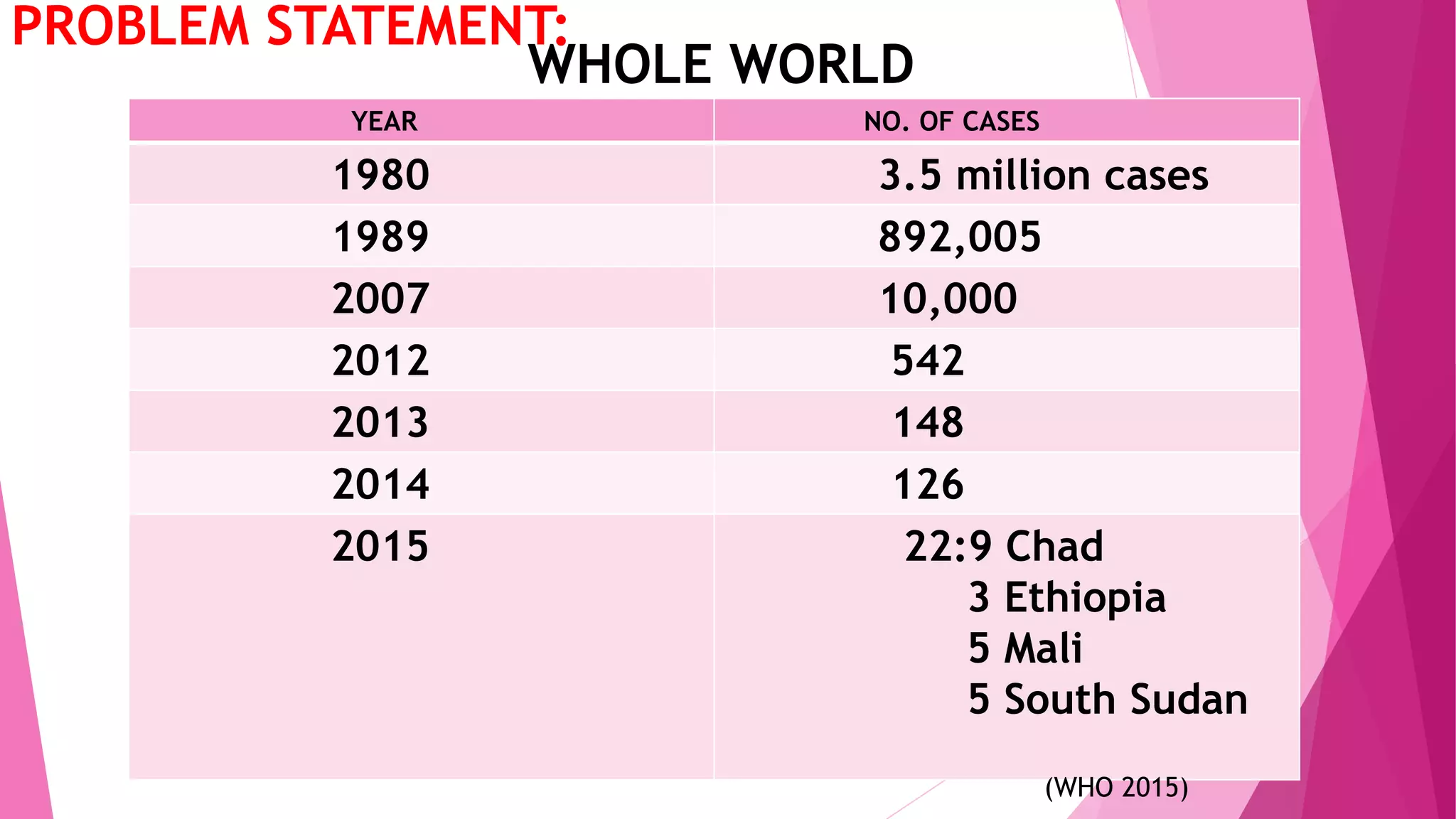
YEAR NO. OF CASES
1980 3.5 million cases
1989 892,005
2007 10,000
2012 542
2013 148
2014 126
2015 22:9 Chad
3 Ethiopia
5 Mali
5 South Sudan
PROBLEM STATEMENT:
WHOLE WORLD
(WHO 2015)
In India, the last case was
reported in july 1996.
On completion of three years
of zero incidence, India was
declared free of guineaworm
disdease.
EPIDEMIOLOGY:
AGENT :Dracunculus medinensis
 It is a round worm
 Also called serpent/medina/Thread
worm.
 Adult parasite inhabits subcutaneous
tissue mainly of legs but other parts
are also included like head and neck.
 Female worm is 55 to 120cm long as
compare to male 2 to 3cm long.
HOST FACTORS:
 Man is the definitive host.
 Multiple and repeated infections
may occur in the same individual.
 Habit of washing and bathing in
surface water and using step-well
makes them prone to infection.
ENVIRONMENTAL FACTORS:
 SEASON : Where the step-wells are
the source of water supply, peak
transmission occurs during the dry
season(March-May) when the contact
between open cases of gunieaworm
disease and the drinking water is the
greatest.
Where ponds are used transmission
occurs when ponds are full during
June-September.
TEMPERATURE:
Larvae develop best between 25 and
30 deg C and will not develop below 19
deg C.
Disease is limited to tropical and
subtropical regions.
LIFE CYCLE OF DRACUNCULIASI
 Gravid female goes down infected
persons lower limb near skin
surface.
Worm penetrates into the dermis
and induces an inflammatory
reaction and blister formation.
Upon contact with water the
worm bursts releases up to 1
million microscopic, free
swimming larva in water.
Larvae remain active in water
for 3-6 days.
Fresh water crustacean called
cyclops take these larvae.
Larvae require 15 days for
their development in these
cyclops.
Cyclops act as INTERMEDIATE
HOST.
Man acquires infection by
drinking water containing
infected cyclops.
In human body digested by
gastric juice, parasites are
released.
These parasites can penetrate
the duodenal wall.
Migrate through the viscera to
the subcutaneous tissues of
various parts of the body.
Grow into adult worms in 10-14
months.
SIGN/SYMPTOMS :
 Intense burning pain localized to
path of travel of worm(the fiery
serpent).
 Fever
 Nausea
 Vomiting
 Allergic reaction
 Arthritis and paralysis (due to
death of adult worm in joint).
 Skin blisters , which when
rupture form ulcers.
 Adult worms protrude from these
ulcers.
MODE OF TRANSMISSION:
 Disease is transmitted entirely
through the consumption of
water containing cyclops
harboring the infective stage of
the parasite.
 Guinea worm disease is a totally
water-based disease.
PREVENTION: Two preventive measures
are:
1.Prevent people from drinking
contaminated water containing the
cyclops which can be seen in clear water
as swimming white specks . This can be
done by using:
 Piped water
 Water from borehole
Boiled water.
Filter all drinking water , using a fine-
mesh cloth filter to remove the guinea
worm containing crustaceans.
Filter the water through ceramic or
sand filters.
Treat water sources with larvicides to
kill the water fleas.
2.Prevent people with emerging Guinea
worms from wading into water sources
used for drinking:
Community-level case detection and
containment is key. Staff must go door
to door looking for cases, and
population must be willing to help and
not hide their cases.
Immerse emerging worms in buckets of
water to reduce the number of larvae in
those worms and discard this water on
dry ground.
Guard local water sources to prevent
people with emerging worms from
entering.
TREATMENT:
 No drug cures the infection but
metronidazole and mebendazole
are sometimes used to limit
inflammation and facilitate worm
removal.
 Wet compressions relieve
discomfort.
 Occlusive dressings improve
hygiene and limit shedding of
infectious larvae.
Worms are removed by
sequentially rolling them out over a
small stick. ‘ROD OF ASCLEPIUS”
Simple surgical procedure can
be used for removal of worms.
Topical antibiotics may limit
bacterial superinfection.
NATIONAL GUINEAWORM
ERADICATION PROGRAMME
India launched its National
Guineaworm Eradication
Programme in 1984 with
technical assistance from WHO.
The country has reported zero
case since August 1996.
In February 2000, the
International Commission for
the Certification of
Dracunculiasis Eradication Team
Geneva recommended that
India be certified free of
dracunculiasis transmission.
Following activities are
continuing as per
recommendations of ICCDE:
Health education activities with
special emphasis on school children
and women in rural areas.
Rumour registration and rumour
investigation.
Maintenance of guineaworm
disease on list of notifiable disease
and continuation of surveillance in
previously infected areas.
Careful supervision of the
functioning of hand pumps and
other sources of safe drinking
water.
Dracunculiasis

Dracunculiasis

  • 1.
    DRACUNCULIASIS MODERATED BY: Dr.ROHUL JABEEN SHAH S.R. INCHARGE : Dr. FEROZ AHMAD WANI PRESENTED BY : Dr. UROOSA FAROOQ
  • 2.
    TABLE OF CONTENTS: 1.Definitions 2.Introduction 3.Problemstatement 4.Epidemiology 5.Life cycle of Guinea worm 6.Clinical features 7.Preventive measures 8.Treatment 9.National Guinea worm Eradication Programme
  • 3.
    CONTROL :The reductionof disease incidence, prevalence, morbidity or mortality to a locally acceptable level as a result of deliberate efforts; continued intervention measures are required to maintain the reduction. e.g., diarrhoeal diseases.
  • 4.
     ELIMINATION OFDISEASE : Reduction to zero of the incidence of a specified disease in a defined geographical area as a result of deliberate efforts; continued intervention measures are required. e.g., neonatal tetanus.
  • 5.
    ELIMINATION OF INFECTIONS: Reductionto zero of the incidence of infection caused by a specific agent in a defined geographical area as a result of deliberate efforts; continued measures to prevent re-establishment of transmission are required. e.g., measles, poliomyelitis, guinea worm and diphtheria.
  • 6.
    ERADICATION: Permanent reduction tozero of the worldwide incidence of infection caused by a specific agent as a result of deliberate efforts; intervention measures are no longer needed. e.g., smallpox. EXTINCTION: The specific infectious agent no longer exists in nature or in the laboratory.
  • 7.
    ERADICATED DISEASES: Small pox Rinderpest GLOBALERADICATION UNDERWAY:  Polio  Dracunculiasis  Yaws  Malaria
  • 8.
    REGIONAL ELIMINATION ESTABLISHED ORUNDER WAY:  Hookworm  Measles  Rubella  Onchocerciasis  Syphilis  Rabies  Filariasis
  • 9.
  • 10.
    DRACUNCULIASIS :  Alsoknown as guinea worm disease.  Vector borne parasitic disease.  Involves subcutaneous tissues(leg and foot).  Caused by nematode parasite, Dracunculus medinensis.  Its not lethal but disable its victim temporarily.
  • 11.
    Transmitted exclusively whenpeople drink stagnant water contaminated with parasite infected water fleas.  It affects people in rural, deprived and isolated communities who depend mainly on open surface water sources such as ponds and wells.
  • 12.
    YEAR NO. OFCASES 1980 3.5 million cases 1989 892,005 2007 10,000 2012 542 2013 148 2014 126 2015 22:9 Chad 3 Ethiopia 5 Mali 5 South Sudan PROBLEM STATEMENT: WHOLE WORLD (WHO 2015)
  • 14.
    In India, thelast case was reported in july 1996. On completion of three years of zero incidence, India was declared free of guineaworm disdease.
  • 15.
  • 16.
    AGENT :Dracunculus medinensis It is a round worm  Also called serpent/medina/Thread worm.  Adult parasite inhabits subcutaneous tissue mainly of legs but other parts are also included like head and neck.  Female worm is 55 to 120cm long as compare to male 2 to 3cm long.
  • 17.
    HOST FACTORS:  Manis the definitive host.  Multiple and repeated infections may occur in the same individual.  Habit of washing and bathing in surface water and using step-well makes them prone to infection.
  • 18.
    ENVIRONMENTAL FACTORS:  SEASON: Where the step-wells are the source of water supply, peak transmission occurs during the dry season(March-May) when the contact between open cases of gunieaworm disease and the drinking water is the greatest.
  • 19.
    Where ponds areused transmission occurs when ponds are full during June-September. TEMPERATURE: Larvae develop best between 25 and 30 deg C and will not develop below 19 deg C. Disease is limited to tropical and subtropical regions.
  • 20.
    LIFE CYCLE OFDRACUNCULIASI
  • 22.
     Gravid femalegoes down infected persons lower limb near skin surface. Worm penetrates into the dermis and induces an inflammatory reaction and blister formation.
  • 23.
    Upon contact withwater the worm bursts releases up to 1 million microscopic, free swimming larva in water. Larvae remain active in water for 3-6 days.
  • 24.
    Fresh water crustaceancalled cyclops take these larvae. Larvae require 15 days for their development in these cyclops. Cyclops act as INTERMEDIATE HOST.
  • 25.
    Man acquires infectionby drinking water containing infected cyclops. In human body digested by gastric juice, parasites are released.
  • 26.
    These parasites canpenetrate the duodenal wall. Migrate through the viscera to the subcutaneous tissues of various parts of the body. Grow into adult worms in 10-14 months.
  • 27.
    SIGN/SYMPTOMS :  Intenseburning pain localized to path of travel of worm(the fiery serpent).  Fever  Nausea  Vomiting  Allergic reaction
  • 28.
     Arthritis andparalysis (due to death of adult worm in joint).  Skin blisters , which when rupture form ulcers.  Adult worms protrude from these ulcers.
  • 29.
    MODE OF TRANSMISSION: Disease is transmitted entirely through the consumption of water containing cyclops harboring the infective stage of the parasite.  Guinea worm disease is a totally water-based disease.
  • 30.
    PREVENTION: Two preventivemeasures are: 1.Prevent people from drinking contaminated water containing the cyclops which can be seen in clear water as swimming white specks . This can be done by using:  Piped water  Water from borehole
  • 31.
    Boiled water. Filter alldrinking water , using a fine- mesh cloth filter to remove the guinea worm containing crustaceans. Filter the water through ceramic or sand filters. Treat water sources with larvicides to kill the water fleas.
  • 32.
    2.Prevent people withemerging Guinea worms from wading into water sources used for drinking: Community-level case detection and containment is key. Staff must go door to door looking for cases, and population must be willing to help and not hide their cases.
  • 33.
    Immerse emerging wormsin buckets of water to reduce the number of larvae in those worms and discard this water on dry ground. Guard local water sources to prevent people with emerging worms from entering.
  • 34.
    TREATMENT:  No drugcures the infection but metronidazole and mebendazole are sometimes used to limit inflammation and facilitate worm removal.  Wet compressions relieve discomfort.
  • 35.
     Occlusive dressingsimprove hygiene and limit shedding of infectious larvae. Worms are removed by sequentially rolling them out over a small stick. ‘ROD OF ASCLEPIUS”
  • 36.
    Simple surgical procedurecan be used for removal of worms. Topical antibiotics may limit bacterial superinfection.
  • 39.
  • 40.
    India launched itsNational Guineaworm Eradication Programme in 1984 with technical assistance from WHO. The country has reported zero case since August 1996.
  • 41.
    In February 2000,the International Commission for the Certification of Dracunculiasis Eradication Team Geneva recommended that India be certified free of dracunculiasis transmission.
  • 42.
    Following activities are continuingas per recommendations of ICCDE: Health education activities with special emphasis on school children and women in rural areas. Rumour registration and rumour investigation.
  • 43.
    Maintenance of guineaworm diseaseon list of notifiable disease and continuation of surveillance in previously infected areas. Careful supervision of the functioning of hand pumps and other sources of safe drinking water.