The Roundworms
All are parasitic

11 known species compromise the genus

2 main clades
  1. Encapsulated
         species in which the host muscle cells they invade
          become surrounded by a collagen capsule
   2. Non-encapsulated
         no encapsulation occurs in the host muscle
   The five species (and three genotypes yet to be
    defined taxonomically) that comprise the
    encapsulated clade parasitize only mammals
   Three species comprise the non-capsulated clade
   One infects mammals and birds
   Other two species infects mammals and reptiles
   There are only two of these parasites, T.
    papuae and T. zimbabwensis, known to complete
    their entire life cycle independently of whether the
    host is warm-blooded or cold-blooded
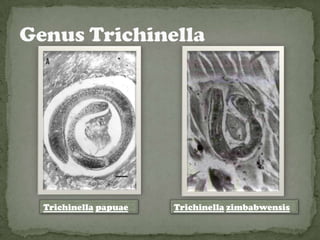
Trichinella papuae   Trichinella zimbabwensis
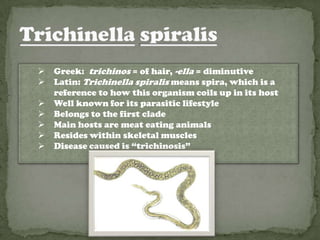
   Greek: trichinos = of hair, -ella = diminutive
   Latin: Trichinella spiralis means spira, which is a
    reference to how this organism coils up in its host
   Well known for its parasitic lifestyle
   Belongs to the first clade
   Main hosts are meat eating animals
   Resides within skeletal muscles
   Disease caused is “trichinosis”
   Buccal cavity
     one of the most important structures for
       adaptation developed
     Has a very similar function to our mouth
     Contains teeth to help the organism to adhere to
       the substrate
     Supplies the organism with a place to take up
       nutrients from its surroundings
   Hydrostatic skeleton
     Helps with movement
   Tail
     Helps in locomotion
     Supplies a place for claudal glands
         responsible for secreting an adhesive mucus
           that helps this organism stick to the substrate
           of interest
   Amphids
     Specialized sensing structures
     Located on the lateral sides of the head
     Gives the organism the ability to sense and then
        adapt to their surroundings
   Simple nervous system
     Consists of dorsal and ventral nerve cords
     allows them to interpret information coming
       from their sensory organs such as the amphids
     Enables them to react to their environment better
       and have an increased chance of survival
   Cuticle
     located on the external aspect of the worm
     is shed off to allow these organisms to grow and
       develop
     larger body size all results in a discount
       metabolic rate per gram of tissue
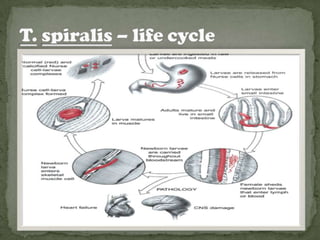
   Encysted nematode is ingested
   Travel to the stomach to be digested
   digestive functions of the stomach allow the
    nematodes to change from their encysted to their
    active forms
   Molts four times for the first 34 hours
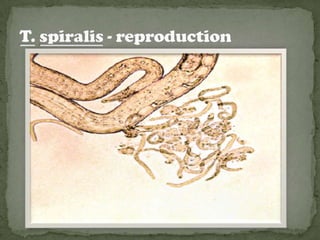
   Female releases pheromones to attract the male
   Male coils itself around the females genitals
   Male then inserts its spicule/s into female’s genitals
    where the amoeboid sperms will crawl
   When eggs are fertilized, the mother will not release
    the eggs unless they have hatched within its uterus
     Usually the 5th or 6th day of infection
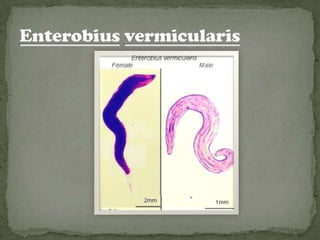
   Greek: enteron = intestine, bios = life
   Has the broadest geographic range of any helminth
   Small, white, and thread-like
   Females: ranging between 8-13 mm x 0.3-0.5 mm
     Possess a long pin-shape posterior end
   Males: ranging between 2-5 mm x 0.1-0.2 mm
   Dwells primarily in the cecum of the large intestine
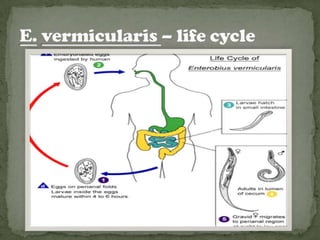
   Females migrate at night to lay 15,000 eggs on the
    perineum
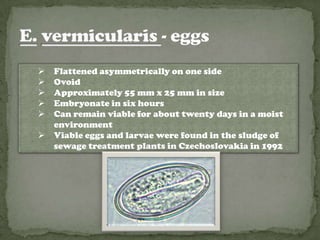
   Flattened asymmetrically on one side
   Ovoid
   Approximately 55 mm x 25 mm in size
   Embryonate in six hours
   Can remain viable for about twenty days in a moist
    environment
   Viable eggs and larvae were found in the sludge of
    sewage treatment plants in Czechoslovakia in 1992
   High prevalence in countries with a temperate
    climate
   approximately 200 million people are infected
    internationally
   The most common intestinal parasite
   Serves as an exception to the general rule that
    intestinal parasites are uncommon in affluent
    societies
   Does not need to rely on a vector for transmission
   Infection usually occurs via ingestion of infectious
    eggs by direct anus-to-mouth transfer by fingers
   Scotch tape test
     Most common test
     A clear adhesive cellulose tape is applied to the
       anal area early in the morning before bathing or
       defecation
     It is then observed under the microscope for the
       presence of eggs
     These eggs may also be stained blue with
       lactophenol cotton blue, which aids in detection
       and identification
     Sensitivity of this test when performed for three
       consecutive mornings is 90%
   Bathe when you wake up to help reduce the egg
    contamination
   Change and wash your underwear each day.
    Frequent changing of night clothes are recommended
   Change underwear, night clothes, and sheets after
    each treatment. Because the eggs are sensitive to
    sunlight, open blinds or curtains in bedrooms during
    the day
   Personal hygiene should include washing hands after
    going to the toilet, before eating and after changing
    diapers
   Trim fingernails short
   Discourage nail-biting and scratching bare anal areas.
    These practices help reduce the risk of continuous
    self reinfection
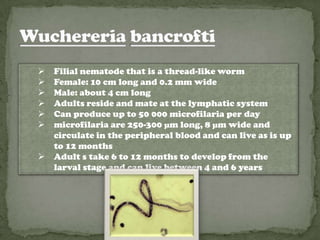
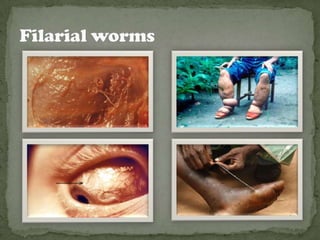
   Filial nematode that is a thread-like worm
   Female: 10 cm long and 0.2 mm wide
   Male: about 4 cm long
   Adults reside and mate at the lymphatic system
   Can produce up to 50 000 microfilaria per day
   microfilaria are 250-300 µm long, 8 µm wide and
    circulate in the peripheral blood and can live as is up
    to 12 months
   Adult s take 6 to 12 months to develop from the
    larval stage and can live between 4 and 6 years
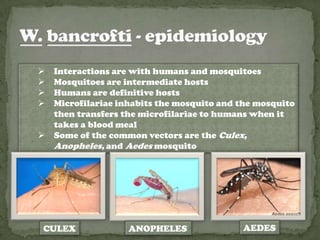
   Interactions are with humans and mosquitoes
   Mosquitoes are intermediate hosts
   Humans are definitive hosts
   Microfilariae inhabits the mosquito and the mosquito
    then transfers the microfilariae to humans when it
    takes a blood meal
   Some of the common vectors are the Culex,
    Anopheles, and Aedes mosquito


CULEX               ANOPHELES               AEDES
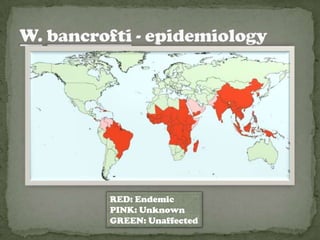
RED: Endemic
PINK: Unknown
GREEN: Unaffected
   This disease is transferred by mosquitoes and is
    found mainly in the tropics and sub-tropics
   Very rarely found in Western countries
   Onset of symptoms is usually slow, but after a couple
    of years, the lymphatic system will no longer work
    like it should
   Lymph nodes become enlarged and clogged
   Swelling, discoloration, and thickening of the skin
    occurs
   Without treatment, the tissue infected with
    Lymphatic filariasis develops into Elephantiasis
   The thickening of skin and other tissues to produce
    huge growths on a person’s body
   Growths result from the blocking of lymphatic
    vessels by the parasite
   Usually found in the lower regions of the body
   W. Bancrofti can affect the arms, legs, and breasts
Phylum nematoda

Phylum nematoda

  • 1.
  • 2.
    All are parasitic 11known species compromise the genus 2 main clades 1. Encapsulated  species in which the host muscle cells they invade become surrounded by a collagen capsule 2. Non-encapsulated  no encapsulation occurs in the host muscle
  • 3.
    The five species (and three genotypes yet to be defined taxonomically) that comprise the encapsulated clade parasitize only mammals  Three species comprise the non-capsulated clade  One infects mammals and birds  Other two species infects mammals and reptiles  There are only two of these parasites, T. papuae and T. zimbabwensis, known to complete their entire life cycle independently of whether the host is warm-blooded or cold-blooded
  • 4.
    Trichinella papuae Trichinella zimbabwensis
  • 5.
    Greek: trichinos = of hair, -ella = diminutive  Latin: Trichinella spiralis means spira, which is a reference to how this organism coils up in its host  Well known for its parasitic lifestyle  Belongs to the first clade  Main hosts are meat eating animals  Resides within skeletal muscles  Disease caused is “trichinosis”
  • 6.
    Buccal cavity  one of the most important structures for adaptation developed  Has a very similar function to our mouth  Contains teeth to help the organism to adhere to the substrate  Supplies the organism with a place to take up nutrients from its surroundings
  • 7.
    Hydrostatic skeleton  Helps with movement  Tail  Helps in locomotion  Supplies a place for claudal glands  responsible for secreting an adhesive mucus that helps this organism stick to the substrate of interest  Amphids  Specialized sensing structures  Located on the lateral sides of the head  Gives the organism the ability to sense and then adapt to their surroundings
  • 8.
    Simple nervous system  Consists of dorsal and ventral nerve cords  allows them to interpret information coming from their sensory organs such as the amphids  Enables them to react to their environment better and have an increased chance of survival  Cuticle  located on the external aspect of the worm  is shed off to allow these organisms to grow and develop  larger body size all results in a discount metabolic rate per gram of tissue
  • 10.
    Encysted nematode is ingested  Travel to the stomach to be digested  digestive functions of the stomach allow the nematodes to change from their encysted to their active forms  Molts four times for the first 34 hours  Female releases pheromones to attract the male  Male coils itself around the females genitals  Male then inserts its spicule/s into female’s genitals where the amoeboid sperms will crawl  When eggs are fertilized, the mother will not release the eggs unless they have hatched within its uterus  Usually the 5th or 6th day of infection
  • 12.
    Greek: enteron = intestine, bios = life  Has the broadest geographic range of any helminth  Small, white, and thread-like  Females: ranging between 8-13 mm x 0.3-0.5 mm  Possess a long pin-shape posterior end  Males: ranging between 2-5 mm x 0.1-0.2 mm  Dwells primarily in the cecum of the large intestine  Females migrate at night to lay 15,000 eggs on the perineum
  • 14.
    Flattened asymmetrically on one side  Ovoid  Approximately 55 mm x 25 mm in size  Embryonate in six hours  Can remain viable for about twenty days in a moist environment  Viable eggs and larvae were found in the sludge of sewage treatment plants in Czechoslovakia in 1992
  • 15.
    High prevalence in countries with a temperate climate  approximately 200 million people are infected internationally  The most common intestinal parasite  Serves as an exception to the general rule that intestinal parasites are uncommon in affluent societies  Does not need to rely on a vector for transmission  Infection usually occurs via ingestion of infectious eggs by direct anus-to-mouth transfer by fingers
  • 17.
    Scotch tape test  Most common test  A clear adhesive cellulose tape is applied to the anal area early in the morning before bathing or defecation  It is then observed under the microscope for the presence of eggs  These eggs may also be stained blue with lactophenol cotton blue, which aids in detection and identification  Sensitivity of this test when performed for three consecutive mornings is 90%
  • 18.
    Bathe when you wake up to help reduce the egg contamination  Change and wash your underwear each day. Frequent changing of night clothes are recommended  Change underwear, night clothes, and sheets after each treatment. Because the eggs are sensitive to sunlight, open blinds or curtains in bedrooms during the day  Personal hygiene should include washing hands after going to the toilet, before eating and after changing diapers  Trim fingernails short  Discourage nail-biting and scratching bare anal areas. These practices help reduce the risk of continuous self reinfection
  • 19.
    Filial nematode that is a thread-like worm  Female: 10 cm long and 0.2 mm wide  Male: about 4 cm long  Adults reside and mate at the lymphatic system  Can produce up to 50 000 microfilaria per day  microfilaria are 250-300 µm long, 8 µm wide and circulate in the peripheral blood and can live as is up to 12 months  Adult s take 6 to 12 months to develop from the larval stage and can live between 4 and 6 years
  • 21.
    Interactions are with humans and mosquitoes  Mosquitoes are intermediate hosts  Humans are definitive hosts  Microfilariae inhabits the mosquito and the mosquito then transfers the microfilariae to humans when it takes a blood meal  Some of the common vectors are the Culex, Anopheles, and Aedes mosquito CULEX ANOPHELES AEDES
  • 22.
  • 23.
    This disease is transferred by mosquitoes and is found mainly in the tropics and sub-tropics  Very rarely found in Western countries  Onset of symptoms is usually slow, but after a couple of years, the lymphatic system will no longer work like it should  Lymph nodes become enlarged and clogged  Swelling, discoloration, and thickening of the skin occurs  Without treatment, the tissue infected with Lymphatic filariasis develops into Elephantiasis
  • 24.
    The thickening of skin and other tissues to produce huge growths on a person’s body  Growths result from the blocking of lymphatic vessels by the parasite  Usually found in the lower regions of the body  W. Bancrofti can affect the arms, legs, and breasts