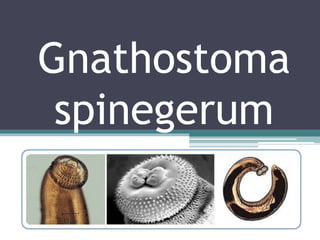

Gnathostoma
spinegerum
Gnathostoma spinegerum
• Several species of the genus Gnathostoma are
responsible for the zoonotic infections of man.
• The most common being the species spinegerum
commonly found in dogs, cats and several other
carnivores
• Human infections have been reported from
Japan, China, Thailand, The Far East and The
Philippines, mostly acquired from consumption
of infected fresh water fish
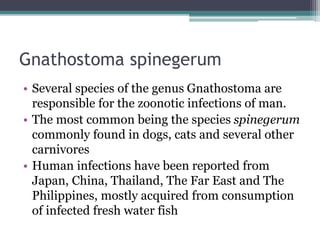
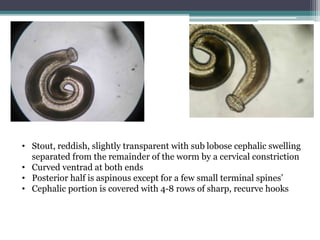
• Stout, reddish, slightly transparent with sub lobose cephalic swelling
separated from the remainder of the worm by a cervical constriction
• Curved ventrad at both ends
• Posterior half is aspinous except for a few small terminal spines’
• Cephalic portion is covered with 4-8 rows of sharp, recurve hooks
Adult worm
• Female
ā–« 25-54µm long
ā–« More curved tails than males
ā–« larger
• Male
ā–« 11-25µm long
ā–« Males have red tails
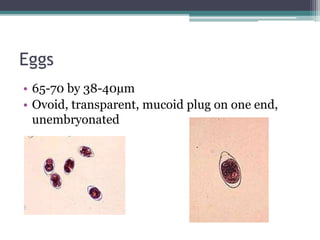
Eggs
• 65-70 by 38-40µm
• Ovoid, transparent, mucoid plug on one end,
unembryonated
Life cycle
• Natural DH : Domestic and wild felines, dogs,
and foxes
• Unatural DH : Man
• Habitat : Tightly-coiled within tumors of the
intestinal walls of the definitive hosts
• Intermediate host
ā–« 1st: Cyclops
ā–« 2nd: Fresh water fish, snakes, crabs, crayfish and
amphibians
Life Cycle
Local Epidemiology
• The human cases of Gnathosomiasis
(G.hispidum) are attributed to the consumtion
of the fresh water fish Misgurnusangillicaudatus
• In the Philippines the larvae of G. Dolorosi are
found in ā€œdalagā€ (Ophicephalustriatus in Laguna
Clinical Diagnosis
• Gnathostomiasisinterna
ā–« Adult worms are coiled inside tumors of the definitive
hosts
• Gnathostomiasisexterna
ā–« Due to 3rd stage larva in humans
ā–« Deep cutaneous and subcutaneous tunnels – visceral
larva migrans
• Migration to other tissue: results in cough,
hematuria, ocular involvement, in serious
manifestations eosinophilic meningitis with
myeloencephalitis
Diagnosis
• Presumptive diagnosis may be made on the
basis on clinical symptoms
• Definitive diagnosis is the removal and
identification of the worm: presence of spines on
the cuticle specially on the anterior end of worm,
presence of large lateral chords, pigmented
granular material in the intestinal cells
• Intradermal test : antigen extracted from adult
or larva of the worm
• Precipitin reaction – specific
• Leukocytes with marked eosinophilia – highly
suggestive
END

Gnathostoma spinigerum

  • 1.
  • 2.
    Gnathostoma spinegerum • Severalspecies of the genus Gnathostoma are responsible for the zoonotic infections of man. • The most common being the species spinegerum commonly found in dogs, cats and several other carnivores • Human infections have been reported from Japan, China, Thailand, The Far East and The Philippines, mostly acquired from consumption of infected fresh water fish
  • 3.
    • Stout, reddish,slightly transparent with sub lobose cephalic swelling separated from the remainder of the worm by a cervical constriction • Curved ventrad at both ends • Posterior half is aspinous except for a few small terminal spines’ • Cephalic portion is covered with 4-8 rows of sharp, recurve hooks
  • 4.
    Adult worm • Female ā–«25-54µm long ā–« More curved tails than males ā–« larger • Male ā–« 11-25µm long ā–« Males have red tails
  • 5.
    Eggs • 65-70 by38-40µm • Ovoid, transparent, mucoid plug on one end, unembryonated
  • 6.
    Life cycle • NaturalDH : Domestic and wild felines, dogs, and foxes • Unatural DH : Man • Habitat : Tightly-coiled within tumors of the intestinal walls of the definitive hosts • Intermediate host ā–« 1st: Cyclops ā–« 2nd: Fresh water fish, snakes, crabs, crayfish and amphibians
  • 7.
  • 8.
    Local Epidemiology • Thehuman cases of Gnathosomiasis (G.hispidum) are attributed to the consumtion of the fresh water fish Misgurnusangillicaudatus • In the Philippines the larvae of G. Dolorosi are found in ā€œdalagā€ (Ophicephalustriatus in Laguna
  • 9.
    Clinical Diagnosis • Gnathostomiasisinterna ā–«Adult worms are coiled inside tumors of the definitive hosts • Gnathostomiasisexterna ā–« Due to 3rd stage larva in humans ā–« Deep cutaneous and subcutaneous tunnels – visceral larva migrans • Migration to other tissue: results in cough, hematuria, ocular involvement, in serious manifestations eosinophilic meningitis with myeloencephalitis
  • 10.
    Diagnosis • Presumptive diagnosismay be made on the basis on clinical symptoms • Definitive diagnosis is the removal and identification of the worm: presence of spines on the cuticle specially on the anterior end of worm, presence of large lateral chords, pigmented granular material in the intestinal cells
  • 11.
    • Intradermal test: antigen extracted from adult or larva of the worm • Precipitin reaction – specific • Leukocytes with marked eosinophilia – highly suggestive END