Presented by P.Bindu, M.Pharmacy 1 st  year, Department  of Pharmacology, Sri padmavathi mahila viswavidyalayam, Tirupati.
CONTENTS I ntroduction - receptor Drug – receptor interactions Ligand gated ion channel  re ceptors G – protein coupled receptors Kinase liked receptors Nuclear receptors Comparison of receptor types Conclusion References
WHAT IS A RECEPTOR? Paul Ehrlich Specialized areas of cell to  which  drugs  get bound. They are  regulatory  protein macro molecules . drug should have – selectivity  to a receptor  ;  receptor  should have -  ligand specificity  to elicit  action.
DRUG RECEPTOR INTERACTIONS  Effect of drug attributed to two factors  Affinity  : tendency of the drug to bind to receptor and form D-R complex . Efficacy or intrinsic activity  : ability of the drug to trigger pharmacological responses after forming D-R complex .
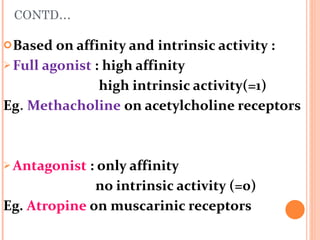
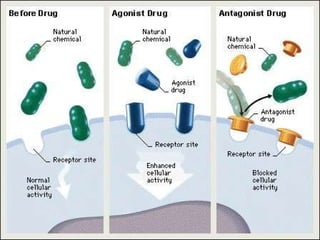
CONTD… Based on affinity and intrinsic activity : Full agonist  : high affinity  high intrinsic activity(=1) Eg .  Methacholine   on acetylcholine receptors Antagonist  : only affinity  no intrinsic activity (=0) Eg.  Atropine  on muscarinic receptors
 
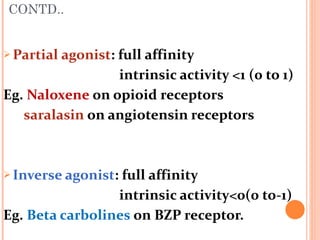
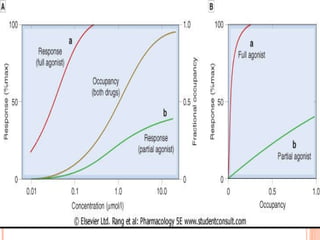
CONTD.. Partial agonist : full affinity intrinsic activity <1 (0 to 1) Eg.  Naloxene  on opioid receptors saralasin  on angiotensin receptors Inverse agonist : full affinity intrinsic activity<0(0 to-1) Eg.  Beta carbolines  on BZP receptor.
 
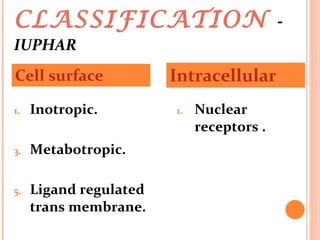
RECEPTOR CLASSIFICATION  -   IUPHAR Inotropic.  Metabotropic.  Ligand regulated trans membrane. Nuclear receptors . Cell surface Intracellular
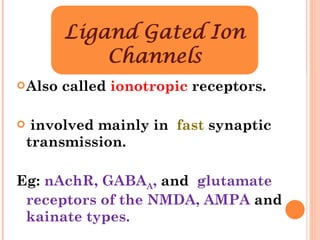
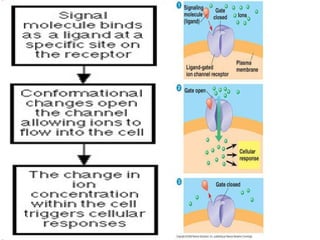
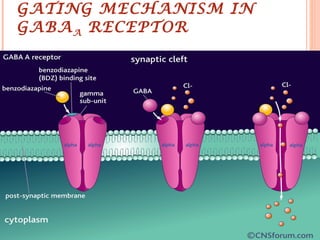
Also called  ionotropic  receptors. involved mainly in  fast  synaptic transmission. Eg:  nAchR, GABA A ,  and   glutamate receptors of the NMDA, AMPA  and  kainate types.
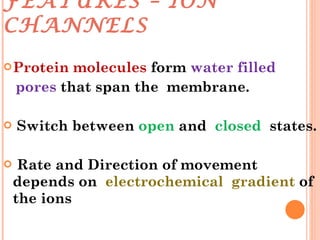
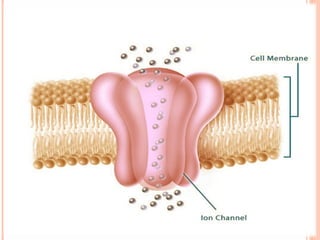
FEATURES – ION CHANNELS Protein   molecules  form  water filled  pores  that span the  membrane. Switch between  open  and  closed   states. Rate and Direction of movement depends on  electrochemical  gradient  of the ions
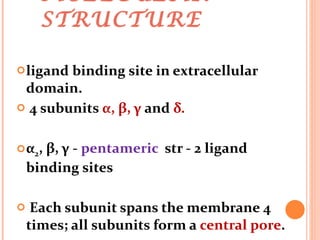
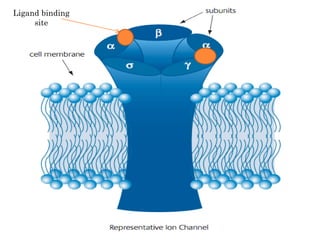
MOLECULAR   STRUCTURE ligand binding site in extracellular domain. 4 subunits  α, β, γ  and  δ. α 2 , β, γ  -  pentameric  str - 2 ligand binding sites Each subunit spans the membrane 4 times; all subunits form a  central pore .
Ligand binding site


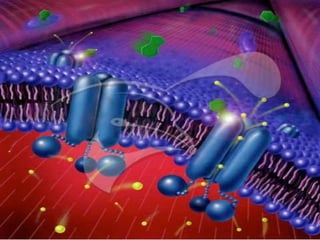
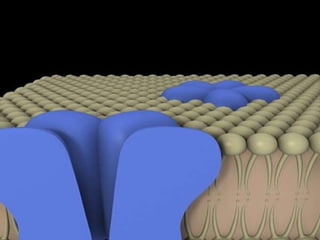
GATING MECHANISM IN GABA A  RECEPTOR
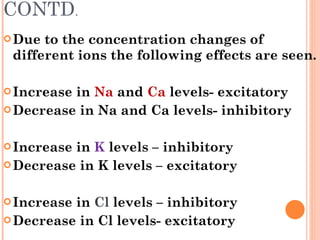
CONTD . Due to the concentration changes of different ions the following effects are seen. Increase in  Na  and  Ca  levels- excitatory Decrease in Na and Ca levels- inhibitory Increase in  K  levels – inhibitory Decrease in K levels – excitatory Increase in  Cl  levels – inhibitory Decrease in Cl levels- excitatory
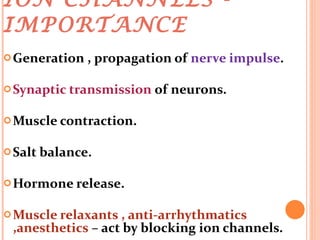
ION CHANNELS - IMPORTANCE Generation , propagation of  nerve impulse . Synaptic transmission  of neurons. Muscle contraction. Salt balance. Hormone release. Muscle relaxants , anti-arrhythmatics ,anesthetics  – act by blocking ion channels.
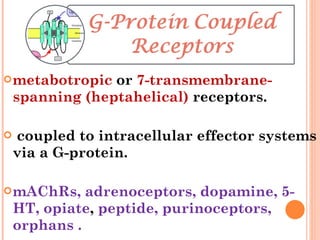
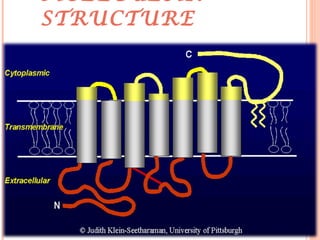
metabotropic  or  7-transmembrane-spanning (heptahelical)  receptors. coupled to intracellular effector systems via a G-protein. mAChRs, adrenoceptors, dopamine, 5-HT, opiate ,  peptide, purinoceptors, orphans .
MOLECULAR STRUCTURE
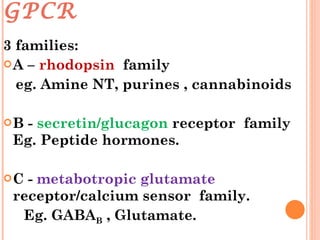
FAMILIES OF GPCR 3 families: A –  rhodopsin   family eg. Amine NT, purines , cannabinoids B -  secretin/glucagon  receptor  family  Eg. Peptide hormones. C -  metabotropic glutamate  receptor/calcium sensor  family. Eg. GABA B  , Glutamate.
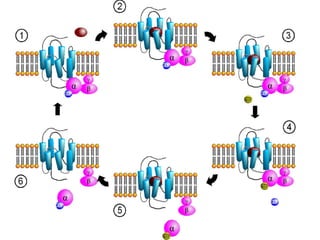
G-PROTEIN -ROLE Membrane resident proteins – recognize activated GPCRs- pass message to effector system. Occurs in interaction with guanine nucleotides ; freely moving in cytoplasm. α, β and γ   subunits – trimer in resting state. 3 subunits attached to GPCR through fatty acid chain – reaction called prenylation.
 
 
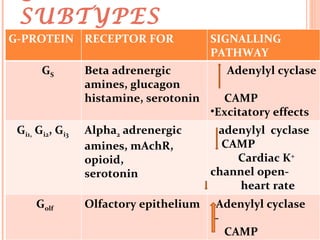
G-PROTEIN SUBTYPES G-PROTEIN RECEPTOR FOR SIGNALLING PATHWAY G S Beta adrenergic amines, glucagon histamine, serotonin Adenylyl cyclase  CAMP Excitatory effects G i1,  G i2 , G i3 Alpha 2  adrenergic amines, mAchR,  opioid, serotonin  adenylyl  cyclase CAMP  Cardiac K +  channel open-  heart rate G olf  Olfactory epithelium Adenylyl cyclase  –  CAMP
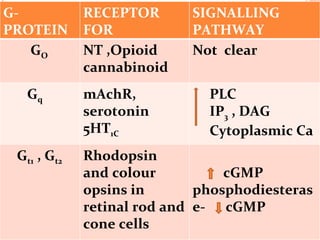
G-PROTEIN RECEPTOR FOR SIGNALLING PATHWAY G O NT ,Opioid cannabinoid Not  clear G q mAchR,  serotonin 5HT 1C PLC IP 3  , DAG Cytoplasmic Ca  G t1  , G t2 Rhodopsin and colour  opsins in retinal rod and cone cells cGMP  phosphodiesterase-  cGMP
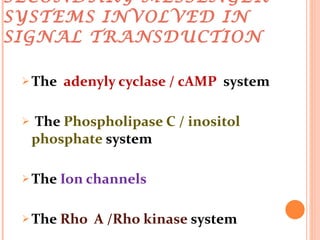
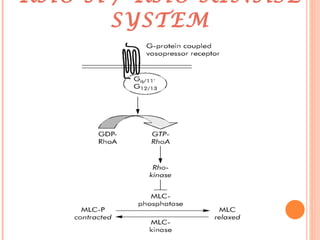
SECONDARY MESSENGER SYSTEMS INVOLVED IN SIGNAL TRANSDUCTION The  adenyly cyclase / cAMP  system The  Phospholipase C / inositol phosphate  system The  Ion channels The  Rho  A /Rho kinase  system
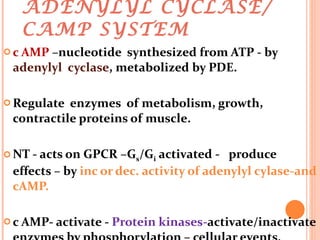
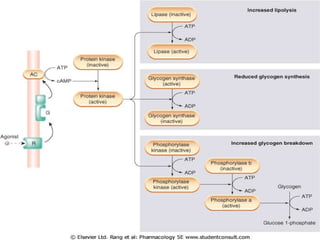
ADENYLYL CYCLASE/ CAMP SYSTEM c AMP  –nucleotide  synthesized from ATP - by  adenylyl  cyclase , metabolized by PDE. Regulate  enzymes  of metabolism, growth, contractile proteins of muscle. NT - acts on GPCR –G s /G i  activated -  produce  effects – by  inc or dec. activity of adenylyl cylase-and cAMP. c AMP- activate -  Protein kinases- activate/inactivate enzymes by phosphorylation – cellular events.
 
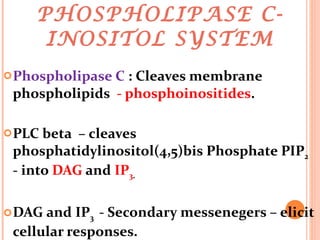
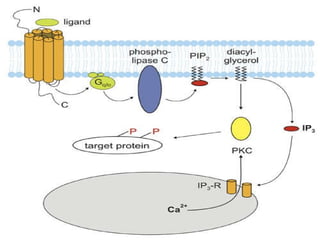
PHOSPHOLIPASE C-INOSITOL SYSTEM Phospholipase C  : Cleaves membrane  phospholipids  - phosphoinositides . PLC beta  – cleaves phosphatidylinositol(4,5)bis Phosphate PIP 2  - into  DAG  and  IP 3 .  DAG and IP 3  - Secondary messenegers – elicit cellular responses.
 
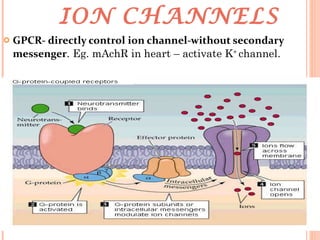
ION CHANNELS  GPCR- directly control ion channel-without secondary messenger . Eg. mAchR in heart – activate K +  channel.
RHO A / RHO KINASE SYSTEM
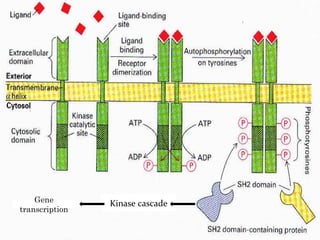
Involved in growth, proliferation, differentiation or survival-called  growth factors. Mediate actions of protein mediators-  GF ,  cytokines  , harmones-  insulin  and  leptin . Slow  – require the expression of new genes. Single membrane spanning helix - extracellular ligand binding domain - intracellular domain.
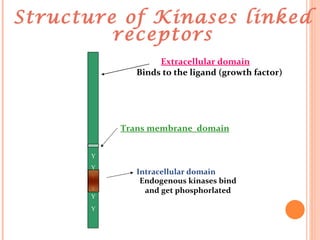
Structure of Kinases linked receptors Y Y Y Y Y Y Extracellular domain Binds to the ligand (growth factor) Trans membrane  domain Intracellular domain Endogenous kinases bind and get phosphorlated
TYPES receptor  tyrosine kinases Eg. EGF , NGF , insulin receptor serine/ threonine  kinases  Eg. TGF cytokine  receptors Eg. Cytokines , CSF guanylyl cyclase  receptors Eg.  ANP
Kinase cascade Gene transcription
Important pathways activated : 1.  The Ras/Raf/mitogen- activated protein (MAP) kinase pathway - activated by  tyrosine kinases . - important in cell division, growth, differentiation.  2.  The Jak/Stat pathway  - activated by  cytokines . -controls synthesis and release of inflammatory mediators.
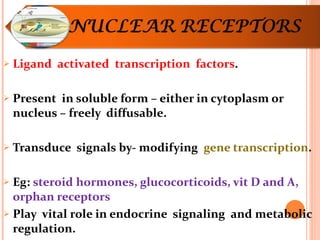
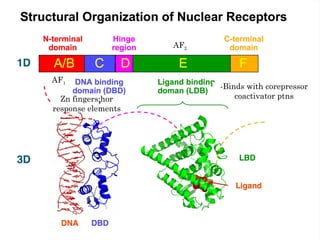
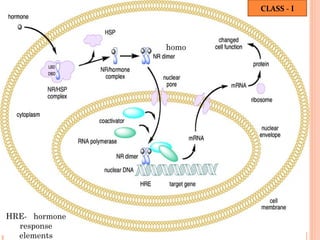
Ligand  activated  transcription  factors . Present  in soluble form – either in cytoplasm or nucleus – freely  diffusable. Transduce  signals by- modifying  gene transcription . Eg:  steroid hormones, glucocorticoids, vit D and A, orphan receptors Play  vital role in endocrine  signaling  and metabolic regulation.
Zn fingers;hor response elements -Binds with corepressor coactivator ptns AF 1 AF 2
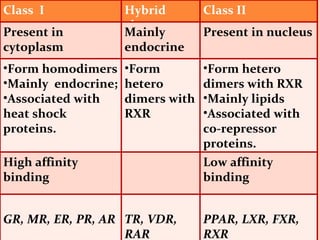
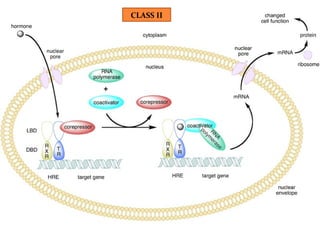
Class  I  Hybrid class Class II Present in cytoplasm Mainly endocrine Present in nucleus Form homodimers Mainly  endocrine;  Associated with heat shock proteins. Form hetero dimers with RXR Form hetero dimers with RXR Mainly lipids Associated with co-repressor proteins. High affinity binding Low affinity binding GR, MR, ER, PR, AR  TR, VDR, RAR PPAR, LXR, FXR, RXR
homo HRE-  hormone response elements CLASS - I
CLASS II
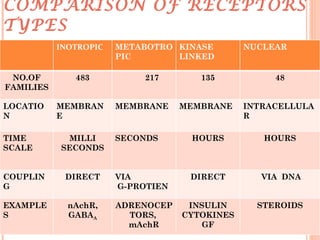
COMPARISON OF RECEPTORS TYPES INOTROPIC METABOTROPIC KINASE LINKED NUCLEAR NO.OF FAMILIES 483 217 135 48 LOCATION MEMBRANE MEMBRANE MEMBRANE INTRACELLULAR TIME SCALE MILLI SECONDS SECONDS HOURS HOURS COUPLING DIRECT VIA G-PROTIEN DIRECT VIA  DNA EXAMPLES nAchR, GABA A ADRENOCEPTORS,  mAchR INSULIN CYTOKINES GF STEROIDS
CONCLUSION Extensive  research done on Receptor pharmacology  -lead to discovery of new drug targets for treatment of several diseases. Still requires discovery of new receptor types and the mechanisms of many orphan receptors that can result in effective treatment of many diseases. Requires development of receptor crystallization etc. Much to be discovered about the nuclear receptors.
REFERENCES Rang , Dale, Ritter ,Flower :Rang and Dale’s pharmacology;6 th  edition, Churchill Livingstone;2008, 9-52. Bertram G.Katzung : Basic and clinical pharmacology; 10 th  edition;2006. KD Tripati: essentials of medical pharmacology ; 6 th  edition; 2008, 40-52.